


 Скачать презентацию Landmark English Documents F Magna Carta 1215
4499d6416ef9e945d1aea299e90cd234.ppt
- Количество слайдов: 34
 Landmark English Documents F Magna Carta (1215) = first attempt to limit the power of the monarch F Petition of Right (1628) = challenged the idea of divine right - monarch was not above the law F English Bill of Rights (1689) = protection against arbitrary rule - monarch must rule with consent of Parliament
 IN CONGRESS, JULY 4, 1776 The unanimous Declaration of the thirteen United States of America When in the Course of human events it becomes necessary for one people to dissolve the political bands which have connected them with another and to assume among the powers of the earth, the separate and equal station to which the Laws of Nature and of Nature's God entitle them, a decent respect to the opinions of mankind requires that they should declare the causes which impel them to the separation. We hold these truths to be self-evident, that all men are created equal, that they are endowed by their Creator with certain unalienable Rights, that among these are Life, Liberty and the pursuit of Happiness. — That to secure these rights, Governments are instituted among Men, deriving their just powers from the consent of the governed, — That whenever any Form of Government becomes destructive of these ends, it is the Right of the People to alter or to abolish it, and to institute new Government………….
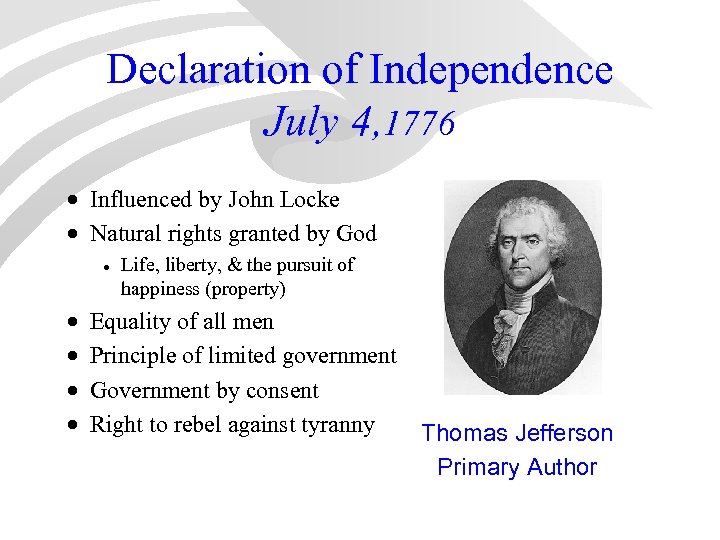 Declaration of Independence July 4, 1776 · Influenced by John Locke · Natural rights granted by God · · · Life, liberty, & the pursuit of happiness (property) Equality of all men Principle of limited government Government by consent Right to rebel against tyranny Thomas Jefferson Primary Author
 Weaknesses of the Articles of Confederation L L L L Confederate system w/one branch at the national level Unicameral Congress - one vote per state National Congress powerless to tax National Congress powerless to regulate foreign & interstate trade No executive branch to enforce acts of Congress No national court to settle disputes between states Amendment: ALL 13 states had to agree - unanimous 9/13 majority to pass laws
 Solutions provided by the U. S. Constitution ü ü Federal System Bicameral Congress: (Connecticut Compromise) ü Senate – States are equally represented – 2 per state ü House of Representatives – Based on population size ü ü ü Congress given power to tax Congress given power to regulate trade Executive Branch to enforce laws Judicial Branch to interpret laws & Constitution Amendment: Proposed by 2/3 Congress ü Ratified by ¾ of the state legislatures ü 50%+1 to pass laws
 Articles of Confederation vs. the Constitution L L L L Confederate system Unicameral Congress - one vote per state Powerless to tax Powerless to regulate foreign & interstate trade No executive branch to enforce acts of Congress No national court to settle disputes between states Amendment: ALL 13 states had to agree - unanimous 9/13 majority to pass laws ü ü ü ü Federal System Bicameral Congress: Senate & House of Representatives Congress given power to tax Congress given power to regulate trade Executive Branch to enforce laws Judicial Branch to interpret laws & Constitution Amendment: 2/3 Congress + ¾ State Legislatures 50%+1 to pass laws
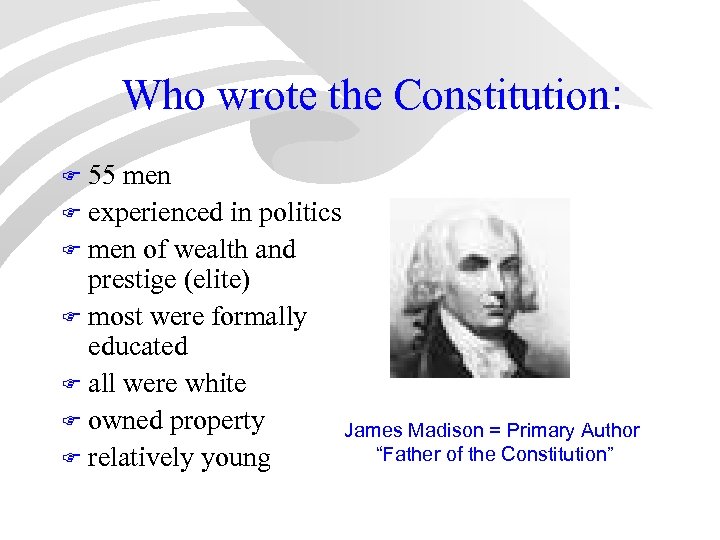 Who wrote the Constitution: 55 men F experienced in politics F men of wealth and prestige (elite) F most were formally educated F all were white F owned property James Madison = Primary Author “Father of the Constitution” F relatively young F
 The Constitution (1789) Ratification - approval process: Issues: Representation, tyranny of the majority, governmental power J Federalists (James Madison, John Jay & Alexander Hamilton) • • • Representative of the people and have a measure of autonomy from the people = efficiency & competency Feared tyranny of the majority Favored strong national government
 Ratification of the Constitution… L Anti-Federalists (Thomas Jefferson, Robert Yates & Patrick Henry) • • feared giving too much power to the national government favored state power feared aristocratic nature of governments opposed the lack of a bill of rights
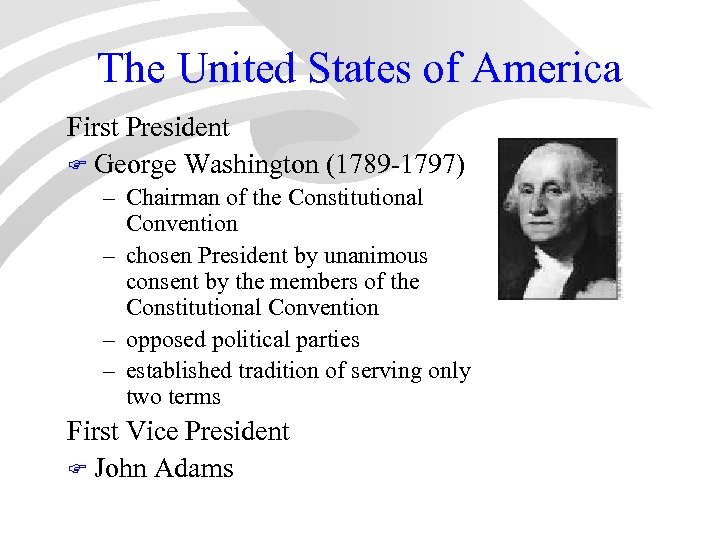 The United States of America First President F George Washington (1789 -1797) – Chairman of the Constitutional Convention – chosen President by unanimous consent by the members of the Constitutional Convention – opposed political parties – established tradition of serving only two terms First Vice President F John Adams
 Principles of the Constitution F Popular Sovereignty F Limited Government F Separation of Powers F Checks and Balances F Judicial Review F Federalism
 Popular Sovereignty F The people are the source of political authority - (power) F Government by consent F Representative democracy (republic) F “We the People of the United States…”
 Limited Government F Rule of law F No one is above the law - including members of the government F The government must operate within the boundaries of the Constitution
 Separation of Powers F Division of the national government into three co-equal branches F Each branch given specific responsibilities F Legislative Branch = make laws F Executive Branch = enforce laws F Judicial Branch = interpret laws
 Checks and Balances v System designed to prevent any branch of the national government from becoming more powerful than another branch
 Judicial Review F The power of the courts to decide the constitutionality of laws and acts of government F Marbury v. Madison
 Federalism F The powers of government are divided between national and state levels F Results in a dual system of government F Each level has some independent powers
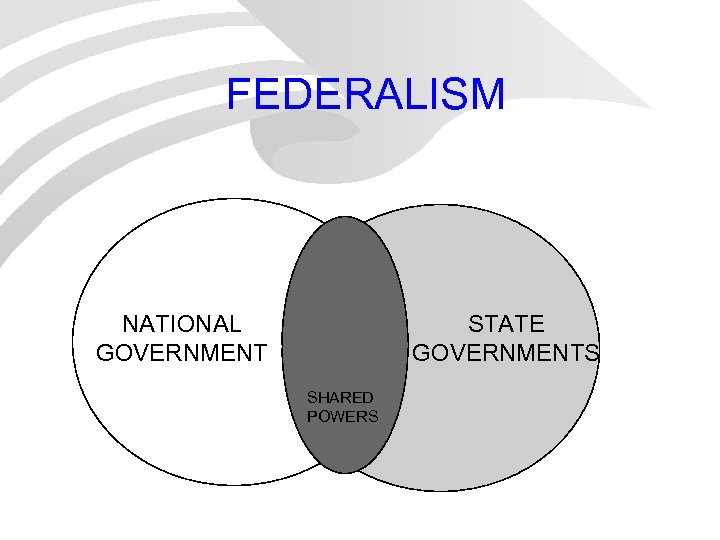 FEDERALISM NATIONAL GOVERNMENT STATE GOVERNMENTS SHARED POWERS
 Federalism F Inherent/Exclusive Powers: Powers given to the national government because it is the only representative of the entire nation (i. e. , war powers) F Delegated/Expressed Powers: Powers written in the Constitution (i. e. , power to regulate trade) F Implied Powers: Powers not exactly written in the Constitution - based on the Necessary & Proper Clause F Reserved Powers: Powers of the state government / 10 th Amendment (i. e. , public schools, marriage laws) F Concurrent Powers: Powers shared by both the national and state levels of government (i. e. , power to tax)
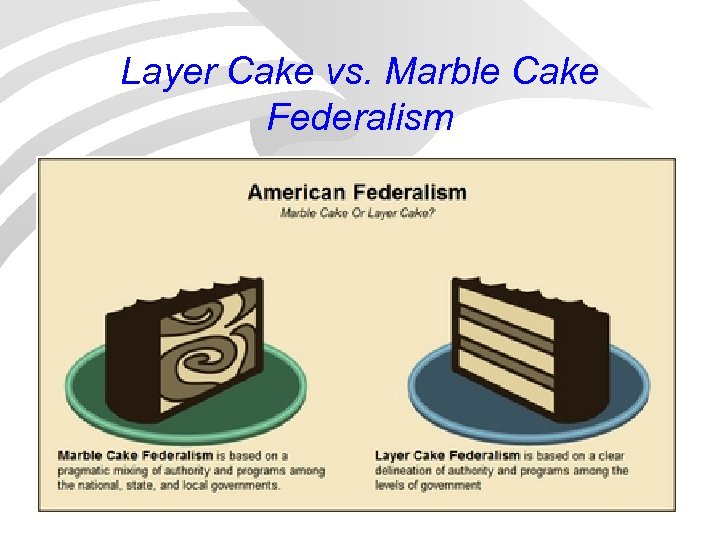 Layer Cake vs. Marble Cake Federalism
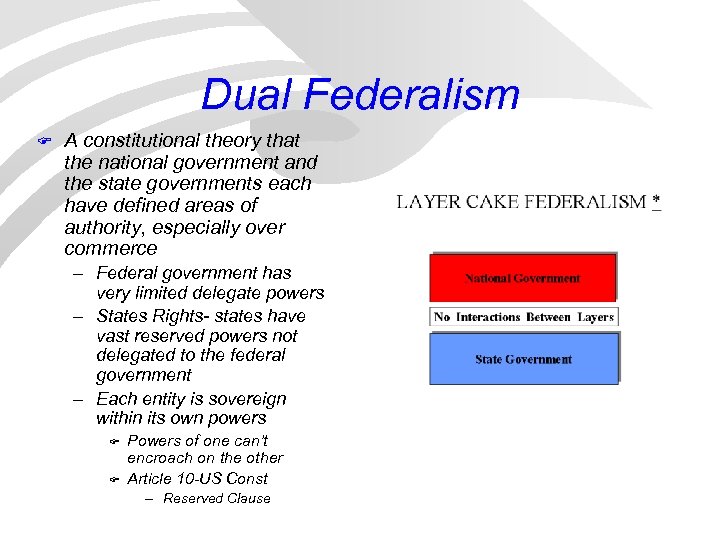 Dual Federalism F A constitutional theory that the national government and the state governments each have defined areas of authority, especially over commerce – Federal government has very limited delegate powers – States Rights- states have vast reserved powers not delegated to the federal government – Each entity is sovereign within its own powers F F Powers of one can’t encroach on the other Article 10 -US Const – Reserved Clause
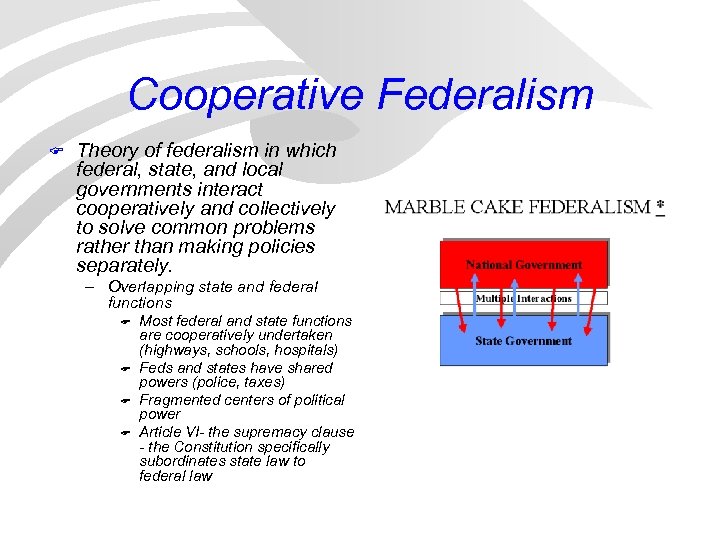 Cooperative Federalism F Theory of federalism in which federal, state, and local governments interact cooperatively and collectively to solve common problems rather than making policies separately. – Overlapping state and federal functions F F Most federal and state functions are cooperatively undertaken (highways, schools, hospitals) Feds and states have shared powers (police, taxes) Fragmented centers of political power Article VI- the supremacy clause - the Constitution specifically subordinates state law to federal law
 Necessary & Proper Clause F Article I, Section 8, Clause 18 F Basis for the implied powers given to Congress F Must be tied to an expressed power F Known as the Elastic Clause F “To make all laws which shall be necessary and proper for carrying into execution the foregoing powers…”
 Supremacy Clause F Article VI, Section 2 F The Constitution and treaties of the United States are “the supreme law of the land” F U. S. Constitution – – Acts of Congress & Treaties State Constitutions State Statutes (laws) City & County Charters & Ordinances (laws) F U. S. Supreme Court = highest court
 Article IV: Provision for reciprocity among states and among citizens of all states: Full Faith & Credit Clause F Each state had to give “full faith and credit” to the official acts of all other states. Privileges & Immunities Clause Citizens of any state were guaranteed the “privileges and immunities” of every other state, as though they were citizens of that state F
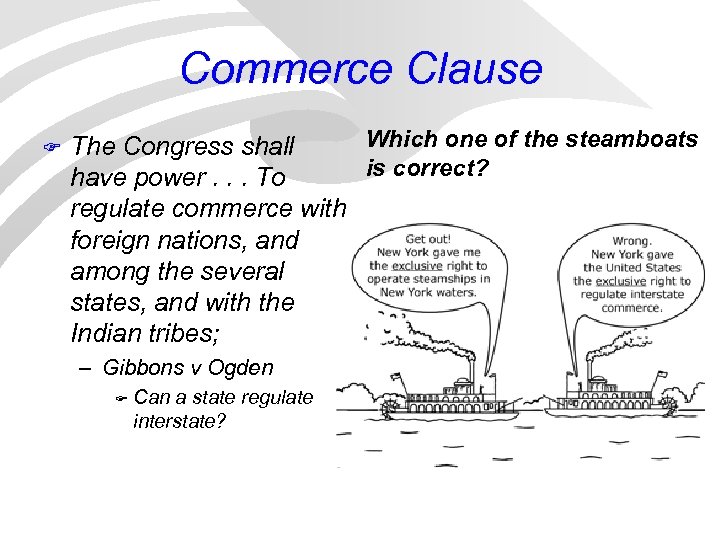 Commerce Clause F Which one of the steamboats The Congress shall is correct? have power. . . To regulate commerce with foreign nations, and among the several states, and with the Indian tribes; – Gibbons v Ogden F Can a state regulate interstate?
 Connecticut Compromise F Compromise between New Jersey and Virginia Plans F Bicameral Congress – two chambers F House of Representatives – states are represented according to the size of their population F Senate – equal representation – each state receives two seats
 Three-Fifths Compromise F In Slave-owning states – Every five slaves would be counted as three people for the purposes of counting population size for representation in the U. S. House of Representatives and for purposes of taxation
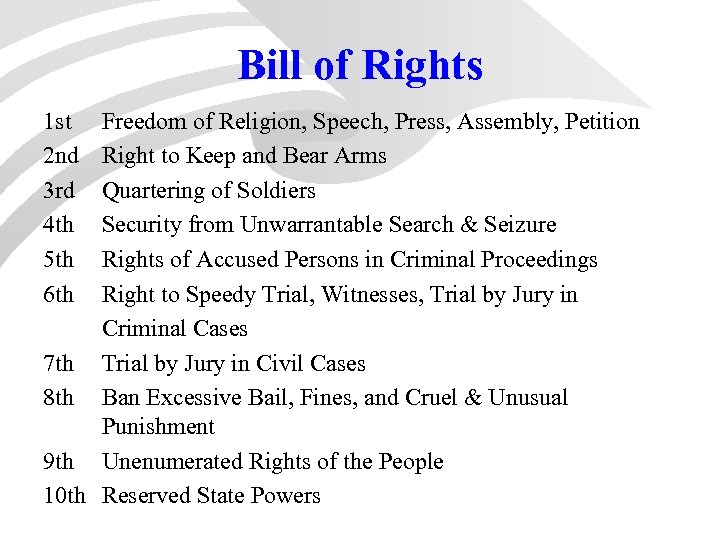 Bill of Rights 1 st 2 nd 3 rd 4 th 5 th 6 th Freedom of Religion, Speech, Press, Assembly, Petition Right to Keep and Bear Arms Quartering of Soldiers Security from Unwarrantable Search & Seizure Rights of Accused Persons in Criminal Proceedings Right to Speedy Trial, Witnesses, Trial by Jury in Criminal Cases 7 th Trial by Jury in Civil Cases 8 th Ban Excessive Bail, Fines, and Cruel & Unusual Punishment 9 th Unenumerated Rights of the People 10 th Reserved State Powers
 Marbury v. Madison (1803) Established the doctrine of judicial review F Article III - judicial powers F Chief Justice John Marshall F Issue of President John Adams appointing Federalists and Thomas Jefferson’s Secretary of State James Madison refusing to deliver commissions. F – Mr. Adams, the late President of the United States, nominated the applicants to the senate for their advice and consent to be appointed justices of the peace of the District of Columbia; that the senate advised and consented to the appointments; that commissions in due form were signed by the said President appointing them justices…
 Mc. Culloch v. Maryland (1819) F Upheld the right of implied powers based on the Necessary and Proper Clause and the Supremacy Clause F Called the “Bank of the United States” case – involved the Second Bank of the United States and the State of Maryland F Supreme Court landmark case – unanimous decision F Chief Justice John Marshall
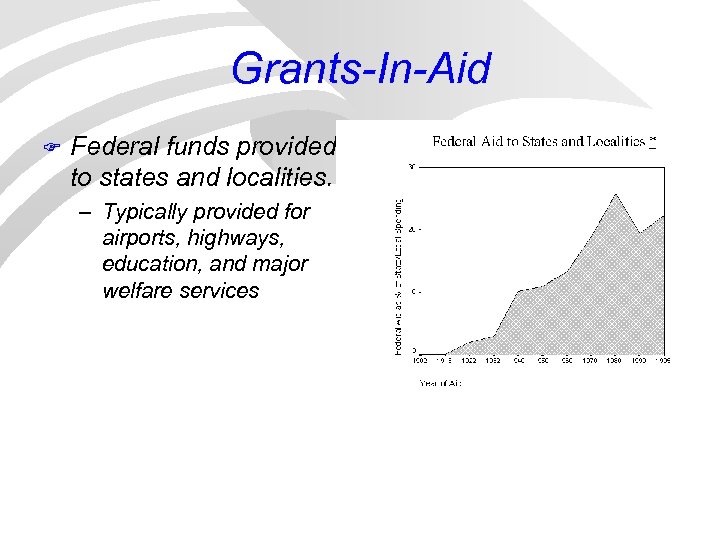 Grants-In-Aid F Federal funds provided to states and localities. – Typically provided for airports, highways, education, and major welfare services
 Categorical Grants F Federal grants for specific purposes defined by federal law – Requires the state or locality to “match” some part of the federal grant – Formula Grants F States and Feds share costs of a proejct F Ex. (20% fed-80% state) – Project Grants F Money given out to states and localities for a purpose F Applied for by state F Usually research based- universities, agencies
 Block Grants F Grants of money from the federal government to states for programs in certain general areas rather than for specific kinds of programs – Money to states with few strings attached – States have broad discretionary powers to use money as they see fit – Favored by Republicans/Conservatives – Nixon and Regan: New Federalism F More Power to the states