 Скачать презентацию LAND DEVELOPMENT DIVISION ENGINEER FORUM February 23 2012
37490e02150552c698cac10fff6e9cef.ppt
- Количество слайдов: 122




LAND DEVELOPMENT DIVISION ENGINEER FORUM February 23, 2012 Conference Room D
Today’s Agenda • 2009 SCDHEC’s Audit Findings • 2010 Woolpert’s Internal Audit Findings • Results from Summer 2011 Survey • Proposed Changes • EPA and SCDHEC Regulation Forecast • Status and expected contents of our next NPDES MS 4 permit
Land Development Regulations • Land Development Regulations Update • Stakeholder Approach • Time Frame – Begin March 2012 & up to 1 year to complete stakeholder review • Includes LID’s, TND’s, Centers & Corridors, Traffic Impact, etc. • Update Zoning Ordinance to reflect changes in LDR
SCDHEC’s Audit Results • EPA guidance requires SCDHEC to conduct an in • • depth audit at least once every five (5) years In March of 2009 SCDHEC held a two day audit covering all 13 elements of our MS 4 Permit The conclusion was Greenville County’s program was satisfactory with deficiencies in two elements: – Construction Site Runoff – Public Education and Public Participation
DHEC’s Audit Comments • …” The County needs to improve documentation • of how they are determining that BMP’s proposed on sites that drain to Impaired Waters (both 303(d) listed and those included in a TMDL) are adequate to address the pollutant of concern in the receiving water body. ” “Overall, Greenville County is not effectively approving construction site plans to MEP standards. The MS 4’s focus must be on water quality. ”
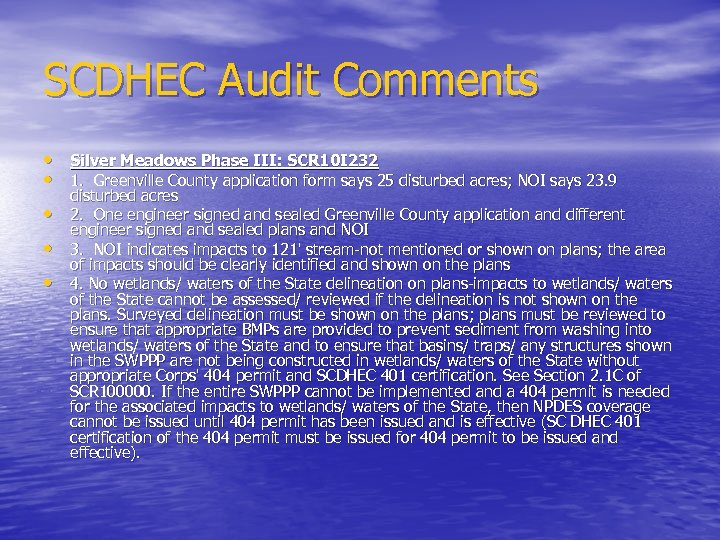
SCDHEC Audit Comments • Silver Meadows Phase III: SCR 10 I 232 • 1. Greenville County application form says 25 disturbed acres; NOI says 23. 9 • • • disturbed acres 2. One engineer signed and sealed Greenville County application and different engineer signed and sealed plans and NOI 3. NOI indicates impacts to 121' stream not mentioned or shown on plans; the area of impacts should be clearly identified and shown on the plans 4. No wetlands/ waters of the State delineation on plans impacts to wetlands/ waters of the State cannot be assessed/ reviewed if the delineation is not shown on the plans. Surveyed delineation must be shown on the plans; plans must be reviewed to ensure that appropriate BMPs are provided to prevent sediment from washing into wetlands/ waters of the State and to ensure that basins/ traps/ any structures shown in the SWPPP are not being constructed in wetlands/ waters of the State without appropriate Corps' 404 permit and SCDHEC 401 certification. See Section 2. 1 C of SCR 100000. If the entire SWPPP cannot be implemented and a 404 permit is needed for the associated impacts to wetlands/ waters of the State, then NPDES coverage cannot be issued until 404 permit has been issued and is effective (SC DHEC 401 certification of the 404 permit must be issued for 404 permit to be issued and effective).
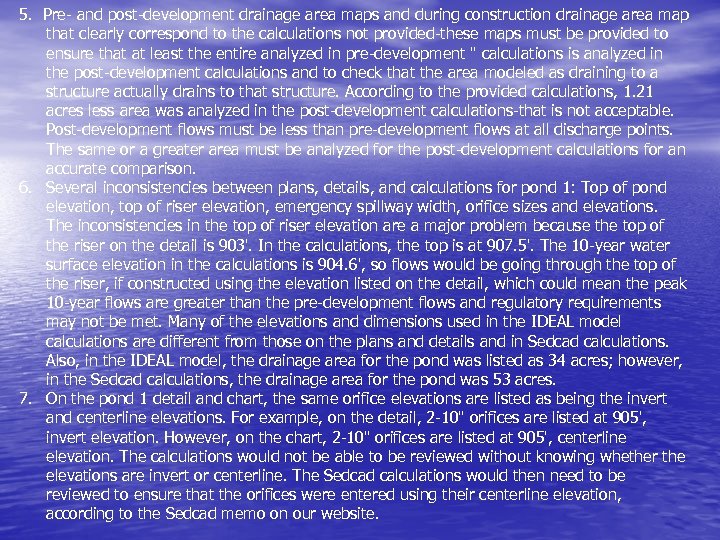
5. Pre and post development drainage area maps and during construction drainage area map that clearly correspond to the calculations not provided these maps must be provided to ensure that at least the entire analyzed in pre development " calculations is analyzed in the post development calculations and to check that the area modeled as draining to a structure actually drains to that structure. According to the provided calculations, 1. 21 acres less area was analyzed in the post development calculations that is not acceptable. Post development flows must be less than pre development flows at all discharge points. The same or a greater area must be analyzed for the post development calculations for an accurate comparison. 6. Several inconsistencies between plans, details, and calculations for pond 1: Top of pond elevation, top of riser elevation, emergency spillway width, orifice sizes and elevations. The inconsistencies in the top of riser elevation are a major problem because the top of the riser on the detail is 903'. In the calculations, the top is at 907. 5'. The 10 year water surface elevation in the calculations is 904. 6', so flows would be going through the top of the riser, if constructed using the elevation listed on the detail, which could mean the peak 10 year flows are greater than the pre development flows and regulatory requirements may not be met. Many of the elevations and dimensions used in the IDEAL model calculations are different from those on the plans and details and in Sedcad calculations. Also, in the IDEAL model, the drainage area for the pond was listed as 34 acres; however, in the Sedcad calculations, the drainage area for the pond was 53 acres. 7. On the pond 1 detail and chart, the same orifice elevations are listed as being the invert and centerline elevations. For example, on the detail, 2 10" orifices are listed at 905', invert elevation. However, on the chart, 2 10" orifices are listed at 905', centerline elevation. The calculations would not be able to be reviewed without knowing whether the elevations are invert or centerline. The Sedcad calculations would then need to be reviewed to ensure that the orifices were entered using their centerline elevation, according to the Sedcad memo on our website.
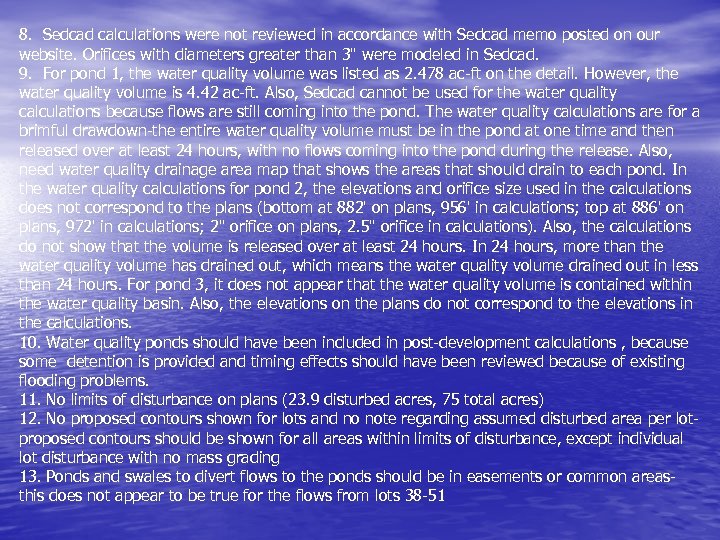
8. Sedcad calculations were not reviewed in accordance with Sedcad memo posted on our website. Orifices with diameters greater than 3" were modeled in Sedcad. 9. For pond 1, the water quality volume was listed as 2. 478 ac ft on the detail. However, the water quality volume is 4. 42 ac ft. Also, Sedcad cannot be used for the water quality calculations because flows are still coming into the pond. The water quality calculations are for a brimful drawdown the entire water quality volume must be in the pond at one time and then released over at least 24 hours, with no flows coming into the pond during the release. Also, need water quality drainage area map that shows the areas that should drain to each pond. In the water quality calculations for pond 2, the elevations and orifice size used in the calculations does not correspond to the plans (bottom at 882' on plans, 956' in calculations; top at 886' on plans, 972' in calculations; 2" orifice on plans, 2. 5" orifice in calculations). Also, the calculations do not show that the volume is released over at least 24 hours. In 24 hours, more than the water quality volume has drained out, which means the water quality volume drained out in less than 24 hours. For pond 3, it does not appear that the water quality volume is contained within the water quality basin. Also, the elevations on the plans do not correspond to the elevations in the calculations. 10. Water quality ponds should have been included in post development calculations , because some detention is provided and timing effects should have been reviewed because of existing flooding problems. 11. No limits of disturbance on plans (23. 9 disturbed acres, 75 total acres) 12. No proposed contours shown for lots and no note regarding assumed disturbed area per lot proposed contours should be shown for all areas within limits of disturbance, except individual lot disturbance with no mass grading 13. Ponds and swales to divert flows to the ponds should be in easements or common areas this does not appear to be true for the flows from lots 38 51
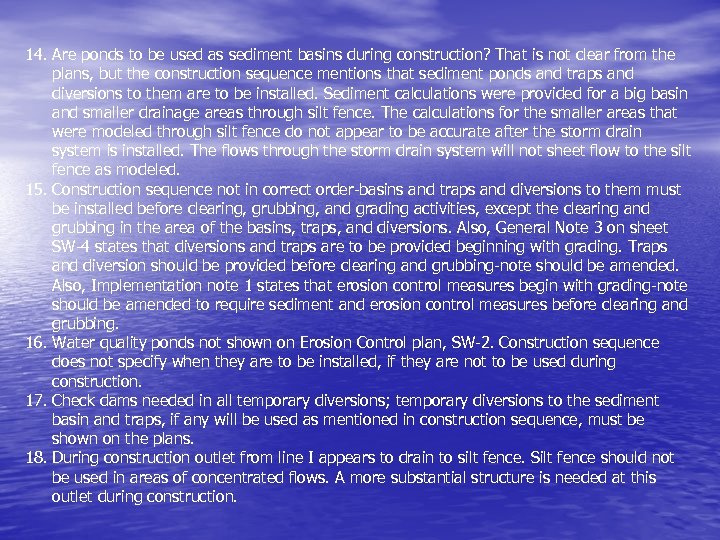
14. Are ponds to be used as sediment basins during construction? That is not clear from the plans, but the construction sequence mentions that sediment ponds and traps and diversions to them are to be installed. Sediment calculations were provided for a big basin and smaller drainage areas through silt fence. The calculations for the smaller areas that were modeled through silt fence do not appear to be accurate after the storm drain system is installed. The flows through the storm drain system will not sheet flow to the silt fence as modeled. 15. Construction sequence not in correct order basins and traps and diversions to them must be installed before clearing, grubbing, and grading activities, except the clearing and grubbing in the area of the basins, traps, and diversions. Also, General Note 3 on sheet SW 4 states that diversions and traps are to be provided beginning with grading. Traps and diversion should be provided before clearing and grubbing note should be amended. Also, Implementation note 1 states that erosion control measures begin with grading note should be amended to require sediment and erosion control measures before clearing and grubbing. 16. Water quality ponds not shown on Erosion Control plan, SW 2. Construction sequence does not specify when they are to be installed, if they are not to be used during construction. 17. Check dams needed in all temporary diversions; temporary diversions to the sediment basin and traps, if any will be used as mentioned in construction sequence, must be shown on the plans. 18. During construction outlet from line I appears to drain to silt fence. Silt fence should not be used in areas of concentrated flows. A more substantial structure is needed at this outlet during construction.
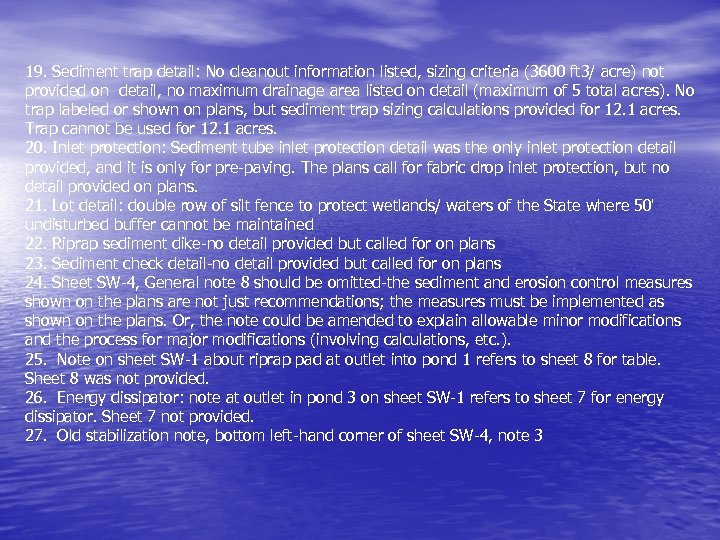
19. Sediment trap detail: No cleanout information listed, sizing criteria (3600 ft 3/ acre) not provided on detail, no maximum drainage area listed on detail (maximum of 5 total acres). No trap labeled or shown on plans, but sediment trap sizing calculations provided for 12. 1 acres. Trap cannot be used for 12. 1 acres. 20. Inlet protection: Sediment tube inlet protection detail was the only inlet protection detail provided, and it is only for pre paving. The plans call for fabric drop inlet protection, but no detail provided on plans. 21. Lot detail: double row of silt fence to protect wetlands/ waters of the State where 50' undisturbed buffer cannot be maintained 22. Riprap sediment dike no detail provided but called for on plans 23. Sediment check detail no detail provided but called for on plans 24. Sheet SW 4, General note 8 should be omitted the sediment and erosion control measures shown on the plans are not just recommendations; the measures must be implemented as shown on the plans. Or, the note could be amended to explain allowable minor modifications and the process for major modifications (involving calculations, etc. ). 25. Note on sheet SW 1 about riprap pad at outlet into pond 1 refers to sheet 8 for table. Sheet 8 was not provided. 26. Energy dissipator: note at outlet in pond 3 on sheet SW 1 refers to sheet 7 for energy dissipator. Sheet 7 not provided. 27. Old stabilization note, bottom left hand corner of sheet SW 4, note 3
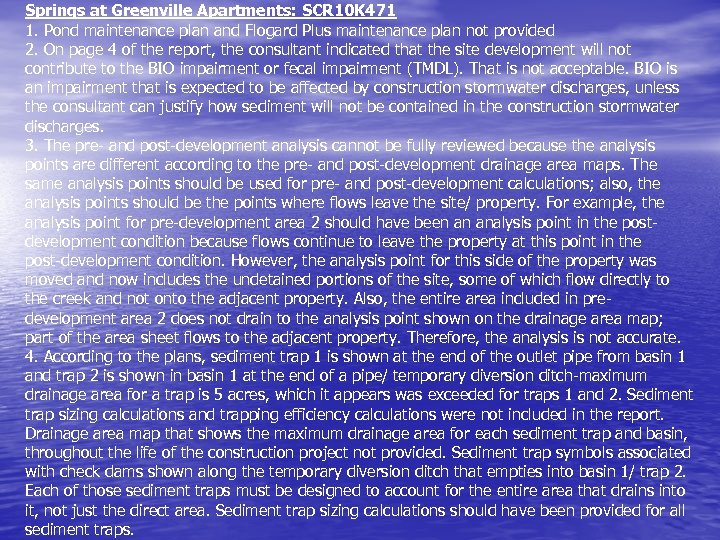
Springs at Greenville Apartments: SCR 10 K 471 1. Pond maintenance plan and Flogard Plus maintenance plan not provided 2. On page 4 of the report, the consultant indicated that the site development will not contribute to the BIO impairment or fecal impairment (TMDL). That is not acceptable. BIO is an impairment that is expected to be affected by construction stormwater discharges, unless the consultant can justify how sediment will not be contained in the construction stormwater discharges. 3. The pre and post development analysis cannot be fully reviewed because the analysis points are different according to the pre and post development drainage area maps. The same analysis points should be used for pre and post development calculations; also, the analysis points should be the points where flows leave the site/ property. For example, the analysis point for pre development area 2 should have been an analysis point in the post development condition because flows continue to leave the property at this point in the post development condition. However, the analysis point for this side of the property was moved and now includes the undetained portions of the site, some of which flow directly to the creek and not onto the adjacent property. Also, the entire area included in pre development area 2 does not drain to the analysis point shown on the drainage area map; part of the area sheet flows to the adjacent property. Therefore, the analysis is not accurate. 4. According to the plans, sediment trap 1 is shown at the end of the outlet pipe from basin 1 and trap 2 is shown in basin 1 at the end of a pipe/ temporary diversion ditch maximum drainage area for a trap is 5 acres, which it appears was exceeded for traps 1 and 2. Sediment trap sizing calculations and trapping efficiency calculations were not included in the report. Drainage area map that shows the maximum drainage area for each sediment trap and basin, throughout the life of the construction project not provided. Sediment trap symbols associated with check dams shown along the temporary diversion ditch that empties into basin 1/ trap 2. Each of those sediment traps must be designed to account for the entire area that drains into it, not just the direct area. Sediment trap sizing calculations should have been provided for all sediment traps.
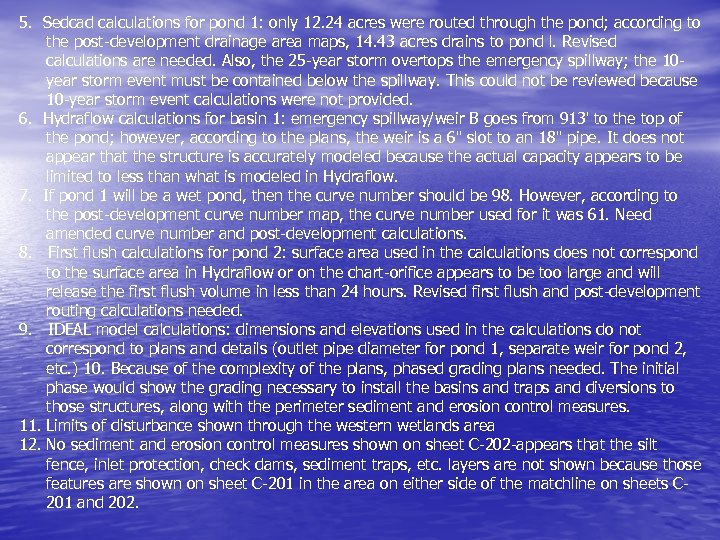
5. Sedcad calculations for pond 1: only 12. 24 acres were routed through the pond; according to the post development drainage area maps, 14. 43 acres drains to pond l. Revised calculations are needed. Also, the 25 year storm overtops the emergency spillway; the 10 year storm event must be contained below the spillway. This could not be reviewed because 10 year storm event calculations were not provided. 6. Hydraflow calculations for basin 1: emergency spillway/weir B goes from 913' to the top of the pond; however, according to the plans, the weir is a 6" slot to an 18" pipe. It does not appear that the structure is accurately modeled because the actual capacity appears to be limited to less than what is modeled in Hydraflow. 7. If pond 1 will be a wet pond, then the curve number should be 98. However, according to the post development curve number map, the curve number used for it was 61. Need amended curve number and post development calculations. 8. First flush calculations for pond 2: surface area used in the calculations does not correspond to the surface area in Hydraflow or on the chart orifice appears to be too large and will release the first flush volume in less than 24 hours. Revised first flush and post development routing calculations needed. 9. IDEAL model calculations: dimensions and elevations used in the calculations do not correspond to plans and details (outlet pipe diameter for pond 1, separate weir for pond 2, etc. ) 10. Because of the complexity of the plans, phased grading plans needed. The initial phase would show the grading necessary to install the basins and traps and diversions to those structures, along with the perimeter sediment and erosion control measures. 11. Limits of disturbance shown through the western wetlands area 12. No sediment and erosion control measures shown on sheet C 202 appears that the silt fence, inlet protection, check dams, sediment traps, etc. layers are not shown because those features are shown on sheet C 201 in the area on either side of the matchline on sheets C 201 and 202.
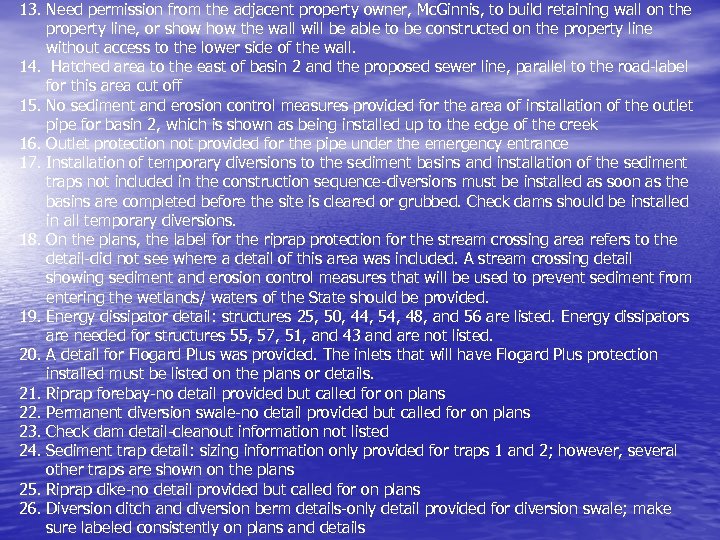
13. Need permission from the adjacent property owner, Mc. Ginnis, to build retaining wall on the property line, or show the wall will be able to be constructed on the property line without access to the lower side of the wall. 14. Hatched area to the east of basin 2 and the proposed sewer line, parallel to the road label for this area cut off 15. No sediment and erosion control measures provided for the area of installation of the outlet pipe for basin 2, which is shown as being installed up to the edge of the creek 16. Outlet protection not provided for the pipe under the emergency entrance 17. Installation of temporary diversions to the sediment basins and installation of the sediment traps not included in the construction sequence diversions must be installed as soon as the basins are completed before the site is cleared or grubbed. Check dams should be installed in all temporary diversions. 18. On the plans, the label for the riprap protection for the stream crossing area refers to the detail did not see where a detail of this area was included. A stream crossing detail showing sediment and erosion control measures that will be used to prevent sediment from entering the wetlands/ waters of the State should be provided. 19. Energy dissipator detail: structures 25, 50, 44, 54, 48, and 56 are listed. Energy dissipators are needed for structures 55, 57, 51, and 43 and are not listed. 20. A detail for Flogard Plus was provided. The inlets that will have Flogard Plus protection installed must be listed on the plans or details. 21. Riprap forebay no detail provided but called for on plans 22. Permanent diversion swale no detail provided but called for on plans 23. Check dam detail cleanout information not listed 24. Sediment trap detail: sizing information only provided for traps 1 and 2; however, several other traps are shown on the plans 25. Riprap dike no detail provided but called for on plans 26. Diversion ditch and diversion berm details only detail provided for diversion swale; make sure labeled consistently on plans and details
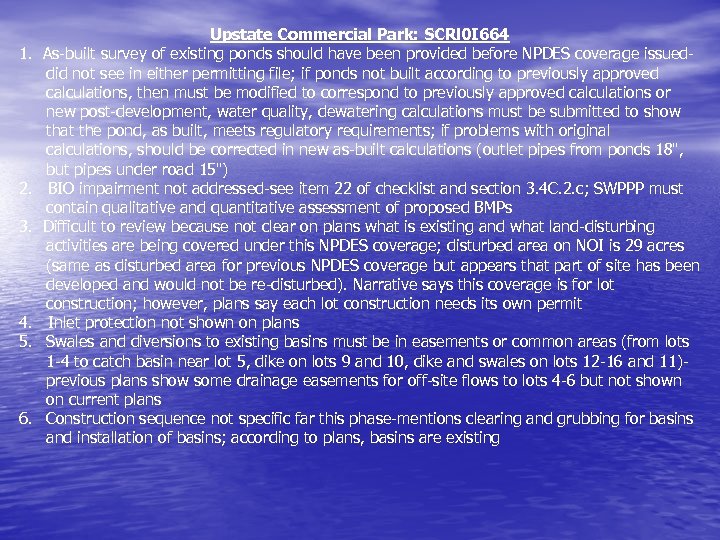
1. 2. 3. 4. 5. 6. Upstate Commercial Park: SCRl 0 I 664 As built survey of existing ponds should have been provided before NPDES coverage issued did not see in either permitting file; if ponds not built according to previously approved calculations, then must be modified to correspond to previously approved calculations or new post development, water quality, dewatering calculations must be submitted to show that the pond, as built, meets regulatory requirements; if problems with original calculations, should be corrected in new as built calculations (outlet pipes from ponds 18", but pipes under road 15") BIO impairment not addressed see item 22 of checklist and section 3. 4 C. 2. c; SWPPP must contain qualitative and quantitative assessment of proposed BMPs Difficult to review because not clear on plans what is existing and what land disturbing activities are being covered under this NPDES coverage; disturbed area on NOI is 29 acres (same as disturbed area for previous NPDES coverage but appears that part of site has been developed and would not be re disturbed). Narrative says this coverage is for lot construction; however, plans say each lot construction needs its own permit Inlet protection not shown on plans Swales and diversions to existing basins must be in easements or common areas (from lots 1 4 to catch basin near lot 5, dike on lots 9 and 10, dike and swales on lots 12 16 and 11) previous plans show some drainage easements for off site flows to lots 4 6 but not shown on current plans Construction sequence not specific far this phase mentions clearing and grubbing for basins and installation of basins; according to plans, basins are existing
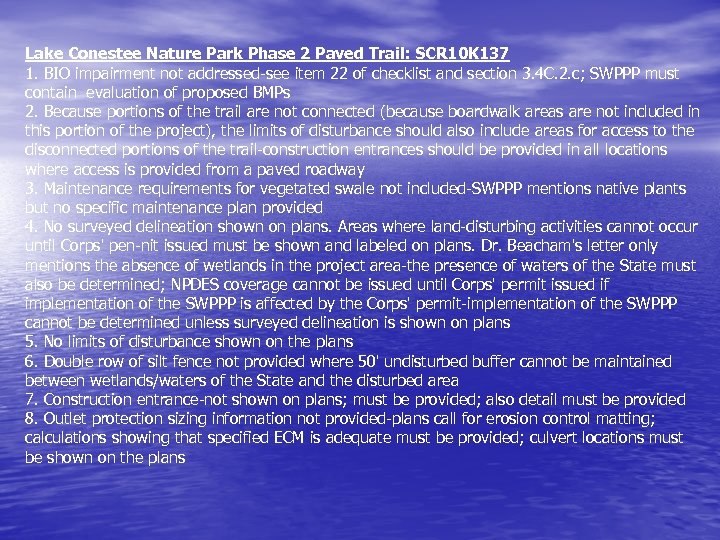
Lake Conestee Nature Park Phase 2 Paved Trail: SCR 10 K 137 1. BIO impairment not addressed see item 22 of checklist and section 3. 4 C. 2. c; SWPPP must contain evaluation of proposed BMPs 2. Because portions of the trail are not connected (because boardwalk areas are not included in this portion of the project), the limits of disturbance should also include areas for access to the disconnected portions of the trail construction entrances should be provided in all locations where access is provided from a paved roadway 3. Maintenance requirements for vegetated swale not included SWPPP mentions native plants but no specific maintenance plan provided 4. No surveyed delineation shown on plans. Areas where land disturbing activities cannot occur until Corps' pen nit issued must be shown and labeled on plans. Dr. Beacham's letter only mentions the absence of wetlands in the project area the presence of waters of the State must also be determined; NPDES coverage cannot be issued until Corps' permit issued if implementation of the SWPPP is affected by the Corps' permit implementation of the SWPPP cannot be determined unless surveyed delineation is shown on plans 5. No limits of disturbance shown on the plans 6. Double row of silt fence not provided where 50' undisturbed buffer cannot be maintained between wetlands/waters of the State and the disturbed area 7. Construction entrance not shown on plans; must be provided; also detail must be provided 8. Outlet protection sizing information not provided plans call for erosion control matting; calculations showing that specified ECM is adequate must be provided; culvert locations must be shown on the plans
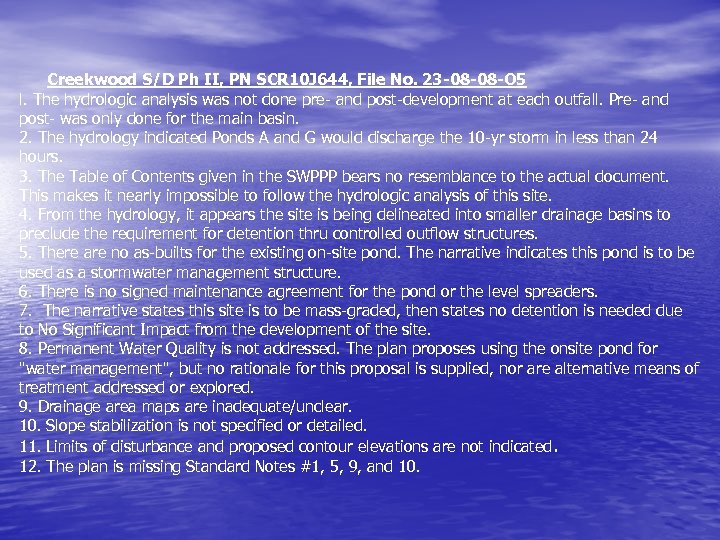
Creekwood S/D Ph II, PN SCR 10 J 644, File No. 23 -08 -08 -O 5 l. The hydrologic analysis was not done pre and post development at each outfall. Pre and post was only done for the main basin. 2. The hydrology indicated Ponds A and G would discharge the 10 yr storm in less than 24 hours. 3. The Table of Contents given in the SWPPP bears no resemblance to the actual document. This makes it nearly impossible to follow the hydrologic analysis of this site. 4. From the hydrology, it appears the site is being delineated into smaller drainage basins to preclude the requirement for detention thru controlled outflow structures. 5. There are no as builts for the existing on site pond. The narrative indicates this pond is to be used as a stormwater management structure. 6. There is no signed maintenance agreement for the pond or the level spreaders. 7. The narrative states this site is to be mass graded, then states no detention is needed due to No Significant Impact from the development of the site. 8. Permanent Water Quality is not addressed. The plan proposes using the onsite pond for "water management", but no rationale for this proposal is supplied, nor are alternative means of treatment addressed or explored. 9. Drainage area maps are inadequate/unclear. 10. Slope stabilization is not specified or detailed. 11. Limits of disturbance and proposed contour elevations are not indicated. 12. The plan is missing Standard Notes #1, 5, 9, and 10.
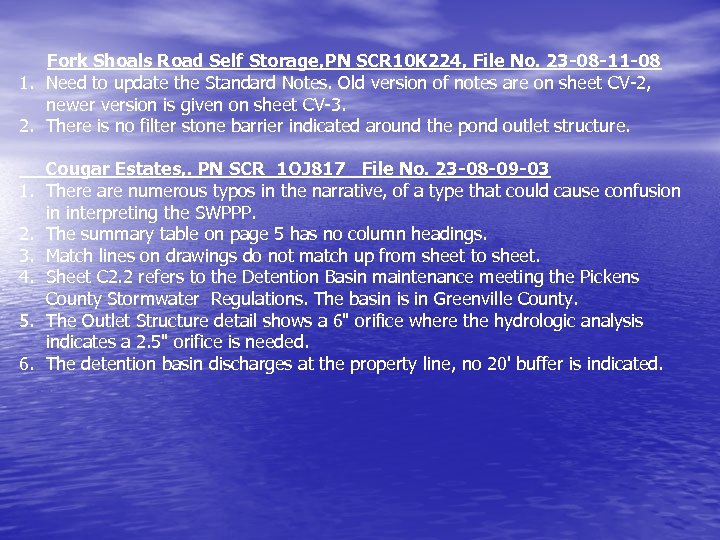
Fork Shoals Road Self Storage, PN SCR 10 K 224, File No. 23 -08 -11 -08 1. Need to update the Standard Notes. Old version of notes are on sheet CV 2, newer version is given on sheet CV 3. 2. There is no filter stone barrier indicated around the pond outlet structure. 1. 2. 3. 4. 5. 6. Cougar Estates, . PN SCR_1 OJ 817 _File No. 23 -08 -09 -03 There are numerous typos in the narrative, of a type that could cause confusion in interpreting the SWPPP. The summary table on page 5 has no column headings. Match lines on drawings do not match up from sheet to sheet. Sheet C 2. 2 refers to the Detention Basin maintenance meeting the Pickens County Stormwater Regulations. The basin is in Greenville County. The Outlet Structure detail shows a 6" orifice where the hydrologic analysis indicates a 2. 5" orifice is needed. The detention basin discharges at the property line, no 20' buffer is indicated.
Goodwin Farms, PN SCR 10 J 143, File No. 23 -08 -05 -22 l. The NOI is incorrect. Item IV. 2. C. 1 the BIO impairment info is incorrectly analyzed. 2. The supporting documentation is not bound & tabbed, & therefore difficult to manage. 3. There is no legend on the plans. 4. The disturbed area is not delineated. 5. Proposed elevation contours are not shown. 6. Sedimentology is not discussed in the narrative. The Site Plan has sediment traps discharging to wet detention ponds. This design is not supported in the documentation. Maintenance of this design is not supported in the documentation. 7. Drainage Area Maps are not given for the sediment traps. 8. Sedimentology calculations use the 3 detention ponds for the calculations, but the plan indicates the detention ponds are not to be used for sediment control after the roads are built. The sedimentology of the traps is not discussed, and the drainage areas for the traps are not delineated. 9. No road profiles are supplied
Assistant County Administrator’s Response • Will review its internal Plan Reviewer training • • • requirements and make appropriate adjustments Staff will hold joint training class with DHEC staff to get better understanding of expectations Provide staff with in house refresher training and incorporate the results from this audit report Continually evaluate its construction plan review program to find improvements
Impaired Water Response • In an effort to aid the design community as well as provide the County quantifiable assurances for meeting MS 4 permit goals, the County has developed and made available the IDEAL computer program. With the IDEAL model, the design engineer can calculate the annual loading for the pollutant of concern for the pre developed condition as a baseline and the developed condition showing no increase for impaired waters discharge compliance. The county intends to continue to implement the program as it is referenced in the permit.
TMDL Compliance Response • The waste load allocation percent reduction from the first impaired station downstream of a proposed project will be applied to the land disturbance permit requirements. The applicant will have to demonstrate with IDEAL that the annual pollutant of concern loading for the site in a developed condition will be reduced by the respective amount as compared to the pre developed condition.

Concerns or Questions regarding IDEAL Don Alexander, PE Woolpert Consultants Software Technical Support
Woolpert’s Internal Audit • Consisted of two parts – Evaluate original site county plan reviewed and approved engineer design plan – Field review to compare the design plans against actual site implementation and to determine if the EPSC features actually implemented were effective at reducing erosion and sedimentation at construction sites such that sediment was being retained to achieve MEP
Sites selected • 30 construction sites were selected – – 12 single family 2 multi family 11 commercial 5 industrial The number of sites were randomly selected from within each classification as determined using the total population of active sites within each classification and active at time of inspection
Plan Review Audit Results • Summary of Most Common Plan Review Deficiencies: – – – – Disturbed limits not shown Soil type not denoted No sequence bar chart Lack of EPSC calculations No drainage area specified for BMPs Difficult to determine if BMPs sized properly Lack of details for BMPs Greenville County/adequate details not used
Field General Scores • Common Issues at all 30 Sites – No Design Plans Available – No Inspection Logs Available – No Stabilization of Inactive Areas
Field Review Results • Summary of Most Common Field Review Deficiencies: – No geotextile layer in rock check dams and construction entrances – Lack of maintenance of BMPs – Inadequate fabric height for silt fences – Inadequate fabric depth for filter fabric inlet protection – Erosion and damage at outlets – No protection provided at several inlets
Plan Review Conclusions and Recommendations • Add requirements to plan review checklist for • • • sites that drain to impaired/303 d/TMDL streams Review CSPR and Internal Plan Reviewer training materials and make appropriate revisions per results of audit Emphasize that EPSC Plans must include design calculations for all EPSC BMPs Recommend use of Greenville County details or “equivalent” if available for a particular BMP
Plan Review Conclusions and Recommendations • Provide in house refresher training for plan reviewers to incorporate results of audit and highlight most common plan review deficiencies: – – – – Lack of EPSC calculations Disturbed limits not shown No sequence bar chart Soil type not denoted Lack of standard details for BMPs Greenville County standard details not used Highlight specific BMP deficiencies
Field Inspection Conclusion and Recommendations • Provide in house refresher training to incorporate results of audit and highlight most common field inspection deficiencies: – – – Lack of inspection logs Lack of filter fabric in appropriate BMPs No project plans are kept on site Improper site stabilization Poor maintenance of BMPs Inadequate fabric height for silt fence and depth for filter fabric inlet protection – Erosion and damage at outlets – No protection provided at several inlets
Engineer’s Survey Results • The majority still use some version of Hydraflow • • • or Sedcad 4 Pre Design meetings last too long and could be limited to 30 minutes if all involved work briskly through the checklist Exempt owners from Pre Design meetings if they understand the process, owner requirements and liabilities 50% would be in favor of having a credit card option for fee payments
Engineer’s Survey Continued • 60% are in favor of going to an electronic • • • process if it saves time and resources thus money to their client 71% who answered this question favored the subdivision approval process being done electronically 40% would be in favor of using the Charleston approach to NOI and permit approval Majority of the general comments were in regards to our requirements being above and beyond SCDHEC’s
Hydrologic and Hydraulic Software • Staff heard that Auto. CADD would no longer • • • support Hydraflow Based on survey results most still use some version of this software LDD will continue using Hydraflow and Sedcad as the standard software we train our plan review staff to know and use We will continue to listen to the engineering community on it’s ease of availability and support from the software manufacturer
Pre Design Meetings • We will commit to continue the practice of scheduling the • • meeting to take place within 6 days from request We will commit to keeping meeting times to no more than 45 to 60 minutes in length We will not over run the scheduled meeting time or make the next appointment wait past their time We will let the Design Professional do most of the talking as they provide us with the needed information regarding their proposed design To meet our commitments the engineer must also commit to …
Expectations of the Engineering Community • Provide options that will meet the county’s post • • • construction water quality permit requirements In order to receive a permit number at the conclusion of the meeting be prepared with all specifics noted on the next slide Will not debate “Non standard design manual approaches” during meeting instead will require proposed approach to go through the formal concept review process If specifics that meet the design manual are not met and more discussion is needed with the time remaining the meeting will become a development conference
Pre Design Meeting Focus • Design Professional will come to the meeting prepared to explain how they will address in their design the three major elements of permit compliance – – – Peak Rate Attenuation Sedimentology Post Construction Water Quality Identify potential areas of off site impacts Explain what parts of the site will require the most attention to meet the requirements
Designer’s Preparation Prior to the Meeting • Familiarize yourself with the storm water permit • • • requirements and design manual Familiarize yourself with other local, state and federal regulatory requirements and ordinances Field visit of the site to understand existing site conditions Review project files for critical information if part of a previously permitted project or larger common plan Prepare a vicinity map with existing conditions and proposed development plan Identify potential storm water management features Complete the Pre Design Registry Form
Exempted Owners from Pre Design Meeting • Will exempt developers/utility providers who regularly work in construction and are aware of EPA requirements – Owner will still need to sign an acknowledgement form (a tool in potential enforcement action) – Signed acknowledgement will be included in submittal package – They will receive copy of Pre Design summary form outlining project scope, impacts and proposed solution
Owner at Pre Design Meeting • Owners who’s primary business in not • • • construction will be required to attend Owner packet will no longer be explained in detail just that it’s mandatory that they read and understand their liabilities and responsibilities If they have questions ask their design professional to explain responsibilities Signed acknowledgement form (which is used for enforcement and magistrate fines) must be included in the submittal package
County verses SCDHEC’s or other Upstate City/County Requirements • Greenville County is a Phase I MS 4 permit holder verses Phase II MS 4 permit holders – Phase I’s must meet higher standard for post construction water quality – IDEAL software model is how we meet this higher standard requirements – GC has had a permit since 2001 vs. 2007 – Phase II permit holders have not gone through a SCDHEC audit yet
County verses SCDHEC or other Upstate City/County Requirements • We are guaranteeing a 10 work day plan review turn around time vs. a 20 work day turn around • We are reviewing a higher volume of plans verses these other local/MS 4 agencies • Need a standard format and software to meet this guarantee
10 Business Day Turn Around • Development Community desired a quicker turn • • around time than required by state law Construction Boom years coupled with limited county manpower staffing made this difficult Stakeholders group agreed that a standard software and submittal package format would allow staff to review plans quicker for permit issuance
Times have Changed The development community may have different needs today than 10 years ago
Options for Plan Review Submittals • If the development community feels that engineering cost is a more important factor than time we can offer alternatives • Standard of 20 day turn around • County’s Current 10 day turn around • Expedited Review
State Standard 20 day turn around • Pre Design Meeting not required • Engineer can submit using any software model of their choice • Must provide a network diagram and pre and post maps as currently • • required by SCDHEC Use Standard SCDHEC checklist but with our 25 year storm design standard Must use IDEAL to meet our Phase I MS 4 permit requirements for post construction water quality Must address Tree Ordinance and any other county related zoning requirements specific to this project that effects land disturbance This permit submittal option fee will cost $600 more than 10 day turn around option since it will take additional staff time to perform the needed sub area delineation and verify travel paths, lengths, slopes, etc
County’s Current 10 day turn around • Pre Design meeting must be held • Must use Hydraflow or Sed. Cad software • Must include the 360 area map with delineated • • areas, CN’s, slopes, and flow path lengths Must provide chart with input data to support hydrology model & network diagram Must address all the key information in the narrative especially anything that outlines master plan assumptions & how you will meet water quality standards
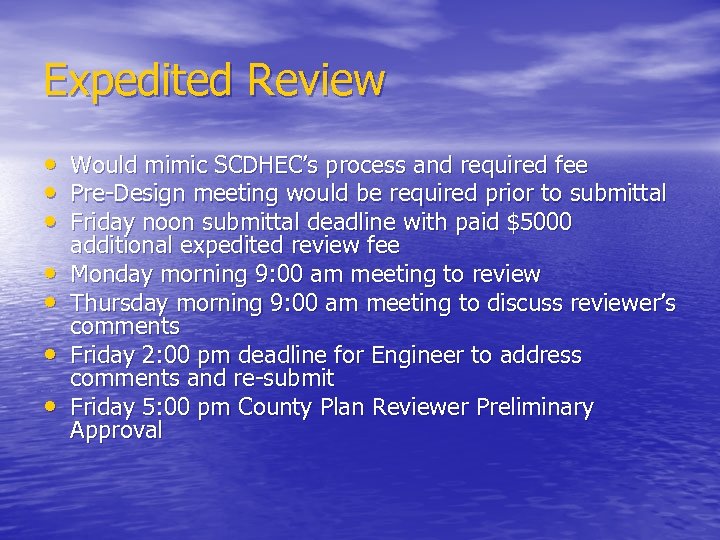
Expedited Review • Would mimic SCDHEC’s process and required fee • Pre Design meeting would be required prior to submittal • Friday noon submittal deadline with paid $5000 • • additional expedited review fee Monday morning 9: 00 am meeting to review Thursday morning 9: 00 am meeting to discuss reviewer’s comments Friday 2: 00 pm deadline for Engineer to address comments and re submit Friday 5: 00 pm County Plan Reviewer Preliminary Approval
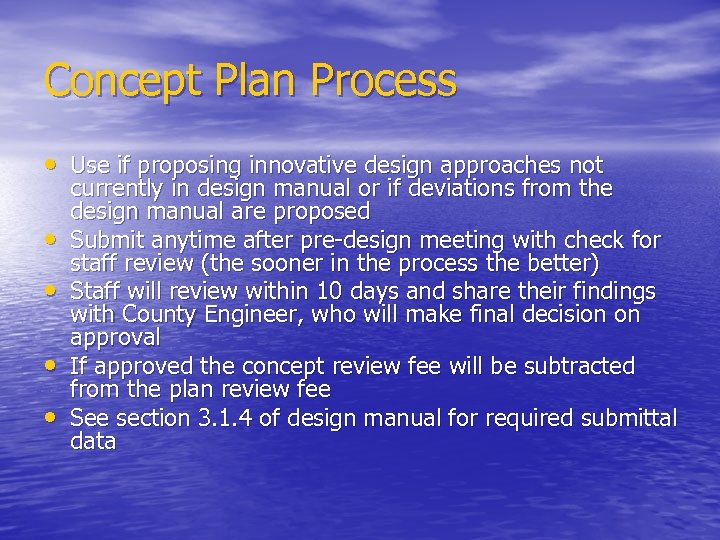
Concept Plan Process • Use if proposing innovative design approaches not • • currently in design manual or if deviations from the design manual are proposed Submit anytime after pre design meeting with check for staff review (the sooner in the process the better) Staff will review within 10 days and share their findings with County Engineer, who will make final decision on approval If approved the concept review fee will be subtracted from the plan review fee See section 3. 1. 4 of design manual for required submittal data
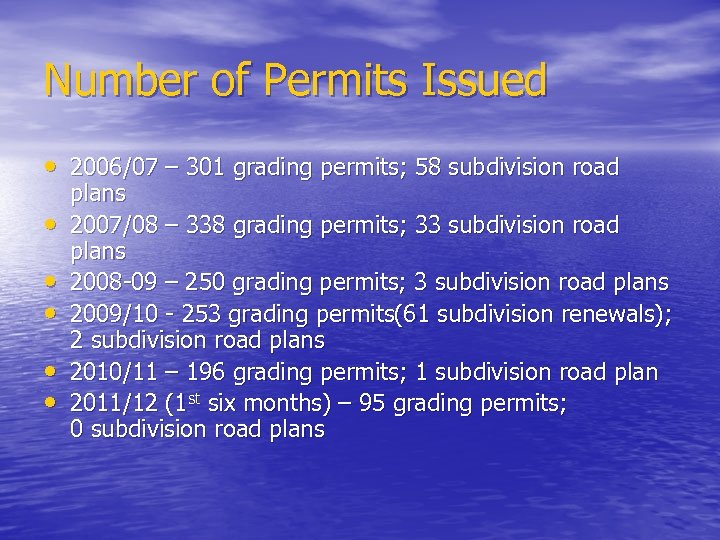
Number of Permits Issued • 2006/07 – 301 grading permits; 58 subdivision road • • • plans 2007/08 – 338 grading permits; 33 subdivision road plans 2008 09 – 250 grading permits; 3 subdivision road plans 2009/10 253 grading permits(61 subdivision renewals); 2 subdivision road plans 2010/11 – 196 grading permits; 1 subdivision road plan 2011/12 (1 st six months) – 95 grading permits; 0 subdivision road plans
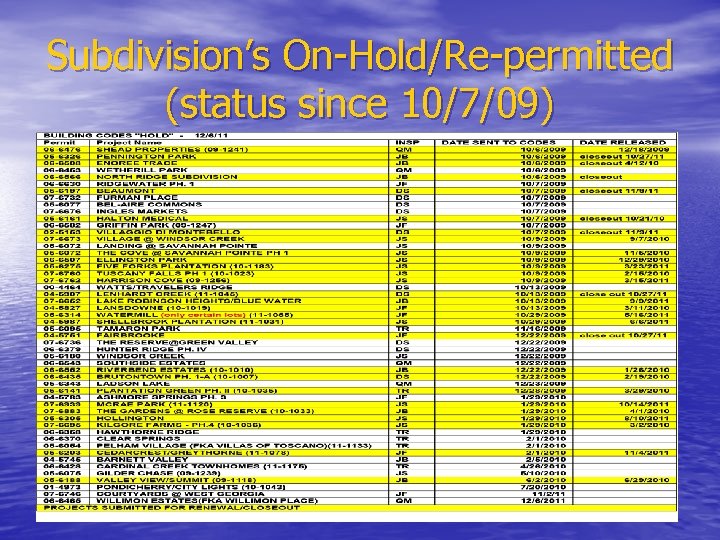
Subdivision’s On Hold/Re permitted (status since 10/7/09)
Average Turn Around (We have one of the shortest turn around commitments in the Upstate) • 2010/11 – 1 st Submittals – 7. 38 days – Re submittals 3. 9 days – Modifications 6. 47 days • 2011/12 (1 st six mo’s) – 1 st Submittals – 6. 27 days – Re submittals – 3. 50 days – Modifications – 7. 18 days
SCDHEC NOI Applications • Greenville County LDD’s processing of NOI application & • • • forwarding to DHEC along with our approval form is a courtesy & not a requirement of state law Survey says Engineer’s want to maintain this practice vs getting NOI approval first or Engineer filing the NOI directly to DHEC after our preliminary approval. DHEC has outlined their expectation regarding the completion of their application. We review the application to assist the engineer in identifying items that could delay it’s approval. LDD does not have the authority to change, modify or add to this application.
EPA’s definition of “part of a larger common plan” • Large Construction Activity – development or • • sale that will ultimately disturb equal to or greater than five (5) acres Small Construction Activity – results in land disturbance of equal to or greater than one acre and less than five acres EPA & DHEC has stated NOI coverage is required even if disturbing less than one acre, if included as part of a large common plan of development where ultimately disturb equal to more than one acre but less than five (5) acres
EPA’S Broad Definition Part of Larger Common Plan • Any announcement or piece of documentation (including a sign, public notice or hearing, sales pitch, advertisement, drawing, permit application, zoning request, computer design) or physical demarcation (including boundary signs, lot stakes, surveyor markings) indicating construction activity may occur on a specific plot
Common Plan of Development or Sale • Is a contiguous area where multiple, separate & distinct • • construction activities may be taking place either simultaneously or on different schedules This includes activities scheduled to occur in “phases” SCDHEC considers it to be part of a LCP if there has been land disturbance activities (clearing, grading or excavating) resulting in an accumulation of 1 or more disturbed acre since 1992 or will exceed the 1 acre limit with future land disturbing activities
County Defined verses SCDHEC • Any larger common plan that has no active construction and/or was not previously permitted under a general construction permit by SCDHEC but is documented as being previously permitted by Greenville County and is in LDD’s database
Engineering Minimum Plans • Are used when the project scope size or runoff increase • • • doesn’t qualify under the non simplified requirements but requires the expertise of an engineer Engineer certification or supervision of work needed due to changes to the drainage system, environmentally sensitive downstream conditions or stabilization plan needed for sites disturbed w/out permits & under NOV Project minimally exceeds simplified criteria in size or runoff increase where LID’s will be used to meet requirements Project is simplified in scope or size but is part of a site defined by SCDHEC or LDD as a part of a larger common plan
Engineer Supervision • Site requires periodic observation of construction • • • & a final inspection for design compliance Project does not warrant CEPSCI inspection level oversight Engineer defines the frequency of site visits and the general nature of his/her oversight This inspection can be made by a representative of his/her office under engineer’s supervision
Low Impact Development Requirement (Green Infrastructure) • Rezoning to higher density to meet the Centers and Corridors plan would need to use LID’s to meet water quality standards • Changes to LDR will incorporate the use of LID’s in road right of way applications • Details are being sought from other agencies – PDF and CADD formats will be provided for engineer’s use
Steep Slope/Mountainous Grading Requirements • Traditional engineering designs to meet storm • • water management are difficult in mountainous terrain To meet requirements 65 percent of the site should be preserved in a forested or native soil and the effective imperious surface of the area must be <10% Runoff from imperious area must drain to native buffer areas or into an LID feature
Small Residential Subdivisions • Full Dispersion or Partial w/ LID features (when • • • over 50% is lawn) instead of Detention facility Use in Subdivisions being created by Summary Plat Use when dividing one parcel into two Use in small subdivision developments where a common area is not feasible and/or HOA will not have the legal or financial ability to maintain a common area with a traditional storm water management facility
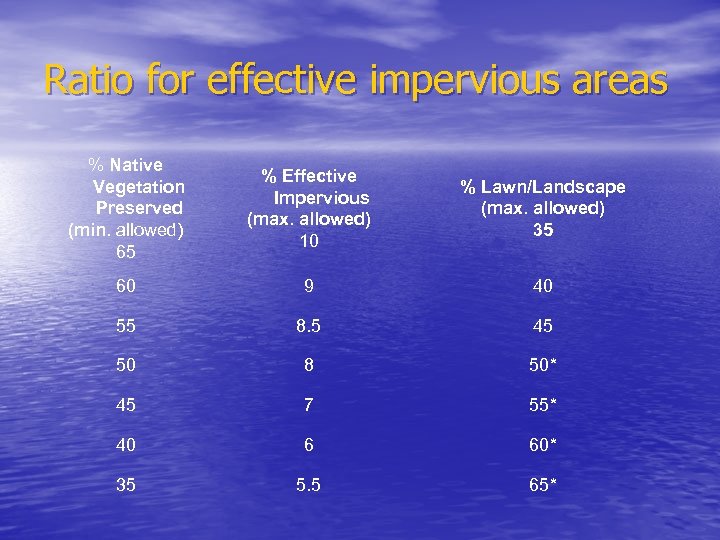
Ratio for effective impervious areas % Native Vegetation Preserved (min. allowed) 65 % Effective Impervious (max. allowed) 10 % Lawn/Landscape (max. allowed) 35 60 9 40 55 8. 5 45 50 8 50* 45 7 55* 40 6 60* 35 5. 5 65*
Infiltration Basin Requirements • Not applicable in industrial and commercial areas where • • • solvents, petroleum or pesticides are loaded, unloaded, stored or applied Provide data that soils are not >20% clay & <40% silt/clay. Clay soils are not conducive to infiltration Double Ring test for infiltration must be perform by geotechnical engineering firm and sealed by a PE from that firm Infiltration rates must be between. 5 & 3 in/hr Infiltration basins have a high failure rate due to improper siting, design and lack of maintenance Must meet all criteria outlined on LDD’S new checklist
Mechanical Water Quality Device Policy • On current approved list (Appendix G) • If not, provide the device’s pollutant efficiency • • data approved by EPA ETV or NJCAT programs Use efficiency data as input data for IDEAL to prove required removal efficiencies for pollutant of concern Devices will be approved on a site by site basis with IDEAL’s adequate removal demonstrated
Staff Request for Consideration • 360 map – small scale and color on top of color is • • • difficult to read (especially yellow & green) Similar line types used on small drawings are difficult to read Each firm uses different legends markings for similar items such as retaining walls Inspectors rely on the “site map” on plans to find the site location – please make sure to include Quantities need to be field measured for accuracy on letters of credit & roadway acceptance certifications Stormwater facilities need volume capacity verified earlier in construction during grading operations
Permit Extension Joint Resolution of 2010 (H 4445) • For development approval that is current and valid at any point during the period beginning January 1, 2008 and ending December 31, 2012, the running of the period of the development approval and any associated vested right is suspended during the period beginning January 1, 2008 and ending December 31, 2012
Grading Permit Renewal beginning 2013 • July 2012 – Inspection staff will categorize current permitted sites – Subdivisions that have reached 50% build out and need certifications and pond acceptance documents – Subdivisions that need to renew (not 50% yet) – Sites that are substantially complete, need stabilization letter and close out documents – Active Sites that need to renew – Inactive Sites that need to be stabilized and permit voided – Sites that were never started and permit voided – Permitted sites that do not need renewal in the first 6 months of 2013
2012 Permit Renewal Process • Letters will go out by September giving • • developers 3 months to stabilize & close based on 50% build out or renew their permits Engineer of Record will be copied Unresolved sites compliance will have permits revoked, holds placed on building permits and possible citations and civil penalties depending on the condition of site
SCDHEC’s 2012 General Construction Permit Requirements • The public notice period has closed • Currently being edited based on comments received during notice period • Anticipated date for issuance is this Spring • LDD Staff is reviewing permit application forms, checklists & current procedures for possible changes to meet the new requirements
SCDHEC’s 2012 General Construction Permit Requirements • Secondary Permittee – Home Builders, Individual • • Lot Owners, Contractors and possibly Utility Providers Contractor Certification forms must be on site Utility Providers may obtain from DHEC a blanket notice of intent Individual Lot NOI will be required (plat, plan or map needed) Primary’s SWPPP must outline if Secondary will adhere to the SWPPP or develop their own
General Construction Permit Requirements Continued • Ongoing Project (2006 GCP) – May be asked to confirm intent to be covered – If requested, must provide w/in 30 days – If not confirmed coverage is terminated – Must modify current SWPPP to add Section 3. 1. 1 F no later than 6 month after new permit
General Construction Permit Requirements Continued • Section 3. 1. 1 F – Add appendix for progress reports, compliance and modification – Revise SWPPP to address non numeric effluent limits unless specifically excluded – Change frequency of site visits to weekly – Add Rain Log appendix – Add Inspection Log appendix – Qualified Inspector can not be direct employee of contractor
General Construction Permit Requirements Continued • Ongoing Project (1998 GCP) – Must comply with Section 3. 1. 1 F – Must have a permanent maintenance agreement
General Construction Permit Requirements Continued • New Owners of Previously Permitted Sites – Must notify w/in 14 calendar days with project name, initial permittee NOI tracking number – If completely stabilized and inactive 14 days does not apply – If inactive but not completely stabilized must obtain NOI and develop stabilization plan – If complying with existing SWPPP transfer NOI – Completed NOI must come with G’ville Co approval letter stating that the construction is consistent with all requirements of this permit
General Construction Permit Requirements Continued • On site SWPPP – Living document w/modification and record logs – Kept on site until final stabilization – Notice on site of plans location with updated contact info posted near main entrance (if no personnel present) – Contractors and Builders w/day to day operations must have a copy of the on site SWPPP at central location by identifying responsibility – Copy sent to DHEC’s regional office for linear projects – Must be made available upon request – Created after NOI coverage is granted
General Construction Permit Requirements Continued • On Site SWPPP contents – Copy of Comprehensive SWPPP (excluding engineering report) – SCDHEC General Construction Permit – NOI letter (stamped and approved) – NPDES Coverage Approval letter – Local Approval – USACOE Approval (if applicable) – Contractor Certifications – Record Keeping (Pre Con log, Inspection log, Stabilization log, Rain log & Contractor log)
General Construction Permit Requirements Continued • Defines Major and Minor Modifications – Major (significant changes in design, construction, operation or maintenance that reasonable potential to cause or contribute to violations of SC Water Quality standards) – Major changes must go back to regulating agency for review and approval – MS 4 is given authority to determine if SWPPP is ineffective & that modifications are needed
General Construction Permit Requirements Continued • Major Modifications include: – – – Resizing sediment/detention basins Deletion of sediment traps/detention basins Relocation of sediment traps/detention basins Addition of sediment traps/detention basins Modifications to outlet structures of basins Changes in grading that alter drainage patterns that increase/decrease flow to traps/basins – Amending construction sequence that basins are not installed before grubbing operations
General Construction Permit Requirements Continued • Major Modifications involving Point Discharge or outfall locations changes include: – – – Modifications to regulated WQ structure Adding new point discharge Adding impervious or disturbed area Navigable water crossing changes Site layouts that require redesigning storm water management conveyance systems – Adding sediment traps
General Construction Permit Requirements Continued • Minor Modifications (Changes can be made to on site SWPPP only) – Adding ECSC BMP’s (if no wetlands involved) – Relocating ESSC BMP’s – Removing disturbed areas – Individual lot drainage modifications
General Construction Permit Requirements Continued • SWPPP Content – Narrative – Scope of Project w/ detailed description pre & post condition – Description of existing flooding problems on site or surrounding areas – Required on site support activities (concrete or batch plants) – Identification of prior uses of the site, potential sources of pollution & how it contributes to WQ standard violations – Identify industrial stormwater discharges that will be on the site
General Construction Permit Requirements Continued • SWPPP Contents – Specifically state that “impervious surfaces for stabilization should be avoided” as Erosion Prevention BMP – Identify and describe measures to prevent the discharge of building and construction debris – Identify all potential sources of pollution (sediment, fertilizers, etc) – Detention/Retention Ponds design refer to 72. 307
General Construction Permit Requirements Continued • SWPPP – Sequence of Construction – >5 acres must have phased erosion control plan for each phase having a specific sequence of construction – Sequence must be include on construction site plan • Must begin w/ construction entrance and perimeter control • End w/ temp sediment & erosion control measures • Conversion of BMP to permanent control • Level of detail vary based on complexity of project
General Construction Permit Requirements Continued • SWPPP Content – Sensitive Areas – Must identify all Waters of the State, Wetlands w/in disturbed areas, total area and if immediately adjacent. – Identify receiving waters – Must show all Waters of the State on separate plan sheet if w/in construction site – Must identify all impacted areas by outlining and labeling that no work can begin until COE &401 obtained – If structural BMP is proposed w/in Waters of the state must meet section 3. 2. 6. A. V
General Construction Permit Requirements Continued • SWPPP – Buffer Zone Preservation – When waters of the state are located on or immediately adjacent to the construction site • Identify and preserve an undisturbed vegetated buffer during construction • 30’ Buffer minimum between waters of the state • 45’ Buffer around high class water or impaired waters • Additional local requirements may apply
General Construction Permit Requirements Continued • SWPPP – Buffer Zone Preservation – All discharges though the buffer must be non channelized and/or non concentrated – Must first be treated by the construction site’s sediment and erosion controls BMP’s – Special circumstances may allow work in the buffer if all disturbed areas above have reached final stabilization and work will not cause violation of water quality standards
General Construction Permit Requirements Continued • SWPPP – Buffer Zone Preservation – If buffer is unattainable the SWPPP must identify and require the implementation of sediment and erosion control that will prevent the discharge of sediment laden stormwater – Must provide a written waiver with justification and supporting documentation – Additional BMP’s that surpasses the regular standards – Maintenance Agreement during construction with outline of detailed plan for each BMP – Letter from the permitting agency (ie: GC LDD) – DHEC must approve all written variance requests
General Construction Permit Requirements Continued • SWPPP – Buffer Zone Preservation – Certain types of construction activities are exempted • Water, Sewer, Utility, and Roadway construction at water crossing • Construction of water dependent structures and access areas • Development of a site where no naturally vegetated buffer area existed prior to the construction project • Construction sites previously covered under 2006 GCP
General Construction Permit Requirements Continued • SWPPP Content – EPSC BMP’s – Accurately and descriptively address the use, installation, maintenance and inspection of the EPSC BMP’s – Compute only # of acres draining to sediment basin that are disturbed – Use porous baffles in temp. sediment traps and sediment basins (unless infeasible) – Sediment traps must be used if draining > 2 acres but < 5 acres
General Construction Permit Requirements Continued • SWPPP Content – Runoff Control – Permanent Conveyance Measures must handle the 10 yr – 24 hr storm and must be <5 fps. If >5 fps must reduce velocity to non erosive or use liner to reduce erosion – Temporary Conveyance channels must divert concentrated flow of stormwater running to it, on to the site and stabilize these w/in 7 days
General Construction Permit Requirements Continued • SWPPP Content – Post Construction WQ – Development condition must not cause or contribute to violations of WQ standards – Non Structural BMP’s must be designed, installed and maintained to maximum pollutant removal – LID BMP’s must be installed only after areas are stabilized – Design, Inspect and maintain BMP’s in SWPPP at a minimum consistent w/ design manual
General Construction Permit Requirements Continued • SWPPP – Maps – – – – – Show overlaying contours of the site & surrounding areas on topo map Include names of each soil types on soil map Each floodplain must be clearly identified Vicinity map must include a north arrow Drainage map needed for pre & post developed conditions & contours Drainage basins & sub basins where stormwater runoff collects & drains to a common outfall Include offsite areas draining onto the site Drainage maps must be consistent w/ the info provide in all calculations provided in the report Drainage Map for each BMP to meet WQ (outline drainage basin for proposed BMP’s, location of each proposed BMP & area in acres to each
General Construction Permit Requirements Continued • SWPPP Content – Engineering Report – Stable Channel Analysis to ensure non erosive – Storm Sewer Analysis – Rip Rap Apron Analysis
General Construction Permit Requirements Continued • SWPPP – Engineering Report – Permanent WQ analysis w/ detailed calculations for any structural BMP – Sedimentology (trapping efficiency analysis) detailed calculations for any BMP used to meet WQ requirements – As built survey required if directing runoff to a previously approved detention pond unless as built has been provided and accepted
General Construction Permit Requirements Continued • SWPPP – Detention As built Data – All existing grades/contours/depth of pond – Invert diameters, elevations & dimensions of all outlet structures (pipes, orifices, weirs, risers & emergency spillway) – Location & inverts for all pipe discharging into the pond
General Construction Permit Requirements Continued • SWPPP – Construction Plans – Must be consistent w/ 72 307. A. 3 – Detailed EPSC Plan sheets including, grading and drainage plan and BMP detail sheet
General Construction Permit Requirements Continued • SWPPP Content – Phased EPSC Plan – Each Phase must be on a separate plan sheet and one sheet w/all the details – Non linear sites disturbing >10 must have at least a 3 phased EPSC plan • Initial/major grading • Construction interim (temp BMP’s to convey, manage, treat) • Final Contours (stabilization plan) – Non linear sites disturbing <10 acres must have at least a 2 phased EPSC plan • Initial/major grading • Final Contours (stabilization plan)
General Construction Permit Requirements Continued • SWPPP – Non Effluent Limits – Control Stormwater volume and velocity w/in site to minimize erosion • Volume (limit amount disturbed, phasing, terracing, diverting offsite flow, controlling drainage patterns) • Velocity (surfacing roughening, sediment traps, temp seeding, blankets, TRM, BFM, riprap, polys)
General Construction Permit Requirements Continued • SWPPP – Non Numeric Effluent Limits – Control Stormwater discharges to minimize erosion at outlets, downstream channels & streambanks • Volume discharge control (Hydrology, surface outlets, WQ storage w/in impoundments) • Peak rate discharge (energy dissipaters, level spreaders, riprap aprons, blankets, TRM)
General Construction Permit Requirements Continued • SWPPP – Non Effluent Limits – Minimize Amount of Soil Exposed • Phased EPSC plan that limits amount of exposed soil • Outline the limits of disturbance on plan • Stabilize exposed area ASAP • Implement temporary seeding
General Construction Permit Requirements Continued • SWPPP – Non Effluent Limits – Minimize the disturbance of steep slopes (15% and greater) • Divert flow around steep slope disturbance • Use specialized control for steep slopes (mattings, blankets, pipe slope drains, seep berms) • Stabilization ASAP after disturbance (no later than 7 days) & w/in 3 working days of stabilization efforts must have vegetation cover & installed non vegetation cover
General Construction Permit Requirements Continued • SWPPP – Non Effluent Limits – Minimize sediment discharges from the site during construction – Maintain natural buffers around surface waters – Direct stormwater to vegetated areas to maximize infiltration during construction – Minimize soil compaction and preserve topsoil
General Construction Permit Requirements Continued • SWPPP – Non Effluent Limits – Stabilize soil w/in a time period as determined by the permitting authority. Mulch and other temp measures should be used when vegetation stabilization in not immediately feasible – Discharges from dewatering are prohibited unless managed by appropriate controls
General Construction Permit Requirements Continued • SWPPP – Non Effluent Limits – Minimize discharges of pollutants during construction • Equipment/vehicle washing, wheel washing & other wash waters (must be treated in a sediment trap) • Exposure of building material/products, construction waste, trash, landscape, detergents, sanitary waste, fertilizers, herbicides • Spill & Leak prevention plan & response procedure
General Construction Permit Requirements Continued • SWPPP – Non Effluent Limits – Prohibited Discharges • Washout of Concrete • Washout of paints, oils, stucco, curing compounds • Fuels, oils & other vehicle/equipment maintenance material • Soaps & solvents in washing
General Construction Permit Requirements Continued • SWPPP – TMDL – If TMDL applicable to stormwater construction discharges have been established in receiving waters must incorporate measures or controls that are consistent with TMDL – If specific waste load allocation has been established to discharge must incorporate that allocation into SWPPP (IDEAL) – 303(d) for sediment, BIO, TP & TN • Carefully evaluate all selected BMP’s & their performance • >25 acres must be a written quantitative and qualitative assessment (IDEAL)
General Construction Permit Requirements Continued • Implementation, Inspection & Maintenance – Pre Construction Conference • Linear (Stand Alone) Construction Projects – Can conduct conference offsite w/ each contractor • Non linear construction disturbing 10 acres & > – Primary or Secondary Permittee must conduct conference w/ each contractor or builder who is not a permittee on site
General Construction Permit Requirements Continued • Implementation, Inspection & Maintenance – Pre Con’s Purpose • Preparing of the SWPPP, Equivalent Registration or the Person w/ operational control of the plans to explain the entire SWPPP to the contractors & builders • Specifically go over the areas of the SWPPP that relates to the work performed by them • Must address how modifications (major/minor) to the plans will be addressed and processed at the construction site to maintain compliance • Meeting must be documented w/in the On Site SWPPP (dates, locations, times, attendance) • Document meeting to complete contractor certification form
General Construction Permit Requirements Continued • Inspections – Scope (all disturbed areas, perimeter BMP, exposed material storage areas, evidence of potential pollutants entering conveyance system, discharge locations, EPSC measures, vehicle access point, inefficiencies w/in BMP’s) – Frequency (minimum once every week, once finally stabilized definable area can be marked off on site SWPPP) – Rain Gauge (maintain on site gauge or use data from certified weather record w/in reasonable proximity, record rainfall events. 5” &>, must maintain in rain log in on site SWPPP) – Inspector Qualifications (can not be a direct employee of any contractor responsible for activity covered by the inspector, for projects > 2 acres, for 2 acres & < permittee may perform inspections provided the preparer of SWPPP explains the SWPPP implementation & inspection requirements) – Monthly Reports (DHEC may require on case by case basis submitted monthly reports)
General Construction Permit Requirements Continued • Maintenance – Permittee must address the necessary replacement or modification required to correct BMP w/in 48 hrs of identification – Sediment must be removed when deposited sediment reaches 1/3 height of the BMP – A detailed permanent maintenance plan must be outlined in the narrative – Agreement and maintenance plan must be in the SWPPP
General Construction Permit Requirements Continued • Maintenance Agreements – Signed notarized agreement from responsible party for each of the permanent WQ features – MS 4 must be notified in writing of any changes in the maintenance responsibilities – Construction sites originally permitted under 1998 GCP must sign notarized maintenance agreement
General Construction Permit Requirements Continued • Secondary Permittees are responsible for either • maintaining or coordinating the maintenance of Common BMP’s which accept storm water discharge from any areas associated with their work with the Primary permittee Maintenance Plans Content – Description of maintenance plan used – Manufactured devices must have detailed procedures for maintenance included in plan – Each WQ feature must have maintenance activity described for all items of feature
General Construction Permit Requirements Continued • Termination of Coverage (NOT) – Can submit only if one or more below exist • Final stabilization has been achieved on all portions of the site for which permittee is responsible • Another operator has assumed control over all areas not finally stabilized • Individual Lot Coverage or Alternate General NPDES permit has been obtained • For residential subdivision lot temp stabilized and lot ownership transferred to homeowner • Land disturbance was never initiated on the site and the site remains permanently stabilized
General Construction Permit Requirements Continued • Notice of Termination (NOT) – DHEC must receive letter from MS 4 that site meets criteria to terminate permit – If ownership or maintenance of permanent WQ features have change since original approval copy of revised agreement must be attached – Primary Permittee’s in residential subdivisions can request NOT when Secondary Permittees are authorized to conduct construction activities for the remaining disturbed areas of the construction site and final stabilization has been achieved on all other area of the site.
EPA’s Permit Requirements • Stormwater Regulations – – – Original Deadline was September 30, 2011 Extended to December 30, 2011 Negotiating with Chesapeake Bay Foundation due to lawsuit filed & current delays Additional cost benefit data need Proposed regulations new date for release is December 2012/Janaury 2013 New deadline for implementation later in 2013
EPA’s Permit Requirements • National Effluent Standards (Turbidity) – Deadline delayed to obtain better scientific data – January 3, 2012 notice requesting more data • Effectiveness of technologies in controlling turbidity • Seeks comments on passive treatment data already available • Dr. Barfield to summarize research authorized last year by Greenville County • 60 day comment period established for this request
SCDHEC’s Permit Renewals • DHEC was waiting for the new EPA proposed regulations to ensure Phase II permit regulations were “in line” with new standards • With EPA’s delay until 2013 it is believed that DHEC will go ahead and issue both Phase I and Phase II renewal permits
Greenville County’s 3 rd Cycle NPDES Phase I MS 4 Permit • Our current MS 4 permit expires July 1, 2012 • We submitted our renewal permit application on December 29, 2011 • Some changes expected in our permit requirements • Increased compliance for watersheds with TMDL designations
Possible requirement changes • Review of local codes and land development requirements to reduce storm water impacts of new development and significant redevelopment – Mandate LID principals in specific applications – Reduction in impervious surfaces – Reduction of flow and volume – Increase or mimic natural hydrology
303(d) and TMDL Compliance • Engineer will need to use IDEAL to model pre • and post construction water quality for identified pollutant for numeric quantification. For TMDL watersheds with waste load allocation percentage reduction requirements the site will need to be designed to show in IDEAL that the percentage reduction was achieved on site
Reedy River Nutrient TMDL • Will required the pre and post construction • • IDEAL model runs May require use of Green Infrastructure or disturbance thresholds May require more stringent buffer widths and requirements May require stream stabilization or restoring buffers in conjunction with site improvements Increased education of HOA and in common areas on pet waste & maintaining buffers/LID’s

Thank You for your Attendance Questions?
Скачать презентацию LAND DEVELOPMENT DIVISION ENGINEER FORUM February 23 2012
37490e02150552c698cac10fff6e9cef.ppt