


 Скачать презентацию LAN Addressing Advanced Computer Networks Oct 21 2014
d368ee5a0744091ff92a2e097c8cb397.ppt
- Количество слайдов: 19
 LAN Addressing Advanced Computer Networks Oct 21, 2014 CS 524: Advanced Computer Networks 1
 An Internet Connection n n End stations are connected to LANs are connected through Bridges to form extended LANs Extended LANs are connected through gateways/routers/switches Layered architecture n n Connection is between “peers” Service Models (Fig. 1. 3 of Perlman) n PDUs (between peers) and SDUs(from up layers) 2
 Local Area Networks n n First part of the course IEEE 802 Committee n n n LAN Standardization Physical and Data Link Layers of OSI Model Data Link layer subdivided by them: n n n MAC (Dependent on the type of LAN) LLC (allows sharing data link resources) Several LANs were standardized 3
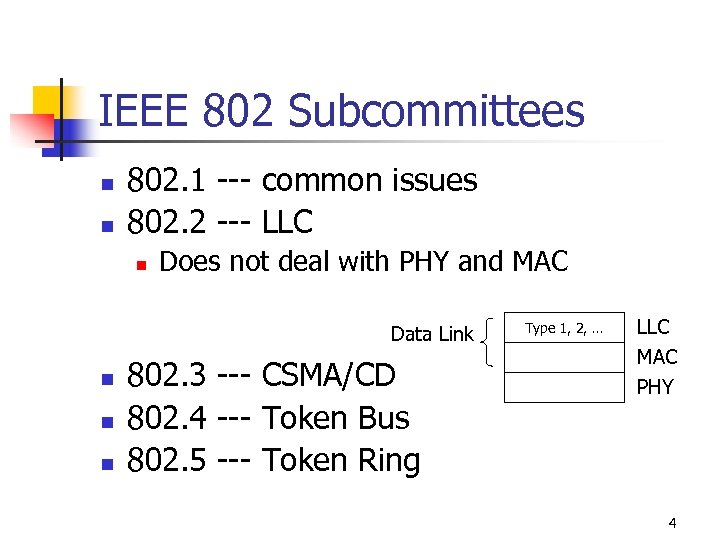 IEEE 802 Subcommittees n n 802. 1 --- common issues 802. 2 --- LLC n Does not deal with PHY and MAC Data Link n n n 802. 3 --- CSMA/CD 802. 4 --- Token Bus 802. 5 --- Token Ring Type 1, 2, … LLC MAC PHY 4
 LAN Addresses n n Most LANs are “broadcast” type LAN addresses solve two problems on shared (or broadcast) LANs n n Who is the sender? Who is the receiver? IEEE 802 standardized the address length Two different lengths were chosen n n 16 bit (unique on the network) --- obsolete 48 bit (unique globally --- plug and play) 5
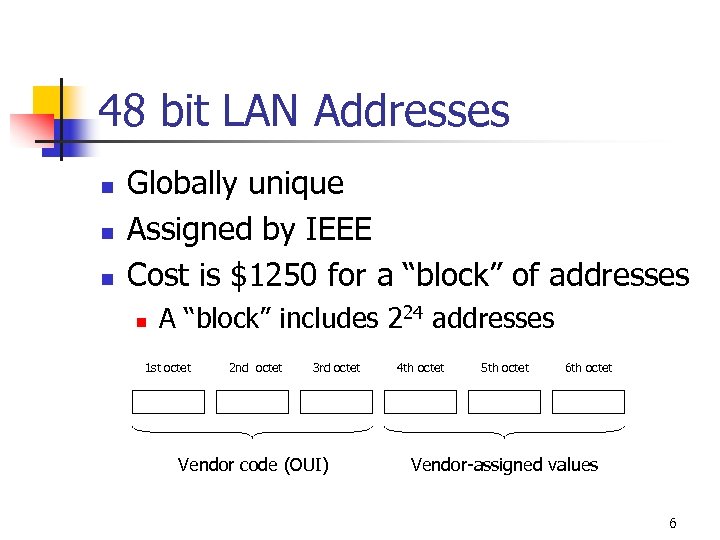 48 bit LAN Addresses n n n Globally unique Assigned by IEEE Cost is $1250 for a “block” of addresses n A “block” includes 224 addresses 1 st octet 2 nd octet 3 rd octet Vendor code (OUI) 4 th octet 5 th octet 6 th octet Vendor-assigned values 6
 48 bit LAN Addresses n OUI = Organizationally unique identifier n n Fixed value assigned by IEEE 224 different possibilities n n Not all of them are used!!! Vendor-assigned Values n n n A total of 224 unique addresses are available by purchasing one block A block may be shared A vendor can buy more blocks with different OUIs 7
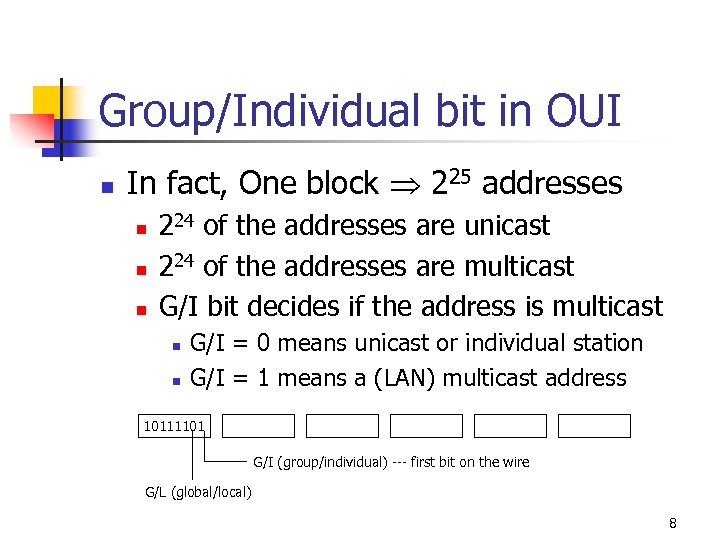 Group/Individual bit in OUI n In fact, One block 225 addresses n n n 224 of the addresses are unicast 224 of the addresses are multicast G/I bit decides if the address is multicast n n G/I = 0 means unicast or individual station G/I = 1 means a (LAN) multicast address 10111101 G/I (group/individual) --- first bit on the wire G/L (global/local) 8
 Global/Local bit in OUI n n Another bit in the OUI is designated by the IEEE as G/L bit IEEE sets G/L = 0 when giving out the blocks of addresses Addresses with G/L = 1 can be used without paying IEEE but the network administrator is responsible to assign addresses such that there is no collision This leaves with 222 unique OUIs 9
 Why multicast addresses? n n In most LANs (e. g. , CSMA/CD LANs), every entity receives all the data on the LAN segment it is connected to Hardware filtering is desirable because promiscuous listening is expensive n n Some entities (e. g. , bridges and LAN monitors) have to listen promiscuously One station will be interested in one unicast address and multiple multicast addresses n n Unicast address is hardwired Multicast addresses fall into hardwired hash buckets 10
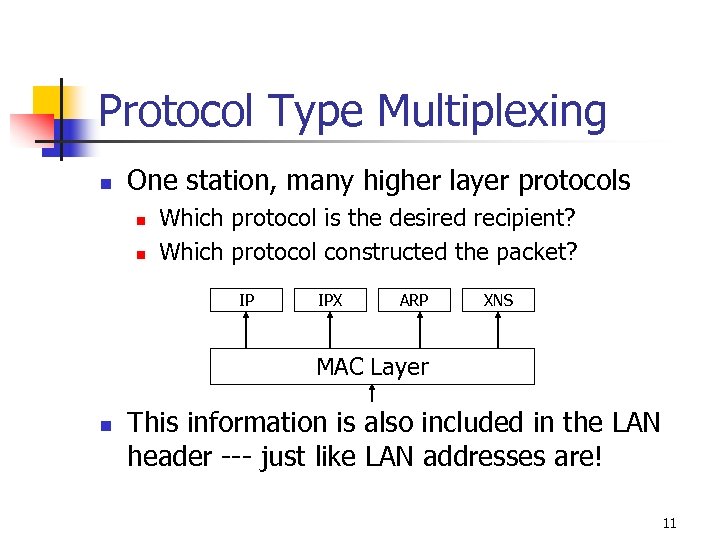 Protocol Type Multiplexing n One station, many higher layer protocols n n Which protocol is the desired recipient? Which protocol constructed the packet? IP IPX ARP XNS MAC Layer n This information is also included in the LAN header --- just like LAN addresses are! 11
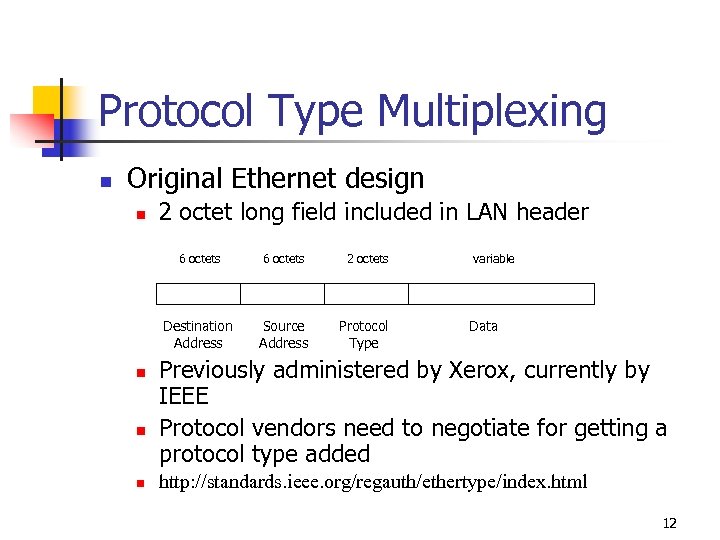 Protocol Type Multiplexing n Original Ethernet design n 2 octet long field included in LAN header 6 octets n n 2 octets Destination Address n 6 octets Source Address Protocol Type variable Data Previously administered by Xerox, currently by IEEE Protocol vendors need to negotiate for getting a protocol type added http: //standards. ieee. org/regauth/ethertype/index. html 12
 SAP Multiplexing n More flexible to have separate source and destination protocol type fields n n Can assign different numbers to the same protocol on different machines Service Access Points (SAPs) n n Included in 802 LAN header SSAP and DSAP n 1 octet each but only 6 bits are used 13
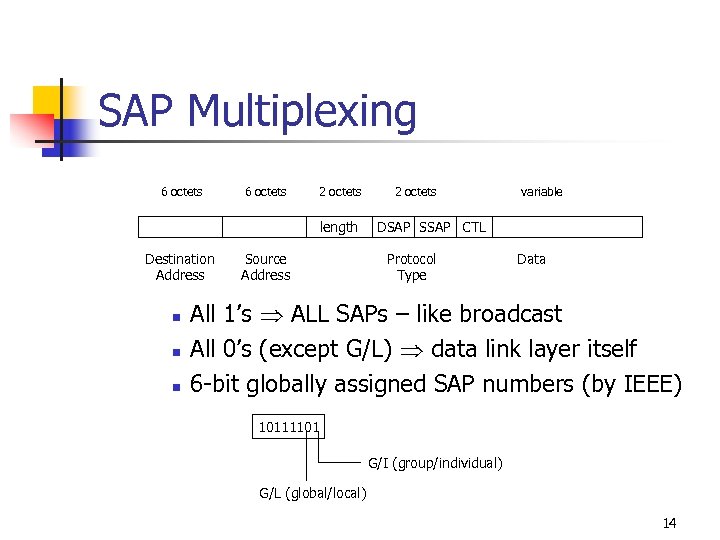 SAP Multiplexing 6 octets 2 octets length Destination Address n n n Source Address 2 octets variable DSAP SSAP CTL Protocol Type Data All 1’s ALL SAPs – like broadcast All 0’s (except G/L) data link layer itself 6 -bit globally assigned SAP numbers (by IEEE) 10111101 G/I (group/individual) G/L (global/local) 14
 SAP Multiplexing n n n G/L bit is similar to the one used in LAN addresses G/I bit --- perhaps to keep compatibility with the LAN addresses? ? ? Only 64 unique SAP protocols are supported n n Strict rules for assigning a SAP number Protocol must be designed by standard bodies 15
 SAP Multiplexing n Local SAP protocols can be used n n Network/Protocol manager’s responsibility to ensure unique SAPs to protocols Conversation startup is difficult n SAP number at the destination machine is not known at the source machine! 16
 SNAP SAP n Subnetwork Access Protocol n n n When DSAP = SNAP SAP n n Single globally assigned SAP value AA hex (1010) --- SNAP SAP Header is expanded to include a “protocol type” field A “longer” protocol type field can then be used n Standardized to 5 octets (see book for reason!) 17
 Transmission Bit Order n 802. 1 defines a canonical format for LAN addresses n n 802. 3 and 802. 4 n n LSB is transmitted first 802. 5 and FDDI n n 00 -60 -1 D-23 -20 -A 9 MSB is transmitted first Internetworking different topologies n Bit order should be shuffled if forwarding frames between incompatible LAN topologies 18
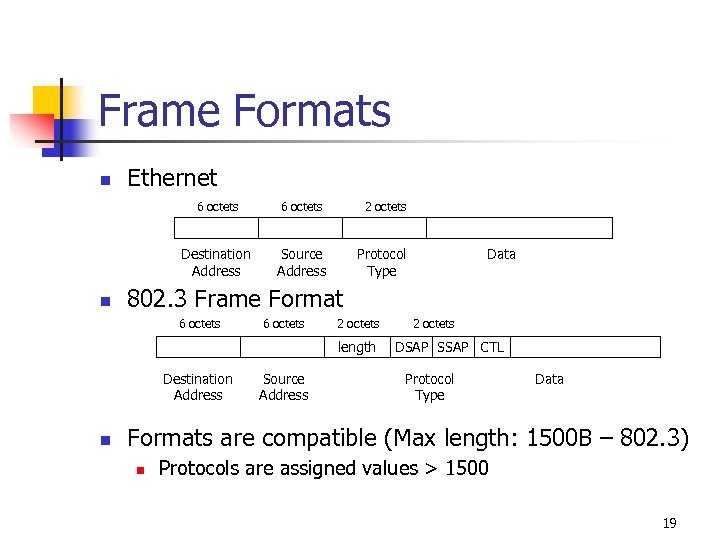 Frame Formats n Ethernet 6 octets 2 octets Destination Address n 6 octets Source Address Protocol Type 802. 3 Frame Format 6 octets 2 octets length Destination Address n Data Source Address 2 octets DSAP SSAP CTL Protocol Type Data Formats are compatible (Max length: 1500 B – 802. 3) n Protocols are assigned values > 1500 19