 Скачать презентацию Lamb Hair Mc Daniel MKTG 2009 -2010 8
9236c71c490dae06eb5d43a41f199c0c.ppt
- Количество слайдов: 66




Lamb, Hair, Mc. Daniel MKTG 2009 -2010 8 Decision Support Systems and Marketing Research CHAPTER Designed by Amy Mc. Guire, B-books, Ltd. Chapter 8 Prepared by Dana Freeman, B-books, Ltd. Copyright © 2010 Cengage Learning Inc. All rights reserved 1
Learning Outcomes LO 1 Explain the concept and purpose of a marketing decision support system LO 2 Define marketing research and explain its importance to marketing decision making LO 3 Describe the steps involved in conducting a marketing research project Chapter 8 Copyright © 2010 Cengage Learning Inc. All rights reserved 2
Learning Outcomes LO 4 Discuss the profound impact of the Internet on marketing research LO 5 Discuss the growing importance of scanner-based research LO 6 Explain the concept of competitive intelligence Chapter 8 Copyright © 2010 Cengage Learning Inc. All rights reserved 3
LO 1 Marketing Decision Support Systems Explain the concept and purpose of a marketing decision support system Chapter 8 Copyright © 2010 Cengage Learning Inc. All rights reserved 4
Marketing Decision Support Systems An interactive, flexible computerized information system that enables managers to obtain and manipulate information as they are making decisions. LO 1 Chapter 8 Copyright © 2010 Cengage Learning Inc. All rights reserved 5
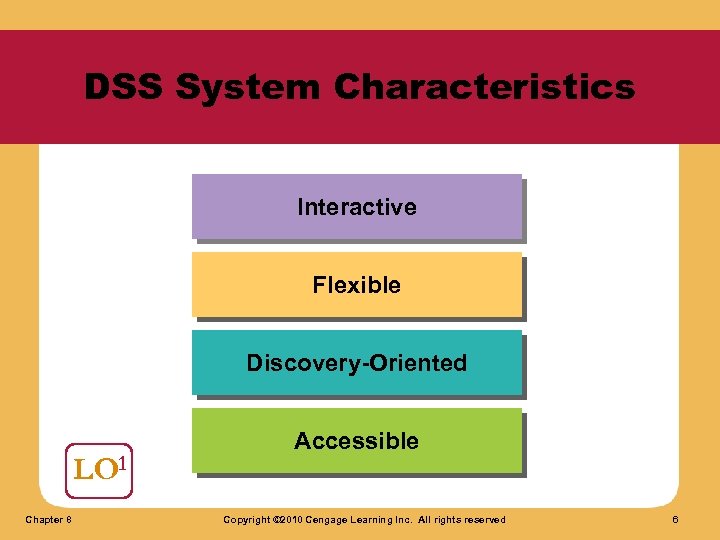
DSS System Characteristics Interactive Flexible Discovery-Oriented LO 1 Chapter 8 Accessible Copyright © 2010 Cengage Learning Inc. All rights reserved 6
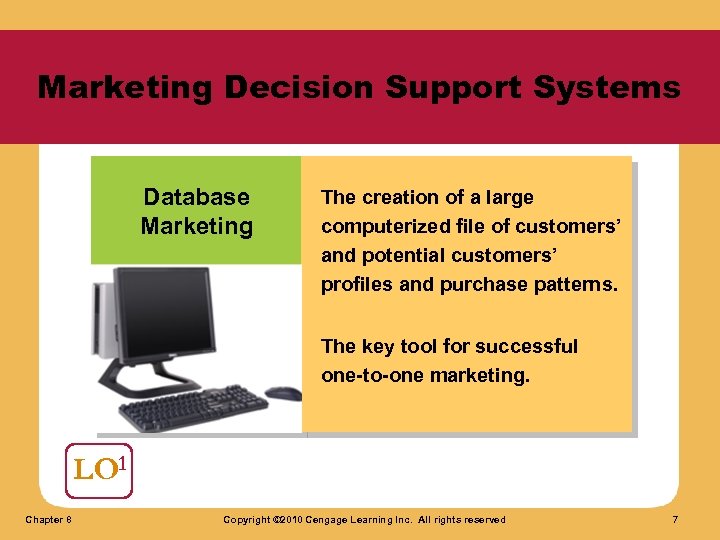
Marketing Decision Support Systems Database Marketing The creation of a large computerized file of customers’ and potential customers’ profiles and purchase patterns. The key tool for successful one-to-one marketing. LO 1 Chapter 8 Copyright © 2010 Cengage Learning Inc. All rights reserved 7
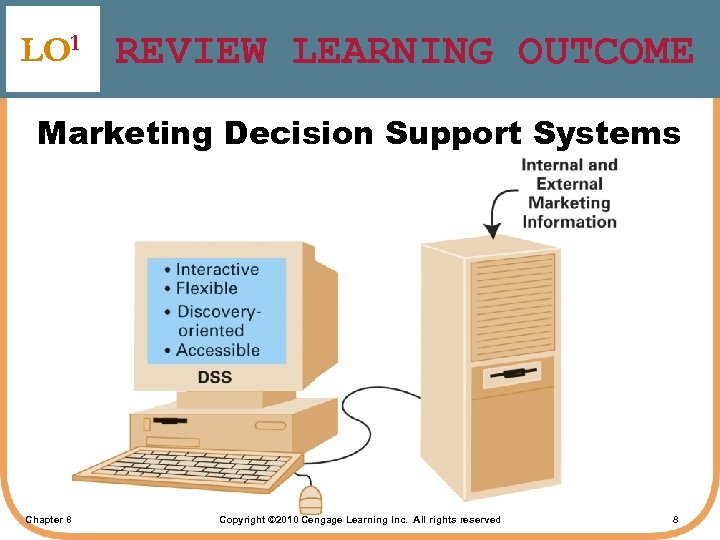
LO 1 REVIEW LEARNING OUTCOME Marketing Decision Support Systems Chapter 8 Copyright © 2010 Cengage Learning Inc. All rights reserved 8
LO 2 The Role of Marketing Research Define marketing research and explain its importance to marketing decision making Chapter 8 Copyright © 2010 Cengage Learning Inc. All rights reserved 9
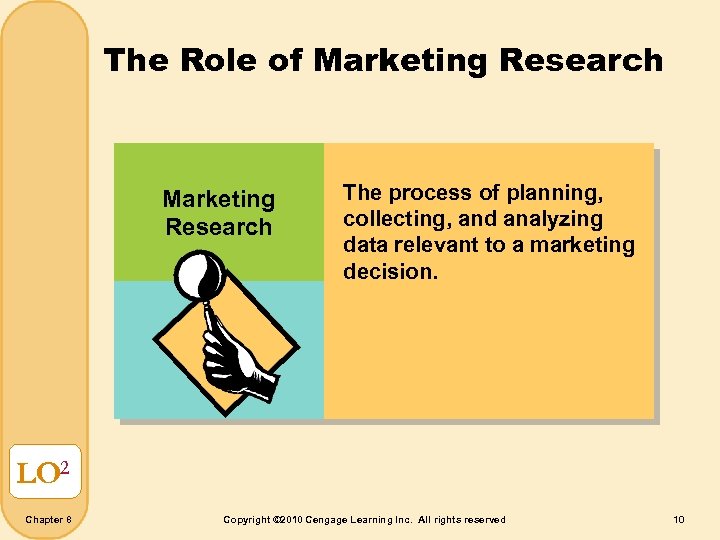
The Role of Marketing Research The process of planning, collecting, and analyzing data relevant to a marketing decision. LO 2 Chapter 8 Copyright © 2010 Cengage Learning Inc. All rights reserved 10
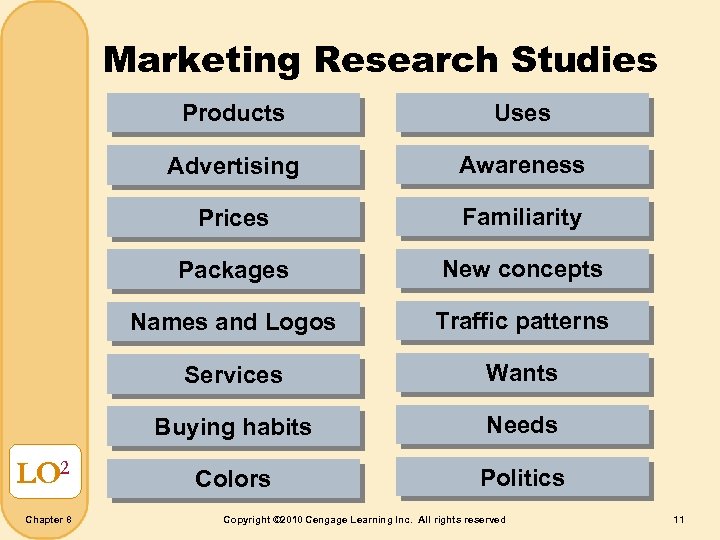
Marketing Research Studies Products Advertising Familiarity Packages New concepts Names and Logos Traffic patterns Services Wants Buying habits Chapter 8 Awareness Prices LO 2 Uses Needs Colors Politics Copyright © 2010 Cengage Learning Inc. All rights reserved 11
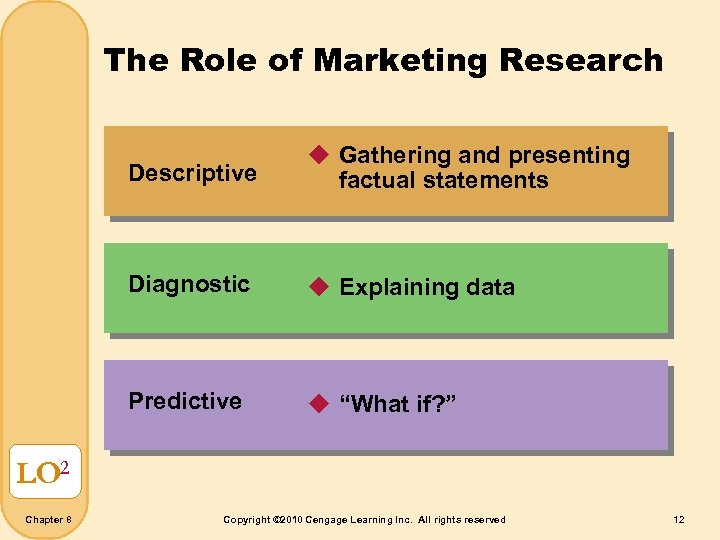
The Role of Marketing Research Descriptive u Gathering and presenting factual statements Diagnostic u Explaining data Predictive u “What if? ” LO 2 Chapter 8 Copyright © 2010 Cengage Learning Inc. All rights reserved 12
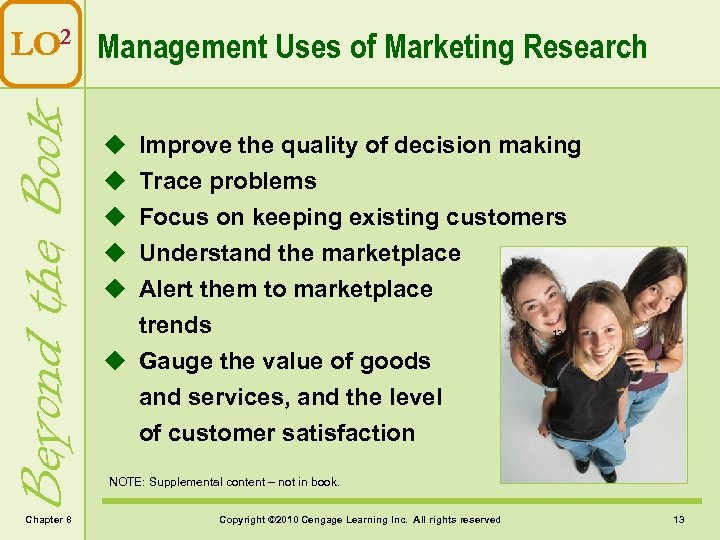
Beyond the Book LO 2 Management Uses of Marketing Research Chapter 8 u u u Improve the quality of decision making Trace problems Focus on keeping existing customers Understand the marketplace Alert them to marketplace trends 13 u Gauge the value of goods and services, and the level of customer satisfaction NOTE: Supplemental content – not in book. Copyright © 2010 Cengage Learning Inc. All rights reserved 13
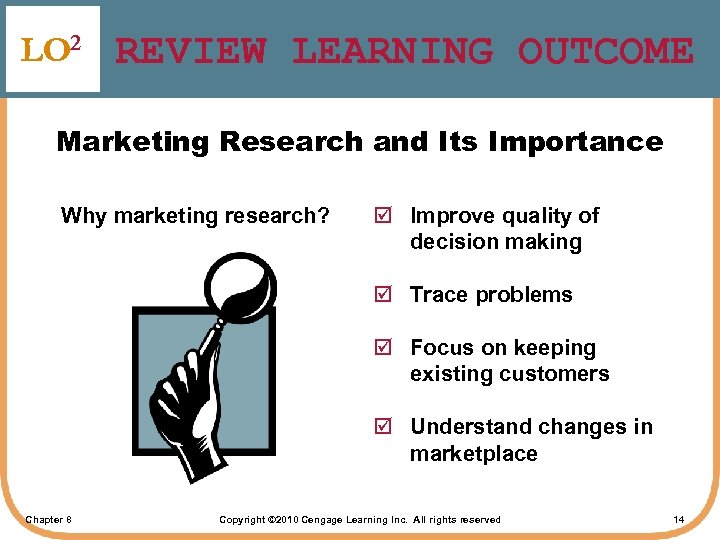
LO 2 REVIEW LEARNING OUTCOME Marketing Research and Its Importance Why marketing research? þ Improve quality of decision making þ Trace problems þ Focus on keeping existing customers þ Understand changes in marketplace Chapter 8 Copyright © 2010 Cengage Learning Inc. All rights reserved 14
LO 3 Steps in a Marketing Research Project Describe the steps involved in conducting a marketing research project Chapter 8 Copyright © 2010 Cengage Learning Inc. All rights reserved 15
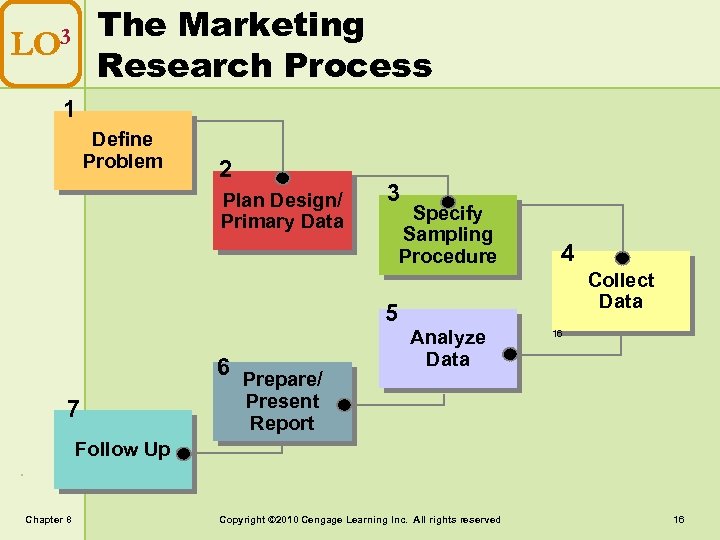
The Marketing Research Process LO 3 1 Define Problem 2 Plan Design/ Primary Data 3 Specify Sampling Procedure 4 Collect Data 5 6 Prepare/ 7 Analyze Data 16 Present Report Follow Up Chapter 8 Copyright © 2010 Cengage Learning Inc. All rights reserved 16
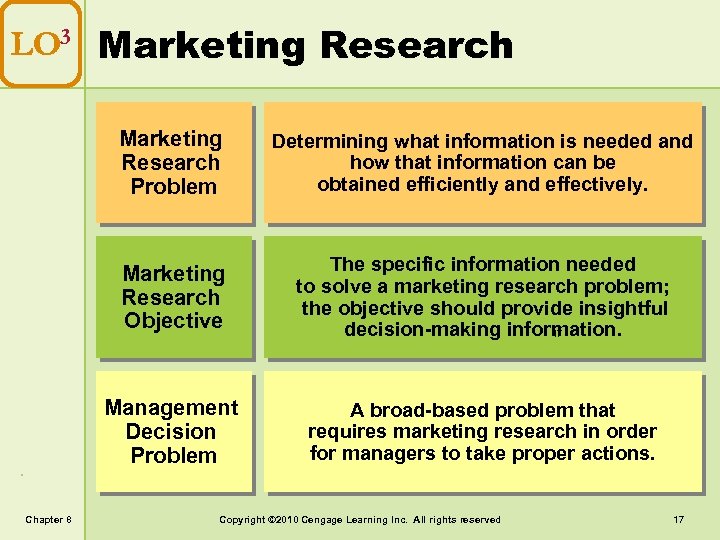
LO 3 Marketing Research Problem Marketing Research Objective The specific information needed to solve a marketing research problem; the objective should provide insightful decision-making information. 17 Management Decision Problem Chapter 8 Determining what information is needed and how that information can be obtained efficiently and effectively. A broad-based problem that requires marketing research in order for managers to take proper actions. Copyright © 2010 Cengage Learning Inc. All rights reserved 17
LO 3 Secondary Data previously collected for any purpose other than the one at hand. 18 Chapter 8 Copyright © 2010 Cengage Learning Inc. All rights reserved 18
LO 3 Sources of Secondary Data Internal Corporate Information Government Agencies Trade and Industry Associations Business Periodicals 19 News Media http: //www. coca-colastore. com Online Chapter 8 Copyright © 2010 Cengage Learning Inc. All rights reserved 19
LO 3 Advantages of Secondary Data u Saves time and money if on target u Aids in determining direction for primary data collection u Pinpoints the kinds of people to approach u Serves as a basis of comparison for other data Chapter 8 Copyright © 2010 Cengage Learning Inc. All rights reserved 20 20
LO 3 Disadvantages of Secondary Data u May not give adequate detailed information u May not be on target with the research problem u Quality and accuracy of data may pose a problem Chapter 8 Copyright © 2010 Cengage Learning Inc. All rights reserved 21 21
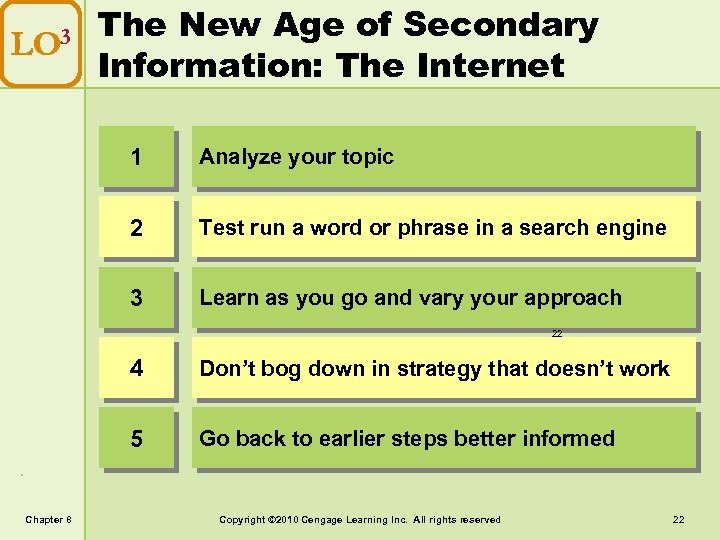
LO 3 The New Age of Secondary Information: The Internet 1 Analyze your topic 2 Test run a word or phrase in a search engine 3 Learn as you go and vary your approach 22 4 5 Chapter 8 Don’t bog down in strategy that doesn’t work Go back to earlier steps better informed Copyright © 2010 Cengage Learning Inc. All rights reserved 22
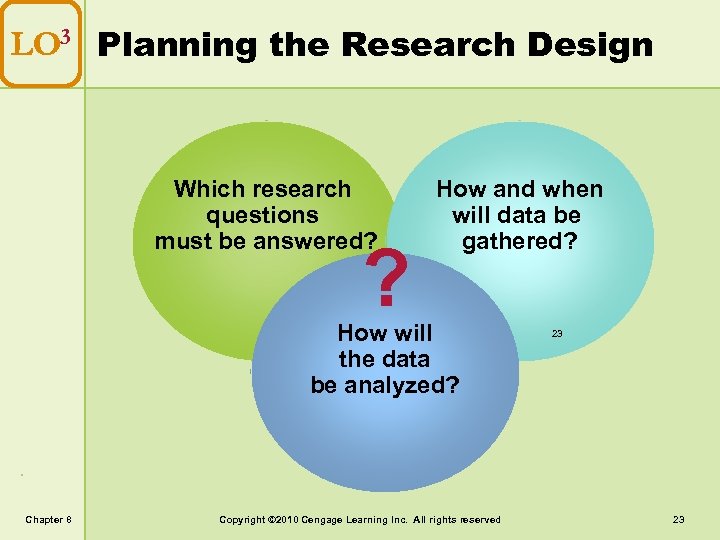
LO 3 Planning the Research Design Which research questions must be answered? ? How and when will data be gathered? How will the data be analyzed? Chapter 8 Copyright © 2010 Cengage Learning Inc. All rights reserved 23 23
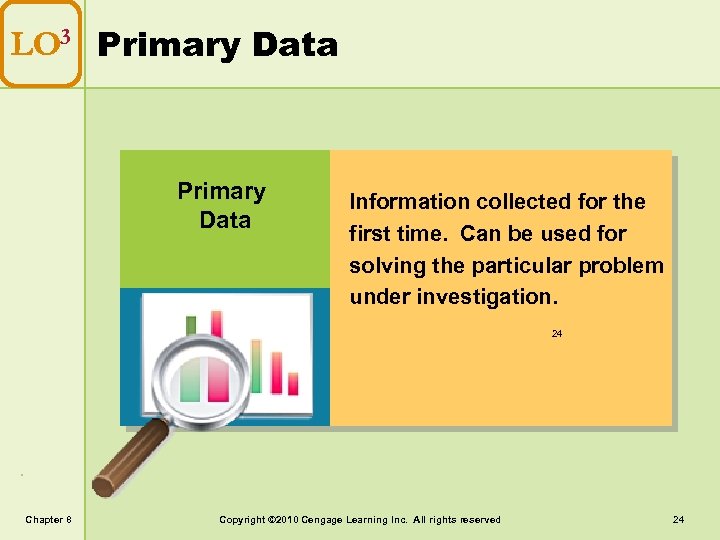
LO 3 Primary Data Information collected for the first time. Can be used for solving the particular problem under investigation. 24 Chapter 8 Copyright © 2010 Cengage Learning Inc. All rights reserved 24
LO 3 Advantages of Primary Data u Answers a specific research question u Data are current u Source of data is known u Secrecy can be maintained Chapter 8 Copyright © 2010 Cengage Learning Inc. All rights reserved 25 25
LO 3 Disadvantages of Primary Data u Expensive u “Piggybacking” may confuse respondents u Quality declines if interviews are lengthy u Reluctance to participate in lengthy interviews Chapter 8 Disadvantages are usually offset by the advantages of primary data. Copyright © 2010 Cengage Learning Inc. All rights reserved 26 26
LO 3 Survey Research 27 The most popular technique for gathering primary data in which a researcher interacts with people to obtain facts, opinions, and attitudes. Chapter 8 Copyright © 2010 Cengage Learning Inc. All rights reserved 27
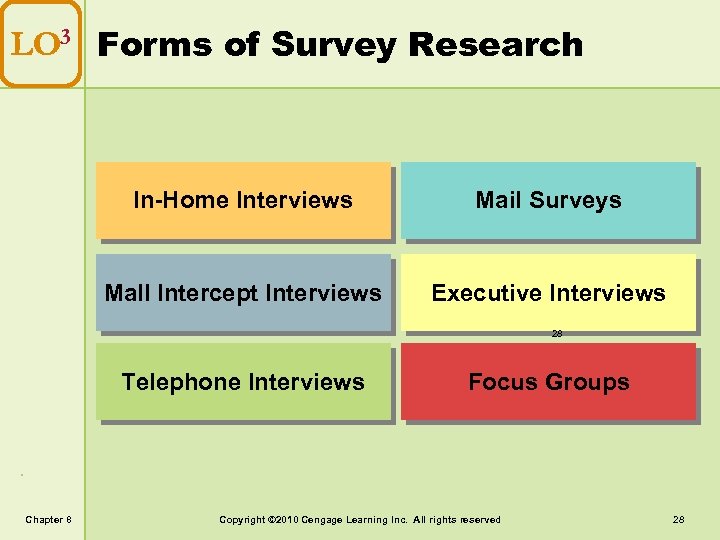
LO 3 Forms of Survey Research In-Home Interviews Mail Surveys Mall Intercept Interviews Executive Interviews 28 Telephone Interviews Chapter 8 Focus Groups Copyright © 2010 Cengage Learning Inc. All rights reserved 28
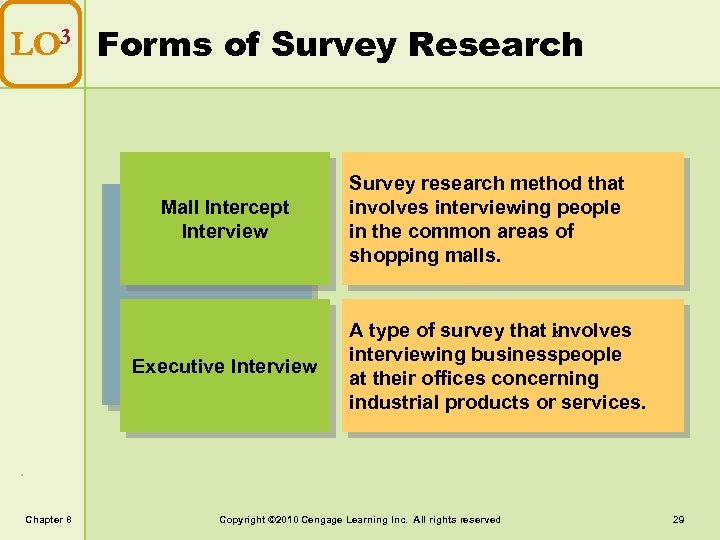
LO 3 Forms of Survey Research Mall Intercept Interview Executive Interview Chapter 8 Survey research method that involves interviewing people in the common areas of shopping malls. A type of survey that 29 involves interviewing businesspeople at their offices concerning industrial products or services. Copyright © 2010 Cengage Learning Inc. All rights reserved 29
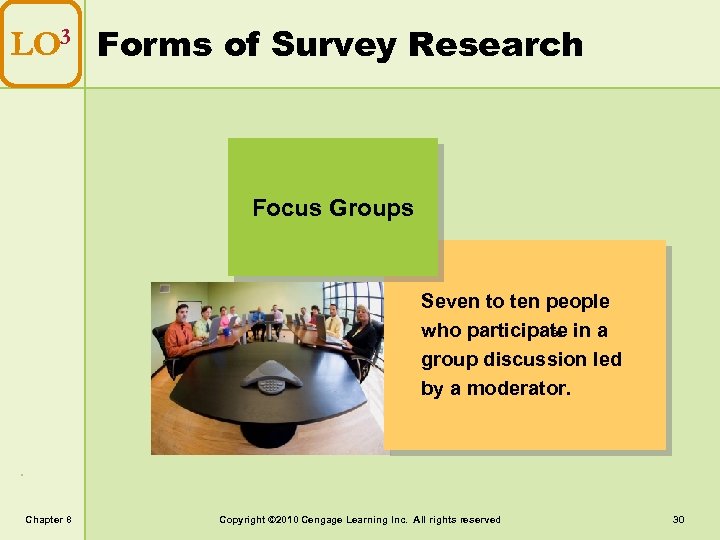
LO 3 Forms of Survey Research Focus Groups Seven to ten people who participate in a 30 group discussion led by a moderator. Chapter 8 Copyright © 2010 Cengage Learning Inc. All rights reserved 30
LO 3 Questionnaire Design Open-Ended Question An interview question that encourages an answer phrased in respondent’s own words. Closed-Ended Question An interview question that asks the respondent to make a selection from a limited list of responses. 31 Scaled. Response Question Chapter 8 A closed-ended question designed to measure the intensity of a respondent’s answer. Copyright © 2010 Cengage Learning Inc. All rights reserved 31
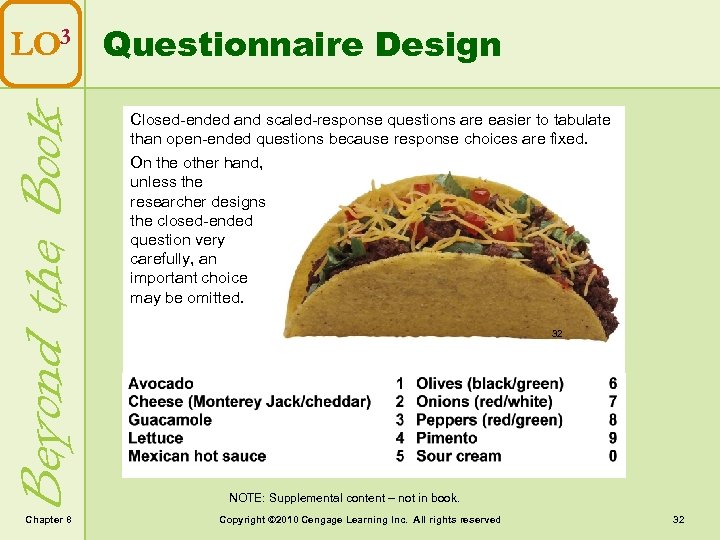
Beyond the Book LO 3 Questionnaire Design Chapter 8 Closed-ended and scaled-response questions are easier to tabulate than open-ended questions because response choices are fixed. On the other hand, unless the researcher designs the closed-ended question very carefully, an important choice may be omitted. 32 NOTE: Supplemental content – not in book. Copyright © 2010 Cengage Learning Inc. All rights reserved 32
LO 3 Questionnaire Design Clear and concise No ambiguous language Only one question Unbiased 33 Reasonable terminology http: //www. createsurvey. com Online Chapter 8 Copyright © 2010 Cengage Learning Inc. All rights reserved 33
LO 3 Observation Research A research method that relies on three types of observation: 34 people watching people Ø people watching an activity Ø machines watching people Ø Chapter 8 Copyright © 2010 Cengage Learning Inc. All rights reserved 34
LO 3 Observational Situations Situation Example Chapter 8 People watching people People watching phenomena Machines watching people Machines watching phenomena Mystery shoppers in a supermarket Observer at an intersection counting traffic Video cameras 35 recording behavior Trafficcounting machine monitoring traffic flow Copyright © 2010 Cengage Learning Inc. All rights reserved 35
LO 3 Ethnographic Research The study of human behavior in its natural context; involves observation of behavior and 36 physical setting. Chapter 8 Copyright © 2010 Cengage Learning Inc. All rights reserved 36
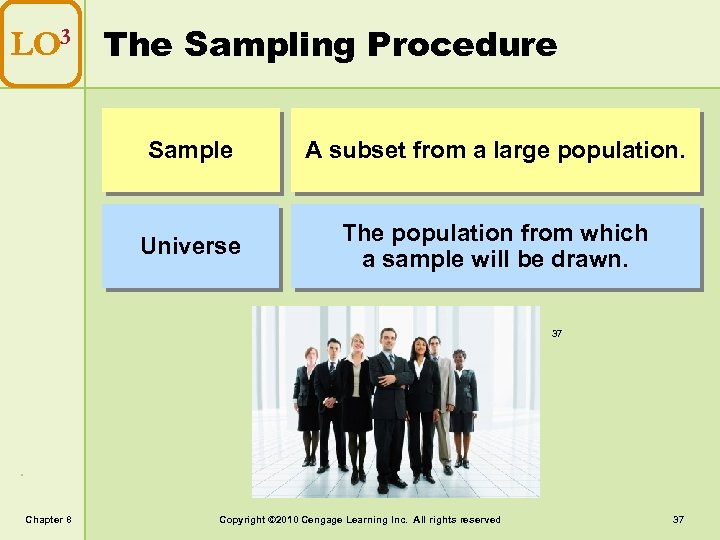
LO 3 The Sampling Procedure Sample A subset from a large population. Universe The population from which a sample will be drawn. 37 Chapter 8 Copyright © 2010 Cengage Learning Inc. All rights reserved 37
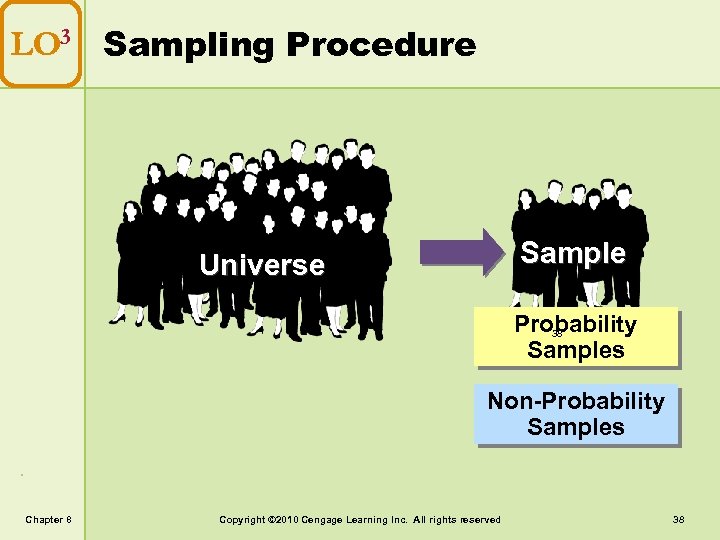
LO 3 Sampling Procedure Sample Universe Probability 38 Samples Non-Probability Samples Chapter 8 Copyright © 2010 Cengage Learning Inc. All rights reserved 38
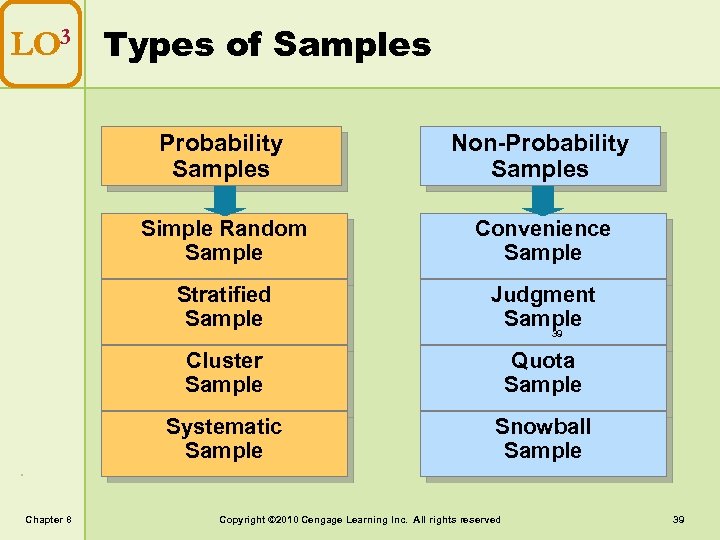
LO 3 Types of Samples Probability Samples Simple Random Sample Convenience Sample Stratified Sample Judgment Sample Cluster Sample Quota Sample Systematic Sample Chapter 8 Non-Probability Samples Snowball Sample 39 Copyright © 2010 Cengage Learning Inc. All rights reserved 39
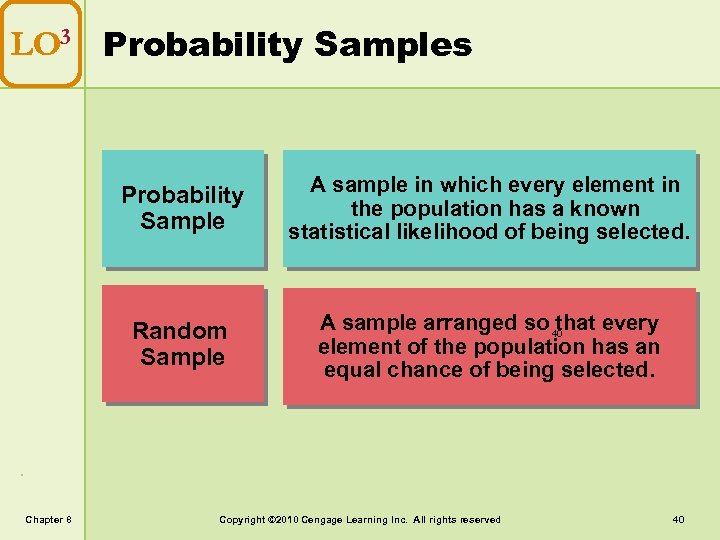
LO 3 Probability Samples Probability Sample Random Sample Chapter 8 A sample in which every element in the population has a known statistical likelihood of being selected. A sample arranged so 40 that every element of the population has an equal chance of being selected. Copyright © 2010 Cengage Learning Inc. All rights reserved 40
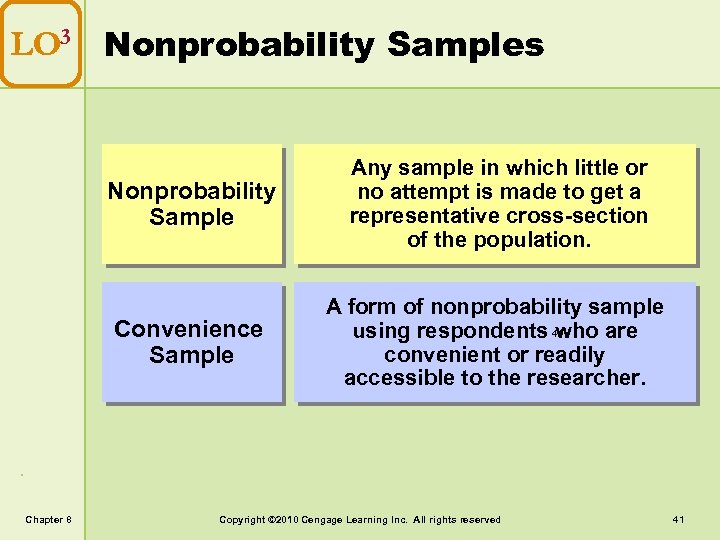
LO 3 Nonprobability Samples Nonprobability Sample Convenience Sample Chapter 8 Any sample in which little or no attempt is made to get a representative cross-section of the population. A form of nonprobability sample using respondents 41 who are convenient or readily accessible to the researcher. Copyright © 2010 Cengage Learning Inc. All rights reserved 41
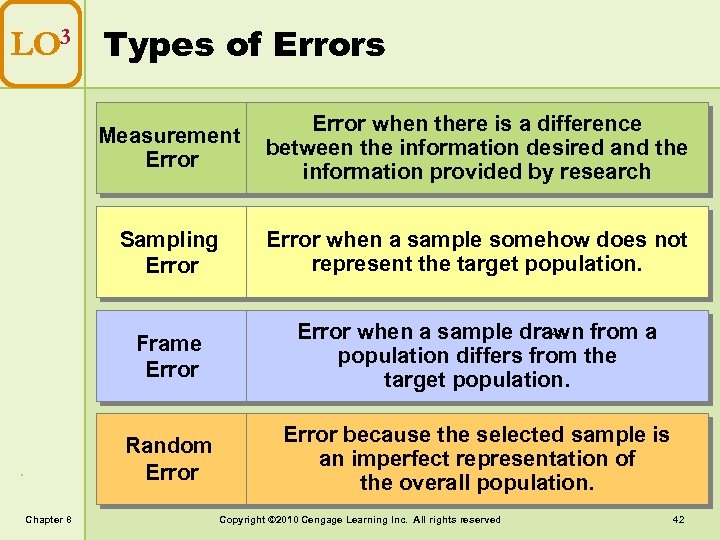
LO 3 Types of Errors Measurement Error Sampling Error when a sample somehow does not represent the target population. Frame Error 42 Error when a sample drawn from a population differs from the target population. Random Error Chapter 8 Error when there is a difference between the information desired and the information provided by research Error because the selected sample is an imperfect representation of the overall population. Copyright © 2010 Cengage Learning Inc. All rights reserved 42
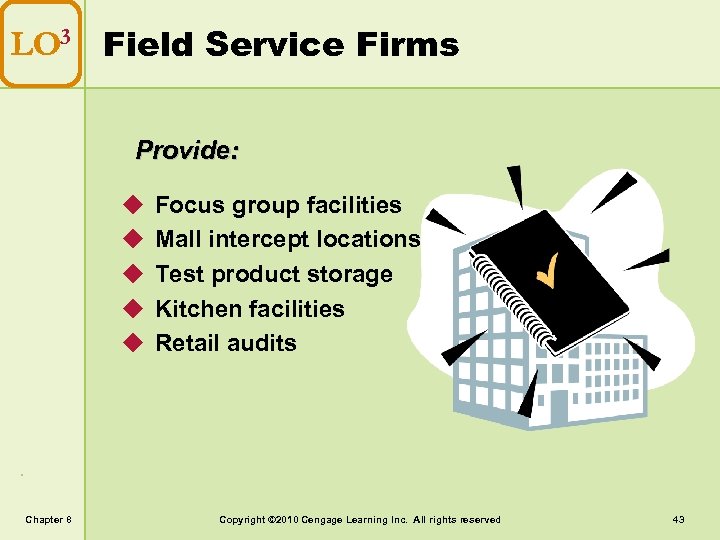
LO 3 Field Service Firms Provide: u u u Chapter 8 Focus group facilities Mall intercept locations Test product storage Kitchen facilities Retail audits Copyright © 2010 Cengage Learning Inc. All rights reserved 43 43
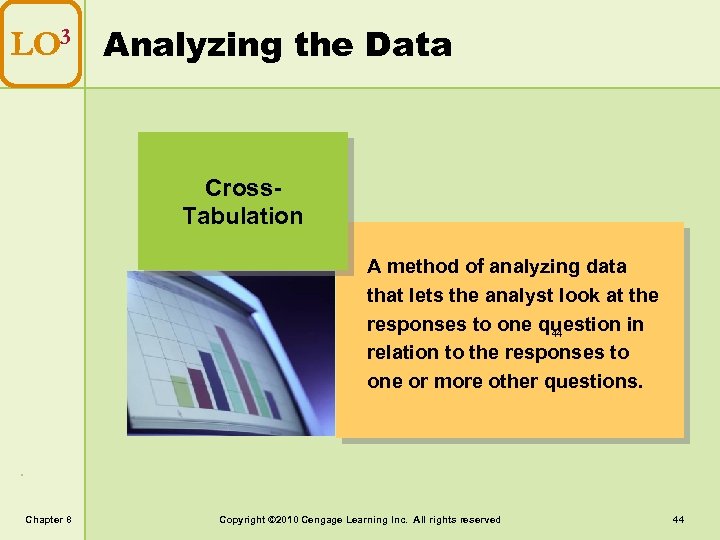
LO 3 Analyzing the Data Cross. Tabulation A method of analyzing data that lets the analyst look at the responses to one question in 44 relation to the responses to one or more other questions. Chapter 8 Copyright © 2010 Cengage Learning Inc. All rights reserved 44
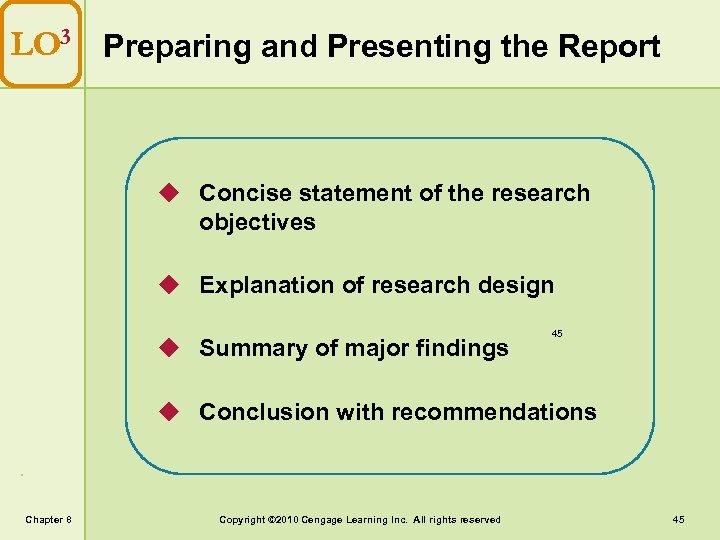
LO 3 Preparing and Presenting the Report u Concise statement of the research objectives u Explanation of research design u Summary of major findings 45 u Conclusion with recommendations Chapter 8 Copyright © 2010 Cengage Learning Inc. All rights reserved 45
LO 3 Following Up u Were the recommendations followed? u Was sufficient decision-making information included in the report? 46 u What could have been done to make the report more useful to management? Chapter 8 Copyright © 2010 Cengage Learning Inc. All rights reserved 46
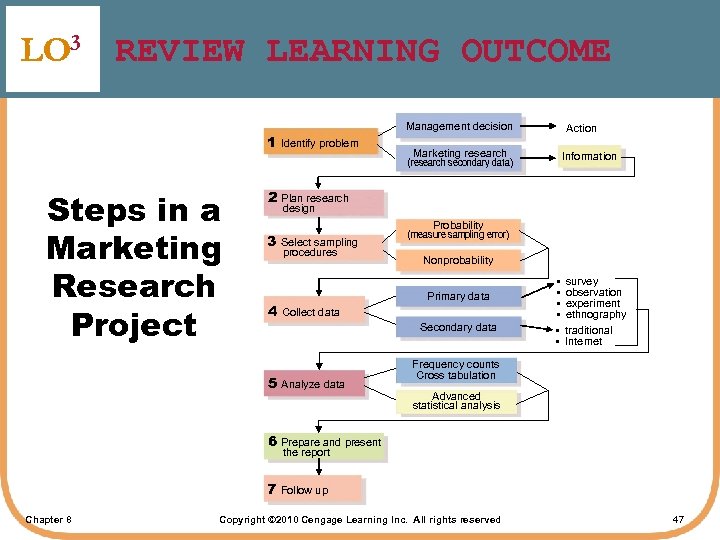
LO 3 REVIEW LEARNING OUTCOME 1 Identify problem Steps in a Marketing Research Project Management decision Action Marketing research (research secondary data) Information 2 Plan research design 3 Select sampling procedures 4 Collect data Probability (measure sampling error) Nonprobability Primary data Secondary data 5 Analyze data • • • survey observation experiment ethnography traditional Internet Frequency counts Cross tabulation Advanced statistical analysis 6 Prepare and present the report 7 Follow up Chapter 8 Copyright © 2010 Cengage Learning Inc. All rights reserved 47

LO 4 Impact of the Internet on Marketing Research Discuss the profound impact of the Internet on marketing research Chapter 8 Copyright © 2010 Cengage Learning Inc. All rights reserved 48
Impact of the Internet u Allows better and faster decision making u Improves ability to respond quickly to customer needs and market shifts u Makes follow-up studies and tracking research easier u Slashes labor- and time-intensive research activities and costs LO 4 Chapter 8 Copyright © 2010 Cengage Learning Inc. All rights reserved 49
Advantages of Internet Surveys Rapid development, Real-time reporting Reduced costs Personalized questions and data Improved respondent participation LO 4 Chapter 8 Contact with the hard-to-reach Copyright © 2010 Cengage Learning Inc. All rights reserved 50
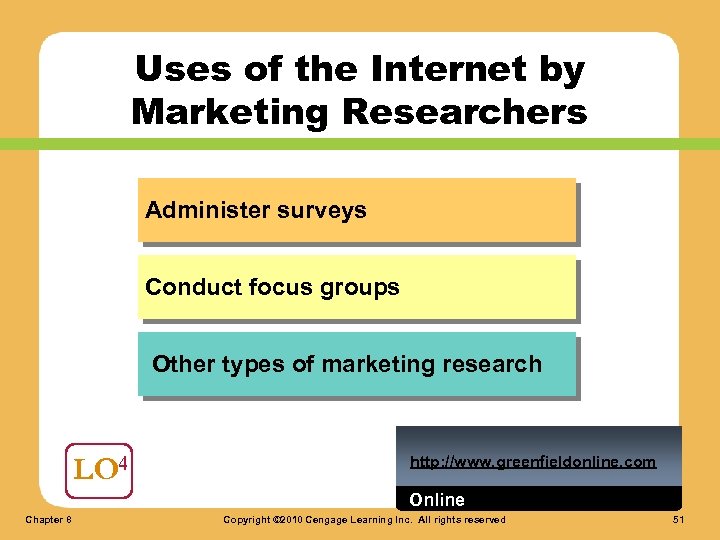
Uses of the Internet by Marketing Researchers Administer surveys Conduct focus groups Other types of marketing research LO 4 http: //www. greenfieldonline. com Online Chapter 8 Copyright © 2010 Cengage Learning Inc. All rights reserved 51
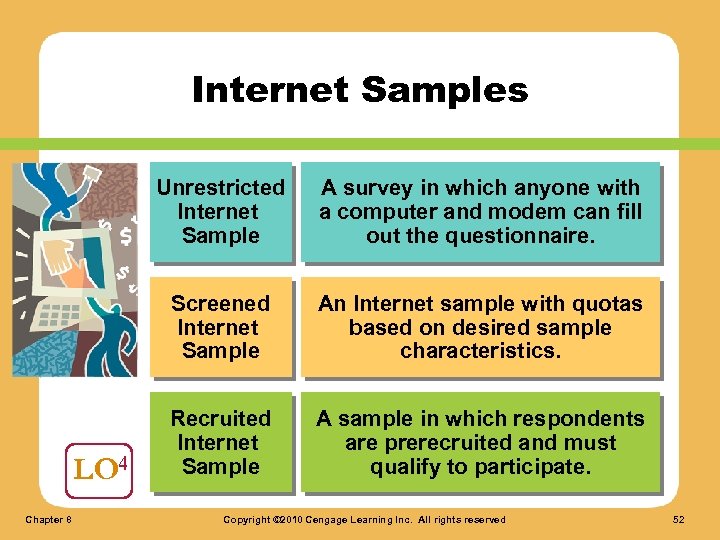
Internet Samples Unrestricted Internet Sample Screened Internet Sample LO 4 Chapter 8 A survey in which anyone with a computer and modem can fill out the questionnaire. An Internet sample with quotas based on desired sample characteristics. Recruited Internet Sample A sample in which respondents are prerecruited and must qualify to participate. Copyright © 2010 Cengage Learning Inc. All rights reserved 52
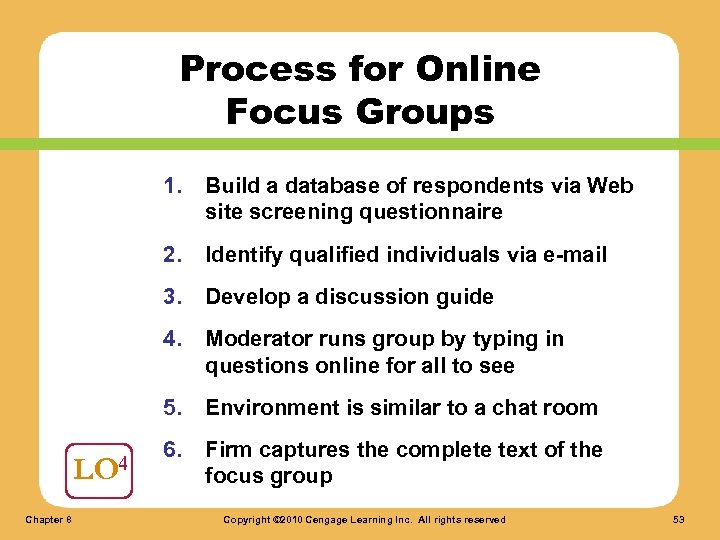
Process for Online Focus Groups 1. 2. Develop a discussion guide 4. Moderator runs group by typing in questions online for all to see 5. Chapter 8 Identify qualified individuals via e-mail 3. LO 4 Build a database of respondents via Web site screening questionnaire Environment is similar to a chat room 6. Firm captures the complete text of the focus group Copyright © 2010 Cengage Learning Inc. All rights reserved 53
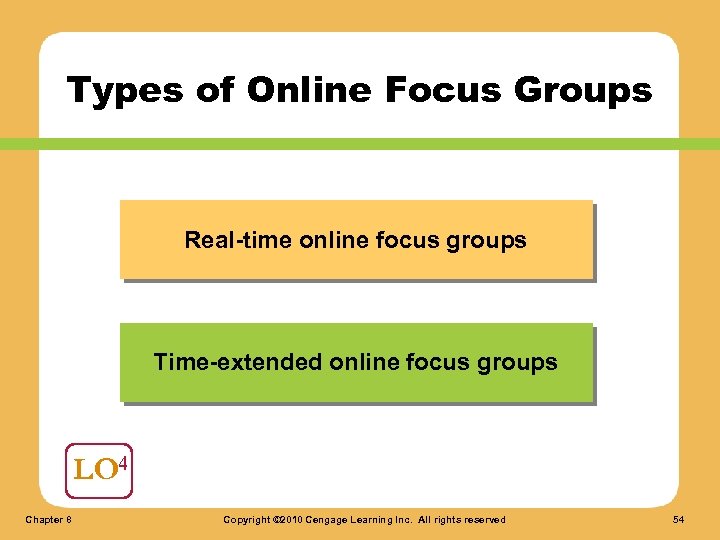
Types of Online Focus Groups Real-time online focus groups Time-extended online focus groups LO 4 Chapter 8 Copyright © 2010 Cengage Learning Inc. All rights reserved 54
Advantages of Online Focus Groups u u u Speed Cost-effectiveness Broad geographic scope Accessibility Honesty LO 4 Chapter 8 Copyright © 2010 Cengage Learning Inc. All rights reserved 55
Role of Blogs in Marketing Research u Refined technologies allow companies to mine data available in Internet blogs. u Companies can identify the most influential bloggers and learn exactly what they are saying (and how they are saying it). LO 4 Chapter 8 Copyright © 2010 Cengage Learning Inc. All rights reserved 56
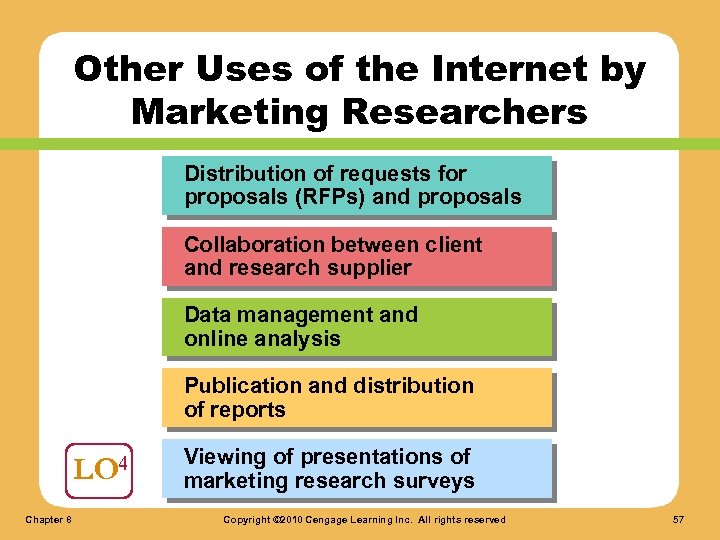
Other Uses of the Internet by Marketing Researchers Distribution of requests for proposals (RFPs) and proposals Collaboration between client and research supplier Data management and online analysis Publication and distribution of reports LO 4 Chapter 8 Viewing of presentations of marketing research surveys Copyright © 2010 Cengage Learning Inc. All rights reserved 57
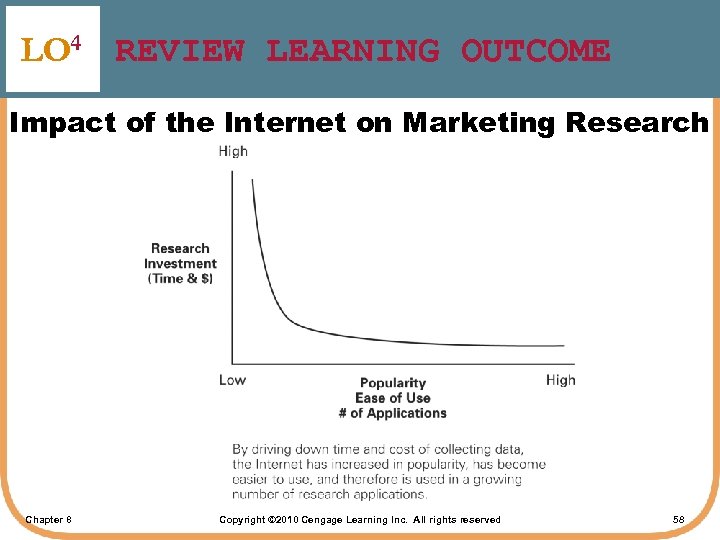
LO 4 REVIEW LEARNING OUTCOME Impact of the Internet on Marketing Research Chapter 8 Copyright © 2010 Cengage Learning Inc. All rights reserved 58
LO 5 Scanner-Based Research Discuss the growing importance of scanner-based research Chapter 8 Copyright © 2010 Cengage Learning Inc. All rights reserved 59
Scanner-Based Research A system for gathering information Scanner-based Research from a single group of respondents by continuously monitoring the advertising, promotion, and pricing they are exposed to and the things they buy. Behavior. Scan Info. Scan LO 5 Chapter 8 Copyright © 2010 Cengage Learning Inc. All rights reserved 60
When Should Marketing Research Be Conducted? u Where there is a high level of uncertainty u When value of research information exceeds the cost of generating the information LO 5 Chapter 8 Copyright © 2010 Cengage Learning Inc. All rights reserved 61
LO 5 REVIEW LEARNING OUTCOME Scanner-Based Research Behavior. Scan Panel information from Specific groups of people, enables researchers to manipulate variables and see real results Chapter 8 Info. Scan Aggregate consumer information on all bar-coded products Copyright © 2010 Cengage Learning Inc. All rights reserved 62
LO 6 Competitive Intelligence Explain the concept of competitive intelligence Chapter 8 Copyright © 2010 Cengage Learning Inc. All rights reserved 63
LO 6 Competitive Intelligence An intelligence system that helps managers assess their competition and vendors in order to become more efficient and effective competitors. 64 http: //www. scip. org Online Chapter 8 Copyright © 2010 Cengage Learning Inc. All rights reserved 64
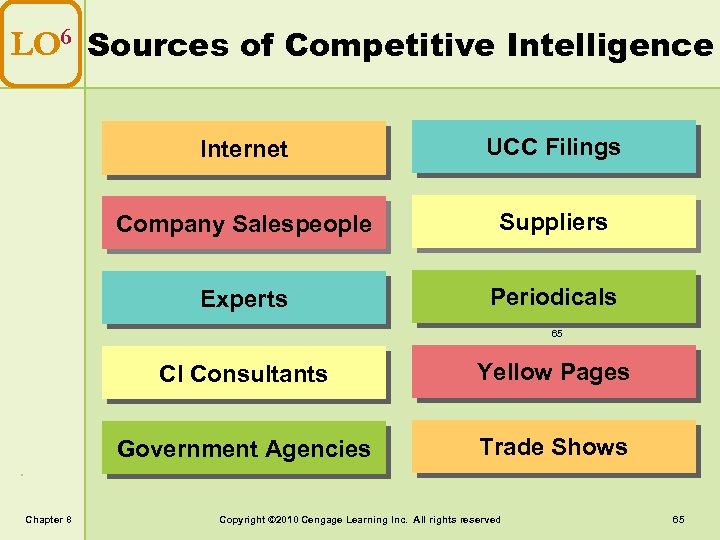
LO 6 Sources of Competitive Intelligence Internet UCC Filings Company Salespeople Suppliers Experts Periodicals 65 CI Consultants Government Agencies Chapter 8 Yellow Pages Trade Shows Copyright © 2010 Cengage Learning Inc. All rights reserved 65
LO 6 REVIEW LEARNING OUTCOME Competitive Intelligence CI Part of a sound marketing strategy Helps companies respond to competitive threats Helps reduce unnecessary costs Chapter 8 Copyright © 2010 Cengage Learning Inc. All rights reserved 66
Скачать презентацию Lamb Hair Mc Daniel MKTG 2009 -2010 8
9236c71c490dae06eb5d43a41f199c0c.ppt