


 Скачать презентацию Lake Victoria City Development Strategies CDS for Improved
5cc6929cc7a56594091628b0de8f2a00.ppt
- Количество слайдов: 15
 Lake Victoria City Development Strategies (CDS) for Improved Urban Environment and Poverty Reduction
 Lake Victoria City Development Strategies (CDS) p Socioeconomic future of nations increasingly determined in urban areas p Global process of decentralization shifting power & resources to cities and citizens p Quality of urban governance differentiates declining cities from prosperous ones p CDS is an initiative of UN-HABITAT with support from SIDA p Support for urban development and environment is priority area for Sida p Bukoba, Entebbe, Homa Bay, Kampala, Kisumu, and Musoma council’s are implementers p UN-HABITAT working in partnership with cities to improve opportunities for all citizens in an inclusive manner esp. urban poor and women ¨ CDS goal - collective city vision and action plan to improve urban governance and management, increase investment to expand employment and services, and systematic and sustained reductions in urban poverty ¨ CDS applied in Asia, Africa, Europe and L. America(160 cities worldwide
 Lake Victoria City Development Strategies (CDS) p CDS aim is to mobilize city authorities and stakeholders in Lake region to develop a programme for laying out City Development Strategies. p The strategies uphold popular, private and public participation and decision-making in efforts to improve the living conditions and environment for urban dwellers. p Lake Victoria is 2 nd largest fresh water body shared by Kenya (6%), Tanzania (49%) and Uganda (45%) p 1/3 of combined population of Kenya, Tanzania and Uganda derive livelihood from the lake through fishing and agriculture. p Lake represents important economic resource for the region which can only be sustained if the lake's rich and diverse ecosystem is well managed.
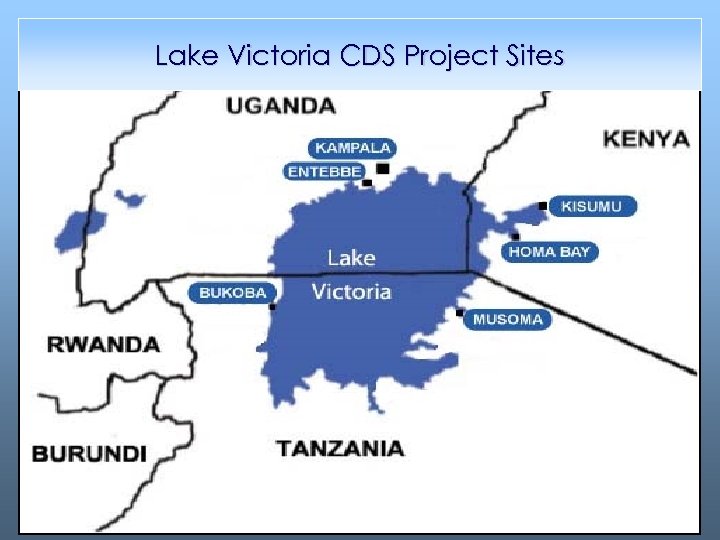 Lake Victoria CDS Project Sites
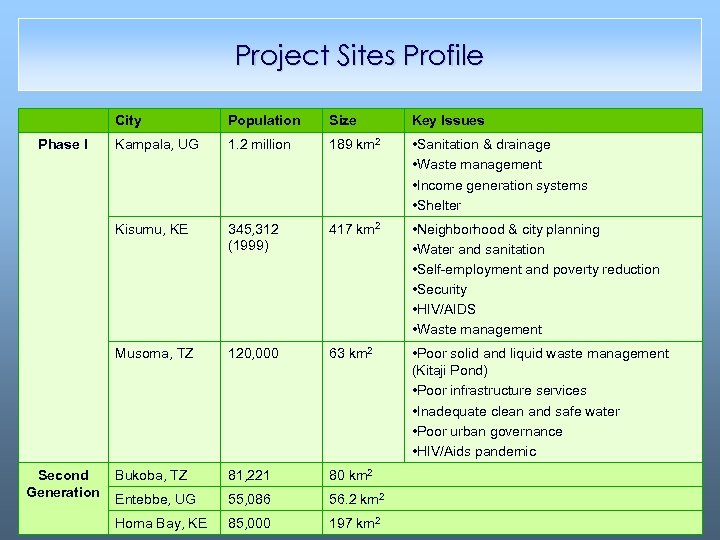 Project Sites Profile City Key Issues Kampala, UG 1. 2 million 189 km 2 • Sanitation & drainage • Waste management • Income generation systems • Shelter 345, 312 (1999) 417 km 2 • Neighborhood & city planning • Water and sanitation • Self-employment and poverty reduction • Security • HIV/AIDS • Waste management Musoma, TZ Second Generation Size Kisumu, KE Phase I Population 120, 000 63 km 2 • Poor solid and liquid waste management (Kitaji Pond) • Poor infrastructure services • Inadequate clean and safe water • Poor urban governance • HIV/Aids pandemic Bukoba, TZ 81, 221 80 km 2 Entebbe, UG 55, 086 56. 2 km 2 Homa Bay, KE 85, 000 197 km 2
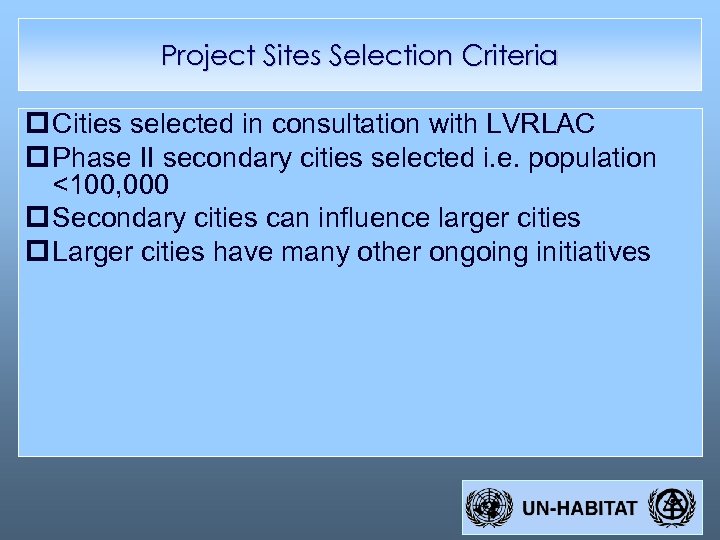 Project Sites Selection Criteria p Cities selected in consultation with LVRLAC p Phase II secondary cities selected i. e. population <100, 000 p Secondary cities can influence larger cities p Larger cities have many other ongoing initiatives
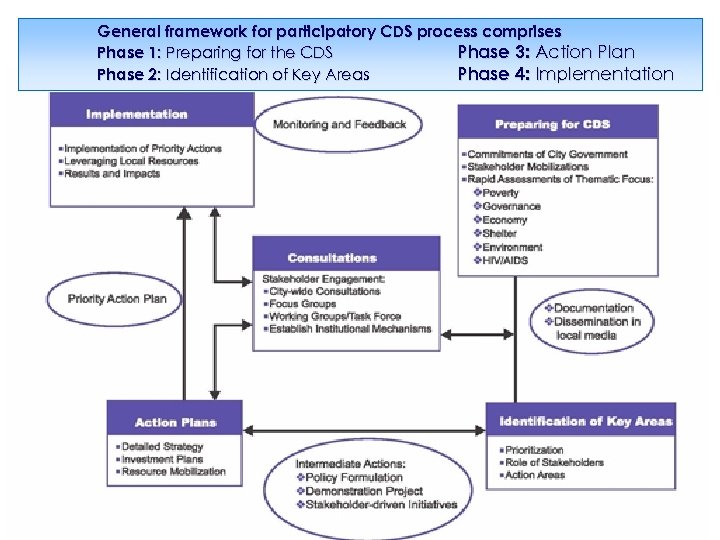 General framework for participatory CDS process comprises Phase 1: Preparing for the CDS Phase 3: Action Plan Phase 2: Identification of Key Areas Phase 4: Implementation
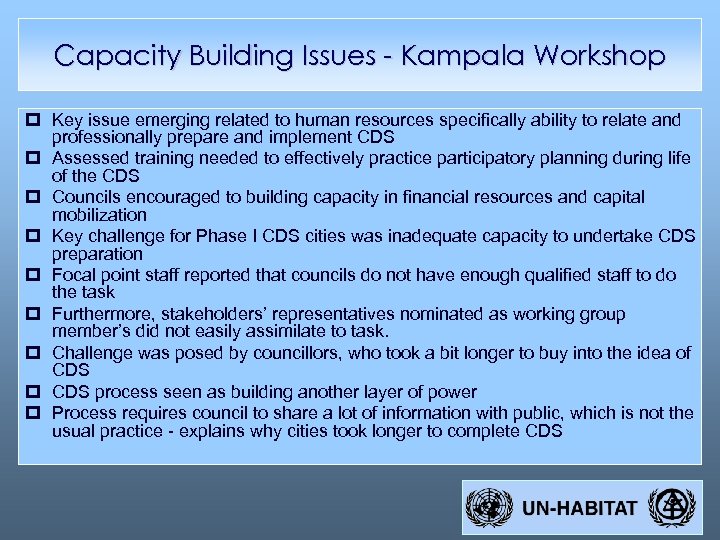 Capacity Building Issues - Kampala Workshop p Key issue emerging related to human resources specifically ability to relate and professionally prepare and implement CDS p Assessed training needed to effectively practice participatory planning during life of the CDS p Councils encouraged to building capacity in financial resources and capital mobilization p Key challenge for Phase I CDS cities was inadequate capacity to undertake CDS preparation p Focal point staff reported that councils do not have enough qualified staff to do the task p Furthermore, stakeholders’ representatives nominated as working group member’s did not easily assimilate to task. p Challenge was posed by councillors, who took a bit longer to buy into the idea of CDS process seen as building another layer of power p Process requires council to share a lot of information with public, which is not the usual practice - explains why cities took longer to complete CDS
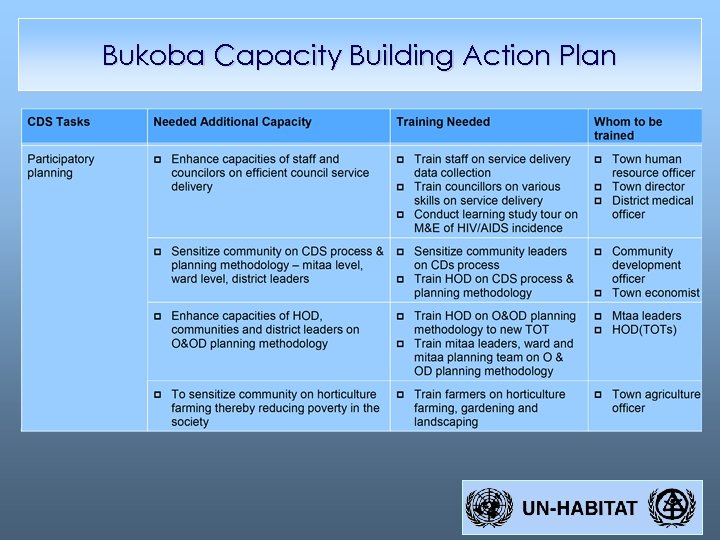 Bukoba Capacity Building Action Plan
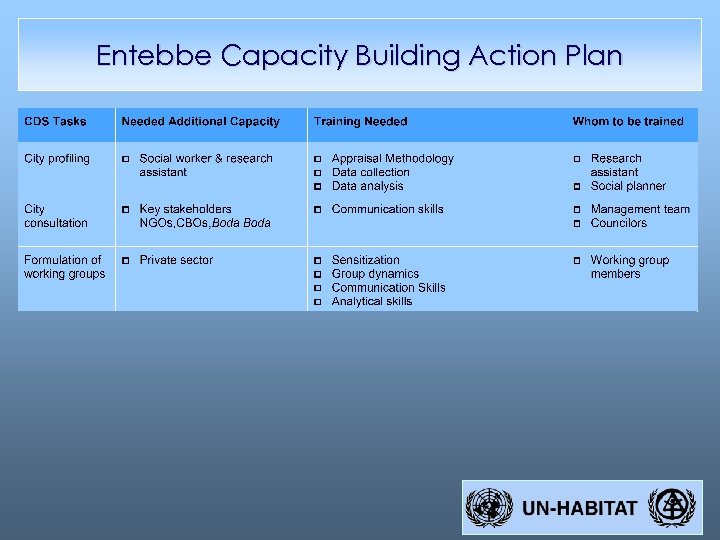 Entebbe Capacity Building Action Plan
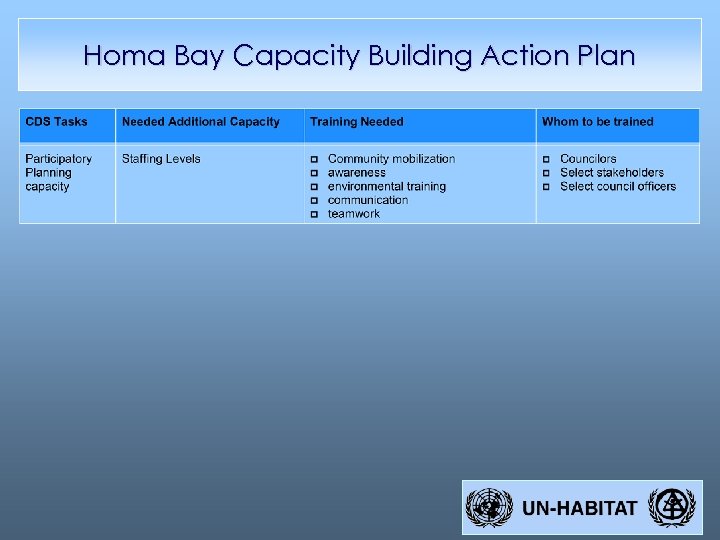 Homa Bay Capacity Building Action Plan
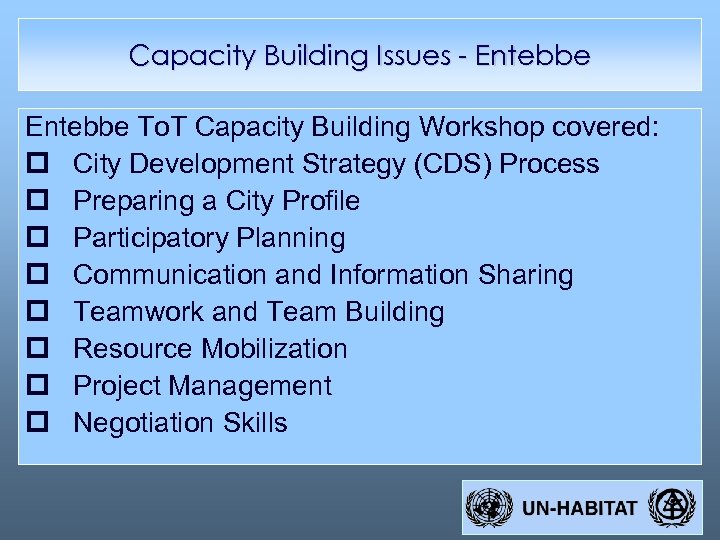 Capacity Building Issues - Entebbe To. T Capacity Building Workshop covered: p City Development Strategy (CDS) Process p Preparing a City Profile p Participatory Planning p Communication and Information Sharing p Teamwork and Team Building p Resource Mobilization p Project Management p Negotiation Skills
 Capacity Building Achievements p Cities understand better how to practice participatory planning during the CDS process p Participants better placed to perfect art of communication and negotiation skills p Council officials and stakeholders can better negotiate successfully among themselves p CDS working group member’s synergies and teamwork improved p LAs improve on own revenue sources and skills to seek external funding p Participants better understand how to implement & manage action plans p Participants well equipped to form a training of trainer’s resource pool
 Capacity Building Outputs p Financing Toolkit - LAs equipped with integrated tools for resource mobilization p Training course on Municipal Planning and Service Delivery - MASHAV, Jerusalem, Oct - Nov 2006 p Kampala 2 nd Generation Induction Workshop - May 2005 p Capacity Building Action Plan p Entebbe To. T Capacity Building Workshop - July 2005 p Lake Victoria CDS Cities Websites and Training Manual produced p Lake Victoria Cleanup Week - annual event p Lake Victoria Environmental Management Award – recognizes achievers in environmental management
 Recommendations and Way Forward p p p p p Training to strengthen stakeholders capacities Councils utilize financing toolkit to guide them on raising resource HIV/AIDS Action Plans to be part of the CDS activity for the lake region Phase I CDS cities to act as resource cities for consolidating the CDS which is an ongoing process Develop a mechanism for working with and building capacity of CBOs/NGOs at the city level - partnership with ECOVIC and LVRLAC. Setting up of the Mayors Advisory Council. Expand the programme to other municipalities Institutionalization of the CDS process Pioneer CDS cities is to apply their acquired skills and share information with the Second Generation cities. He called for the bringing onboard of new stakeholders and up-scaling of information about the region Second Generation cities - strive to have true stakeholder participation by having strong, active, successful, productive and honest interactions with various stakeholders