 Скачать презентацию Laboratoire LSR Logiciels Systèmes Réseaux Software Systems Networks
8f09dbda5f86a91f9b951e164e4854fc.ppt
- Количество слайдов: 30



Laboratoire LSR Logiciels Systèmes Réseaux Software, Systems, Networks An environment for Interactive Service Specification K. Berkani, R. Cave, S. Coudert, F. Klay, P. Le Gall, Farid Ouabdesselam, J. -L. Richier France Télécom R&D, Lannion, France La. MI, Université d’Evry, France FIW 03 - F. Ouabdesselam
Summary n n n Undesired interactions at the requirements level : a subjective notion, efficiency and effectiveness of property-based detection A new feature integration method with filtering: composition, static validation, dynamic validation Interaction expert-based “fault model”, interaction patterns, automated generation of animation guides towards interaction-prone situations FIW 03 - F. Ouabdesselam 2
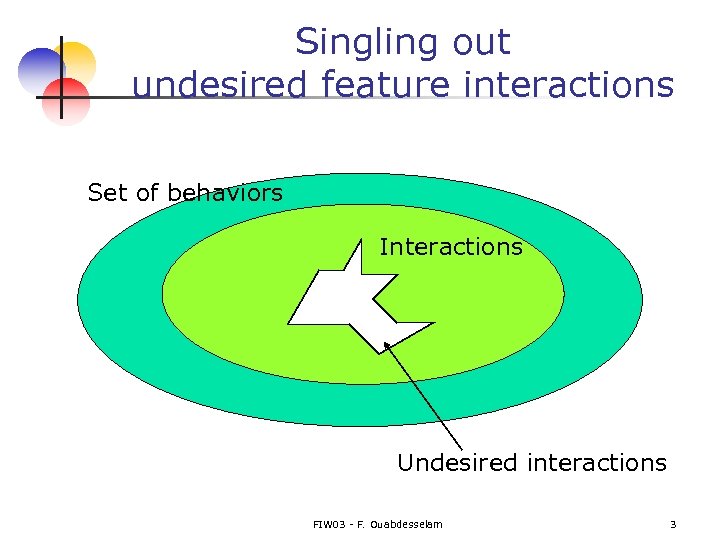
Singling out undesired feature interactions Set of behaviors Interactions Undesired interactions FIW 03 - F. Ouabdesselam 3
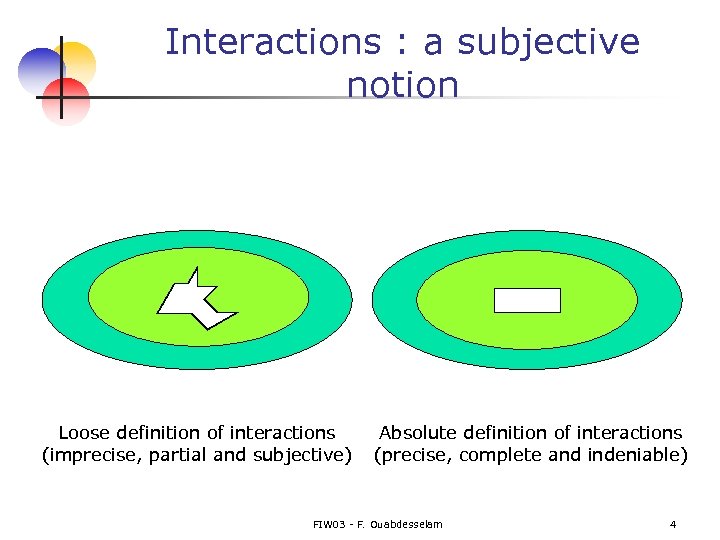
Interactions : a subjective notion Loose definition of interactions (imprecise, partial and subjective) Absolute definition of interactions (precise, complete and indeniable) FIW 03 - F. Ouabdesselam 4
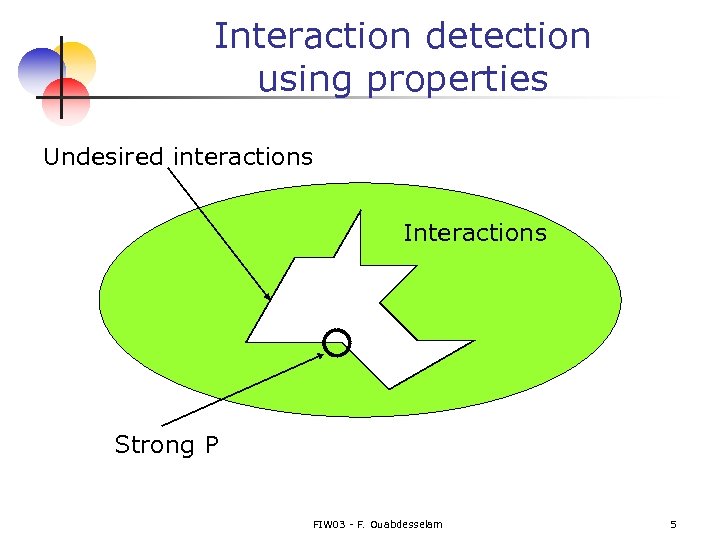
Interaction detection using properties Undesired interactions Interactions Strong P FIW 03 - F. Ouabdesselam 5
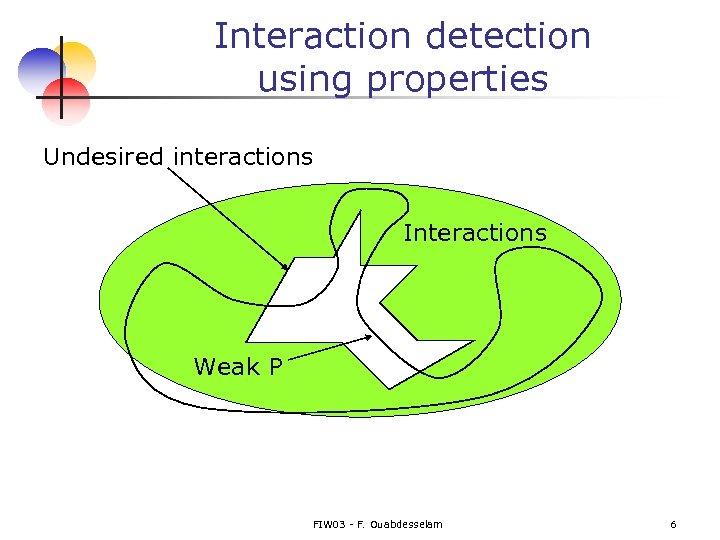
Interaction detection using properties Undesired interactions Interactions Weak P FIW 03 - F. Ouabdesselam 6
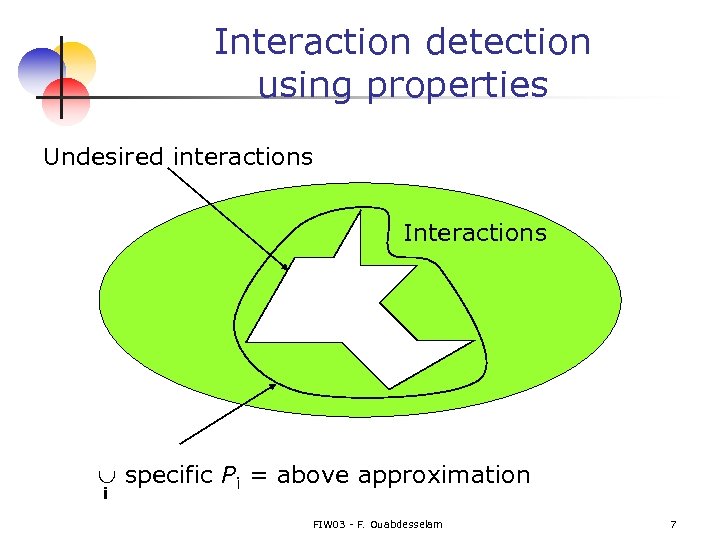
Interaction detection using properties Undesired interactions Interactions specific Pi = above approximation i FIW 03 - F. Ouabdesselam 7
A new feature integration method with filtering n Facts n Interactions : a subjective trait of service operation n Proof or model checking-based detection is hopeless n General purpose detection criteria are mostly not scalable à Designers’ expertise is essential à Use analogy between feature integration and testing FIW 03 - F. Ouabdesselam 8
A new feature integration method with filtering n Objectives n Tool-based and expert-oriented service integration methodology at the requirements level n Interactive specification and detection processes with automation of repetitive tasks n Joint and incremental elaboration of a specification <Sys , Prop> describing any service or a system resulting from the integration of several (features) services to POTS n Use filtering to adjust Prop FIW 03 - F. Ouabdesselam 9
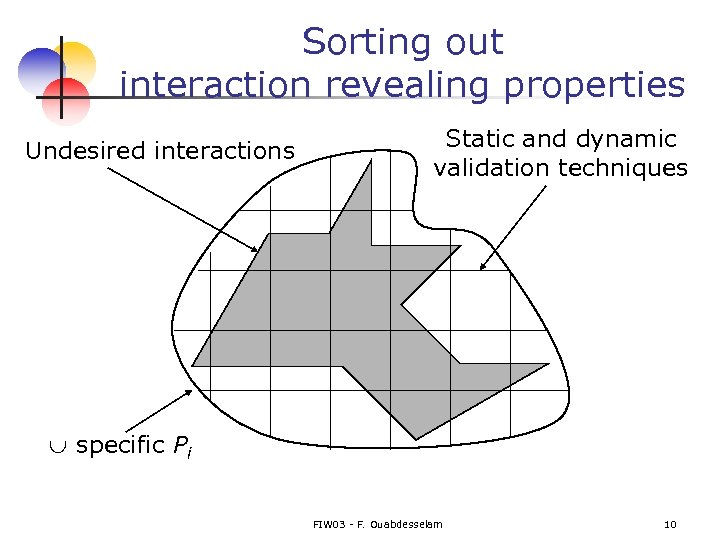
Sorting out interaction revealing properties Undesired interactions Static and dynamic validation techniques specific Pi FIW 03 - F. Ouabdesselam 10
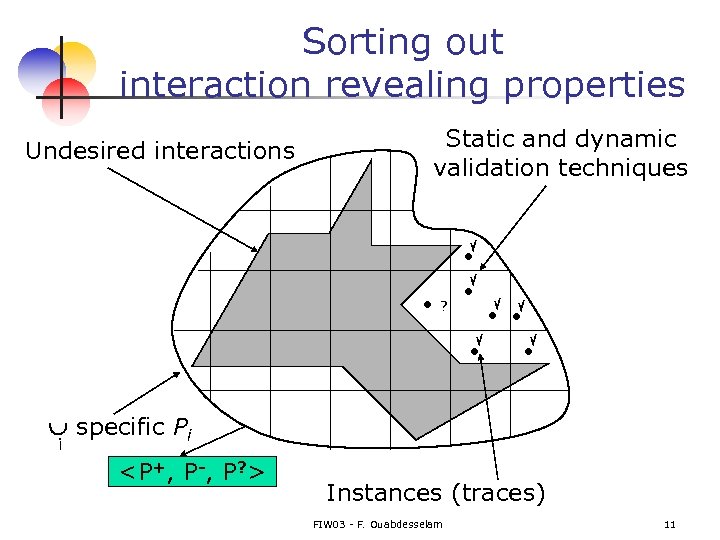
Sorting out interaction revealing properties Undesired interactions Static and dynamic validation techniques • • ? • • • specific Pi i <P+, P-, P? > Instances (traces) FIW 03 - F. Ouabdesselam 11
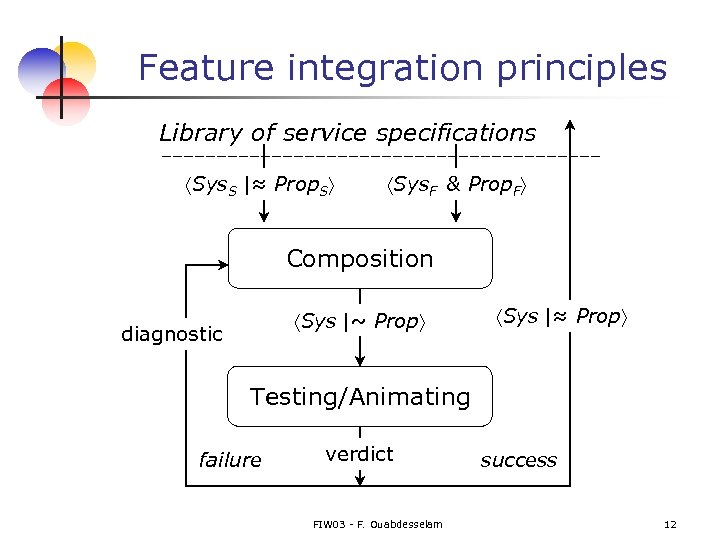
Feature integration principles Library of service specifications Sys. S |≈ Prop. S Sys. F & Prop. F Composition Sys |~ Prop diagnostic Sys |≈ Prop Testing/Animating failure verdict FIW 03 - F. Ouabdesselam success 12
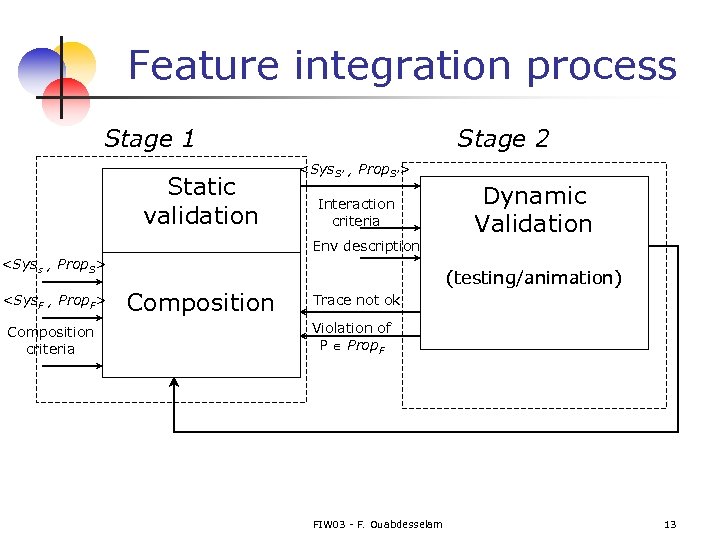
Feature integration process Stage 1 Static validation Stage 2 <Sys. S’ , Prop. S’> Interaction criteria Env description <Syss , Prop. S> <Sys. F , Prop. F> Composition criteria Composition Dynamic Validation (testing/animation) Trace not ok Violation of P Prop. F FIW 03 - F. Ouabdesselam 13
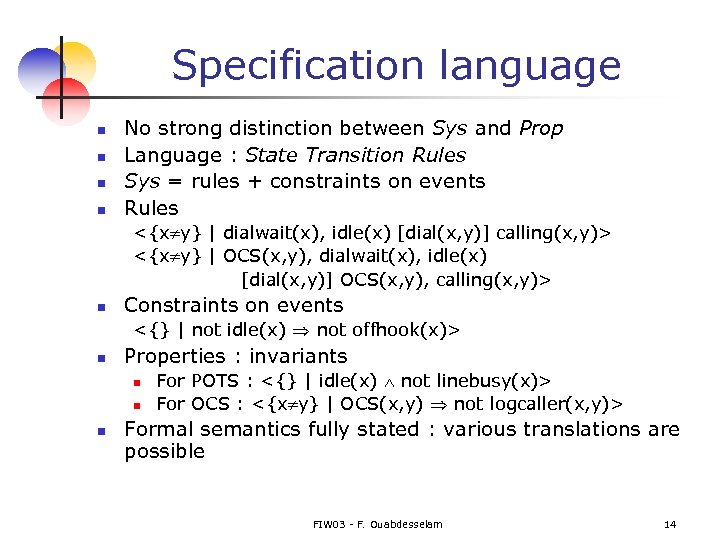
Specification language n n No strong distinction between Sys and Prop Language : State Transition Rules Sys = rules + constraints on events Rules <{x y} | dialwait(x), idle(x) [dial(x, y)] calling(x, y)> <{x y} | OCS(x, y), dialwait(x), idle(x) [dial(x, y)] OCS(x, y), calling(x, y)> n Constraints on events <{} | not idle(x) not offhook(x)> n Properties : invariants n n n For POTS : <{} | idle(x) not linebusy(x)> For OCS : <{x y} | OCS(x, y) not logcaller(x, y)> Formal semantics fully stated : various translations are possible FIW 03 - F. Ouabdesselam 14
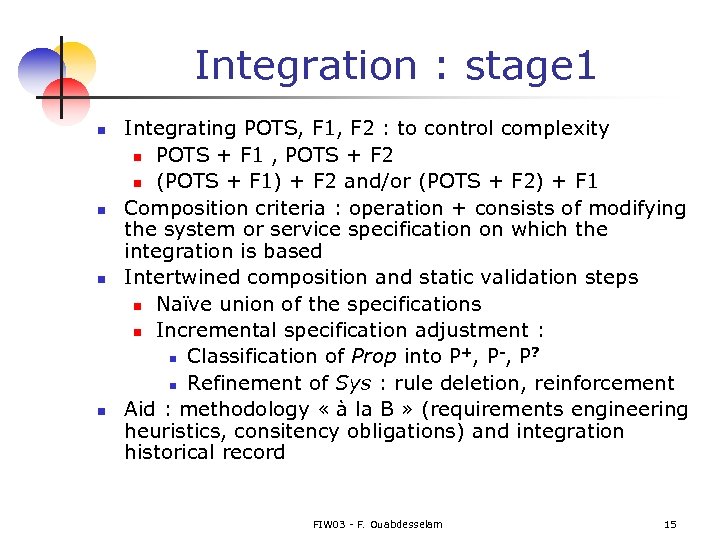
Integration : stage 1 n n Integrating POTS, F 1, F 2 : to control complexity n POTS + F 1 , POTS + F 2 n (POTS + F 1) + F 2 and/or (POTS + F 2) + F 1 Composition criteria : operation + consists of modifying the system or service specification on which the integration is based Intertwined composition and static validation steps n Naïve union of the specifications n Incremental specification adjustment : + ? n Classification of Prop into P , P n Refinement of Sys : rule deletion, reinforcement Aid : methodology « à la B » (requirements engineering heuristics, consitency obligations) and integration historical record FIW 03 - F. Ouabdesselam 15
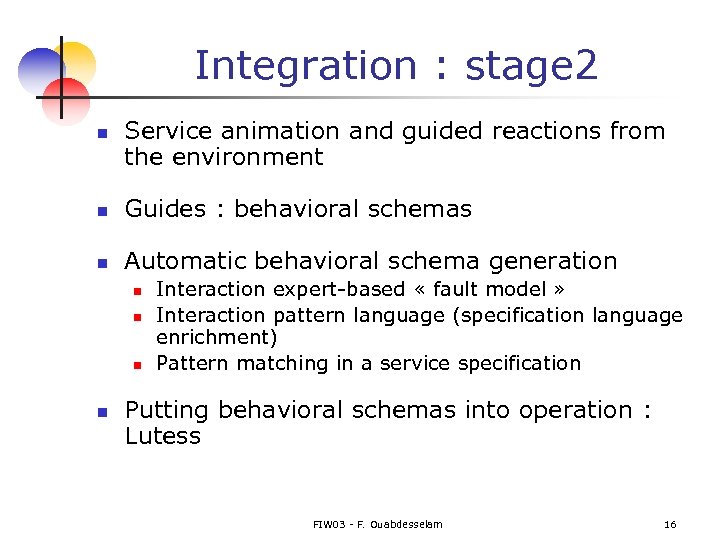
Integration : stage 2 n Service animation and guided reactions from the environment n Guides : behavioral schemas n Automatic behavioral schema generation n n Interaction expert-based « fault model » Interaction pattern language (specification language enrichment) Pattern matching in a service specification Putting behavioral schemas into operation : Lutess FIW 03 - F. Ouabdesselam 16
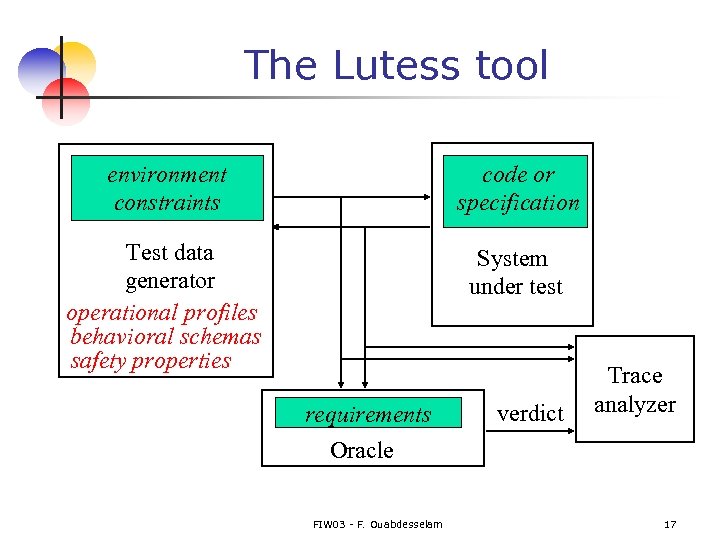
The Lutess tool environment constraints code or specification Test data generator operational profiles behavioral schemas safety properties System under test requirements Oracle FIW 03 - F. Ouabdesselam verdict Trace analyzer 17
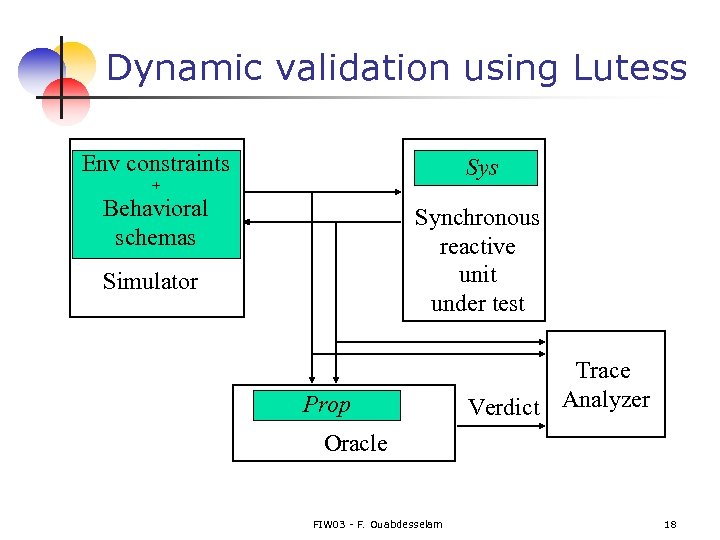
Dynamic validation using Lutess Env constraints Sys + Behavioral schemas Synchronous reactive unit under test Simulator Prop Trace Verdict Analyzer Oracle FIW 03 - F. Ouabdesselam 18
The synchronous approach n n Instantaneous reactions to external events All components evolve simultaneously THUS n all transitions are observable n internal actions are hidden => the state space is reduced => more concise traces FIW 03 - F. Ouabdesselam 19
![Specification synchronous animation Pots 1: < | idle(X) [offhook(X)] dialwait(X) > + Set of](https://present5.com/presentation/8f09dbda5f86a91f9b951e164e4854fc/image-20.jpg "Specification synchronous animation Pots 1: < | idle(X) [offhook(X)] dialwait(X) > + Set of")
Specification synchronous animation Pots 1: < | idle(X) [offhook(X)] dialwait(X) > + Set of values for the variables (ex: U = {A, B, C}) + Initial state (ex : Q 0 = {idle(A), idle(B), idle(C)} ) + Service subscription parameters (ex: TCS(A, C), CFB(B, C)) Sys I Q 0 FIW 03 - F. Ouabdesselam O 20
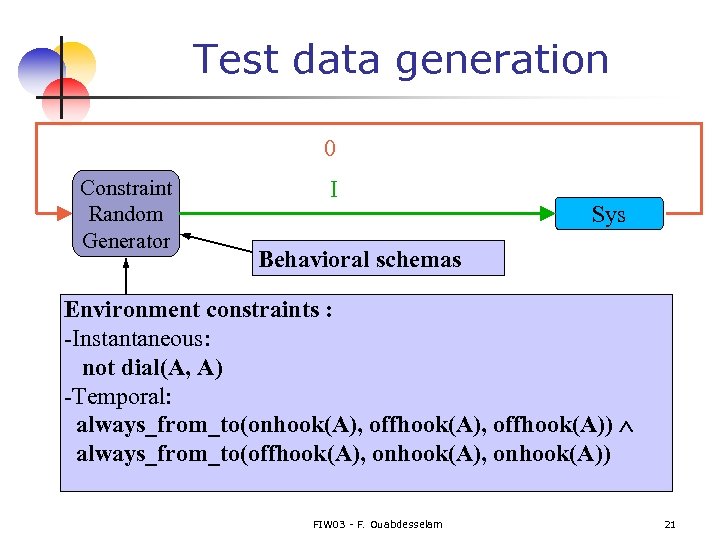
Test data generation 0 Constraint Random Generator I Sys Behavioral schemas Environment constraints : -Instantaneous: not dial(A, A) -Temporal: always_from_to(onhook(A), offhook(A)) Ù always_from_to(offhook(A), onhook(A)) FIW 03 - F. Ouabdesselam 21
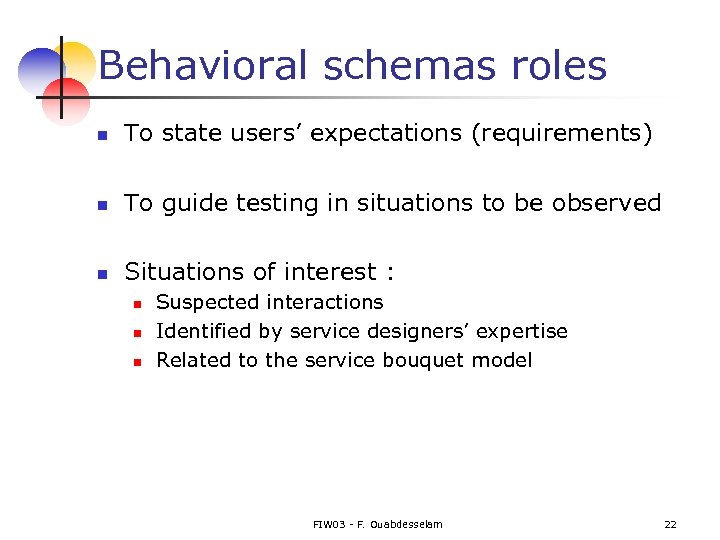
Behavioral schemas roles n To state users’ expectations (requirements) n To guide testing in situations to be observed n Situations of interest : n n n Suspected interactions Identified by service designers’ expertise Related to the service bouquet model FIW 03 - F. Ouabdesselam 22
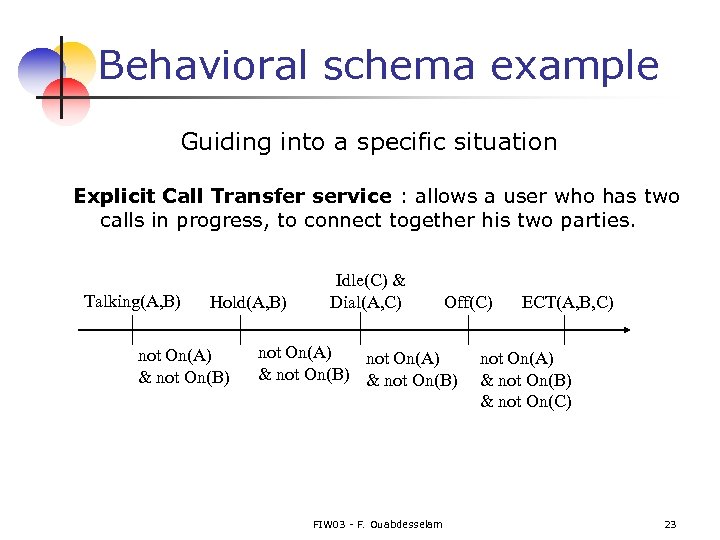
Behavioral schema example Guiding into a specific situation Explicit Call Transfer service : allows a user who has two calls in progress, to connect together his two parties. Talking(A, B) Hold(A, B) not On(A) & not On(B) Idle(C) & Dial(A, C) Off(C) not On(A) & not On(B) FIW 03 - F. Ouabdesselam ECT(A, B, C) not On(A) & not On(B) & not On(C) 23
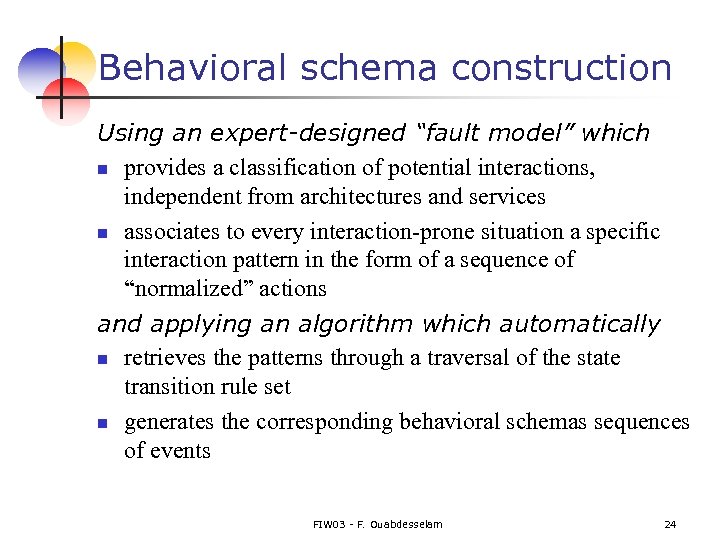
Behavioral schema construction Using an expert-designed “fault model” which n provides a classification of potential interactions, independent from architectures and services n associates to every interaction-prone situation a specific interaction pattern in the form of a sequence of “normalized” actions and applying an algorithm which automatically n retrieves the patterns through a traversal of the state transition rule set n generates the corresponding behavioral schemas sequences of events FIW 03 - F. Ouabdesselam 24
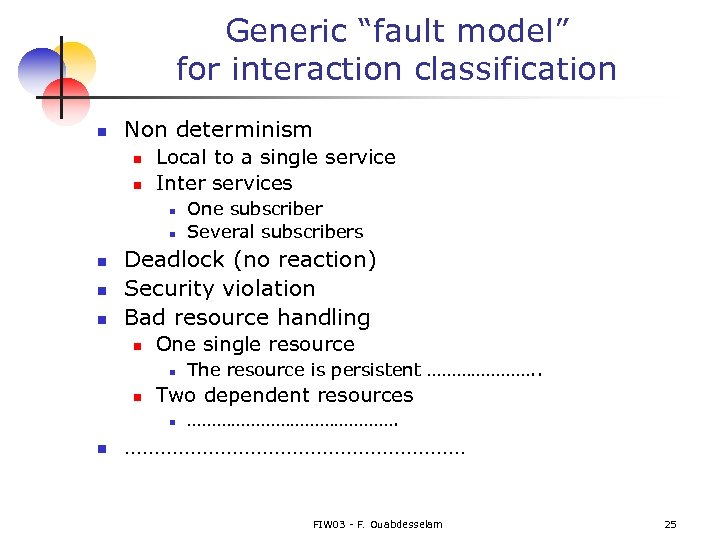
Generic “fault model” for interaction classification n Non determinism n n Local to a single service Inter services n n n Deadlock (no reaction) Security violation Bad resource handling n One single resource n n The resource is persistent …………………. . Two dependent resources n n One subscriber Several subscribers ………………………… FIW 03 - F. Ouabdesselam 25
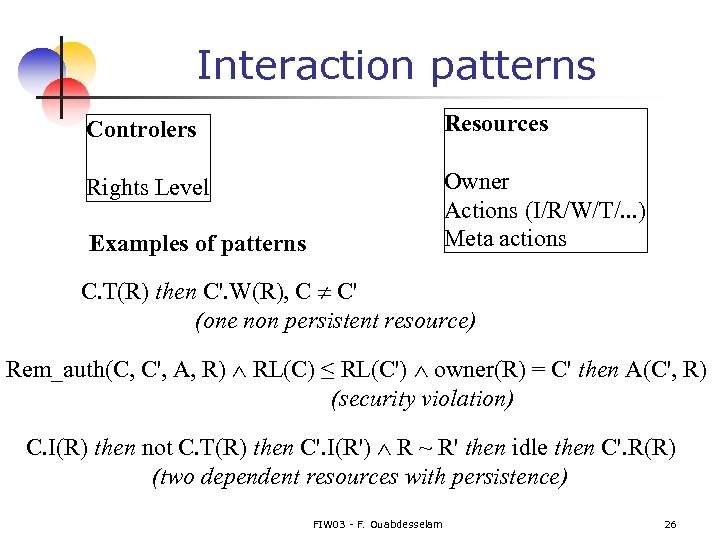
Interaction patterns Controlers Resources Rights Level Owner Actions (I/R/W/T/. . . ) Meta actions Examples of patterns C. T(R) then C'. W(R), C C' (one non persistent resource) Rem_auth(C, C', A, R) RL(C) ≤ RL(C') owner(R) = C' then A(C', R) (security violation) C. I(R) then not C. T(R) then C'. I(R') R ~ R' then idle then C'. R(R) (two dependent resources with persistence) FIW 03 - F. Ouabdesselam 26
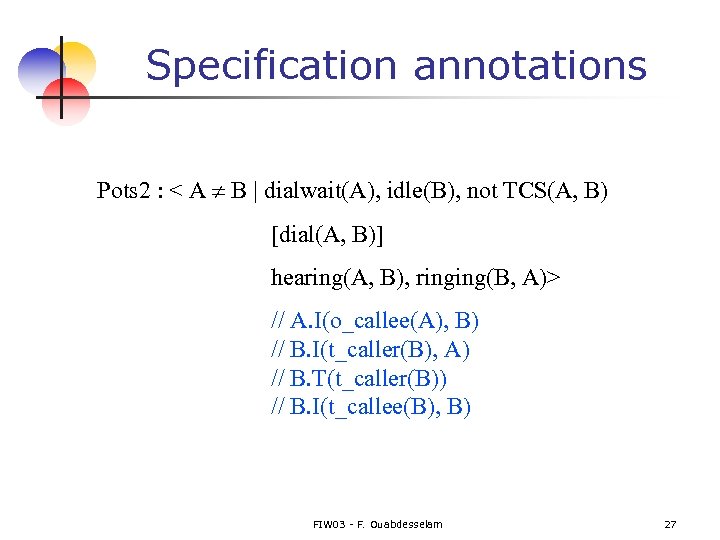
Specification annotations Pots 2 : < A B | dialwait(A), idle(B), not TCS(A, B) [dial(A, B)] hearing(A, B), ringing(B, A)> // A. I(o_callee(A), B) // B. I(t_caller(B), A) // B. T(t_caller(B)) // B. I(t_callee(B), B) FIW 03 - F. Ouabdesselam 27
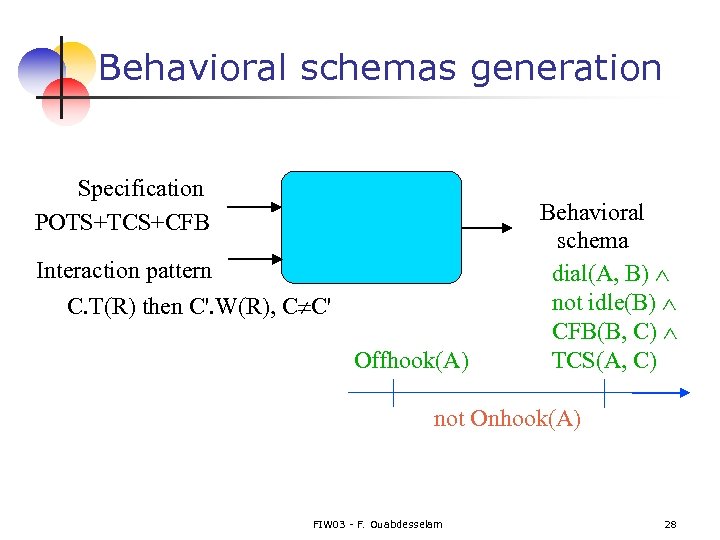
Behavioral schemas generation Specification POTS+TCS+CFB Interaction pattern C. T(R) then C'. W(R), C C' Offhook(A) Behavioral schema dial(A, B) not idle(B) CFB(B, C) TCS(A, C) not Onhook(A) FIW 03 - F. Ouabdesselam 28
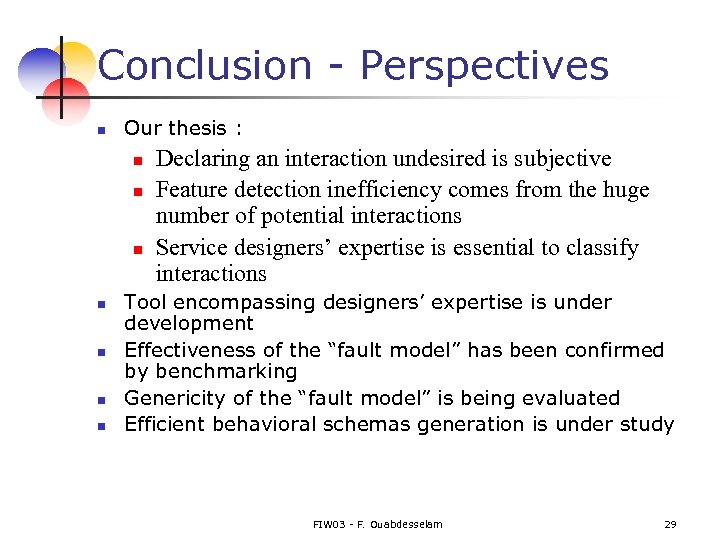
Conclusion - Perspectives n Our thesis : n n n n Declaring an interaction undesired is subjective Feature detection inefficiency comes from the huge number of potential interactions Service designers’ expertise is essential to classify interactions Tool encompassing designers’ expertise is under development Effectiveness of the “fault model” has been confirmed by benchmarking Genericity of the “fault model” is being evaluated Efficient behavioral schemas generation is under study FIW 03 - F. Ouabdesselam 29
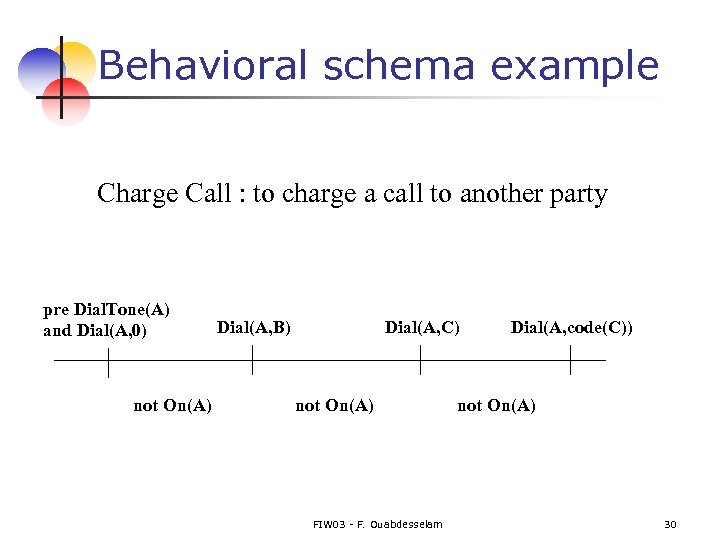
Behavioral schema example Charge Call : to charge a call to another party pre Dial. Tone(A) and Dial(A, 0) not On(A) Dial(A, B) Dial(A, C) not On(A) FIW 03 - F. Ouabdesselam Dial(A, code(C)) not On(A) 30
Скачать презентацию Laboratoire LSR Logiciels Systèmes Réseaux Software Systems Networks
8f09dbda5f86a91f9b951e164e4854fc.ppt