 Скачать презентацию Laboratoire des Sciences du Climat et de l Environnement
dc49b6340861845603aa3638a221cd80.ppt
- Количество слайдов: 22



Laboratoire des Sciences du Climat et de l'Environnement Flux data to highlight model deficiencies & The use of satellite data and flux data to optimize ecosystem model parameters P. Peylin, C. Bacour, P. Ciais, H. Verbeek, P. Rayner
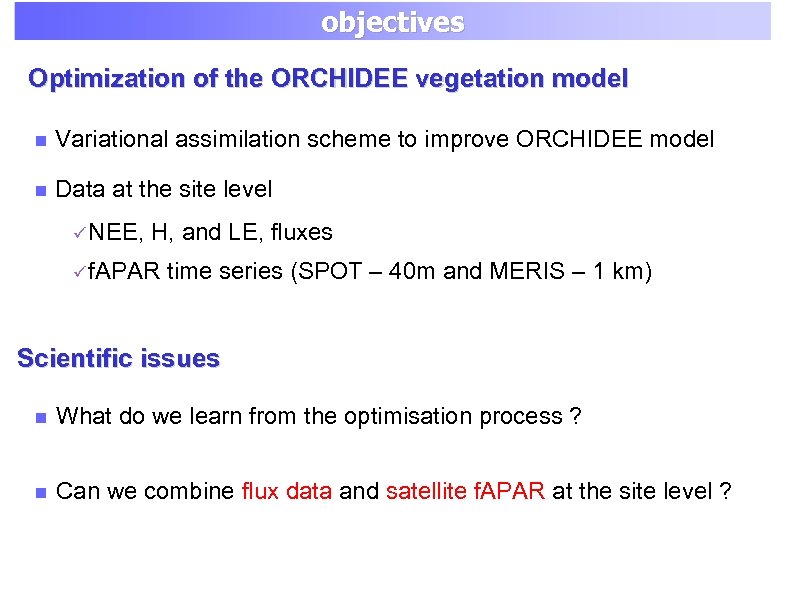
objectives Optimization of the ORCHIDEE vegetation model Variational assimilation scheme to improve ORCHIDEE model Data at the site level NEE, H, and LE, fluxes f. APAR time series (SPOT – 40 m and MERIS – 1 km) Scientific issues What do we learn from the optimisation process ? Can we combine flux data and satellite f. APAR at the site level ?
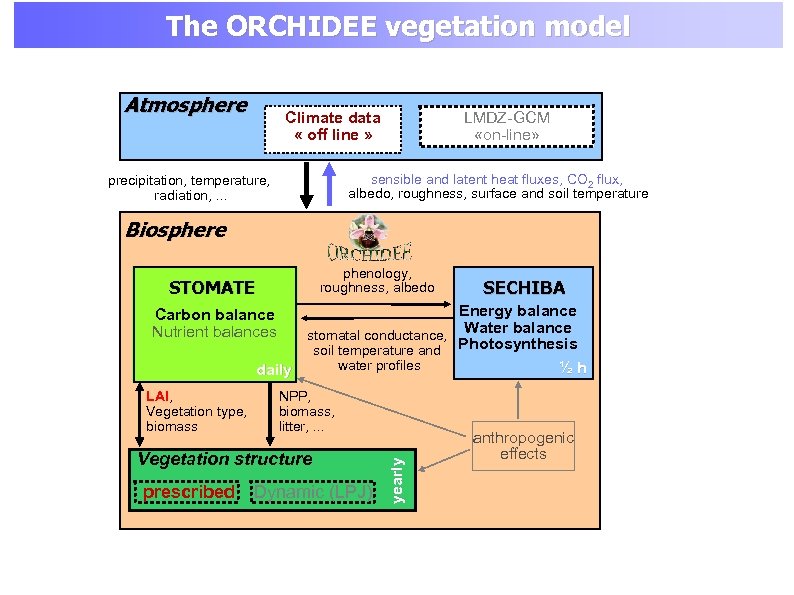
The ORCHIDEE vegetation model Atmosphere Climate data « off line » LMDZ-GCM «on-line» sensible and latent heat fluxes, CO 2 flux, albedo, roughness, surface and soil temperature precipitation, temperature, radiation, . . . Biosphere phenology, roughness, albedo STOMATE SECHIBA Energy balance Water balance stomatal conductance, soil temperature and Photosynthesis water profiles ½ h daily Carbon balance Nutrient balances NPP, biomass, litter, . . . Vegetation structure prescribed Dynamic (LPJ) yearly LAI, Vegetation type, biomass anthropogenic effects
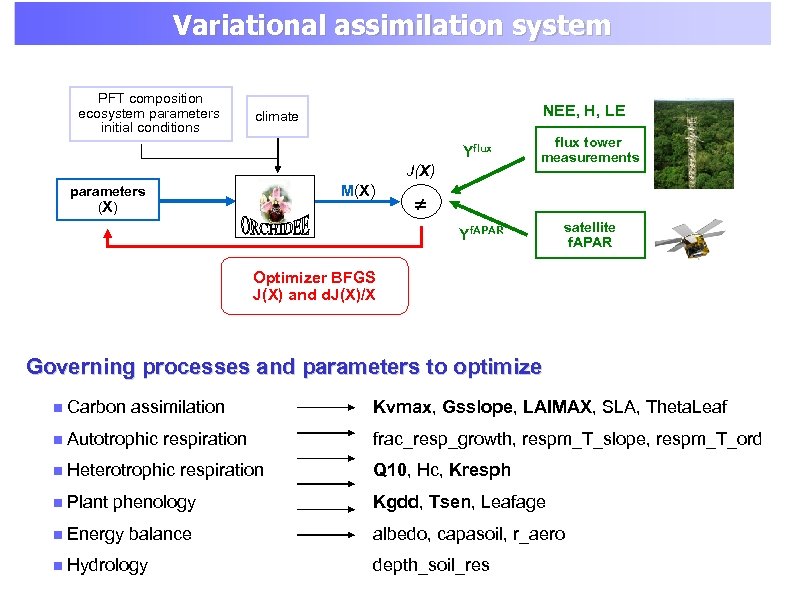
Variational assimilation system PFT composition ecosystem parameters initial conditions NEE, H, LE climate Yflux tower measurements Yf. APAR satellite f. APAR J(X) M(X) parameters (X ) Optimizer BFGS J(X) and d. J(X)/X Governing processes and parameters to optimize Carbon assimilation Kvmax, Gsslope, LAIMAX, SLA, Theta. Leaf Autotrophic respiration frac_resp_growth, respm_T_slope, respm_T_ord Heterotrophic respiration Q 10, Hc, Kresph Plant phenology Kgdd, Tsen, Leafage Energy balance albedo, capasoil, r_aero Hydrology depth_soil_res
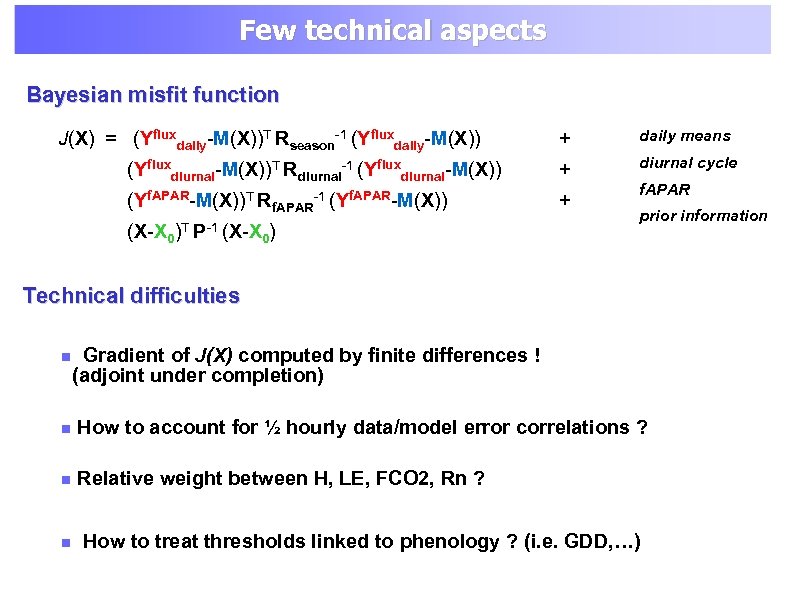
Few technical aspects Bayesian misfit function J(X) = (Yfluxdaily-M(X))T Rseason-1 (Yfluxdaily-M(X)) + daily means (Yfluxdiurnal-M(X))T Rdiurnal-1 (Yfluxdiurnal-M(X)) + diurnal cycle (Yf. APAR-M(X))T Rf. APAR-1 (Yf. APAR-M(X)) + (X-X 0 )T P-1 (X-X 0) f. APAR prior information Technical difficulties Gradient of J(X) computed by finite differences ! (adjoint under completion) How to account for ½ hourly data/model error correlations ? Relative weight between H, LE, FCO 2, Rn ? How to treat thresholds linked to phenology ? (i. e. GDD, …)
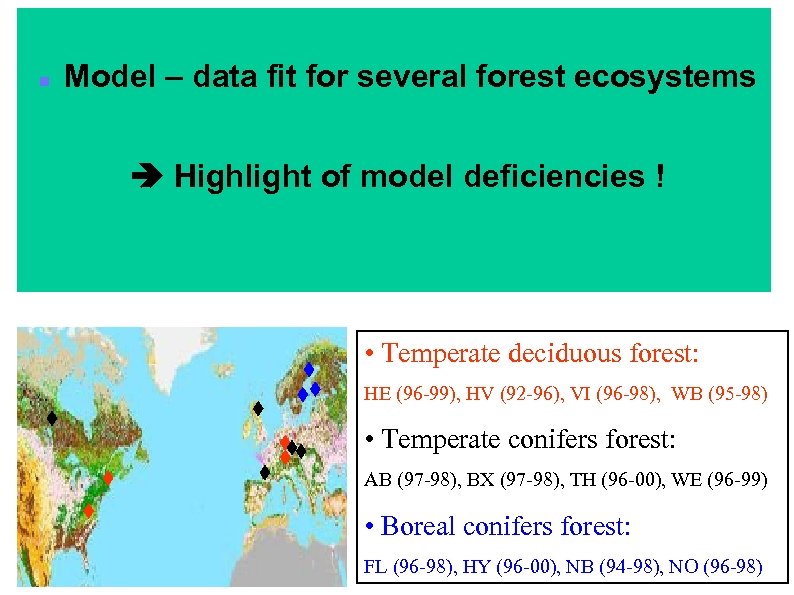
Model – data fit for several forest ecosystems Highlight of model deficiencies ! • Temperate deciduous forest: HE (96 -99), HV (92 -96), VI (96 -98), WB (95 -98) • Temperate conifers forest: AB (97 -98), BX (97 -98), TH (96 -00), WE (96 -99) • Boreal conifers forest: FL (96 -98), HY (96 -00), NB (94 -98), NO (96 -98)
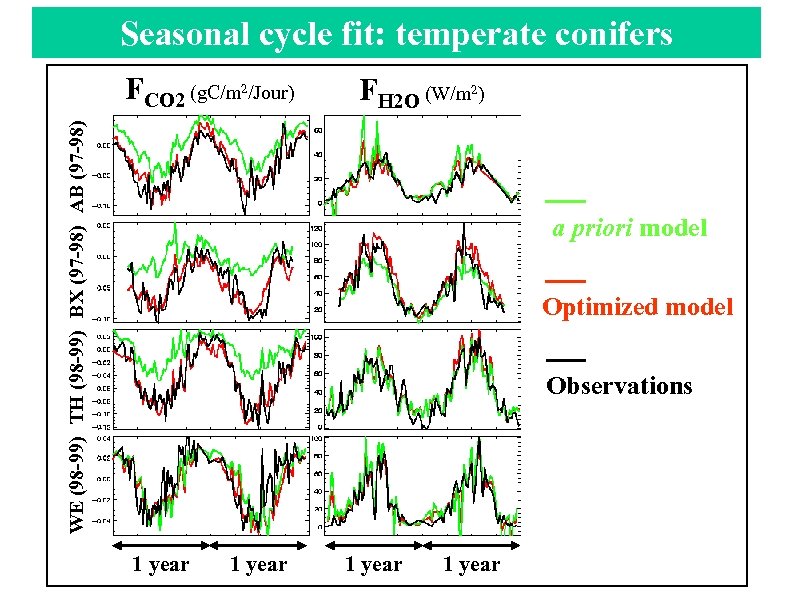
Seasonal cycle fit: temperate conifers FH 2 O (W/m 2) WE (98 -99) TH (98 -99) BX (97 -98) AB (97 -98) FCO 2 (g. C/m 2/Jour) a priori model Optimized model Observations 1 year
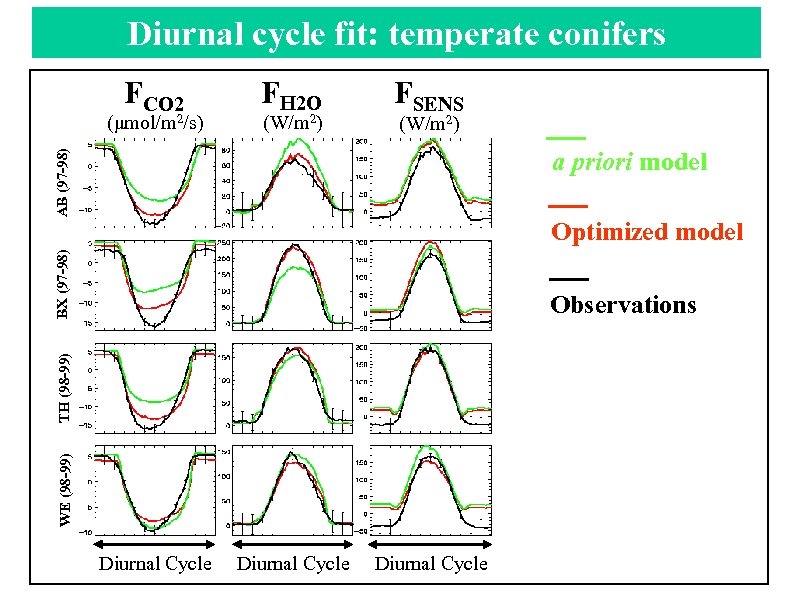
Diurnal cycle fit: temperate conifers FCO 2 (μmol/m 2/s) FH 2 O (W/m 2) FSENS (W/m 2) AB (97 -98) a priori model BX (97 -98) Optimized model WE (98 -99) TH (98 -99) Observations Diurnal Cycle
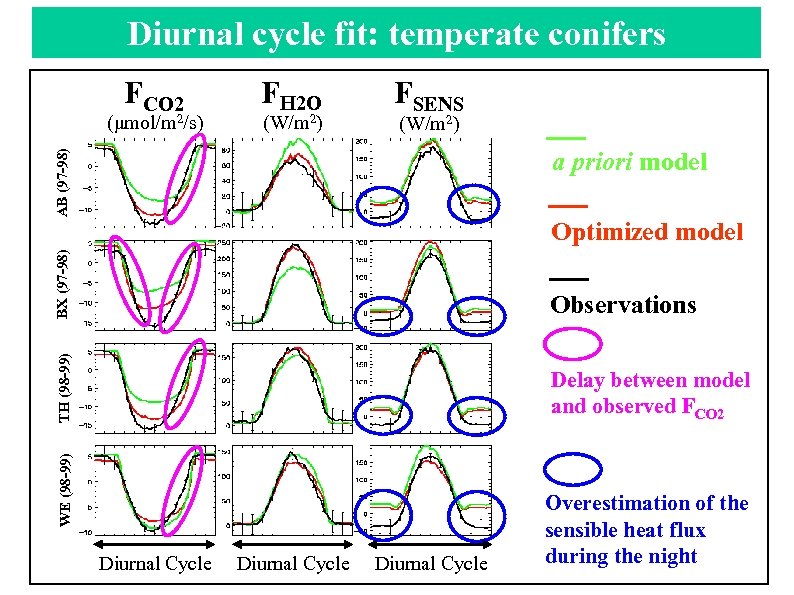
Diurnal cycle fit: temperate conifers FCO 2 (μmol/m 2/s) FH 2 O (W/m 2) FSENS (W/m 2) AB (97 -98) a priori model BX (97 -98) Delay between model and observed FCO 2 WE (98 -99) Observations TH (98 -99) Optimized model Diurnal Cycle Overestimation of the sensible heat flux during the night
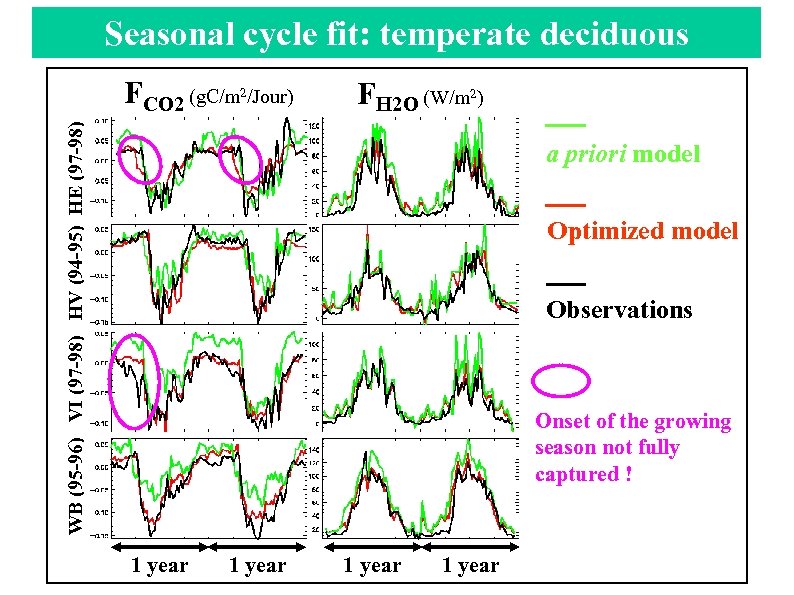
Seasonal cycle fit: temperate deciduous FH 2 O (W/m 2) WB (95 -96) VI (97 -98) HV (94 -95) HE (97 -98) FCO 2 (g. C/m 2/Jour) a priori model Optimized model Observations Onset of the growing season not fully captured ! 1 year
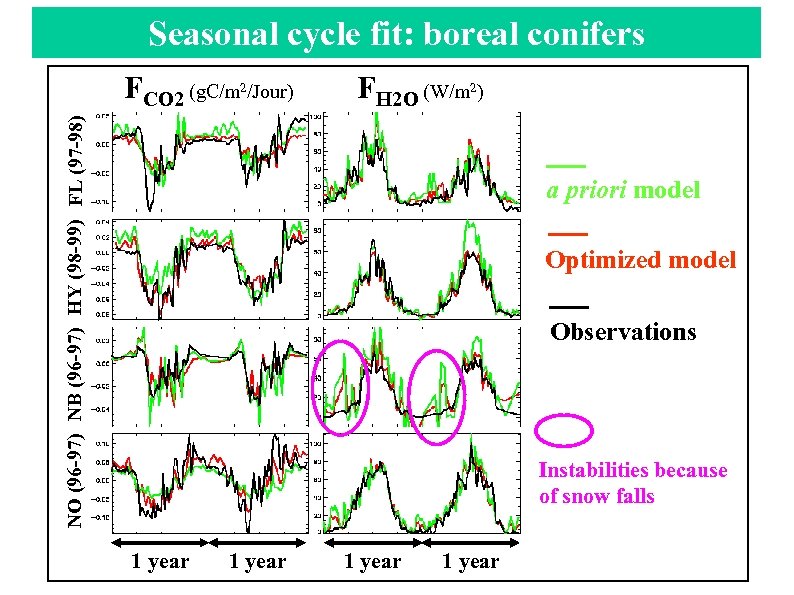
Seasonal cycle fit: boreal conifers FH 2 O (W/m 2) NO (96 -97) NB (96 -97) HY (98 -99) FL (97 -98) FCO 2 (g. C/m 2/Jour) a priori model Optimized model Observations Instabilities because of snow falls 1 year
Complementarity between f. APAR and flux data ? First test for the Fontainebleau “OAK” forest
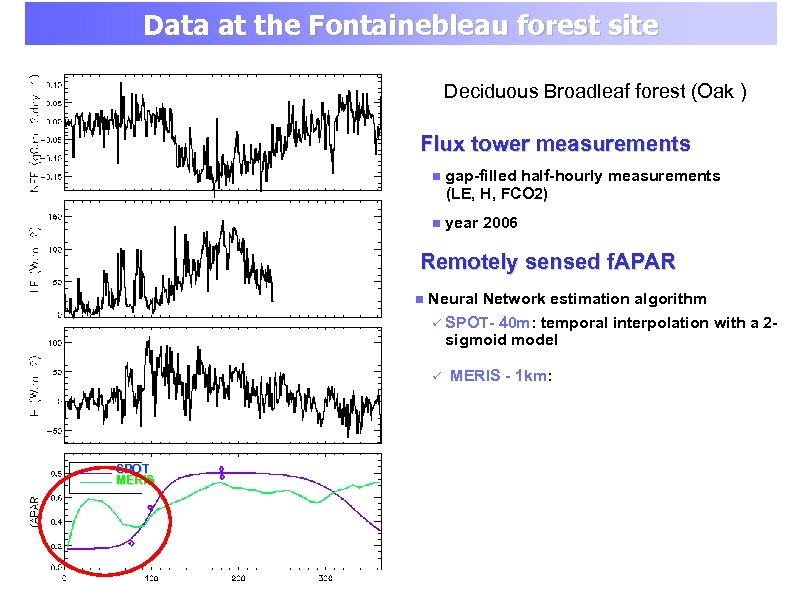
Data at the Fontainebleau forest site Deciduous Broadleaf forest (Oak ) Flux tower measurements gap-filled half-hourly measurements (LE, H, FCO 2) year 2006 Remotely sensed f. APAR Neural Network estimation algorithm SPOT MERIS SPOT- 40 m: temporal interpolation with a 2 sigmoid model MERIS - 1 km:
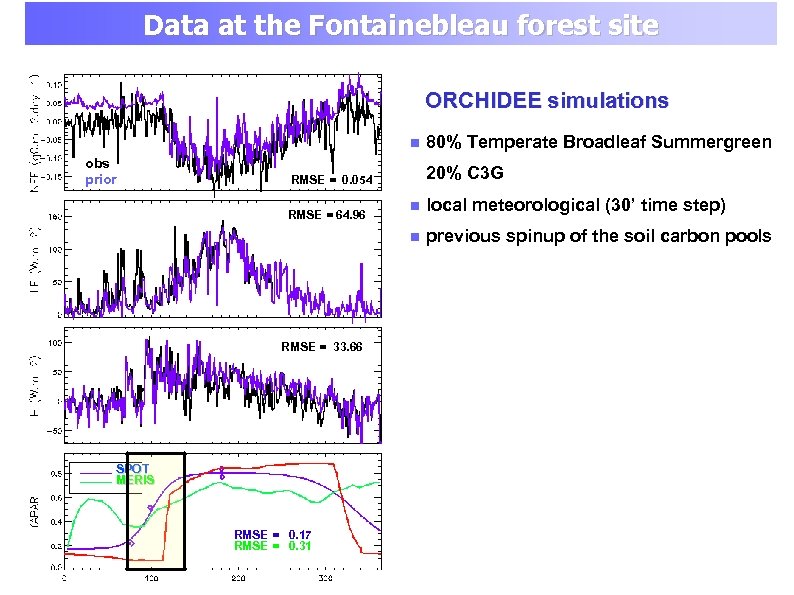
Data at the Fontainebleau forest site ORCHIDEE simulations obs prior 80% Temperate Broadleaf Summergreen 20% C 3 G RMSE = 0. 054 RMSE = 33. 66 SPOT MERIS RMSE = 0. 17 RMSE = 0. 31 local meteorological (30’ time step) RMSE = 64. 96 previous spinup of the soil carbon pools
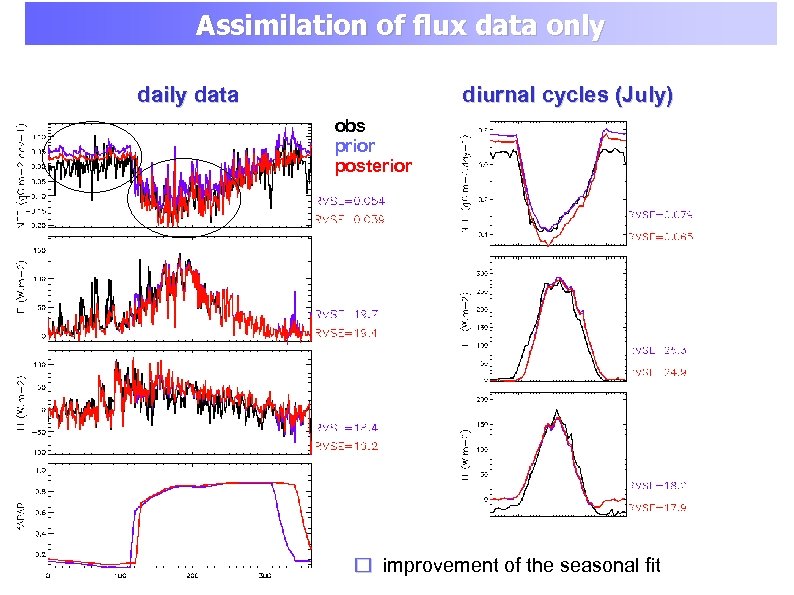
Assimilation of flux data only daily data diurnal cycles (July) obs prior posterior improvement of the seasonal fit
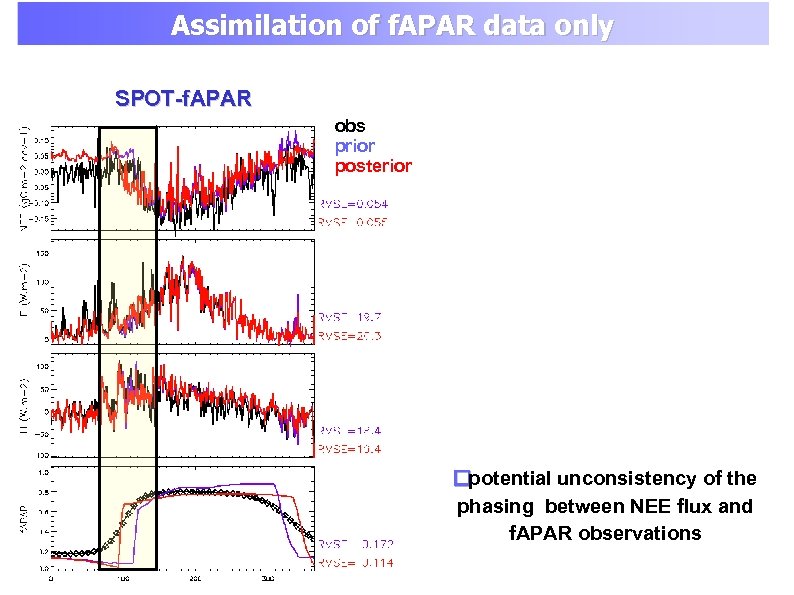
Assimilation of f. APAR data only SPOT-f. APAR obs prior posterior potential unconsistency of the phasing between NEE flux and f. APAR observations
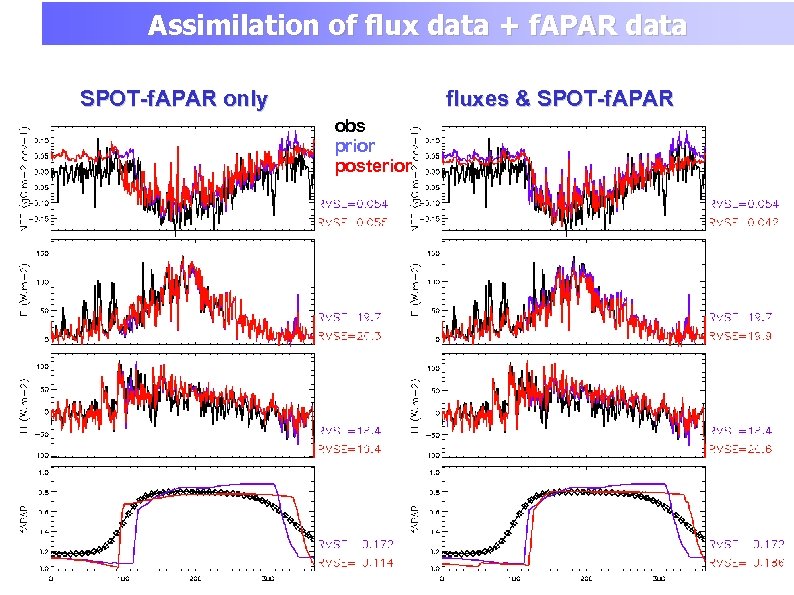
Assimilation of flux data + f. APAR data SPOT-f. APAR only fluxes & SPOT-f. APAR obs prior posterior
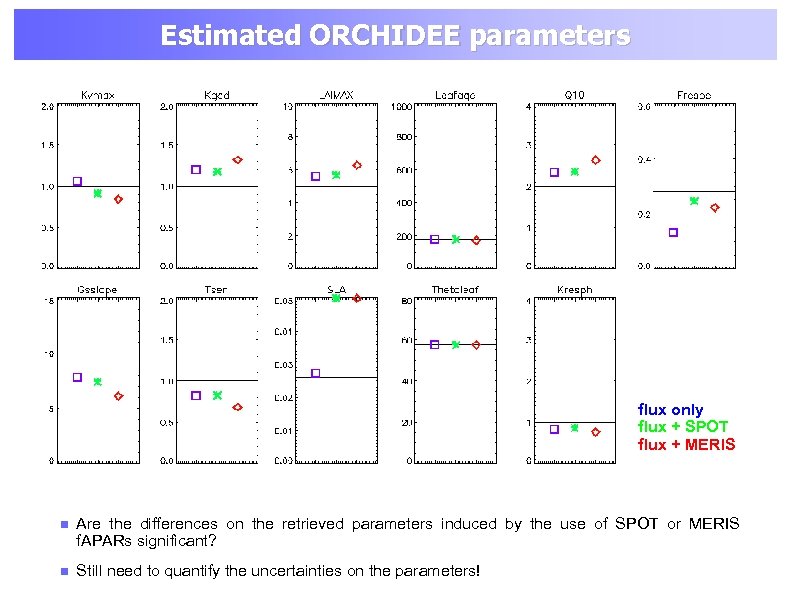
Estimated ORCHIDEE parameters flux only flux + SPOT flux + MERIS Are the differences on the retrieved parameters induced by the use of SPOT or MERIS f. APARs significant? Still need to quantify the uncertainties on the parameters!
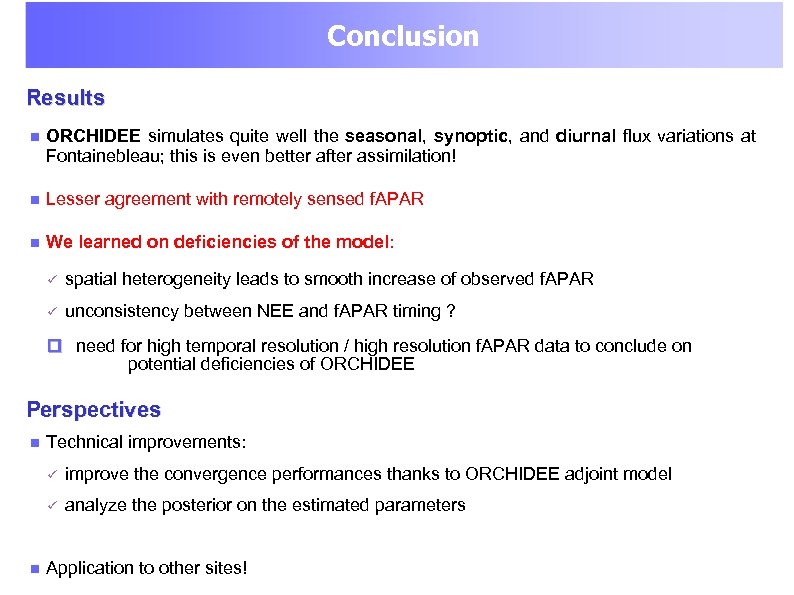
Conclusion Results ORCHIDEE simulates quite well the seasonal, synoptic, and diurnal flux variations at Fontainebleau; this is even better after assimilation! Lesser agreement with remotely sensed f. APAR We learned on deficiencies of the model: spatial heterogeneity leads to smooth increase of observed f. APAR unconsistency between NEE and f. APAR timing ? need for high temporal resolution / high resolution f. APAR data to conclude on potential deficiencies of ORCHIDEE Perspectives Technical improvements: improve the convergence performances thanks to ORCHIDEE adjoint model analyze the posterior on the estimated parameters Application to other sites!
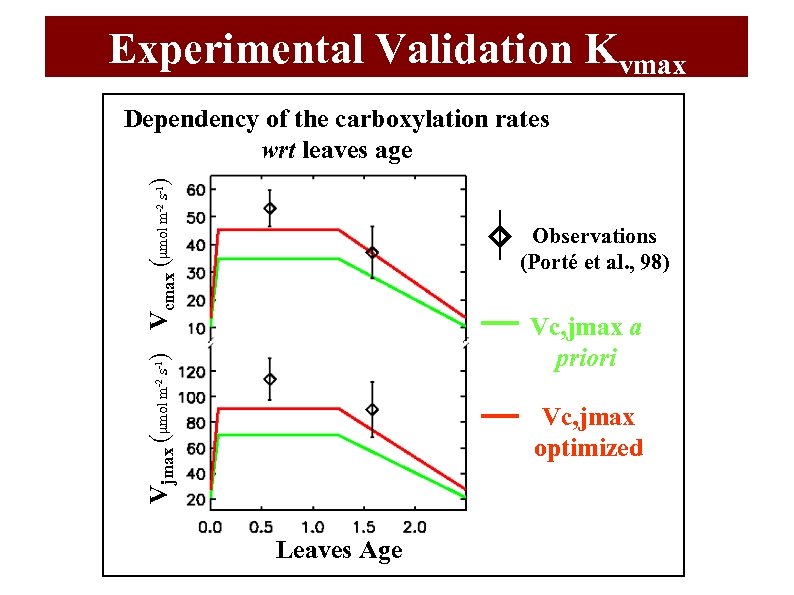
Experimental Validation Kvmax ) Vcmax (μmol m -2 s-1 ) Dependency of the carboxylation rates wrt leaves age Observations (Porté et al. , 98) Vjmax (μmol m -2 s-1 Vc, jmax a priori Vc, jmax optimized Leaves Age
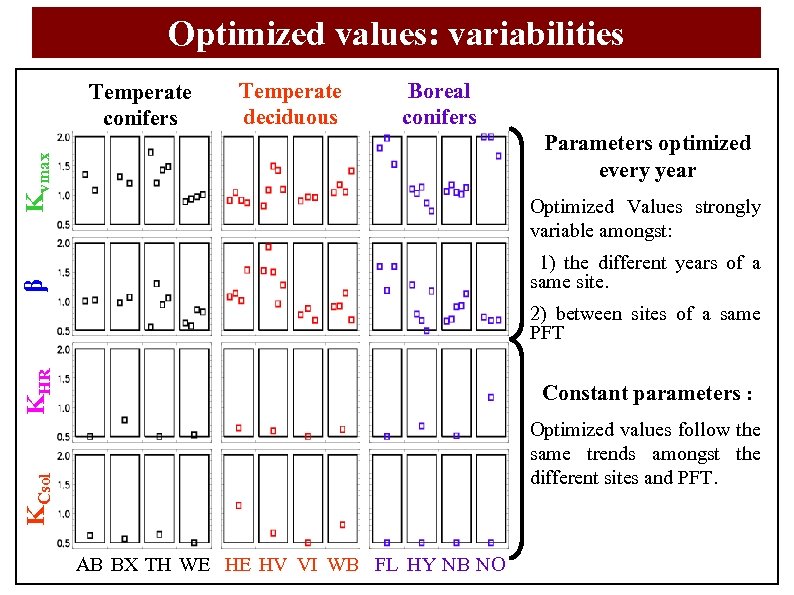
Optimized values: variabilities Temperate conifers Temperate deciduous Boreal conifers Kvmax Parameters optimized every year Optimized Values strongly variable amongst: β 1) the different years of a same site. KHR 2) between sites of a same PFT Constant parameters : KCsol Optimized values follow the same trends amongst the different sites and PFT. AB BX TH WE HE HV VI WB FL HY NB NO
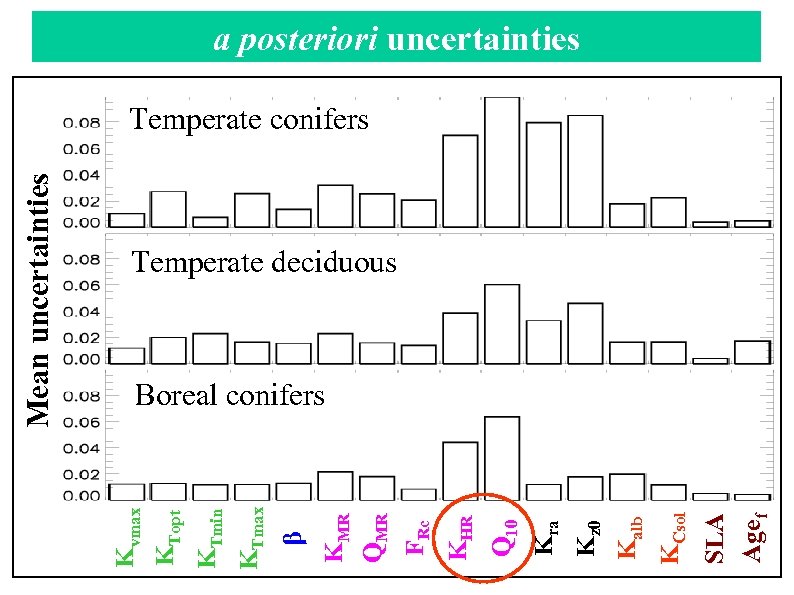
a posteriori uncertainties Temperate deciduous SLA Agef KCsol Kalb Kz 0 Kra Q 10 KHR FRc KMR QMR β KTmax KTmin KTopt Boreal conifers Kvmax Mean uncertainties Temperate conifers
Скачать презентацию Laboratoire des Sciences du Climat et de l Environnement
dc49b6340861845603aa3638a221cd80.ppt