 Скачать презентацию La Sagrada Família Basilica and Expiatory Church of
Sagrada Familia.ppt
- Количество слайдов: 23



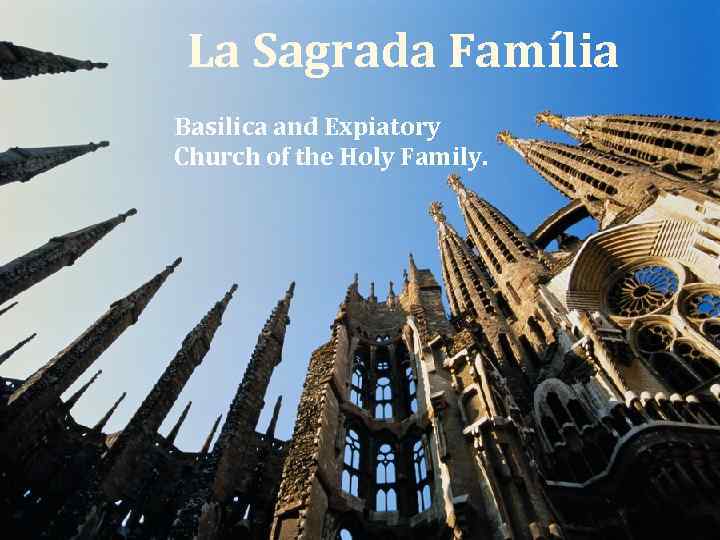
La Sagrada Família Basilica and Expiatory Church of the Holy Family.
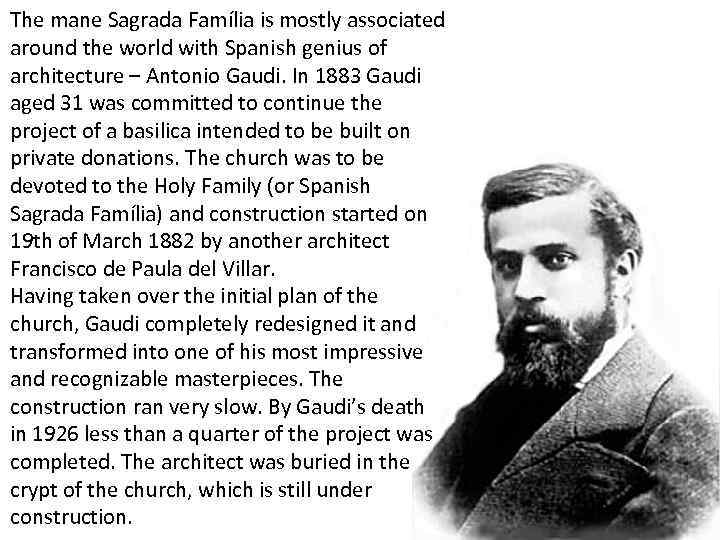
The mane Sagrada Família is mostly associated around the world with Spanish genius of architecture – Antonio Gaudi. In 1883 Gaudi aged 31 was committed to continue the project of a basilica intended to be built on private donations. The church was to be devoted to the Holy Family (or Spanish Sagrada Família) and construction started on 19 th of March 1882 by another architect Francisco de Paula del Villar. Having taken over the initial plan of the church, Gaudi completely redesigned it and transformed into one of his most impressive and recognizable masterpieces. The construction ran very slow. By Gaudi’s death in 1926 less than a quarter of the project was completed. The architect was buried in the crypt of the church, which is still under construction.
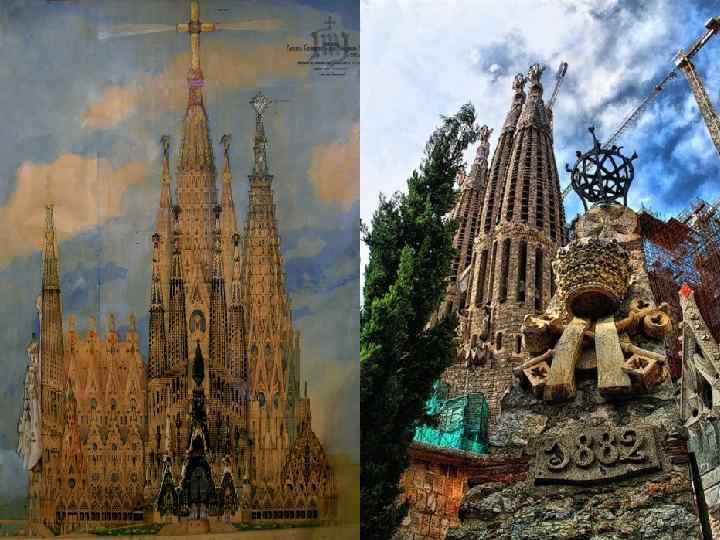
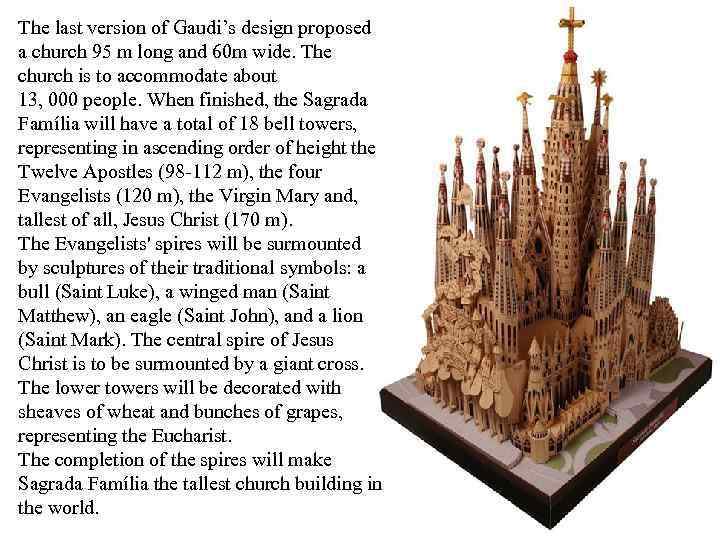
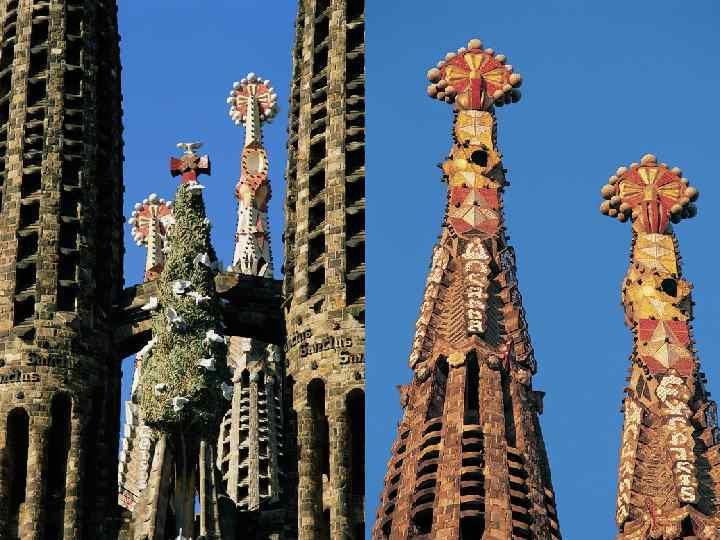
The last version of Gaudi’s design proposed a church 95 m long and 60 m wide. The church is to accommodate about 13, 000 people. When finished, the Sagrada Família will have a total of 18 bell towers, representing in ascending order of height the Twelve Apostles (98 -112 m), the four Evangelists (120 m), the Virgin Mary and, tallest of all, Jesus Christ (170 m). The Evangelists' spires will be surmounted by sculptures of their traditional symbols: a bull (Saint Luke), a winged man (Saint Matthew), an eagle (Saint John), and a lion (Saint Mark). The central spire of Jesus Christ is to be surmounted by a giant cross. The lower towers will be decorated with sheaves of wheat and bunches of grapes, representing the Eucharist. The completion of the spires will make Sagrada Família the tallest church building in the world.
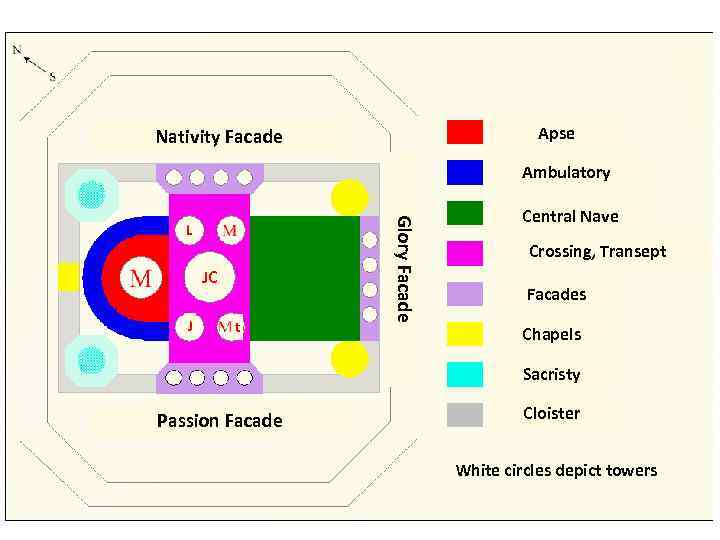
Apse Nativity Facade Ambulatory JC J t Glory Facade L Central Nave Crossing, Transept Facades Chapels Sacristy Passion Facade Cloister White circles depict towers
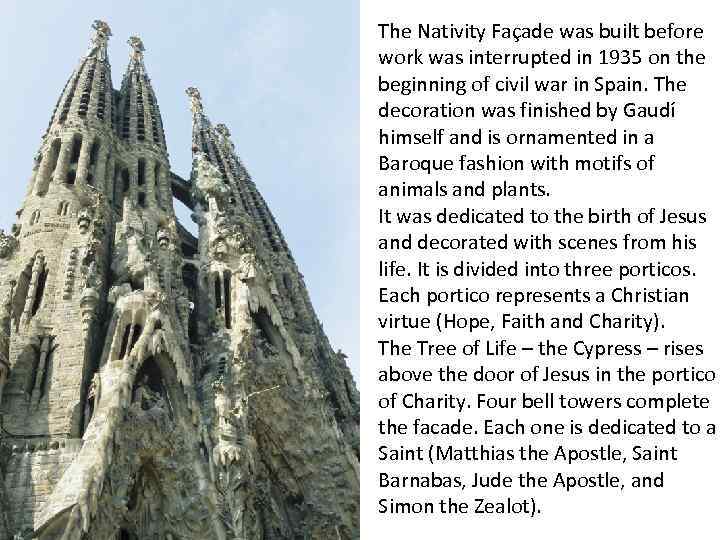
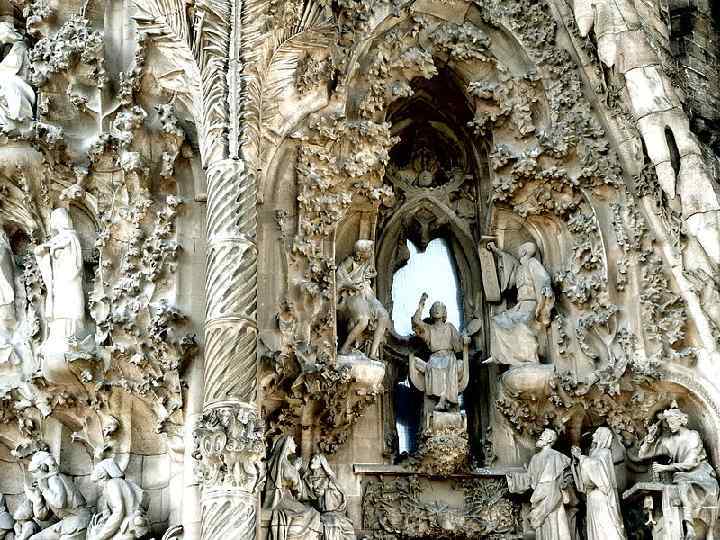
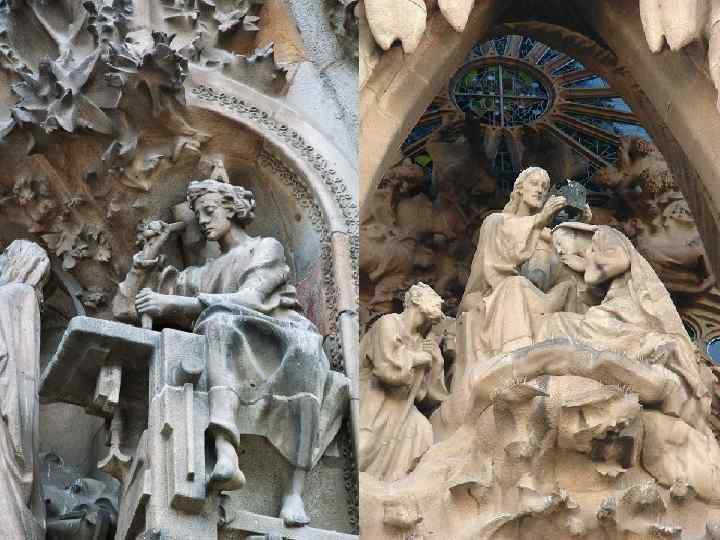
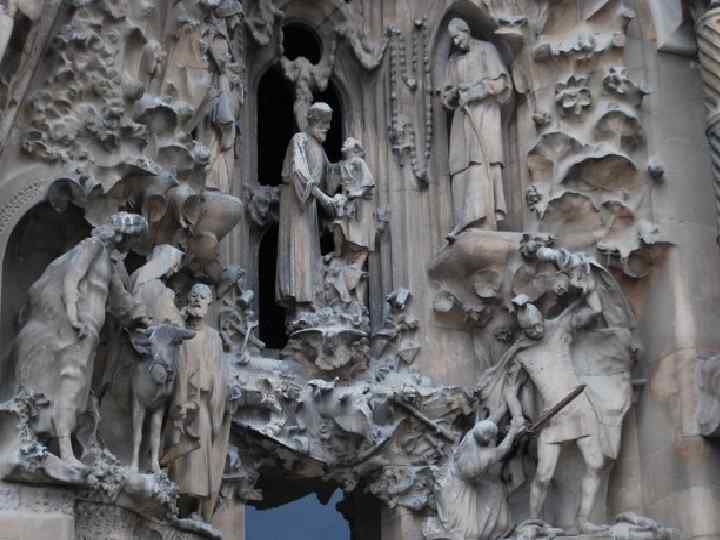
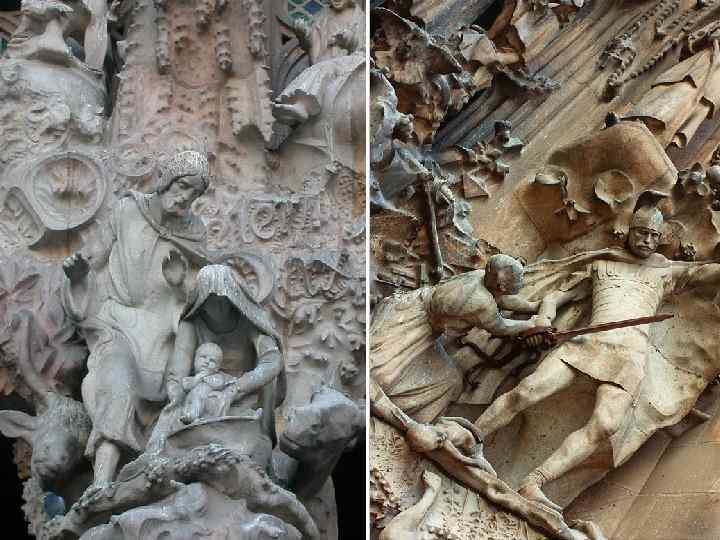
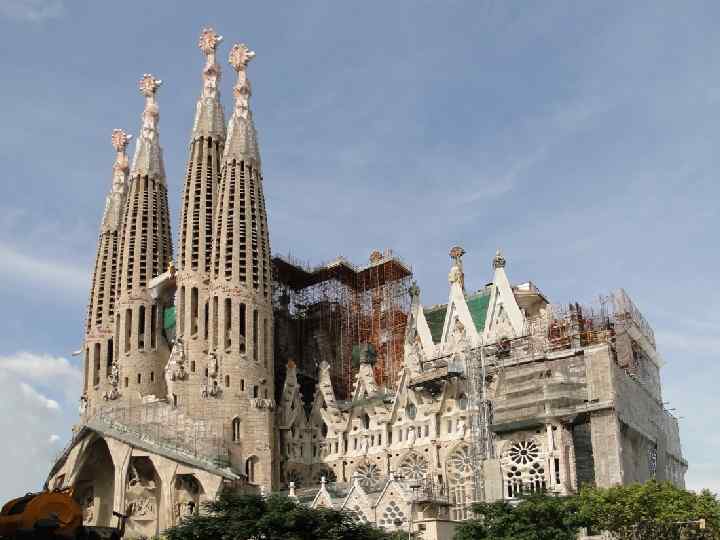
The Nativity Façade was built before work was interrupted in 1935 on the beginning of civil war in Spain. The decoration was finished by Gaudí himself and is ornamented in a Baroque fashion with motifs of animals and plants. It was dedicated to the birth of Jesus and decorated with scenes from his life. It is divided into three porticos. Each portico represents a Christian virtue (Hope, Faith and Charity). The Tree of Life – the Cypress – rises above the door of Jesus in the portico of Charity. Four bell towers complete the facade. Each one is dedicated to a Saint (Matthias the Apostle, Saint Barnabas, Jude the Apostle, and Simon the Zealot).
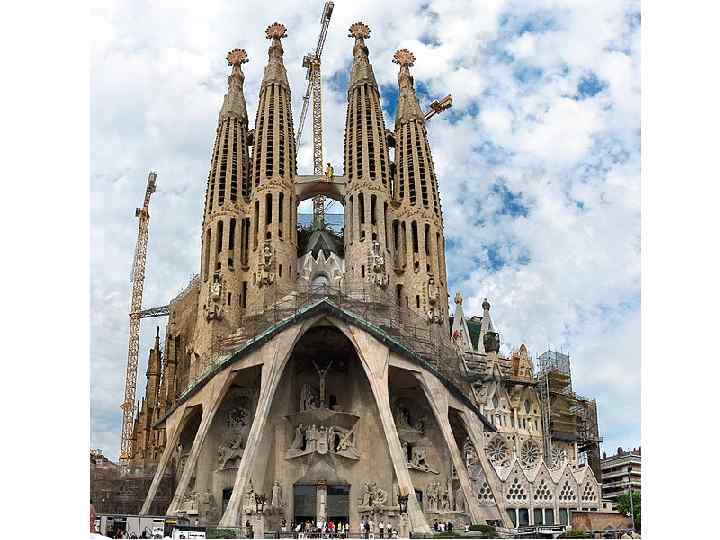
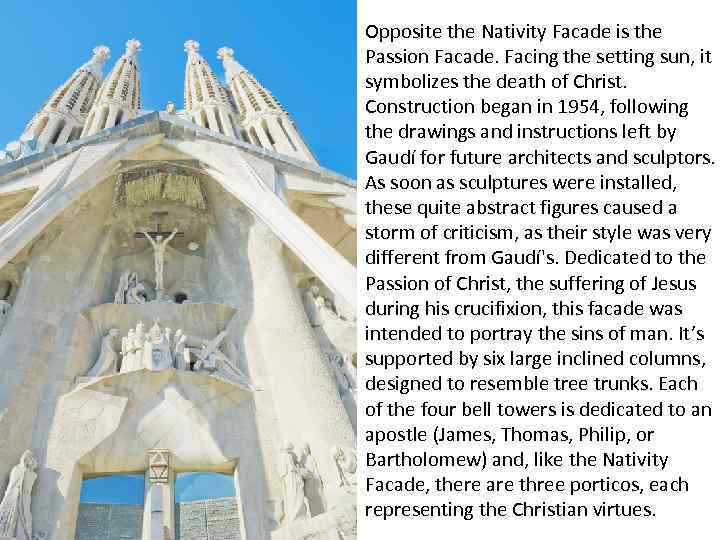
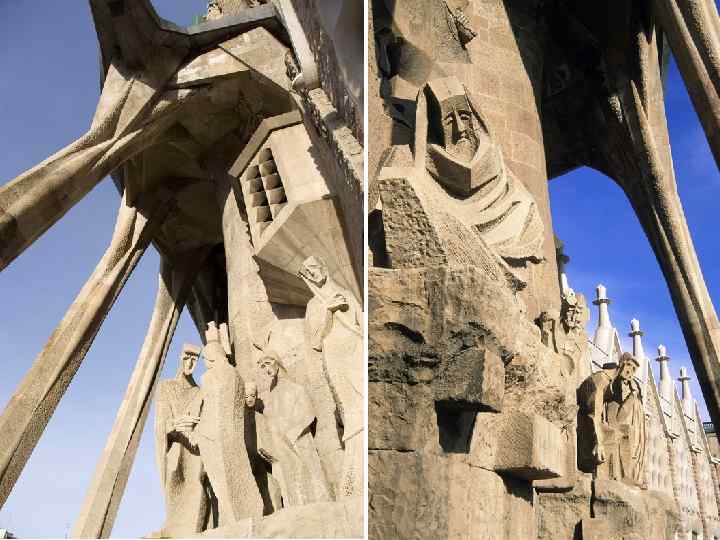
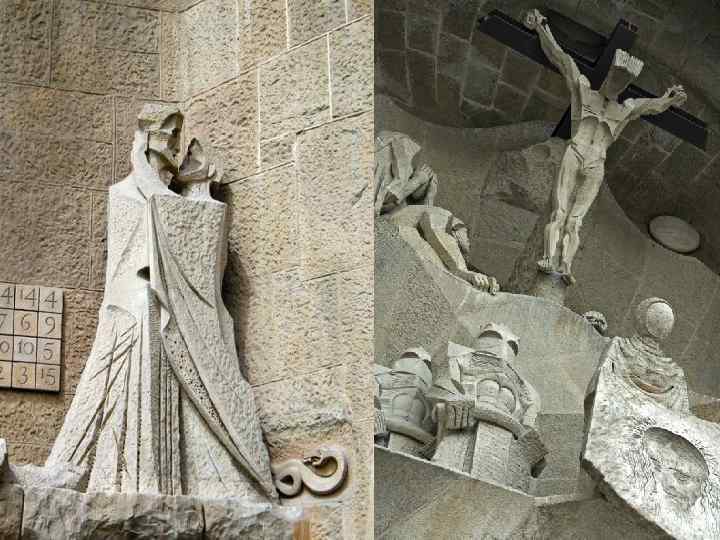
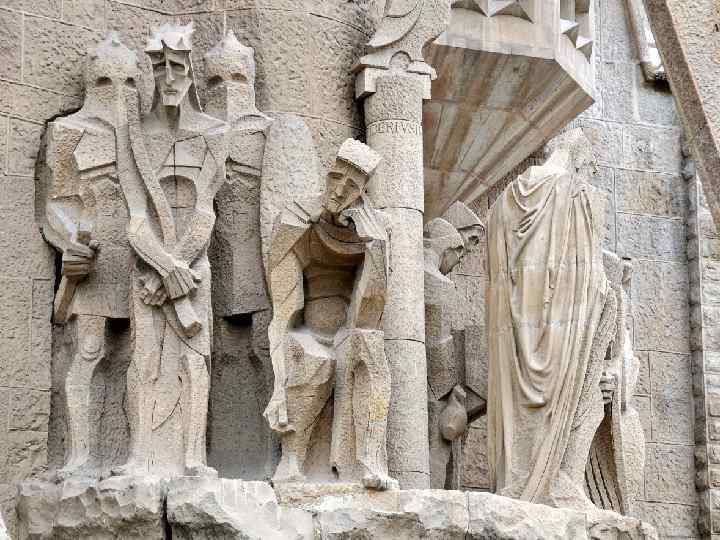
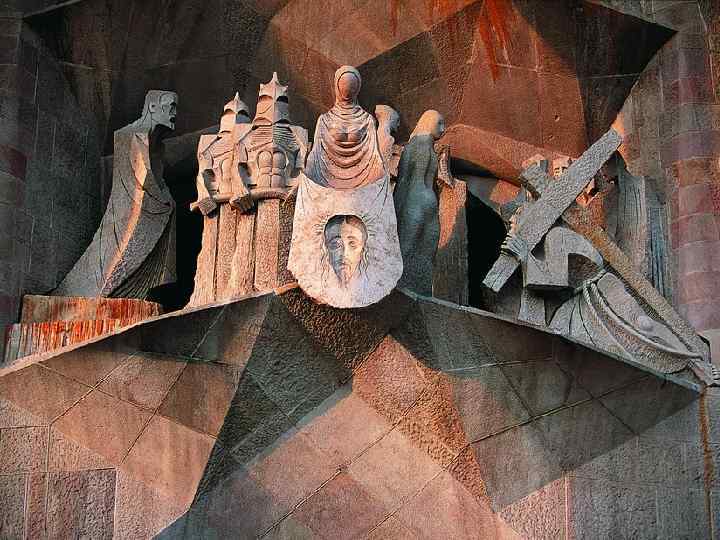
Opposite the Nativity Facade is the Passion Facade. Facing the setting sun, it symbolizes the death of Christ. Construction began in 1954, following the drawings and instructions left by Gaudí for future architects and sculptors. As soon as sculptures were installed, these quite abstract figures caused a storm of criticism, as their style was very different from Gaudí's. Dedicated to the Passion of Christ, the suffering of Jesus during his crucifixion, this facade was intended to portray the sins of man. It’s supported by six large inclined columns, designed to resemble tree trunks. Each of the four bell towers is dedicated to an apostle (James, Thomas, Philip, or Bartholomew) and, like the Nativity Faсade, there are three porticos, each representing the Christian virtues.
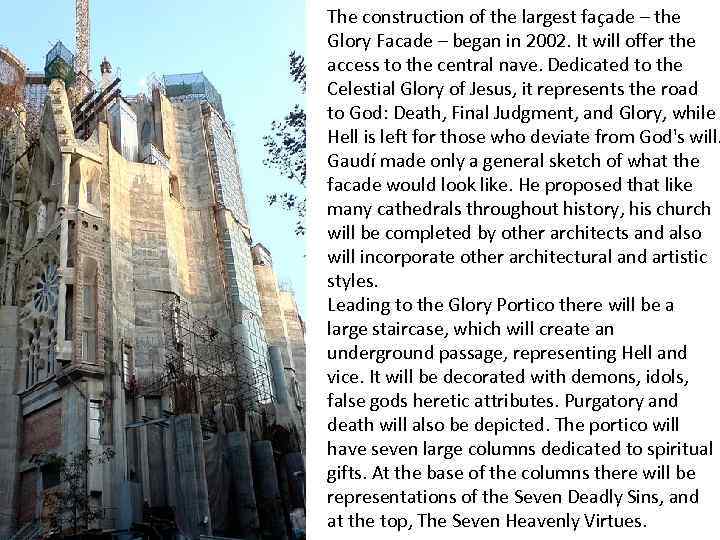
The construction of the largest façade – the Glory Faсade – began in 2002. It will offer the access to the central nave. Dedicated to the Celestial Glory of Jesus, it represents the road to God: Death, Final Judgment, and Glory, while Hell is left for those who deviate from God's will. Gaudí made only a general sketch of what the facade would look like. He proposed that like many cathedrals throughout history, his church will be completed by other architects and also will incorporate other architectural and artistic styles. Leading to the Glory Portico there will be a large staircase, which will create an underground passage, representing Hell and vice. It will be decorated with demons, idols, false gods heretic attributes. Purgatory and death will also be depicted. The portico will have seven large columns dedicated to spiritual gifts. At the base of the columns there will be representations of the Seven Deadly Sins, and at the top, The Seven Heavenly Virtues.
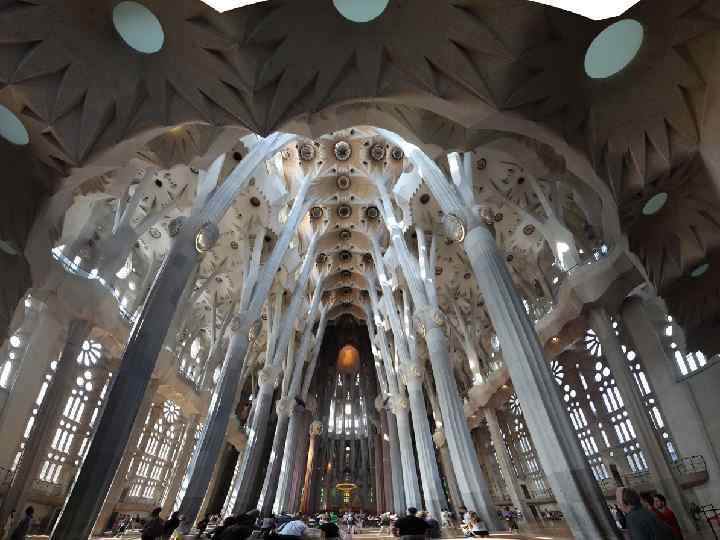
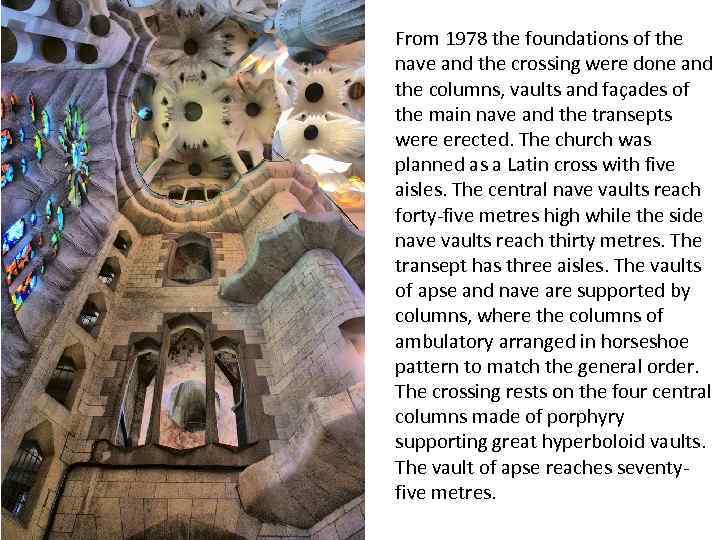
From 1978 the foundations of the nave and the crossing were done and the columns, vaults and façades of the main nave and the transepts were erected. The church was planned as a Latin cross with five aisles. The central nave vaults reach forty-five metres high while the side nave vaults reach thirty metres. The transept has three aisles. The vaults of apse and nave are supported by columns, where the columns of ambulatory arranged in horseshoe pattern to match the general order. The crossing rests on the four central columns made of porphyry supporting great hyperboloid vaults. The vault of apse reaches seventyfive metres.
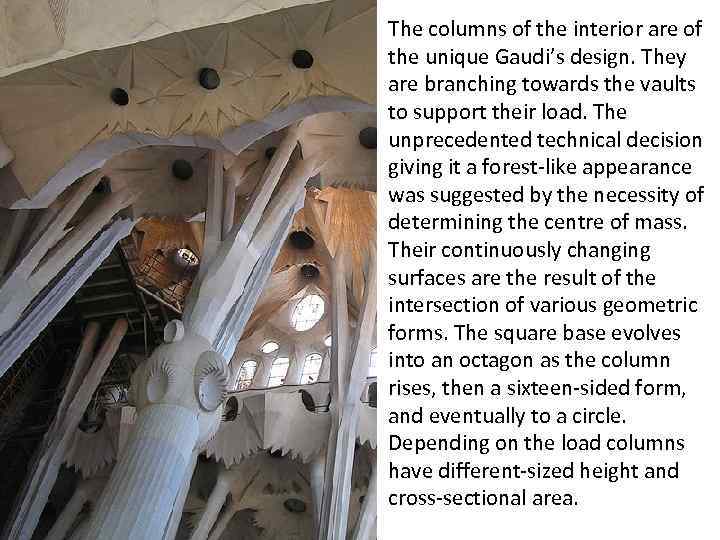
The columns of the interior are of the unique Gaudi’s design. They are branching towards the vaults to support their load. The unprecedented technical decision giving it a forest-like appearance was suggested by the necessity of determining the centre of mass. Their continuously changing surfaces are the result of the intersection of various geometric forms. The square base evolves into an octagon as the column rises, then a sixteen-sided form, and eventually to a circle. Depending on the load columns have different-sized height and cross-sectional area.
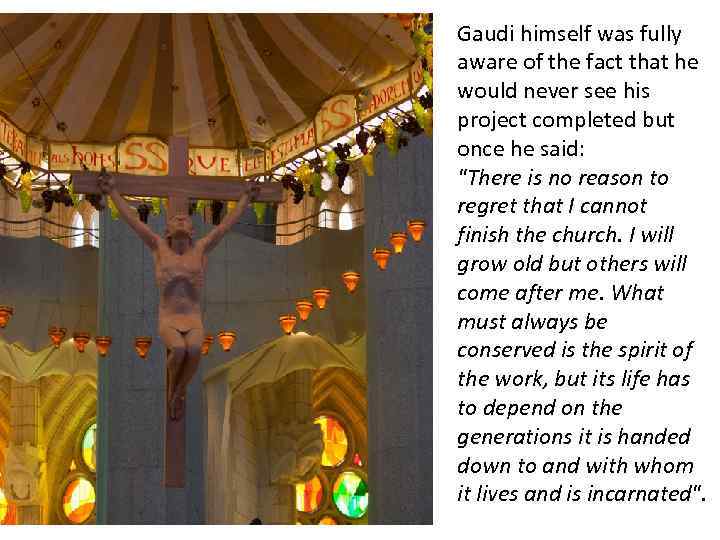
Gaudi himself was fully aware of the fact that he would never see his project completed but once he said: "There is no reason to regret that I cannot finish the church. I will grow old but others will come after me. What must always be conserved is the spirit of the work, but its life has to depend on the generations it is handed down to and with whom it lives and is incarnated".
Скачать презентацию La Sagrada Família Basilica and Expiatory Church of
Sagrada Familia.ppt