


 Скачать презентацию La G e Die Geographie der Sprache ogra
caf182c87d5dd9e13f86081733fc6cb4.ppt
- Количество слайдов: 46
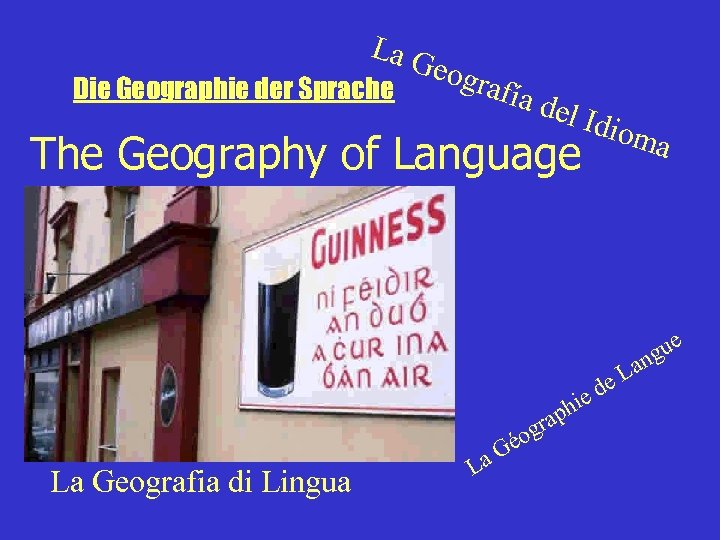 La G e Die Geographie der Sprache ogra fía d el Id iom a The Geography of Language e gu an hie ap gr éo La Geografia di Lingua a. G L e. L d
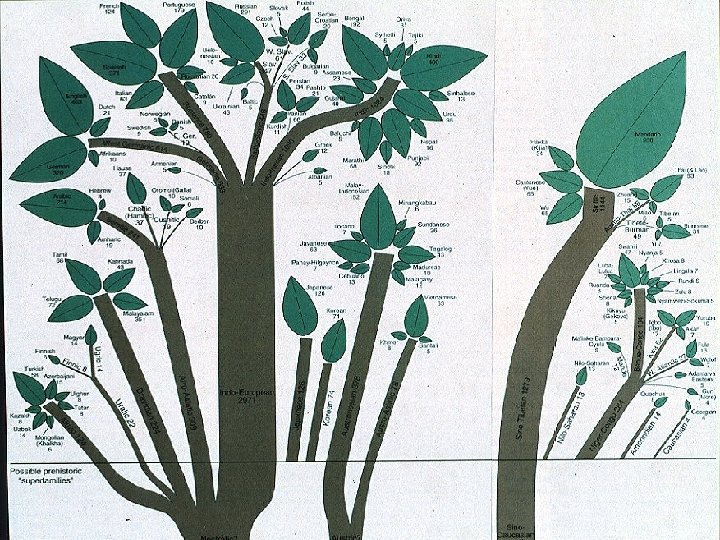
 Language Defined Organized system of spoken words by which people communicate with one another with mutual comprehension (Getis, 1985). • Languages subtly gradate one to another. Dialects and other regional differences may eventually lead to incomprehensibility - a new language. • Migration and Isolation explain how a single language can later become two or more.
 Geographer’s Perspective on Language • Language is an essential element of culture, possibly the most important medium by which culture is transmitted. • Languages even structure the perceptions of their speakers. Attitudes, understandings, and responses are partly determined by the words available. • Languages are a hallmark of cultural diversity with distinctive regional distributions.
 Language Distribution indicates • • History and conquest Isolation or integration of cultures Migration of peoples Economic Domination of certain cultures Influence of wealth and technology Political Divisions (country boundaries) Physical geography barriers (mts. , deserts)
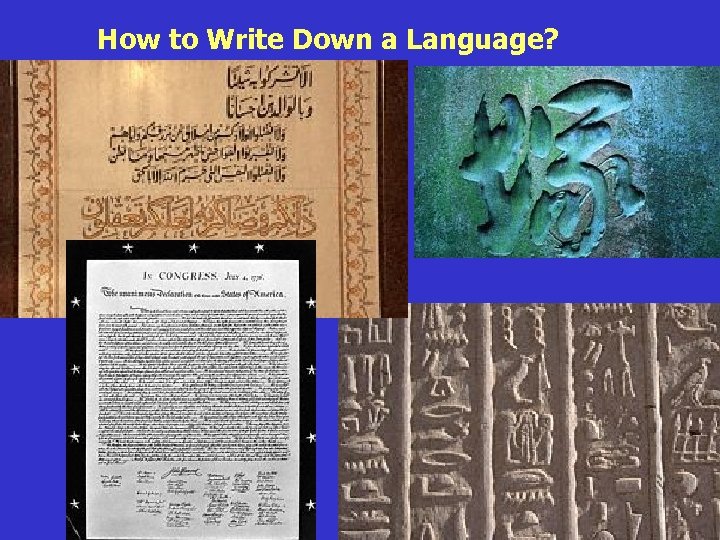 How to Write Down a Language? Roots of Language
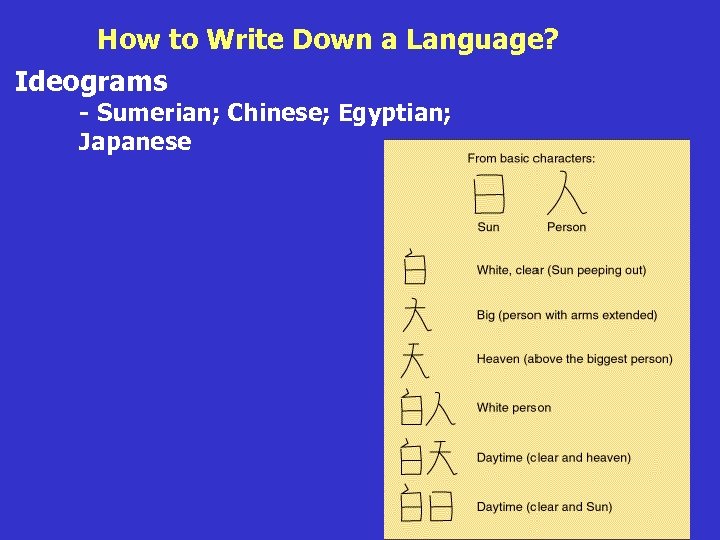 How to Write Down a Language? Ideogramsof Language Roots - Sumerian; Chinese; Egyptian; Japanese
 How to Write Down a Language? Roots Phonetic of Language - Most languages, including Romance languages Symbols (letters) represent sounds, not ideas. A phonetic alphabet is the key innovation.
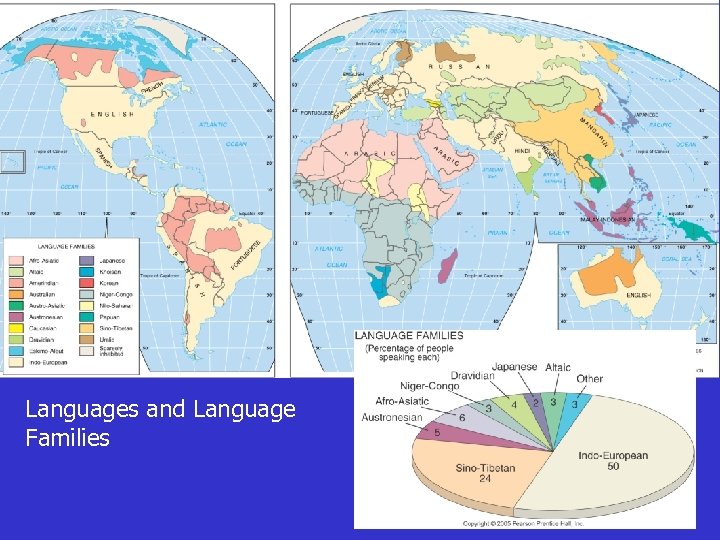 Languages and Language Families
 Language Divisions • Language Families • Language Branches • Language Groups • Languages • Dialects • Accents
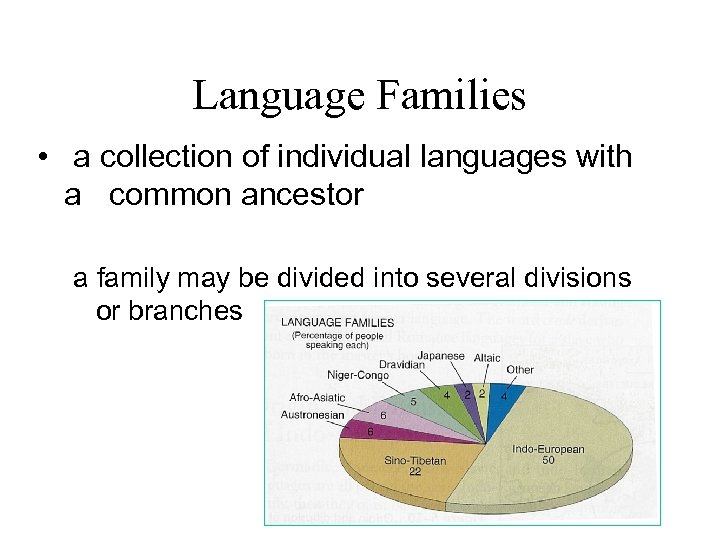 Language Families • a collection of individual languages with a common ancestor a family may be divided into several divisions or branches
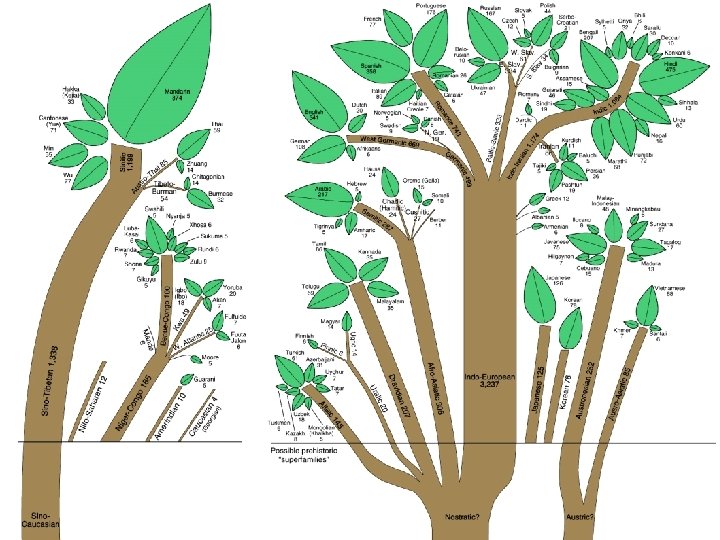
 Language Branches • a group of languages that share a common origin but have evolved into different languages • example: Romance Branch - Indo-European Family – French, Spanish, Portuguese, Romanch
 Language Groups • Several individual languages within a language branch – share a common origin in recent past – few differences in grammar and vocabulary
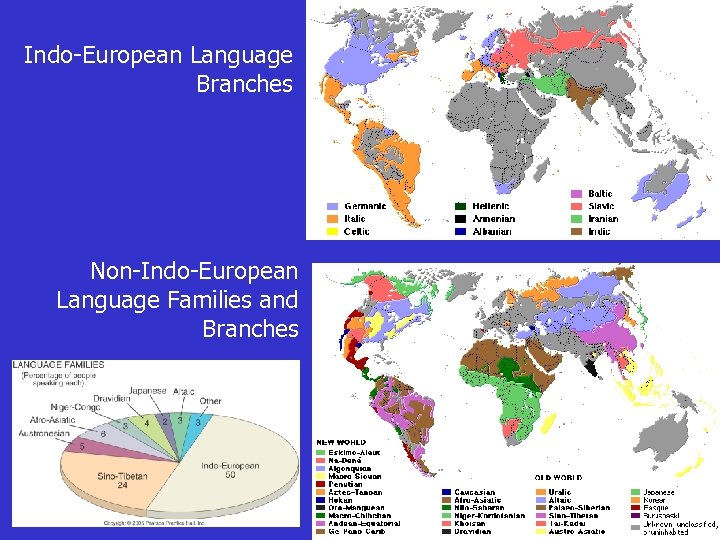 Indo-European Language Branches Non-Indo-European Language Families and Branches
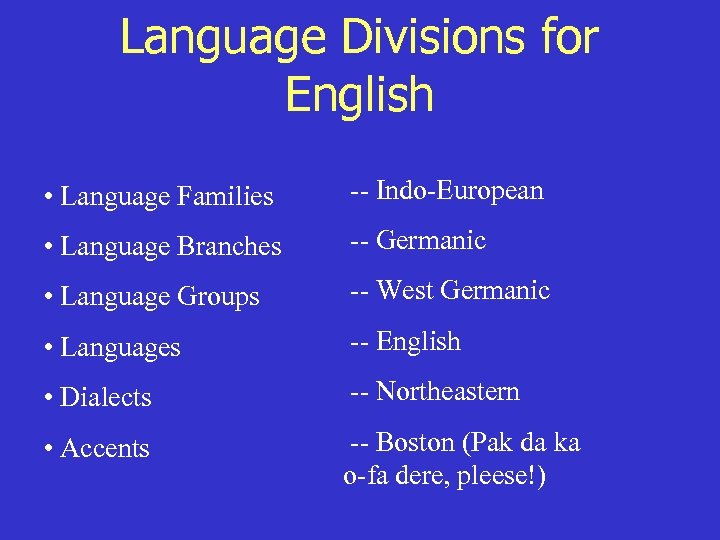 Language Divisions for English • Language Families -- Indo-European • Language Branches -- Germanic • Language Groups -- West Germanic • Languages -- English • Dialects -- Northeastern • Accents -- Boston (Pak da ka o-fa dere, pleese!)
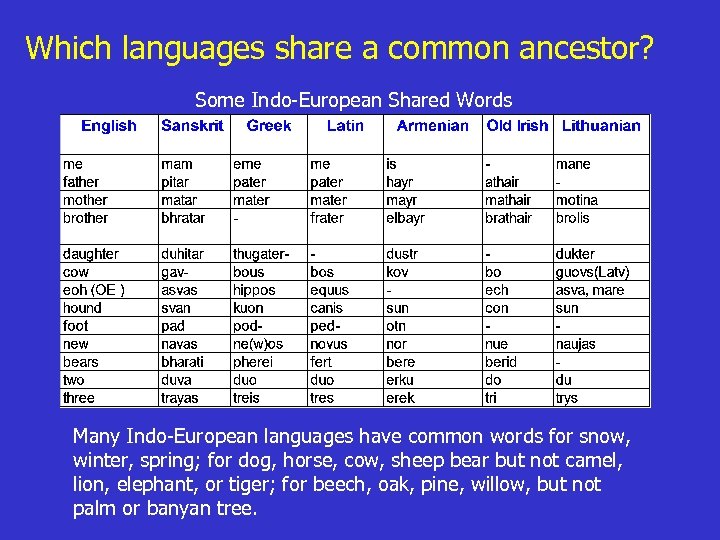 Which languages share a common ancestor? Some Indo-European Shared Words Many Indo-European languages have common words for snow, winter, spring; for dog, horse, cow, sheep bear but not camel, lion, elephant, or tiger; for beech, oak, pine, willow, but not palm or banyan tree.
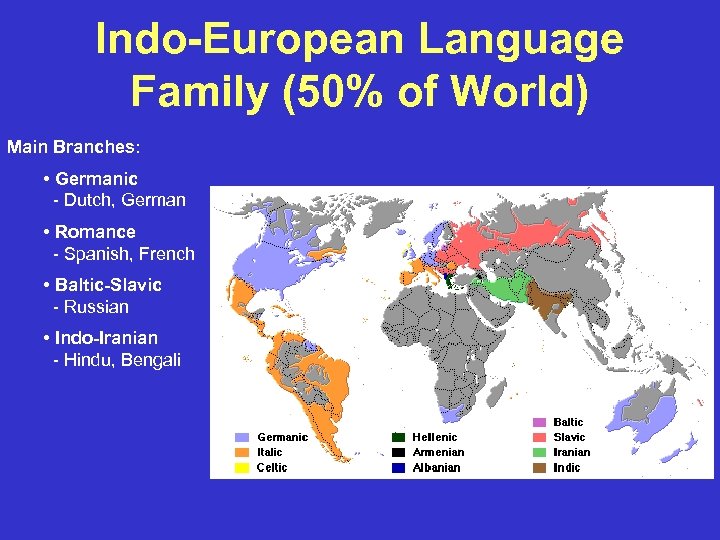 Indo-European Language Family (50% of World) Main Branches: • Germanic - Dutch, German • Romance - Spanish, French • Baltic-Slavic - Russian • Indo-Iranian - Hindu, Bengali
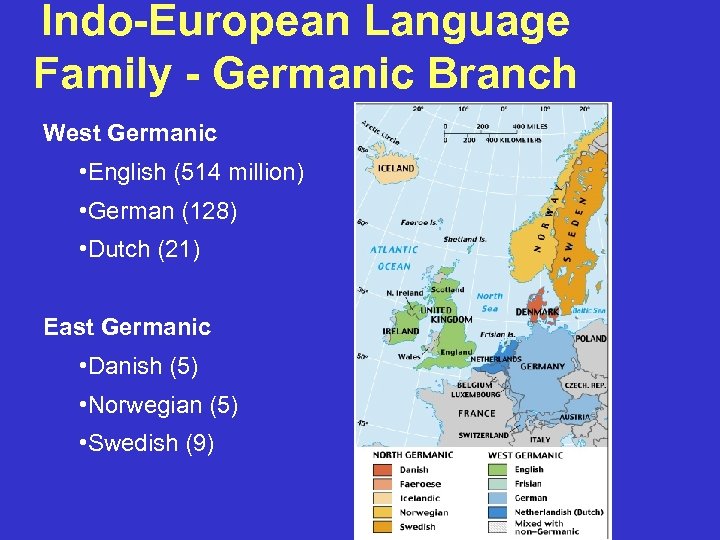 Indo-European Language Family - Germanic Branch West Germanic • English (514 million) • German (128) • Dutch (21) East Germanic • Danish (5) • Norwegian (5) • Swedish (9)
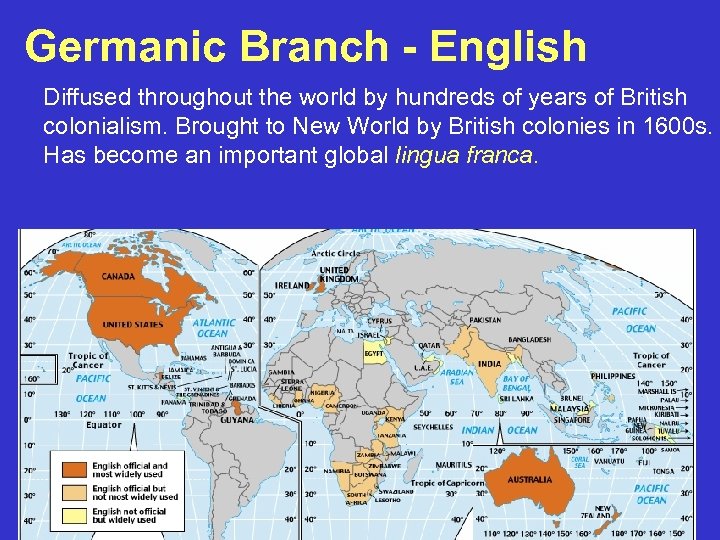 Germanic Branch - English Diffused throughout the world by hundreds of years of British colonialism. Brought to New World by British colonies in 1600 s. Has become an important global lingua franca.
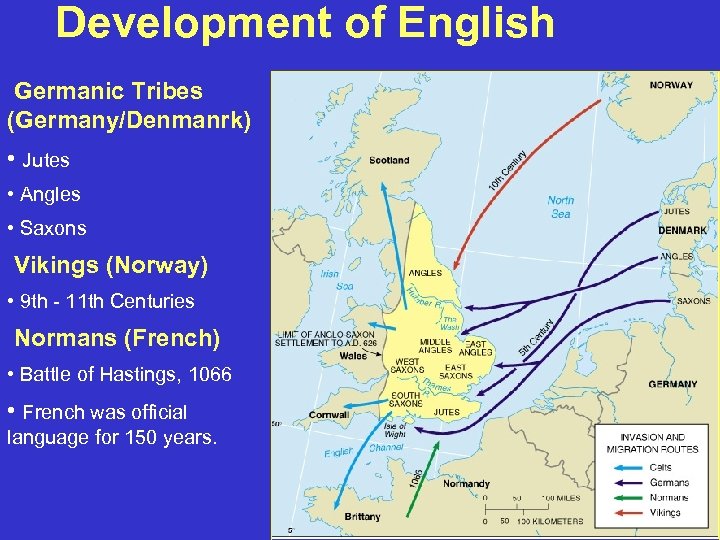 Development of English Germanic Tribes (Germany/Denmanrk) • Jutes • Angles • Saxons Vikings (Norway) • 9 th - 11 th Centuries Normans (French) • Battle of Hastings, 1066 • French was official language for 150 years.
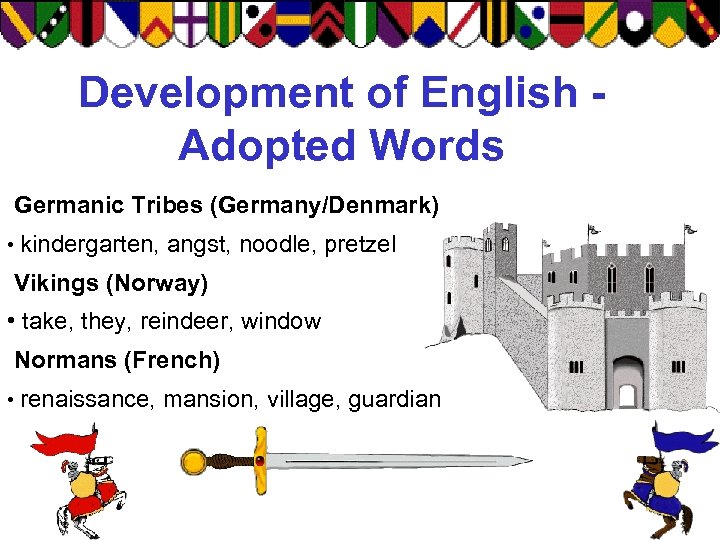 Development of English Adopted Words Germanic Tribes (Germany/Denmark) • kindergarten, angst, noodle, pretzel Vikings (Norway) • take, they, reindeer, window Normans (French) • renaissance, mansion, village, guardian
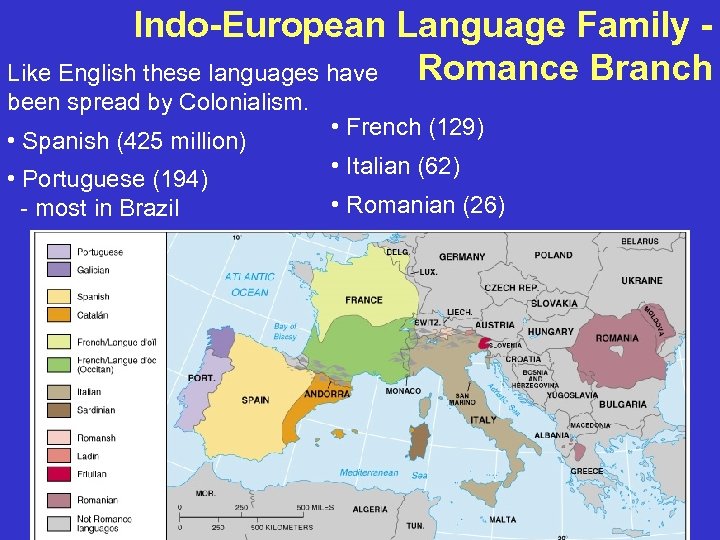 Indo-European Language Family Romance Branch Like English these languages have been spread by Colonialism. • Spanish (425 million) • Portuguese (194) - most in Brazil • French (129) • Italian (62) • Romanian (26)
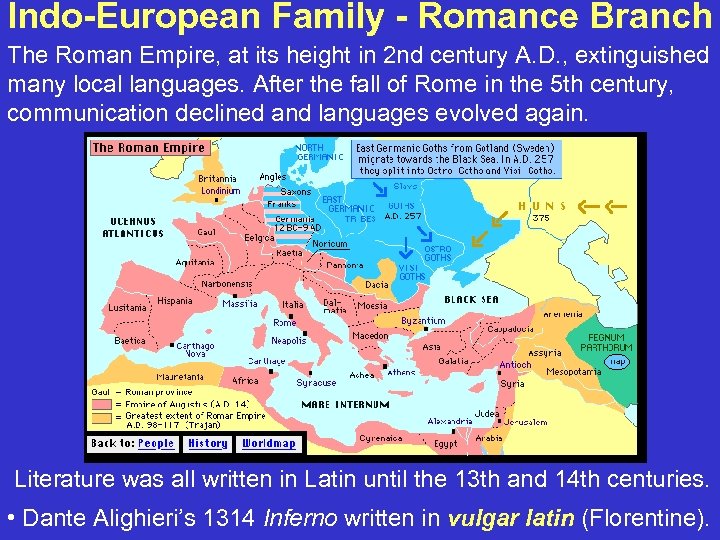 Indo-European Family - Romance Branch The Roman Empire, at its height in 2 nd century A. D. , extinguished many local languages. After the fall of Rome in the 5 th century, communication declined and languages evolved again. Literature was all written in Latin until the 13 th and 14 th centuries. • Dante Alighieri’s 1314 Inferno written in vulgar latin (Florentine).
 English in Decline as a Language Assignment – Read answer the following: 1. Summarize the article. 2. What is the article suggesting? 3. Where does the article focus? 4. What type of diffusion does it illustrate? 5. What patterns do you see being created from the results? 6. Why are the results occurring? What systems and processes created this pattern? 7. Prediction – So what? What if? 8. Consider what will happen if English disappears, what do we make of this occurrence? How might technology influence the spread/decline of English?
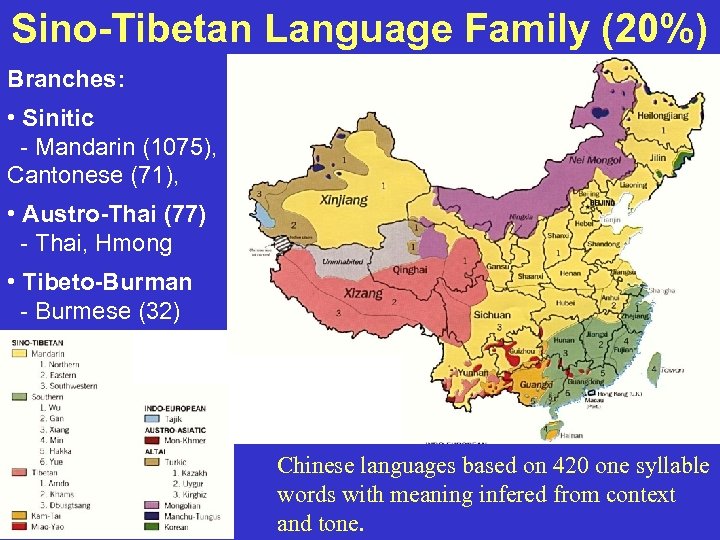 Sino-Tibetan Language Family (20%) Branches: • Sinitic - Mandarin (1075), Cantonese (71), • Austro-Thai (77) - Thai, Hmong • Tibeto-Burman - Burmese (32) Chinese languages based on 420 one syllable words with meaning infered from context and tone.
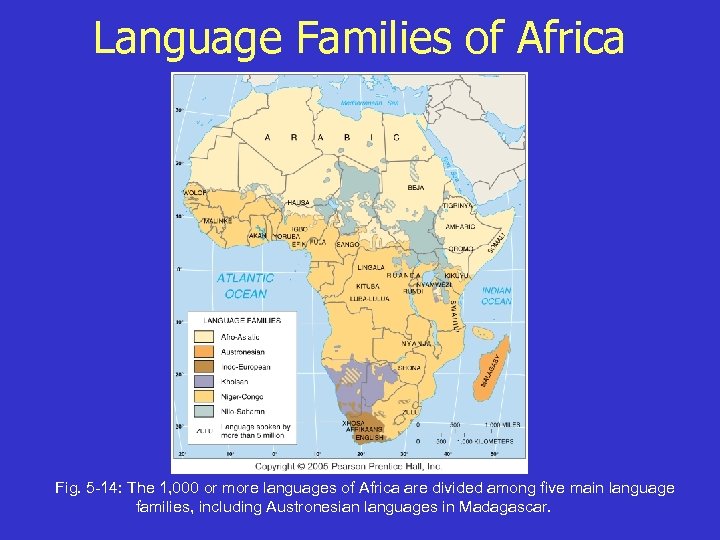 Language Families of Africa Fig. 5 -14: The 1, 000 or more languages of Africa are divided among five main language families, including Austronesian languages in Madagascar.
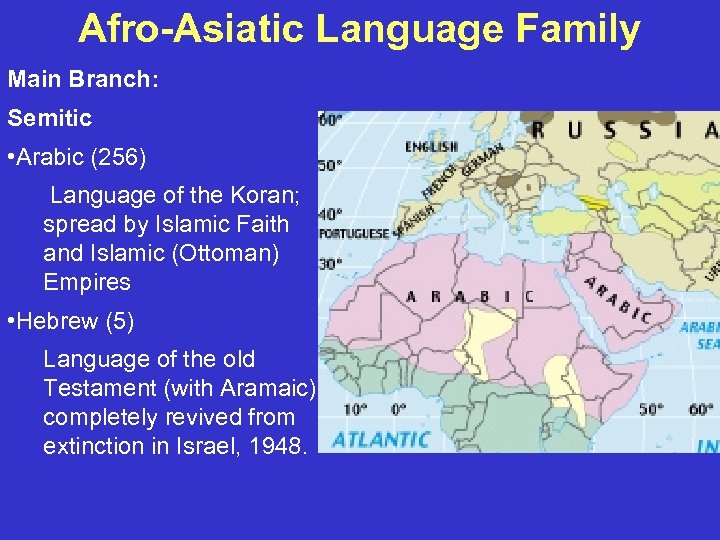 Afro-Asiatic Language Family Main Branch: Semitic • Arabic (256) Language of the Koran; spread by Islamic Faith and Islamic (Ottoman) Empires • Hebrew (5) Language of the old Testament (with Aramaic); completely revived from extinction in Israel, 1948.
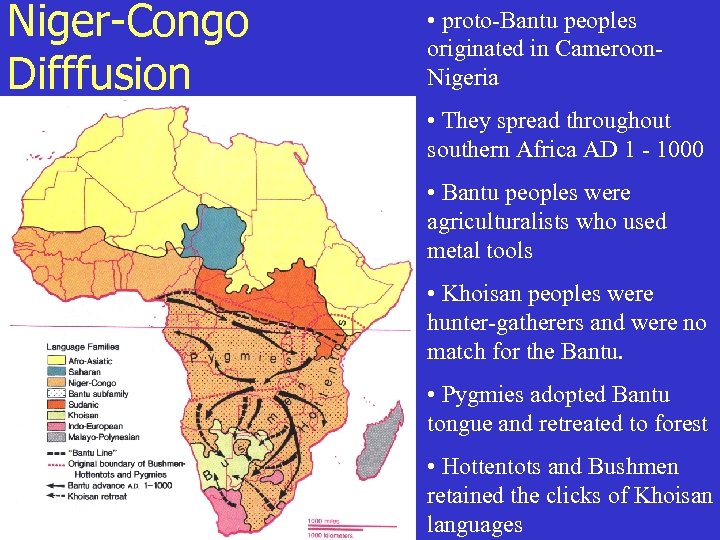 Niger-Congo Difffusion • proto-Bantu peoples originated in Cameroon. Nigeria • They spread throughout southern Africa AD 1 - 1000 • Bantu peoples were agriculturalists who used metal tools • Khoisan peoples were hunter-gatherers and were no match for the Bantu. • Pygmies adopted Bantu tongue and retreated to forest • Hottentots and Bushmen retained the clicks of Khoisan languages
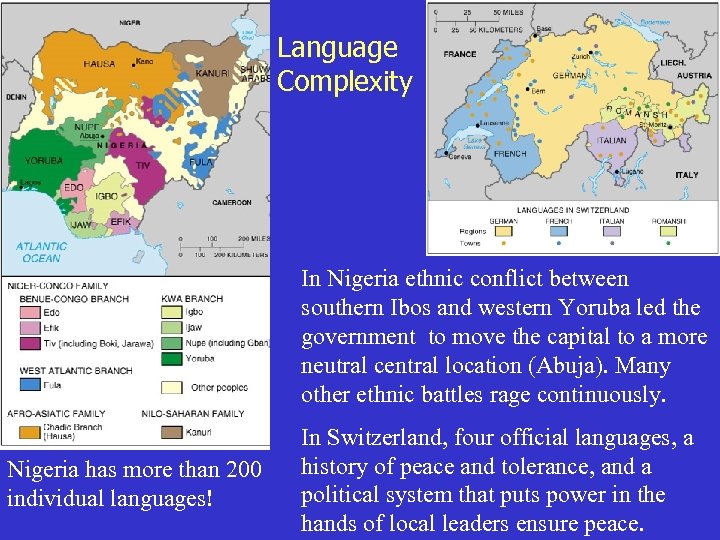 Language Complexity In Nigeria ethnic conflict between southern Ibos and western Yoruba led the government to move the capital to a more neutral central location (Abuja). Many other ethnic battles rage continuously. Nigeria has more than 200 individual languages! In Switzerland, four official languages, a history of peace and tolerance, and a political system that puts power in the hands of local leaders ensure peace.
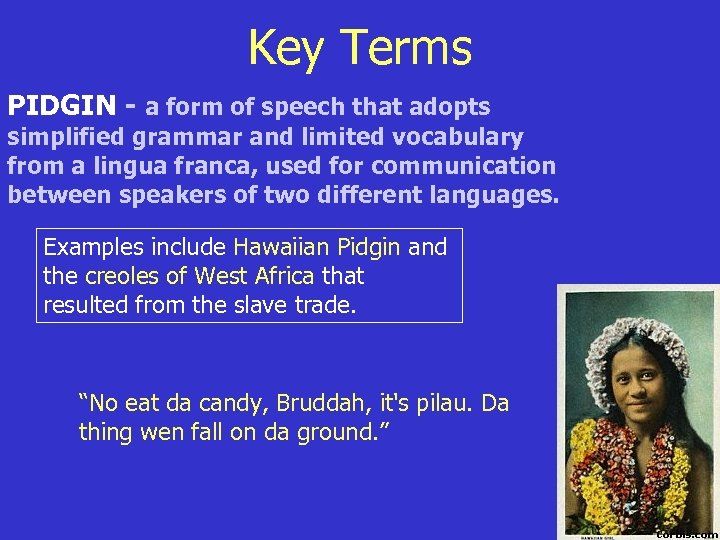 Key Terms PIDGIN - a form of speech that adopts simplified grammar and limited vocabulary from a lingua franca, used for communication between speakers of two different languages. Examples include Hawaiian Pidgin and the creoles of West Africa that resulted from the slave trade. “No eat da candy, Bruddah, it's pilau. Da thing wen fall on da ground. ”
 Give us da food we need fo today an every day. Hemmo our shame, an let us go Fo all da kine bad stuff we do to you, Jalike us guys let da odda guys go awready, And we no stay huhu wit dem Fo all da kine bad stuff dey do to us. No let us get chance fo do bad kine stuff, But take us outa dea, so da Bad Guy no can hurt us. Cuz you our King. You get da real power, An you stay awesome foeva. Dass it!” Matthew 6: 9 -13 “The Lord’s Prayer” - Taken from Da Jesus Book, a twelve year effort by 6 linguists to translate the New Testament into Hawaiian Pidgin, published 2001
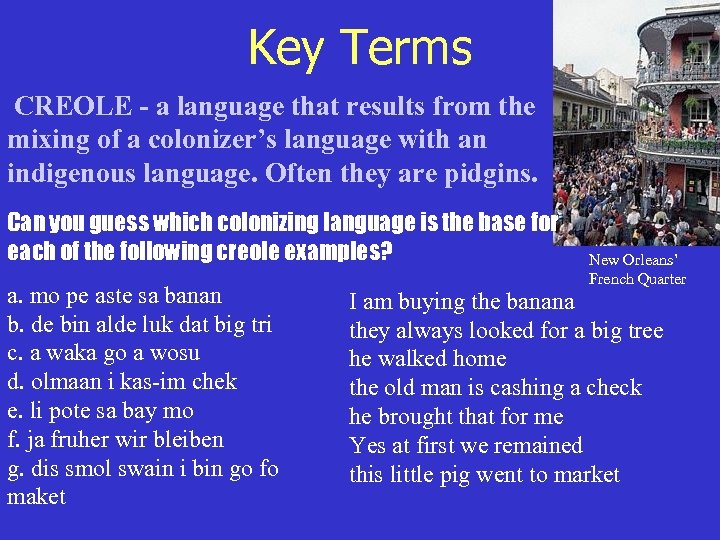 Key Terms CREOLE - a language that results from the mixing of a colonizer’s language with an indigenous language. Often they are pidgins. Can you guess which colonizing language is the base for each of the following creole examples? a. mo pe aste sa banan b. de bin alde luk dat big tri c. a waka go a wosu d. olmaan i kas-im chek e. li pote sa bay mo f. ja fruher wir bleiben g. dis smol swain i bin go fo maket New Orleans’ French Quarter I am buying the banana they always looked for a big tree he walked home the old man is cashing a check he brought that for me Yes at first we remained this little pig went to market
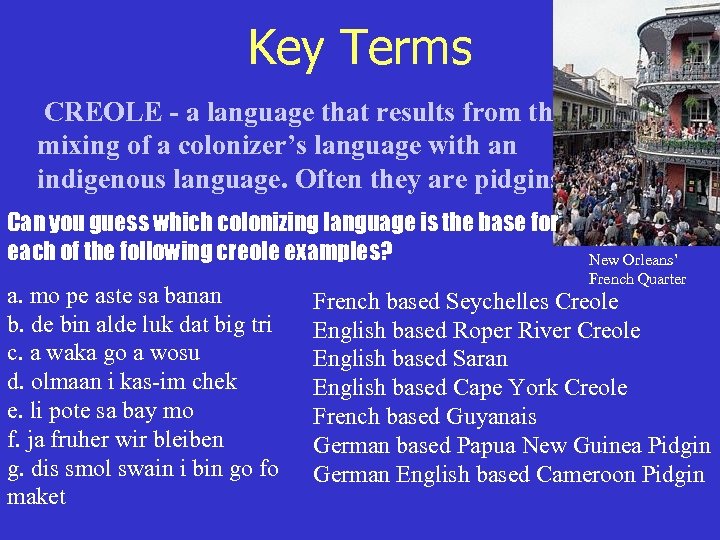 Key Terms CREOLE - a language that results from the mixing of a colonizer’s language with an indigenous language. Often they are pidgins Can you guess which colonizing language is the base for each of the following creole examples? a. mo pe aste sa banan b. de bin alde luk dat big tri c. a waka go a wosu d. olmaan i kas-im chek e. li pote sa bay mo f. ja fruher wir bleiben g. dis smol swain i bin go fo maket New Orleans’ French Quarter French based Seychelles Creole English based Roper River Creole English based Saran English based Cape York Creole French based Guyanais German based Papua New Guinea Pidgin German English based Cameroon Pidgin
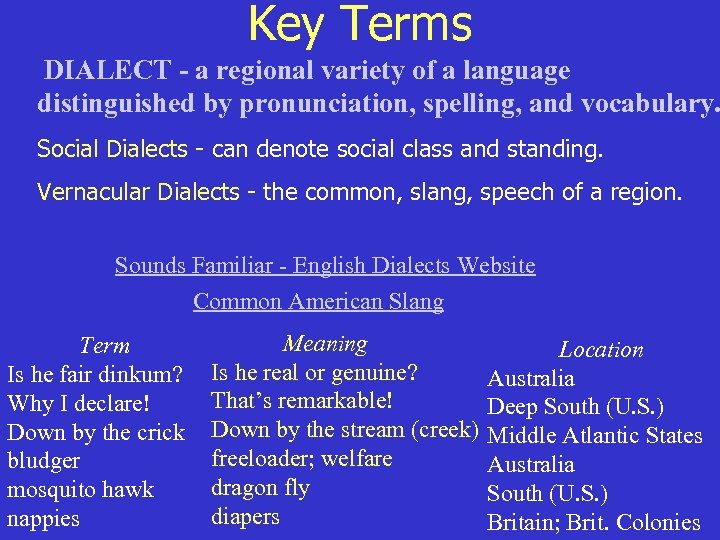 Key Terms DIALECT - a regional variety of a language distinguished by pronunciation, spelling, and vocabulary. Social Dialects - can denote social class and standing. Vernacular Dialects - the common, slang, speech of a region. Sounds Familiar - English Dialects Website Common American Slang Term Is he fair dinkum? Why I declare! Down by the crick bludger mosquito hawk nappies Meaning Is he real or genuine? That’s remarkable! Down by the stream (creek) freeloader; welfare dragon fly diapers Location Australia Deep South (U. S. ) Middle Atlantic States Australia South (U. S. ) Britain; Brit. Colonies
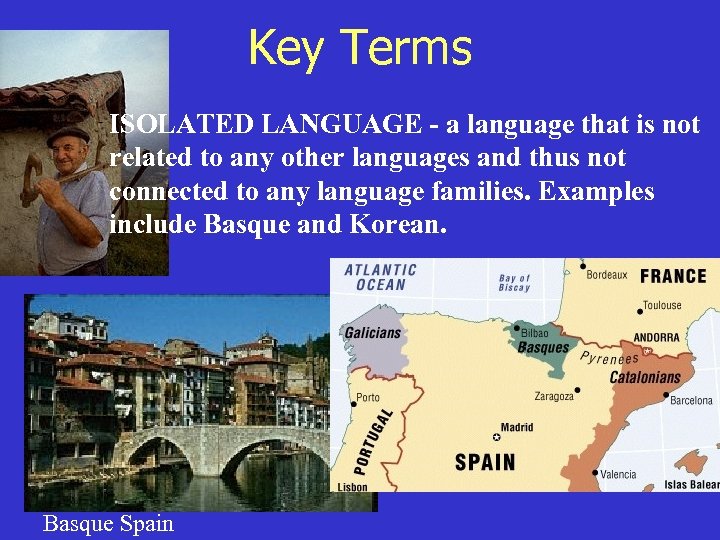 Key Terms ISOLATED LANGUAGE - a language that is not related to any other languages and thus not connected to any language families. Examples include Basque and Korean. Basque Spain
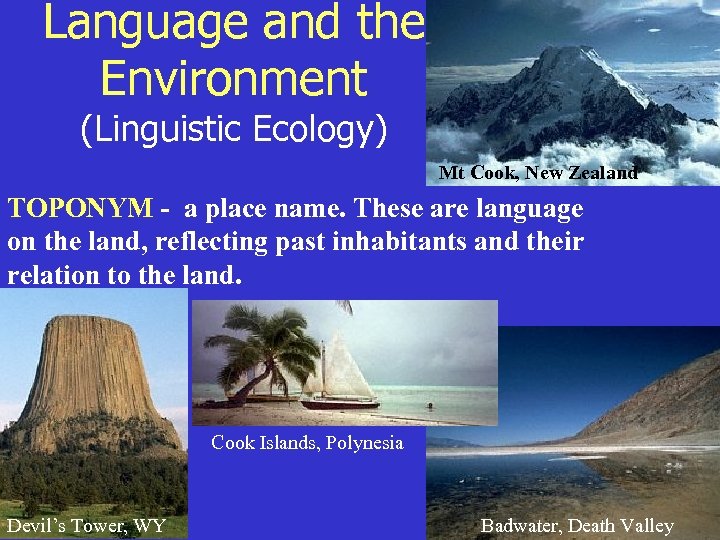 Language and the Environment (Linguistic Ecology) Mt Cook, New Zealand TOPONYM - a place name. These are language on the land, reflecting past inhabitants and their relation to the land. Cook Islands, Polynesia Devil’s Tower, WY Badwater, Death Valley
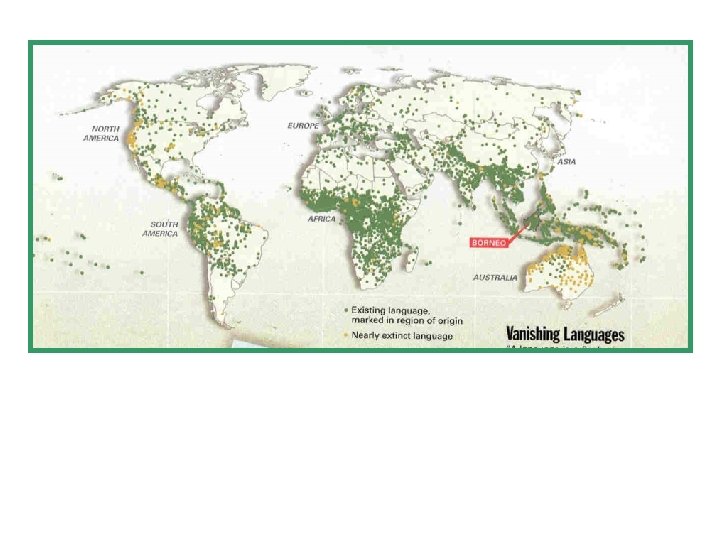
 Endangered Languages As recently as 3, 000 years ago, there were 10, 000 to 15, 000 languages in the world. Now: about 6000 left. Of those, 1/2 will be gone by the year 2100 and all but 500 of the rest will be endangered. More than 90 percent of the languages in existence today will be extinct or threatened in little more than a century if current trends continue.
 Endangered Languages Why are they disappearing? Globalization Migration (Urbanization) Economic Development - Lingua Francas Media Internet (Requires Arabic Character Set) Lingua Franca - a language used for trade by two people who speak different native tongues.
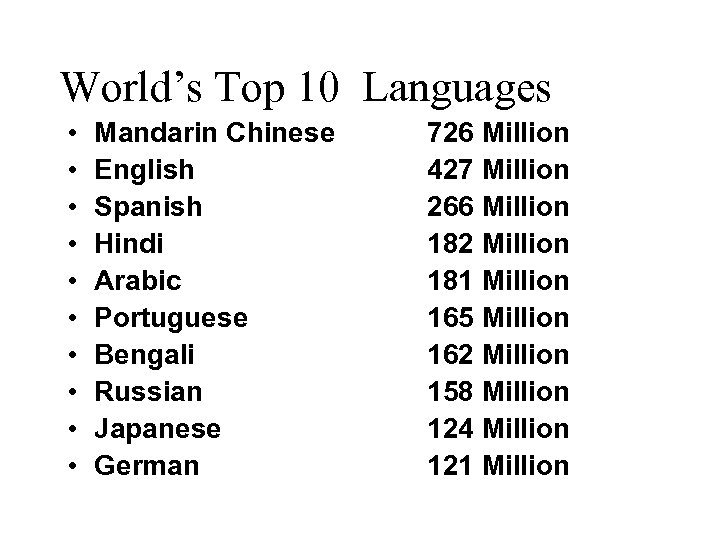 World’s Top 10 Languages • • • Mandarin Chinese English Spanish Hindi Arabic Portuguese Bengali Russian Japanese German 726 Million 427 Million 266 Million 182 Million 181 Million 165 Million 162 Million 158 Million 124 Million 121 Million
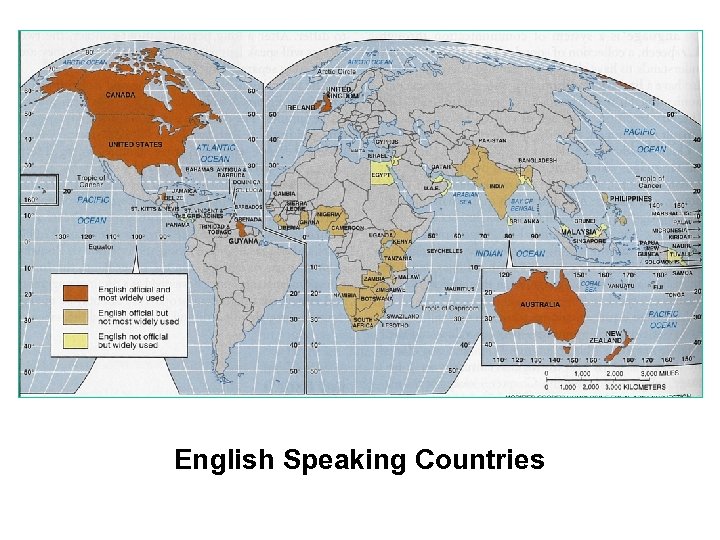 English Speaking Countries
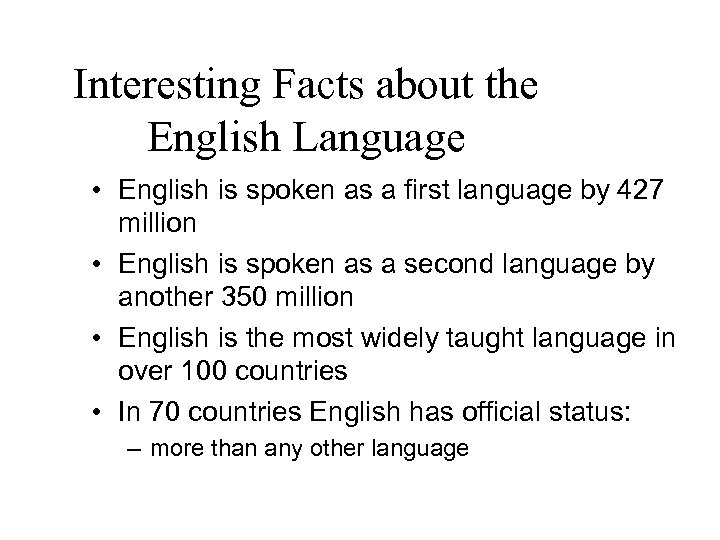 Interesting Facts about the English Language • English is spoken as a first language by 427 million • English is spoken as a second language by another 350 million • English is the most widely taught language in over 100 countries • In 70 countries English has official status: – more than any other language
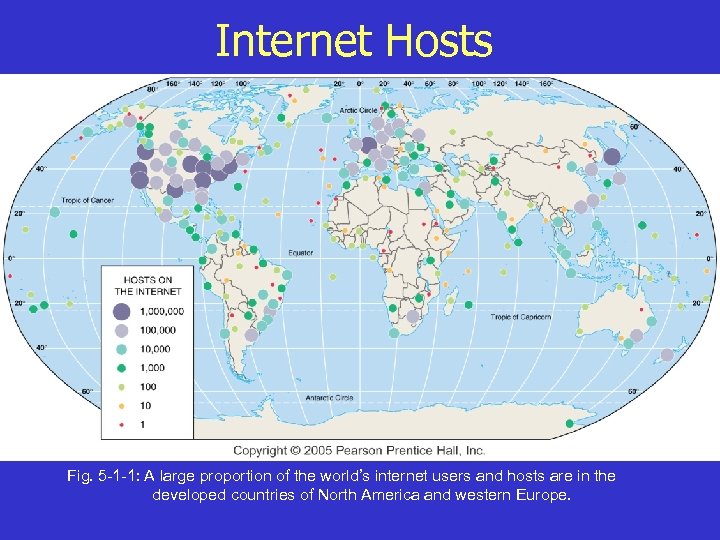 Internet Hosts Fig. 5 -1 -1: A large proportion of the world’s internet users and hosts are in the developed countries of North America and western Europe.
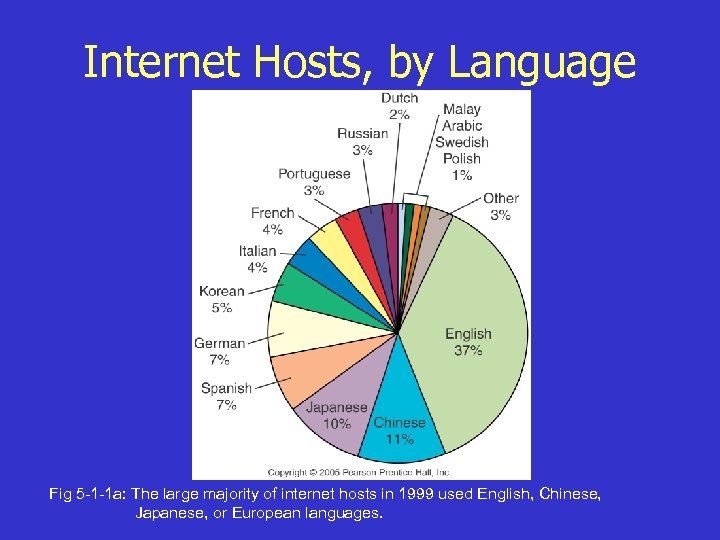 Internet Hosts, by Language Fig 5 -1 -1 a: The large majority of internet hosts in 1999 used English, Chinese, Japanese, or European languages.
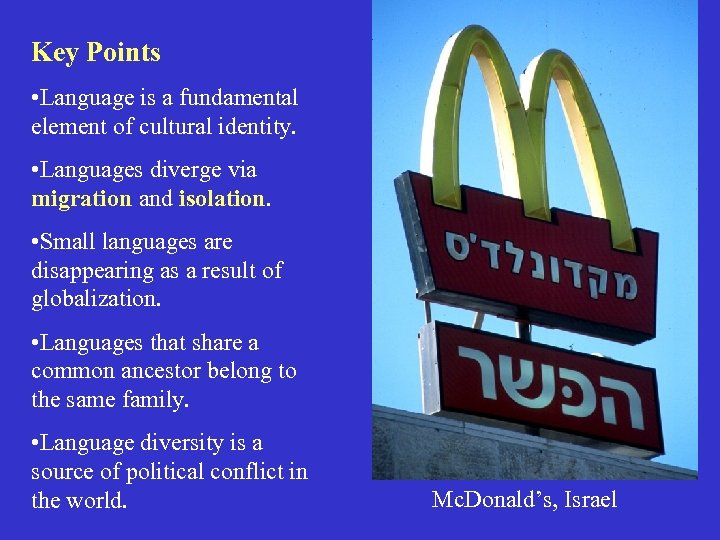 Key Points • Language is a fundamental element of cultural identity. • Languages diverge via migration and isolation. • Small languages are disappearing as a result of globalization. • Languages that share a common ancestor belong to the same family. • Language diversity is a source of political conflict in the world. Mc. Donald’s, Israel