 Скачать презентацию La bonne utilisation du dico How to use
979eb214c548d5d0cef1fd22e503a093.ppt
- Количество слайдов: 23



La bonne utilisation du dico! (How to use the dictionary efficiently)
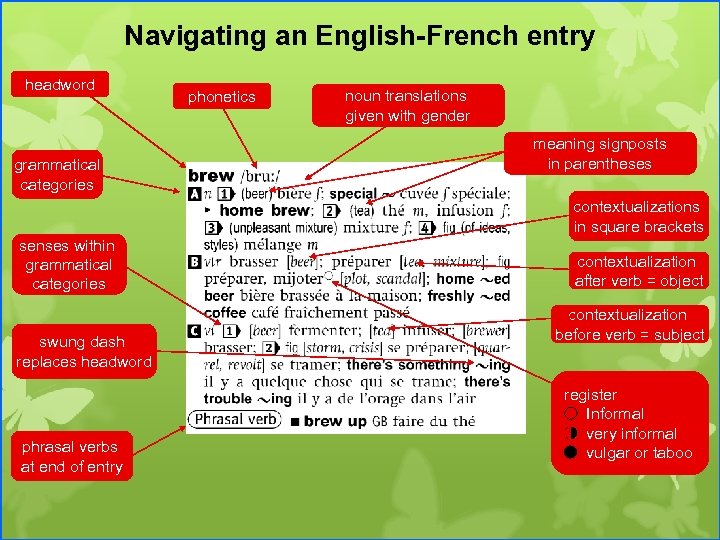
Navigating an English-French entry headword grammatical categories phonetics noun translations given with gender meaning signposts in parentheses contextualizations in square brackets senses within grammatical categories swung dash replaces headword phrasal verbs at end of entry contextualization after verb = object contextualization before verb = subject register Informal very informal vulgar or taboo
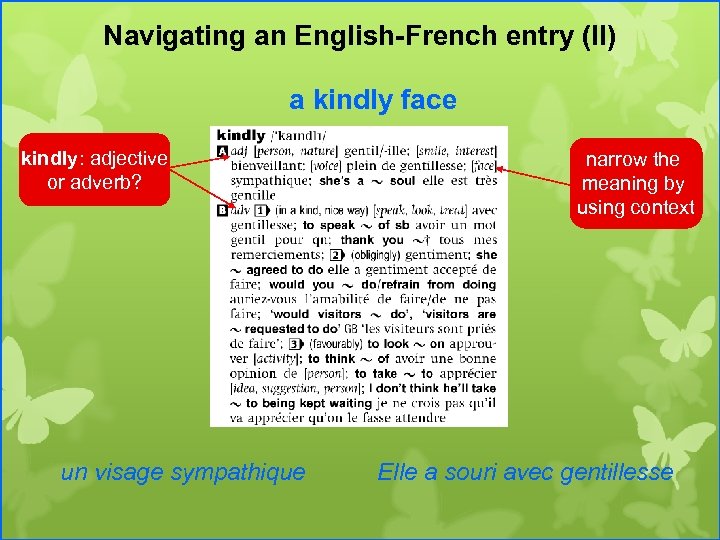
Navigating an English-French entry (II) a kindly face kindly: adjective or adverb? un visage sympathique narrow the meaning by using context Elle a souri avec gentillesse
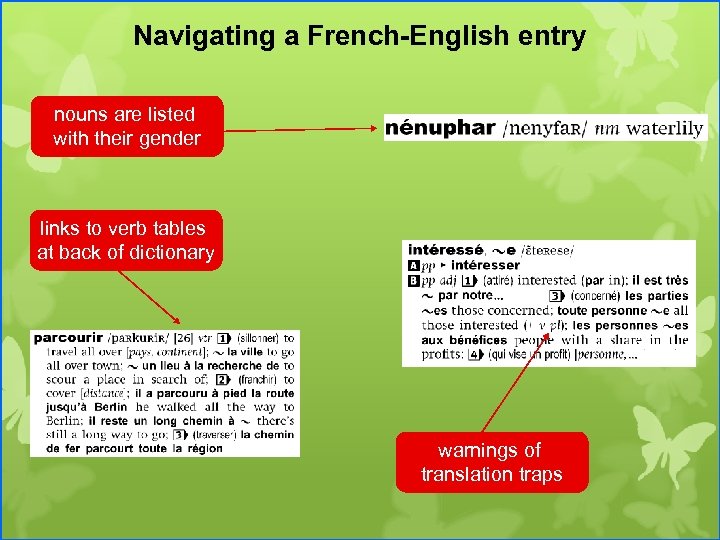
Navigating a French-English entry nouns are listed with their gender links to verb tables at back of dictionary warnings of translation traps
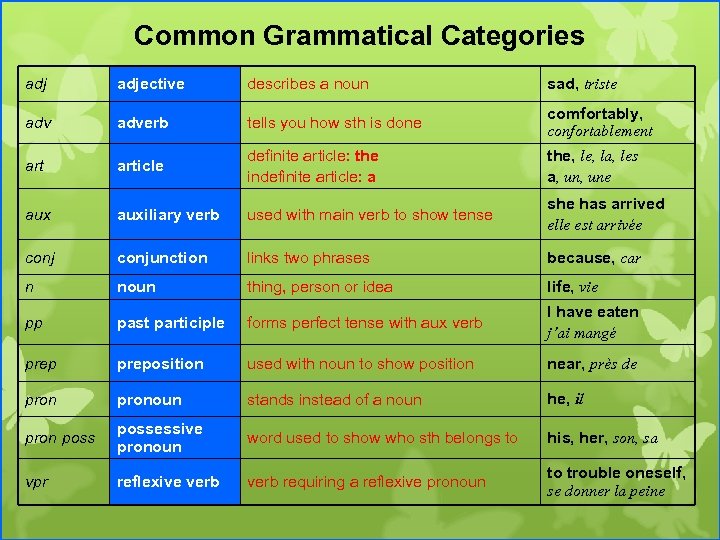
Common Grammatical Categories adjective describes a noun sad, triste adverb tells you how sth is done comfortably, confortablement article definite article: the indefinite article: a the, la, les a, une auxiliary verb used with main verb to show tense she has arrived elle est arrivée conjunction links two phrases because, car n noun thing, person or idea life, vie pp past participle forms perfect tense with aux verb I have eaten j’ai mangé preposition used with noun to show position near, près de pronoun stands instead of a noun he, il pron possessive pronoun word used to show who sth belongs to his, her, son, sa vpr reflexive verb requiring a reflexive pronoun to trouble oneself, se donner la peine
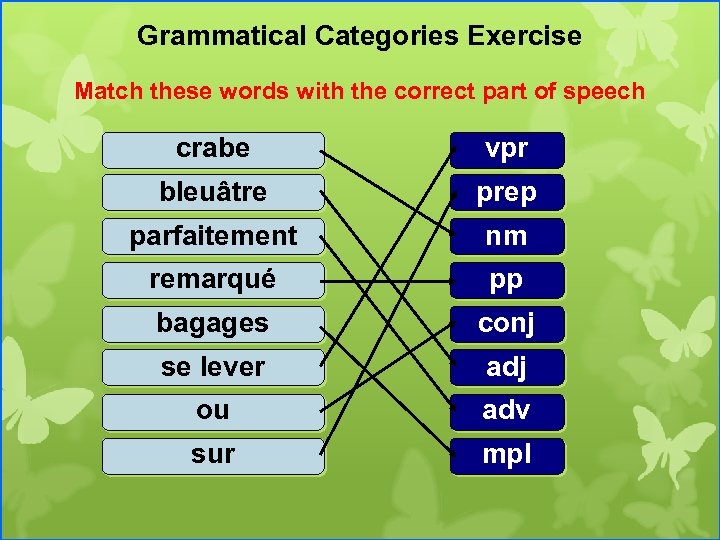
Grammatical Categories Exercise Match these words with the correct part of speech crabe vpr bleuâtre prep parfaitement nm remarqué pp bagages conj se lever adj ou adv sur mpl
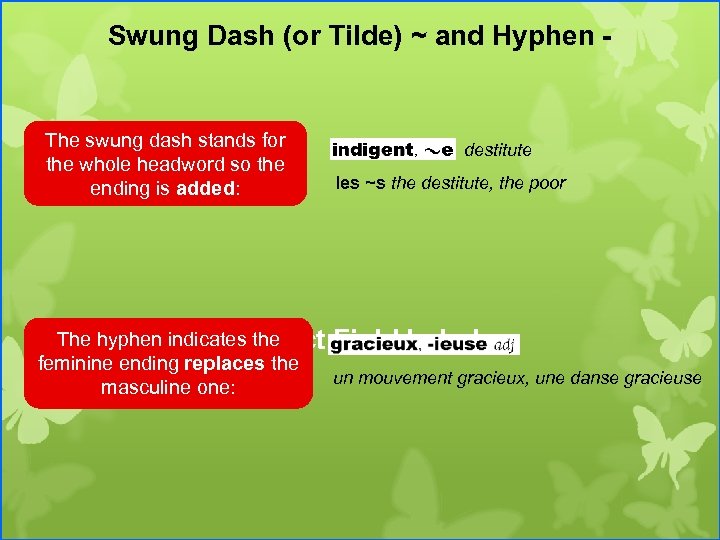
Swung Dash (or Tilde) ~ and Hyphen - The swung dash stands for the whole headword so the ending is added: destitute les ~s the destitute, the poor The hyphen indicates the Subject Field Labels feminine ending replaces the un mouvement gracieux, une danse gracieuse masculine one:
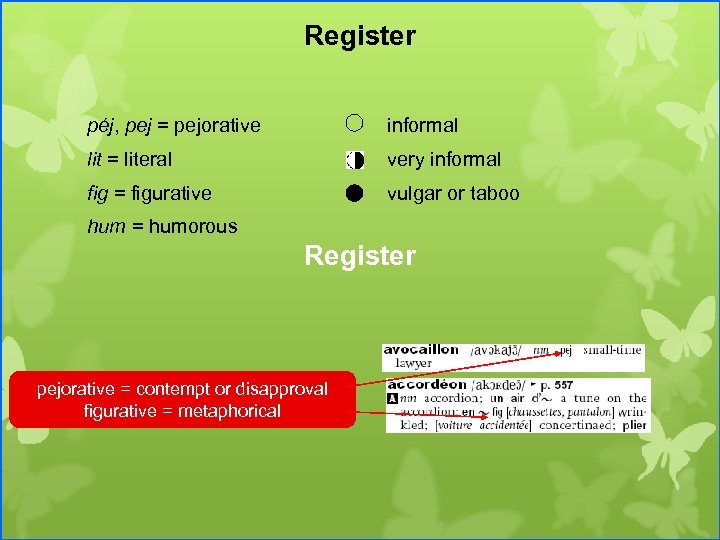
Register péj, pej = pejorative informal lit = literal very informal fig = figurative vulgar or taboo hum = humorous Register pejorative = contempt or disapproval figurative = metaphorical

Irregular Plurals lice = poux Cross-checking is particularly useful for adjectives ending in –al: plural is géniaux plural is bancals And for hyphenated words: plural is bandes-annonces plural is bandes-son
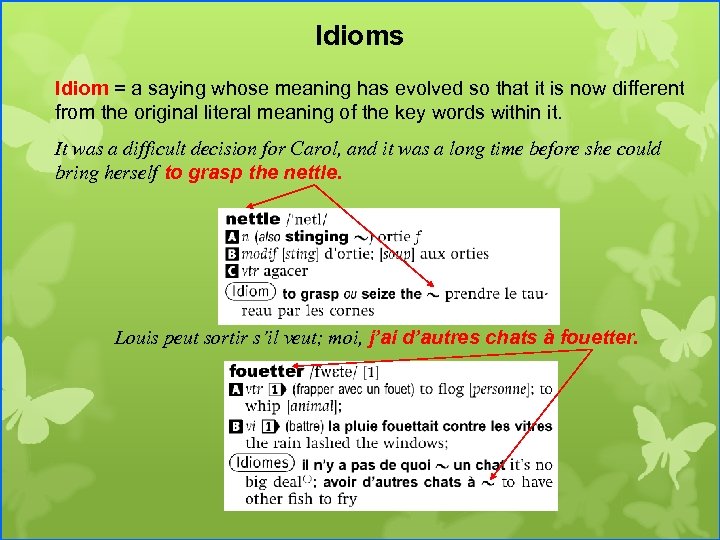
Idioms Idiom = a saying whose meaning has evolved so that it is now different from the original literal meaning of the key words within it. It was a difficult decision for Carol, and it was a long time before she could bring herself to grasp the nettle. Louis peut sortir s’il veut; moi, j’ai d’autres chats à fouetter.
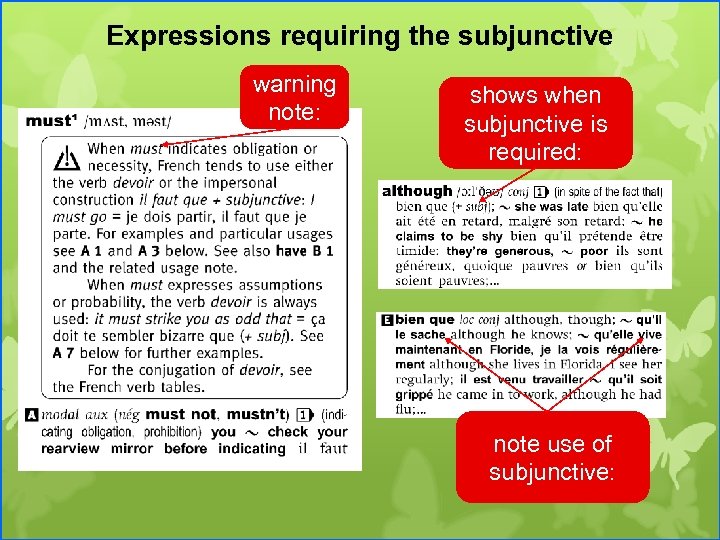
Expressions requiring the subjunctive warning note: shows when subjunctive is required: note use of subjunctive:
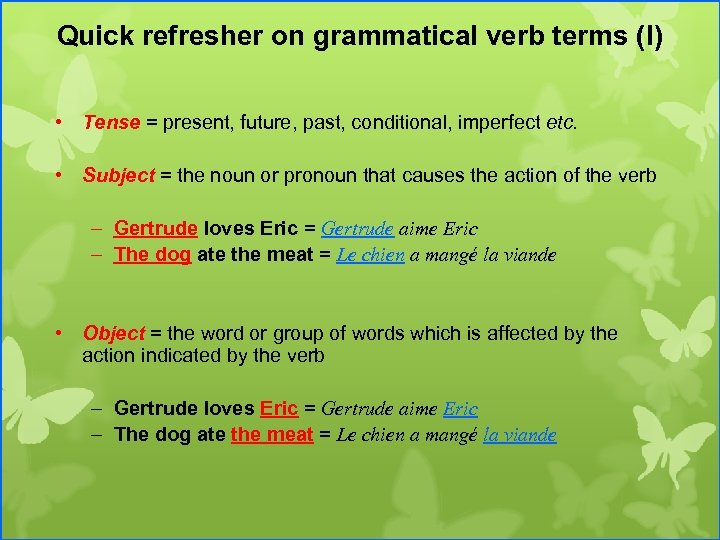
Quick refresher on grammatical verb terms (I) • Tense = present, future, past, conditional, imperfect etc. • Subject = the noun or pronoun that causes the action of the verb – Gertrude loves Eric = Gertrude aime Eric – The dog ate the meat = Le chien a mangé la viande • Object = the word or group of words which is affected by the action indicated by the verb – Gertrude loves Eric = Gertrude aime Eric – The dog ate the meat = Le chien a mangé la viande
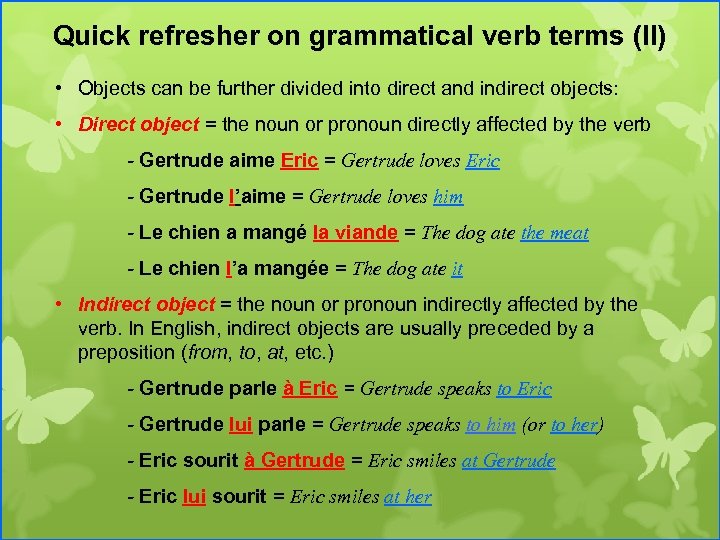
Quick refresher on grammatical verb terms (II) • Objects can be further divided into direct and indirect objects: • Direct object = the noun or pronoun directly affected by the verb - Gertrude aime Eric = Gertrude loves Eric - Gertrude l’aime = Gertrude loves him - Le chien a mangé la viande = The dog ate the meat - Le chien l’a mangée = The dog ate it • Indirect object = the noun or pronoun indirectly affected by the verb. In English, indirect objects are usually preceded by a preposition (from, to, at, etc. ) - Gertrude parle à Eric = Gertrude speaks to Eric - Gertrude lui parle = Gertrude speaks to him (or to her) - Eric sourit à Gertrude = Eric smiles at Gertrude - Eric lui sourit = Eric smiles at her
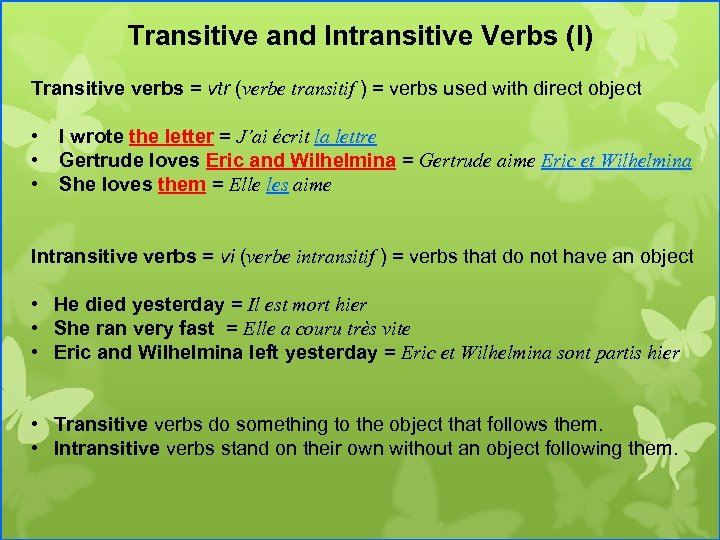
Transitive and Intransitive Verbs (I) Transitive verbs = vtr (verbe transitif ) = verbs used with direct object • • • I wrote the letter = J’ai écrit la lettre Gertrude loves Eric and Wilhelmina = Gertrude aime Eric et Wilhelmina She loves them = Elle les aime Intransitive verbs = vi (verbe intransitif ) = verbs that do not have an object • He died yesterday = Il est mort hier • She ran very fast = Elle a couru très vite • Eric and Wilhelmina left yesterday = Eric et Wilhelmina sont partis hier • Transitive verbs do something to the object that follows them. • Intransitive verbs stand on their own without an object following them.
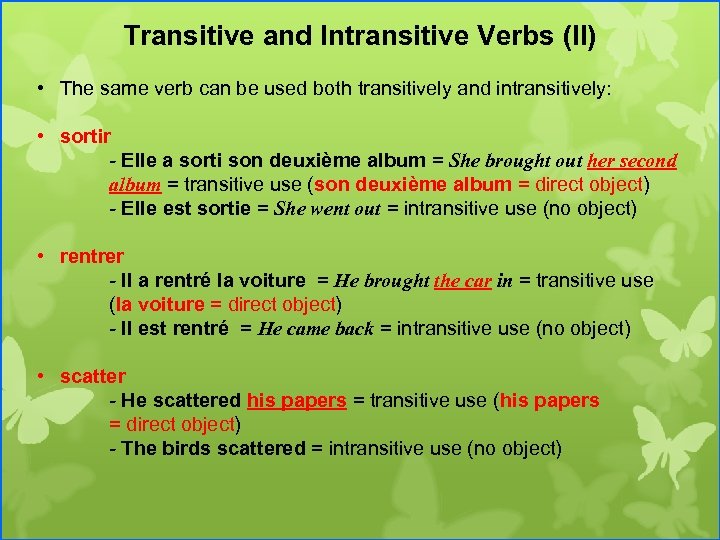
Transitive and Intransitive Verbs (II) • The same verb can be used both transitively and intransitively: • sortir - Elle a sorti son deuxième album = She brought out her second album = transitive use (son deuxième album = direct object) - Elle est sortie = She went out = intransitive use (no object) • rentrer - Il a rentré la voiture = He brought the car in = transitive use (la voiture = direct object) - Il est rentré = He came back = intransitive use (no object) • scatter - He scattered his papers = transitive use (his papers = direct object) - The birds scattered = intransitive use (no object)
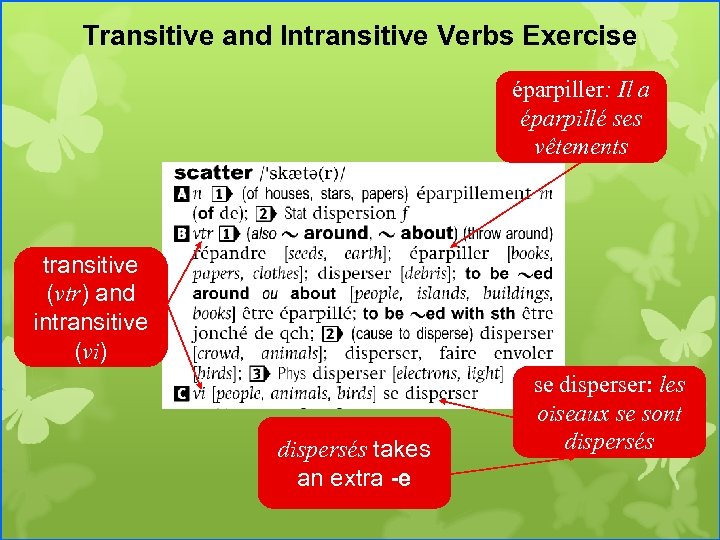
Transitive and Intransitive Verbs Exercise éparpiller: Il a éparpillé ses vêtements transitive (vtr) and intransitive (vi) dispersés takes an extra -e se disperser: les oiseaux se sont dispersés
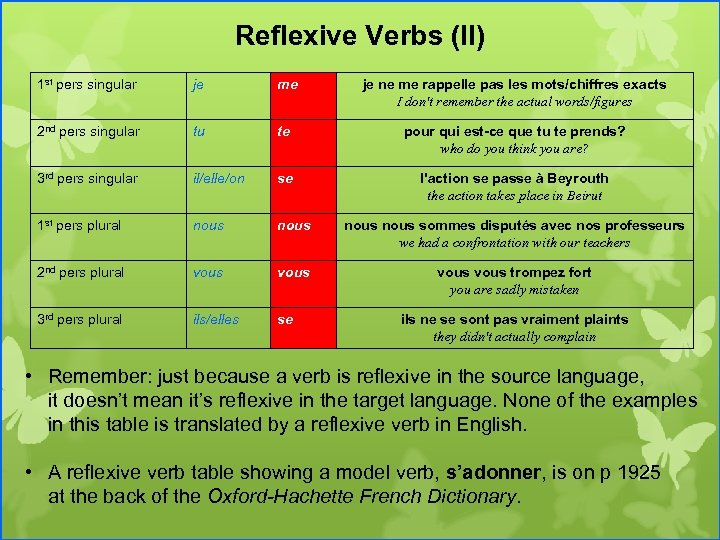
Reflexive Verbs (II) 1 st pers singular je me je ne me rappelle pas les mots/chiffres exacts I don't remember the actual words/figures 2 nd pers singular tu te pour qui est-ce que tu te prends? who do you think you are? 3 rd pers singular il/elle/on se l'action se passe à Beyrouth the action takes place in Beirut 1 st pers plural nous sommes disputés avec nos professeurs we had a confrontation with our teachers 2 nd pers plural vous trompez fort you are sadly mistaken 3 rd pers plural ils/elles se ils ne se sont pas vraiment plaints they didn't actually complain • Remember: just because a verb is reflexive in the source language, it doesn’t mean it’s reflexive in the target language. None of the examples in this table is translated by a reflexive verb in English. • A reflexive verb table showing a model verb, s’adonner, is on p 1925 at the back of the Oxford-Hachette French Dictionary.
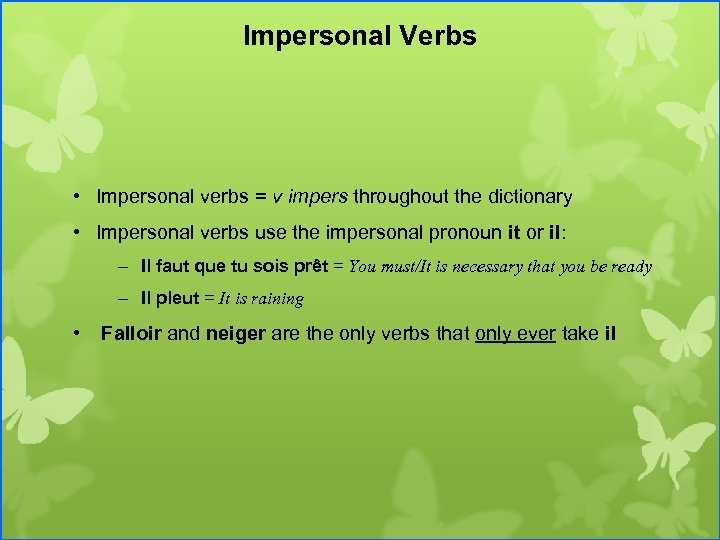
Impersonal Verbs • Impersonal verbs = v impers throughout the dictionary • Impersonal verbs use the impersonal pronoun it or il: – Il faut que tu sois prêt = You must/It is necessary that you be ready – Il pleut = It is raining • Falloir and neiger are the only verbs that only ever take il
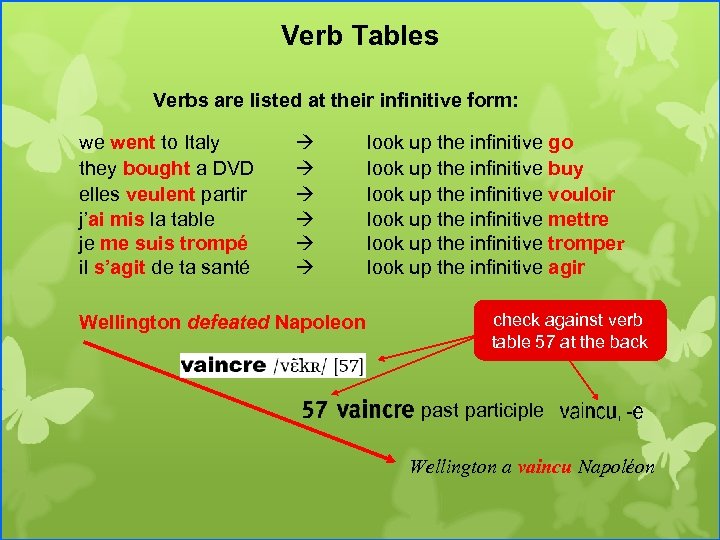
Verb Tables Verbs are listed at their infinitive form: we went to Italy they bought a DVD elles veulent partir j’ai mis la table je me suis trompé il s’agit de ta santé Wellington defeated Napoleon look up the infinitive go look up the infinitive buy look up the infinitive vouloir look up the infinitive mettre look up the infinitive tromper look up the infinitive agir check against verb table 57 at the back past participle Wellington a vaincu Napoléon
Cross-checking on the other side of the dictionary helps when: • a French word has several meanings • you are unsure which French translation to choose • you don’t know if the French word you know can be used in a certain context • you want to check the plural or feminine form • you want to know how to conjugate the verb
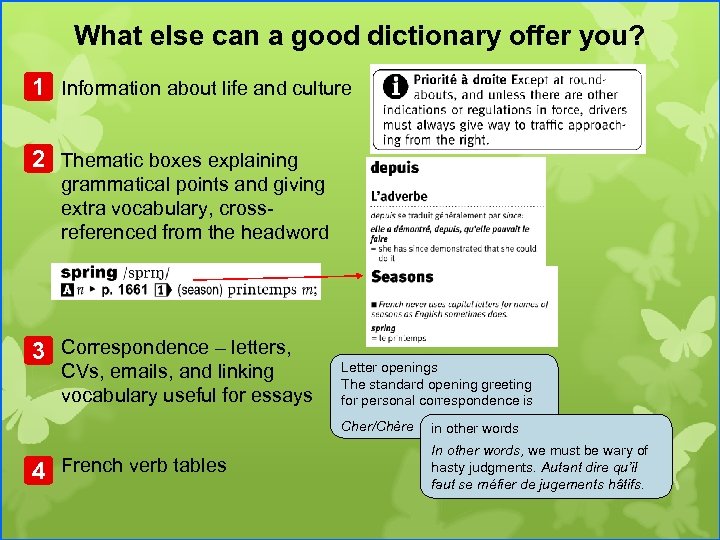
What else can a good dictionary offer you? 1 Information about life and culture 2 Thematic boxes explaining grammatical points and giving extra vocabulary, crossreferenced from the headword 3 Correspondence – letters, CVs, emails, and linking vocabulary useful for essays Letter openings The standard opening greeting for personal correspondence is Cher/Chère 4 French verb tables in other words In other words, we must be wary of hasty judgments. Autant dire qu’il faut se méfier de jugements hâtifs.
Review (I) • Important factors to bear in mind when choosing a bilingual dictionary • Navigating through an entry – English-French, then French-English • Explaining abbreviations and symbols: • common grammatical categories • swung dash (or tilde) and hyphen • subject field labels • regional labels • register labels • sb, sth, qn, and qch • phonetics • How the dictionary can help you with: • irregular plurals • gender • idioms • word order • subjunctive
Review (II) • How the dictionary can help you with verbs: • tense, subject, and object • direct and indirect objects • transitive and intransitive verbs • reflexive verbs • impersonal verbs • phrasal verbs • verb tables • verb complementation • Avoiding mistakes: • adapting examples • cross-checking • Extra features Questions
Скачать презентацию La bonne utilisation du dico How to use
979eb214c548d5d0cef1fd22e503a093.ppt