


 Скачать презентацию L to J Quiz English I Mr Stoner
a5f4ab3d5d6f9e71e47a422c0af1c1fb.ppt
- Количество слайдов: 102
 L to J Quiz English I Mr. Stoner & Mrs. Sitton Egyptian High School Tamms, IL kstoner@egyptianschool. com asitton@egyptianschool. com
 Question List 1 2 3 4 5 6 7 8 9 10 11 12 13 14 15 16 17 18 19 20 21 22 23 24 25 26 27 28 29 30 31 32 33 34 35 36 37 38 39 40 41 42 43 44 45 46 47 48 49 50 51 52 53 54 55 56 57 58 59 60 61 62 63 64 65 66 67 68 69 70 71 72 73 74 75 76 77 78 79 80 81 82 83 84 85 86 87 88 89 90 91 92 93 94 95 96 97 98 99 100
 1 a casual, familiar, and colloquial use of language Ex: My buddy is worn out. Menu Informal style/tone
 2 words from the text that show, prove or give reasons for making a judgment Ex: To prove a point in his argument, the student used ________. Menu Textual evidence
 3 words and details used by an author that appeal to a reader’s senses (the five senses plus emotion Ex: The heat from the oven rushed into the character’s face as the sweet smell permeated the air. Menu Sensory language
 4 a category of artistic, musical, or literary composition characterized by a particular style, form, or content Ex: romance, history, comedy, rock, country, drama Menu Genre
 5 a character in drama who speaks the prologue and epilogue and comments on the action/a group of singers Ex: These characters were often used in mythology and portrayed by small groups wearing masks and robes Menu Chorus
 6 A character with multiple or conflicting motivations Ex: The main character is almost always this type of character. Menu Complex character
 7 when the words and actions of the characters of a work of literature have a different meaning for the reader than they do for the characters Ex: We, the readers, knew the cake was poisoned, but the character did not. Menu Dramatic Irony
 8 when a story is relayed by a narrator who is also a character within the story, so that the narrative reveals the plot by referring to this viewpoint as “I” Ex: There I was, surrounded by ninjas when I remembered my anti-ninja training. Menu First Person
 9 a composition written in verse that often uses rhythm and/or rhyme Ex: “The Raven” Menu Poem/Poetry
 10 a conversation between two or more persons Ex: “Can we go home yet? ” “No, the bell hasn’t rung” Menu Dialogue
 11 a decisive moment that is of maximum intensity or is a major turning point in a plot Ex: When Spiderman fought the Green Goblin. Menu Climax
 12 when a narrator refers to one of the characters as “you”, therefore making the audience member feel as if he or she is a character in the story Ex: You should add two eggs to the batter and stir vigorously. Menu Second person
 13 a device often used in drama whereby a character speaks to himself or herself, relating his or her thoughts and feelings, thereby also sharing them with the audience Ex: Romeo talks to himself about his feelings for Juliet. Menu Soliloquy
 14 a direct specific meaning as distinct from an implied or associated idea Ex: The definition of a word without implied meaning Menu Denotation
 15 a division of a poem consisting of a series of lines arranged together in a usually recurring pattern of meter and rhyme Ex: Similar to a paragraph in prose Menu Stanza
 16 a figure of speech which involves a direct comparison between two unlike things, usually with words like or as Ex: It’s as hot as a desert in here. Menu Simile
 17 a genre that uses literary style and techniques to create factually accurate narratives Ex: Essays, memoirs, and articles Menu Literary Nonfiction
 18 when a character is specifically described or developed by a narrator Ex: Bill was a good man who was six-feet tall and had brown hair. Menu Direct characterization
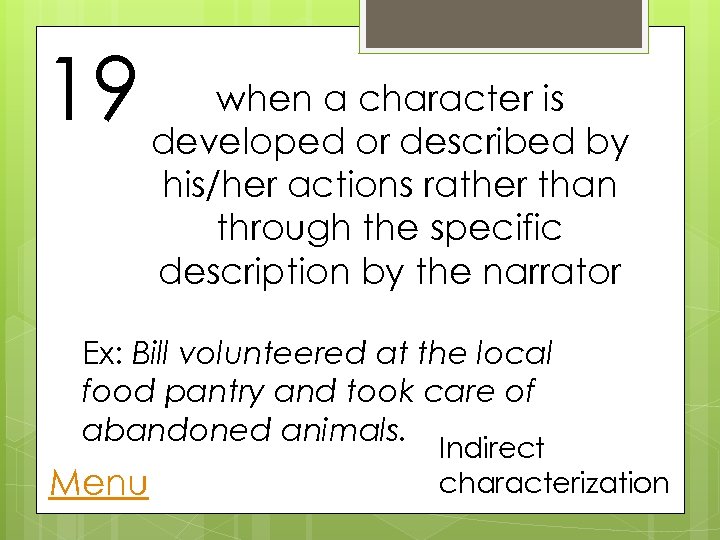 when a character is 19 developed or described by his/her actions rather than through the specific description by the narrator Ex: Bill volunteered at the local food pantry and took care of abandoned animals. Menu Indirect characterization
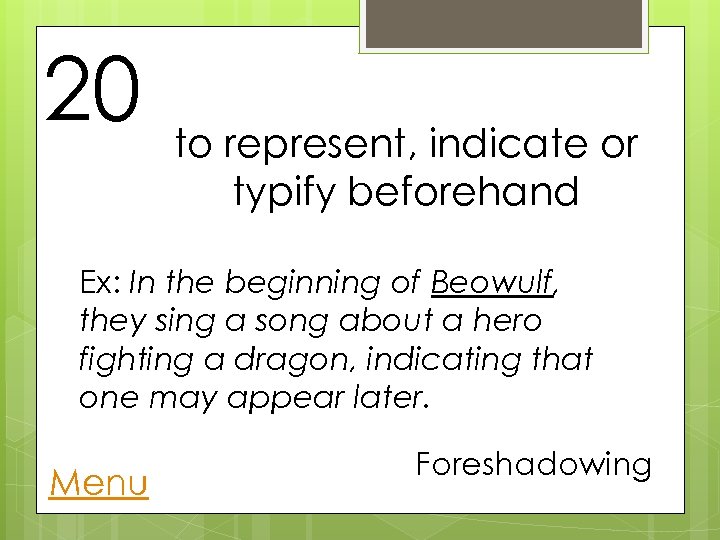 20 to represent, indicate or typify beforehand Ex: In the beginning of Beowulf, they sing a song about a hero fighting a dragon, indicating that one may appear later. Menu Foreshadowing
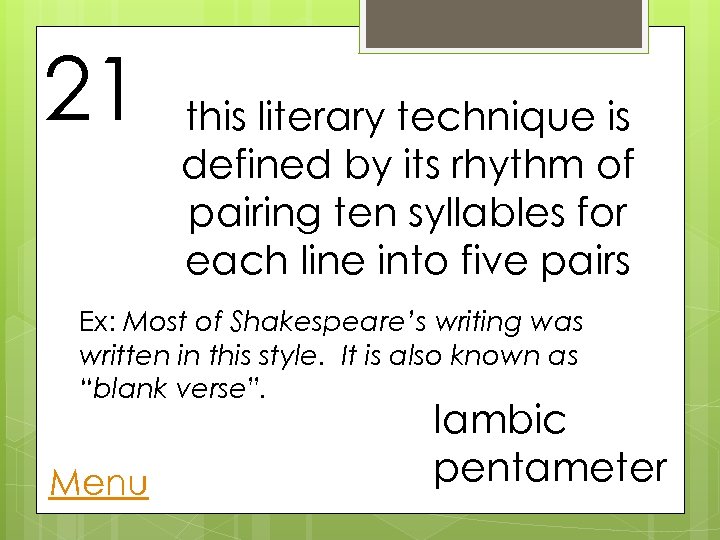 21 this literary technique is defined by its rhythm of pairing ten syllables for each line into five pairs Ex: Most of Shakespeare’s writing was written in this style. It is also known as “blank verse”. Menu Iambic pentameter
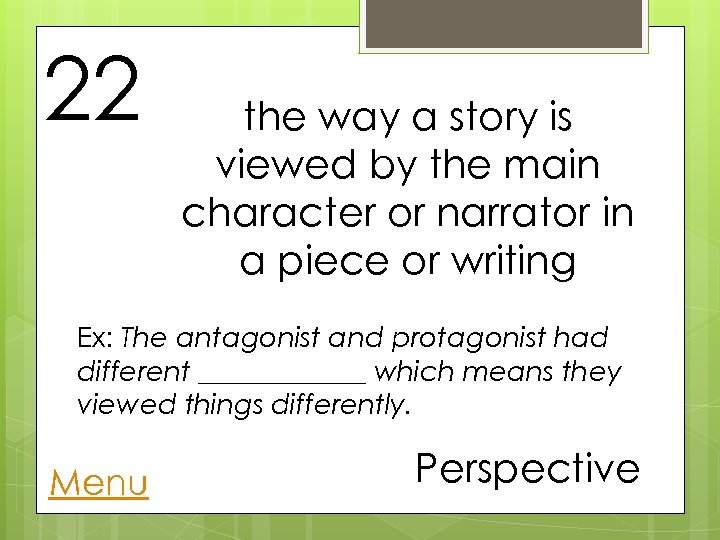 22 the way a story is viewed by the main character or narrator in a piece or writing Ex: The antagonist and protagonist had different ______ which means they viewed things differently. Menu Perspective
 23 the usually humorous use of a word in such a way as to suggest two or more of its meanings or the meaning of another word similar in sound Ex: “Flies can do this, but I must fly away. ” Menu Pun
 24 a happy or pleasant ending to signify a character’s acceptance by society Ex: This happens when the protagonist is better off at the end than he/she was at the beginning. Menu Comedic resolution
 25 a literary technique in the opening of a story that grabs the reader’s attention so that he or she will keep on reading Ex: When Rainsford falls off the boat in “The Most Dangerous Game” Menu Narrative hook
 26 a long narrative poem in elevated style recounting the deeds of a legendary or historical hero Ex: “Beowulf” “The Odyssey” “Paradise Lost” Menu Epic
 27 the suggesting of a meaning by a word apart from the thing it explicitly names or describes Ex: “Fat” or “hefty” has a different ______ than “heavy” or “overweight”. Menu Connotation
 28 a meaning decided or concluded by reasoning using evidence Ex: “Frank had to duck when entering a room. ” Therefore, we know Frank is tall. Menu Inferred meaning
 29 a method of storytelling in which the narrator knows only the thoughts and feelings of a single character, while other characters are presented only externally Ex: Most drama is written in this point of view. Menu Third person limited
 30 a method of storytelling in which the narrator knows the thoughts and feelings of all of the characters in the story Ex: This point of view is difficult to translate into plays or movies. Menu Third person omniscient
 31 the study of a literary work, separating it into parts in order to determine its nature Ex: In order to write a strong reflective essay over a piece of literature, this must take place. Menu Analysis
 32 the representation in art of an event or story Ex: This type of writing is not persuasive or expository. Menu Narrative
 33 the repetition of vowel sounds Ex: Alice always ate apples. Menu Assonance
 34 the repetition of the same pattern or words or phrases within a sentence, passage or selection to show that two or more ideas have the same level or importance Ex: They were walking , talking, and chewing gum. Menu Parallel structure
 35 the repetition of consonant sounds Ex: Bonnie’s blue bonnet bore brown butterflies. Menu Alliteration
 36 the reason(s) an author has for writing a piece; to inform persuade or entertain Ex: The ______ of most stories is to entertain. Menu Author’s purpose
 37 a passing or casual reference; an incidental mention of something, either directly or by implication Ex: Their love was as strong as Romeo and Juliet’s. Menu Allusion
 38 the quality of a literary work that causes the audience to be uncertain or tense about the outcome of the events Ex: Alfred Hitchcock was a master of _______. Menu Suspense
 39 a regularly recurring phrase or verse especially at the end of each stanza or division of a poem or song Ex: “nevermore” in “The Raven” Menu Refrain
 40 a related series of incidents in a literary plot that build toward the point of greatest interest Ex: Spiderman learns how to use his powers while the Green Goblin begins causing trouble. Menu Rising action
 41 a sense of heightened involvement, uncertainty and interest an audience experiences as the climax of action approaches Ex: The general feel of the rising action Menu Tension
 42 a single idea or thesis that continues throughout a research paper Ex: This is present when a paper is well organized and holds true to its thesis statement throughout. Menu Unity
 43 a small part of a whole; specific information about the central idea or theme Ex: These strengthen your ideas. The more you can offer, the better. Menu Detail
 44 a speech presented by a single character to another character or characters Ex: Shylock’s speech about the pound of flesh in “The Merchant of Venice” Menu Monologue
 45 a statement of the major point of a written piece and how you carry out your point Ex: School uniforms have no place at Egyptian High School. Menu Argument
 46 a statement or assertion opposing the originally presented claim Ex: There are many people who say that school uniforms are a good idea, but… Menu Counterclaim
 47 a statement of assertion presented as fact Ex: School uniforms would take away our individuality. Menu Claim
 48 the principal character in a literary work (as in a drama or story) Ex: Spiderman, Luke Skywalker, Neo, Romeo/Juliet Menu Protagonist
 49 a statement that contains or implies its own contradiction and has an uncertain meaning or no meaning Ex: This statement is false. Menu Paradox
 50 a step in the writing process used to correct or improve the original work Ex: going back over your paper and making changes Menu Revise
 51 the position of the narrator in relation to the story derived from the author’s depiction of events and attitude toward the characters Ex: 1 st person, 2 nd person, 3 rd person limited, 3 rd person omniscient Menu Point of view/ perspective
 52 the plan or main story (as in a movie or literary work) Ex: What happens in a story Menu Plot
 53 a type of writing with the purpose of providing information in such a way that a person, place or thing can be seen in the reader’s mind Ex: This must be present in order for imagery to occur. “The room was dark. ” Menu Description
 54 a variety of a language used by the members of a group Ex: “Don’t you make me whoop ya. ” Menu Dialect
 55 the pattern of rhymes used in a poem, usually marked by letters to symbolize correspondences, such as rhyme royal, ababbcc Ex: aabb, abba, abab Menu Rhyme scheme
 56 the parts of a written or spoken statement that precede or follow a specific word or passage, usually influencing its meaning of effect Ex: You can use this to figure out the meaning of a word. Menu Context
 57 the part of a literary plot that occurs after the climax has been reached and the conflict has been resolved (prior to the resolution) Ex: everyone deals with the death of Norman Osborne after the Green Goblin was defeated Menu Falling action
 58 the organization or arrangement of written work Ex: MLA or APA Menu Format
 59 the opposition of persons or forces that gives rise to the dramatic action in a drama or fiction Ex: man vs. man, man vs. self, man vs. nature Menu Conflict
 60 A message conveyed or a lesson to be learned from a story or event Ex: Slow and steady wins the race Menu Moral
 61 a written selection intended to explain a topic, an idea or a process Ex: Essays or articles Menu Informative/ explanatory text
 62 a written work that tells a story through action and is meant to be performed Ex: The Crucible, Romeo and Juliet Menu Drama
 63 the manner, position or direction in which something is set – the time and place Ex: The story took place in California during the gold rush. Menu Setting
 64 the main thought or subject of a written or spoken work Ex: This is the one or two word answer to “What was it about? ” Menu Topic
 65 the main idea or basic meaning of a literary work; a common thread or repeated idea that is incorporated throughout a written work Ex: In Spiderman, this is “with great power comes great responsibility” Menu Theme/central idea
 66 an alphabetical list of specialized words and definitions Ex: This often appears at the end of a text to aid in the understanding of difficult words. Menu Glossary
 67 The part of the story which introduced characters and setting Ex: The part of “The Most Dangerous Game” before Rainsford falls off the boat Menu Exposition
 68 the insertion of an earlier event into a story, play or movie so the audience can witness past events Ex: When a character tells a story that happened to him/her as a child. Menu Flashback
 69 An expression combining terms that contradict one another Ex: “fine mess” “living dead” “deafening silence” Menu Oxymoron
 70 the inherent difficulty of reading and comprehending a text combined with consideration of the reader and task variables Ex: Macbeth has a higher _____ than See Spot Run. Menu Text complexity
 71 an indirect indication Ex: He blamed the court, and by _______, the government. Menu Implication
 72 the final sentence or section in a written selection Ex: They lived happily ever after. Menu Concluding statement/section
 73 an outcome or result of a situation or sequence of events; an aftermath Ex: This takes place after the falling action of a story. Menu Resolution
 74 an unhappy, disastrous end; a final downfall of a character brought on by an error in judgment or outside forces Ex: the ending of Romeo and Juliet or Hamlet Menu Tragic resolution
 75 an utterance meant to be inaudible to someone; especially : an actor’s speech heard by the audience but supposedly not by the other characters Ex: When a character is talking to someone and turns to the audience to talk about him or her. Menu Aside
 76 any language that goes beyond the literal meaning of words in order to furnish new effects or fresh insights into an idea or a subject Ex: I have told you a million times to clean your room. Menu Figurative Language
 77 the feeling conveyed by a written or spoken work; the attitude an author takes toward the subject of a literary work Ex: The two reports wrote differing articles about the president’s speech. Menu Tone
 78 the expected style of writing based on arbitrary rules or practices recognized as valid by a particular art or discipline Ex: Though never specified, we all wrote our paper in 12 -point font. Menu Conventions/ Norms
 79 the emotional feel created in a story often crafted through weather or location Ex: The mist creeped through the graveyard as midnight approached. Menu Mood
 80 the determination of which particular word or phrase to use in a particular instance Ex: determining to use “dislike” instead of “hate” to not hurt someone’s feeling Menu Word choice
 81 careful and considered thoughts on a topic or literary work Ex: This is what you are doing when you take time to look back and think about something you have read. Menu Reflection
 82 choice of words especially with regard to correctness, clearness, or effectiveness Ex: A person may use different _______ when in class and when with his/her peers. Menu Diction
 83 the attribution of a personal nature or character to inanimate objects or abstract notions Ex: The sun threw its light down upon us until we could bear it no longer. Personification Menu
 84 Effective, well-grounded evidence or arguments used as the basis for an action, decision or belief Ex: The type of reasoning used to make an argument effective or correct Menu Valid reasoning
 85 expressing or covering much in few words; brief in form but comprehensive in scope Ex: “Earlier, I went to Wal-Mart. ” instead of “I went to the store. It was earlier today. The store was Wal-mart. ” Menu Concise
 86 Fully and clearly expressed or defined Ex: The argument laid out over the course of the fifty-page document was _____. Menu Explicit
 87 incongruity between the actual result of a sequence of events and the normal or expected result Ex: The fireman’s house burned. Menu Irony
 88 language spoken or written according to the rules of English Ex: The type of English you use when speaking or writing in class. Menu Formal English
 89 literary consequence or import; the meaning or intended purpose of literary writing Ex: Beowulf’s ______ comes from its roots in the history of the written word and oral storytelling. Menu Literary significance
 90 making a comparison between two things without using like or as Ex: The fans were statues as the away team’s best player came to the plate. Menu Metaphor
 91 The art of using language to communicate effectively and persuasively Ex: Because of his skill with ____, the audience unanimously agreed with his argument by the end. Menu Rhetoric
 92 one of the persons of a drama or novel Ex: the entire cast is composed of these Menu Character
 93 The main opponent or adversary to the protagonist Ex: Darth Vader, the Green Goblin, Iago Menu Antagonist
 94 out-of-date, does not fit in the timeline Ex: The story jumped around in time. Back to the Future Menu Anachronistic
 95 Outstanding – The best possible example Ex: Shakespeare is an ______ playwright. Menu Exemplary
 96 the arrangement of words, phrases, clauses and sentences; sentence construction Ex: Also refers to the study of the rules for the formation of sentences. Menu Syntax
 97 Someone who seeks pleasure above all else Ex: Marquis de Sade was considered a ______ because he strived for complete freedom to do whatever a person wanted. Menu Hedonist
 98 reasoning built on a false notion or mistaken belief Ex: If you don’t wait to swim for at least fifteen minutes after eating, you will get a cramp. Menu Fallacious reasoning
 99 shorten, abridge Ex: etc. - Dr. - Blvd. Menu Abbreviate
 a your 100 textsentence or two in focus that contains the of your essay and tells your reader what the essay is going to be about Ex: The life of the typical college student is characterized by time spent studying, attending class, and socializing with peers. Menu Thesis statement