


 Скачать презентацию L 7 Work Energy and Conservation Principles of Energy
L 07 - Work, Energy 2014-15.pptx
- Количество слайдов: 27
 L 7. Work–Energy and Conservation Principles of Energy and Momentum 1. Concept of Work Done 2. Work of constant and variable forces 3. The Work-Kinetic Energy (WKE) Theorem 4. Power 5. Potential Energy (PE or U), Kinetic Energy (KE) and conservation of mechanical energy 6. Momentum and Impulse 7. Conservation of linear momentum 8. Elastic and Inelastic Collisions 1
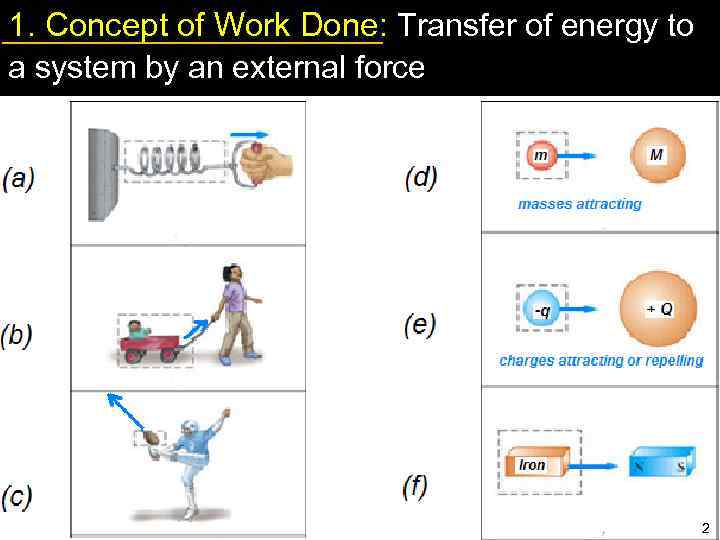 1. Concept of Work Done: Transfer of energy to a system by an external force 2
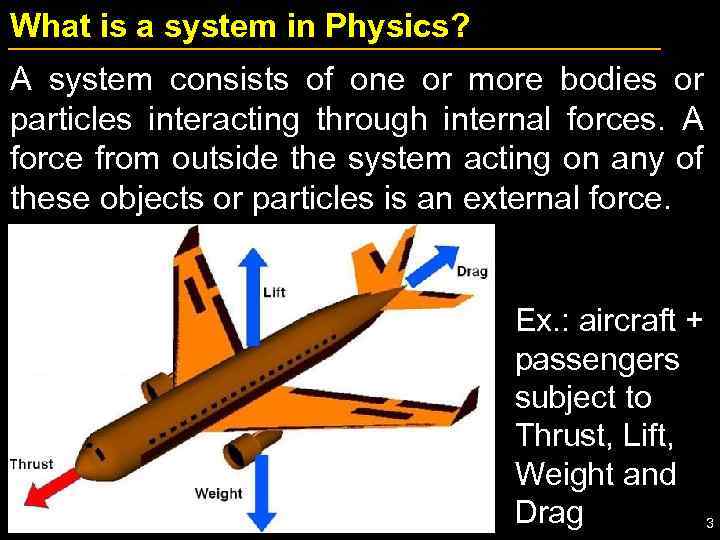 What is a system in Physics? A system consists of one or more bodies or particles interacting through internal forces. A force from outside the system acting on any of these objects or particles is an external force. Ex. : aircraft + passengers subject to Thrust, Lift, Weight and Drag 3
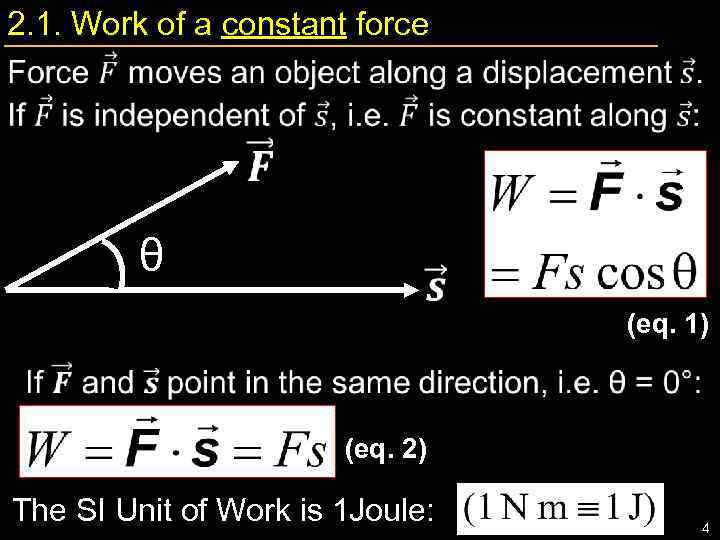 2. 1. Work of a constant force θ (eq. 1) (eq. 2) The SI Unit of Work is 1 Joule: 4
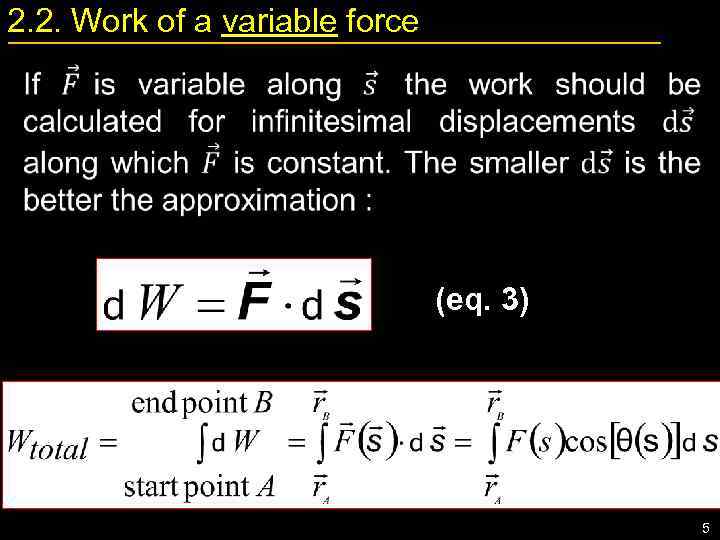 2. 2. Work of a variable force • (eq. 3) 5
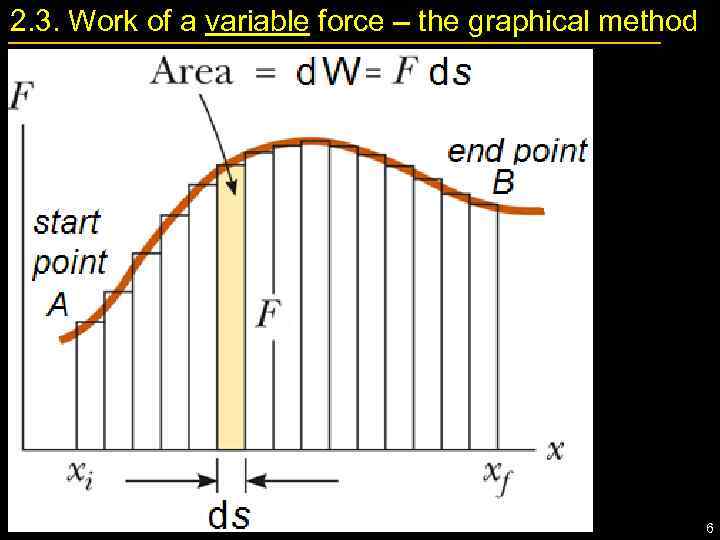 2. 3. Work of a variable force – the graphical method 6
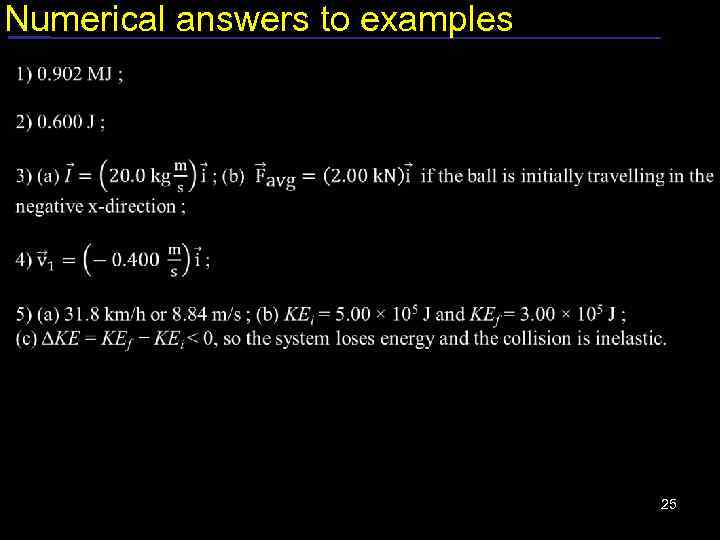
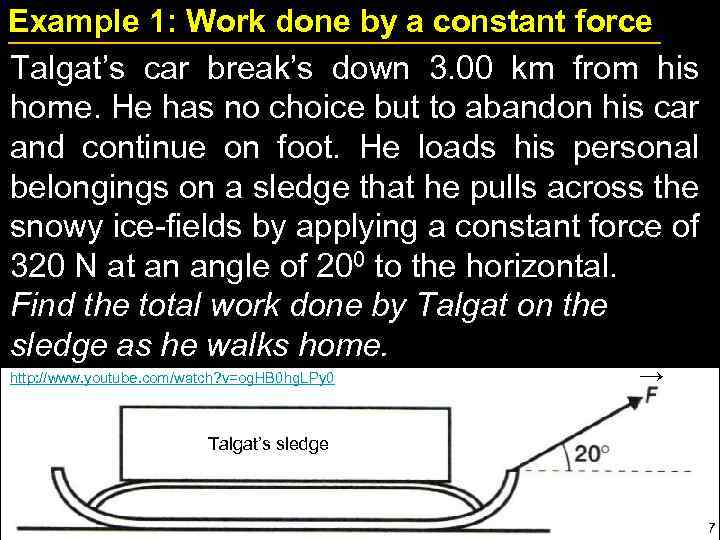 Example 1: Work done by a constant force Talgat’s car break’s down 3. 00 km from his home. He has no choice but to abandon his car and continue on foot. He loads his personal belongings on a sledge that he pulls across the snowy ice-fields by applying a constant force of 320 N at an angle of 200 to the horizontal. Find the total work done by Talgat on the sledge as he walks home. http: //www. youtube. com/watch? v=og. HB 0 hg. LPy 0 → Talgat’s sledge 7
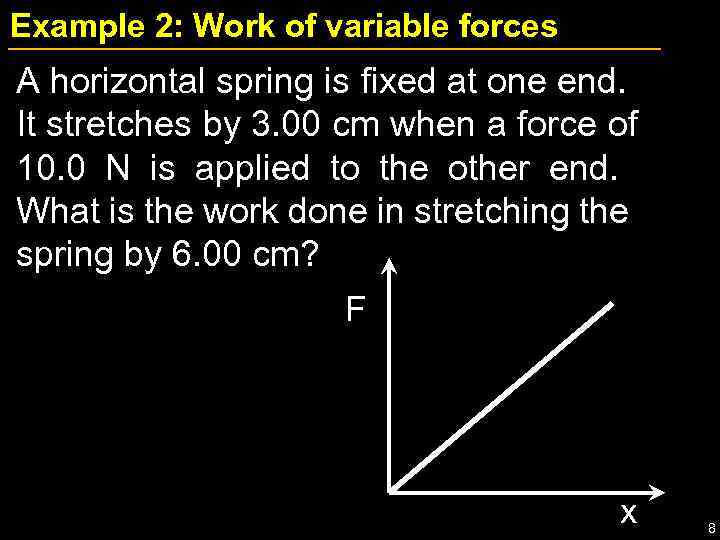 Example 2: Work of variable forces A horizontal spring is fixed at one end. It stretches by 3. 00 cm when a force of 10. 0 N is applied to the other end. What is the work done in stretching the spring by 6. 00 cm? F x 8
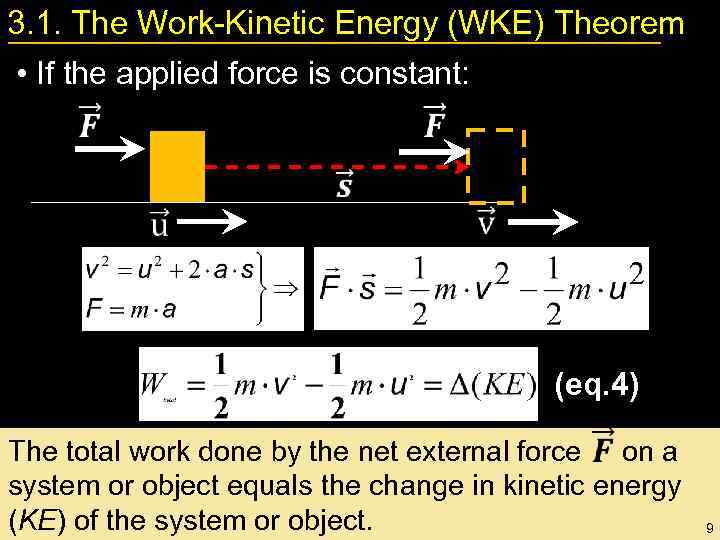 3. 1. The Work-Kinetic Energy (WKE) Theorem • If the applied force is constant: (eq. 4) The total work done by the net external force on a system or object equals the change in kinetic energy (KE) of the system or object. 9
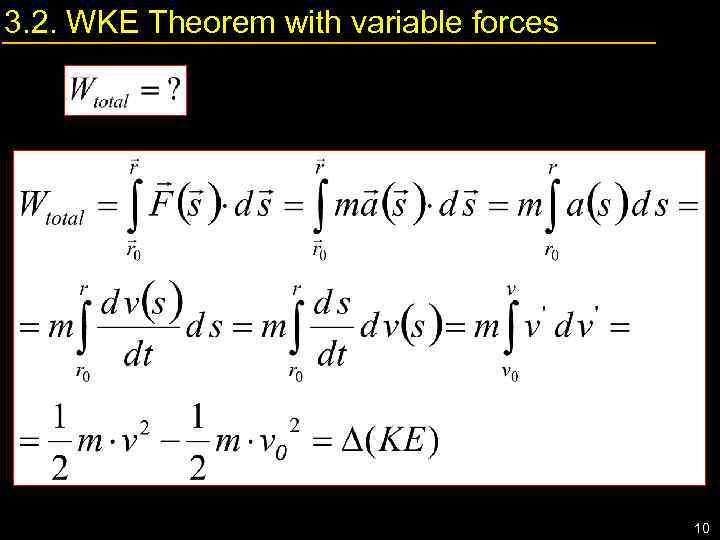 3. 2. WKE Theorem with variable forces 10
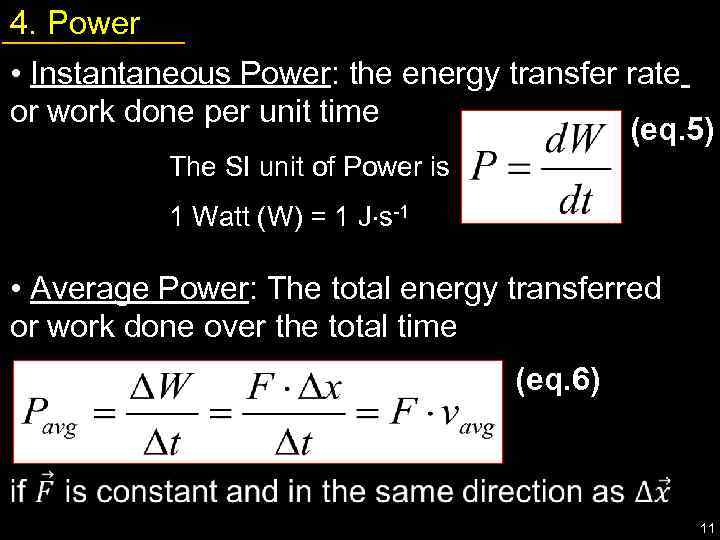 4. Power • Instantaneous Power: the energy transfer rate or work done per unit time (eq. 5) The SI unit of Power is 1 Watt (W) = 1 J s-1 • Average Power: The total energy transferred or work done over the total time (eq. 6) 11
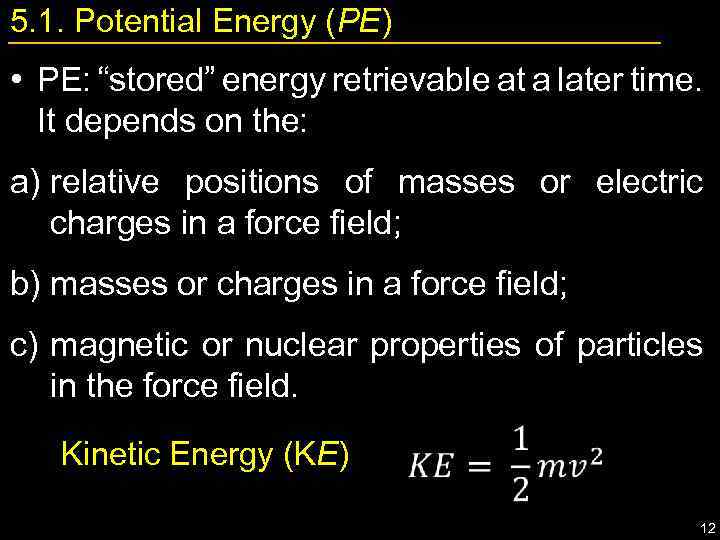 5. 1. Potential Energy (PE) • PE: “stored” energy retrievable at a later time. It depends on the: a) relative positions of masses or electric charges in a force field; b) masses or charges in a force field; c) magnetic or nuclear properties of particles in the force field. Kinetic Energy (KE) 12
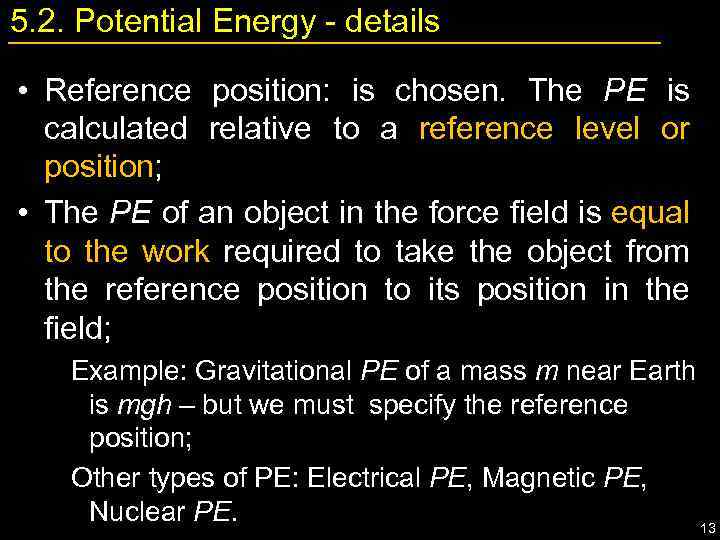 5. 2. Potential Energy - details • Reference position: is chosen. The PE is calculated relative to a reference level or position; • The PE of an object in the force field is equal to the work required to take the object from the reference position to its position in the field; Example: Gravitational PE of a mass m near Earth is mgh – but we must specify the reference position; Other types of PE: : Electrical PE, Magnetic PE, Nuclear PE. 13
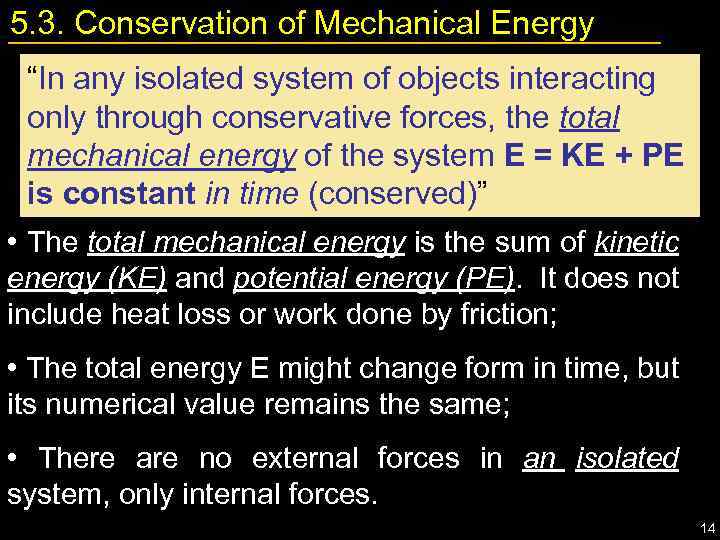 5. 3. Conservation of Mechanical Energy “In any isolated system of objects interacting only through conservative forces, the total mechanical energy of the system E = KE + PE is constant in time (conserved)” • The total mechanical energy is the sum of kinetic energy (KE) and potential energy (PE). It does not include heat loss or work done by friction; • The total energy E might change form in time, but its numerical value remains the same; • There are no external forces in an isolated system, only internal forces. 14
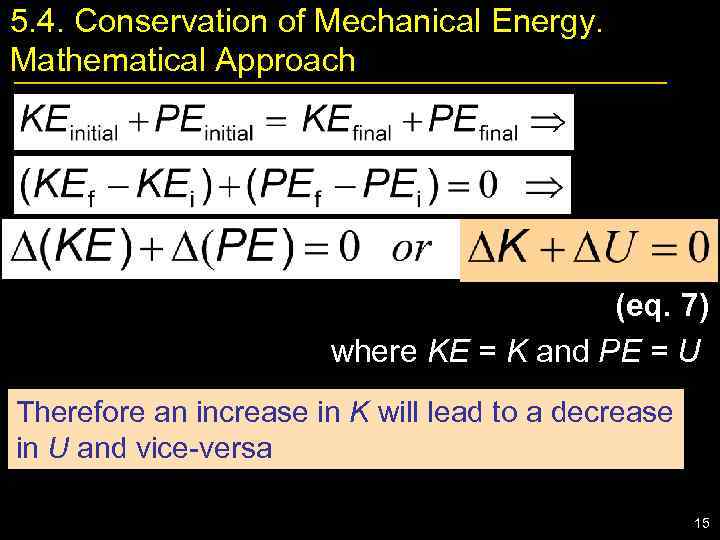 5. 4. Conservation of Mechanical Energy. Mathematical Approach (eq. 7) where KE = K and PE = U Therefore an increase in K will lead to a decrease in U and vice-versa 15
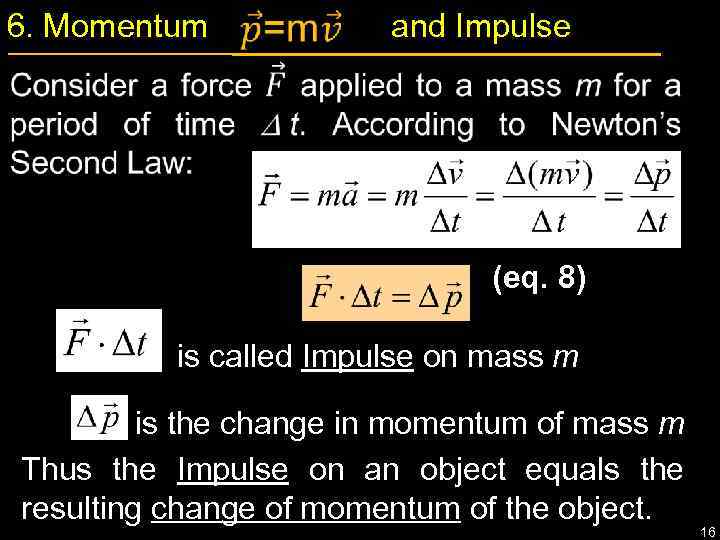 6. Momentum and Impulse (eq. 8) is called Impulse on mass m is the change in momentum of mass m Thus the Impulse on an object equals the resulting change of momentum of the object. 16
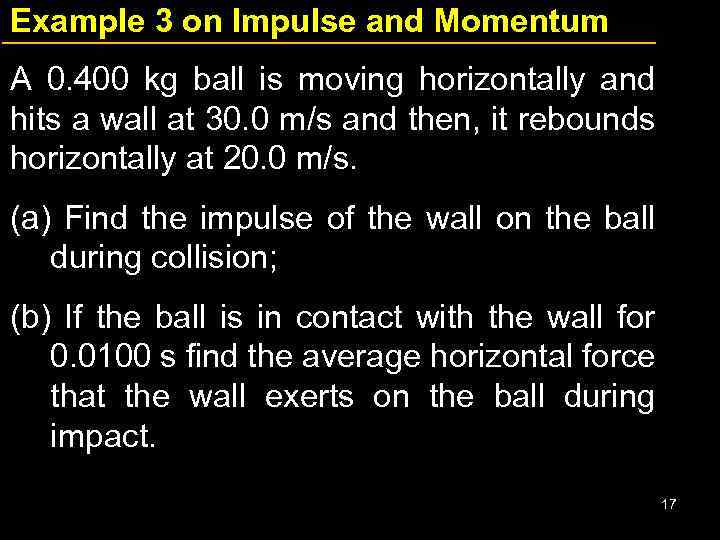 Example 3 on Impulse and Momentum A 0. 400 kg ball is moving horizontally and hits a wall at 30. 0 m/s and then, it rebounds horizontally at 20. 0 m/s. (a) Find the impulse of the wall on the ball during collision; (b) If the ball is in contact with the wall for 0. 0100 s find the average horizontal force that the wall exerts on the ball during impact. 17
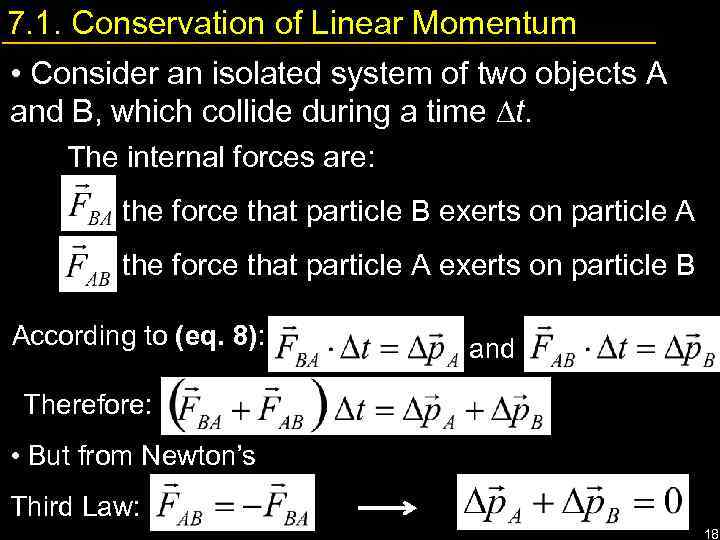 7. 1. Conservation of Linear Momentum • Consider an isolated system of two objects A and B, which collide during a time t. The internal forces are: FBA the force that particle B exerts on particle A FAB the force that particle A exerts on particle B According to (eq. 8): and Therefore: • But from Newton’s Third Law: 18
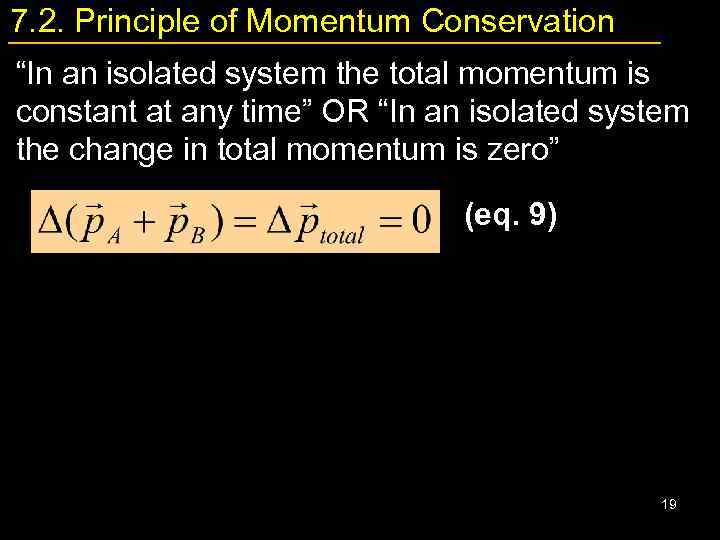 7. 2. Principle of Momentum Conservation “In an isolated system the total momentum is constant at any time” OR “In an isolated system the change in total momentum is zero” (eq. 9) 19
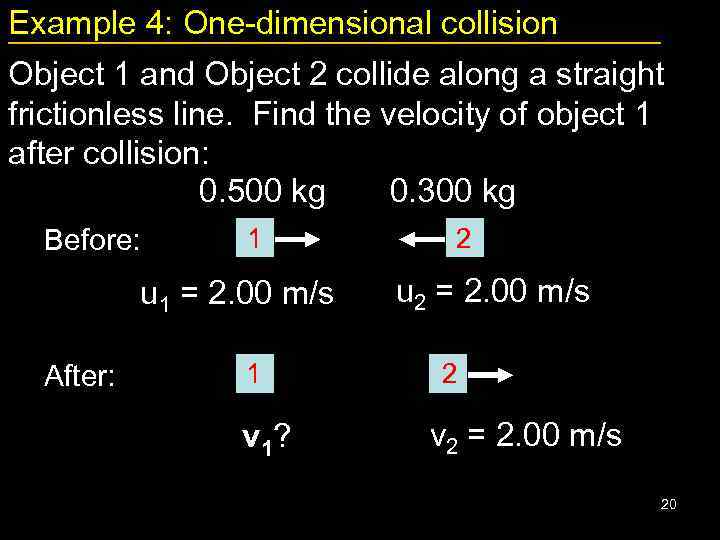 Example 4: One-dimensional collision Object 1 and Object 2 collide along a straight frictionless line. Find the velocity of object 1 after collision: 0. 500 kg 0. 300 kg Before: 1 u 1 = 2. 00 m/s After: 1 v 1? 2 u 2 = 2. 00 m/s 2 v 2 = 2. 00 m/s 20
 8. Elastic and Inelastic Collisions • A collision is elastic if the KE and momentum are conserved; • Momentum may be conserved, but the KE is not conserved in inelastic collisions. a) How is the KE lost from a system? b) How can you find out if the KE is conserved or not? 21
 Example 5: Inelastic collision A 7, 000 kg fire engine travelling at 40. 0 km/h collides head-on with a 700 kg truck, which is running at 50. 0 km/h on an icy road. After the collision, they stick together and move in the same direction with a common speed v. a) Find v; b) Calculate the total kinetic energy before and after collision; c) What kind of a collision is this? http: //www. youtube. com/watch? v=b. XFp_Jn 0 Yp. E https: //www. youtube. com/watch? v=PPdo. Pxq 5 NJQ https: //www. youtube. com/watch? v=e_7 np. S 0 d 1 JM https: //www. youtube. com/watch? v=Id. Jv. SBGWEhk https: //www. youtube. com/watch? v=Rwnf. Es_fb. R 8 https: //www. youtube. com/watch? v=D 5 iw_tj. HARk https: //www. youtube. com/watch? v=8 b 1 fq. SLKSGk http: //www. youtube. com/watch? v=mv 8 d. Nxtf. KY 8 22
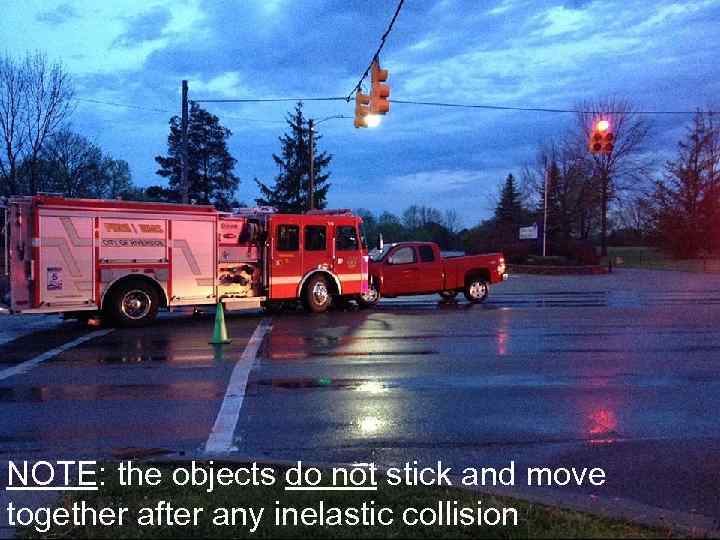 NOTE: the objects do not stick and move together after any inelastic collision 23
 At the end of this lecture you should: • Know and be able to prove mathematically that the net Work done on a system or object by an external force equals the change in Kinetic Energy (KE) of the system or object; • Know how to calculate the work done by constant or variable forces; • Know that Power can be defined as work done per unit time; • Be able to define the Potential Energy (PE) of a system or objects, and know how to calculate the PE of objects in gravitational fields; • Be able to state and prove the Principle of Conservation of Mechanical Energy; • Know the definition of Impulse and how it relates to momentum; • Be able to state and prove the Principle of Conservation of Linear Momentum by using Newton's Laws; • Know the difference between elastic and inelastic collisions; • Be able to solve problems based on conservation laws, particularly one- and two-dimensional collisions problems and motion in a gravitational field. 24
 Numerical answers to examples 25
 Required reading material Serway & Vuille: Essentials of College Physics Chapter 5: Pages 90 -114 Examples: 5. 1, 5. 3, 5. 4, 5. 5, 5. 6 and 5. 10 Chapter 6: Pages 124 -140 Examples: 6. 1, 6. 2, 6. 3, 6. 4, 6. 5, 6. 6 and 6. 7 • Adams & Allday: Advanced Physics Chapter 3: Pages 66 -73, 88, 89, 92, 93, 96 and 97 26
 Are any of the following collisions elastic? https: //www. youtube. com/watch? v=F 1 o. ONgw 7 Knk https: //www. youtube. com/watch? v=wl. Noza 8 o. AZw https: //www. youtube. com/watch? v=251 mfy 0 mq. SU https: //www. youtube. com/watch? v=2 i 72 js 7 Enfg https: //www. youtube. com/watch? v=tk. Qx. K 4 BYi. Xk https: //www. youtube. com/watch? v=d. XO 2 OB 4 u. Pi. A https: //www. youtube. com/watch? v=Aq. Jwc. Ri. NNi. Y http: //www. youtube. com/watch? v=sv. Fws. Js. HHGs https: //www. youtube. com/watch? v=F 8 Ewn. Wh. Yjx. U http: //www. youtube. com/watch? v=F 2 s 4 e 4 B 4 sm. M https: //www. youtube. com/watch? v=XHC 27 vi. PYt. A http: //www. youtube. com/watch? v=XDiuqcx-vp. I https: //www. youtube. com/watch? v=cf. Iy 3 fl. Y_3 E http: //www. youtube. com/watch? v=Ez. Ka. G 8 n 96 GI https: //www. youtube. com/watch? v=S 56 g. KDPBIy. I http: //www. youtube. com/watch? v=5 zr. PNTDAt. MQ https: //www. youtube. com/watch? v=Djo_s. Jwg. IQ 0 https: //www. youtube. com/watch? v=-Jcrh 7 FDml 8 https: //www. youtube. com/watch? v=4 Nu. Gd_Syz. X 8 https: //www. youtube. com/watch? v=80 JLQts 88 c. M https: //www. youtube. com/watch? v=qoj. LBmo. JNpk And to wrap things up: http: //thedailyshow. cc. com/videos/lstf 5 e/how-i-meteored-your-motherland 27