


 Скачать презентацию L 37 Magnetic Phenomena Agenda 1 Sources
L37 Magnetic_Phenomena.pptx
- Количество слайдов: 27
 L 37 – Magnetic Phenomena Agenda 1. Sources of Magnetism 2. Magnetic Field Lines 3. Magnetic Force on moving charges 4. Magnetic Force on a current carrying wire 5. Magnetic Fields due to a current carrying wire 6. Magnetic Force between two current carrying wires 1
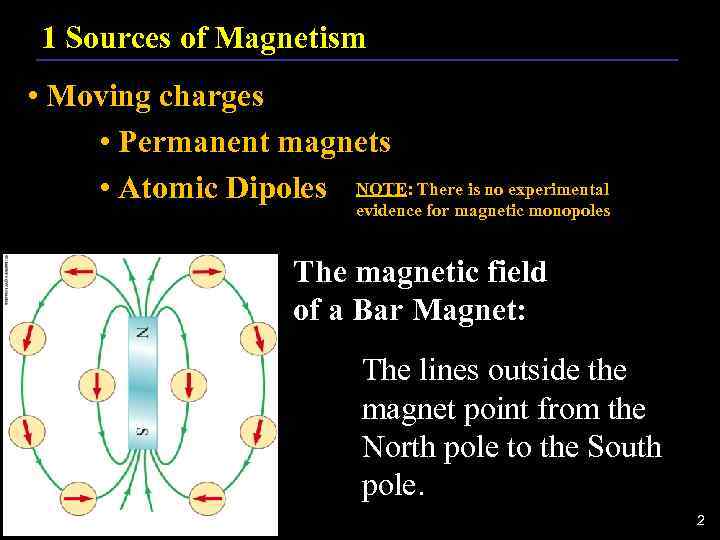 1 Sources of Magnetism • Moving charges • Permanent magnets • Atomic Dipoles NOTE: There is no experimental evidence for magnetic monopoles The magnetic field of a Bar Magnet: The lines outside the magnet point from the North pole to the South pole. 2
 1. 1 Earth’s magnetic field • Dynamo Effect • Magnetic poles • Deflection of charged particles 3
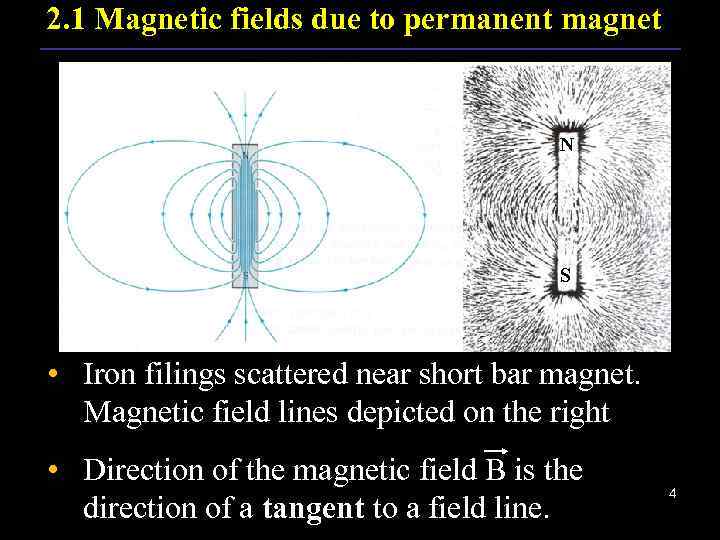 2. 1 Magnetic fields due to permanent magnet N S • Iron filings scattered near short bar magnet. Magnetic field lines depicted on the right • Direction of the magnetic field B is the direction of a tangent to a field line. 4
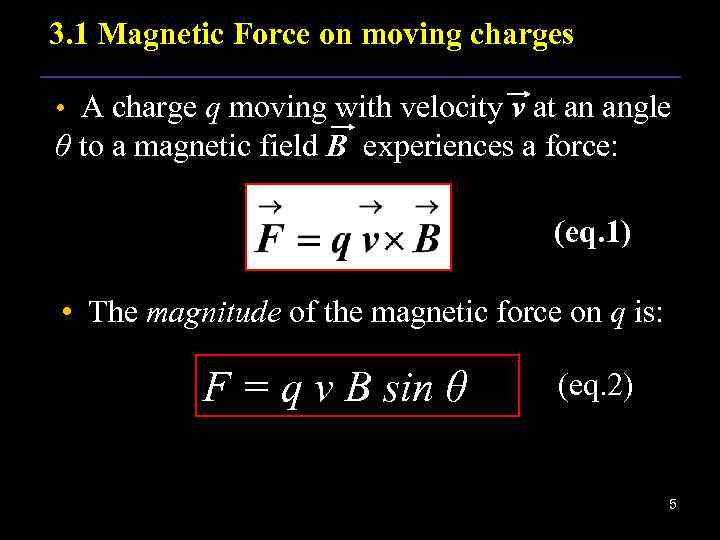 3. 1 Magnetic Force on moving charges • A charge q moving with velocity v at an angle θ to a magnetic field B experiences a force: (eq. 1) • The magnitude of the magnetic force on q is: F = q v B sin θ (eq. 2) 5
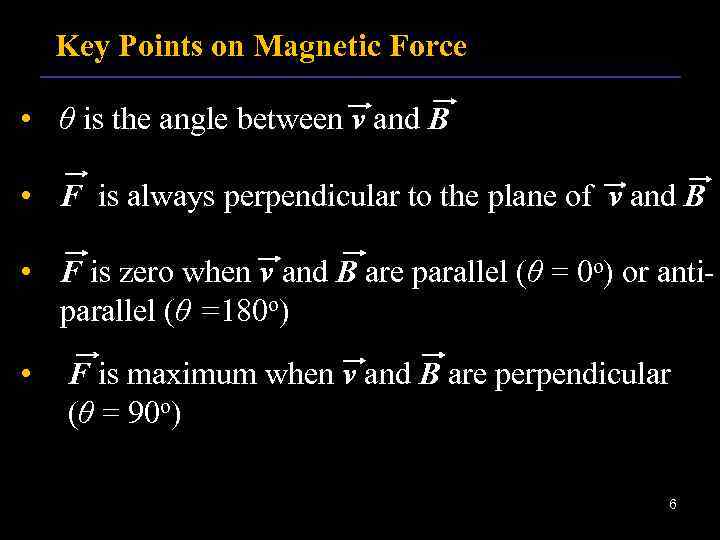 Key Points on Magnetic Force • θ is the angle between v and B • F is always perpendicular to the plane of v and B • F is zero when v and B are parallel (θ = 0 o) or antiparallel (θ =180 o) • F is maximum when v and B are perpendicular (θ = 90 o) 6
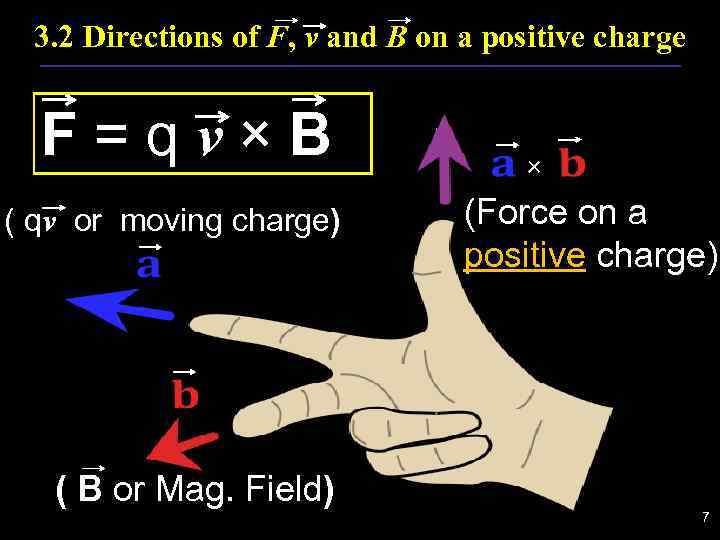 3. 2 Directions of F, v and B on a positive charge F = q v × B ( qv or moving charge) × (Force on a positive charge) ( B or Mag. Field) 7
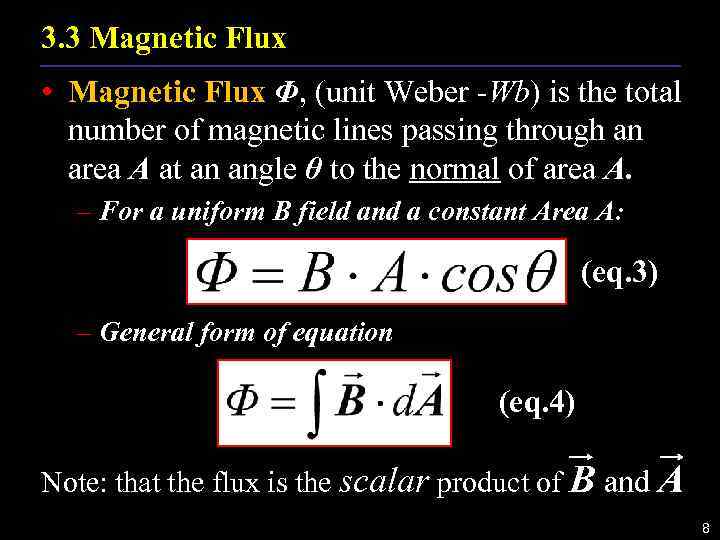 3. 3 Magnetic Flux • Magnetic Flux Φ, (unit Weber -Wb) is the total number of magnetic lines passing through an area A at an angle θ to the normal of area A. – For a uniform B field and a constant Area A: (eq. 3) – General form of equation (eq. 4) Note: that the flux is the scalar product of B and A 8
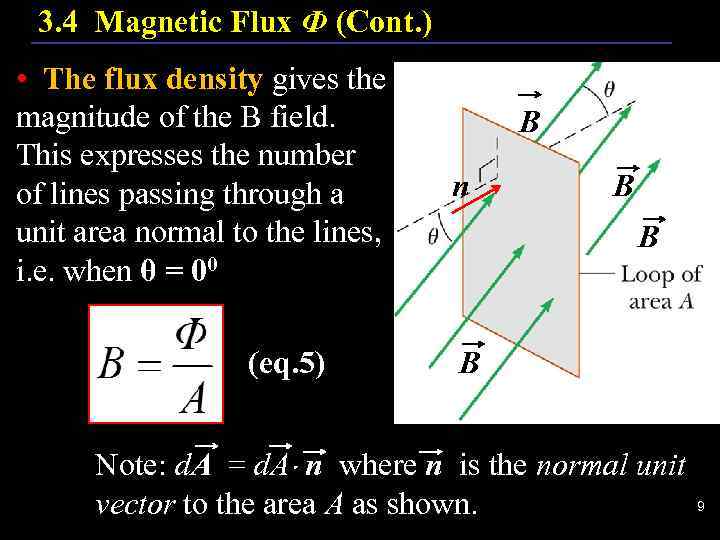 3. 4 Magnetic Flux Ф (Cont. ) • The flux density gives the magnitude of the B field. This expresses the number of lines passing through a unit area normal to the lines, i. e. when θ = 00 (eq. 5) B n B B B Note: d. A = d. A n where n is the normal unit vector to the area A as shown. 9
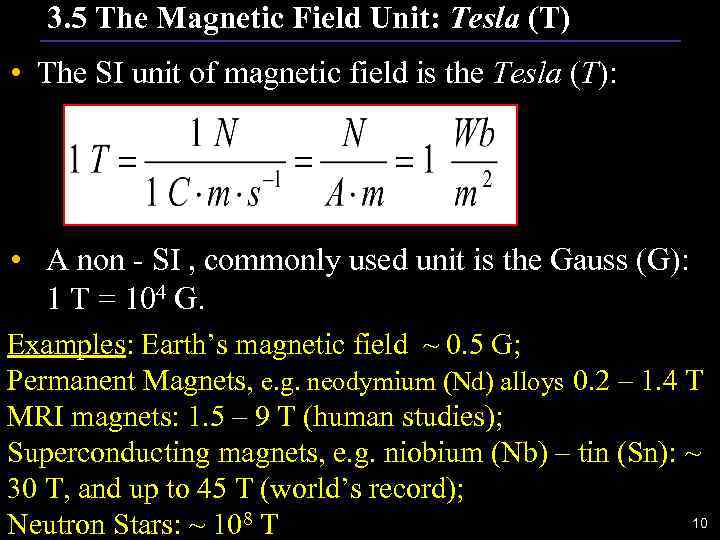 3. 5 The Magnetic Field Unit: Tesla (T) • The SI unit of magnetic field is the Tesla (T): • A non - SI , commonly used unit is the Gauss (G): 1 T = 104 G. Examples: Earth’s magnetic field ~ 0. 5 G; Permanent Magnets, e. g. neodymium (Nd) alloys 0. 2 – 1. 4 T MRI magnets: 1. 5 – 9 T (human studies); Superconducting magnets, e. g. niobium (Nb) – tin (Sn): ~ 30 T, and up to 45 T (world’s record); 10 Neutron Stars: ~ 108 T
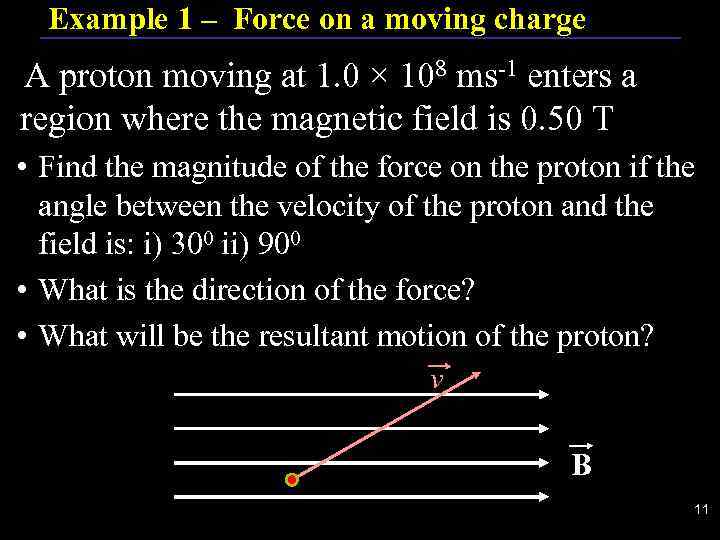 Example 1 – Force on a moving charge A proton moving at 1. 0 × 108 ms-1 enters a region where the magnetic field is 0. 50 T • Find the magnitude of the force on the proton if the angle between the velocity of the proton and the field is: i) 300 ii) 900 • What is the direction of the force? • What will be the resultant motion of the proton? v B 11
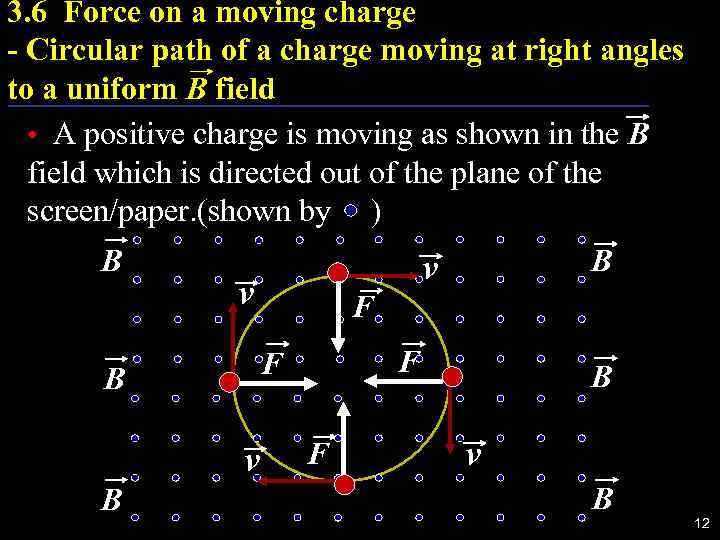 3. 6 Force on a moving charge - Circular path of a charge moving at right angles to a uniform B field • A positive charge is moving as shown in the B field which is directed out of the plane of the screen/paper. (shown by ) B v v B F F F B B v F B v B 12
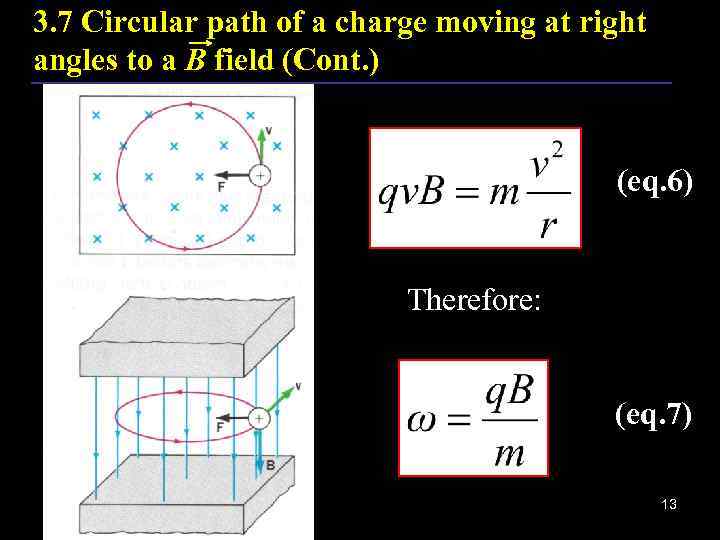 3. 7 Circular path of a charge moving at right angles to a B field (Cont. ) (eq. 6) Therefore: (eq. 7) 13
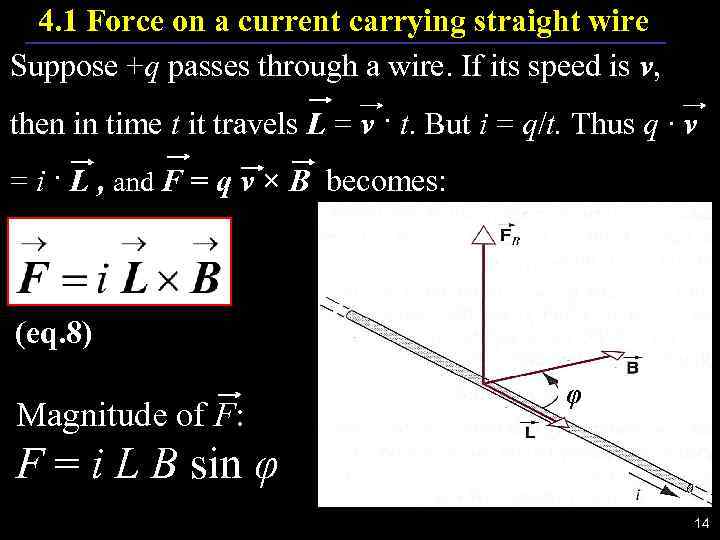 4. 1 Force on a current carrying straight wire Suppose +q passes through a wire. If its speed is v, then in time t it travels L = v · t. But i = q/t. Thus q ∙ v = i · L , and F = q v × B becomes: (eq. 8) Magnitude of F: φ F = i L B sin φ 14
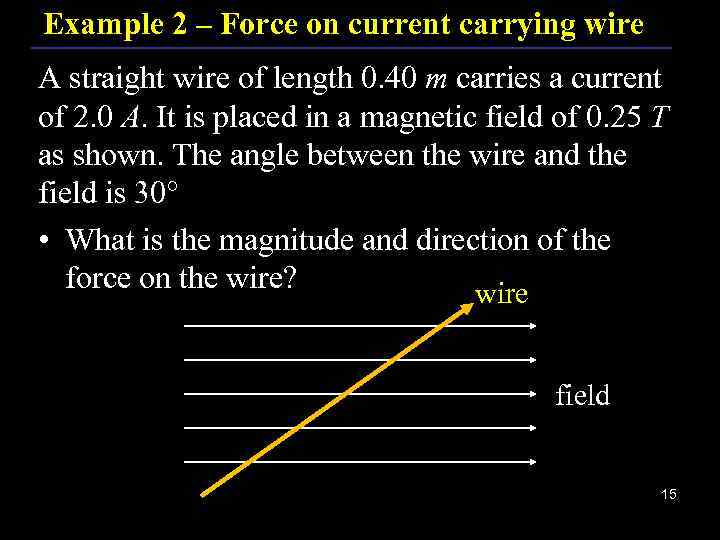 Example 2 – Force on current carrying wire A straight wire of length 0. 40 m carries a current of 2. 0 A. It is placed in a magnetic field of 0. 25 T as shown. The angle between the wire and the field is 30° • What is the magnitude and direction of the force on the wire? wire field 15
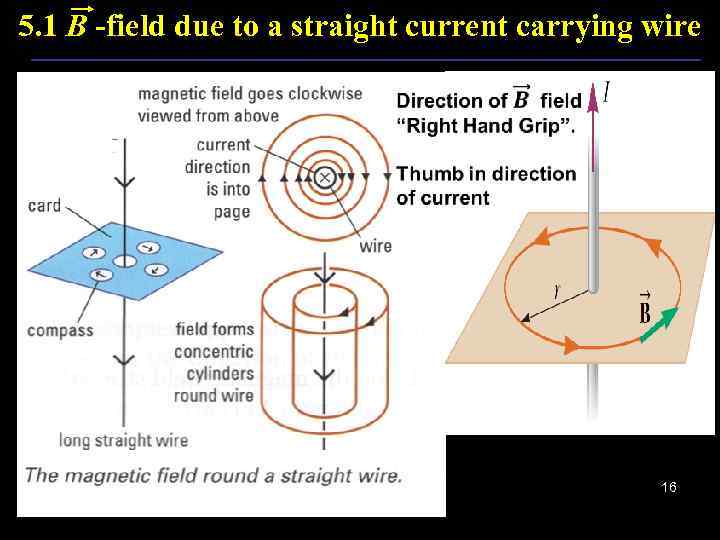 5. 1 B -field due to a straight current carrying wire i 16
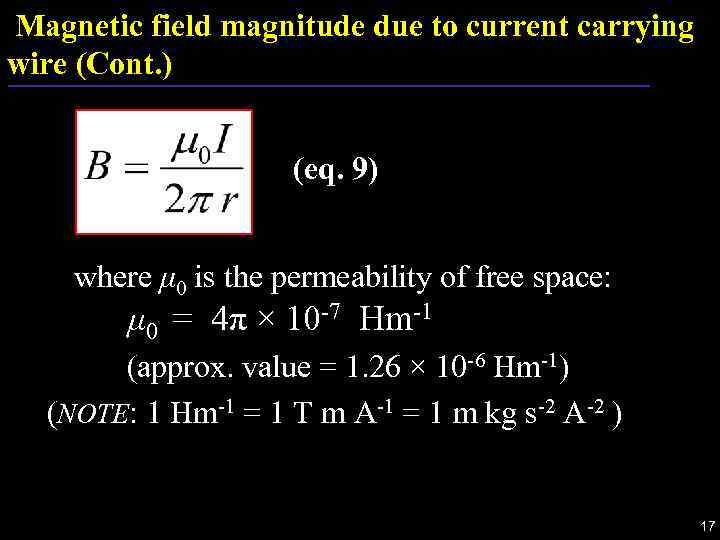 Magnetic field magnitude due to current carrying wire (Cont. ) (eq. 9) where μ 0 is the permeability of free space: μ 0 = 4π × 10 -7 Hm-1 (approx. value = 1. 26 × 10 -6 Hm-1) (NOTE: 1 Hm-1 = 1 T m A-1 = 1 m kg s-2 A-2 ) 17
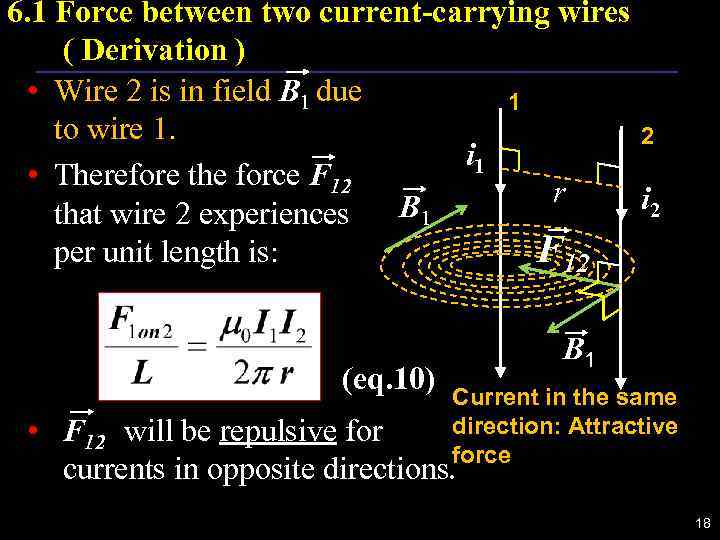 6. 1 Force between two current-carrying wires ( Derivation ) • Wire 2 is in field B 1 due 1 to wire 1. 2 i 1 • Therefore the force F 12 r i 2 that wire 2 experiences B 1 per unit length is: F 12 (eq. 10) B 1 Current in the same direction: Attractive force • F 12 will be repulsive for currents in opposite directions. 18
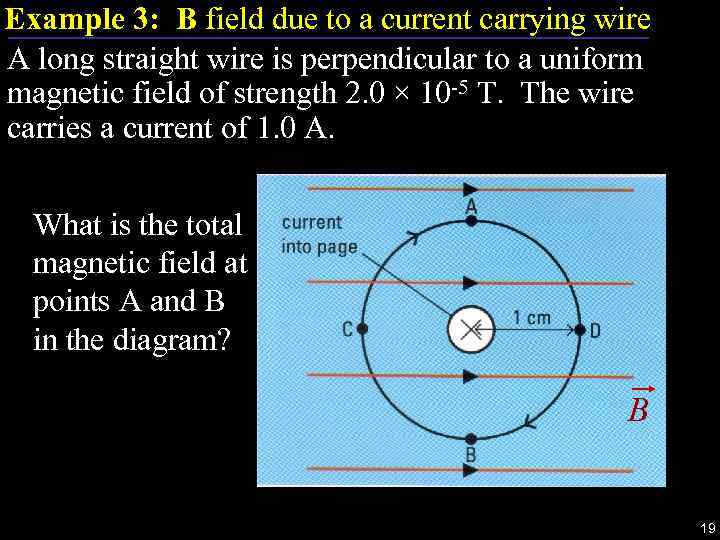 Example 3: B field due to a current carrying wire A long straight wire is perpendicular to a uniform magnetic field of strength 2. 0 × 10 -5 T. The wire carries a current of 1. 0 A. What is the total magnetic field at points A and B in the diagram? B 19
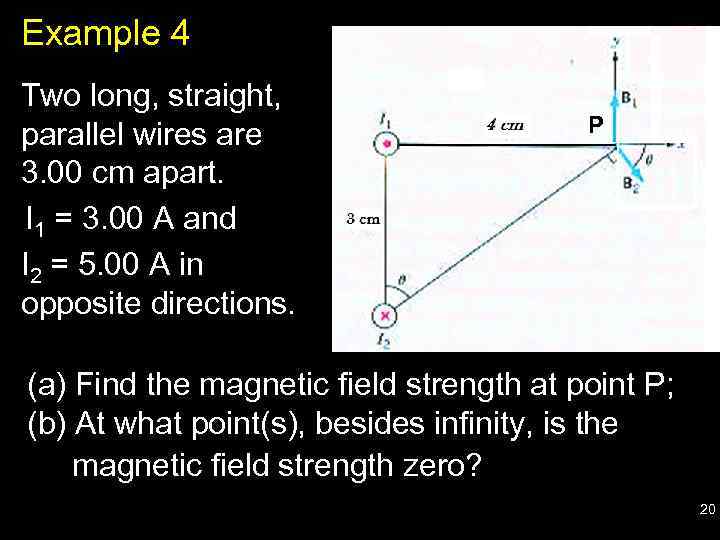 Example 4 Two long, straight, P parallel wires are 3. 00 cm apart. I 1 = 3. 00 A and I 2 = 5. 00 A in opposite directions. (a) Find the magnetic field strength at point P; (b) At what point(s), besides infinity, is the magnetic field strength zero? 20
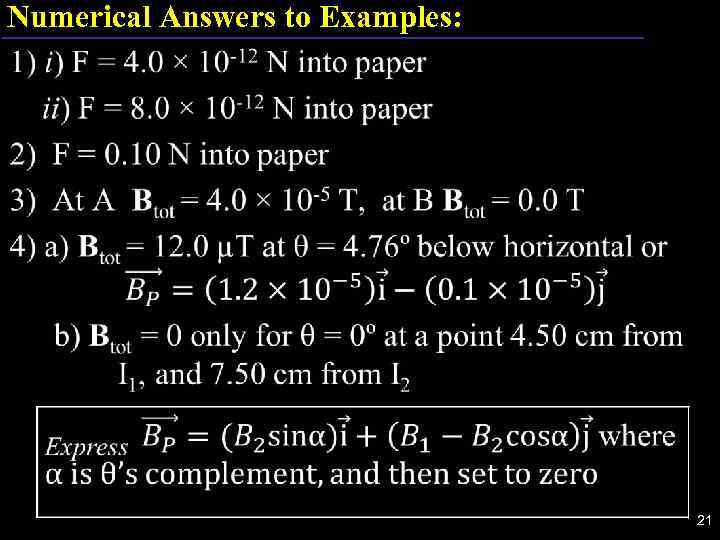 Numerical Answers to Examples: • 21
 Further Reading • Adams and Allday: 5. 14, 5. 15, 5. 16 • Serway: 19. 1, 19. 2, 19. 3, 19. 5 -19. 7 Be sure to look at Book Examples At the end of this lecture you should: • Understand how a magnetic field is defined implicitly by the Lorentz force • Be able to calculate the magnitude and direction of the force on a conductor of length, l, carrying current, I, in a magnetic field of field strength, B • Know the formula for the field strength due to a long straight wire carrying current, I, at a distance, a, from the wire • Understand how the definition of the ampere arises and be able to give the definition • Understand the concept of field lines for a magnetic field • Know the formula for the magnetic field strength due to a solenoid and be able to perform calculations using that formula • Have an understanding of the form of the Earth’s magnetic field and understand that this field resolves into two components 22
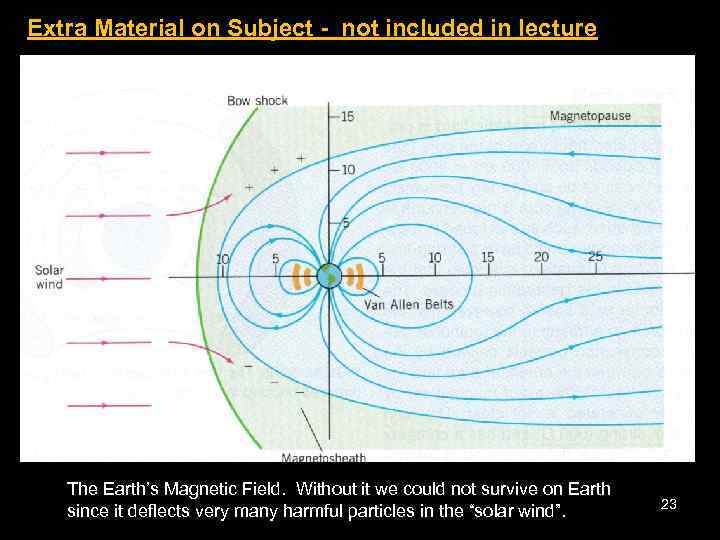 Extra Material on Subject - not included in lecture The Earth’s Magnetic Field. Without it we could not survive on Earth since it deflects very many harmful particles in the “solar wind”. 23
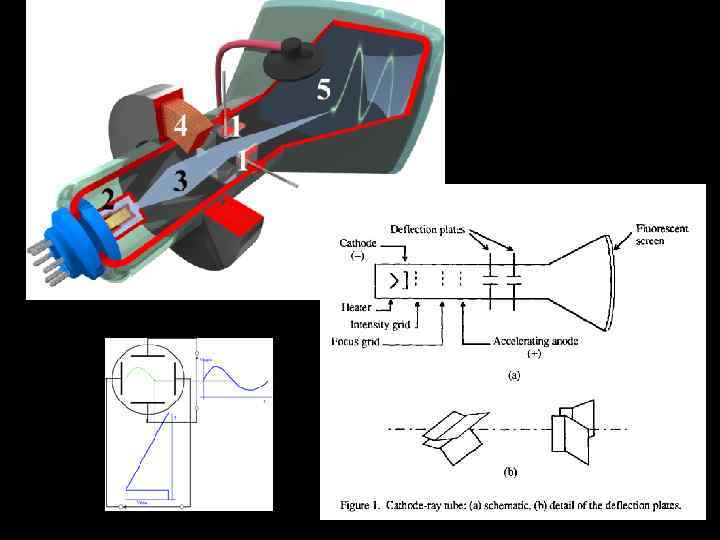
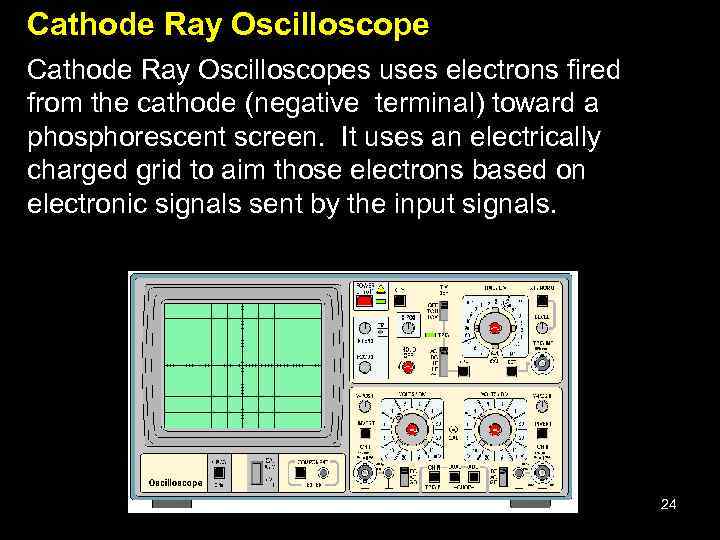 Cathode Ray Oscilloscopes uses electrons fired from the cathode (negative terminal) toward a phosphorescent screen. It uses an electrically charged grid to aim those electrons based on electronic signals sent by the input signals. 24
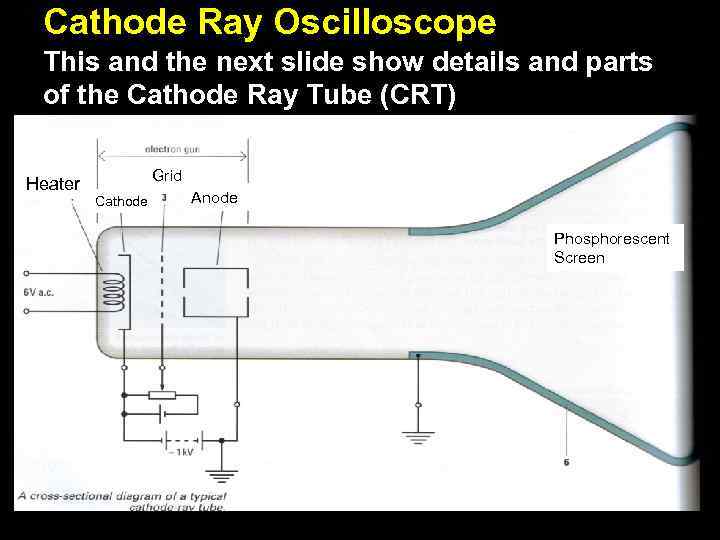 Cathode Ray Oscilloscope This and the next slide show details and parts of the Cathode Ray Tube (CRT) Heater Grid Cathode Anode Phosphorescent Screen 25
 26
26
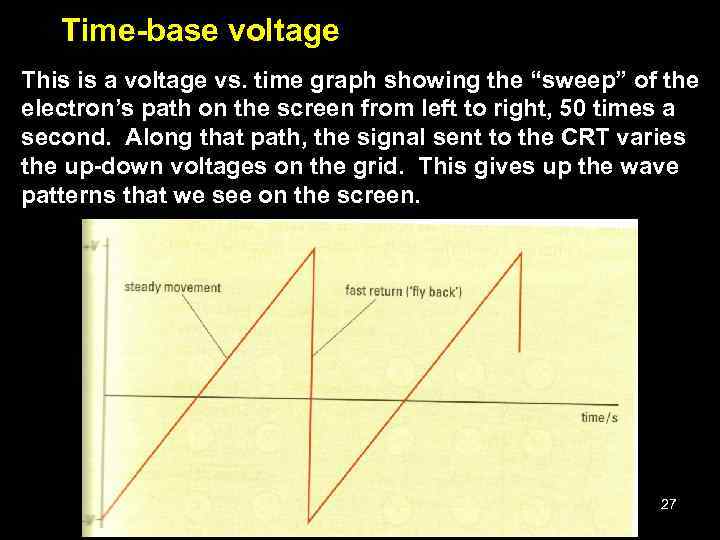 Time-base voltage This is a voltage vs. time graph showing the “sweep” of the electron’s path on the screen from left to right, 50 times a second. Along that path, the signal sent to the CRT varies the up-down voltages on the grid. This gives up the wave patterns that we see on the screen. 27