 Скачать презентацию L 3 Basis of Calculus and Kinematics
L03 Basis of Calculus 2014.pptx
- Количество слайдов: 34



L 3 – Basis of Calculus and Kinematics Outline 1. A review of the Gradient of a Graph 2. Infinitesimal Changes 3. Instantaneous Speed 4. Instantaneous Acceleration 5. Rates of change in Physics 6. Differentiation 7. The Area under a velocity-time graph
Announcements • Your Coursework 1 has been kept on the table in front of Physics office 2 -422 b. Please pick up one copy if you haven’t done so. • A copy has also been uploaded on Moodle with numerical answers. • You are not supposed to submit the coursework. You must check your own work and confirm that you understand the material.

1 st Coursework test • When: Wednesday 22 nd October 2014 • Time: From 4. 00 pm to 5. 00 pm • Where: TBA (To be announced)
Laboratory time table for project • Labs will start from this week • Attendance is optional • Students are not allowed to take any tools out of the laboratory. • Students can work at any place convenient to them. • You can enter the labs only on the days specified on your time table.
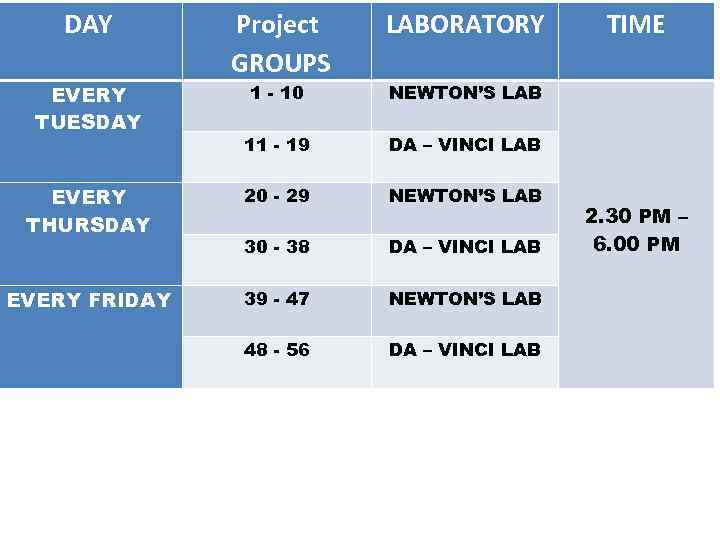
DAY Project GROUPS LABORATORY TIME EVERY TUESDAY 1 - 10 11 - 19 20 - 29 30 - 38 39 - 47 48 - 56 NEWTON’S LAB EVERY THURSDAY EVERY FRIDAY DA – VINCI LAB NEWTON’S LAB DA – VINCI LAB 2. 30 PM – 6. 00 PM
1. A Review of the Gradient of a Graph • Imagine a train that leaves a station and travels at a constant speed on a straight line. • Because it moves with constant speed it means that at equal time intervals: t 2 -t 1, it travels equal space intervals: y 2 -y 1. • If we plotted the position of the train from the starting point versus time it takes it to travel a distance y, we get a straight line:
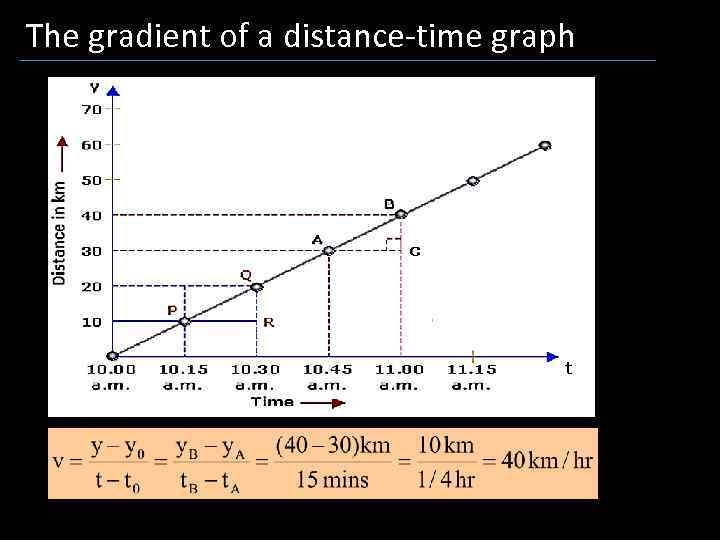
The gradient of a distance-time graph
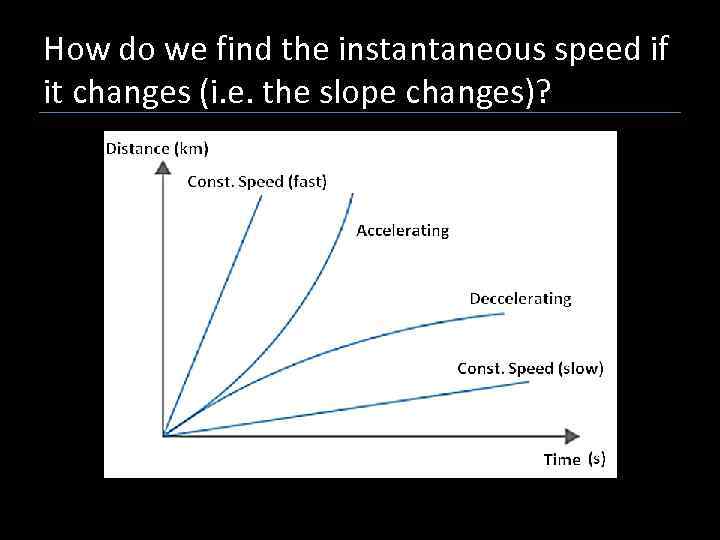
How do we find the instantaneous speed if it changes (i. e. the slope changes)?
We need the idea of “Infinitesimal Change” • The concept of “infinitesimal change” had perplexed Physicists and Mathematicians alike for many centuries. • It was formalised in the 17 th century by the Mathematician Leibinz. • Newton was the first who applied the concept to physical problems to understand rates of change of physical quantities such as velocity and acceleration.
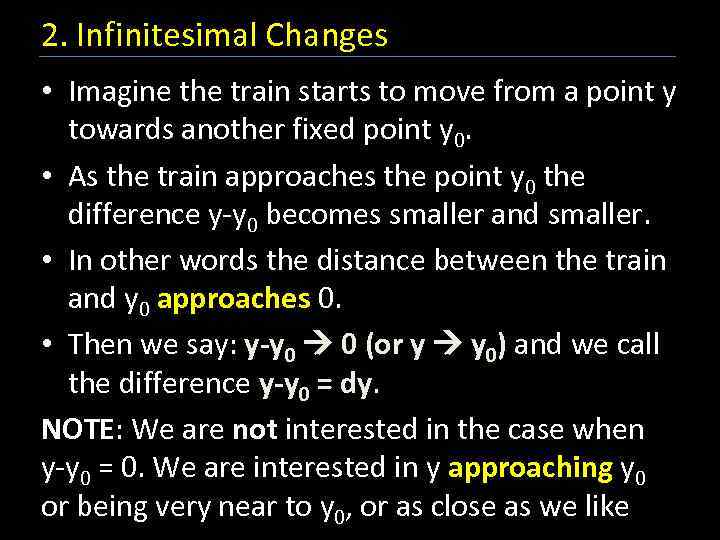
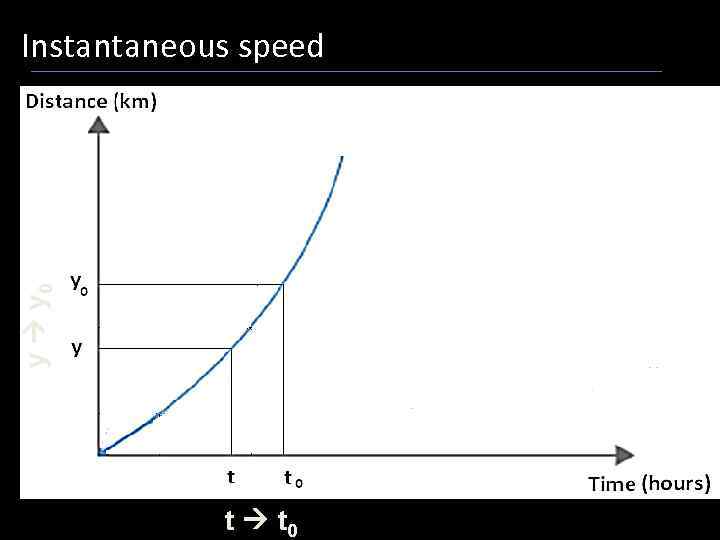
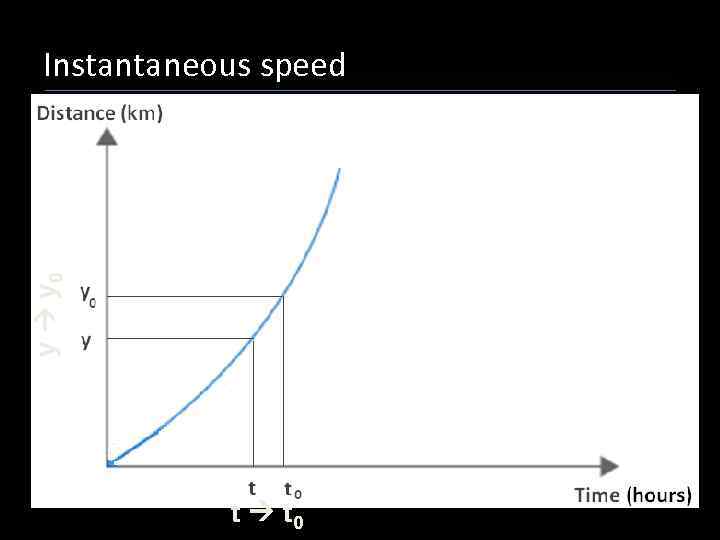
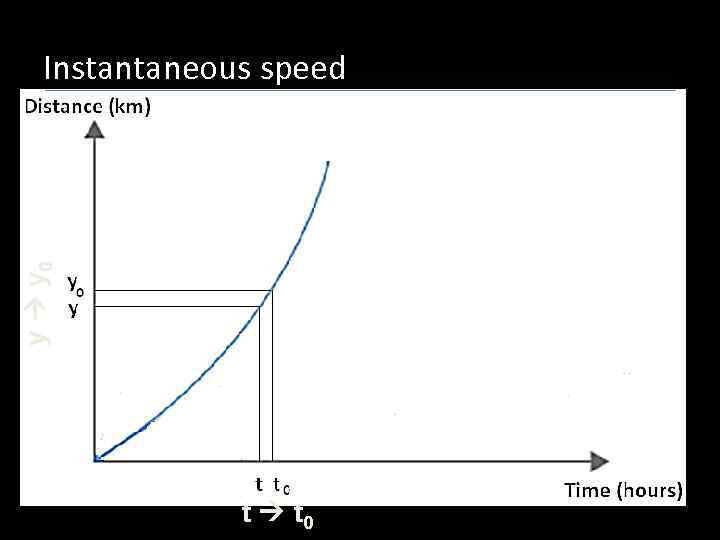
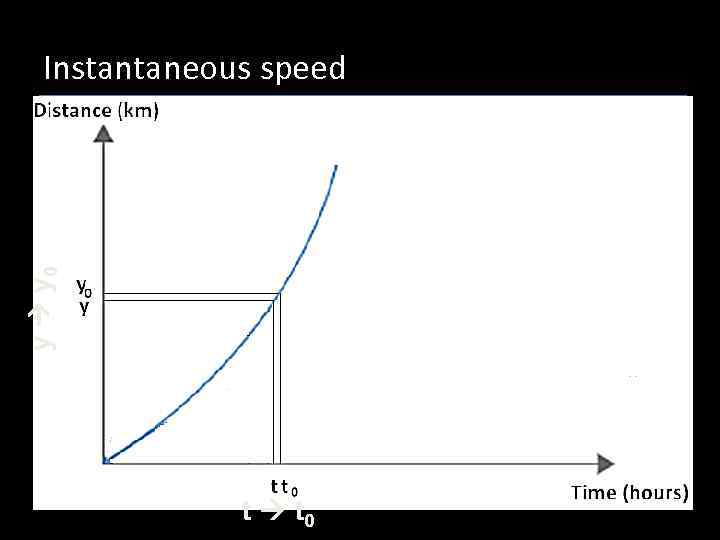
2. Infinitesimal Changes • Imagine the train starts to move from a point y towards another fixed point y 0. • As the train approaches the point y 0 the difference y-y 0 becomes smaller and smaller. • In other words the distance between the train and y 0 approaches 0. • Then we say: y-y 0 0 (or y y 0) and we call the difference y-y 0 = dy. NOTE: We are not interested in the case when y-y 0 = 0. We are interested in y approaching y 0 or being very near to y 0, or as close as we like
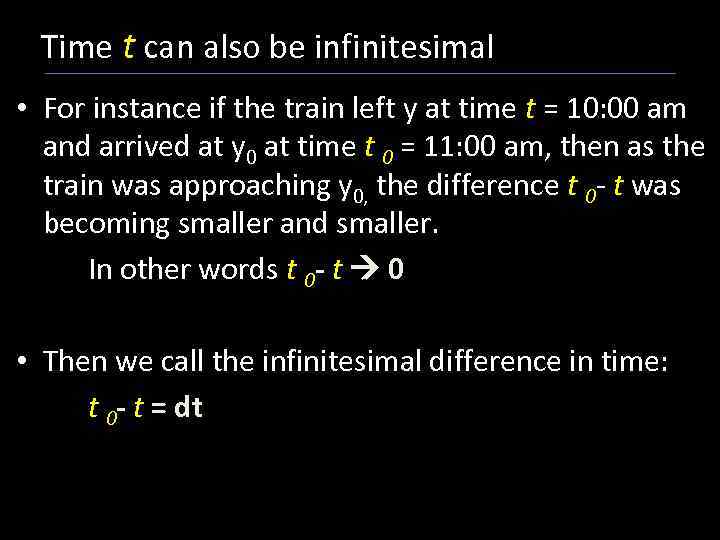
Time t can also be infinitesimal • For instance if the train left y at time t = 10: 00 am and arrived at y 0 at time t 0 = 11: 00 am, then as the train was approaching y 0, the difference t 0 - t was becoming smaller and smaller. In other words t 0 - t 0 • Then we call the infinitesimal difference in time: t 0 - t = dt
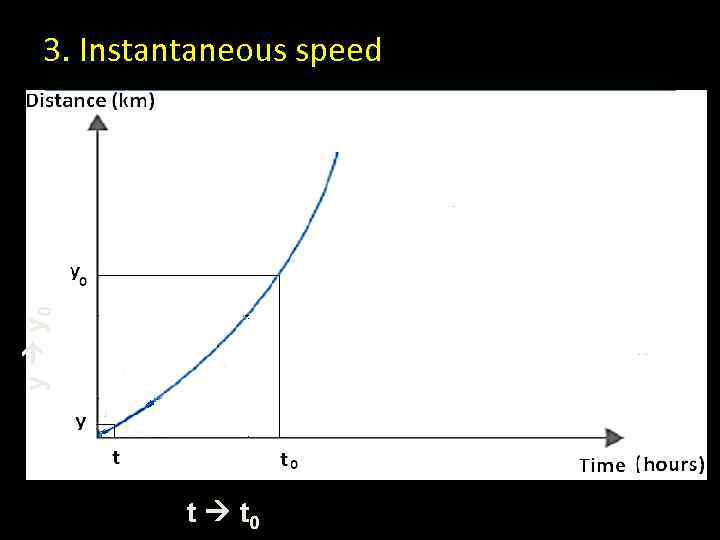
y y 0 3. Instantaneous speed t t 0
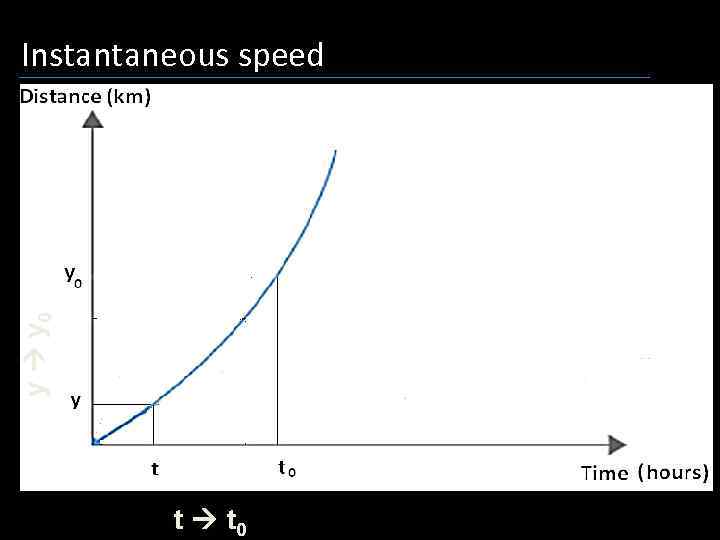
y y 0 Instantaneous speed t t 0
y y 0 Instantaneous speed t t 0
y y 0 Instantaneous speed t t 0
y y 0 Instantaneous speed t t 0
Instantaneous speed y y 0 And so on. . . t t 0
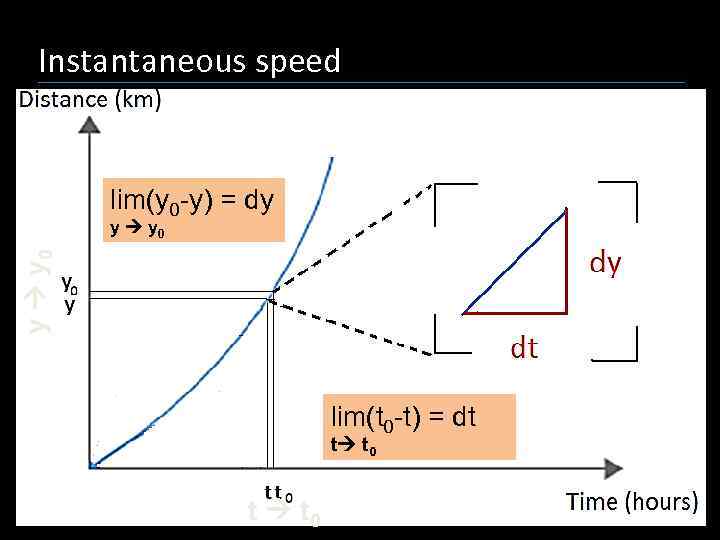
Instantaneous speed Right angle triangle lim(y 0 -y) = dy y y 0 lim(t 0 -t) = dt t t 0 t t 0
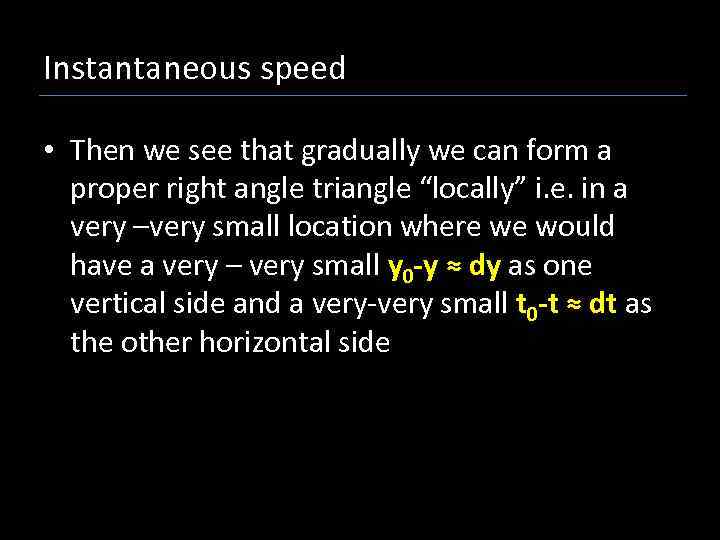
Instantaneous speed • Then we see that gradually we can form a proper right angle triangle “locally” i. e. in a very –very small location where we would have a very – very small y 0 -y ≈ dy as one vertical side and a very-very small t 0 -t ≈ dt as the other horizontal side
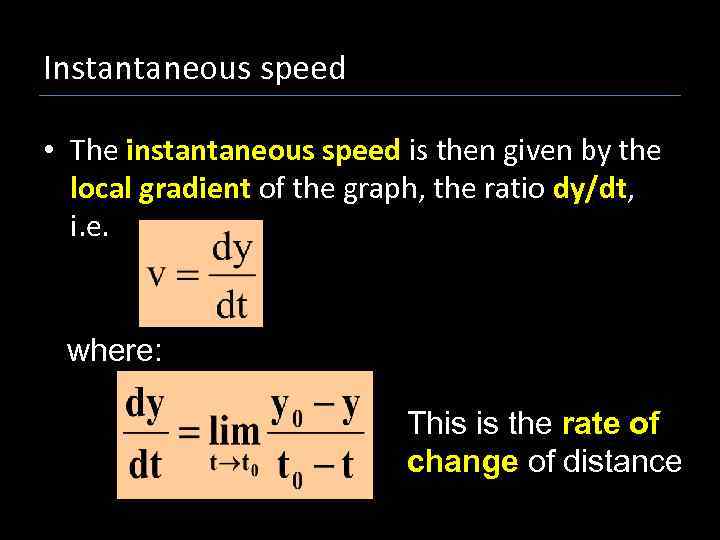
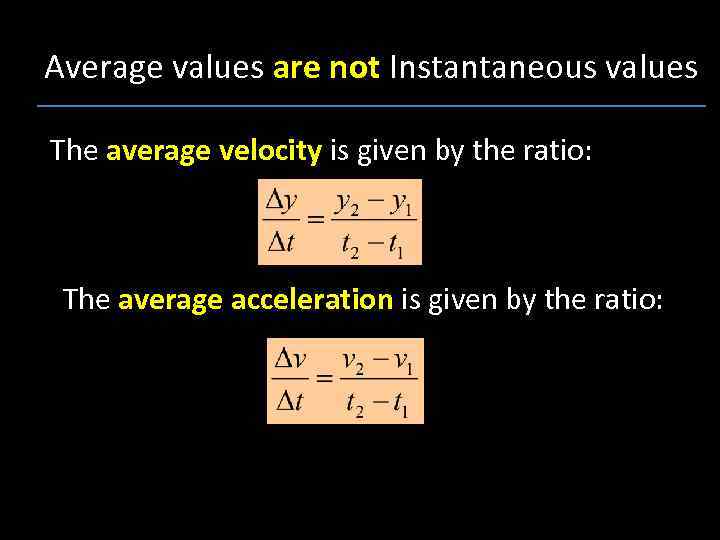
Instantaneous speed • The instantaneous speed is then given by the local gradient of the graph, the ratio dy/dt, i. e. where: This is the rate of change of distance
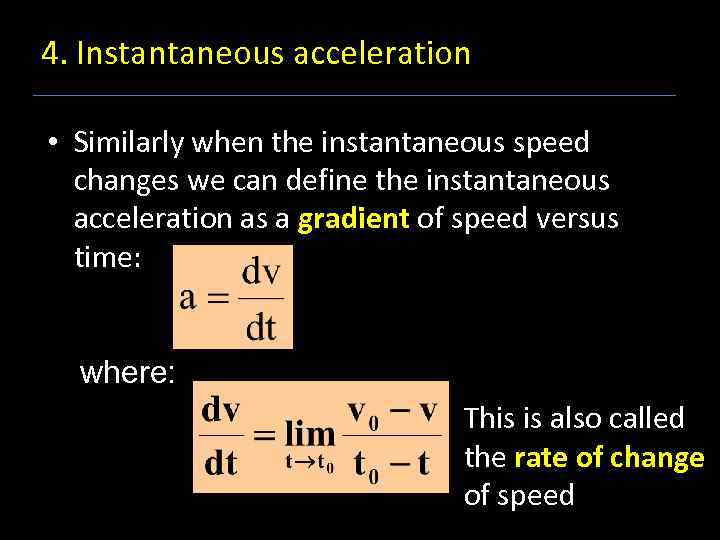
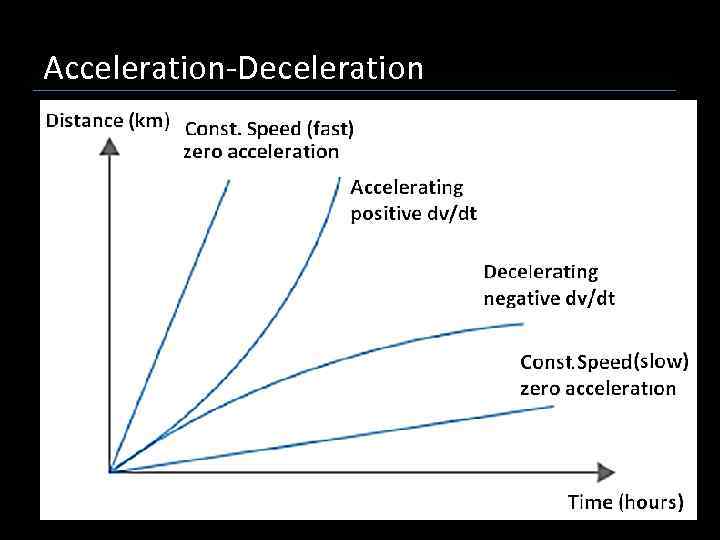
4. Instantaneous acceleration • Similarly when the instantaneous speed changes we can define the instantaneous acceleration as a gradient of speed versus time: where: This is also called the rate of change of speed
Acceleration-Deceleration
Average values are not Instantaneous values The average velocity is given by the ratio: The average acceleration is given by the ratio:
EXAMPLE 1: Estimate the local gradients at some points. Compare them with the average gradients of the graphs
5. Rates of Change in Physics • In Physics you will come across the rate of change of other physical quantities such as: momentum, energy, mass and others. • These will be represented as dp/dt (for momentum), d. E/dt (for energy), dm /dt for mass. • They will always mean the instantaneous values of these quantities as they change with time.
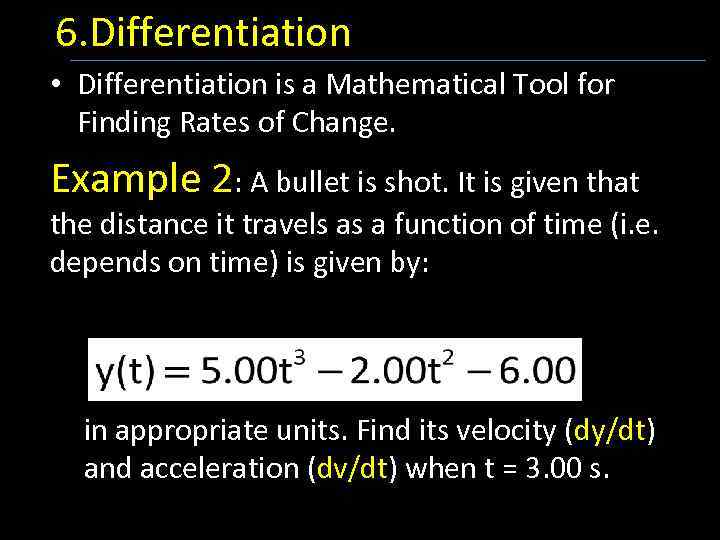
6. Differentiation • Differentiation is a Mathematical Tool for Finding Rates of Change. Example 2: A bullet is shot. It is given that the distance it travels as a function of time (i. e. depends on time) is given by: in appropriate units. Find its velocity (dy/dt) and acceleration (dv/dt) when t = 3. 00 s.
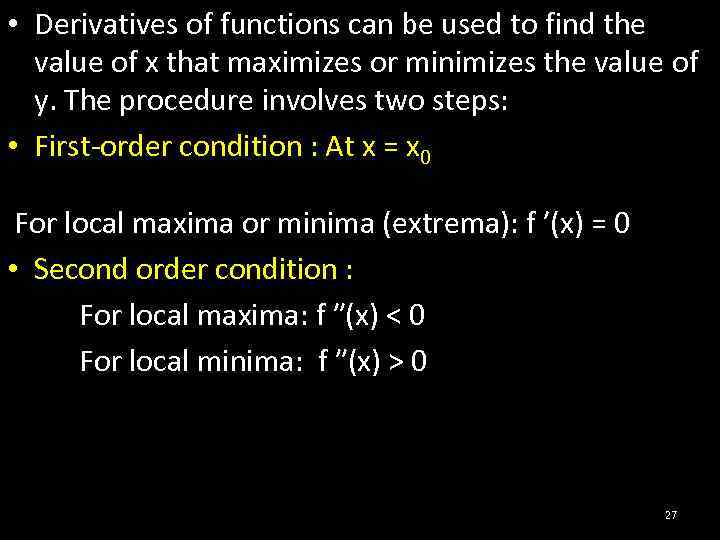
• Derivatives of functions can be used to find the value of x that maximizes or minimizes the value of y. The procedure involves two steps: • First-order condition : At x = x 0 For local maxima or minima (extrema): f ′(x) = 0 • Second order condition : For local maxima: f ″(x) < 0 For local minima: f ″(x) > 0 27
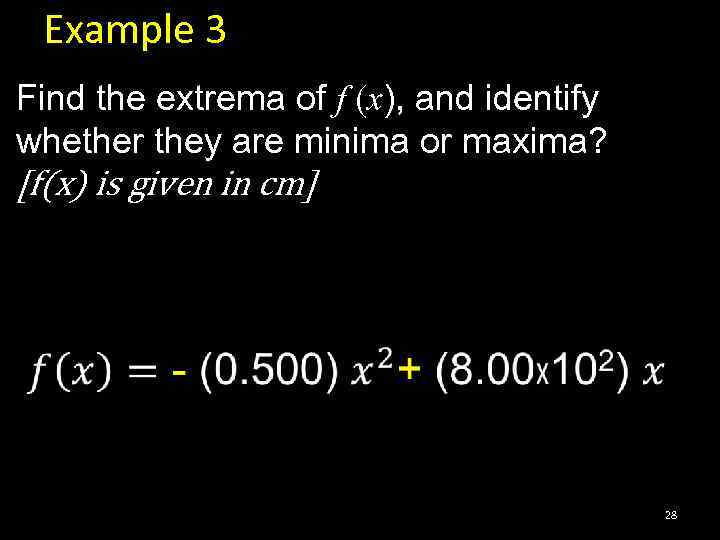
Example 3 Find the extrema of f (x), and identify whether they are minima or maxima? [f(x) is given in cm] 28
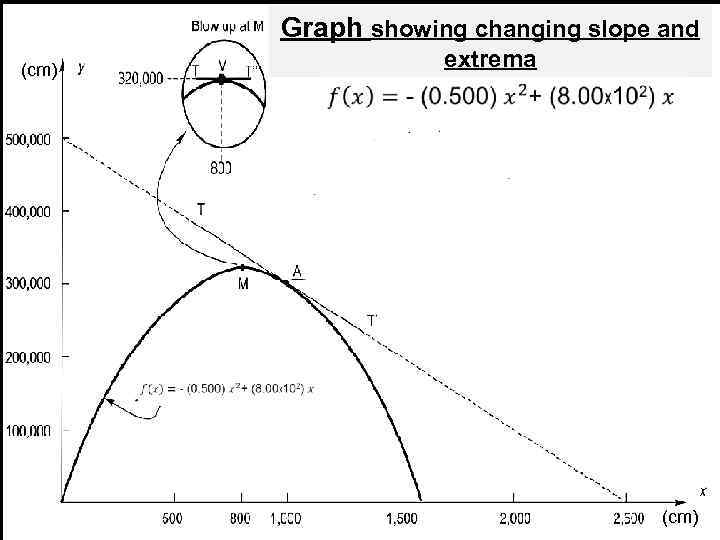
Graph showing changing slope and extrema (cm) 29 (cm)
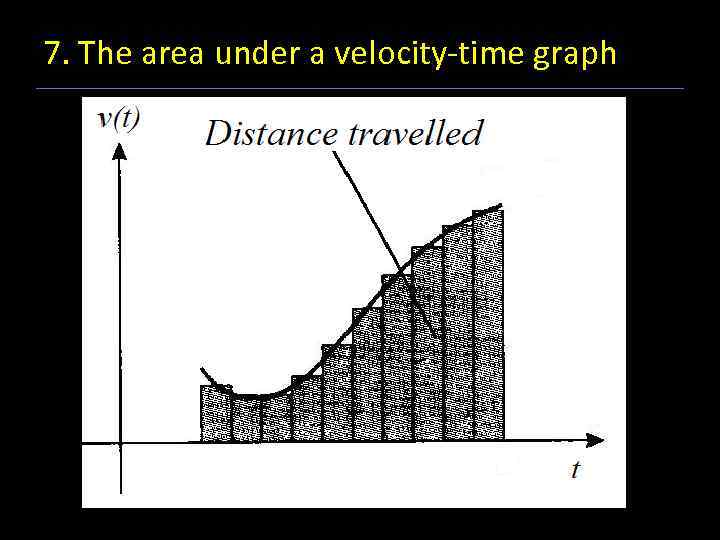
7. The area under a velocity-time graph
7. The area under a velocity-time graph • This gives the distance travelled. • We can find it by dividing the area in to infinitesimal parallelogram areas. • We will revisit the idea of the area under a graph when we talk about the work done by a force and also the impulse of a force.
Summary : • Understand the concept of gradient and its use to find average as well as instantaneous values of velocity and acceleration • Understand use derivatives to solve problems in Physics; • Calculate derivatives of basic functions; • Use 1 st and 2 nd derivatives to find the extrema of a function,
Further Reading • Read Pages 18 -26, from the book of Serway’s Essentials of College Physics –International Student Edition • Read Pages 46 -49 and 606 -608 from Adams and Alday Book, Advanced Physics - Oxford
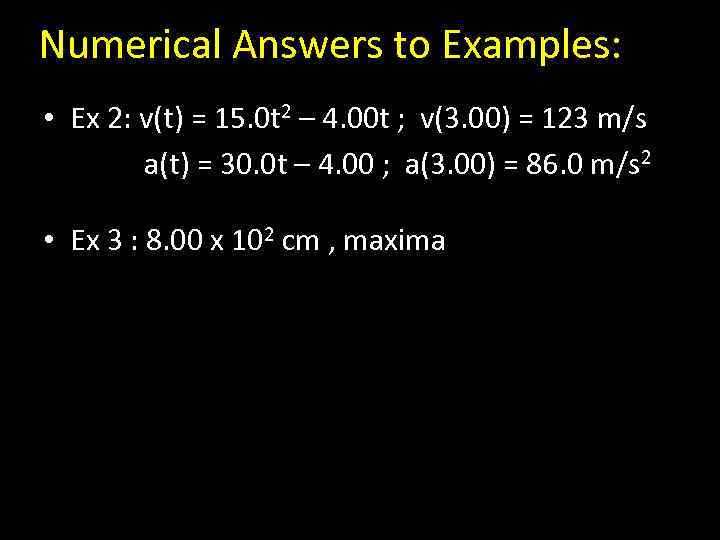
Numerical Answers to Examples: • Ex 2: v(t) = 15. 0 t 2 – 4. 00 t ; v(3. 00) = 123 m/s a(t) = 30. 0 t – 4. 00 ; a(3. 00) = 86. 0 m/s 2 • Ex 3 : 8. 00 x 102 cm , maxima
Скачать презентацию L 3 Basis of Calculus and Kinematics
L03 Basis of Calculus 2014.pptx