


 Скачать презентацию L 2 Venture Team Management EC 10 Innovation
6550f41b55a7ad6c5ba2e73153e0d5fd.ppt
- Количество слайдов: 56
 L 2: Venture Team Management EC 10: Innovation & Commercialisation What it Takes to be a Leader and Manage Change Marcus Thompson wmt 1@stir. ac. uk 2. Team Management 1
 Venture Team Management Outline 1. Managing Innovations n 2. Organisations Built to Innovate n 3. The Technology Commercial Paradigm n 4. Change Management n 2. Team Management 2
 1. Managing Innovations Perspectives on Commercial & Technical Innovation 2. Team Management
 Innovation DNA "successful organisations develop a culture of change that just keeps moving. “ Kanter 1999 – Context – Leadership – Core Values – Culture www. thinksmart. com 2. Team Management 4
 Forms of Innovation New products – either radically new or which extend the product lifecycle. Process innovation – leading to reduced production costs, and affected partially by the learning and experience effect. Marketing Innovations – increase differentiation. Organisational Changes – reduce costs or improve, total quality. 2. Team Management 5
 Technology Perspectives Technology Innovations – exploitation of new ideas – incorporating new technologies, design and best practice is the key business. Commercial Innovation – Venture management strategies and structures that bring these new technologies to market. 2. Team Management 6
 Commercial Innovation is about doing things new or different (from your competitors). – It is a management process that centres on being creative & visionary. – It presents itself as the ability to filter and then commercialise. – It applies to: new products new business practices new market applications 2. Team Management 7
 Commercial V Technical Innovations l These are the skills of the entrepreneur. l Are they the skills of the scientist? 2. Team Management 8
 FORMS Commercialisation and technology transfer takes many forms: – – Licensing technology Spinout company formation Collaborative research and TT projects Faculty/student/industry exchange and internship programs – Consultancy/applied research – Teaching, education and outreach programs 2. Team Management 9
 Key Success Factors for Innovation Sustainable Business Model Architectural Linkages – Social, technical & commercial An Entrepreneurial Team to balance science & commerce Global perspective Adaptive use of technologies & business processes to meet a specified market need. Customer-centred players – niche rather than segment. Exit strategies. 2. Team Management 10
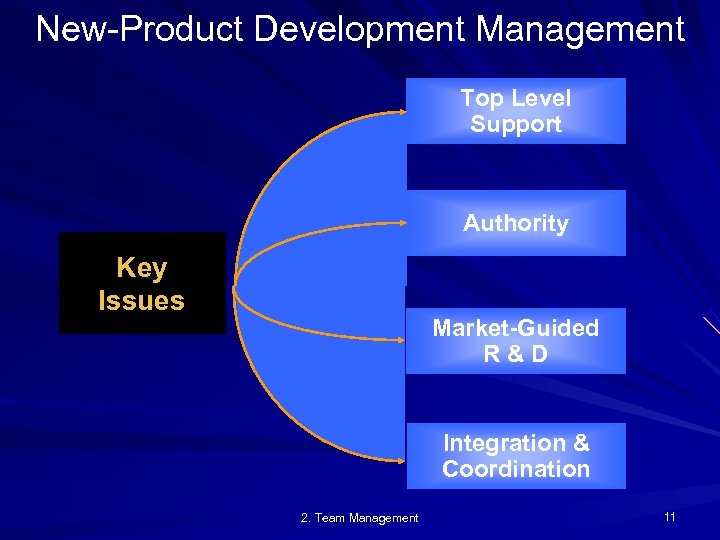 New-Product Development Management Top Level Support Authority Key Issues Market-Guided R&D Integration & Coordination 2. Team Management 11
 Approaches to Innovation OLD STYLE – – – – NEW STYLE Physical creativity center Focus on idea generation Employee-oriented A dedicated change agent’s project Training and facilitation Individual and monetary rewards Small group creativity Leaders passively supportive – Innovation resources as part of business units – Focus on business strategy and creating value – Customer-centred – A team-created innovation culture – Coaching and project team involvement – Team recognition – Tools scalable to organisation 2. Team Management 12
 Un-innovation Product Development & Brand management is the sole responsibility of the Chief Executive 2. Team Management 13
 2. Organisations Built to Innovate How to manage knowledge by building a flexible organisation 2. Team Management 14
 The Importance of Knowledge u we live in the age of the ‘knowledge worker. ’ Education, education – the usefulness of any given skill set will change several times over people’s lifetimes. Therefore, the skills of ‘learning to learn’ are vital throughout an adult’s lifetime – the information explosion means that there is much more ‘information’ easily available, but little or no guidance in how to tell the good from the bad – the information explosion also means that ‘information’ need not be processed if it serves only a temporary purpose, e. g. downloading an essay for an exam 2. Team Management 15
 Knowledge & Creativity u Depend on Diversity u Building on participation is not optional u Develop a sense of shared meanings and u Meaning engages creativity u Reinvent Business Process to Match Creativity – If the business system becomes homogeneous, it becomes vulnerable to environmental shifts. It will no longer work in a new environment and the entire system is at risk. – In a turbulent environment, it is important that the founding team engage everyone who’s going to be affected by change. – This is a paradox. It is the unity of diversity that can be used to unify an organisation. – When people become interested in an issue their creativity is instantly engaged. For people to innovate they must buy into something that has meaning for what they do. 2. Team Management 16
 Drucker on Entrepreneurial Organisations u `Entrepreneurship is based upon the same principles, whether the entrepreneur is an existing large institution or an individual starting his or her new venture single-handed. It makes little or no difference whether the entrepreneur is a business or a non-business public-service organisation, nor even whether the entrepreneur is a government or non-government institution. The rules are pretty much the same, and so are the kinds of innovation and where to look for them. In every case there is a discipline we might call Entrepreneurial Management. 'Druker, P. F. (1985) Innovation and Entrepreneurship, New York: Harper Row. 2. Team Management 17
 Entrepreneurial Organisations “Creating the entrepreneurial organisation is about encouraging opportunity seeking and innovation in a systematic manner, always questioning the established order, seeking ways to improve and create competitive advantage. It is about encouraging the qualities enjoyed by successful entrepreneurs such as vision and drive. It is about learning new ways to manage organisations involving relationships and culture. It is about new ways of dealing with risk, uncertainty and ambiguity so as to maintain flexibility. 2. Team Management 18
 Organisations (continued) “It is about institutionalising a process of continuous strategising, learning from customers, competitors and the environment. It is about encouraging change and managing rapid growth. “And it is about doing these things throughout an organisation so that it reflects the entrepreneurial characteristics of its managers - responding quickly and effectively to opportunities or changes in the market place. Burns, P, The Entrepreneurial Organisation, 2002 2. Team Management 19
 “ The power of the team u Is so great that it is often wise to violate common sense and force a team structure on almost anything…companies that do so will achieve a greater focus, stronger task orientation, more innovation and enhanced individual commitment. . ” Tom Peters, Thriving on Chaos. 2. Team Management 20
 Teams u Groups of individuals – bound together by a common goal – different perceptions of that goal & how it can be delivered – different interests – conflict as dynamic tension – coordination & the big picture – task orientation – change & creativity 2. Team Management 21
 The problem of teams u Interpretation u Mediation u Difference u Denial of difference u Conflict u Marshalling resources 2. Team Management 22
 Teams Roles u Spectators u Participants u Spectators as participants u Participants as spectators u The performance u The spectacle 2. Team Management 23
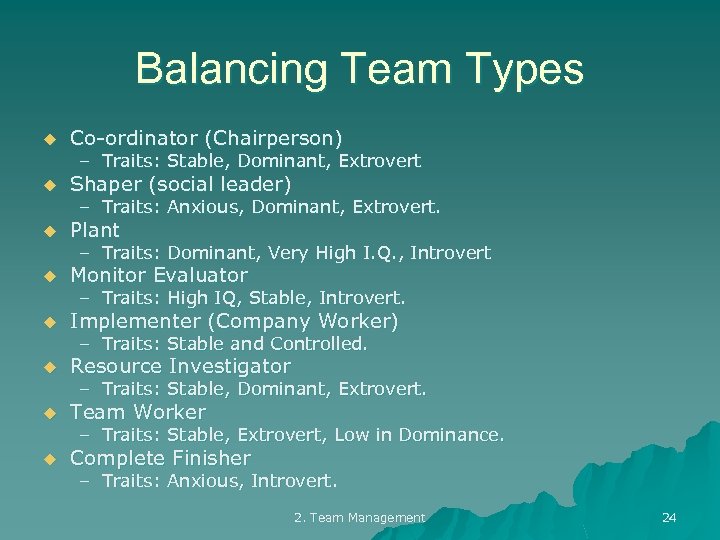 Balancing Team Types u Co-ordinator (Chairperson) u Shaper (social leader) u Plant u Monitor Evaluator u Implementer (Company Worker) u Resource Investigator u Team Worker u Complete Finisher – Traits: Stable, Dominant, Extrovert – Traits: Anxious, Dominant, Extrovert. – Traits: Dominant, Very High I. Q. , Introvert – Traits: High IQ, Stable, Introvert. – Traits: Stable and Controlled. – Traits: Stable, Dominant, Extrovert. – Traits: Stable, Extrovert, Low in Dominance. – Traits: Anxious, Introvert. 2. Team Management 24
 3. The Technology Commercial Paradigm Avoiding the Valley of Death 2. Team Management 25
 High-Tech Firms in UK § Conceptual as well as methodological problems in devising an appropriate definition of high technology activities (Aydalot and Keeble, 1988; Goss and Vozikis, 1994). § Research on ‘technological innovation’ equates the term with ‘high technology’. § Technology & Innovation are closely linked by policy makers. § Debate surrounds the industries that can be regarded as technologically innovative. § Butchart (1987) has presented a ‘process’ based classification of high technology sectors. He identified several Standard Industrial Classification (SIC) sectors (Central Statistics Office, 1979) with: • Above average R & D intensity; and • Above average proportion of scientists, professional engineers and technicians. 2. Team Management 26
 Paradigms § An incremental evolution – progressively position an organisation and its innovation to take advantage of changes in a marketplace. This is sometimes referred to as continuous innovation. § An revolutionary paradigm – Change fundamental industry assumptions, create new solutions to solve customer problems and in so doing create a brand new product or set of applications. – Known as discontinuous innovation. 2. Team Management 27
 Diffusion Theory § Characteristics Rogers identified in Innovators – venturesome, desire for the rash, the daring, and the risky, – control of substantial financial resources to absorb possible loss from an unprofitable innovation. – the ability to understand apply complex technical knowledge, and – the ability to cope with a high degree of uncertainty about an innovation. § Characteristics Rogers identified in the Early Adopters: – – – integrated part of the local social system, greatest degree of opinion leadership in most systems, serve as role model for other members or society, respected by peers, and successful. 2. Team Management 28
 Diffusion Theory § Characteristics Rogers (1962) identified in the Early Majority: – interact frequently with peers, – seldom hold positions of opinion leadership, – 1/3 of the members of a system, making the early majority the largest category. – deliberate before adopting a new idea. § Characteristics Rogers identified in the Late Majority: – – one-third of the members of a system, pressure from peers, economic necessity, sceptical and cautious. § Characteristics Rogers identified in the Laggards: – – – possess no opinion leadership, isolates, point of reference in the past, suspicious of innovations, innovation-decision process is lengthy, and resources are limited. 2. Team Management 29
 § Rogers defines the diffusion process as one "which is the spread of a new idea from its source of invention or creation to its ultimate users or adopters". § Rogers differentiates the adoption process from the diffusion process in that the diffusion process occurs within society, as a group process; whereas, the adoption process is pertains to an individual. § He defines "the adoption process as the mental process through which an individual passes from first hearing about an innovation to final adoption". 2. Team Management 30
 Adoption § § § awareness, interest, evaluation, trial adoption. 2. Team Management 31
 Rejection § an innovation may be rejected during any stage of the adoption process. – disenchantment discontinuance - a decision to reject an idea as a result of dissatisfaction with it's performance, and – replacement discontinuance - a decision to reject an idea in order to adopt a better idea. 2. Team Management 32
 Innovation Decision Process § Rogers identifies 5 Stages – from first knowledge of innovation § Awareness knowledge is information that an innovation exists. § How-to-knowledge consists of the information necessary to use an innovation properly, and § Principles knowledge consists of information dealing with the functioning principles underlying how the innovation works. – – forming an attitude toward the innovation, to a decision to adopt or reject, to implementation of the new idea, to confirmation of this decision. 2. Team Management 33
 Early Knowers § Earlier knowers of an innovation have more formal education than later knowers. § Earlier knowers of an innovation have higher socioeconomic status than late knowers. § Earlier knowers of an innovation have more exposure to mass media channels of communication than later knowers. § Earlier knowers of an innovation have more exposure to interpersonal channels than later knowers. 5 Earlier knowers of an innovation have more change agent contact than later knowers. § Earlier knowers of an innovation have more social participation than later knowers. 2. Team Management 34
 Success in Innovation § `success' in innovation is not simply a matter of moving a resource from A to B, but "the capability on the part of the recipient to do something useful with that resource", in other words, to innovate effectively. Mark (Dodgson and Bessant 1996) § initial recognition of opportunity or need, – – – search, comparison, selection, acquisition, implementation, and long-term use (involving learning and development). 2. Team Management 35
 4. Change Management 2. Team Management 36
 Traditional Approach § § § Develop a Mission statement. Establish objectives. Analyse market segments to determine. competitive advantage. § Bring capacity in line with competitive advantage. § Deliver goods and services in line with long term plan. 2. Team Management 37
 Why Organisational Change? § Technological obsolescence § Political and social events § Increasing size and complexity of an organisation § People: new leadership, new entrants to the organisation, etc § Internationalisation of business § Government legislation § Environment § Business relationships: alliances, acquisitions, etc. § Strategic Drift § Life cycle differences 2. Team Management 38
 Strategic Drift § Occurs where a firms strategy does not ‘fit’ or moves away from changes to its operating environment 2. Team Management 39
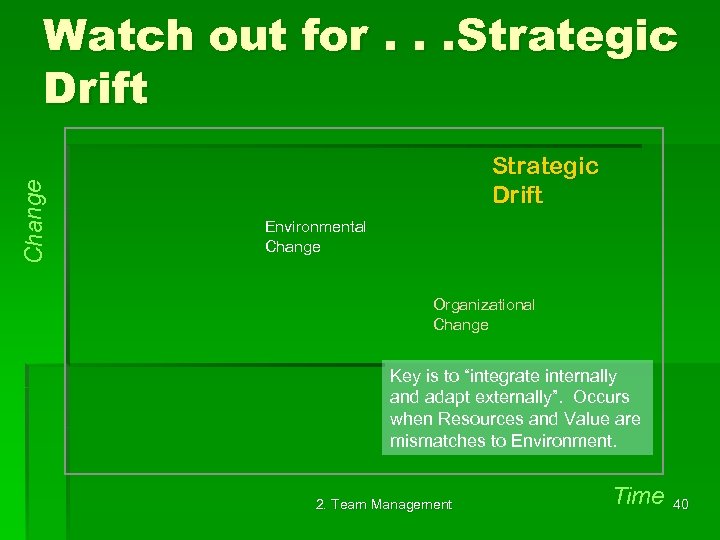 Change Watch out for. . . Strategic Drift Environmental Change Organizational Change Key is to “integrate internally and adapt externally”. Occurs when Resources and Value are mismatches to Environment. 2. Team Management Time 40
 Symptoms of Strategic Drift § § § § Highly homogenous paradigm/culture Strong power blockages to change Lack of market information Little toleration of questioning/challenge “We’ve tried this before and it didn’t work” Deteriorating performance Reliance on price/cost /competition 2. Team Management 41
 Handling Disturbance § “Strategy is first and foremost about the form of total control system which will enable the business owner to handle strategic disturbance effectively, a control system which is inevitably characterised by fundamental antithesis. § Strategy is not about a comprehensive and integrated set of actions or routes to objectives. It is about a comprehensive and integrated total control system, which will enable the owner manager to deal with unforeseeable disturbances, changes in competitive advantage and capability as they occur. The starting point is not the mission, and certainly not detailed long term objectives, but the appropriate style of control. ” (Stacey, 1989). § Control is not just monitoring. It is: § Having a purpose and a route to it (planning). § Checking progress (monitoring). § Taking corrective action. 2. Team Management 42
 Strategic Analysis § The capability (or otherwise) of the organisation to exploit present and future environmental opportunities and/or to withstand environmental threat. § The ways in which resources might be changed to create competitive advantage and to improve the organisation's wealth producing capacity. § Congruence: Environment, Values, Resources § Resources are Strengths & Weaknesses § Values are Leadership & Culture § Environment is Opportunities & Threats (Thompson J, 2002) 2. Team Management 43
 Examples of Strategic Drift § The introduction of new technology into a business that fails to reach its stated objectives. This is due to the failure to prepare the people within the organisation for its efficient use through prior communication, training, or a system of modified rewards. § The appointment of a "today" manager who has the necessary skills, attitude and management style, but is not provided with the financial resources to exercise those talents. § Jobs redesigned around teamwork but with traditional bonus systems maintained. § Customers wanting variety and regular product modifications but technology designed to produce one standard model. § The environment demanding responsive organisation modes but the organisation is maintaining previously effective bureaucratic forms. 2. Team Management 44
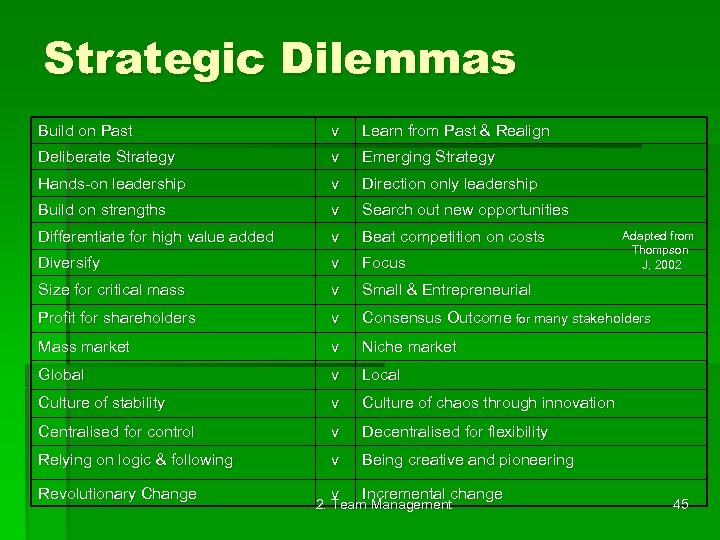 Strategic Dilemmas Build on Past v Learn from Past & Realign Deliberate Strategy v Emerging Strategy Hands-on leadership v Direction only leadership Build on strengths v Search out new opportunities Differentiate for high value added v Beat competition on costs Diversify v Focus Size for critical mass v Small & Entrepreneurial Profit for shareholders v Consensus Outcome for many stakeholders Mass market v Niche market Global v Local Culture of stability v Culture of chaos through innovation Centralised for control v Decentralised for flexibility Relying on logic & following v Being creative and pioneering v Incremental change Revolutionary Change 2. Team Management Adapted from Thompson J, 2002 45
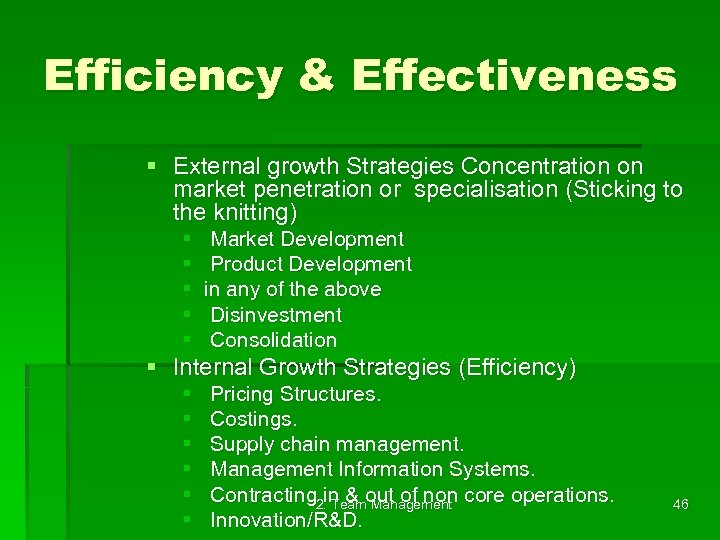 Efficiency & Effectiveness § External growth Strategies Concentration on market penetration or specialisation (Sticking to the knitting) § § § Market Development Product Development in any of the above Disinvestment Consolidation § Internal Growth Strategies (Efficiency) § § § Pricing Structures. Costings. Supply chain management. Management Information Systems. Contracting in & out of non core operations. 2. Team Management Innovation/R&D. 46
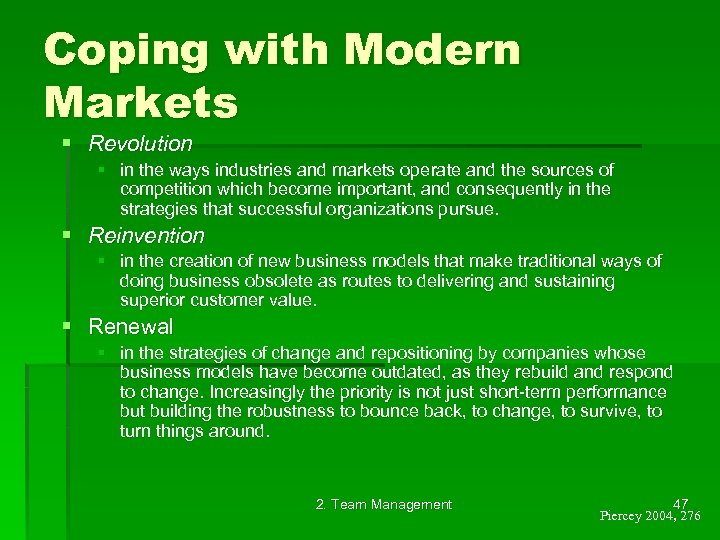 Coping with Modern Markets § Revolution § in the ways industries and markets operate and the sources of competition which become important, and consequently in the strategies that successful organizations pursue. § Reinvention § in the creation of new business models that make traditional ways of doing business obsolete as routes to delivering and sustaining superior customer value. § Renewal § in the strategies of change and repositioning by companies whose business models have become outdated, as they rebuild and respond to change. Increasingly the priority is not just short-term performance but building the robustness to bounce back, to change, to survive, to turn things around. 2. Team Management 47 Piercey 2004, 276
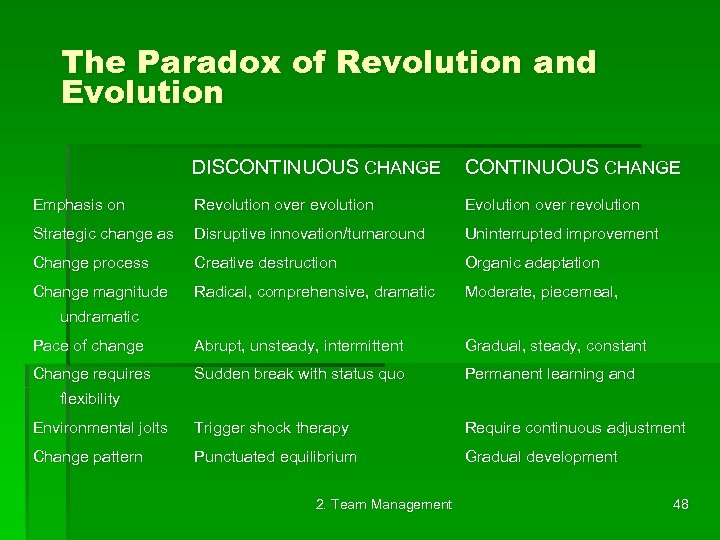 The Paradox of Revolution and Evolution DISCONTINUOUS CHANGE Emphasis on CONTINUOUS CHANGE Revolution over evolution Evolution over revolution Strategic change as Disruptive innovation/turnaround Uninterrupted improvement Change process Organic adaptation Creative destruction Change magnitude Radical, comprehensive, dramatic Moderate, piecemeal, undramatic Pace of change Abrupt, unsteady, intermittent Gradual, steady, constant Change requires Sudden break with status quo Permanent learning and flexibility Environmental jolts Trigger shock therapy Require continuous adjustment Change pattern Gradual development Punctuated equilibrium 2. Team Management 48
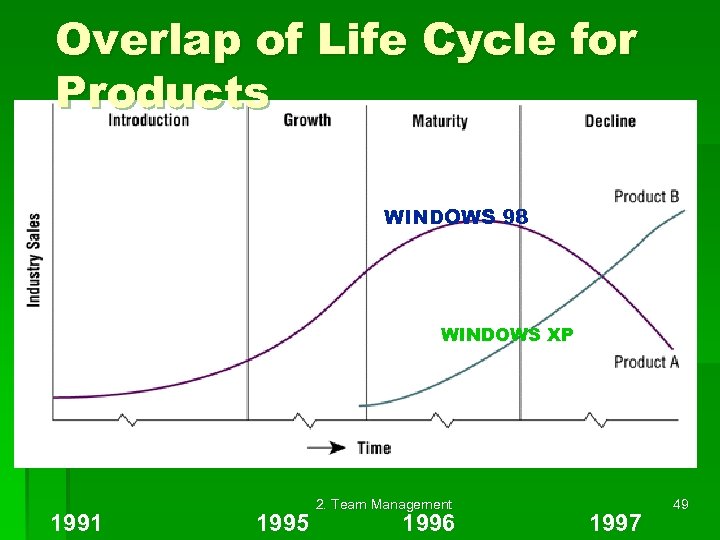 Overlap of Life Cycle for Products WINDOWS 98 WINDOWS XP 1991 1995 2. Team Management 1996 1997 49
 Early Competitive Strategy: Product Performance § In the early stages of the product life cycle, the rate of product change is rapid and the margin large. § Firms with a performance maximising strategy emphasis the unique products and performance, often in anticipation that a new capacity will expand customer requirements. § Product Performance is driven or stimulated by market needs and opportunities. § Product markets are undefined. 2. Team Management 50
 Early Stages § Performance maximising firms will rely heavily on external sources of information and more diverse sources of information. § Buyers are enthusiasts and visionaries; where the visionary buyer requires a significant and far reaching value proposition that fundamentally changes the playing field in his/her industry. § The optimal sales approach is missionary, "hunter style" direct sales looking for large, project-oriented deals, because closing such deals will create reinforcement in the marketplace that the category is in-fact real. 2. Team Management 51
 Middle Strategy: Sales Maximising § As experience is gained by both producers and users, market uncertainty is reduced. § Sales Maximising firms tend to define needs based on their visibility to the customers. § One or several more dominant producer design emerge. § This reduction of market need uncertainty enables increased application of advanced technology as a source of further product innovation. § The result will be more often product variation or new components. § This is the Bowling Alley stage; markets are developing in a niche-by-niche basis. § The optimum approach is to focus on pragmatic, department-level buyers who have severe problems to solve. 2. Team Management 52
 Late Entry Strategy: Cost Minimising § As the product life cycle evolves, variety tends to be reduced and products become standardised. § Competition focuses on price – efficiencies and economies of scale are emphasised. § At this stage, significant change is difficult, it frequently involves both product and process modification and must be dealt with efficiently as a system. § The value proposition is generally application-oriented, and the corresponding ROI is removal of a specific problem. § At this stage, the value proposition must focus on technology, standards, and ability to scale and offer broad support 2. Team Management 53
 Strategic Management in Technology-intensive industries § The development of new technology § § § Generation Uncertainty Diffusion § The strategic management of technology § § Exploiting innovation Industry standards Timing: to lead or to follow? Managing risk 2. Team Management 54
 Characteristics of a Technology Which Influence Imitation Ability to imitate an innovation depends on: How codifiable is the knowledge? Explicit knowledge is easier to understand than tacit knowledge. How complex is the technology? Lead time § If rivals can imitate-- time lag is the major advantage of the innovator. § But maintaining lead-time advantage requires continuous innovation § Lead time is reinforced by learning effects 2. Team Management 55
 Course Reading • Goffin, K, Mitchell, R, 2005, Innovation Management, Developing an Innovation Strategy, Palgrave Chapter 4, pp 98 – 137