 Скачать презентацию L 2 O Sharing Language Learning Objects
13e92feaa37681be493c0f53d5c7bfee.ppt
- Количество слайдов: 11



L 2 O – Sharing Language Learning Objects Kate Dickens, University of Southampton www. elanguages. ac. uk/sharing 5 th June 2006 @ London
Sharing • Who? • Why? • What? • How? 5 th June 2006 @ London
Who? • Sharing online learning resources between institutions? Across sectors? • Language learning = lifelong learning – Partners in HE (Portsmouth/Reading/Southampton/Surrey – HE Academy Subject Centre for Languages, Linguistics & Area Studies – FE/6 th form/SE Region Comenius Centre 5 th June 2006 @ London
Why? • Access to peer-reviewed, qualityassured, ‘engaging’ learning materials that encourage independent learning and can be used to support flexible learning in class, labs or at a distance • In-house teams can be lacking in skills – Instructional design & knowledge of accessibility issues – Access to examples of ‘good practice’ – Resource description 5 June 2006 @ London th
Why? • To be able to be shared, materials need to be ‘attractive’ to the end-user – ‘Asset’ description – assisting in resource discovery • Learning object • Pedagogical asset • Technical asset – In terms of their context – Ease of re-use or ability to be re-purposed 5 th June 2006 @ London
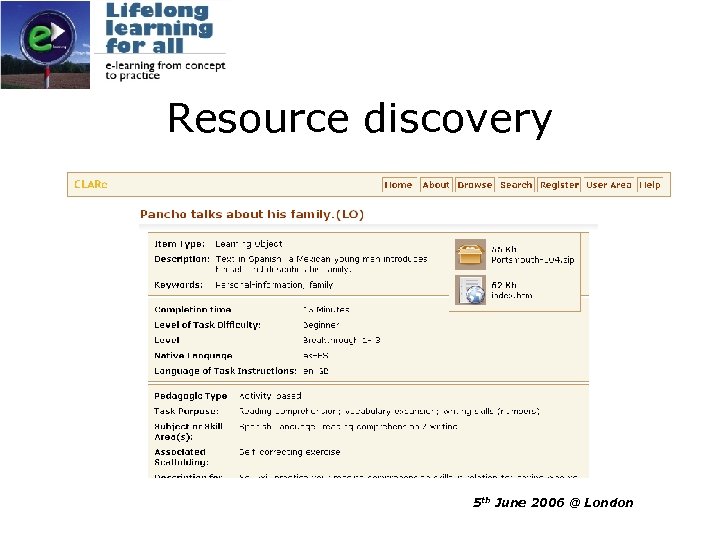
Resource discovery 5 th June 2006 @ London
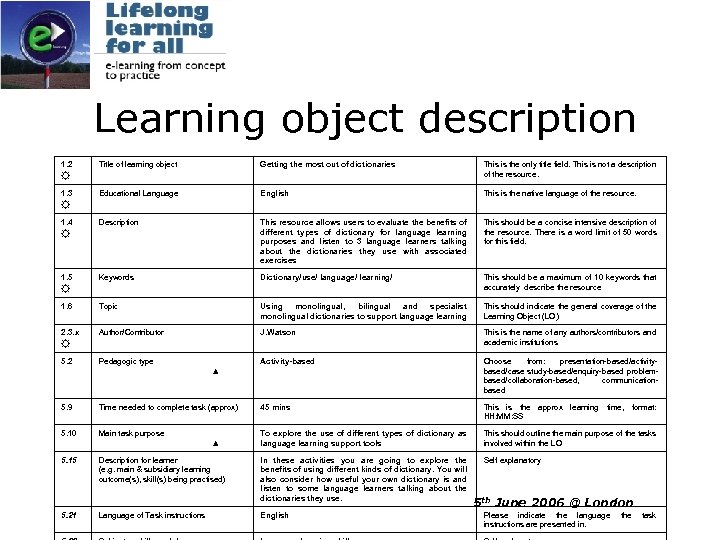
Learning object description 1. 2 Title of learning object Getting the most out of dictionaries This is the only title field. This is not a description of the resource. Educational Language English This is the native language of the resource. Description This resource allows users to evaluate the benefits of different types of dictionary for language learning purposes and listen to 3 language learners talking about the dictionaries they use with associated exercises This should be a concise intensive description of the resource. There is a word limit of 50 words for this field. Keywords Dictionary/use/ language/ learning/ This should be a maximum of 10 keywords that accurately describe the resource 1. 6 Topic Using monolingual, bilingual and specialist monolingual dictionaries to support language learning This should indicate the general coverage of the Learning Object (LO) 2. 3. x Author/Contributor J. Watson This is the name of any authors/contributors and academic institutions Activity-based Choose from: presentation-based/activitybased/case study-based/enquiry-based problembased/collaboration-based, communicationbased ☼ 1. 3 ☼ 1. 4 ☼ 1. 5 ☼ ☼ 5. 2 Pedagogic type ▲ 5. 9 Time needed to complete task (approx) 45 mins This is the approx learning time, format: HH: MM: SS 5. 10 Main task purpose To explore the use of different types of dictionary as language learning support tools This should outline the main purpose of the tasks involved within the LO In these activities you are going to explore the benefits of using different kinds of dictionary. You will also consider how useful your own dictionary is and listen to some language learners talking about the dictionaries they use. Self explanatory ▲ 5. 15 5. 21 Description for learner (e. g. main & subsidiary learning outcome(s), skill(s) being practised) Language of Task instructions English 5 th June 2006 @ London Please indicate the language instructions are presented in. the task
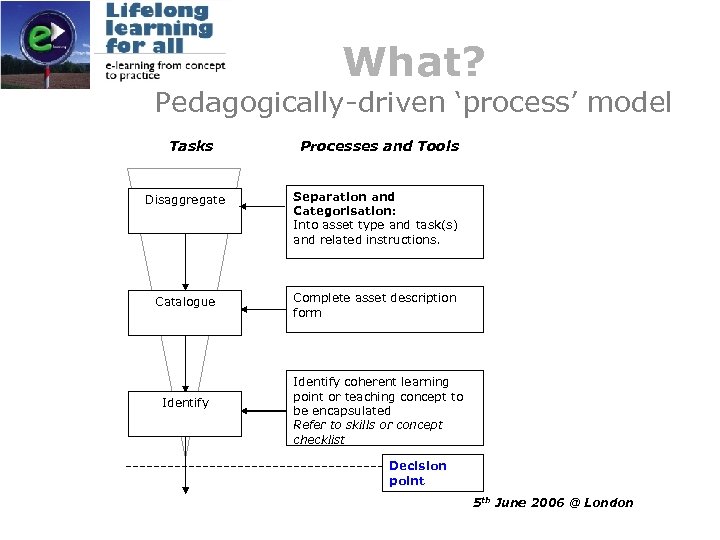
What? Pedagogically-driven ‘process’ model Tasks Processes and Tools Disaggregate Separation and Categorisation: Into asset type and task(s) and related instructions. Catalogue Complete asset description form Identify coherent learning point or teaching concept to be encapsulated Refer to skills or concept checklist Decision point 5 th June 2006 @ London
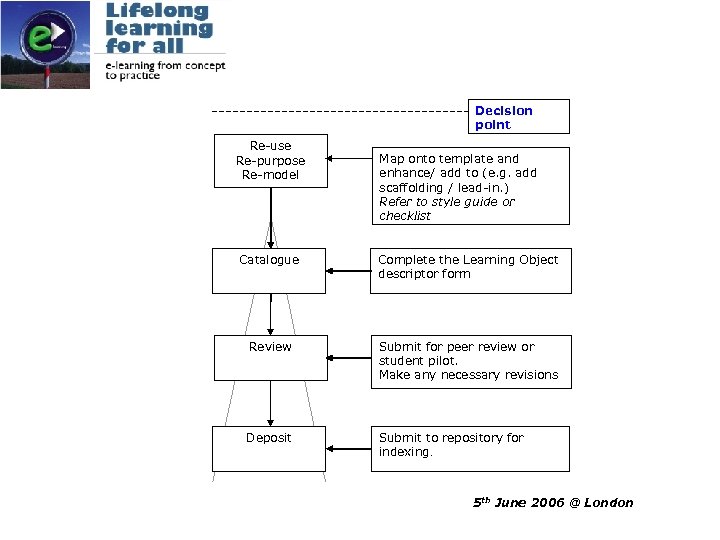
Decision point Re-use Re-purpose Re-model Map onto template and enhance/ add to (e. g. add scaffolding / lead-in. ) Refer to style guide or checklist Catalogue Complete the Learning Object descriptor form Review Submit for peer review or student pilot. Make any necessary revisions Deposit Submit to repository for indexing. 5 th June 2006 @ London
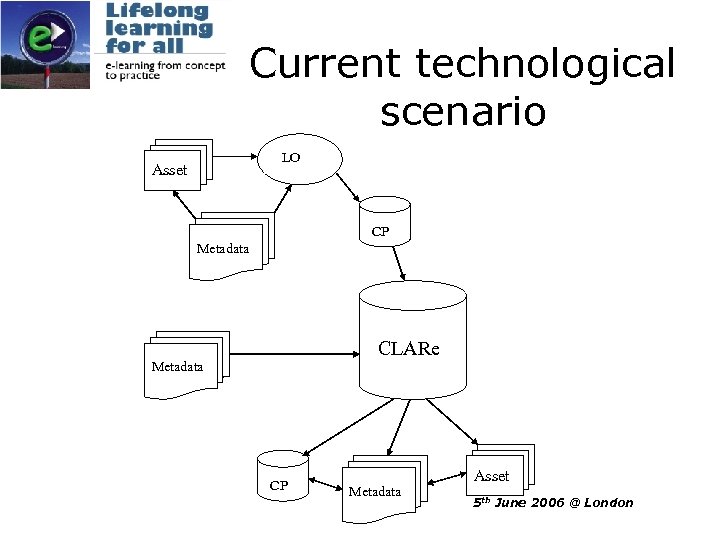
Current technological scenario LO Asset CP Metadata CLARe Metadata CP Metadata Asset 5 th June 2006 @ London
How? Community of Practice “The development of a regionallybased cross-sector community of practice which focuses on moving towards a shared culture of use, re -use and re-purposing of online resources” 5 th June 2006 @ London
Скачать презентацию L 2 O Sharing Language Learning Objects
13e92feaa37681be493c0f53d5c7bfee.ppt