


 Скачать презентацию L 18 Annual Worth Analysis ECON 320 Engineering
f1dee7e5c4d26ca34cd4a408349d9d89.ppt
- Количество слайдов: 15
 L 18: Annual Worth Analysis ECON 320 Engineering Economics Mahmut Ali GOKCE Industrial Systems Engineering Computer Sciences www. izmirekonomi. edu. tr
 Applying Annual Worth Analysis • Unit Cost (Unit Profit) Calculation • Unequal Service Life Comparison www. izmirekonomi. edu. tr
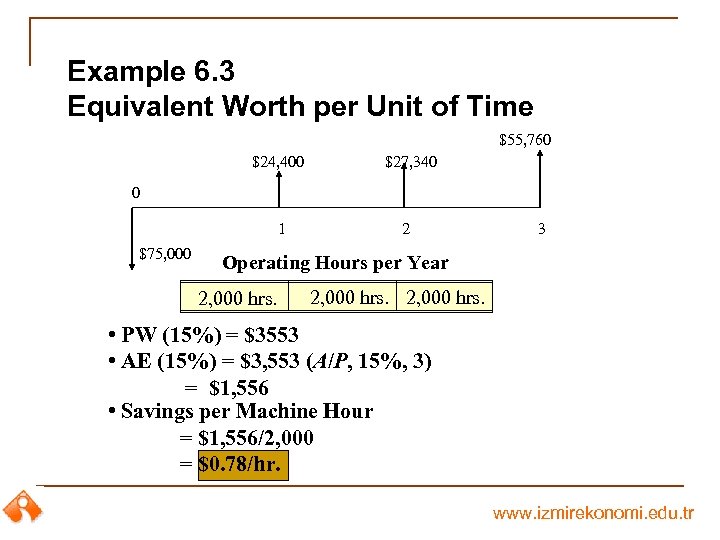 Example 6. 3 Equivalent Worth per Unit of Time $55, 760 $24, 400 $27, 340 1 2 0 $75, 000 3 Operating Hours per Year 2, 000 hrs. • PW (15%) = $3553 • AE (15%) = $3, 553 (A/P, 15%, 3) = $1, 556 • Savings per Machine Hour = $1, 556/2, 000 = $0. 78/hr. www. izmirekonomi. edu. tr
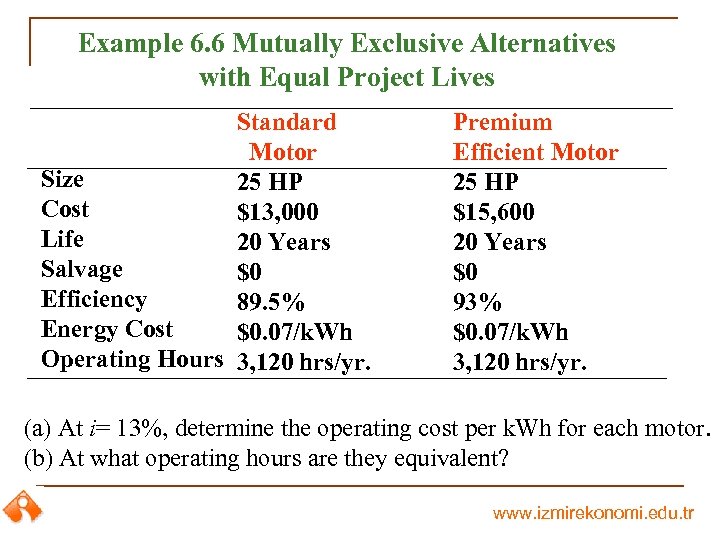 Example 6. 6 Mutually Exclusive Alternatives with Equal Project Lives Standard Motor Size 25 HP Cost $13, 000 Life 20 Years Salvage $0 Efficiency 89. 5% Energy Cost $0. 07/k. Wh Operating Hours 3, 120 hrs/yr. Premium Efficient Motor 25 HP $15, 600 20 Years $0 93% $0. 07/k. Wh 3, 120 hrs/yr. (a) At i= 13%, determine the operating cost per k. Wh for each motor. (b) At what operating hours are they equivalent? www. izmirekonomi. edu. tr
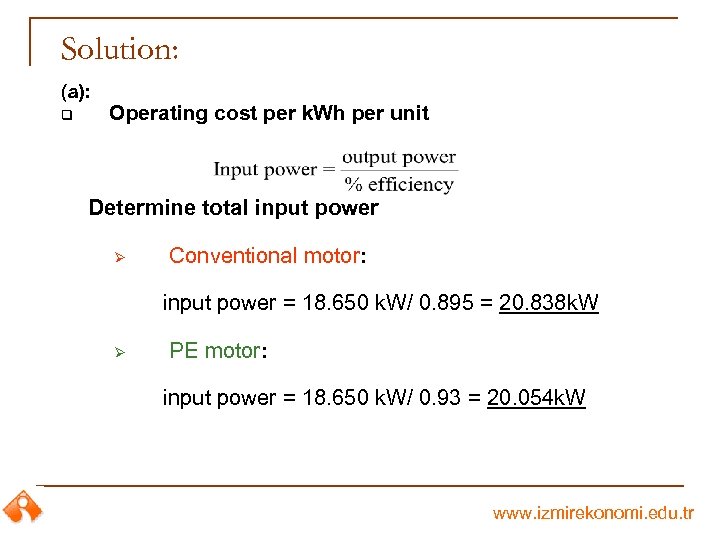 Solution: (a): q Operating cost per k. Wh per unit Determine total input power Ø Conventional motor: input power = 18. 650 k. W/ 0. 895 = 20. 838 k. W Ø PE motor: input power = 18. 650 k. W/ 0. 93 = 20. 054 k. W www. izmirekonomi. edu. tr
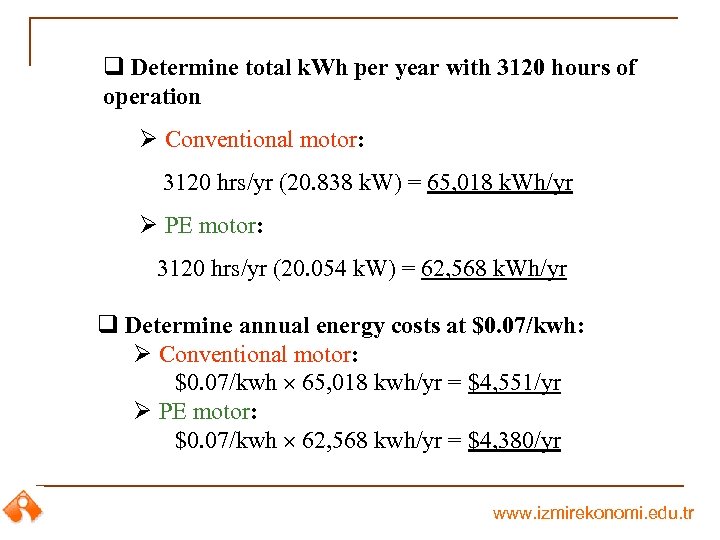 q Determine total k. Wh per year with 3120 hours of operation Ø Conventional motor: 3120 hrs/yr (20. 838 k. W) = 65, 018 k. Wh/yr Ø PE motor: 3120 hrs/yr (20. 054 k. W) = 62, 568 k. Wh/yr q Determine annual energy costs at $0. 07/kwh: Ø Conventional motor: $0. 07/kwh 65, 018 kwh/yr = $4, 551/yr Ø PE motor: $0. 07/kwh 62, 568 kwh/yr = $4, 380/yr www. izmirekonomi. edu. tr
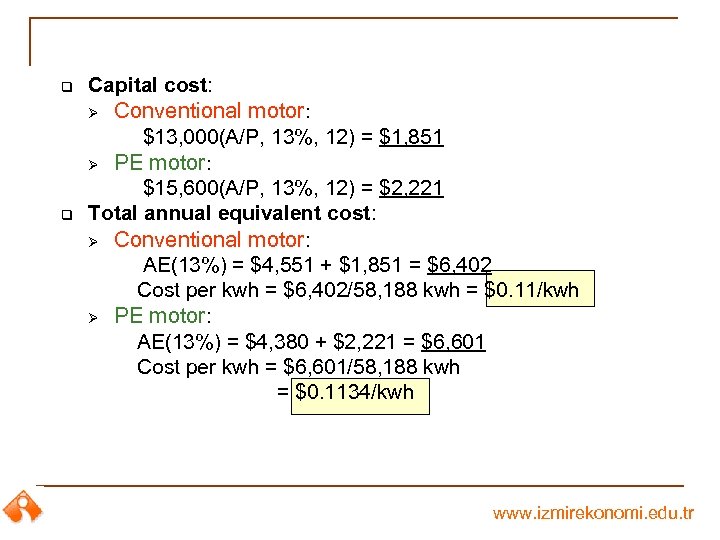 q q Capital cost: Ø Conventional motor: $13, 000(A/P, 13%, 12) = $1, 851 Ø PE motor: $15, 600(A/P, 13%, 12) = $2, 221 Total annual equivalent cost: Ø Conventional motor: AE(13%) = $4, 551 + $1, 851 = $6, 402 Cost per kwh = $6, 402/58, 188 kwh = $0. 11/kwh Ø PE motor: AE(13%) = $4, 380 + $2, 221 = $6, 601 Cost per kwh = $6, 601/58, 188 kwh = $0. 1134/kwh www. izmirekonomi. edu. tr
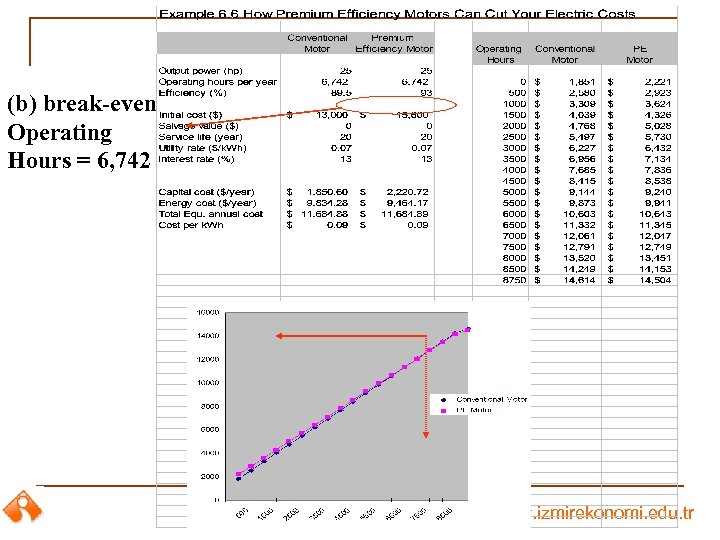 (b) break-even Operating Hours = 6, 742 www. izmirekonomi. edu. tr
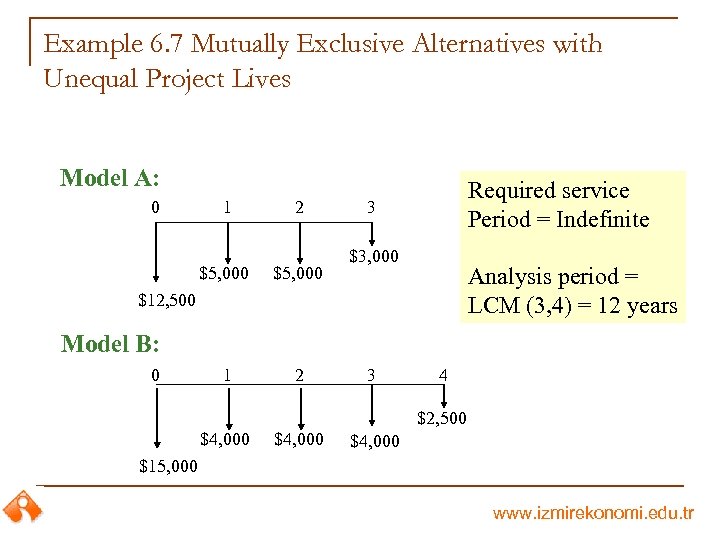 Example 6. 7 Mutually Exclusive Alternatives with Unequal Project Lives Model A: 0 1 2 $5, 000 1 2 Required service Period = Indefinite 3 $3, 000 Analysis period = LCM (3, 4) = 12 years $12, 500 Model B: 0 3 4 $2, 500 $4, 000 $15, 000 www. izmirekonomi. edu. tr
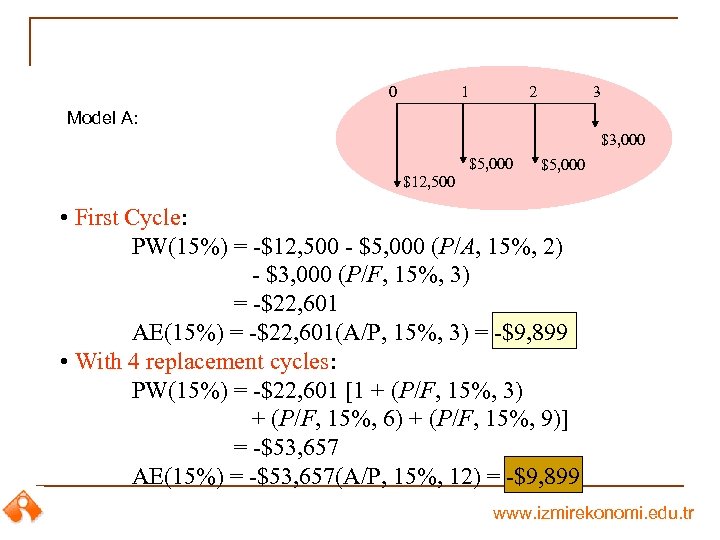 0 1 2 3 Model A: $3, 000 $5, 000 $12, 500 $5, 000 • First Cycle: PW(15%) = -$12, 500 - $5, 000 (P/A, 15%, 2) - $3, 000 (P/F, 15%, 3) = -$22, 601 AE(15%) = -$22, 601(A/P, 15%, 3) = -$9, 899 • With 4 replacement cycles: PW(15%) = -$22, 601 [1 + (P/F, 15%, 3) + (P/F, 15%, 6) + (P/F, 15%, 9)] = -$53, 657 AE(15%) = -$53, 657(A/P, 15%, 12) = -$9, 899 www. izmirekonomi. edu. tr
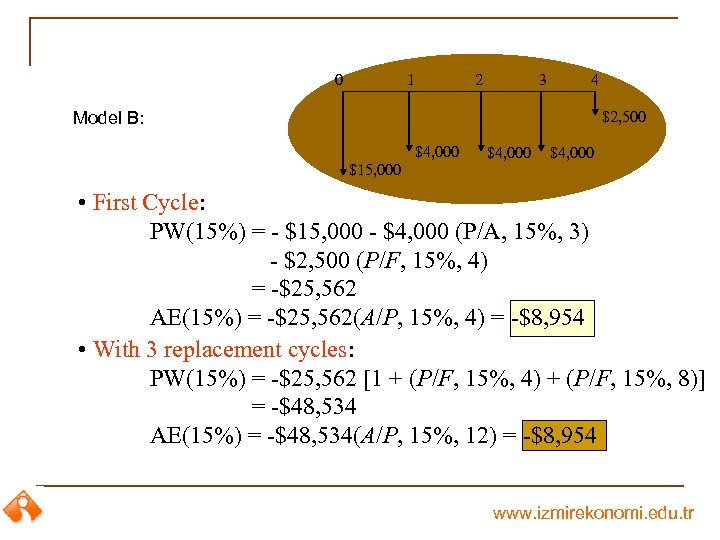 0 1 2 3 4 $2, 500 Model B: $4, 000 $15, 000 $4, 000 • First Cycle: PW(15%) = - $15, 000 - $4, 000 (P/A, 15%, 3) - $2, 500 (P/F, 15%, 4) = -$25, 562 AE(15%) = -$25, 562(A/P, 15%, 4) = -$8, 954 • With 3 replacement cycles: PW(15%) = -$25, 562 [1 + (P/F, 15%, 4) + (P/F, 15%, 8)] = -$48, 534 AE(15%) = -$48, 534(A/P, 15%, 12) = -$8, 954 www. izmirekonomi. edu. tr
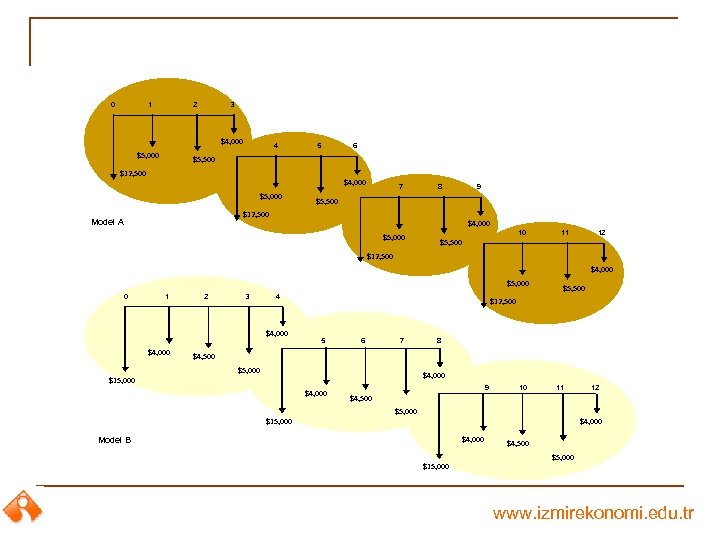 0 1 2 3 $4, 000 $5, 000 4 5 6 $5, 500 $12, 500 $4, 000 $5, 000 7 8 9 $5, 500 $12, 500 Model A $4, 000 $5, 000 10 11 12 $5, 500 $12, 500 $4, 000 $5, 000 0 1 2 3 4 $4, 000 $5, 500 $12, 500 5 6 7 8 $4, 500 $5, 000 $4, 000 $15, 000 $4, 000 9 10 11 12 $4, 500 $5, 000 $15, 000 $4, 000 Model B $4, 500 $5, 000 $15, 000 www. izmirekonomi. edu. tr
 Summary Annual equivalent worth analysis, or AE, is—along with present worth analysis—one of two main analysis techniques based on the concept of equivalence. The equation for AE is AE(i) = PW(i)(A/P, i, N). AE analysis yields the same decision result as PW analysis. www. izmirekonomi. edu. tr
 The capital recovery cost factor, or CR(i), is one of the most important applications of AE analysis in that it allows managers to calculate an annual equivalent cost of capital for ease of itemization with annual operating costs. The equation for CR(i) is CR(i)= (I – S)(A/P, i, N) + i. S, where I = initial cost and S = salvage value. www. izmirekonomi. edu. tr
 n AE analysis is recommended over NPW analysis in many key real-world situations for the following reasons: 1. In many financial reports, an annual equivalent value is preferred to a present worth value. 2. Calculation of unit costs is often required to determine reasonable pricing for sale items. 3. Calculation of cost per unit of use is required to reimburse employees for business use of personal cars. 4. Make-or-buy decisions usually require the development of unit costs for the various alternatives. www. izmirekonomi. edu. tr