 Скачать презентацию L 1 detection performances on LMS-ITS channel Benjamin
27ea8da954d5ab5f3ca144a452869c9b.ppt
- Количество слайдов: 17



L 1 detection performances on LMS-ITS channel Benjamin Ros , Christelle BOUSTIE Benjamin. ros@cnes. fr, christelle. boustie@cnes. fr © CNES presentation for ENGINES 2011 – Tous droits réservés
Introduction ■ In the standardization process, simulations on L 1 detection have shown that w Native DVB-T 2 L 1 encoding was not robust enough against terrestrial mobile Channel w Samsung has proposed Additional Parity (AP) concept mixed with time diversity to increase L 1 detection probability · Results seamed that AP put in previous frame would bring enough robustness even in TU 6 channel (Cf Samsung NGH 751) contribution, providing well suited parameters · Recent results have been brought in LMS-SU channel ■ CNES has developped a “L 1 post” simulation chain, in which AP and spreading algorithms (close to Samsung approach) are implemented based on a DVB-T 2 waveform w Simulations are run over LMS-ITS channel w Effect of PLP number, spreading granularity, interleaving length are studied © CNES presentation for ENGINES 2011 – Tous droits réservés 2
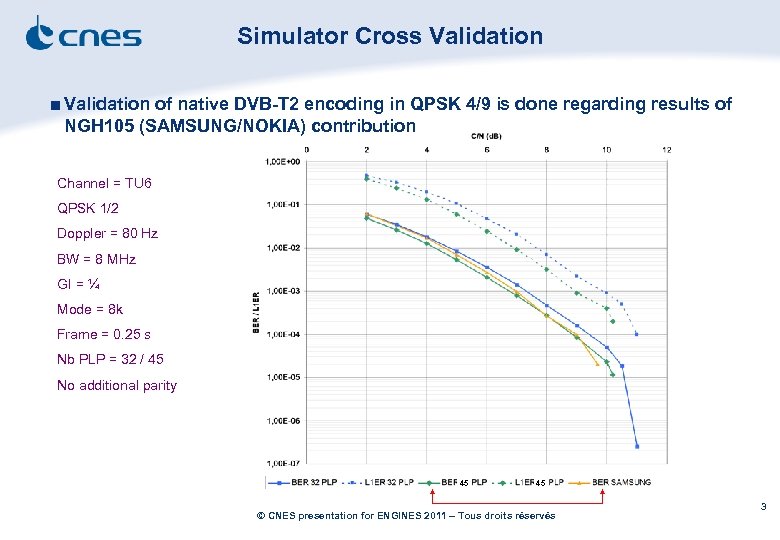
Simulator Cross Validation ■ Validation of native DVB-T 2 encoding in QPSK 4/9 is done regarding results of NGH 105 (SAMSUNG/NOKIA) contribution Channel = TU 6 QPSK 1/2 Doppler = 80 Hz BW = 8 MHz GI = ¼ Mode = 8 k Frame = 0. 25 s Nb PLP = 32 / 45 No additional parity 45 45 © CNES presentation for ENGINES 2011 – Tous droits réservés 3
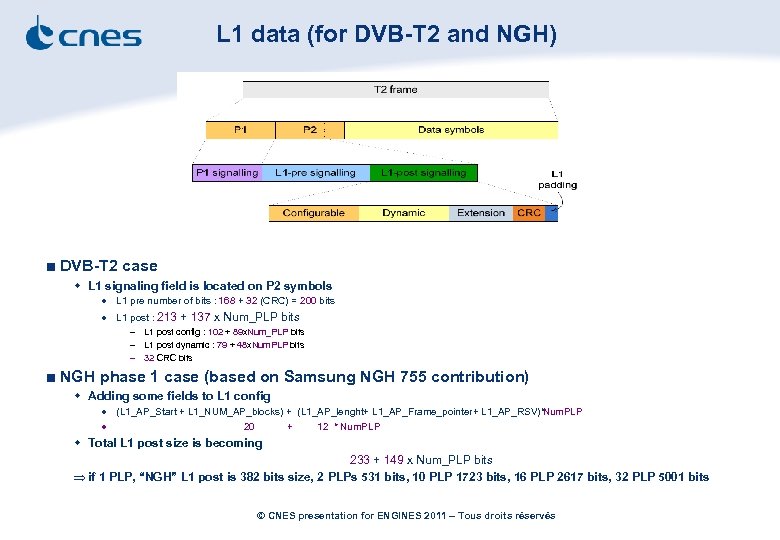
L 1 data (for DVB-T 2 and NGH) ■ DVB-T 2 case w L 1 signaling field is located on P 2 symbols · L 1 pre number of bits : 168 + 32 (CRC) = 200 bits · L 1 post : 213 + 137 x Num_PLP bits – L 1 post config : 102 + 89 x. Num_PLP bits – L 1 post dynamic : 79 + 48 x. Num. PLP bits – 32 CRC bits ■ NGH phase 1 case (based on Samsung NGH 755 contribution) w Adding some fields to L 1 config · (L 1_AP_Start + L 1_NUM_AP_blocks) + (L 1_AP_lenght+ L 1_AP_Frame_pointer+ L 1_AP_RSV)*Num. PLP · 20 + 12 * Num. PLP w Total L 1 post size is becoming 233 + 149 x Num_PLP bits Þ if 1 PLP, “NGH” L 1 post is 382 bits size, 2 PLPs 531 bits, 10 PLP 1723 bits, 16 PLP 2617 bits, 32 PLP 5001 bits © CNES presentation for ENGINES 2011 – Tous droits réservés
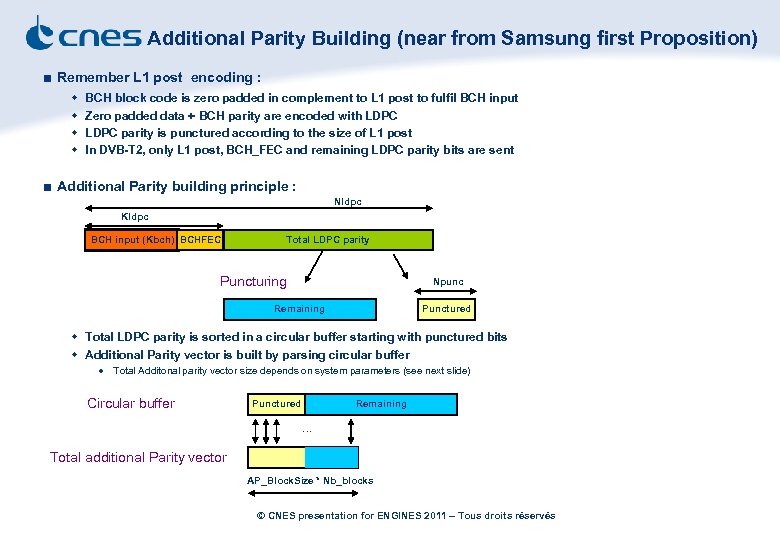
Additional Parity Building (near from Samsung first Proposition) ■ Remember L 1 post encoding : w w BCH block code is zero padded in complement to L 1 post to fulfil BCH input Zero padded data + BCH parity are encoded with LDPC parity is punctured according to the size of L 1 post In DVB-T 2, only L 1 post, BCH_FEC and remaining LDPC parity bits are sent ■ Additional Parity building principle : Nldpc Kldpc BCH input (Kbch) BCHFEC Total LDPC parity Puncturing Npunc Remaining Punctured w Total LDPC parity is sorted in a circular buffer starting with punctured bits w Additional Parity vector is built by parsing circular buffer · Total Additonal parity vector size depends on system parameters (see next slide) Circular buffer Punctured Remaining … Total additional Parity vector AP_Block. Size * Nb_blocks © CNES presentation for ENGINES 2011 – Tous droits réservés
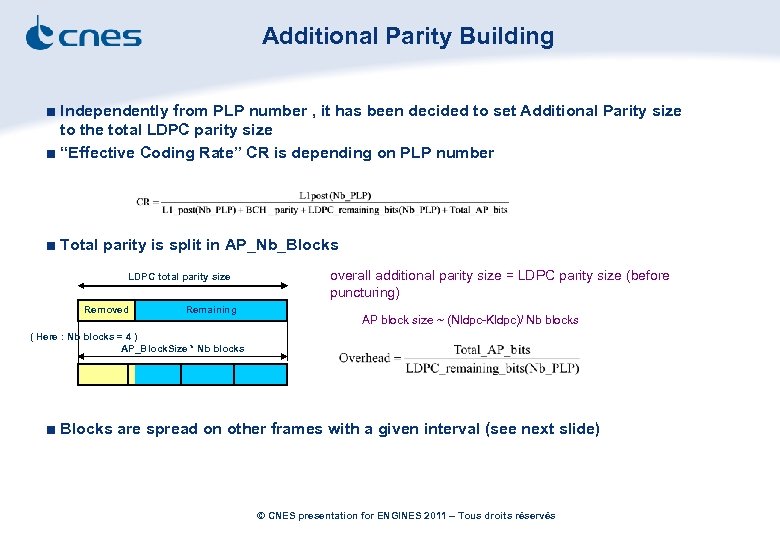
Additional Parity Building ■ Independently from PLP number , it has been decided to set Additional Parity size to the total LDPC parity size ■ “Effective Coding Rate” CR is depending on PLP number ■ Total parity is split in AP_Nb_Blocks LDPC total parity size Removed Remaining overall additional parity size = LDPC parity size (before puncturing) AP block size ~ (Nldpc-Kldpc)/ Nb blocks ( Here : Nb blocks = 4 ) AP_Block. Size * Nb blocks ■ Blocks are spread on other frames with a given interval (see next slide) © CNES presentation for ENGINES 2011 – Tous droits réservés
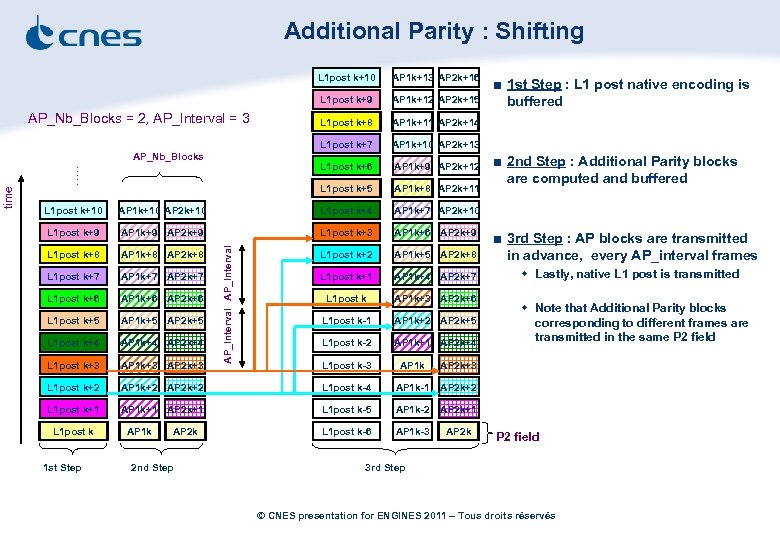
Additional Parity : Shifting L 1 post k+10 L 1 post k+9 AP 1 k+11 AP 2 k+14 AP 1 k+10 AP 2 k+13 AP 1 k+9 AP 2 k+12 L 1 post k+5 …. . AP 1 k+8 AP 2 k+11 L 1 post k+10 AP 1 k+10 AP 2 k+10 L 1 post k+4 L 1 post k+9 AP 1 k+9 AP 2 k+9 L 1 post k+3 AP 1 k+6 AP 2 k+9 L 1 post k+8 AP 1 k+8 AP 2 k+8 L 1 post k+2 AP 1 k+5 AP 2 k+8 L 1 post k+7 AP 1 k+7 AP 2 k+7 L 1 post k+1 AP 1 k+4 AP 2 k+7 L 1 post k+6 AP 1 k+6 AP 2 k+6 L 1 post k AP 1 k+3 AP 2 k+6 L 1 post k+5 AP 1 k+5 AP 2 k+5 L 1 post k-1 AP 1 k+2 AP 2 k+5 L 1 post k+4 AP 1 k+4 AP 2 k+4 L 1 post k-2 AP 1 k+1 AP 2 k+4 L 1 post k+3 AP 1 k+3 AP 2 k+3 L 1 post k+2 L 1 post k+1 ■ 1 st Step : L 1 post native encoding is buffered ■ 2 nd Step : Additional Parity blocks are computed and buffered AP 1 k+7 AP 2 k+10 L 1 post k 1 st Step AP_Interval time L 1 post k+8 L 1 post k+6 AP_Nb_Blocks AP 1 k+12 AP 2 k+15 L 1 post k+7 AP_Nb_Blocks = 2, AP_Interval = 3 AP 1 k+13 AP 2 k+16 L 1 post k-3 AP 1 k L 1 post k-4 AP 1 k-1 L 1 post k-5 AP 1 k-2 AP 2 k+1 L 1 post k-6 AP 1 k-3 AP 2 k w Note that Additional Parity blocks corresponding to different frames are transmitted in the same P 2 field AP 2 k+2 AP 1 k+1 AP 2 k+1 w Lastly, native L 1 post is transmitted AP 2 k+3 AP 1 k+2 AP 2 k+2 ■ 3 rd Step : AP blocks are transmitted in advance, every AP_interval frames AP 1 k AP 2 k 2 nd Step P 2 field 3 rd Step © CNES presentation for ENGINES 2011 – Tous droits réservés
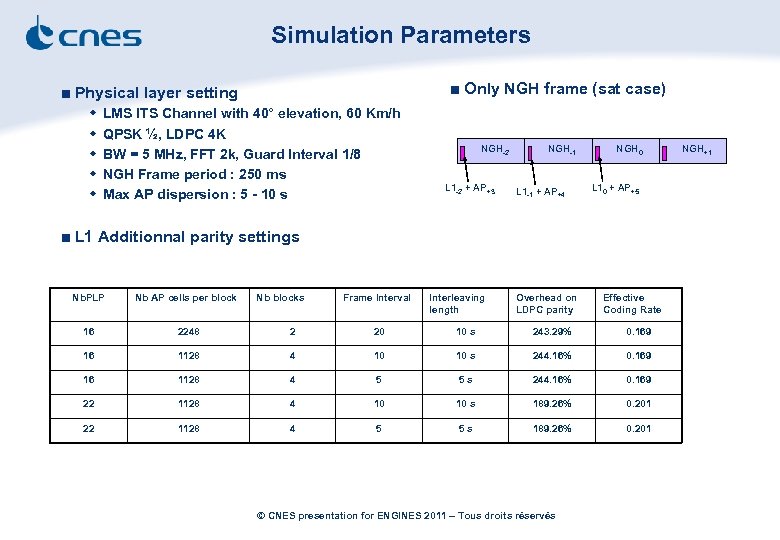
Simulation Parameters ■ Only NGH frame (sat case) ■ Physical layer setting w w w LMS ITS Channel with 40° elevation, 60 Km/h QPSK ½, LDPC 4 K BW = 5 MHz, FFT 2 k, Guard Interval 1/8 NGH Frame period : 250 ms Max AP dispersion : 5 - 10 s NGH-2 L 1 -2 + AP+3 NGH-1 L 1 -1 + AP+4 NGH 0 L 10 + AP+5 ■ L 1 Additionnal parity settings Nb. PLP Nb AP cells per block Nb blocks Frame Interval Interleaving length Overhead on LDPC parity 16 2248 2 20 10 s 243. 29% 0. 169 16 1128 4 10 10 s 244. 16% 0. 169 16 1128 4 5 5 s 244. 16% 0. 169 22 1128 4 10 10 s 189. 26% 0. 201 22 1128 4 5 5 s 189. 26% 0. 201 © CNES presentation for ENGINES 2011 – Tous droits réservés Effective Coding Rate NGH+1
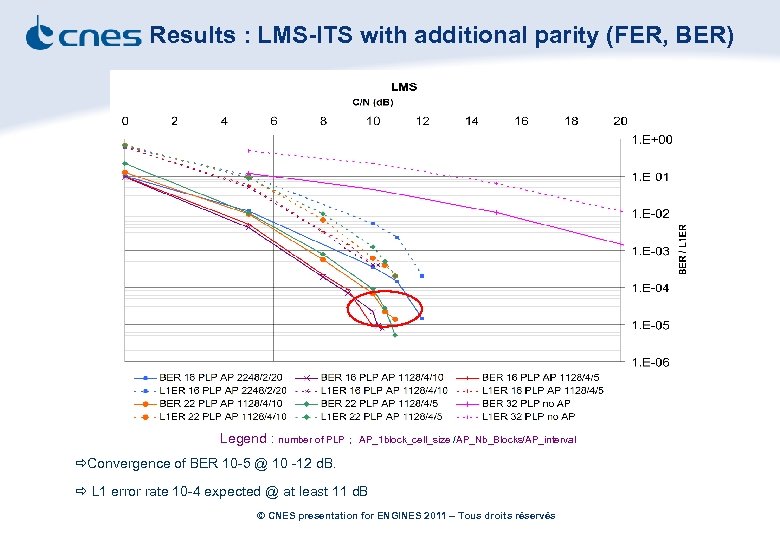
Results : LMS-ITS with additional parity (FER, BER) Legend : number of PLP ; AP_1 block_cell_size /AP_Nb_Blocks/AP_interval Convergence of BER 10 -5 @ 10 -12 d. B. L 1 error rate 10 -4 expected @ at least 11 d. B © CNES presentation for ENGINES 2011 – Tous droits réservés
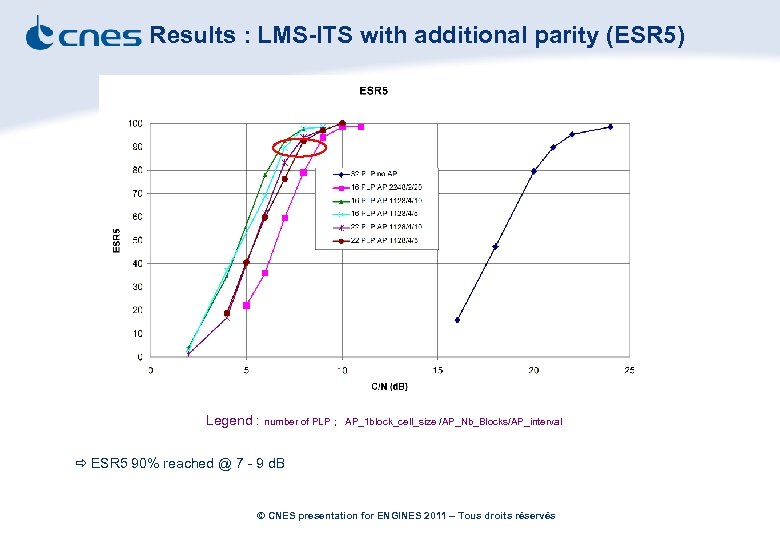
Results : LMS-ITS with additional parity (ESR 5) Legend : number of PLP ; AP_1 block_cell_size /AP_Nb_Blocks/AP_interval ESR 5 90% reached @ 7 - 9 d. B © CNES presentation for ENGINES 2011 – Tous droits réservés
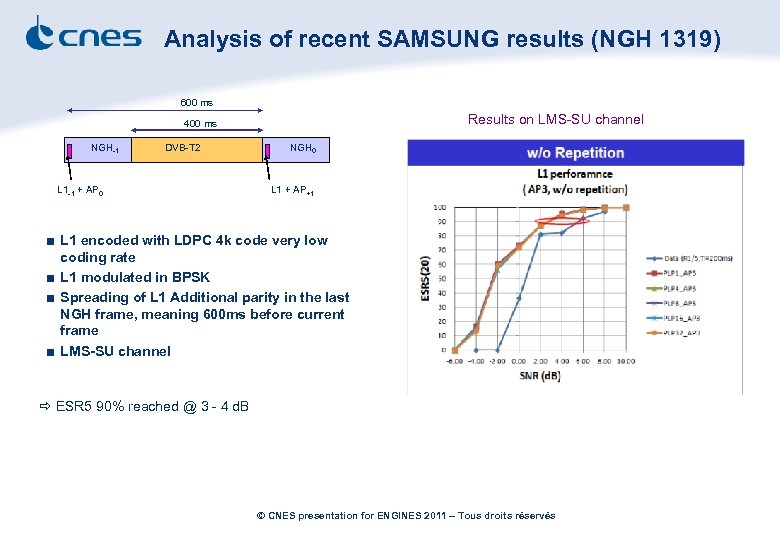
Analysis of recent SAMSUNG results (NGH 1319) 600 ms Results on LMS-SU channel 400 ms NGH-1 DVB-T 2 L 1 -1 + AP 0 NGH 0 L 1 + AP+1 ■ L 1 encoded with LDPC 4 k code very low coding rate ■ L 1 modulated in BPSK ■ Spreading of L 1 Additional parity in the last NGH frame, meaning 600 ms before current frame ■ LMS-SU channel ESR 5 90% reached @ 3 - 4 d. B © CNES presentation for ENGINES 2011 – Tous droits réservés
Conclusions ■ Additional Parity, powerful mean of robustness, has been introduced by SAMSUNG in NGH standardisation This technology is getting more efficient when associated with spreading ■ Other configurations are also acceptable : reduced spreading can be introduced providing a little more favourable environment (LMS-SU) associated with more robust Modulation/Coding scheme (BPSK + LDPC 4 K) ■ Nevertheless, 600 ms interleaving can not be reached with reduced spreading scheme because there is no transport of DVB-T 2 frames on satellite link © CNES presentation for ENGINES 2011 – Tous droits réservés 12
Backing Slides © CNES presentation for ENGINES 2011 – Tous droits réservés
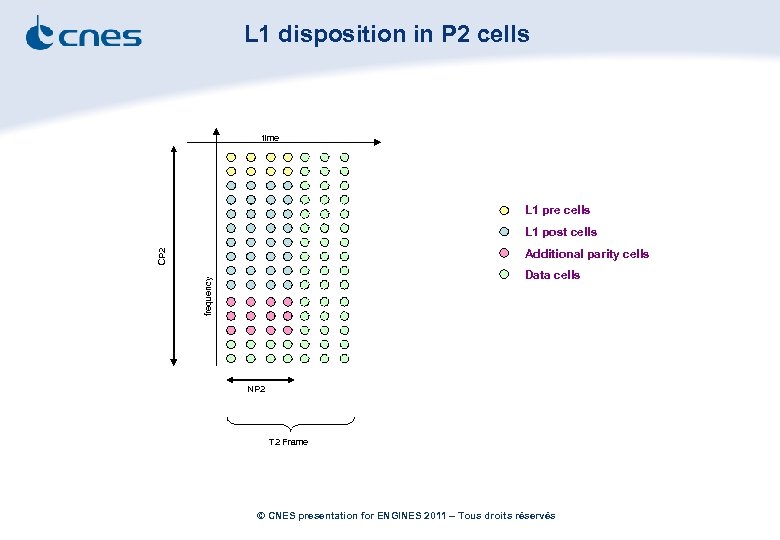
L 1 disposition in P 2 cells time L 1 pre cells L 1 post cells CP 2 Additional parity cells frequency Data cells NP 2 T 2 Frame © CNES presentation for ENGINES 2011 – Tous droits réservés
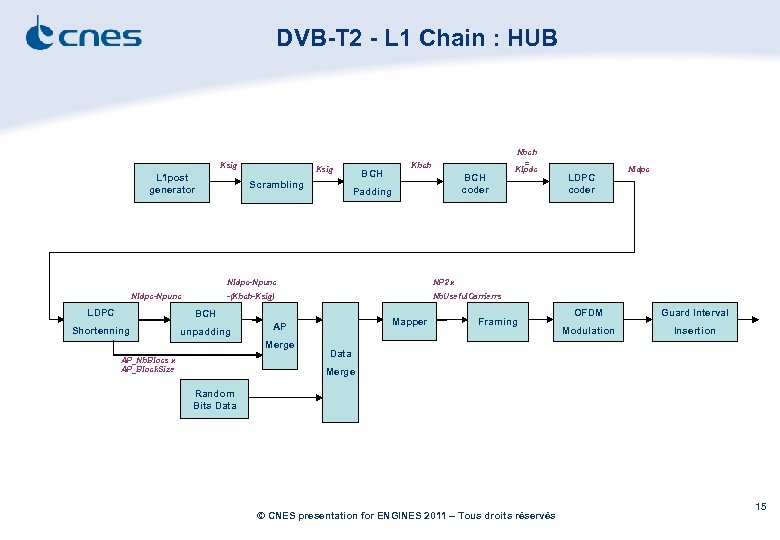
DVB-T 2 - L 1 Chain : HUB Ksig L 1 post generator Ksig Scrambling Kbch BCH coder Padding Nldpc-Npunc LDPC Nldpc Nb. Useful. Carrierrs BCH Shortenning LDPC coder NP 2 x -(Kbch-Ksig) Nldpc-Npunc Nbch = Klpdc unpadding Merge AP_Nb. Blocs x AP_Block. Size Mapper AP Framing OFDM Guard Interval Modulation Insertion Data Merge Random Bits Data © CNES presentation for ENGINES 2011 – Tous droits réservés 15
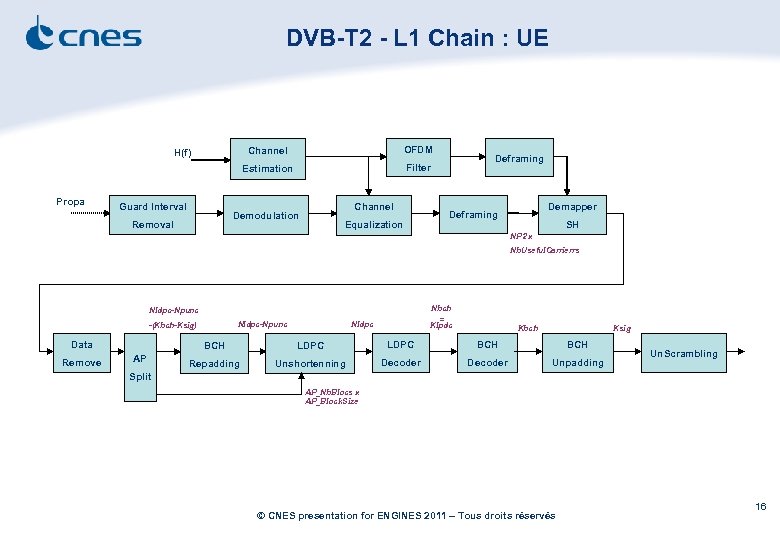
DVB-T 2 - L 1 Chain : UE Channel Propa Guard Interval OFDM Estimation H(f) Filter Channel Demodulation Removal Equalization Deframing Demapper Deframing SH NP 2 x Nb. Useful. Carrierrs Nbch = Klpdc Nldpc-Npunc -(Kbch-Ksig) Kbch Ksig BCH Data Remove Nldpc AP LDPC BCH Repadding Unshortenning Decoder Unpadding Un. Scrambling Split AP_Nb. Blocs x AP_Block. Size © CNES presentation for ENGINES 2011 – Tous droits réservés 16
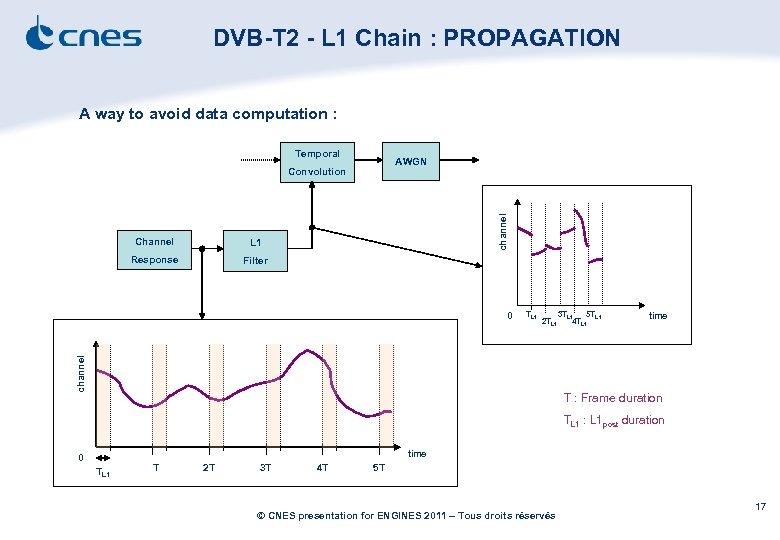
DVB-T 2 - L 1 Chain : PROPAGATION A way to avoid data computation : Temporal AWGN Channel L 1 Response channel Convolution Filter TL 1 2 TL 1 channel 0 3 TL 1 5 TL 1 4 TL 1 time T : Frame duration TL 1 : L 1 post duration time 0 TL 1 T 2 T 3 T 4 T 5 T © CNES presentation for ENGINES 2011 – Tous droits réservés 17
Скачать презентацию L 1 detection performances on LMS-ITS channel Benjamin
27ea8da954d5ab5f3ca144a452869c9b.ppt