


 Скачать презентацию KVALIFIKACIJŲ IR PROFESINIO MOKYMO PLĖTROS CENTRAS QUALIFICATIONS
007b527a82077bc6ea6ea45ab5ce61be.ppt
- Количество слайдов: 22
 KVALIFIKACIJŲ IR PROFESINIO MOKYMO PLĖTROS CENTRAS / QUALIFICATIONS AND VET DEVELOPMENT CENTRE Lithuanian Qualifications Framework and its Implementation Challenges Vincentas Dienys Qualifications and VET Development Centre
 Background for starting (1) KVALIFIKACIJŲ IR PROFESINIO MOKYMO PLĖTROS CENTRAS / QUALIFICATIONS AND VET DEVELOPMENT CENTRE Qualification: the ability and right to engage in a certain professional activity, as recognized according to a procedure prescribed by law or in legislation passed by the Government or an authorized institution. (Law on education, 2003) There were levels defined in different sectors of education: • Higher education – bachelors, masters and doctoral degrees (Law on science and studies, 1991); • VET – 4 levels of LOs for VET sector qualifications (Order of the minister of education and science, 1997); • General education – primary, basic and secondary education (Law on education, 1991)
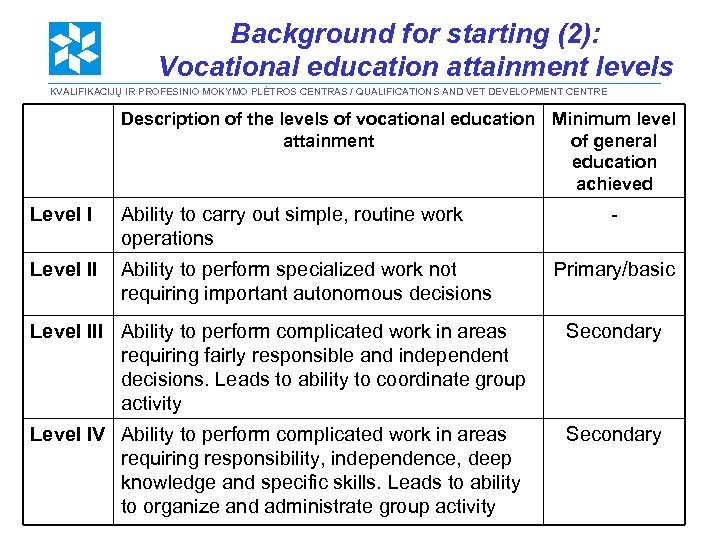 Background for starting (2): Vocational education attainment levels KVALIFIKACIJŲ IR PROFESINIO MOKYMO PLĖTROS CENTRAS / QUALIFICATIONS AND VET DEVELOPMENT CENTRE Description of the levels of vocational education Minimum level attainment of general education achieved Level I Ability to carry out simple, routine work operations Level II Ability to perform specialized work not requiring important autonomous decisions Primary/basic Level III Ability to perform complicated work in areas requiring fairly responsible and independent decisions. Leads to ability to coordinate group activity Secondary Level IV Ability to perform complicated work in areas requiring responsibility, independence, deep knowledge and specific skills. Leads to ability to organize and administrate group activity Secondary
 Summing up situation in 2005 KVALIFIKACIJŲ IR PROFESINIO MOKYMO PLĖTROS CENTRAS / QUALIFICATIONS AND VET DEVELOPMENT CENTRE • There existed three weakly coordinated educational sectors – general education, vocational education and training and higher education. In the VET sector there existed initial VET and continuing VET systems. • • Only a part of qualifications were based on LOs. Qualification was understood as readiness of an individual for a certain professional activity.
 Key features of the process of LTQF-1 design KVALIFIKACIJŲ IR PROFESINIO MOKYMO PLĖTROS CENTRAS / QUALIFICATIONS AND VET DEVELOPMENT CENTRE • Designing of the LTQF took the adaptive approach and did not challenge or had ambitions to radically change the existing system of qualifications. • Process of LTQF design, at least at the initial stage tended to be rather academic process with weak relations to practice, because it was dominated by the experts from the academic field. • Experts from general education sector were not involved.
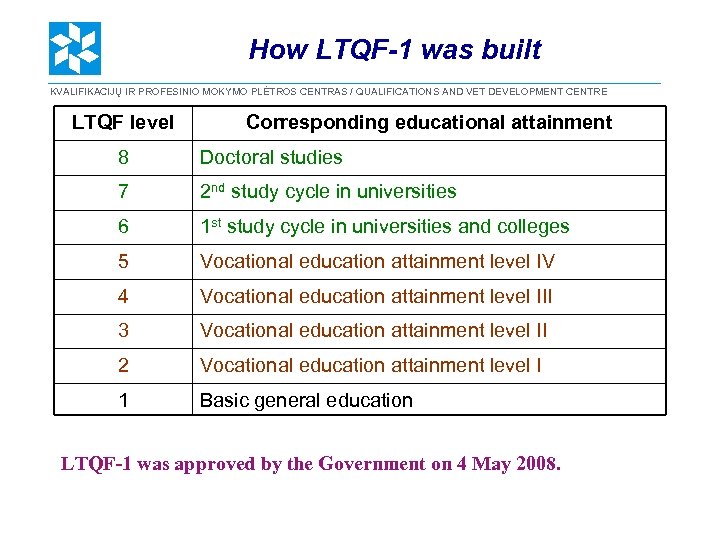 How LTQF-1 was built KVALIFIKACIJŲ IR PROFESINIO MOKYMO PLĖTROS CENTRAS / QUALIFICATIONS AND VET DEVELOPMENT CENTRE LTQF level Corresponding educational attainment 8 Doctoral studies 7 2 nd study cycle in universities 6 1 st study cycle in universities and colleges 5 Vocational education attainment level IV 4 Vocational education attainment level III 3 Vocational education attainment level II 2 Vocational education attainment level I 1 Basic general education LTQF-1 was approved by the Government on 4 May 2008.
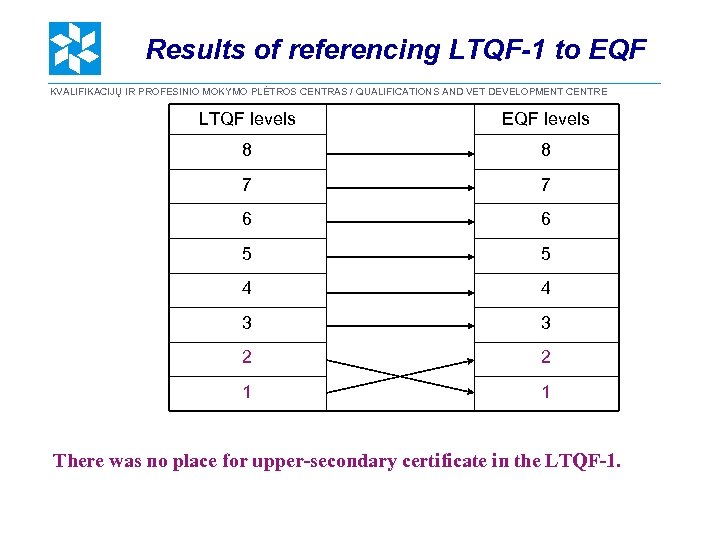 Results of referencing LTQF-1 to EQF KVALIFIKACIJŲ IR PROFESINIO MOKYMO PLĖTROS CENTRAS / QUALIFICATIONS AND VET DEVELOPMENT CENTRE LTQF levels EQF levels 8 8 7 7 6 6 5 5 4 4 3 3 2 2 1 1 There was no place for upper-secondary certificate in the LTQF-1.
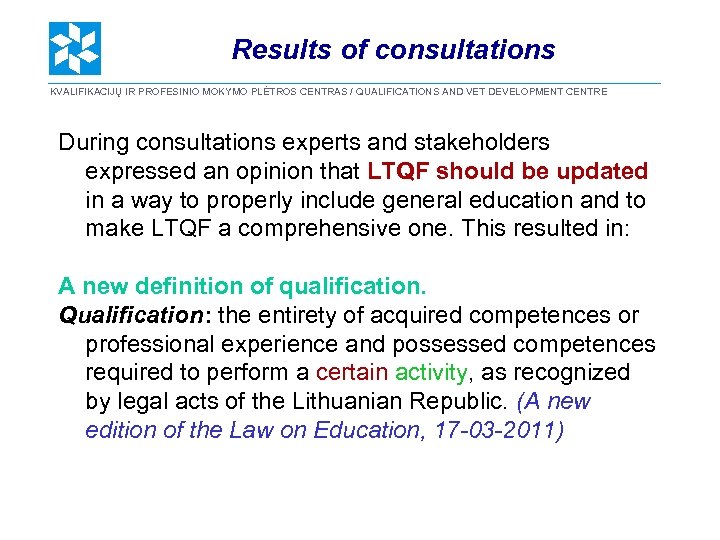 Results of consultations KVALIFIKACIJŲ IR PROFESINIO MOKYMO PLĖTROS CENTRAS / QUALIFICATIONS AND VET DEVELOPMENT CENTRE During consultations experts and stakeholders expressed an opinion that LTQF should be updated in a way to properly include general education and to make LTQF a comprehensive one. This resulted in: A new definition of qualification. Qualification: the entirety of acquired competences or professional experience and possessed competences required to perform a certain activity, as recognized by legal acts of the Lithuanian Republic. (A new edition of the Law on Education, 17 -03 -2011)
 Description criteria used in LTQF KVALIFIKACIJŲ IR PROFESINIO MOKYMO PLĖTROS CENTRAS / QUALIFICATIONS AND VET DEVELOPMENT CENTRE The levels of qualifications are arranged in hierarchical order, with regard to the underlying competence of the qualifications, qualification acquisition and the criteria which define the qualification level: - complexity of activities. This is a qualification criterion used to describe the character of activities, the variety of tasks and the degree of responsibility; - autonomy of activities. This is a qualification criterion used to describe changes in the activity organization and nature of subordination; - variability of activities. This is a qualification criterion used to describe activities in terms of changing technological and organizational environment. (Decree of the Government on the establishment of Lithuanian Qualifications Framework)
 Description of level 3 KVALIFIKACIJŲ IR PROFESINIO MOKYMO PLĖTROS CENTRAS / QUALIFICATIONS AND VET DEVELOPMENT CENTRE The qualification is intended for activities consisting of actions and operations in narrow areas of activities. The activities may include several specialised activity tasks that require the application of well-known and tested solutions. Performance of the activities involves the ability to apply the knowledge characteristic of the activities performed pertaining to the facts, principles and processes of the activity area. The activities are carried out autonomously, under the guidance of an employee of a higher qualification and subject to external performance quality control. The activity environment may require to adapt to simple context changes.
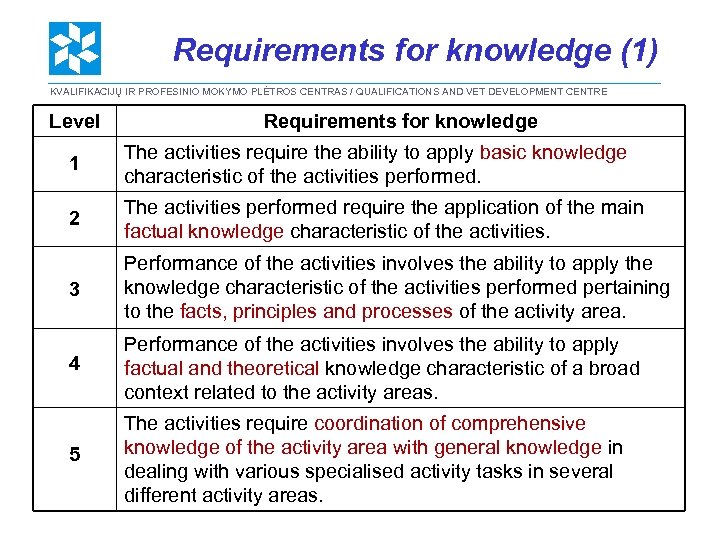 Requirements for knowledge (1) KVALIFIKACIJŲ IR PROFESINIO MOKYMO PLĖTROS CENTRAS / QUALIFICATIONS AND VET DEVELOPMENT CENTRE Level Requirements for knowledge 1 The activities require the ability to apply basic knowledge characteristic of the activities performed. 2 The activities performed require the application of the main factual knowledge characteristic of the activities. 3 Performance of the activities involves the ability to apply the knowledge characteristic of the activities performed pertaining to the facts, principles and processes of the activity area. 4 Performance of the activities involves the ability to apply factual and theoretical knowledge characteristic of a broad context related to the activity areas. 5 The activities require coordination of comprehensive knowledge of the activity area with general knowledge in dealing with various specialised activity tasks in several different activity areas.
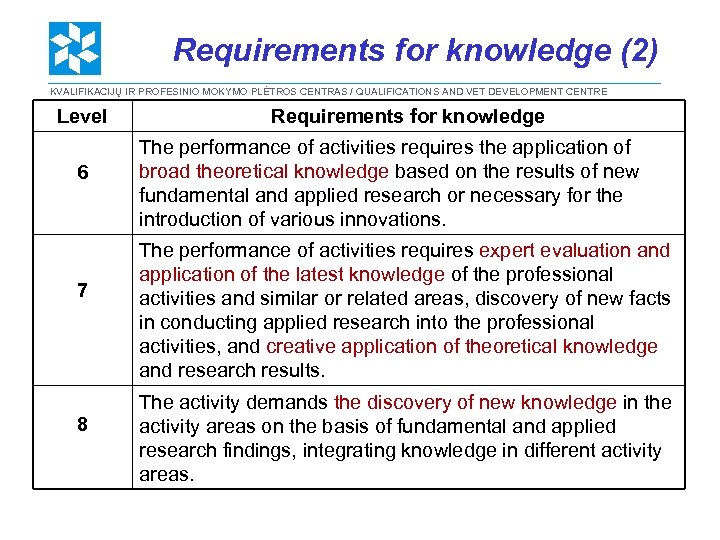 Requirements for knowledge (2) KVALIFIKACIJŲ IR PROFESINIO MOKYMO PLĖTROS CENTRAS / QUALIFICATIONS AND VET DEVELOPMENT CENTRE Level 6 7 8 Requirements for knowledge The performance of activities requires the application of broad theoretical knowledge based on the results of new fundamental and applied research or necessary for the introduction of various innovations. The performance of activities requires expert evaluation and application of the latest knowledge of the professional activities and similar or related areas, discovery of new facts in conducting applied research into the professional activities, and creative application of theoretical knowledge and research results. The activity demands the discovery of new knowledge in the activity areas on the basis of fundamental and applied research findings, integrating knowledge in different activity areas.
 In the LTQF it is also agreed: KVALIFIKACIJŲ IR PROFESINIO MOKYMO PLĖTROS CENTRAS / QUALIFICATIONS AND VET DEVELOPMENT CENTRE • To categorise the qualifications, indicating separately the qualifications for work and/or for study. • To foresee a possibility to acquire qualifications of all levels not only through formal but also through non-formal and informal learning. All text of the LTQF is available at: http: //www. kpmpc. lt/LTKS_EKS/LTQF_official_translation. pdf
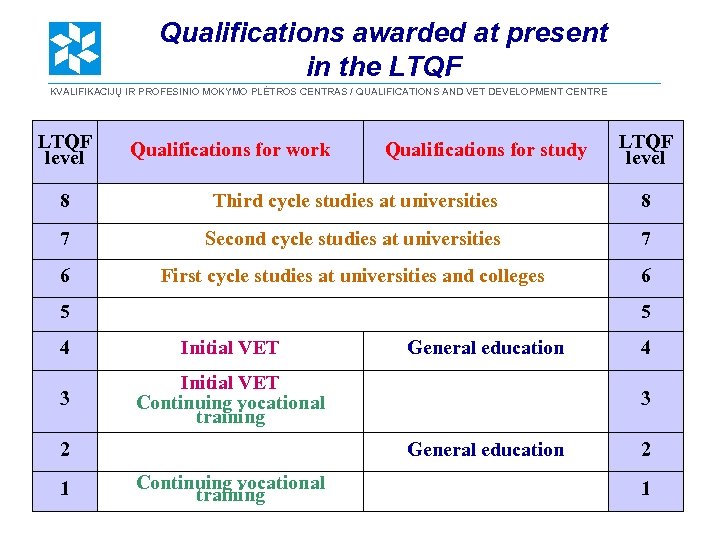 Qualifications awarded at present in the LTQF KVALIFIKACIJŲ IR PROFESINIO MOKYMO PLĖTROS CENTRAS / QUALIFICATIONS AND VET DEVELOPMENT CENTRE LTQF level Qualifications for work Qualifications for study LTQF level 8 Third cycle studies at universities 8 7 Second cycle studies at universities 7 6 First cycle studies at universities and colleges 6 5 5 4 Initial VET 3 Initial VET Continuing vocational training 2 1 General education 3 General education Continuing vocational training 4 2 1
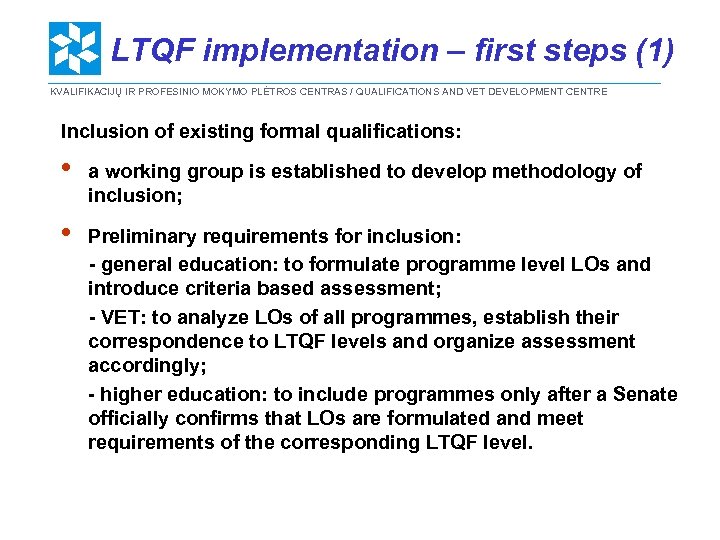 LTQF implementation – first steps (1) KVALIFIKACIJŲ IR PROFESINIO MOKYMO PLĖTROS CENTRAS / QUALIFICATIONS AND VET DEVELOPMENT CENTRE Inclusion of existing formal qualifications: • a working group is established to develop methodology of inclusion; • Preliminary requirements for inclusion: - general education: to formulate programme level LOs and introduce criteria based assessment; - VET: to analyze LOs of all programmes, establish their correspondence to LTQF levels and organize assessment accordingly; - higher education: to include programmes only after a Senate officially confirms that LOs are formulated and meet requirements of the corresponding LTQF level.
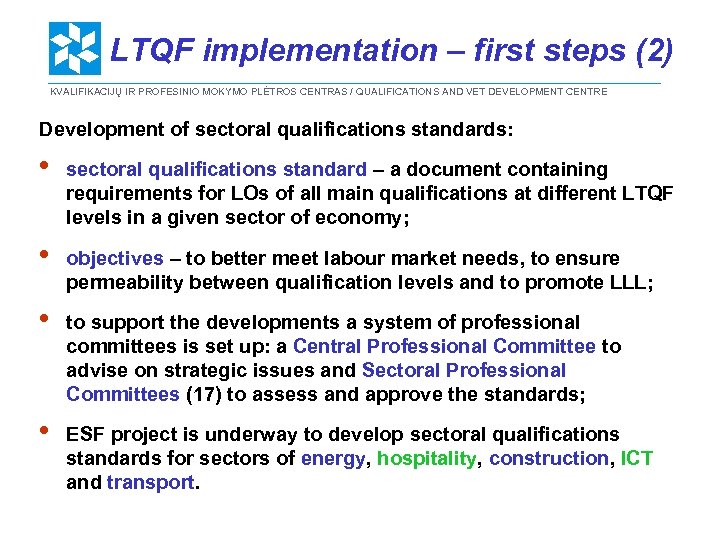 LTQF implementation – first steps (2) KVALIFIKACIJŲ IR PROFESINIO MOKYMO PLĖTROS CENTRAS / QUALIFICATIONS AND VET DEVELOPMENT CENTRE Development of sectoral qualifications standards: • sectoral qualifications standard – a document containing requirements for LOs of all main qualifications at different LTQF levels in a given sector of economy; • objectives – to better meet labour market needs, to ensure permeability between qualification levels and to promote LLL; • to support the developments a system of professional committees is set up: a Central Professional Committee to advise on strategic issues and Sectoral Professional Committees (17) to assess and approve the standards; • ESF project is underway to develop sectoral qualifications standards for sectors of energy, hospitality, construction, ICT and transport.
 LTQF implementation – first steps (3) KVALIFIKACIJŲ IR PROFESINIO MOKYMO PLĖTROS CENTRAS / QUALIFICATIONS AND VET DEVELOPMENT CENTRE In VET sector accreditation of institutions, that are entrusted to assess whether achievements of an individual meet requirements for LOs formulated in corresponding standards or formal VET programmes, was carried out. A responsibility for the assessment of majority of qualifications was delegated to Chambers of Commerce, Industry and Crafts an Chambers of Agriculture. In some specific areas other institutions were accredited, e. g. training centre of the consortium ACHEMA in chemistry, two departments of the Ministry of Interior, etc.
 Challenge No. 1 Globalization of labour market KVALIFIKACIJŲ IR PROFESINIO MOKYMO PLĖTROS CENTRAS / QUALIFICATIONS AND VET DEVELOPMENT CENTRE This challenge obligates to strive for the international comparability of national qualifications. LTQF is open to this type of changes. But the changes could lead to contradictory results: • younger generations will benefit from the increased possibility to be employed abroad; • most competent youth will emigrate to countries having higher living standards, a birthrate will decrease and we shall experience a rapidly increasing ageing of population. In such a situation it will be difficult to modernize economy, and this can lead to even bigger differences of living standards. How to avoid this?
 Challenge No. 2 Mutual trust KVALIFIKACIJŲ IR PROFESINIO MOKYMO PLĖTROS CENTRAS / QUALIFICATIONS AND VET DEVELOPMENT CENTRE Successful EQF implementation requires mutual trust among countries. To achieve this helps a transparent referencing of national qualifications systems to EQF. Equally, effective NQF implementation requires mutual trust inside the education and training system in a country. How to achieve this when bureaucracy and numbers of different regulations are constantly increasing?
 Challenge No. 3 Academic vs. vocational/professional KVALIFIKACIJŲ IR PROFESINIO MOKYMO PLĖTROS CENTRAS / QUALIFICATIONS AND VET DEVELOPMENT CENTRE To regulate LOs of qualifications the Ministry of Education an Science was developing VET standards for IVET and national programmes for CVT of adults. Development of occupational standards was not practiced. Therefore only formal qualifications are provided at present. Moreover, the prestige of academic learning is much higher than vocational/professional one. As a result no professional qualifications, as they are understood in Estonia, are awarded in Lithuania at present. It is a challenge for us!
 KVALIFIKACIJŲ IR PROFESINIO MOKYMO PLĖTROS CENTRAS / QUALIFICATIONS AND VET DEVELOPMENT CENTRE The great thing in the world is not so much where we stand, as in what direction we are moving. . . O. W. Holmes
 KVALIFIKACIJŲ IR PROFESINIO MOKYMO PLĖTROS CENTRAS / QUALIFICATIONS AND VET DEVELOPMENT CENTRE Thank you for your kind attention!