 Скачать презентацию Kutatás-fejlesztés a közlekedési programok területén Prof Bokor József
3016ea2a8fc85958e20d59ab3646d50f.ppt
- Количество слайдов: 30




Kutatás-fejlesztés a közlekedési programok területén Prof. Bokor József MTA SZTAKI - BME Systems and Control Laboratory Computer and Automation Research Institute Hungarian Academy of Sciences
• Research trends and perspectives in the area of – Road vehicle and road traffic systems – Air vehicle and air traffic systems • Interactions in research for future automatic systems will be highlighted Systems and Control Laboratory Computer and Automation Research Institute Hungarian Academy of Sciences 2
Content • Overview of aircraft and air traffic control systems • Research projects in SZTAKI and BME on Flight and Road Traffic Systems • Interactions with road vehicle control systems • Future trends Systems and Control Laboratory Computer and Automation Research Institute Hungarian Academy of Sciences 3
Aircraft and Air Traffic Control Systems • Between 2000 and 2007 the total number of vehicles was increased by 35 -40%. • In the next two decades the air traffic will be doubled. • This implies an expected demand of approximately 24000 aircrafts. Systems and Control Laboratory Computer and Automation Research Institute Hungarian Academy of Sciences 4
Aircraft and Air Traffic Control Systems • What existing or new tasks should be automated an why? • What additional performance requirements will arise? • How to incorporate the emerging C 3 (Computing, Communication and Control) technology (in addition to research for better air frame, engine, new materials) • Cost effectiveness and environmental protection requirements will be strenghten Systems and Control Laboratory Computer and Automation Research Institute Hungarian Academy of Sciences 5
Aircraft and Air Traffic Control Systems Three loops of control and automation: 1. Fly by Wire system: Fly-by-wire control system (implemented on board computers) are to operate the control surfaces and engines to ensure that: • The aircraft is simultanously robustly stable and manoveuvrable against change in Cg, speed, configuration. Extends the stability domain! • Good command following (e. g: for stick) • Protects the aircraft to stay in a safe flight envelope (keeps constraints on pitch, roll, bank angle, high speed, high g level) • Fault detection and reconfiguration, control under loss of effectiveness in control surfaces. Systems and Control Laboratory Computer and Automation Research Institute Hungarian Academy of Sciences 6
Aircraft and Air Traffic Control Systems 2. Guidance and autopilot control loop • Trajectory tracking • Command following: vertical speed, flight path angle, speed. Ex. : Autopilot, Autothrust systems This is a hybrid control system: • Discrete states are the guidance modes: fly a given heading (HDG mode), Altitude Hold (ALT mode). • Continuous state variables of the flying aircrafts Need for theory and application of switching nonlinear (LPV) systems! Systems and Control Laboratory Computer and Automation Research Institute Hungarian Academy of Sciences 7
Aircraft and Air Traffic Control Systems 3. Navigation loop: Guidance of the aircraft along a flight plan or flying a mission. In traditional commertial aircrafts the role of pilots is dominating with collaboration with Air Traffic Management (ATM) systems. Systems and Control Laboratory Computer and Automation Research Institute Hungarian Academy of Sciences 8
Aircraft and Air Traffic Control Systems 4. New loop: Flight Management System (FMS) • FMS sends the waypoint data to the autopilot • Autopilot guides the aircraft along the feasible active flight path leg operating under „optimum” conditions. • Pilot selects the appropriate guidance mode. Systems and Control Laboratory Computer and Automation Research Institute Hungarian Academy of Sciences 9
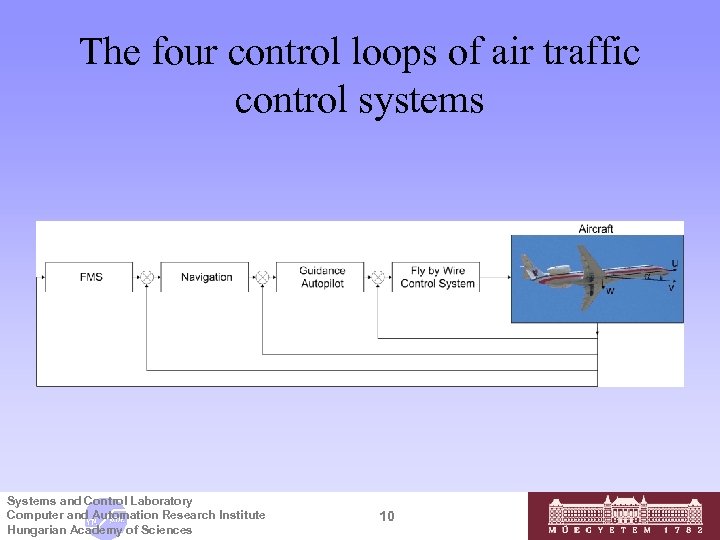
The four control loops of air traffic control systems Systems and Control Laboratory Computer and Automation Research Institute Hungarian Academy of Sciences 10
Aircraft and Air Traffic Control Systems UAV control systems fully automate the 4 loops and: • Automate mission flying and formation flying. • Use Software Enabled Control technology to extend flight capabilities beyond human controlled systems. Strong interaction with research trends in automated • road • underwater vehicle control systems. Systems and Control Laboratory Computer and Automation Research Institute Hungarian Academy of Sciences 11
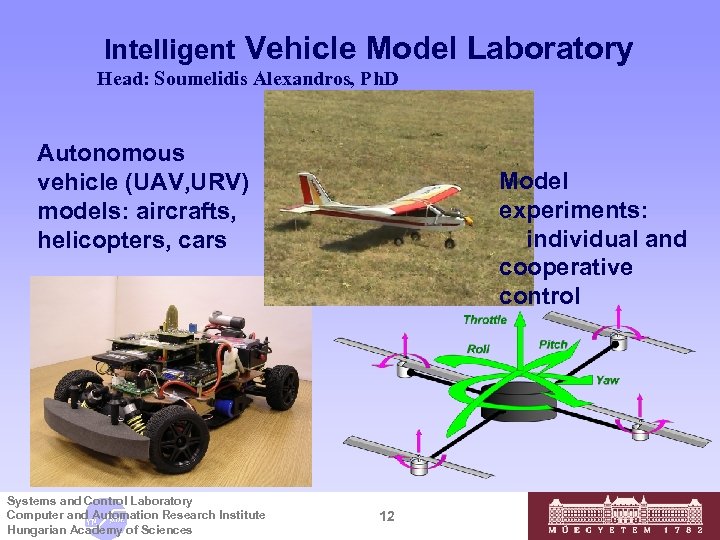
Intelligent Vehicle Model Laboratory Head: Soumelidis Alexandros, Ph. D Autonomous vehicle (UAV, URV) models: aircrafts, helicopters, cars Systems and Control Laboratory Computer and Automation Research Institute Hungarian Academy of Sciences Model experiments: individual and cooperative control 12
UAV lab Systems and Control Laboratory joined to „UAV lab” initiated by the Department of Aerospace Engineering and Mechanics of the University of Minnesota Members: University of Minnesota (Prof. Gary Balas) University of Sannio, Benevento, Italy (Prof. Francesco Borrelli) Computer and Automation Research Institute (Prof. Jozsef Bokor) Budapest University of Technology and Economics (Prof. J. Bolor) Systems and Control Laboratory Computer and Automation Research Institute Hungarian Academy of Sciences 13
UAV lab Objectives: The UAV research group is actively involved in expanding the capabilities of UAV systems for today and tomorrow. Current research focuses on development of navigation, guidance and control strategies for autonomous flight in enclosed indoor environments. The focus of research is not only to address issues from technological standpoint, but also ensure the system is built mostly out of commercial of the shelf (COTS) components to maximize cost benefits, share the knowhow of design and development of hardware and software with researchers across the world with open source philosophy. Systems and Control Laboratory Computer and Automation Research Institute Hungarian Academy of Sciences 14
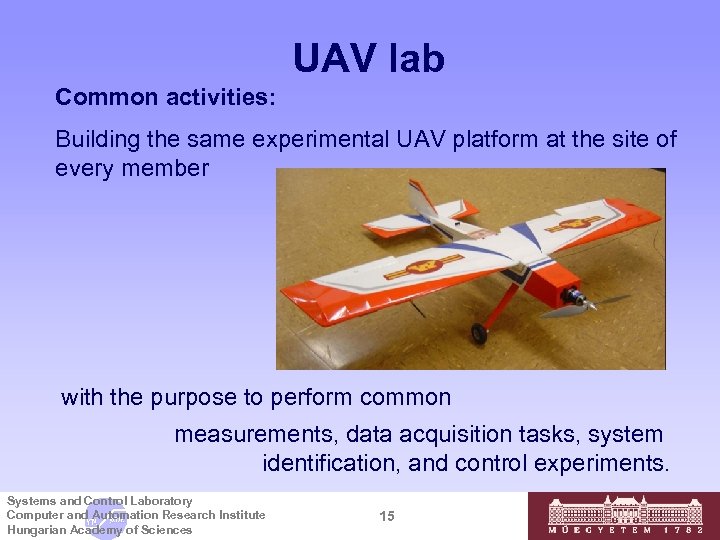
UAV lab Common activities: Building the same experimental UAV platform at the site of every member with the purpose to perform common measurements, data acquisition tasks, system identification, and control experiments. Systems and Control Laboratory Computer and Automation Research Institute Hungarian Academy of Sciences 15
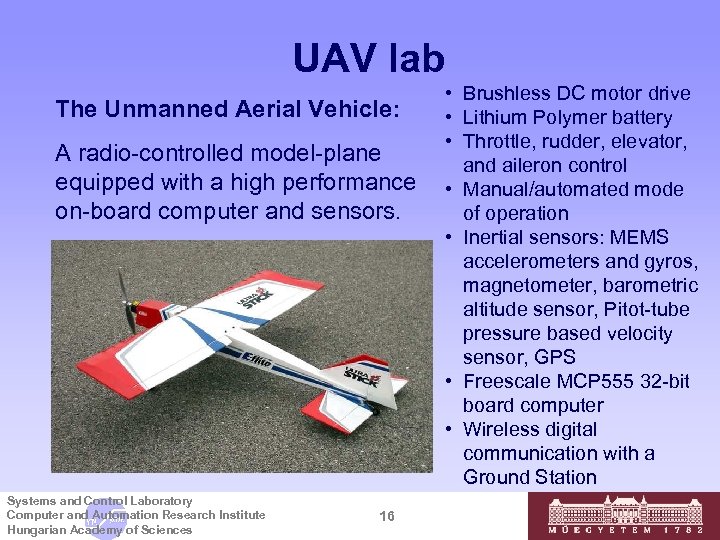
UAV lab The Unmanned Aerial Vehicle: A radio-controlled model-plane equipped with a high performance on-board computer and sensors. Systems and Control Laboratory Computer and Automation Research Institute Hungarian Academy of Sciences 16 • Brushless DC motor drive • Lithium Polymer battery • Throttle, rudder, elevator, and aileron control • Manual/automated mode of operation • Inertial sensors: MEMS accelerometers and gyros, magnetometer, barometric altitude sensor, Pitot-tube pressure based velocity sensor, GPS • Freescale MCP 555 32 -bit board computer • Wireless digital communication with a Ground Station
UAV lab Guidance and Autopilot Loops • • • Waypoint Guidance (lateral–directional control) Altitude hold IAS (Indicated Air Speed) hold Extended Kalman Filter for estimating states Data acquisition – sensor and estimated data Navigation and Flight Control • On-board control – waypoint guidance • Trajectory (waypoint) planning, altitude, IAS setpoint control on the Ground Station • Takeoff / landing, emergency operations: manual control Systems and Control Laboratory Computer and Automation Research Institute Hungarian Academy of Sciences 17
UAV lab Recent tasks: • System identification based upon test-flight data • Building accurate control oriented mathematical model • Designing controllers for several flight situations • Implementing controllers on the board computer • Validation & verification of the controllers in real flight conditions • Considering safety and reliability conditions Systems and Control Laboratory Computer and Automation Research Institute Hungarian Academy of Sciences 18
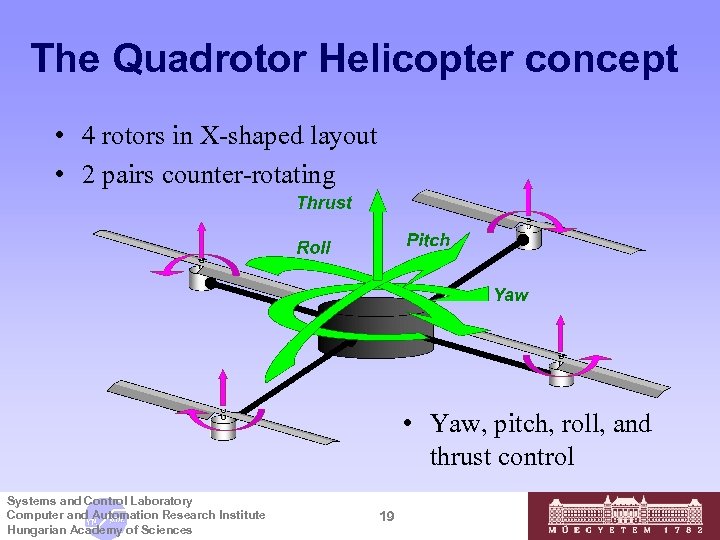
The Quadrotor Helicopter concept • 4 rotors in X-shaped layout • 2 pairs counter-rotating • Yaw, pitch, roll, and thrust control Systems and Control Laboratory Computer and Automation Research Institute Hungarian Academy of Sciences 19
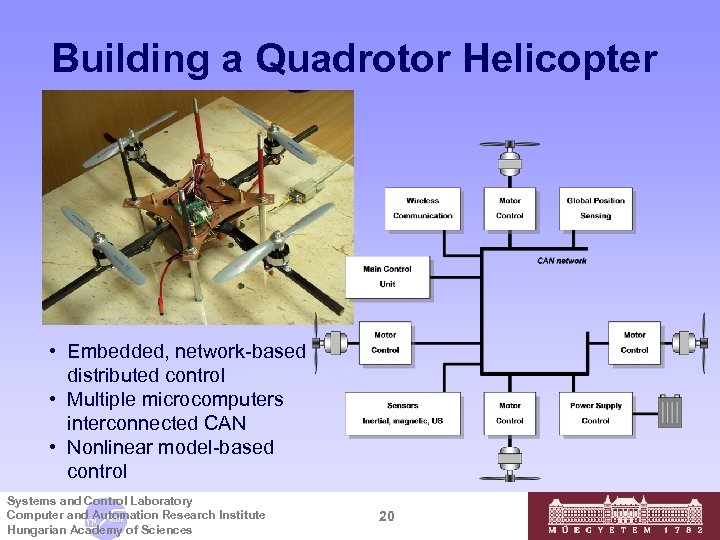
Building a Quadrotor Helicopter • Embedded, network-based distributed control • Multiple microcomputers interconnected CAN • Nonlinear model-based control Systems and Control Laboratory Computer and Automation Research Institute Hungarian Academy of Sciences 20
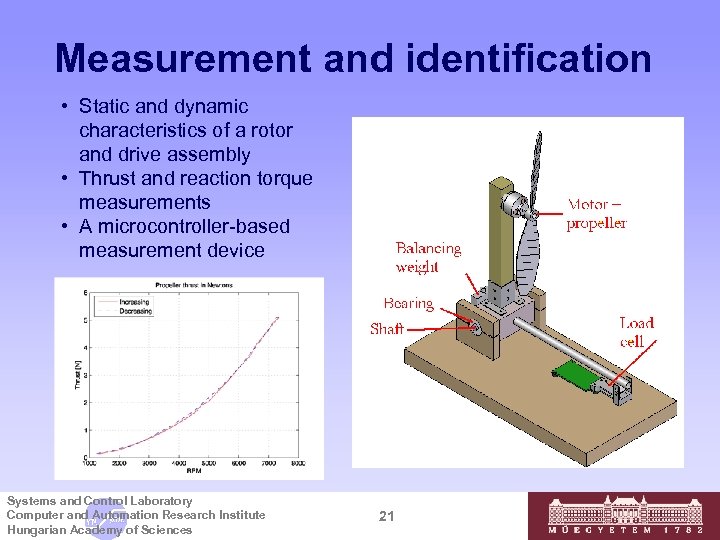
Measurement and identification • Static and dynamic characteristics of a rotor and drive assembly • Thrust and reaction torque measurements • A microcontroller-based measurement device Systems and Control Laboratory Computer and Automation Research Institute Hungarian Academy of Sciences 21
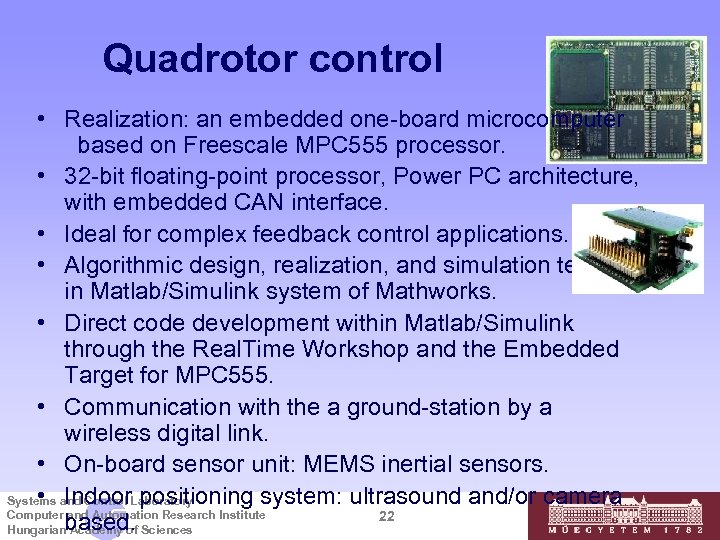
Quadrotor control • Realization: an embedded one-board microcomputer based on Freescale MPC 555 processor. • 32 -bit floating-point processor, Power PC architecture, with embedded CAN interface. • Ideal for complex feedback control applications. • Algorithmic design, realization, and simulation testing in Matlab/Simulink system of Mathworks. • Direct code development within Matlab/Simulink through the Real. Time Workshop and the Embedded Target for MPC 555. • Communication with the a ground-station by a wireless digital link. • On-board sensor unit: MEMS inertial sensors. • Indoor positioning system: ultrasound and/or camera Systems and Control Laboratory Computer and Automation Research Institute 22 Hungarianbased. Sciences Academy of
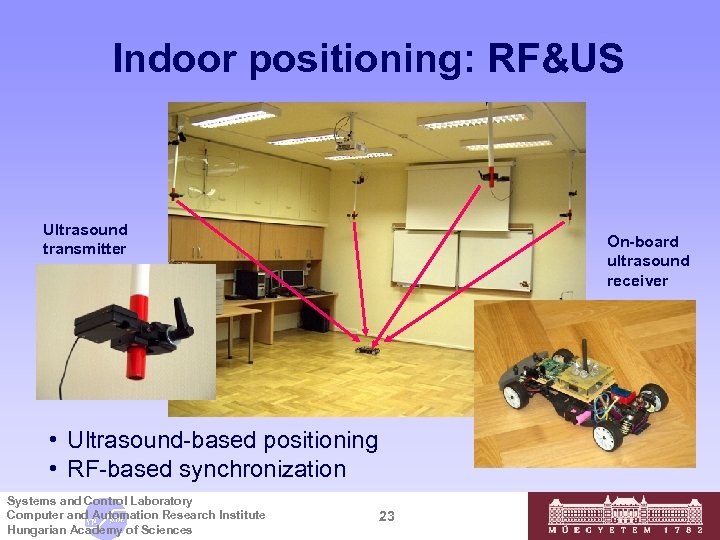
Indoor positioning: RF&US Ultrasound transmitter On-board ultrasound receiver • Ultrasound-based positioning • RF-based synchronization Systems and Control Laboratory Computer and Automation Research Institute Hungarian Academy of Sciences 23
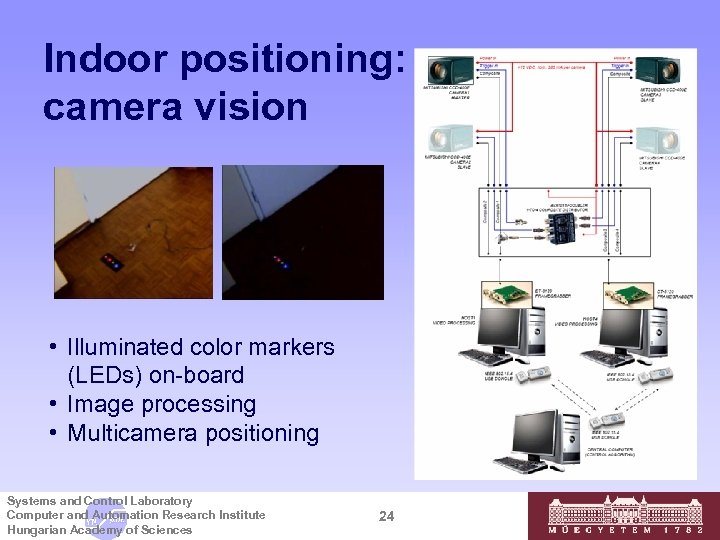
Indoor positioning: camera vision • Illuminated color markers (LEDs) on-board • Image processing • Multicamera positioning Systems and Control Laboratory Computer and Automation Research Institute Hungarian Academy of Sciences 24
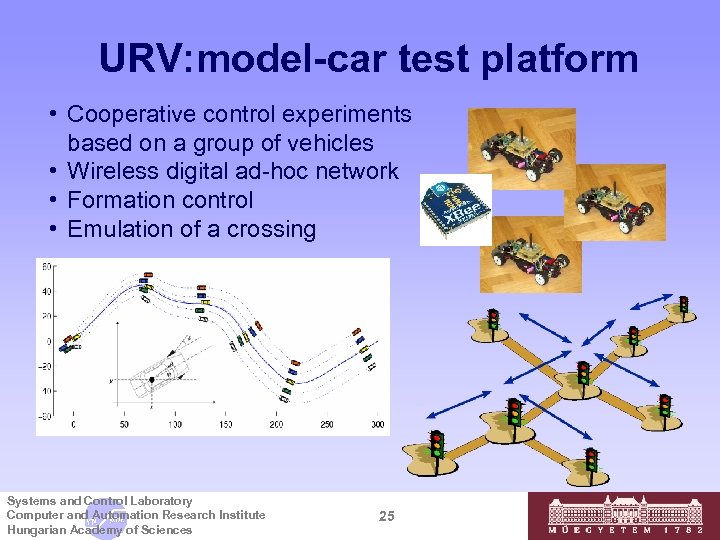
URV: model-car test platform • Cooperative control experiments based on a group of vehicles • Wireless digital ad-hoc network • Formation control • Emulation of a crossing Systems and Control Laboratory Computer and Automation Research Institute Hungarian Academy of Sciences 25
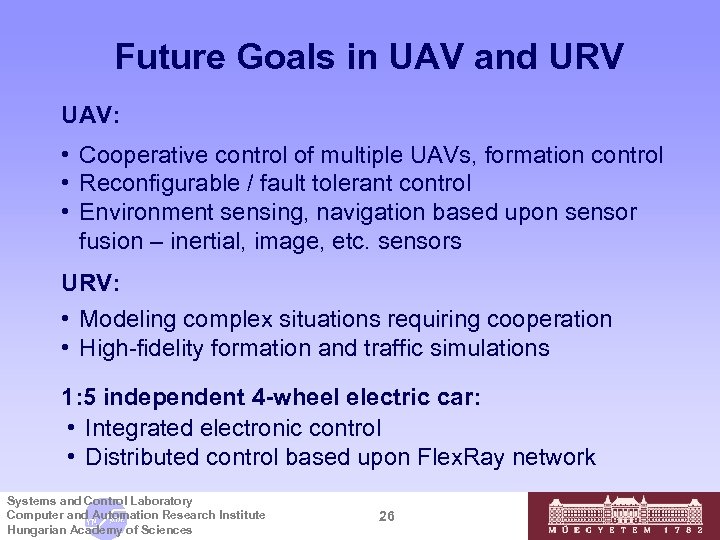
Future Goals in UAV and URV UAV: • Cooperative control of multiple UAVs, formation control • Reconfigurable / fault tolerant control • Environment sensing, navigation based upon sensor fusion – inertial, image, etc. sensors URV: • Modeling complex situations requiring cooperation • High-fidelity formation and traffic simulations 1: 5 independent 4 -wheel electric car: • Integrated electronic control • Distributed control based upon Flex. Ray network Systems and Control Laboratory Computer and Automation Research Institute Hungarian Academy of Sciences 26
Future developments: • Automated taxing (Messier-Bugatti-BME and partners) • Automatic take-off, landing • Collision avoidance in air or ground • Increase of situational awarness by better representation of aircraft states and other enviroment like: - inrfared or millimetre radar sensors - use of terrain and obstacle data base • Mission and formation flying (automated) • Role of pilots: - control and monitor of the automated systems Systems and Control Laboratory - decision making in major failure as Computer and Automation Research Institute 27 Hungarian Academy of Sciences
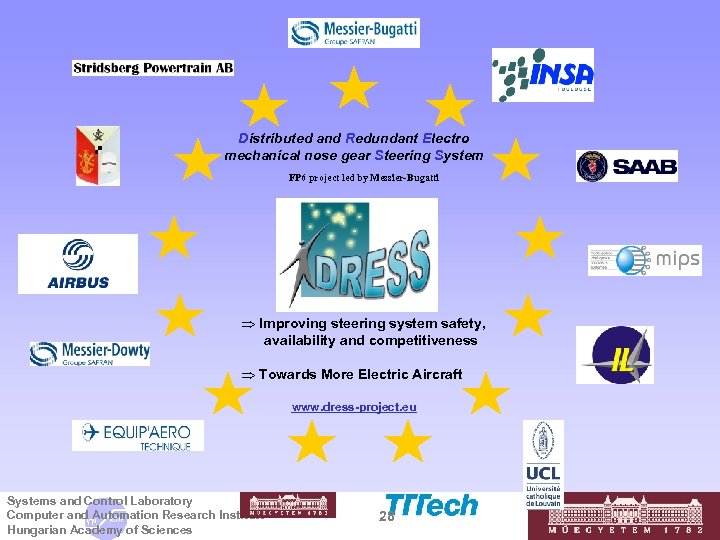
Distributed and Redundant Electro mechanical nose gear Steering System FP 6 project led by Messier-Bugatti Þ Improving steering system safety, availability and competitiveness Þ Towards More Electric Aircraft www. dress-project. eu Systems and Control Laboratory Computer and Automation Research Institute Hungarian Academy of Sciences 28
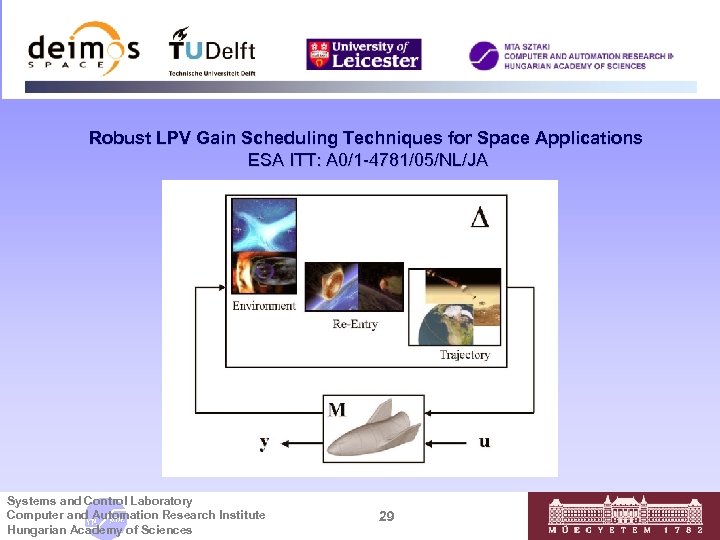
Robust LPV Gain Scheduling Techniques for Space Applications ESA ITT: A 0/1 -4781/05/NL/JA Systems and Control Laboratory Computer and Automation Research Institute Hungarian Academy of Sciences 29

Thank You for Your Attention ! Systems and Control Laboratory Computer and Automation Research Institute Hungarian Academy of Sciences 30
Скачать презентацию Kutatás-fejlesztés a közlekedési programok területén Prof Bokor József
3016ea2a8fc85958e20d59ab3646d50f.ppt