


 Скачать презентацию КУРС ЛЕКЦИЙ ПО СТИЛИСТИКЕ АНГЛИЙСКОГО ЯЗЫКА ФУНКЦИОНАЛЬНЫЕ СТИЛИ
f2e17bd131802dc98f330078a7d151e4.ppt
- Количество слайдов: 91
 КУРС ЛЕКЦИЙ ПО СТИЛИСТИКЕ АНГЛИЙСКОГО ЯЗЫКА ФУНКЦИОНАЛЬНЫЕ СТИЛИ Разработчик: Нагорнова Е. В. , к. ф. н. , доцент кафедры АЯТМОАЯ
 LECTURES IN STYLISTICS FUNCTIONAL STYLES Complier: Nagornova E. V. , c. ph. s. , associate professor English language sub department
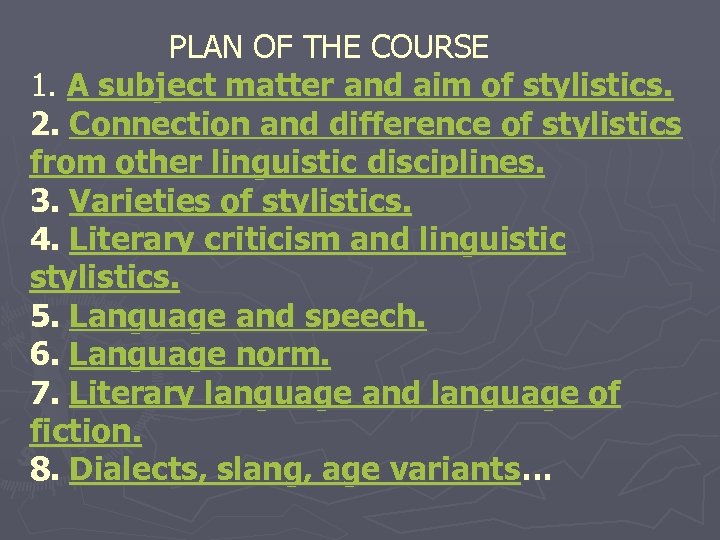 PLAN OF THE COURSE 1. A subject matter and aim of stylistics. 2. Connection and difference of stylistics from other linguistic disciplines. 3. Varieties of stylistics. 4. Literary criticism and linguistic stylistics. 5. Language and speech. 6. Language norm. 7. Literary language and language of fiction. 8. Dialects, slang, age variants…
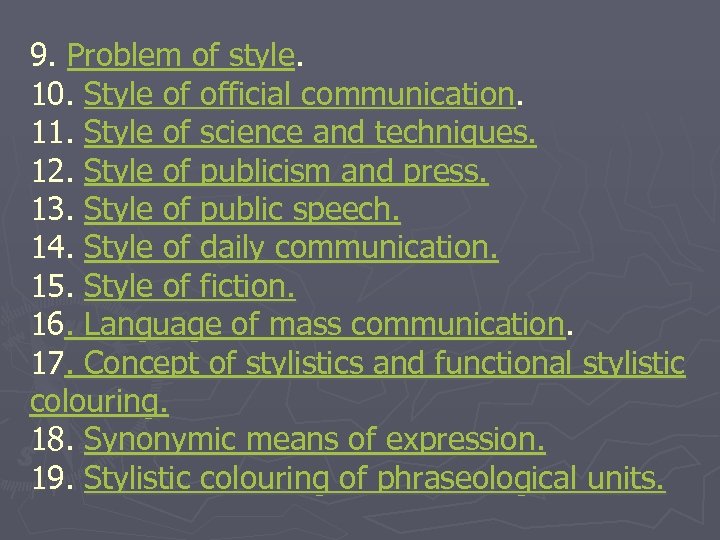 9. Problem of style. 10. Style of official communication. 11. Style of science and techniques. 12. Style of publicism and press. 13. Style of public speech. 14. Style of daily communication. 15. Style of fiction. 16. Language of mass communication. 17. Concept of stylistics and functional stylistic colouring. 18. Synonymic means of expression. 19. Stylistic colouring of phraseological units.
 A subject matter and aim of stylistics In antique philology the significant place belonged to rhetorics. The term “stylistics” is derived from the word “style” which goes back to the Latin word “stilos”. But already in Latin this word came to denote not only the tool of writing but also the manner of writing. The new meaning was borrowed into European languages. The word "stylistics" has come to Russian from the French language stylistique. Usually in Anglo-American sources are used: figures of speech, style and composition, style and rhetorics, grammar and style, style and language, etc.
 However, as special, separate scientific discipline, stylistics is a young science. It has started to be formed approximately with 2030 of XX century, and its final form can be related to the middle of 50 th years, i. e. after occurrence of functional stylistics.
 two problems: problems of distinction of language and speech and a problem of definition of a literary language and its norm. In works of the West-European and American linguists the stylistics is a part of language and opposed grammar. Style is not only the sum of stylistic receptions, but a system of non-verbal and verbal means in which the validity is reflected.
 To estimate, select and expediently to use means of national (native) and foreign language is the primary goal of stylistics, the philological discipline revealed in oral and written speech of different peoples.
 Connection and difference of stylistics from adjacent linguistic disciplines The stylistics as independent linguistic discipline is closely connected to others linguistic disciplines Stylistics and phonetics. The stylistics investigates for what purposes of emotional expressiveness the intonation and sound instrumentation of speech are used, how they can be used. Stylistics and lexicology. The stylistics investigates principles of use of dictionary structure of language (words and word-combinations) in their expressive functions.
 Stylistics and grammar. The stylistics at a level of morphology considers only those morphological forms of words which are used to express emotionally - coloured shades of idea. At a level of syntax it investigates grammatic means of expression of the form and a construction as expressive language means. Stylistics and theory of translation. The process of translation is directly connected to the functional - stylistic analysis of the texts (speech products).
 VARIETIES OF STYLISTICS The general stylistics Private (individual) stylistics The stylistics comparative or analytical The functional stylistics The practical stylistics Statistical stylistics Special attention deserve literary criticism and linguistic stylistics.
 Stylistics of coding and decoding the stylistics is a science which investigates those sides of the statement (text) which transfer the person accepting and decoding information, an idea of the person coding the message. Thus there are stylistics of coding and decoding. In this case the stylistics from the author (i. e. stylistics from the sender of the information) is stylistics of coding, stylistics of the source language. The stylistics of perception (recognition), stylistics of the addressee of the information is stylistics of decoding, stylistics of a target language.
 Literary criticism and linguistic stylistics Three points of view: 1. In stylistics literary criticism should be engaged only, 2. Stylistics - the competence of linguists (linguistic stylistics), 3. An intermediate place between linguistics (in the narrow sense of the word) and literary criticism (stylistics in general, including linguistic stylistics, theory of poetic speech, art stylistics and poetics).
 Considering all those problems, some researchers differentiate stylistics onto: (1)stylistics of language as systems, or structural stylistics which is engaged in studying of specificity of functional styles of language; (2)stylistics of speech, or stylistics of different kinds of the public use of the language, studying semantic and expressive stylistic distinctions between different genres and social kinds of oral and written speech;
 (3) stylistics of literary criticism where theory and a history of poetic speech and poetics are also referred and which investigates all elements of style of a literary work, style of the writer, style of a literary trend. The two first stylistics are linguistic disciplines, and the stylistics of literary criticism is a literary discipline.
 Linguistic stylistics The part uniting history of literature and literary criticism and linguistic stylistics, is style of fiction. Linguistic stylistics studies general points, and literary criticism studies individual displays of this general use of means of language. Stylistics of language and stylistics of speech. The stylistics of language studies styles of language as system of the phonetic, lexical and grammatic phenomena of the language possessing certain stylistic colouring, and the stylistics of speech studies concrete displays of language styles in the certain spheres of communication.
 linguistic stylistics is linguistic science engaged in studying of functional styles and their language features, semantic-expressive and stylistic expressive means of language and language synonymy. The lexical stylistics, or stylistic lexicology studies stylistic functions of vocabulary, considers interaction of straight lines or transferred meanings.
 The phonostylistics, or stylistic phonetics, considers features of the sound organization of speech and its expressive influences. The grammatic stylistics, or stylistic grammar, investigates use of the various morphological and syntactic phenomena (grammatic categories, the order, etc. ) as expressive speech means. The stylistic semasiology is engaged in semantic treatment of figures of speech of any grammatic nature from the point of view of the mechanism made in them from the point of view of semantic changes and their stylistic function.
 Language and speech Language – the system of signs of special nature, and speech - the form of existence of language, application, use, functioning of language in various situations of communication, spheres of communication and activity of people. Signs of language are functionally shown in speech.
 is the form of existence of the given language system. The basic line of differentiation between language and speech is a realization. Language represents simply intention, an opportunity, norm, exists even before realization, speech is something which is already realized. Linguistic stylistics is interested in the choice of language means for effective transfer of the given information to the certain conditions of the communications.
 Language norm The literary language is the normalized language. The norm is objectively existing set established in the given society and at the given period of development of language of habits and rules of public using of the language. The norm is universal and obligatory. Norm of each language - the phenomenon deeply national.
 Literary language and language of fiction The literary language is a cultural language, it is that part of a national language. The literary language functions both in written, and in colloquial (oral) forms. The norm of a literary language differs from the norm of language of fiction where there are the models, missing language norms and limits.
 The concept language of fiction is wider. Writers use in their works, first of all, the elements of norm peculiar to a literary language. However in literary works there are the language phenomena beyond literary, normalized language, that is peculiar speeches of separate characters or the author. Language of fiction represents more free system, than literary language.
 Dialects, local dialects, slang, age versions, man's and female variants " Do tell us all about London, dear father, " asked Mary. . . " How can I - tell yo a'about it, when I never see'd one-tenth of it. It's as big as six Manchesters, they telled me. Onesixth my be made up o ' grand palaces, and three-sixth o'middling kind, and th ' rest o ' holes, iniquity and filth, such as Manctester knows nought on. I'm glad to say ".
 Social dialects " I'm like a navigator on a strange sea without chart or compass. Now I want to get my bearin's. Mebbe you can put me right " (Jack London). It is possible to refer to social dialects London dialect (cockney) on which social bottoms of London communicate. To this dialect phonetic features are inherent, there are, however, morphological and semantic features. For example, phonetic: house - ' ouse; hat - ' at; atmosphere - hatmosphere; thanks - thenks; now nah; morphological: I knowed, I coined; semantic: “to learn” in the meaning of “to teach”.
 For an illustration we shall result the following fragment from the play “Pigmalion”: THE FLOWER GIRL: Nah, then, Freddy, look wh 'y' gowun, deah. FREDDY: Sorry. THE FLOWER GIRL: Theres menners T yu! To-oo banches o'oylets trod into the mad. THE MOTHER: How do you know that my son's name is Freddy, pray? THE FLOWER GIRL: Ow, eez ye-ooa son, is e? Wal, fewd dan y'de ooty bawms a mother, should, eed now bettern to spawl a pore gel's flahran than ran awy athaht pyin. Will ye-oo py me f'them?
 Male and female variants, age versions: children's language, language of youth (schoolboys, students), language of adult generation, language of old men. E. g. the general construction “he is an awful man” in a male’s variant with the big share of probability will be transformed in “THAT MAN”, and in a female’s variant in “What an awful man!” The differentiation is observed as well in a choice of lexics. So, the woman in the certain situation with a high probability will use words “charming, beautiful”, etc. Children very much frequently use diminutive-hypocoristic suffixes-ie, -у (pussy, mummy), sounds [ð] and [Ө] instead of [s], etc.
 Professional slang (jargon), argo " Barkers for me, Barney, " said Toby Crackpit. " Here they are, " replied Barney, producing a pair of pistols, " you loaded them yourself. " " All right! " replied Toby, stowing the pistols away. " The persuaders? " “ I've got them, " replied Sikes. " Crape, keys, centre-bits, darkies-nothing forgotten? " (Ch. Dickens) Here in speech of thieves slang words have the following meaning: barker - a pistol, persuader the Finn, crape - ticks, key - a master key, centrebit - a master key - pattern, darkie - a small lamp.
 Questions to lecture 1. 1. What is the subject matter and aim of stylistics? 2. What is language norm? 3. What are the varieties of stylistics? 4. How is stylistics connected with other linguistic disciplines? 5. What is Argo? 6. Language of fiction and literary language – which is broader?
 Problem of style There are different approaches: Style is denied. 2. Style is the display of author's individuality, this view approaches styles from positions of fiction. 3. Style is a set of texts which characteristics are connected with various ways of use languagespeech means, and with differentiation of the most communicative system depending on situations and spheres of communication. Styles differ on the basis of different criteria; in different languages different styles are allocated. 1.
 Definition of functional style Functional style is the historically developed display of the literary (normalized) national language representing a subsystem which is characterized by equally directed features of use of means of a national language and is adapted to the optimal expression of the given communicative contents. functional style is the language subsystem possessing the phonetic, lexical and grammatic characteristics and serving certain sphere of communication.
 Functional styles of modern English language In modern English language depending on the purpose of the communication and sphere of usage the following five styles are allocated: 1. Style of official communication, 2. Style of a science and techniques, 3. Style of publicism and press, 4. Style of daily communication, 5. Style of fiction. Each of the given styles is characterized by the certain features at all levels.
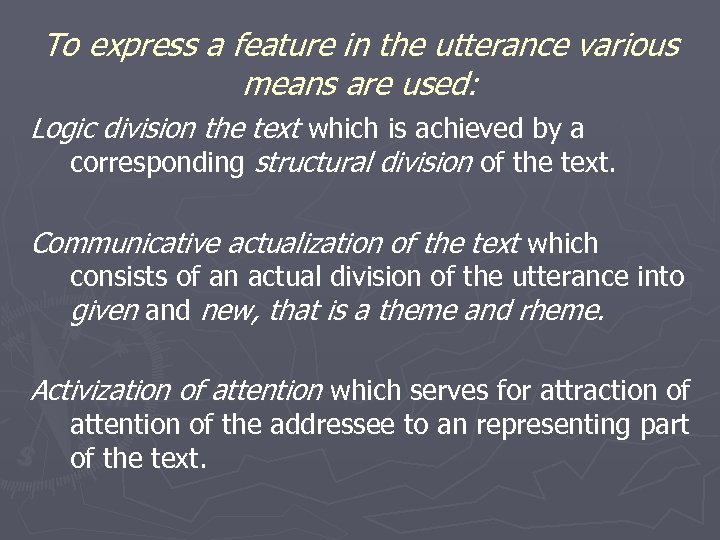 To express a feature in the utterance various means are used: Logic division the text which is achieved by a corresponding structural division of the text. Communicative actualization of the text which consists of an actual division of the utterance into given and new, that is a theme and rheme. Activization of attention which serves for attraction of attention of the addressee to an representing part of the text.
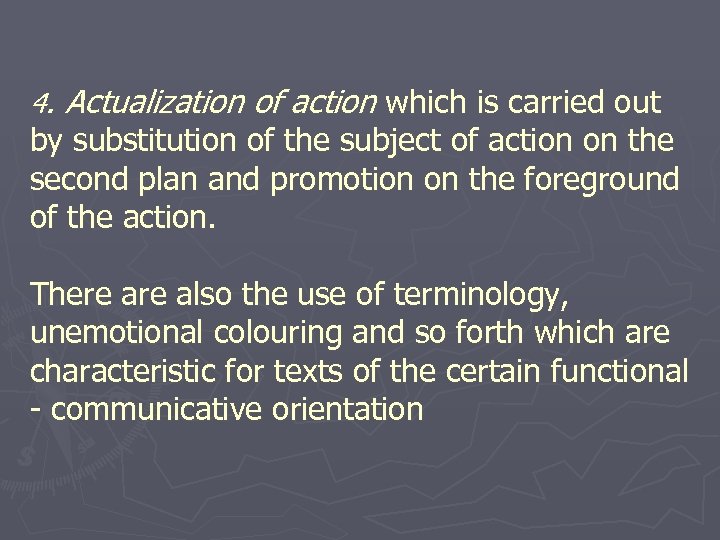 4. Actualization of action which is carried out by substitution of the subject of action on the second plan and promotion on the foreground of the action. There also the use of terminology, unemotional colouring and so forth which are characteristic for texts of the certain functional - communicative orientation
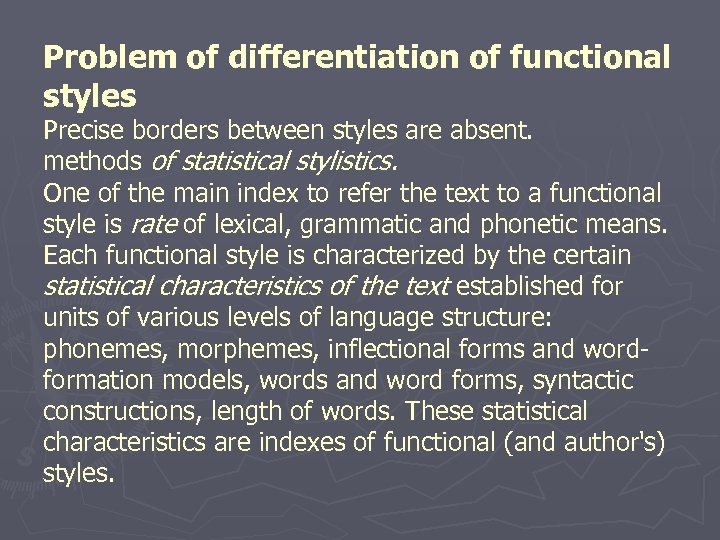 Problem of differentiation of functional styles Precise borders between styles are absent. methods of statistical stylistics. One of the main index to refer the text to a functional style is rate of lexical, grammatic and phonetic means. Each functional style is characterized by the certain statistical characteristics of the text established for units of various levels of language structure: phonemes, morphemes, inflectional forms and wordformation models, words and word forms, syntactic constructions, length of words. These statistical characteristics are indexes of functional (and author's) styles.
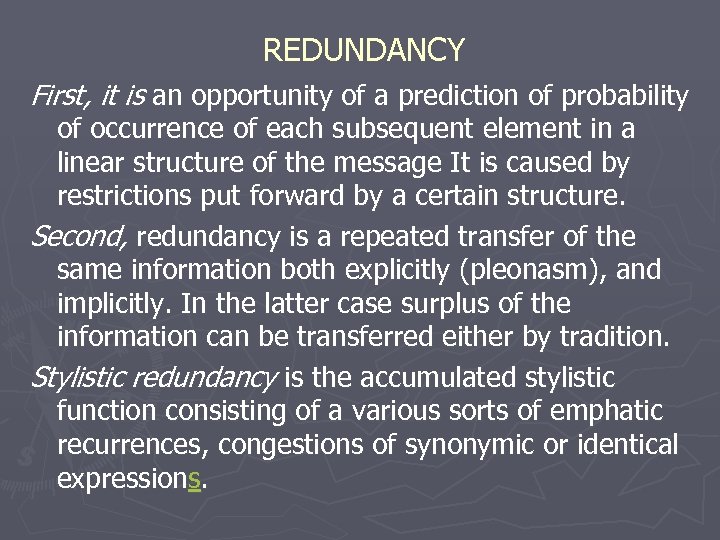 REDUNDANCY First, it is an opportunity of a prediction of probability of occurrence of each subsequent element in a linear structure of the message It is caused by restrictions put forward by a certain structure. Second, redundancy is a repeated transfer of the same information both explicitly (pleonasm), and implicitly. In the latter case surplus of the information can be transferred either by tradition. Stylistic redundancy is the accumulated stylistic function consisting of a various sorts of emphatic recurrences, congestions of synonymic or identical expressions.
 Style of official communication has some variants: Language of diplomatic documents, Language of legal documents, Language of commercial documents, Language of administrative documents, etc. Language of military documents.
 CHARTER OF THE UNITED NATIONS WE THE PEOPLES OF THE UNITED NATIONS DETERMINED To save succeeding generations from the courage of war, which twice in our lifetime has brought untold sorrow to mankind, and To reaffirm faith in fundamental human rights, in the dignity and worth of human person, in the equal rights of men and women and of nations large and small, and To promote social progress and better standards of life in larger freedom, … HAVE RESOLVED TO COMBINE OUR EFFORTS TO ACCOMPLISH THESE AIMS.
 Style of a science and techniques exists in two forms: Written Oral (scientific works, articles, pornographies and so forth) (lectures, reports, messages, etc. ).
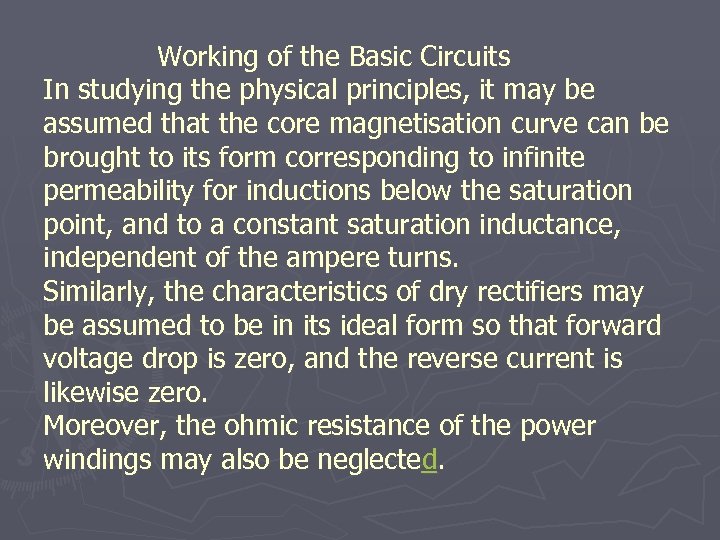 Working of the Basic Circuits In studying the physical principles, it may be assumed that the core magnetisation curve can be brought to its form corresponding to infinite permeability for inductions below the saturation point, and to a constant saturation inductance, independent of the ampere turns. Similarly, the characteristics of dry rectifiers may be assumed to be in its ideal form so that forward voltage drop is zero, and the reverse current is likewise zero. Moreover, the ohmic resistance of the power windings may also be neglected.
 Style of publicism and press: - Oral (buplic speech, reviews of radio and television commentators) - Written (newspaper articles, an essay, journal articles, pamphlets, sketches, headings, announcements advertising).
 Substyle of public speech. “Why did he not make inquiries into the reasons for it happening? Why did he trust to an assumption from the hon. Member for Norwood? The Prime Minister did not make inquiries because he knew that if he did the responsibility would have to be placed somewhere else. If the Prime Minister says he was misled it was because he wanted to be misled. The Army Council has acted with great promptitude. What to do? To repair the serious weaknesses? No, that is the last thing that the Army Council would think of doing… What is the answer of the Government? It is that we should have more arms. ”
 Substyle of newspaper messages. NEWS IN BRIEF Every child in Bedfordshire schools will be given illustrated copy " I the Bible on reaching the age of six, the County Education Сommittee have decided. Canadian officials report that the supply is now sufficient to resume the minting of Canadian five cent pieces from steel, which has been used for many years. The bus-drivers at Exford who have been on strike since Monday last week resumed work yesterday. Because of a shortage of gravediggers, the Rev. D. R. Jenkins, Vicar of Heeley, Sheffield, dug two graves in his church yard…
 Substyle of newspaper articles LORDING IT UNDER the Government's House of Lords reform measures peers, who, along with lunatics, are not allowed to vote in Parliamentary elections, will be able to do so. Since there a comparatively small number of them this is hardly likely to tip the balance in General Elections. Much more serious than their right to vote is the fact that nobody has any right to vote for them. Whether hereditary or life peers, they are not elected. By definition, therefore, the House of Lords, reformed or unreformed, is undemocratic…
 Three dead and thousands homeless NEW DANGER AS RIVERS KEEP RISING ' Major sparked nights of violence ' ' POLICE WERE CHICAGO'S RIOTERS'
 LEARN LANGUAGES AT YOUR LEISURE For your holiday pleasure. Catalogue sent free on request. TUTOR-TAPE CO. LTD. , 2 Replingham Road, London S. W. 18. SITUATIONS WANTED AMERICAN JOURNALIST, B. A. , degree, experienced, male, seeks position in any related field. Box 2. 520.
 ACCOMMODATION REQUIRED WANTED furnished or partly furnished accommodation in London for African couple, students. Box G 9292. FUNERALS Mc. QUEEN, David Jr. , tomorrow (Wed. ) 3. 30 p. m. at Morton Hall Crematorium. No flowers. WEATHER Cloudy, occasional rain. Rather cold. Lighting-up Time: 5. 50 a. m.
 Style of daily communication Literary - familiar substyle When Conan Doyle arrived in Boston, he was at once recognized by the cabman whose cab he had engaged. When he was about to pay his fare, the cabman said: " If you please, sir. I should prefer a ticket to your lecture! " Conan Doyle laughed. " Tell me, " he said, " how you knew who I was and I'll give you tickets for your whole family. " " Thank you, sir, " was the answer. " On the side of your travelling-bag is your name Conan Doyle. "
 Here an example of the literary - familiar dialogue: " Where did you last see him? " I asked. . . " In Cleveland. " " Where in Cleveland? " " Do you know Cleveland? " " I need an address, " I said. " He never had an address. " " But you had to see him somewhere. You lived with him in Cleveland? " " It was not living any more. " (J. Horwitz).
 Here the dialogue sustained in correct, polite tone: " Have you ever been married, Captain Meadows? “ " Not me, " he said and added: " I said I would never marry anyone but you, Emily, and never have. " There was some satisfaction in his voice. " Well, you might have regretted it if you had, " Mrs Meadows said smiling. . . " Well, one thing you've not done, George, " said Mrs Meadows, the smile still in her blue eyes, " and that's to make a fortune. " " I am not a man to save money. But one thing I can say for myself: if I had a chance of going through my life again I'd take it. And not many men can say that. “ (Maugham).
 A friendly letter sustained in literary - familiar style: Dear Irene, I hear that Soames is going to Hanley to-morrow for the night. I thought it would be great fun if we made up a little party and drove down to Richmond. Will you ask Mr Bosinney, and I will get your Flippard? Emily will lend us the carriage. I will call for you and your man at seven o'clock. Your affectionate sister, Winifred Dartie (Galsworthy).
 Familiar - colloquial substyle Conversation of two students can serve: A hand jostled my elbow. It was a freshman squirt who'd been trying his damnedest to break into the Fred Astair crowd. " Hi, " I said flatly. " Hi, " he said. " Pretty good brawl, eh? " " Fair, " I agreed coldly. " Listen, " he piped, " you know everybody here. Tell me who's the snake who's getting the big rush? " " You mean in the red and gold? “ " Hell, not that tramp. The mystery woman over there in the filmy black-stuff (P. Dennis).
 ' You call upon a gentleman in a country town, and his help informs you that he is ' fixing himself just now, but will be down directly; by which you are to understand that he is dressing. You inquire, on board a steamboat, of a fellow-passenger, whether breakfast will be ready soon, and he tells you he should think so, for when he was last below, they were ' fixing the tables': in other words, laying the cloth. You beg a porter to collect your luggage and he entreats you not to be uneasy, for he'll ' fix it presently '; and if you complain of indisposition, you are advised to have recourse to Doctor So-andso, who will ' fix you ' in no time’(Dickens).
 “Come on, Bubbles, ” I said. "We've got to get going. " " Fer Chrissakes, why? " she screamed. " Don't ask a lot of questions, now. Come on. " " Here I been mopin 'aroun' this Gaws-forsaken town all week an ' now when I begin enjerrin ' myself, you wanna drag me away. Well, I won't. I will not! " " Bubbles, you either come with me - this minute or else. " " Or else what? You ast me down to this collitch affail, an ' what happenes? I ain't been within spittin ' distance of the place. I do not meet no socialites, no tawchight purade, no club dinnah dance, no cocktail potties. ” He said. . . (P. Dennis).
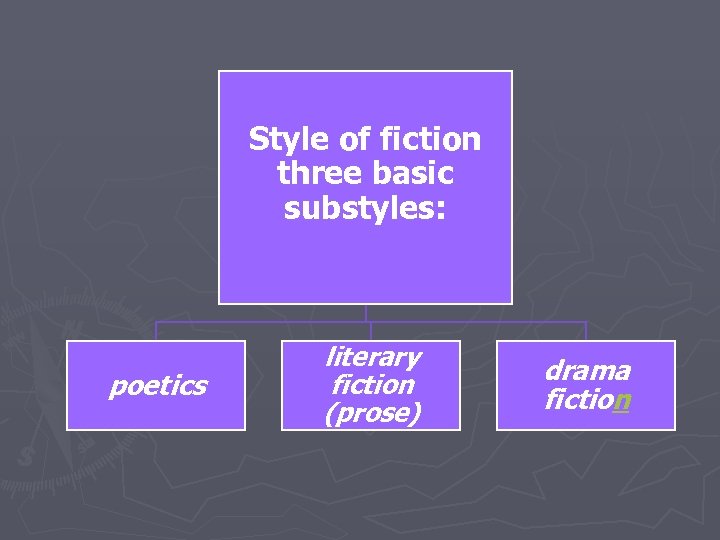 Style of fiction three basic substyles: poetics literary fiction (prose) drama fiction
 Language of mass communication Language of a mass communication is the sign system imposed on the system of common language or created on its bases.
 Human language in the process of mass communication is used to perform the following functions: Informative (intellective-communicative) (transfer of the sum of data, the facts); Avocative (aesthetic) (excitation of feelings); Prescriptive (voluntative) (prompting to actions); Estimated (emotive) (formation of the attitude (relation), estimations); Phatic (an establishment of contact).
 The use of language is characterized by: Phonetic level. The requirements of ephony as display of the standard. Materialization of expressive component by means of an stress, tempo, timbre of speech, intonation, pauses. Lexical level. Requirements of simplicity, clearness, availability in the use of lexics as display of the standard component of a constructive principle. Creation of expressivity due to the usage of expressive, emotional and evaluative lexics. Syntactic level. Optimum length of phrases, a direct word order. Creation of expressivity by means of inversion, communicative types of sentences.
 Four features of language of mass communication: Participation of mass audience in communication; 2. One-directed orientation of communication, absence of a feedback; 3. Absence of direct contact between interlocutors; 4. Distant communication, i. e. use of technical equipment. The mass communication should be defined as 1. socially caused process of distribution of the information with the help of means on the extensive and dispersed audiences.
 Questions to lecture 2 1. 2. 3. 4. 5. 6. 7. What are the approaches to define a style? Define a functional style. What functional styles are distinguished in English language? What are the main functions of the language? What functions does every style fulfill? State style features on all linguistic levels. What are the substyles of publicistic style?
 Concept of stylistic and functional stylistic colouring The stylistic colouring of a word is the position of this word (phenomenon) in the general lexical (phonologic, grammatic and so forth) system of language concerning two factors: first, functional sphere of the use (functional stylistic colouring), and second, an emotional situation in which the communication takes place (emotional stylistic colouring).
 Words with neutral stylistic colouring make a lexical basis of all styles. These words are common words, the usual and widely spread names of objects, phenomena, qualities, actions and conditions (mother, father, house, tree, girl, come, write), i. e. the words which are not having well defined stylistic colouring. Therefore they equally can be used in any functional style.
 In modern English language the scale of emotional – stylistic colouring looks as following: - Solemn - official lexics, - Neutral lexics, - Familiar - colloquial lexics, - Vulgar lexics.
 It is possible to illustrate the given scale in the following sentences corresponding to each levels in the scale. - The individual in question is capable of destroying any adversary since his limbs are of wondrous power. - This man can beat up any other fighter, for he has very strong fists. - This here fellow will give any other fighting chap a thrashing: got mighty strong fists. - This guy can damn well give you a lick: he's nifty with his mitts.
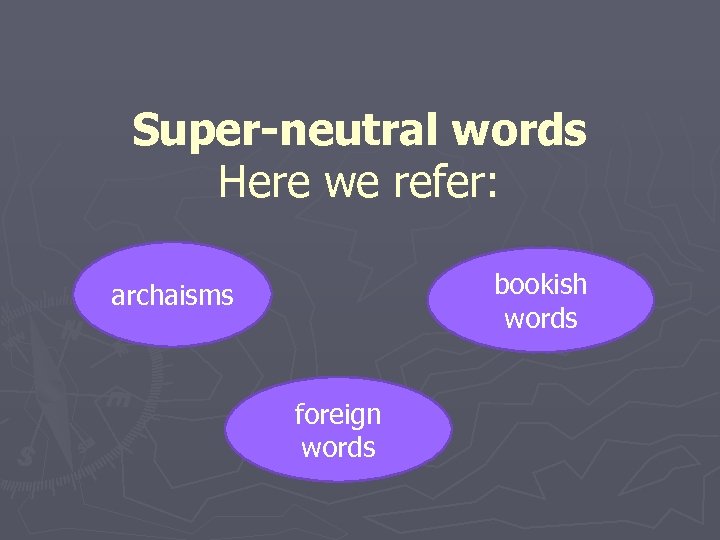 Super-neutral words Here we refer: bookish words archaisms foreign words
 Archaisms are the words which are practically out of use in present day language and are felt as obsolete. They are subdivided into two groups. The first is represented by “material archaisms” or “historical archaisms” – words whose referents have disappeared. The second group is formed by archaisms proper – those words which have been ousted by their synonyms.
 Bookish words. These words belong to that stratum of the vocabulary which is used in cultivated speech only - in books or in such special types of oral communication as public speeches, official negotiations, etc. They are mostly loan-words, Latin and Greek. They are either high-flown synonyms of neutral words, or popular terms of science. A great crowd came to see - A vast concourse was assembled to witness. Began his answer - commenced his rejoinder.
 Foreign words should not be confused with borrowed words. Foreign words in English are for the most part late borrowings from French - those words which have preserved their French pronunciation and spelling. For example, the French formula «Au revoir» used in English by those ignorant of French has something exquisite. In the French word «chic» the same tinge of elegance is felt.
 Sub-neutral Words Among the sub-neutral words the following groups are distinguished: -words used in informal speech only (the colloquial words); -jargon words -slang, -individual creations (nonce-words); -vulgar words.
 Colloquial words. They are words with a tinge of familiarity or inofficiality about them. There is nothing ethically improper in their stylistic coloring, except that they cannot be used in official forms of speech. - colloquial words proper (colloquial substitutes of neutral words), e. g. , chap; - phonetic variants of neutral words: baccy (tobacco), fella (fellow); - diminutives of neutral words: daddy, piggy, as well as - diminutives of proper names - Bobby, Becky, Johny;
 - words the primary meaning of which refer them to neutral sphere while the figurative meaning places them outside the neutral sphere, making them lightly colloquial. E. g. , spoon as a colloquial word means «a man with a low mentality» . most interjections belong to the colloquial sphere: gee! Er? Well, etc.
 In creation of slang various figures of speech take part: the upper storey (head) - metaphor; skirt (girl) - metonymy; killing (astonishing) - hyperbole; whistle (flute) - understatement; clear as mud - irony. In slang we find expressions borrowed from written speech (e. g. , «yours truly» used instead of the pronoun «I» ). Some slang words are just distortions of literary words: cripes (instead of Christ). Sometimes slang words are just invented: shinanigan (trifles, nonsense).
 Nonce-words are defined as chance words, occasional words, words created for the given occasion by analogy with the existing words by means of affixation, composition, conversion, etc. E. g. , «There was a balconyful of gentlemen. . . » (the word balconyful was coined by analogy with the words «mouthful» , «spoonful» , «handful» ). Being non-existent, unknown, yet comprehensible in the given situation, such words produce humorous effect. Being used just once, they disappear completely.
 Vulgar words. This is a stylistically lowest group of words which are considered offensive for polite usage. Two groups: lexical vulgarisms (words expressing ideas considered unmentionable in a civilized society. It is, so to speak, the very lexical meaning of such words which is vulgar) and stylistic vulgarisms (words the lexical meanings of which have nothing indecent or improper about them). When used in works of literature they perform the function of characterization. If used too frequently, vulgar words lose their emotional quality and become mere expletives (e. g. , «You are so darn good-looking» ).
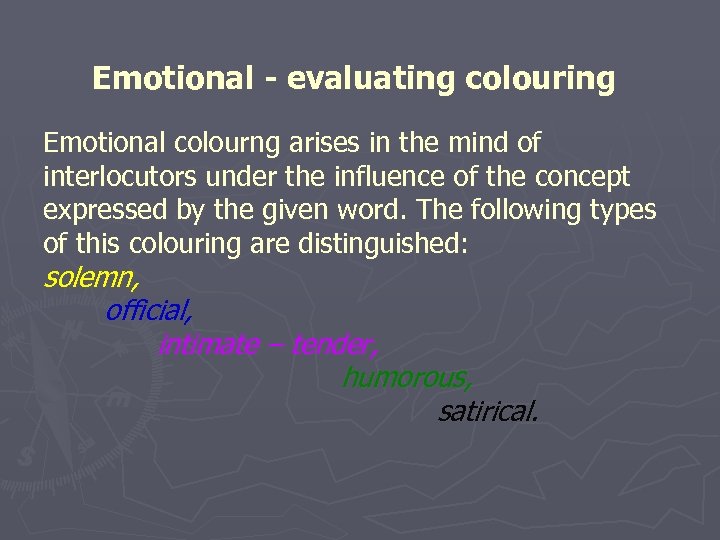 Emotional - evaluating colouring Emotional colourng arises in the mind of interlocutors under the influence of the concept expressed by the given word. The following types of this colouring are distinguished: solemn, official, intimate – tender, humorous, satirical.
 Solemn colouring causes in the addressee the feeling of respect, worship, amazement in front of greatness of the described events, persons. Official colouring is cold, businesslike, without detection of personal feelings to all stated. Intimate - tender colouring expresses sympathy, friendly sympathy, affinity. Humorous colouring causes cheerful or indulgent laughter, and satirical or derisive colouring creates the negative attitude to represented, sets as the purpose to discredit, betray to a shame.
 Word meaning. A polysemy of words Existence of a polysemy does not prevent people from understanding each other during the communication. The meaning of the word is caused by all lexicosemantic system of the language as a whole and represents the reflections of socially realized objective validity in consciousness of people. These meanings are assigned to words by all practice of the public use of this word in communication of people. We shall stop only on the following types of semantic-stylistic meanings: objective - logical, proper and emotional. There is also one more – contextual meaning (given to a word by a context)
 Objective-logical meaning is an expression by a word of the general concept about an object or phenomenon through one of its attributes, which by virtue of historical conditions of development of meanings, became basic for the whole concept at the given stage.
 Proper meaning Words which name one object, person or geographical concept (phenomenon) can possess a proper meaning, which differentiate this object from lines of the same objects, persons, geographical concepts. For example, London, New York, Mary, France, Moscow.
 Emotional meaning Subjective - evaluating attitude of the speaker is expressed. To the words possessing only emotional value we can refer: ha! pooh! alas! ah! gee! gosh!, etc. The words designating feelings, always carry emotional meaning (for example, words such as love, anger, hatred). The certain group of words has a tendency to lose the objective - logical meaning and to compensate this loss by strong emotional meaning. Vulgar layers of lexics, swear words, damnations, obscene words and so forth can be referred to this.
 Very frequently the emotional word meaning is shown only in the certain context. Besides there are the certain formal - structural elements transmitting emotional meaning. They are: - suffixes -у, -ie, -let (sonny, birdie, ringlet) and - so-called words - amplifiers such as dreadful, terrible, awful, nice, great.
 Contextual meaning In connection with special conditions of the use many words can get the separate meanings in a context. These meanings having changeable character, appearing at present moment and possible in conditions only of the given context, refer to contextual. For example, the word “job” in a context “at the door of each job his heart shrunk” gets meaning «establishment, office» .
 The lexical meaning of the word is the content of the word caused by connection of the designated object and expressed concept. It is reflected in the position of this word in the system of language concerning objective – logical meanings of other words and stylistic colouring of these words. . To solve the question of relation of stylistic colouring of a word to its meaning we shall consider such kinds of stylistic colouring as contextual and absolute.
 Contextual and absolute colouring Contextual colouring is connected with the use of a word in speech, depends on a context, enters into a contextual word meaning. Besides the context supposes the individual use of words concerning spheres of communication. Absolute stylistic colouring is the consequence of the frequent use of the word in the certain functional sphere and the certain emotional situation; that leads to transition of quantity to quality, to fastening of the given stylistic colouring to the word, i. e. transformation of contextual meaning to absolute. Thus, absolute colouring is secondary.
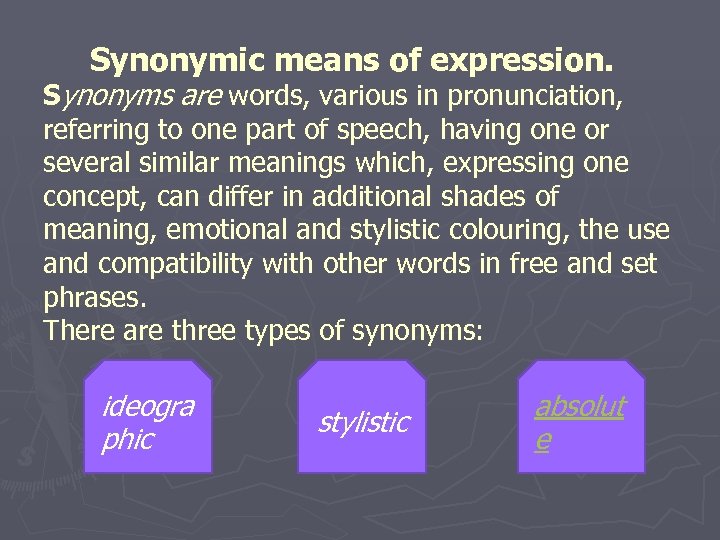 Synonymic means of expression. Synonyms are words, various in pronunciation, referring to one part of speech, having one or several similar meanings which, expressing one concept, can differ in additional shades of meaning, emotional and stylistic colouring, the use and compatibility with other words in free and set phrases. There are three types of synonyms: ideogra phic stylistic absolut e
 Phraseological units and their stylistic colouring
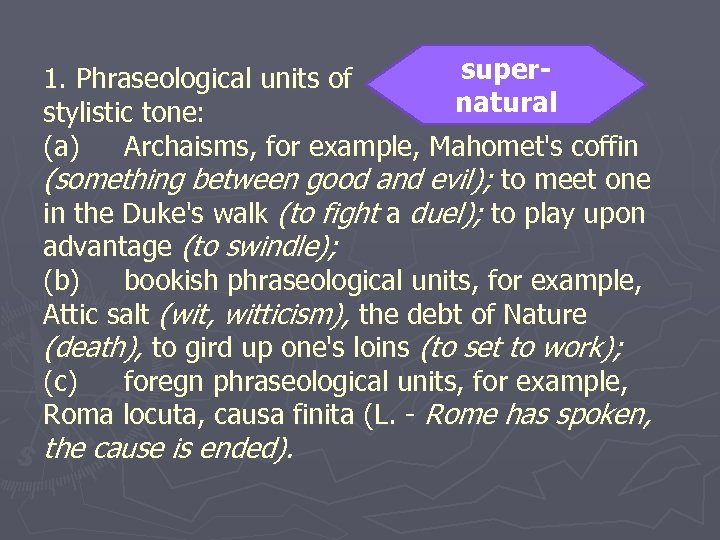 super 1. Phraseological units of natural stylistic tone: (а) Archaisms, for example, Mahomet's coffin (something between good and evil); to meet one in the Duke's walk (to fight a duel); to play upon advantage (to swindle); (b) bookish phraseological units, for example, Attic salt (wit, witticism), the debt of Nature (death), to gird up one's loins (to set to work); (c) foregn phraseological units, for example, Roma locuta, causa finita (L. - Rome has spoken, the cause is ended).
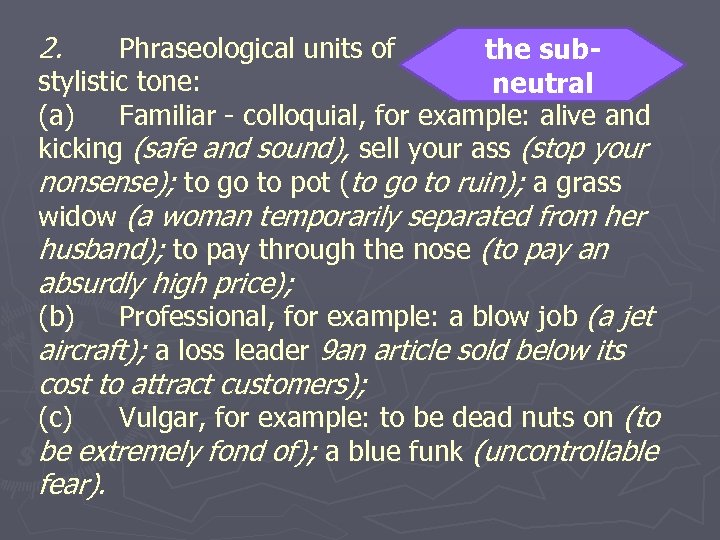 2. Phraseological units of the substylistic tone: neutral (а) Familiar - colloquial, for example: alive and kicking (safe and sound), sell your ass (stop your nonsense); to go to pot (to go to ruin); a grass widow (a woman temporarily separated from her husband); to pay through the nose (to pay an absurdly high price); Professional, for example: a blow job (a jet aircraft); a loss leader 9 an article sold below its (b) cost to attract customers); Vulgar, for example: to be dead nuts on (to be extremely fond of); a blue funk (uncontrollable (c) fear).
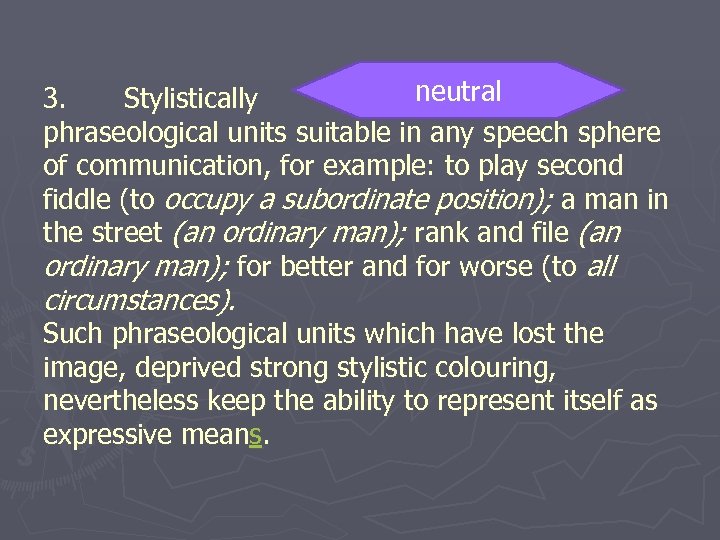 neutral 3. Stylistically phraseological units suitable in any speech sphere of communication, for example: to play second fiddle (to occupy a subordinate position); a man in the street (an ordinary man); rank and file (an ordinary man); for better and for worse (to all circumstances). Such phraseological units which have lost the image, deprived strong stylistic colouring, nevertheless keep the ability to represent itself as expressive means.
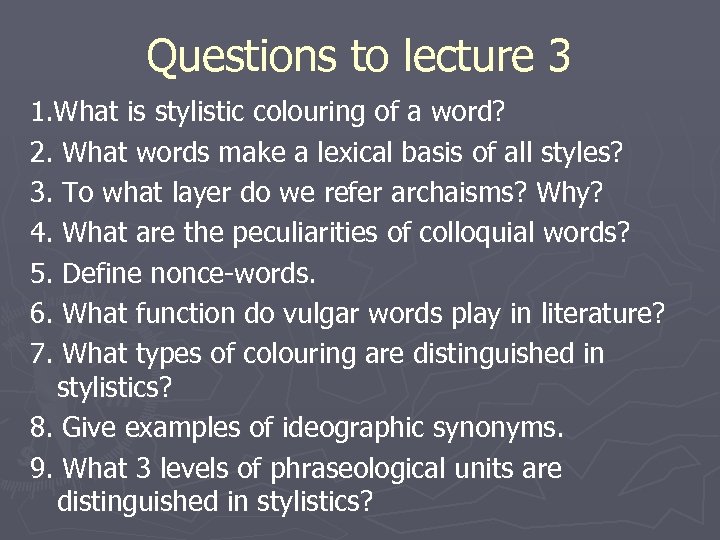 Questions to lecture 3 1. What is stylistic colouring of a word? 2. What words make a lexical basis of all styles? 3. To what layer do we refer archaisms? Why? 4. What are the peculiarities of colloquial words? 5. Define nonce-words. 6. What function do vulgar words play in literature? 7. What types of colouring are distinguished in stylistics? 8. Give examples of ideographic synonyms. 9. What 3 levels of phraseological units are distinguished in stylistics?
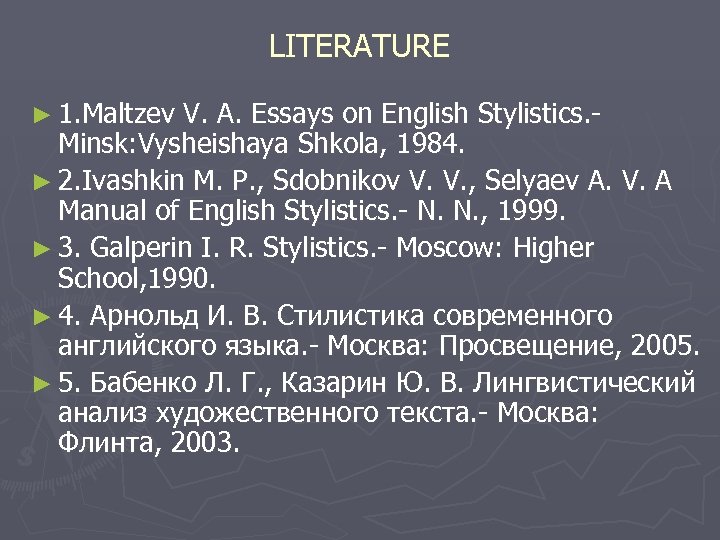 LITERATURE ► 1. Maltzev V. A. Essays on English Stylistics. Minsk: Vysheishaya Shkola, 1984. ► 2. Ivashkin M. P. , Sdobnikov V. V. , Selyaev A. V. A Manual of English Stylistics. - N. N. , 1999. ► 3. Galperin I. R. Stylistics. - Moscow: Higher School, 1990. ► 4. Арнольд И. В. Стилистика современного английского языка. - Москва: Просвещение, 2005. ► 5. Бабенко Л. Г. , Казарин Ю. В. Лингвистический анализ художественного текста. - Москва: Флинта, 2003.