


 Скачать презентацию Kuali Enterprise Notification Tell Me What I Want
ef8e5a37ba3db211cc87483f0aebf7f8.ppt
- Количество слайдов: 35
 Kuali Enterprise Notification Tell Me What I Want And Need To Know Aaron Godert (Sr. Software Architect, Cornell University) John Fereira (Programmer/Analyst, Cornell University)
 Introducing KEN • Kuali Enterprise Notification (KEN) provides a single list for all university related communications – Workflow items (KEW) – Non-workflow items (KEN) • Examples of non-workflow items: – Your book is overdue – A concert is coming up on campus – Graduation check list to all Seniors
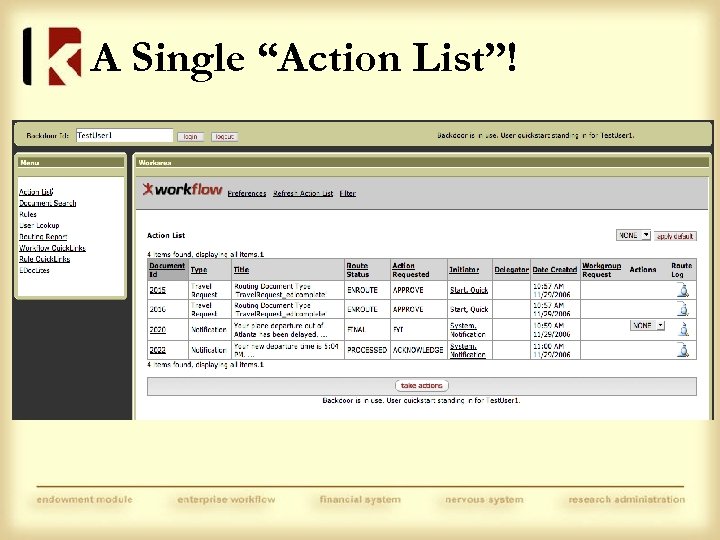 A Single “Action List”!
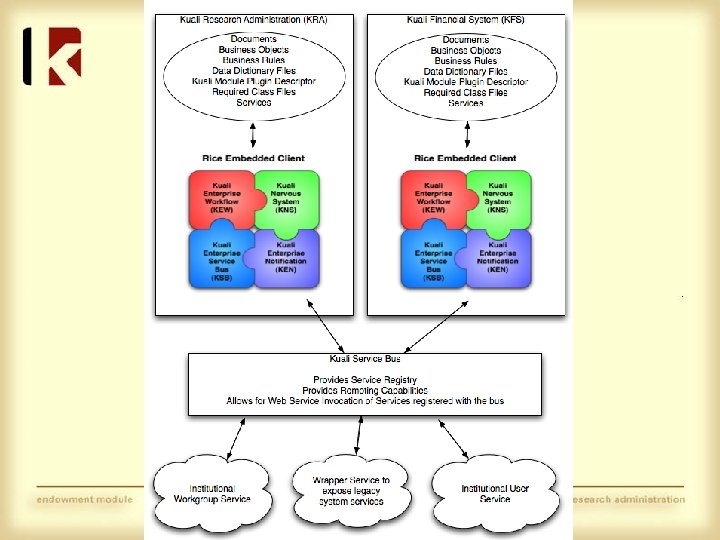
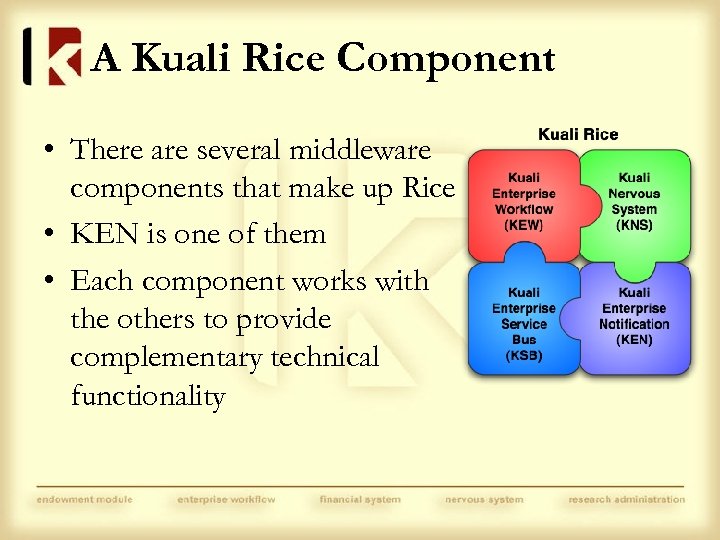 A Kuali Rice Component • There are several middleware components that make up Rice • KEN is one of them • Each component works with the others to provide complementary technical functionality
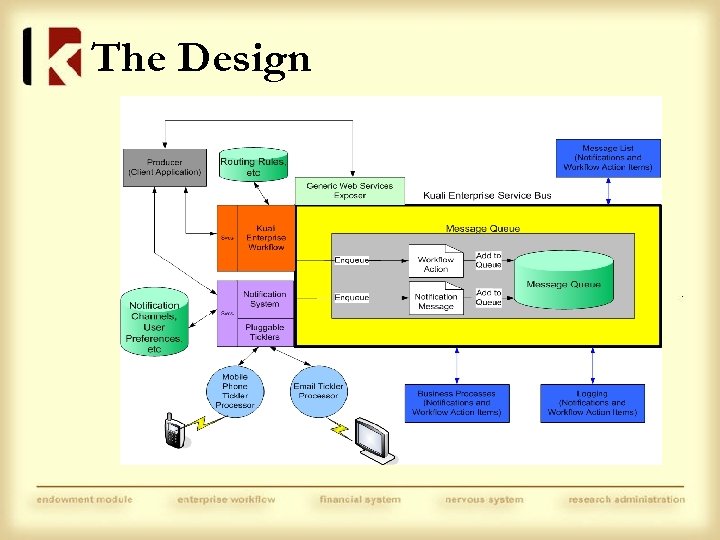
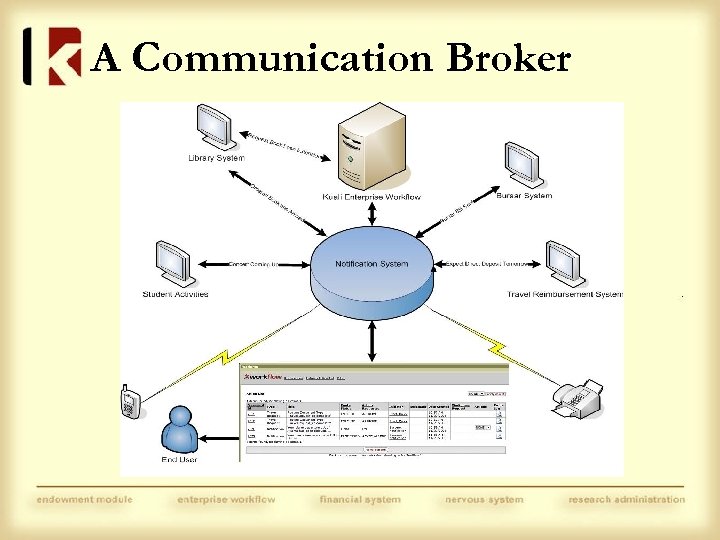 A Communication Broker
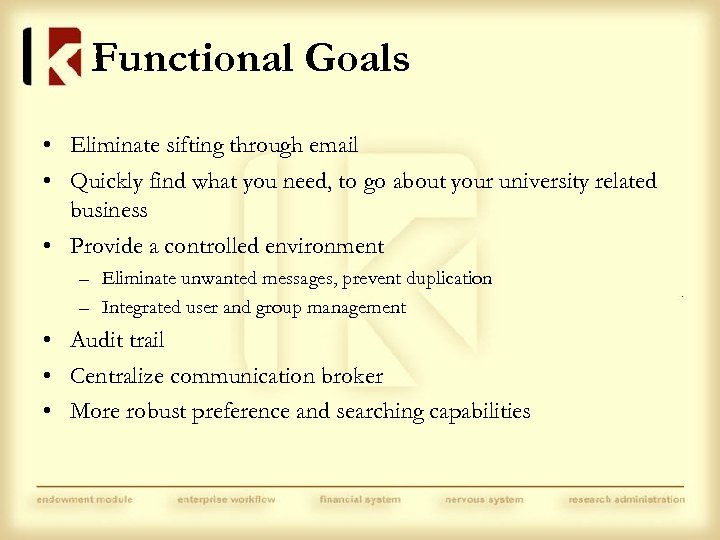 Functional Goals • Eliminate sifting through email • Quickly find what you need, to go about your university related business • Provide a controlled environment – Eliminate unwanted messages, prevent duplication – Integrated user and group management • Audit trail • Centralize communication broker • More robust preference and searching capabilities
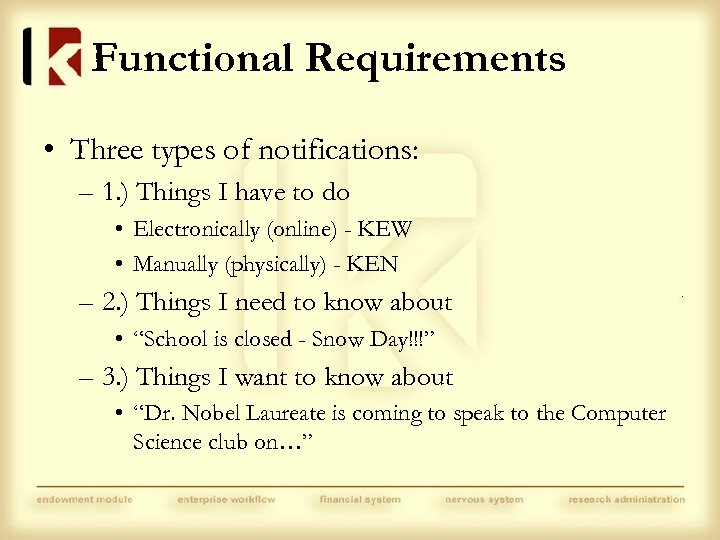 Functional Requirements • Three types of notifications: – 1. ) Things I have to do • Electronically (online) - KEW • Manually (physically) - KEN – 2. ) Things I need to know about • “School is closed - Snow Day!!!” – 3. ) Things I want to know about • “Dr. Nobel Laureate is coming to speak to the Computer Science club on…”
 Functional Requirements • • • Target groups of people and specific people Control delivery dates Notifications automated by systems - s 2 s Manual entry of notifications - generic message form Event notification – Integration with personal calendars • Multiple delivery end-points – Email – Text message to mobile phones
 Potential Consumer Applications • Bursar Applications • Registrar Applications • Library Applications – Overdue checkout item notices – Item recall notices – Event announcements
 Technical Goals • Adhere to SOA principles • Develop collaboratively using the Community Source model • Build using standard Open Source J 2 EE technologies • Re-use technical products in Kuali
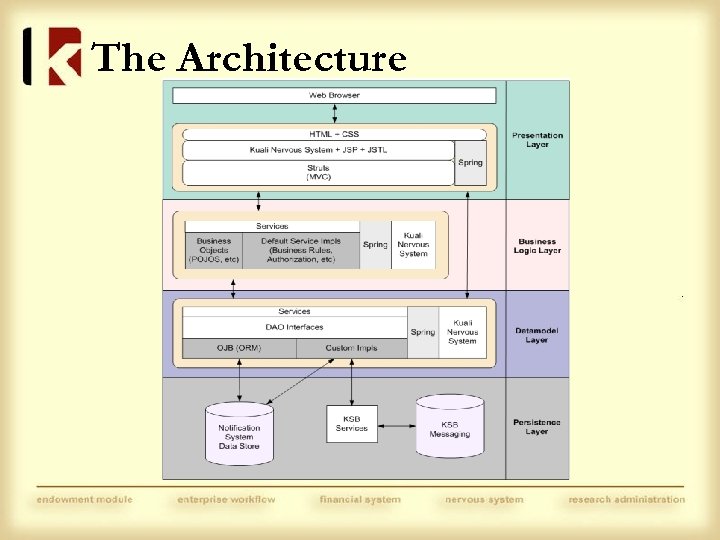 The Architecture
 The Design
 The Tools • Java SDK 1. 5+ • Spring Framework – Service interface and implementations – Spring MVC • Apache OJB – Object relational mapper • Mc. Koi DB (evaluating Apache Derby) – Quickstart • Start with Oracle DDL (evaluating Apache DDLutils) – Production
 The Tools • Open. Symphony Quartz – Spring integration • Apache Tomcat 5. 5+ • JSP/JSTL • XML/XSD – DOM/Xpath – XStream • XSLT • Apache Axis
 Sending a Notification: s 2 s • Java API - Java services (injected using Spring) – POJO in and POJO out Notification n = new Notification(); n. add. Recipient(“Test. User 1”); … Notification. Response response = notification. Service. send. Notification(n); – String in and String out (XML) String notification. Xml =
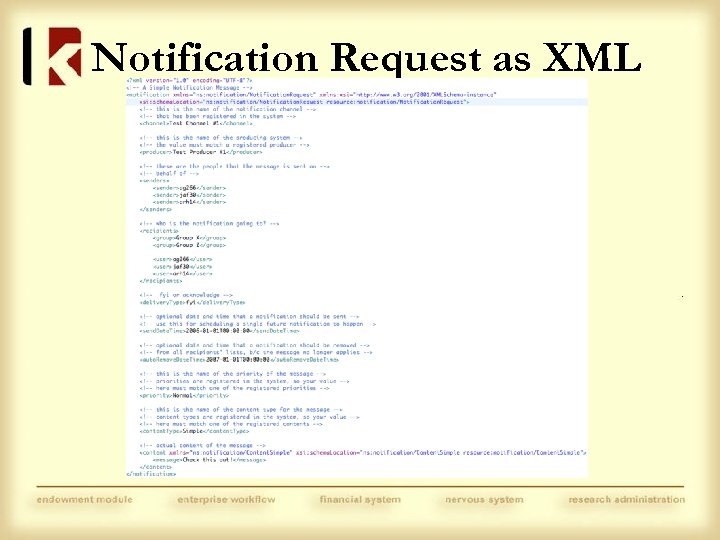 Notification Request as XML
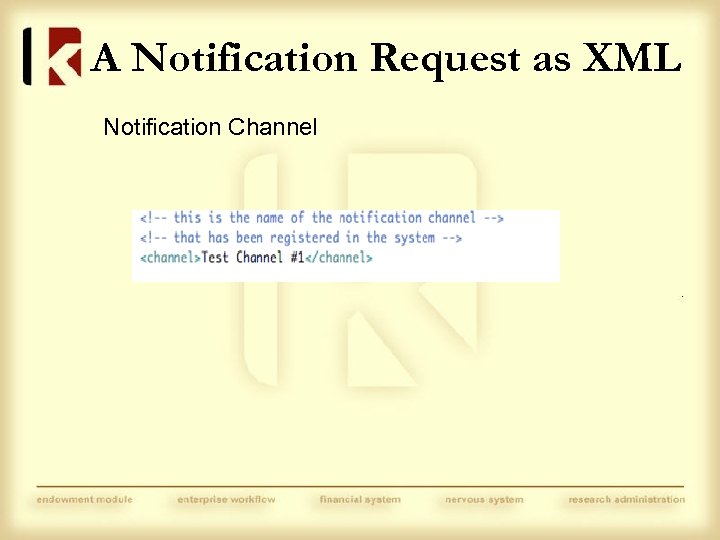 A Notification Request as XML Notification Channel
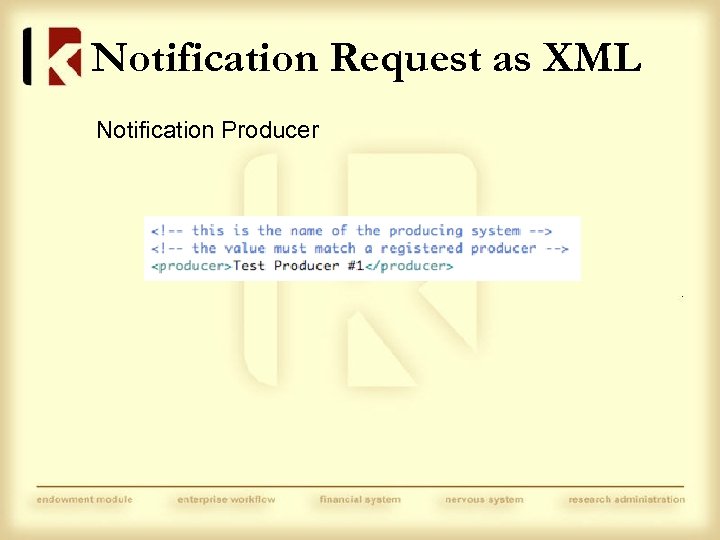 Notification Request as XML Notification Producer
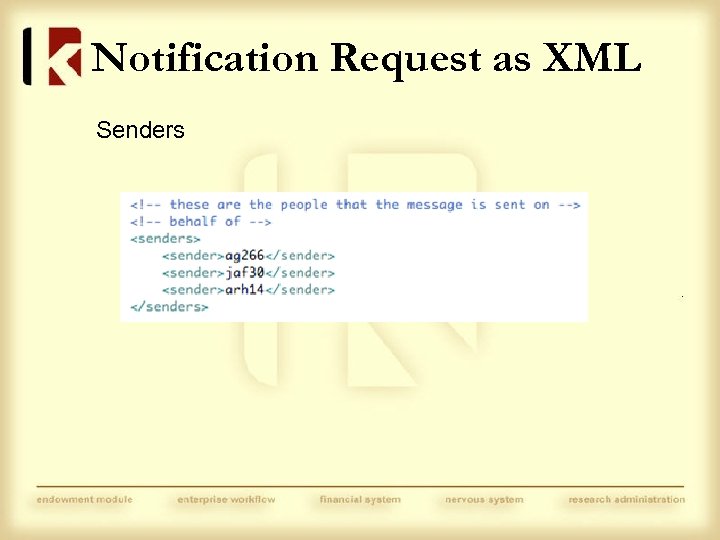 Notification Request as XML Senders
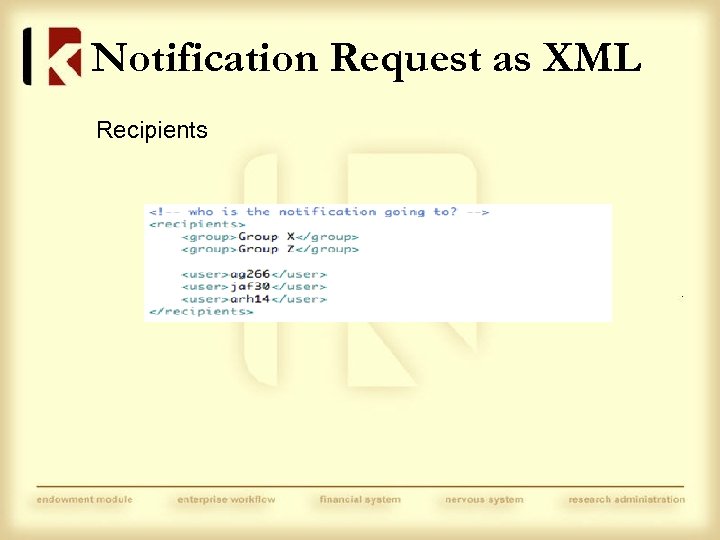 Notification Request as XML Recipients
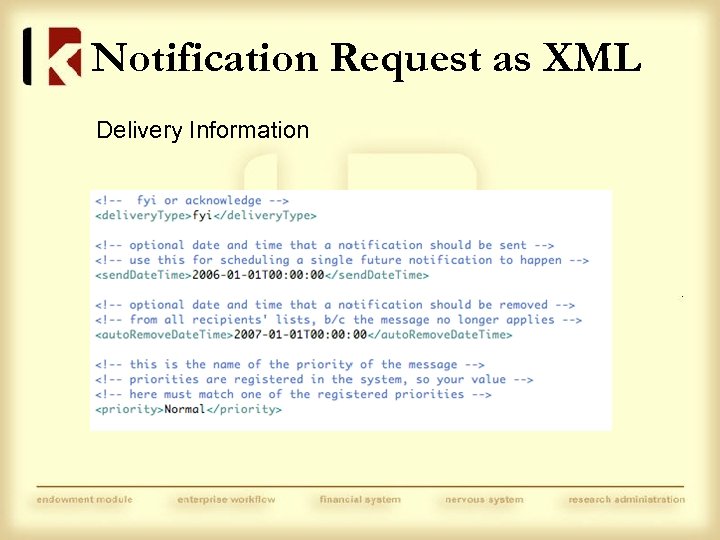 Notification Request as XML Delivery Information
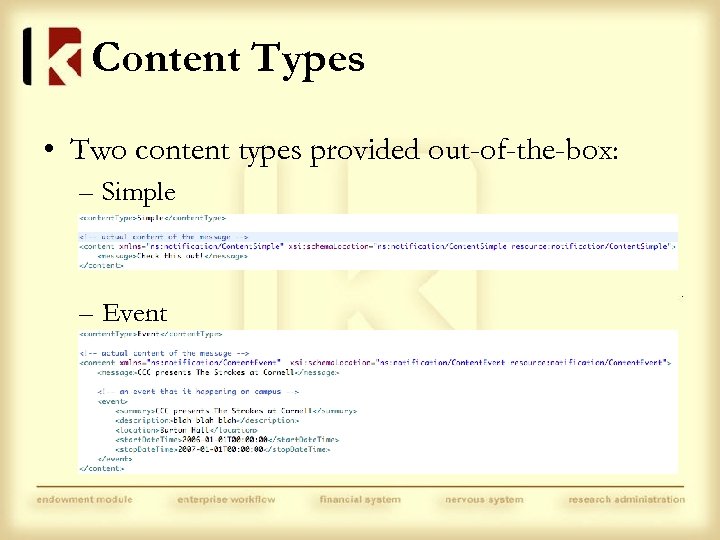 Content Types • Two content types provided out-of-the-box: – Simple – Event
 Flexible Content Types • To add a new content type: 1. Write the sample XML for inside of the
 Flexible Delivery Endpoints • Not yet built • Java interface to implement – Specify properties that would get set by a user in their preferences – Property values would be used to actually deliver the message • Mobile phone # • Email address – Implement the “deliver()” method • Call out to an SMS API • Call out to an Email API • Delivery will be asynch - wire up a Quartz job in Spring
 Kuali Rice Integration
 KEW Integration • Action list – KEW already has the concept of an action item • User and group management – KEN’s recipient service is implemented by calling the KEW user and workgroup services – Common set of users and groups for both applications • Logging – Notifications become action items, action items get automatic logging • EDoc. Lite (EDL) – Our generic notification message sending form is an EDL – Positioned for workflow approvals of messages
 KSB Integration • Exposing the Java service “send. Notification()” directly on the bus – Http. Remoting over SSL – POJO (serializable) input/output • Exposing as a WS on the bus using the generic web service feature of KSB – I don’t have to touch Apache Axis! – Implement a KSB Java interface • Responsible for translating XML (String) to POJOs – Wire up the call in Spring with approximately 10 lines of XML
 KNS Integration • Not yet integrated • Maintenance document features – Dynamic rendering and persisting of administrative reference tables • Adding/updating/deleting Notification Producers, Notification Channels, Content Types, etc • Automatic workflow integration • Automatic versioning of records
 Features in 1. 0 • Send notifications via s 2 s API/WS calls; users can also send via message form (EDL) • Users will see their notifications alongside of workflow items in a more general action list – Within the list, users will be able to: • • • Search for by channel, type, producer, sender, and priority Save searches for later use Take action on notifications (clearing/acknowledging) Click on notification to see more details about the notification View a log for the notification (who, what, where, when, why)
 Features in 1. 0 • Users will be able to set up multiple delivery end points or “ticklers” – We’ll come OOTB with an email tickler • Flexible content types (XML/XSD/XSL) • Basic authorization - Notification Channel to Notification Producer mappings • CAS end user authentication • SSL for transport of anything over HTTP (WS/web app) • User and group management
 Status of 1. 0 Features • Basic features are in place – Can send a notification s 2 s and through a generic message form • Basic KEW and KSB integration complete – Notification messages are showing up in the single action list – Basic logging, searching, and preferences are in place – EDL form for sending messages • Still need to: – Build sample clients in various technologies to test – Build multiple delivery end point framework – Tweak action list, logging, searching, and preferences to be more generic and less workflow specific
 Future Features • SMS delivery end point • JSR Compliant Portlets – Action list – Preference management • • • KNS Maintenance documents for administration Attachments Additional content types OOTB s 2 s revocation of notification messages Ability to schedule recurring messages And more…
 Time Frame for Deliverables • 1. 0 - April 2007 • 1. X+ (future features) - aiming for 3 month cycles • Kuali Rice bundling - Summer 2007
 Interested? • Looking for contributors on the Kuali Rice effort and KEN • Looking for developers to write test clients in various technologies • Always open to new requirements • More information: http: //wiki. library. cornell. edu/wiki/display/notsys • Contact ag 266@cornell. edu