


 Скачать презентацию КСР 2 Methods of Lexicological Analysis Plan
УСР 2 (Lecture 9).ppt
- Количество слайдов: 42
 КСР 2 Methods of Lexicological Analysis
 Plan: 1. 2. 3. 4. 5. 6. Contrastive Analysis. Statistical Analysis. Immediate Constituents Analysis. Distributional Analysis. Transformational Analysis. Componential Analysis.
 List of Terms: n contrastive analysis n statistical analysis n immediate constituents analysis n distributional analysis n transformational analysis n componential analysis
 The process of scientific investigation may be subdivided into several stages: 1. observation (the collection of data) 2. classification (orderly arrangement of the data obtained through observation)
 Example: English nouns n -er is added to verbal stems (speak + -er), noun stems (village + -er), n the same morpheme in mother, father. But they haven’t a suffix n -er can be found in derived and non- derived words
 3. generalisation (the formulation of a hypothesis, rule, or law)
 Example: The rule: derived nouns in -er may have either verbal or noun stems. The suffix -er in combination with adjectival or adverbial stems cannot form nouns (bigger, longer are not nouns).
 4. verification (to seek evidence of the correctness of the generalizations that are the result of the inquires)
 Various methods of lexicological research are used for classification, generalization and verification: 1. Contrastive analysis. 2. Statistical methods of analysis. 3. Immediate Constituents analysis. 4. Distributional analysis. 5. Transformational analysis. 6. Componential analysis.
 The selection of this or that particular method largely depends on the goal set before the investigator.
 Contrastive analysis
 n Comparative linguistics investigates those elements and processes despite their surface diversity that all languages have in common. n Contrastive linguistics attempts to find out similarities and differences in both related and non-related languages.
 The aim of the contrastive analysis: a detailed comparison of the structure of a native and a target language
 Contrastive analysis can be carried out at three linguistic levels: n phonology n grammar (morphology and syntax) n lexis (vocabulary)
 Contrastive analysis is the basis of teaching foreign languages: it helps to foresee and prevent recurrent mistakes caused by the interference of the learner‘s mother tongue.
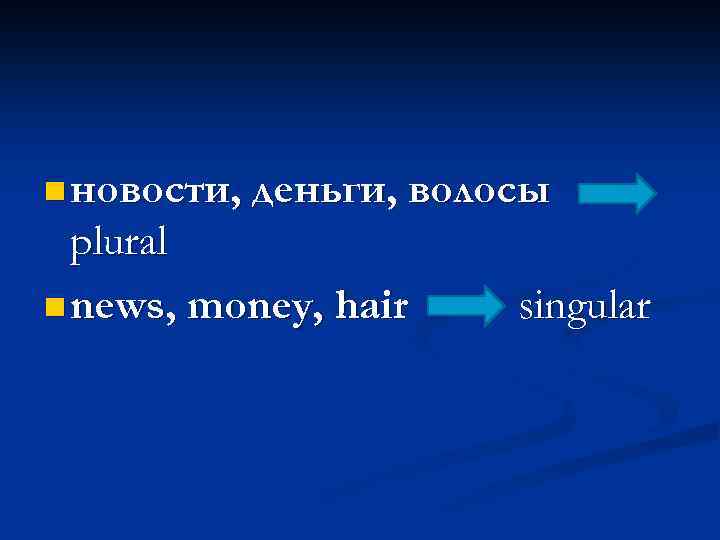 n новости, деньги, волосы plural n news, money, hair singular
 Contrastive analysis is generally applied to reveal the features of sameness and difference in the lexical meaning and the semantic structure of correlated words in different languages.
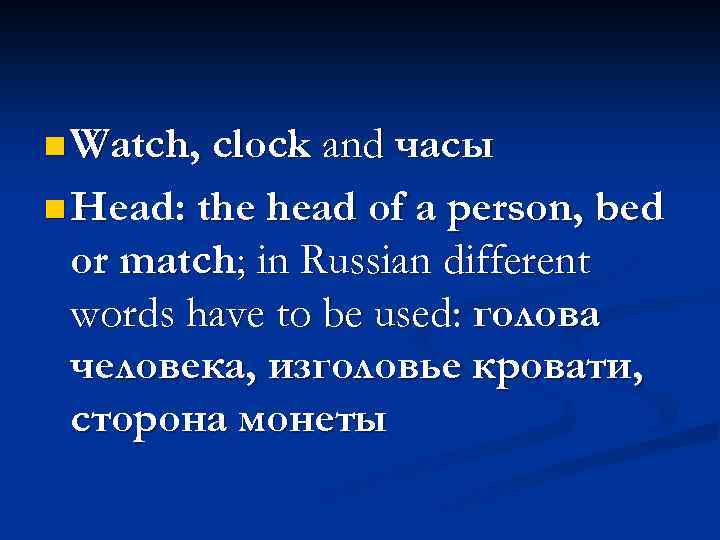 n Watch, clock and часы n Head: the head of a person, bed or match; in Russian different words have to be used: голова человека, изголовье кровати, сторона монеты
 Statistical methods of analysis
 The aim of the statistical analysis: n the quantitative evaluation of the material (different structural types of words, affixes, vocabularies of great writers, etc. ) n the selection of vocabulary items of a foreign language for teaching purposes
 Statistical regularities can be observed only if the phenomena under analysis are sufficiently numerous.
 Immediate Constituents analysis
 The theory of Immediate Constituents is based on the idea that combinations of units are usually structured into hierarchial sets of binary constructions (Immediate Constituents.
 The aim of the Immediate Constituents analysis: 1. to find out the morphemic structure of lexical units
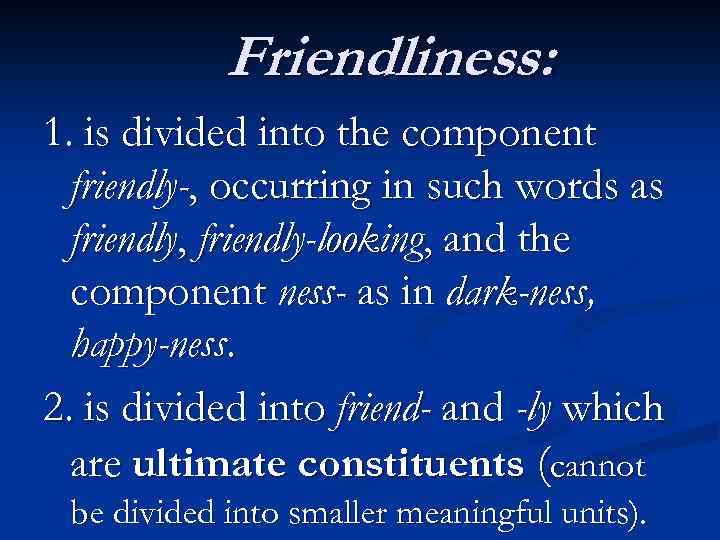 Friendliness: 1. is divided into the component friendly-, occurring in such words as friendly, friendly-looking, and the component ness- as in dark-ness, happy-ness. 2. is divided into friend- and -ly which are ultimate constituents (cannot be divided into smaller meaningful units).
 The aim of the Immediate Constituents analysis: 2. to determine the ways in which lexical units are relevantly related to one another
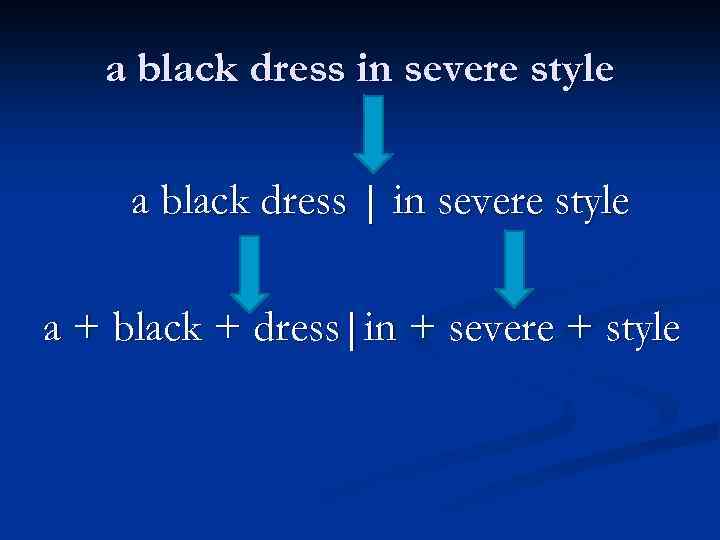 a black dress in severe style a black dress | in severe style a + black + dress|in + severe + style
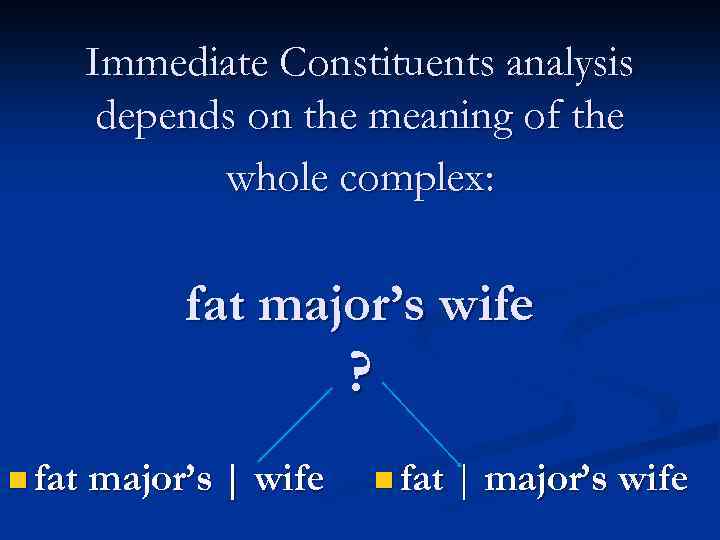 Immediate Constituents analysis depends on the meaning of the whole complex: fat major’s wife ? n fat major’s | wife n fat | major’s wife
 Distributional Analysis
 Distribution: n the position which linguistic units may occupy in the flow of speech, or the co-occurrence of units of the same level: words to words, morpheme to morphemes
 The aim of the distributional analysis: n the investigation of sameness / difference of meaning of words and word-groups n the analysis of word-formation.
 The word has different meanings in different patterns: n to treat smb kindly (treat + N + Adv) – to behave towards; n to treat smb to ice-cream + N + to (treat + N) – to supply with smth at one’s own expense.
 The boy_____ home. the missing word is easily identified as a verb (came, went, goes, etc. ), but not as an adverb or a noun, or an adjective
 Transformational Analysis
 Transformational analysis: n repatterning (reorganization) of identical distributional structures in order to discover difference or sameness of their meaning.
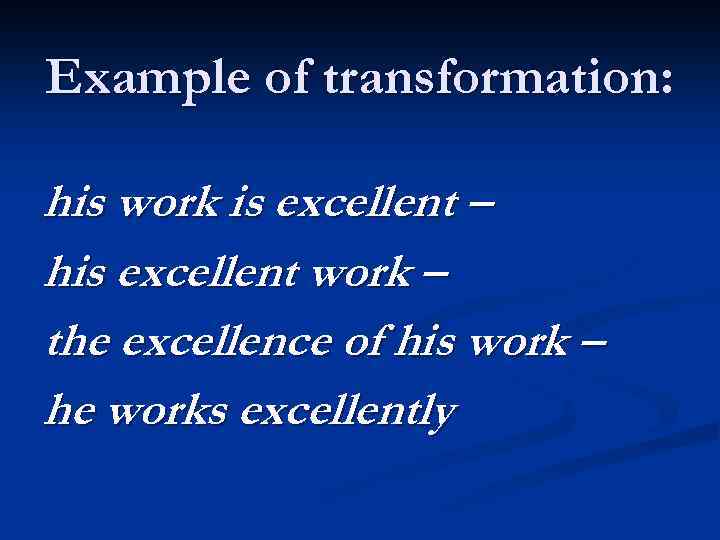 Example of transformation: his work is excellent – his excellent work – the excellence of his work – he works excellently
 The aim of the transformational analysis: n to investigate polysemantic patterns (e. g. compounds which have the same pattern (n + n) may have different lexical meanings: dogfight – a fight between dogs; dogcart – a cart drawn by dogs)
 Componential Analysis
 In the componential analysis linguists proceed from the assumption that the denotational component of word meaning can be seen as a complex cluster of smaller units - semantic components, or semes organized in a componential structure.
![n man can be described as [+HUMAN] [+ADULT] [+MALE] n boy as [+HUMAN] [–ADULT]](https://present5.com/presentation/78209858_438870091/image-40.jpg "n man can be described as [+HUMAN] [+ADULT] [+MALE] n boy as [+HUMAN] [–ADULT]") n man can be described as [+HUMAN] [+ADULT] [+MALE] n boy as [+HUMAN] [–ADULT] [+MALE] n woman as [+HUMAN] [+ADULT] and [–MALE] n girl as [+HUMAN] [–ADULT] and [– MALE].
n man can be described as [+HUMAN] [+ADULT] [+MALE] n boy as [+HUMAN] [–ADULT] [+MALE] n woman as [+HUMAN] [+ADULT] and [–MALE] n girl as [+HUMAN] [–ADULT] and [– MALE].
 It helps to find out which of the meanings should be represented first of all in the dictionaries of different types and how the words should be combined in order to make your speech sensible.
 List of Literature: 1. 2. 3. Воробей, А. Н. Глоссарий лингвистических терминов / А. Н. Воробей, Е. Г. Карапетова. – Барановичи : УО "Бар. ГУ", 2004. – 108 с. Лексикология английского языка : учебник для интов и фак-тов иностр. яз. / Р. З. Гинзбург [и др. ] ; под общ. ред. Р. З. Гинзбург. – 2 -е изд. , испр. и доп. – М. : Высш. школа, 1979. – С. 234– 261. Лещева, Л. М. Слова в английском языке. Курс лексикологии современного английского языка : учебник для студ. фак-в и отдел. английского языка (на англ. яз. ) / Л. М. Лещева. – Минск : Академия управления при Президенте Республики Беларусь, 2001. – С. 42– 44, 64.