 Скачать презентацию Kristen Farberman Michelle Hoffmann Jeff Laughlin Xin Liu
5b8921804f286123c2141678a43f8ab7.ppt
- Количество слайдов: 45



Kristen Farberman Michelle Hoffmann Jeff Laughlin Xin Liu April 29, 2004
Presentation Outline Ø Traits of a typical entrepreneur Ø How to start a business Ø The business plan Ø Case studies v. Grant Willer, Note Knowledge, LLC v. Richard Laughlin, Midwest Testing, Inc. v. Charles Wang, Computer Associates, Inc. Ø Reasons for failure Ø Conclusion
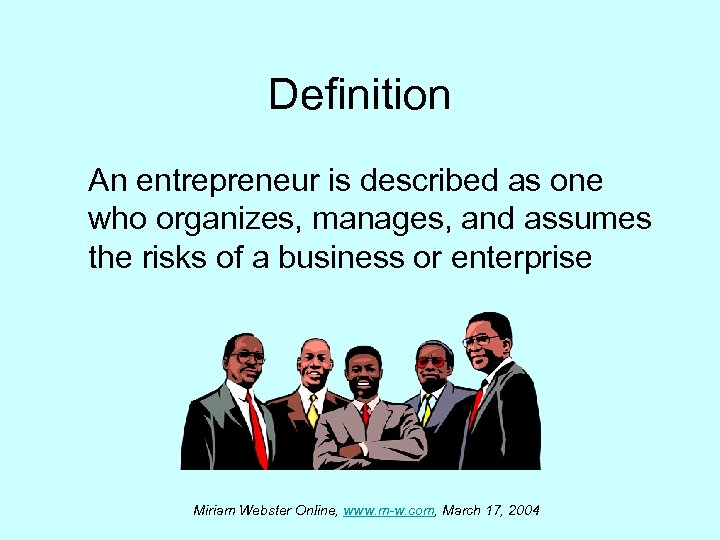
Definition An entrepreneur is described as one who organizes, manages, and assumes the risks of a business or enterprise Miriam Webster Online, www. m-w. com, March 17, 2004
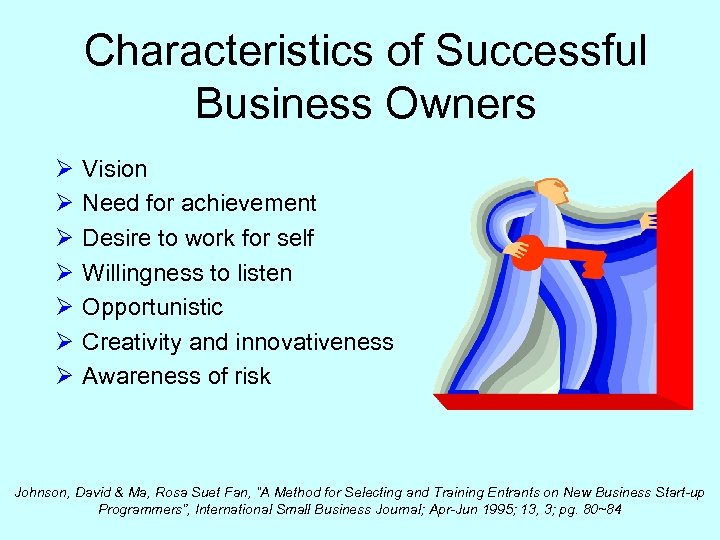
Characteristics of Successful Business Owners Ø Ø Ø Ø Vision Need for achievement Desire to work for self Willingness to listen Opportunistic Creativity and innovativeness Awareness of risk Johnson, David & Ma, Rosa Suet Fan, “A Method for Selecting and Training Entrants on New Business Start-up Programmers”, International Small Business Journal; Apr-Jun 1995; 13, 3; pg. 80~84
Benefits to Owning a Business Ø Ø Ø Self-management Financial independence Creative freedom Full use of personal skills and knowledge Greater opportunities “Start up Basics. ” www. sbaonline. sba. gov, March 17, 2004 <http: //www. sbaonline. sba. gov/starting_business/startup/basics. html>
Determine an Entrepreneurial Passion ØWhat do I like to do with my time? ØWhat technical skills do I possess? ØWhat do others say are my strengths? ØCould this endeavor become a profitable business? "Are You Ready? . " www. sbaonline. sba. gov, March 17, 2004 http: //www. sbaonline. sba. gov/starting_business/startup/areyouready. html
Identify a Business Niche ØWhat services or products will be sold? ØIs the idea practical? ØWho are the competitors? ØWhat are the competitive advantages? ØCan better quality service be provided? ØCan a demand be created? “Start up Basics. ” www. sbaonline. sba. gov, March 17, 2004 <http: //www. sbaonline. sba. gov/starting_business/startup/basics. html>
The Business Plan Ø Defines the business Ø Identifies goals Ø Includes a current and projected balance sheet, income statement, and cash flow analysis Ø Allows all stakeholders to better understand the company Ø Identifies the potential customers for the product of service "Busines Plan Basics. ” www. sbaonline. sba. gov, March 17, 2004 http: //www. sbaonline. sba. gov/starting_business/planning/basic. html
The Business Plan Ø Establishes marketing strategies to reach customers Ø Projects all necessary financial needs Ø Displays technical competency and business efficiency "Busines Plan Basics. ” www. sbaonline. sba. gov, March 17, 2004 http: //www. sbaonline. sba. gov/starting_business/planning/basic. html
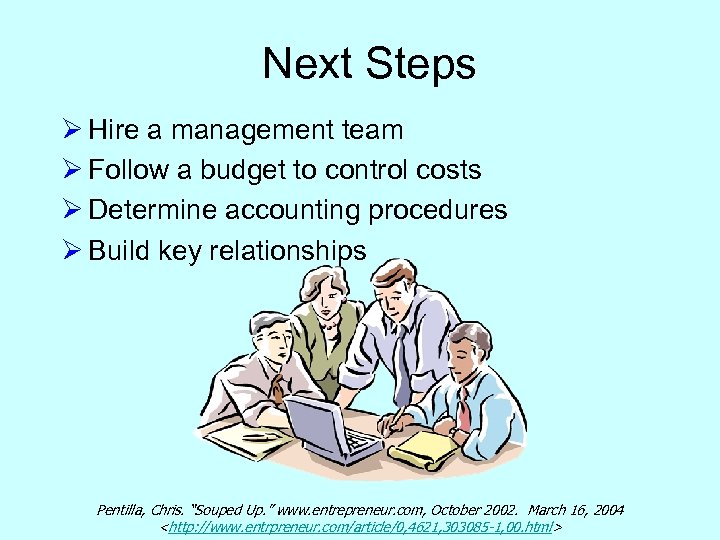
Next Steps Ø Hire a management team Ø Follow a budget to control costs Ø Determine accounting procedures Ø Build key relationships Pentilla, Chris. “Souped Up. ” www. entrepreneur. com, October 2002. March 16, 2004 <http: //www. entrpreneur. com/article/0, 4621, 303085 -1, 00. html>
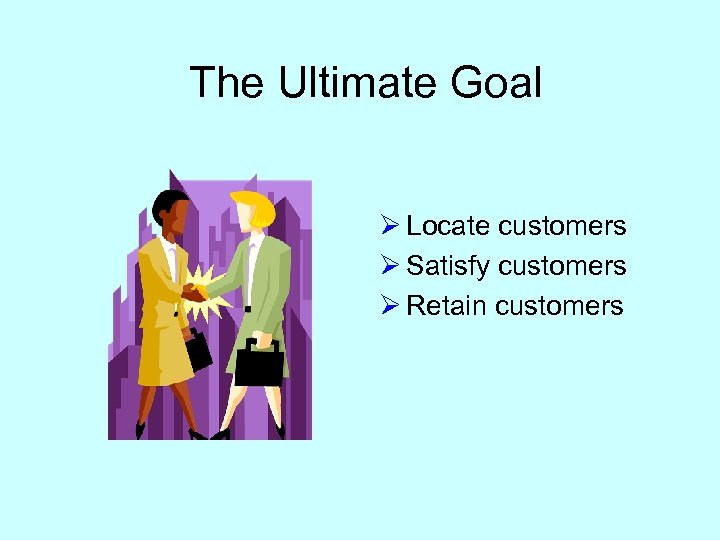
The Ultimate Goal Ø Locate customers Ø Satisfy customers Ø Retain customers
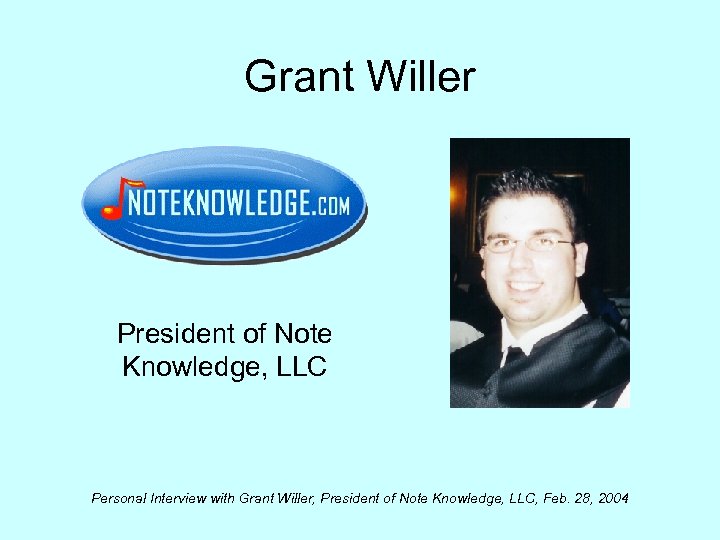
Grant Willer President of Note Knowledge, LLC Personal Interview with Grant Willer, President of Note Knowledge, LLC, Feb. 28, 2004
Background ØBorn in 1980 in Saint Louis ØOldest of four boys ØGraduated from UMSL in 2003 with degrees in marketing and management ØFamily history of entrepreneurship
Personality Traits Ø Creative Ø Outgoing Ø Inventive Ø Friendly Ø Constructive Ø Down-to-earth Ø Rational Ø Assertive
Motivations for Starting a Company Ø Escape Ø Freedom Ø The challenge Ø Success Ø Desire to lead
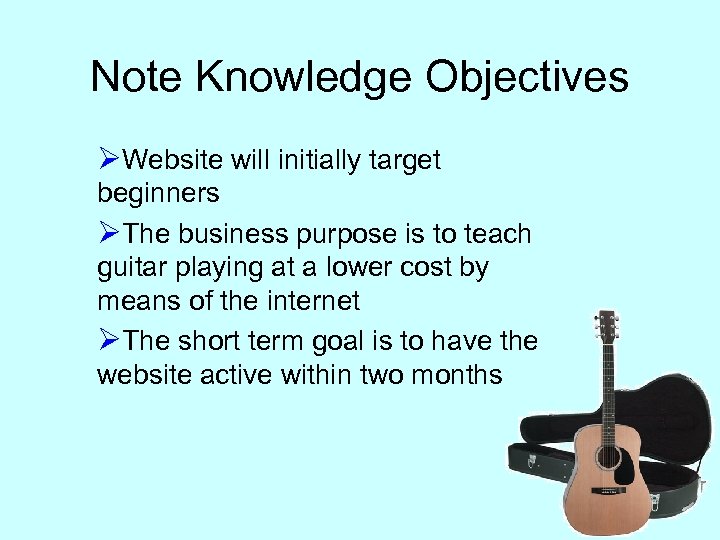
Note Knowledge Objectives ØWebsite will initially target beginners ØThe business purpose is to teach guitar playing at a lower cost by means of the internet ØThe short term goal is to have the website active within two months
Current Development of Note Knowledge ØWrote a business plan ØUsed strategic management principles ØSurveyed potential customers ØSpoke with an accountant ØMet with a lawyer ØTalked with a web designer ØCreate lessons ØBegin advertising
Major Challenges Ø Designing the service to create maximum value for customers Ø Encouraging efficient learning through an entertaining website Ø Developing the step-by-step detailed lessons
Words of Wisdom Ø“Don’t be discouraged. Write a solid business plan and seek advice from those who have been through the process. ” Ø“We planned for over a month before we even incorporated. ” Ø“Planning is key. ” - Grant Willer
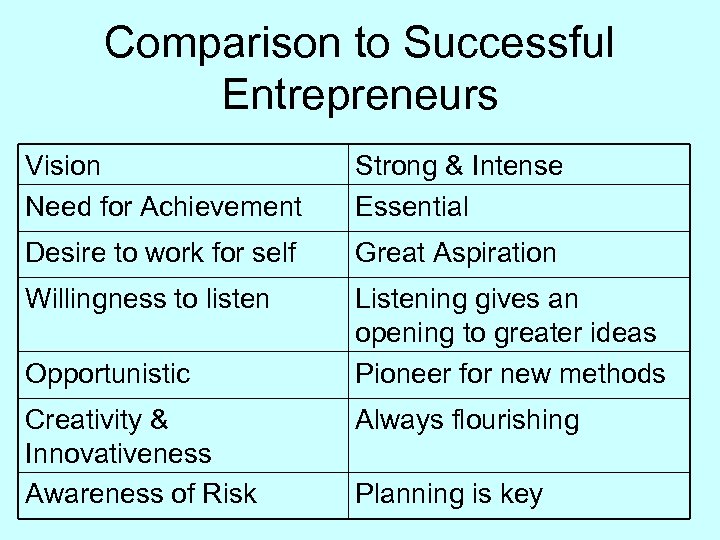
Comparison to Successful Entrepreneurs Vision Need for Achievement Strong & Intense Essential Desire to work for self Great Aspiration Willingness to listen Listening gives an opening to greater ideas Pioneer for new methods Opportunistic Creativity & Innovativeness Awareness of Risk Always flourishing Planning is key

Midwest Testing, Inc. Personal Interview with Richard Laughlin, President of MTI, Feb. 25, 2004
Company History ØFounded in 1985 by Richard Laughlin ØFinanced with $30 k loan from a friend ØStarted with 3 employees, currently 40 total personnel ØA highly mobile construction firm based in the St. Louis metro area
Richard Laughlin’s Bio ØBorn March 27, 1953 ØOlder of two boys ØGraduated UMR Civil Engineering in 1975 with Masters in Geotechnical ØBrief experiences as an employee
Childhood Experiences ØAlways took charge and thrived as a leader ØLearned business principles for independence (Ex. pulling weeds) ØConstantly brainstorming different ways to earn money
Entrepreneurial History ØMowing lawns ØHouse painting ØLaughlin Brothers ØBroetke-Laughlin partnership ØMidwest Testing, Inc
Major Challenges ØLearning to be a businessman ØFinding work during difficult times such as a recession ØMaking the tough decisions, especially in regards to costs

His Vision “ Our clients talk. We listen. We deliver creative solutions. Let Midwest Testing apply innovation and technology to make a positive impression on the construction industry. ” - Richard Laughlin "Midwest Testing. " www. mwtesting. com 23 Mar. 2004
Closing Thoughts ØCustomers, customers ØSimplify how to run a business ØHonesty, hard work, persistence, and the desire to listen ØFind and maintain long term relationships ØHire great people and make them part of the team
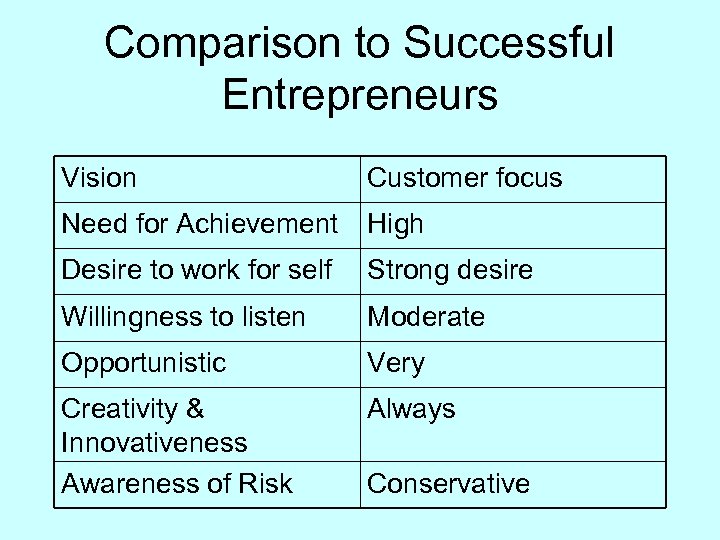
Comparison to Successful Entrepreneurs Vision Customer focus Need for Achievement High Desire to work for self Strong desire Willingness to listen Moderate Opportunistic Very Creativity & Innovativeness Awareness of Risk Always Conservative
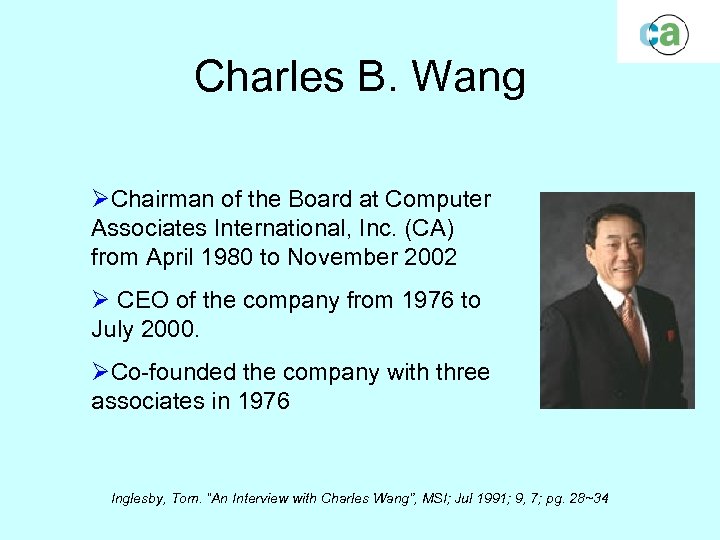
Charles B. Wang ØChairman of the Board at Computer Associates International, Inc. (CA) from April 1980 to November 2002 Ø CEO of the company from 1976 to July 2000. ØCo-founded the company with three associates in 1976 Inglesby, Tom. “An Interview with Charles Wang”, MSI; Jul 1991; 9, 7; pg. 28~34
Player Behind the Scene “In 1999, CA sold $5. 6 billion worth of software, trailing only Microsoft Corp. and IBM, but did not take in a dollar from the consumer market. CA makes a vast array of programs for managing large, diverse computer systems. ‘We are all the plumbing behind the scenes, as opposed to all the pretty faucets, ’ says Wang” Anthony Bianco, Steve Hamm, Manjeet Kripalani, Software's Tough Guy: Charles Wang muscled his way to the top. Now he wants respect, Business Week, New York: March, 6, 2000, Iss. 3671; pg. 132
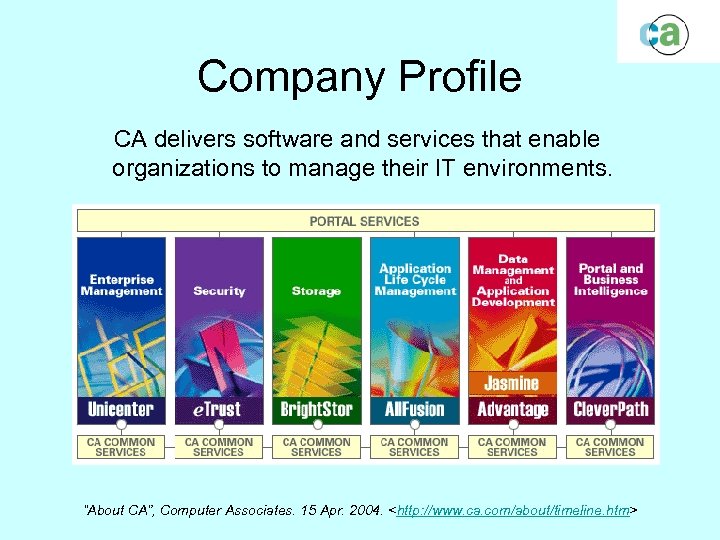
Company Profile CA delivers software and services that enable organizations to manage their IT environments. “About CA”, Computer Associates. 15 Apr. 2004. <http: //www. ca. com/about/timeline. htm>
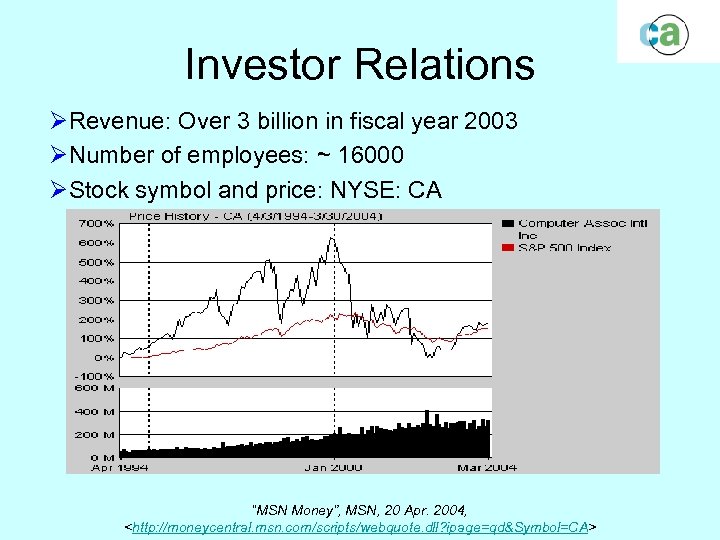
Investor Relations ØRevenue: Over 3 billion in fiscal year 2003 ØNumber of employees: ~ 16000 ØStock symbol and price: NYSE: CA “MSN Money”, MSN, 20 Apr. 2004, <http: //moneycentral. msn. com/scripts/webquote. dll? ipage=qd&Symbol=CA>
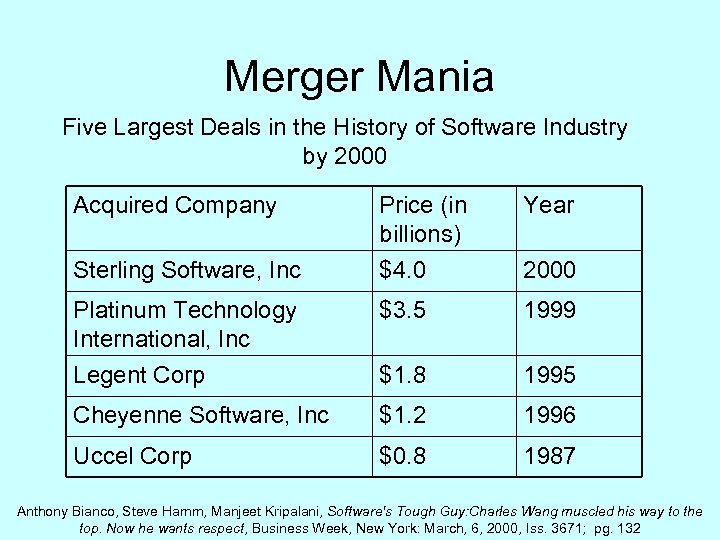
Merger Mania Five Largest Deals in the History of Software Industry by 2000 Acquired Company Price (in billions) Year Sterling Software, Inc $4. 0 2000 Platinum Technology International, Inc $3. 5 1999 Legent Corp $1. 8 1995 Cheyenne Software, Inc $1. 2 1996 Uccel Corp $0. 8 1987 Anthony Bianco, Steve Hamm, Manjeet Kripalani, Software's Tough Guy: Charles Wang muscled his way to the top. Now he wants respect, Business Week, New York: March, 6, 2000, Iss. 3671; pg. 132
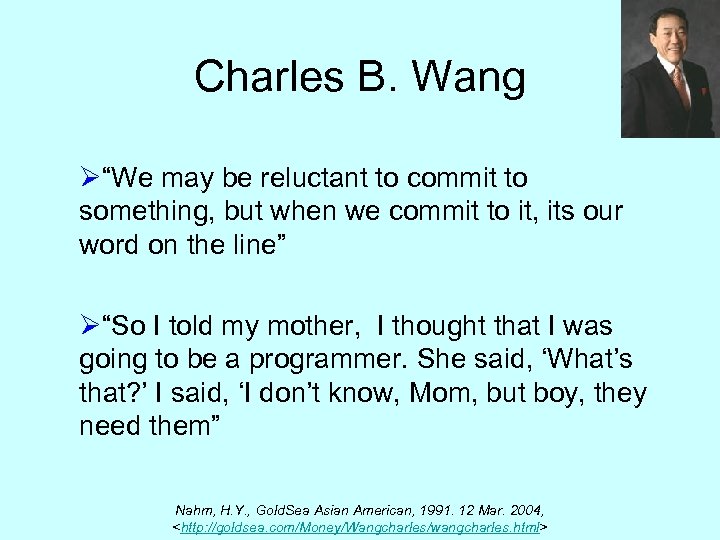
Charles B. Wang Ø“We may be reluctant to commit to something, but when we commit to it, its our word on the line” Ø“So I told my mother, I thought that I was going to be a programmer. She said, ‘What’s that? ’ I said, ‘I don’t know, Mom, but boy, they need them” Nahm, H. Y. , Gold. Sea Asian American, 1991. 12 Mar. 2004, <http: //goldsea. com/Money/Wangcharles/wangcharles. html>
Biography ØBorn in Shanghai, China in August 1944 ØThe second of three sons ØGrandfather was a landowner involved in business and politics ØFather studied law at Harvard. He served for a time as a justice of the Shanghai Supreme Court ØMoved to the United States with his family in 1952 ØRaised in Queens Village, New York ØAttended Brooklyn Technical High School Nahm, H. Y. , Gold. Sea Asian American, 1991. 12 Mar. 2004, <http: //goldsea. com/Money/Wangcharles/wangcharles. html>
Biography ØEarned B. S. in Mathematics from Queens College ØBecame a programmer trainee at the Electronics Research Laboratory of Columbia University in 1967 ØJoined the software division of Standard Data Corporation in 1971 ØSpun off SDC in 1976, founded CA, CEO ØBecame the Chairman of the Board in 1980 ØRetired in 2002 Nahm, H. Y. , Gold. Sea Asian American, 1991. 12 Mar. 2004, <http: //goldsea. com/Money/Wangcharles/wangcharles. html>
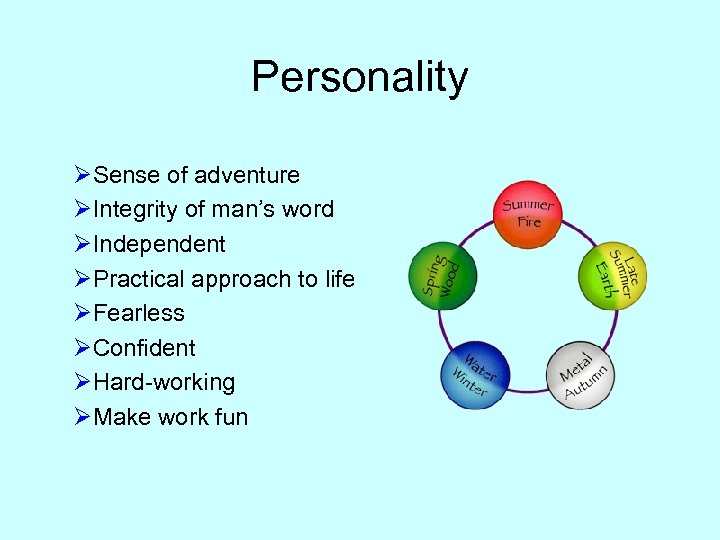
Personality ØSense of adventure ØIntegrity of man’s word ØIndependent ØPractical approach to life ØFearless ØConfident ØHard-working ØMake work fun
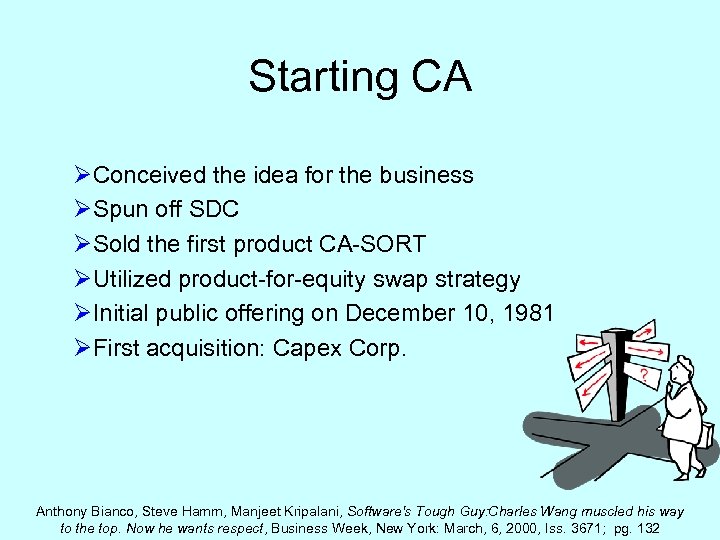
Starting CA ØConceived the idea for the business ØSpun off SDC ØSold the first product CA-SORT ØUtilized product-for-equity swap strategy ØInitial public offering on December 10, 1981 ØFirst acquisition: Capex Corp. Anthony Bianco, Steve Hamm, Manjeet Kripalani, Software's Tough Guy: Charles Wang muscled his way to the top. Now he wants respect, Business Week, New York: March, 6, 2000, Iss. 3671; pg. 132
Major Challenges ØGiving up a quality job to start a company ØPreparing the payroll initially ØEstablishing market driven ideas ØSurviving a fast-changing technological industry ØMaintaining cultural stability during acquisitions ØUnderstanding the market ØObtaining sufficient resources
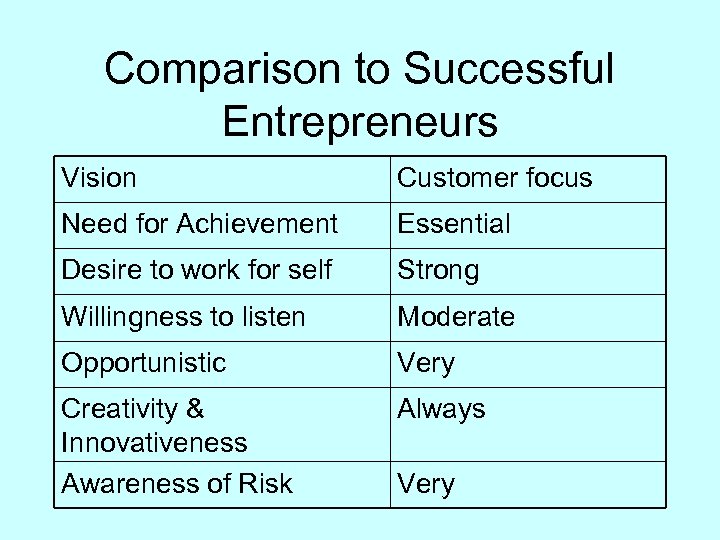
Comparison to Successful Entrepreneurs Vision Customer focus Need for Achievement Essential Desire to work for self Strong Willingness to listen Moderate Opportunistic Very Creativity & Innovativeness Awareness of Risk Always Very
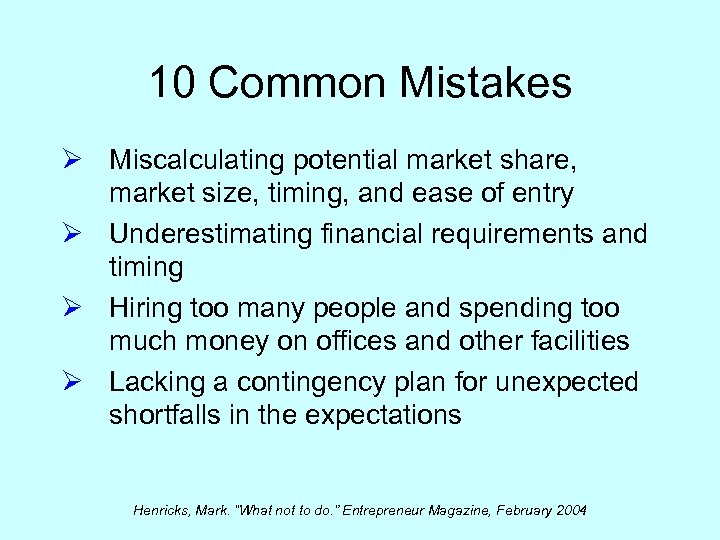
10 Common Mistakes Ø Miscalculating potential market share, market size, timing, and ease of entry Ø Underestimating financial requirements and timing Ø Hiring too many people and spending too much money on offices and other facilities Ø Lacking a contingency plan for unexpected shortfalls in the expectations Henricks, Mark. “What not to do. ” Entrepreneur Magazine, February 2004
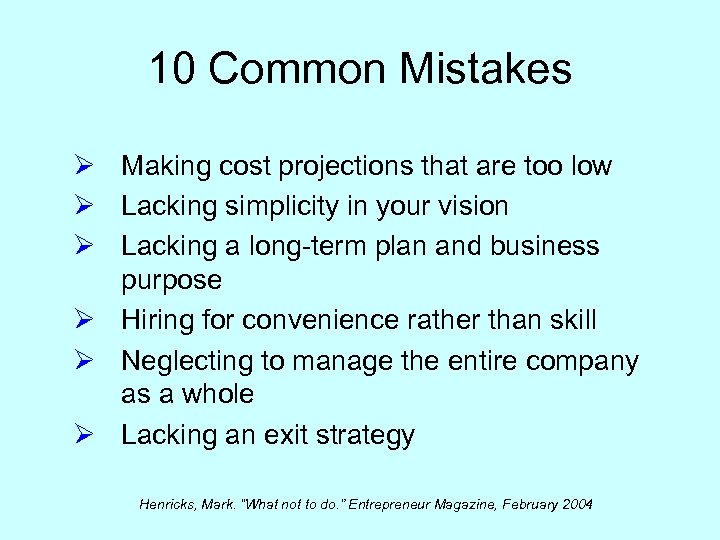
10 Common Mistakes Ø Making cost projections that are too low Ø Lacking simplicity in your vision Ø Lacking a long-term plan and business purpose Ø Hiring for convenience rather than skill Ø Neglecting to manage the entire company as a whole Ø Lacking an exit strategy Henricks, Mark. “What not to do. ” Entrepreneur Magazine, February 2004
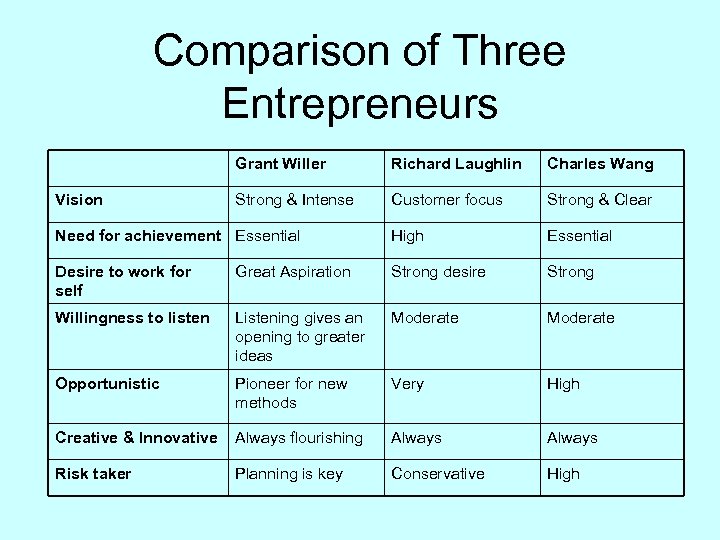
Comparison of Three Entrepreneurs Grant Willer Richard Laughlin Charles Wang Strong & Intense Customer focus Strong & Clear Need for achievement Essential High Essential Desire to work for self Great Aspiration Strong desire Strong Willingness to listen Listening gives an opening to greater ideas Moderate Opportunistic Pioneer for new methods Very High Creative & Innovative Always flourishing Always Risk taker Planning is key Conservative High Vision

Questions?
Скачать презентацию Kristen Farberman Michelle Hoffmann Jeff Laughlin Xin Liu
5b8921804f286123c2141678a43f8ab7.ppt