 Скачать презентацию KRIBB s Experiences on International Cooperation Technology Transfer
27777c6ced31b38a79765defa72230e0.ppt
- Количество слайдов: 21



KRIBB’s Experiences on International Cooperation & Technology Transfer
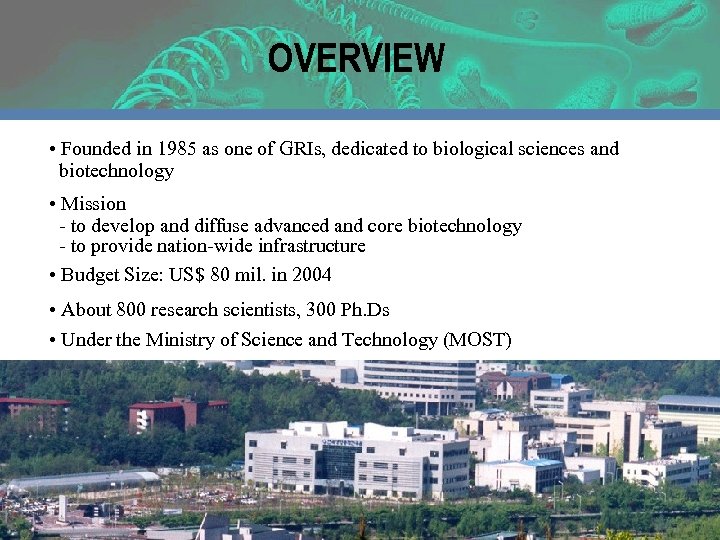
OVERVIEW • Founded in 1985 as one of GRIs, dedicated to biological sciences and biotechnology • Mission - to develop and diffuse advanced and core biotechnology - to provide nation-wide infrastructure • Budget Size: US$ 80 mil. in 2004 • About 800 research scientists, 300 Ph. Ds • Under the Ministry of Science and Technology (MOST)
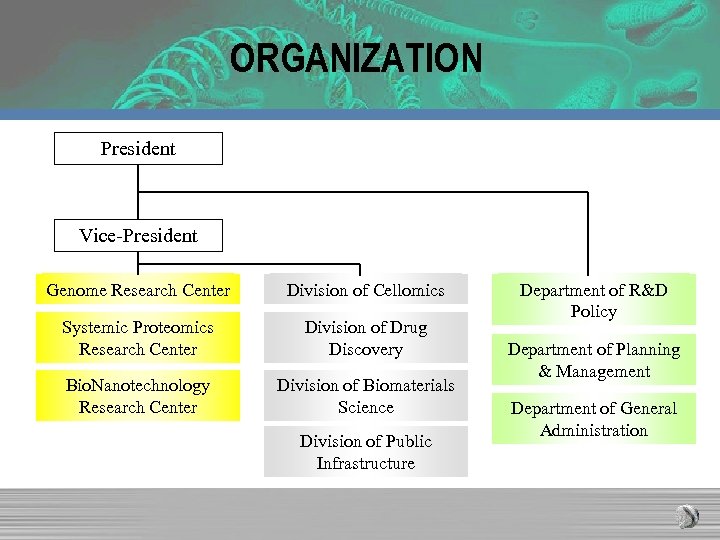
ORGANIZATION President Vice-President Genome Research Center Division of Cellomics Systemic Proteomics Research Center Division of Drug Discovery Bio. Nanotechnology Research Center Division of Biomaterials Science Division of Public Infrastructure Department of R&D Policy Department of Planning & Management Department of General Administration
INTERNATIONAL COOPERATION(1) • Scientific research is becoming More “globalized” - increasing numbers of countries are building their scientific capabilities and participating in world science; More “collaborative” - a growing proportion of projects and the publications they produce result from international collaborations; and More “distributed” - scientific teams are collaborating across greater distances and involve more widely dispersed expertise. National boundaries have diminishing significance for scientific activities
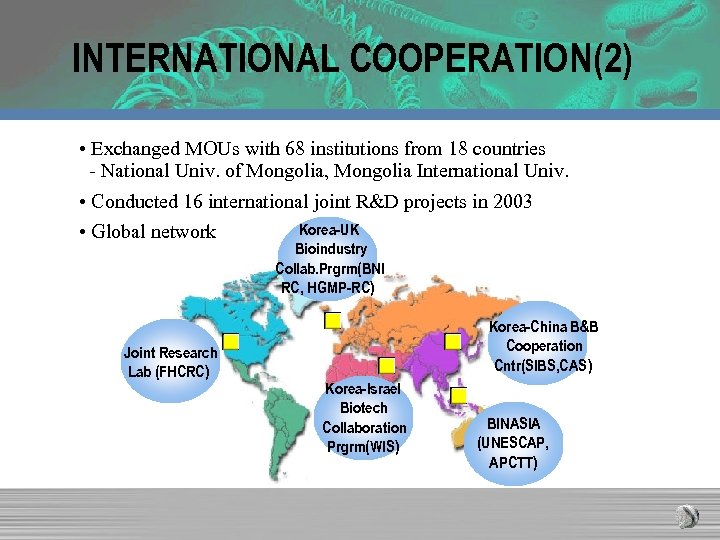
INTERNATIONAL COOPERATION(2) • Exchanged MOUs with 68 institutions from 18 countries - National Univ. of Mongolia, Mongolia International Univ. • Conducted 16 international joint R&D projects in 2003 Korea-UK • Global network Bioindustry Collab. Prgrm(BNI RC, HGMP-RC) Korea-China B&B Cooperation Cntr(SIBS, CAS) Joint Research Lab (FHCRC) Korea-Israel Biotech Collaboration Prgrm(WIS) BINASIA (UNESCAP, APCTT)
INTERNATIONAL COOPERATION(3) • Establishment of Branch Institute of FHCRC • Mission: contribution to the prevention, early detection, diagnosis and treatment of cancer and other related diseases that are health concerns in Korea. • MOU among the City of Daejeon, KRIBB, and FHCRC is to be signed in Nov. or Dec. , 2004. • Main Projects - Biomarker Project: to identify blood-serum protein markers that can distinguish individuals with early stage cancers (Daejeon City US$4. 5 m, KRIBB US$800, 000 annually for 5 years - Last Cohort Project: to implement a large epidemiological study using a Korean cohort of study subjects to establish a specimen and database that could be used for identifying the causes of cancer and other diseases
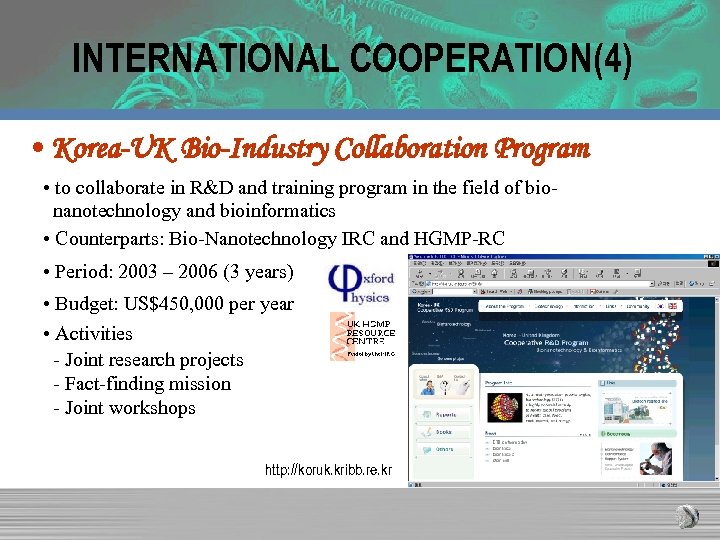
INTERNATIONAL COOPERATION(4) • Korea-UK Bio-Industry Collaboration Program • to collaborate in R&D and training program in the field of bionanotechnology and bioinformatics • Counterparts: Bio-Nanotechnology IRC and HGMP-RC • Period: 2003 – 2006 (3 years) • Budget: US$450, 000 per year • Activities - Joint research projects - Fact-finding mission - Joint workshops http: //koruk. kribb. re. kr
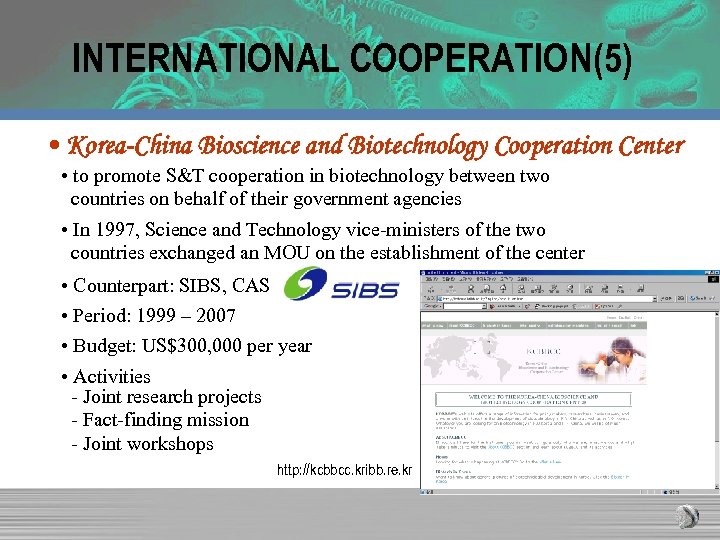
INTERNATIONAL COOPERATION(5) • Korea-China Bioscience and Biotechnology Cooperation Center • to promote S&T cooperation in biotechnology between two countries on behalf of their government agencies • In 1997, Science and Technology vice-ministers of the two countries exchanged an MOU on the establishment of the center • Counterpart: SIBS, CAS • Period: 1999 – 2007 • Budget: US$300, 000 per year • Activities - Joint research projects - Fact-finding mission - Joint workshops http: //kcbbcc. kribb. re. kr
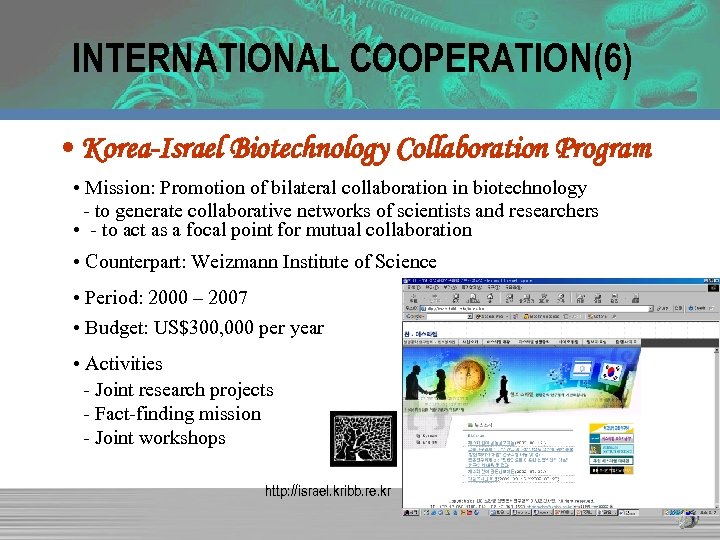
INTERNATIONAL COOPERATION(6) • Korea-Israel Biotechnology Collaboration Program • Mission: Promotion of bilateral collaboration in biotechnology - to generate collaborative networks of scientists and researchers • - to act as a focal point for mutual collaboration • Counterpart: Weizmann Institute of Science • Period: 2000 – 2007 • Budget: US$300, 000 per year • Activities - Joint research projects - Fact-finding mission - Joint workshops http: //israel. kribb. re. kr
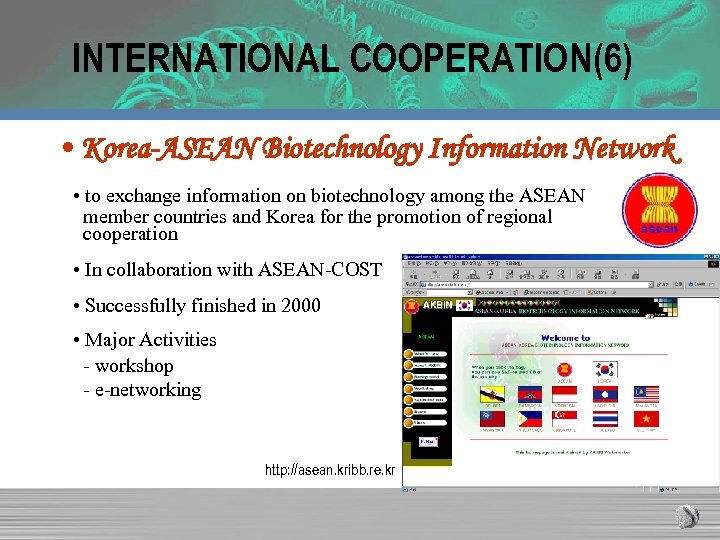
INTERNATIONAL COOPERATION(6) • Korea-ASEAN Biotechnology Information Network • to exchange information on biotechnology among the ASEAN member countries and Korea for the promotion of regional cooperation • In collaboration with ASEAN-COST • Successfully finished in 2000 • Major Activities - workshop - e-networking http: //asean. kribb. re. kr
TECHNOLOGY TRANSFER(1) • Governmental Policies • In Korea, the public-to-private transfer of technology has been of growing policy interest since late 1960 s. • The New Economic Five Year Plan(1993 -1997) directed the government to fully utilize its domestic R&D capabilities by facilitating R&D collaboration among GRIs, universities, and industrial firms, thereby promoting global technological and economic competitiveness. • To comply with the Plan, in late 1990 s, MOST started to encourage transfer of government-owned technologies to SMEs. • In 2000, Technology Transfer Promotion Law was enacted for systematic facilitation of the technology transfer to SMEs.
TECHNOLOGY TRANSFER(2) • KRIBB’s Policy • KRIBB is a steward of governmental funds. • Actively encourages to license inventions for commercial development which are in the public interest. • Increased incentives to PIs, who transferred technologies, to 70% of the total income from 50%. • Technology Transfer Office: to provide a bridge between KRIBB and industry to facilitate the conversion of intellectual property to useful commercial products • Mechanisms: Assignment Agreements, Confidential Disclosure Agreements, Research Contracts, Material Transfer Agreements, License Agreements
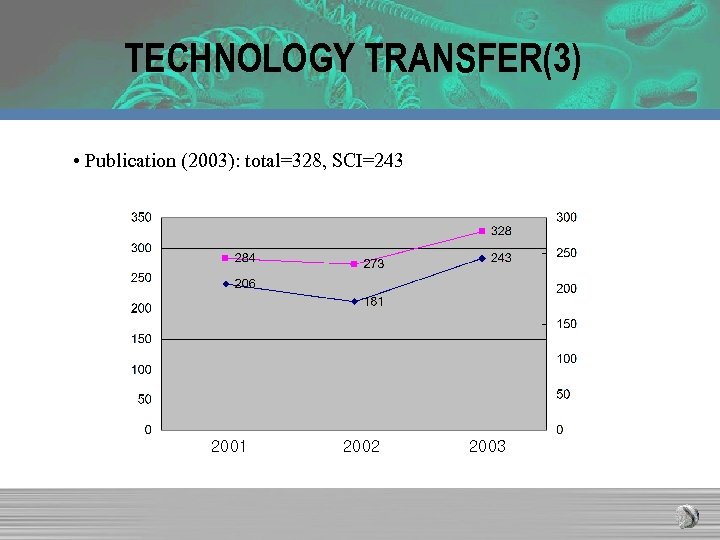
TECHNOLOGY TRANSFER(3) • Publication (2003): total=328, SCI=243 2001 2002 2003
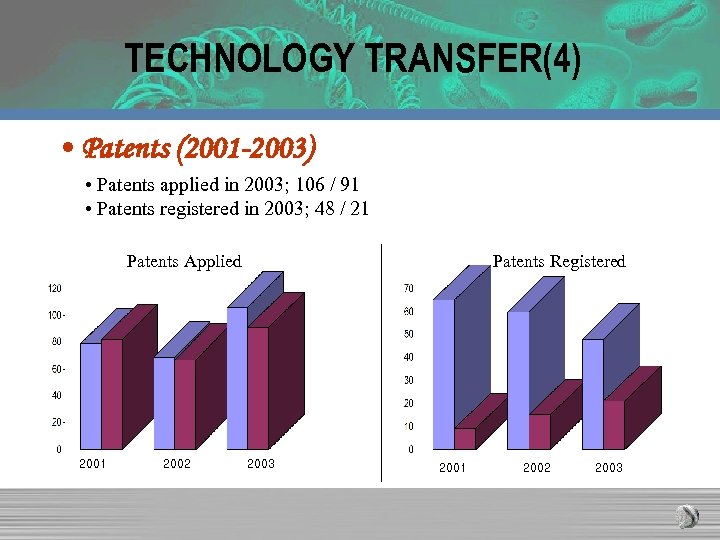
TECHNOLOGY TRANSFER(4) • Patents (2001 -2003) • Patents applied in 2003; 106 / 91 • Patents registered in 2003; 48 / 21 Patents Applied 2001 2002 Patents Registered 2003 2001 2002 2003
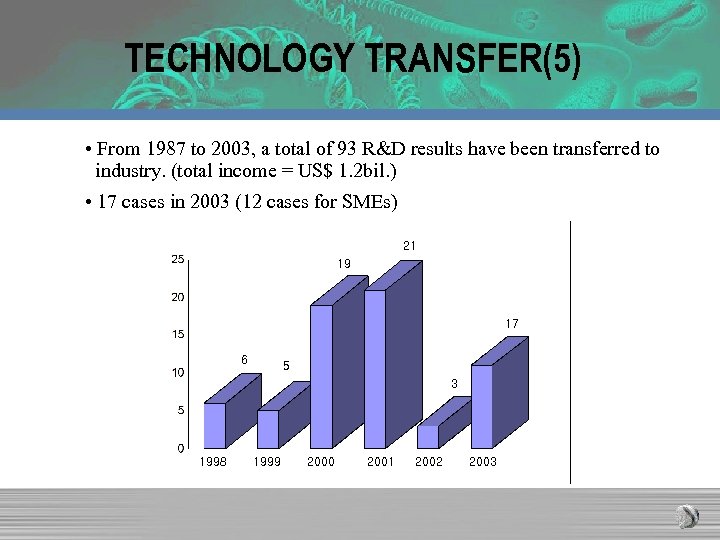
TECHNOLOGY TRANSFER(5) • From 1987 to 2003, a total of 93 R&D results have been transferred to industry. (total income = US$ 1. 2 bil. ) • 17 cases in 2003 (12 cases for SMEs) 21 19 1711 6 5 3 1998 1999 2000 2001 2002 2003
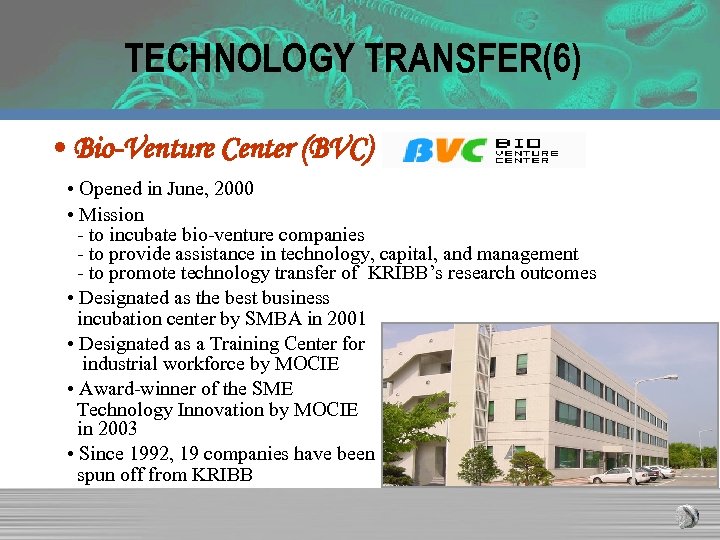
TECHNOLOGY TRANSFER(6) • Bio-Venture Center (BVC) • Opened in June, 2000 • Mission - to incubate bio-venture companies - to provide assistance in technology, capital, and management - to promote technology transfer of KRIBB’s research outcomes • Designated as the best business incubation center by SMBA in 2001 • Designated as a Training Center for industrial workforce by MOCIE • Award-winner of the SME Technology Innovation by MOCIE in 2003 • Since 1992, 19 companies have been spun off from KRIBB
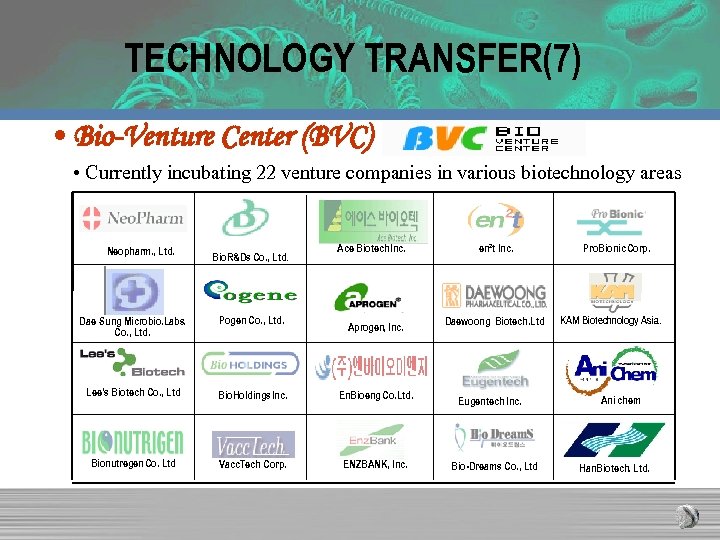
TECHNOLOGY TRANSFER(7) • Bio-Venture Center (BVC) • Currently incubating 22 venture companies in various biotechnology areas Neopharm. , Ltd. Bio. R&Ds Co. , Ltd. Ace Biotech Inc. Dae Sung Microbio. Labs. Co. , Ltd. Pogen Co. , Ltd. Lee's Biotech Co. , Ltd Bio. Holdings. Inc. En. Bioeng Co. Ltd. Bionutregen Co. Ltd Vacc. Tech Corp. ENZBANK, Inc. Aprogen, Inc. en²t Inc. Daewoong Biotech. Ltd Eugentech Inc. Bio-Dreams Co. , Ltd Pro. Bionic Corp. KAM Biotechnology Asia. Ani chem Han. Biotech. Ltd.
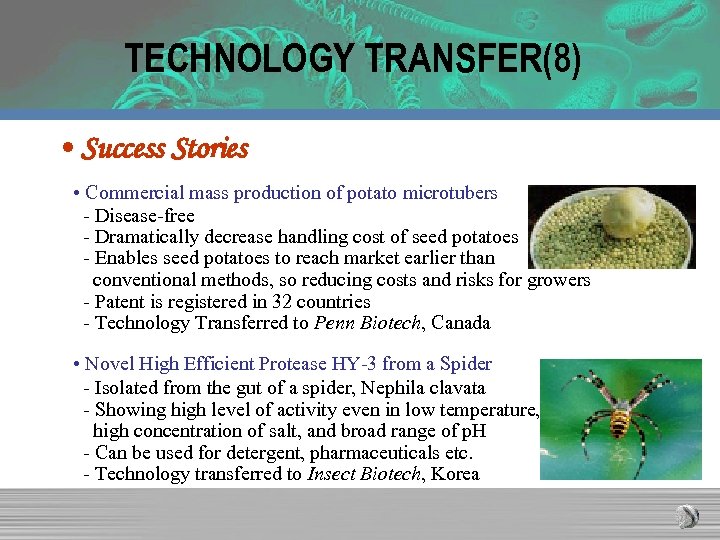
TECHNOLOGY TRANSFER(8) • Success Stories • Commercial mass production of potato microtubers - Disease-free - Dramatically decrease handling cost of seed potatoes - Enables seed potatoes to reach market earlier than conventional methods, so reducing costs and risks for growers - Patent is registered in 32 countries - Technology Transferred to Penn Biotech, Canada • Novel High Efficient Protease HY-3 from a Spider - Isolated from the gut of a spider, Nephila clavata - Showing high level of activity even in low temperature, high concentration of salt, and broad range of p. H - Can be used for detergent, pharmaceuticals etc. - Technology transferred to Insect Biotech, Korea
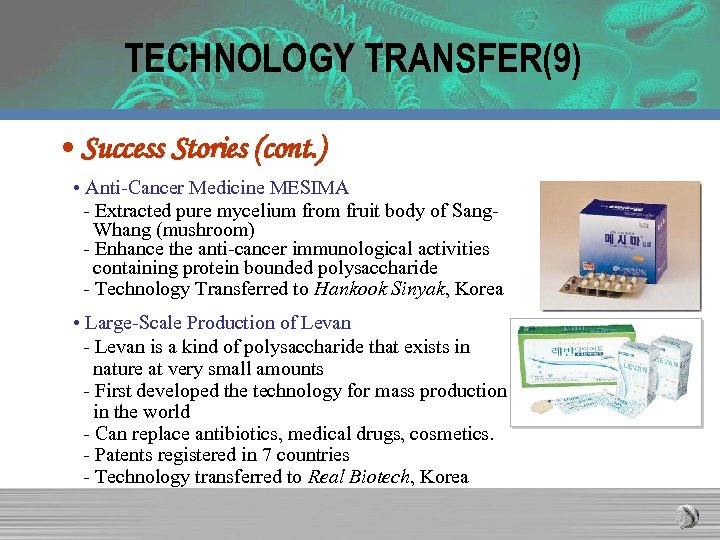
TECHNOLOGY TRANSFER(9) • Success Stories (cont. ) • Anti-Cancer Medicine MESIMA - Extracted pure mycelium from fruit body of Sang. Whang (mushroom) - Enhance the anti-cancer immunological activities containing protein bounded polysaccharide - Technology Transferred to Hankook Sinyak, Korea • Large-Scale Production of Levan - Levan is a kind of polysaccharide that exists in nature at very small amounts - First developed the technology for mass production in the world - Can replace antibiotics, medical drugs, cosmetics. - Patents registered in 7 countries - Technology transferred to Real Biotech, Korea
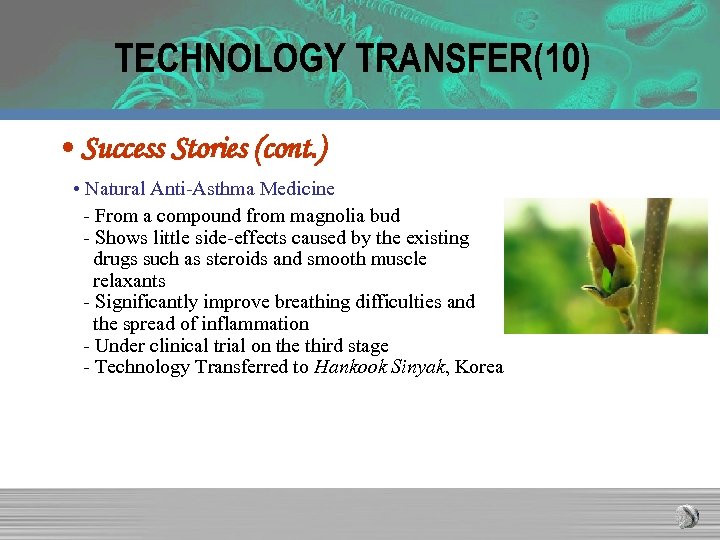
TECHNOLOGY TRANSFER(10) • Success Stories (cont. ) • Natural Anti-Asthma Medicine - From a compound from magnolia bud - Shows little side-effects caused by the existing drugs such as steroids and smooth muscle relaxants - Significantly improve breathing difficulties and the spread of inflammation - Under clinical trial on the third stage - Technology Transferred to Hankook Sinyak, Korea
Thank You !
Скачать презентацию KRIBB s Experiences on International Cooperation Technology Transfer
27777c6ced31b38a79765defa72230e0.ppt