 Скачать презентацию Korean Initiatives on Biotechnology Challenges and Opportunities Expert
819d929359c047e164d3195f03cc3486.ppt
- Количество слайдов: 33



Korean Initiatives on Biotechnology: Challenges and Opportunities Expert Group Meeting, BINASIA 29 -30 April, 2004 Bangkok, Thailand Sang Ki Rhee, Ph. D. Project Coordinator, BINASIA Korea Research Institute of Bioscience and Biotechnology in Korea
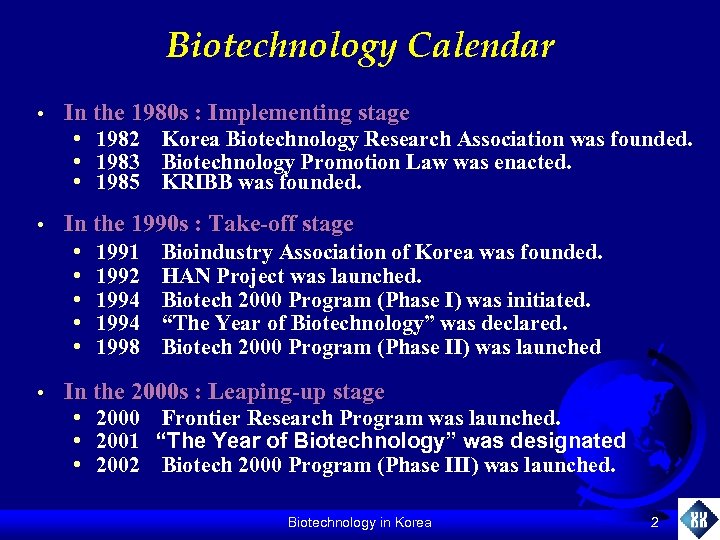
Biotechnology Calendar • In the 1980 s : Implementing stage • 1982 Korea Biotechnology Research Association was founded. • 1983 Biotechnology Promotion Law was enacted. • 1985 KRIBB was founded. • In the 1990 s : Take-off stage • • • 1991 Bioindustry Association of Korea was founded. 1992 HAN Project was launched. 1994 Biotech 2000 Program (Phase I) was initiated. 1994 “The Year of Biotechnology” was declared. 1998 Biotech 2000 Program (Phase II) was launched In the 2000 s : Leaping-up stage • 2000 Frontier Research Program was launched. • 2001 “The Year of Biotechnology” was designated • 2002 Biotech 2000 Program (Phase III) was launched. Biotechnology in Korea 2
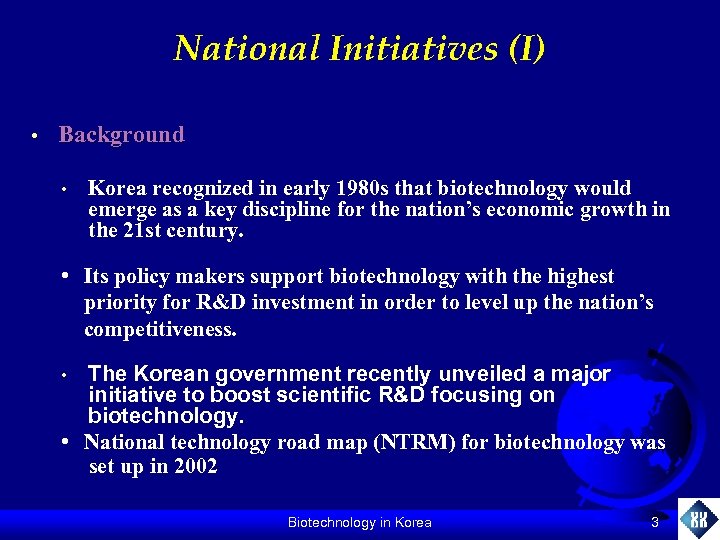
National Initiatives (I) • Background • Korea recognized in early 1980 s that biotechnology would emerge as a key discipline for the nation’s economic growth in the 21 st century. • Its policy makers support biotechnology with the highest priority for R&D investment in order to level up the nation’s competitiveness. The Korean government recently unveiled a major initiative to boost scientific R&D focusing on biotechnology. • National technology road map (NTRM) for biotechnology was set up in 2002 • Biotechnology in Korea 3
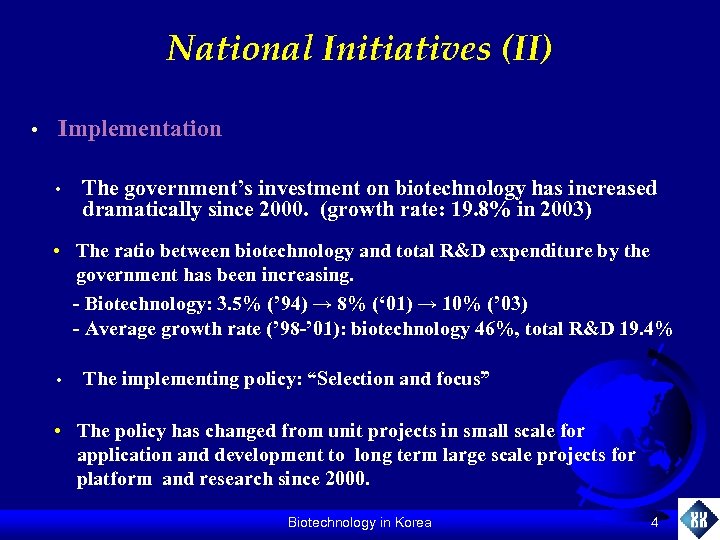
National Initiatives (II) • Implementation • The government’s investment on biotechnology has increased dramatically since 2000. (growth rate: 19. 8% in 2003) • The ratio between biotechnology and total R&D expenditure by the government has been increasing. - Biotechnology: 3. 5% (’ 94) → 8% (‘ 01) → 10% (’ 03) - Average growth rate (’ 98 -’ 01): biotechnology 46%, total R&D 19. 4% • The implementing policy: “Selection and focus” • The policy has changed from unit projects in small scale for application and development to long term large scale projects for platform and research since 2000. Biotechnology in Korea 4
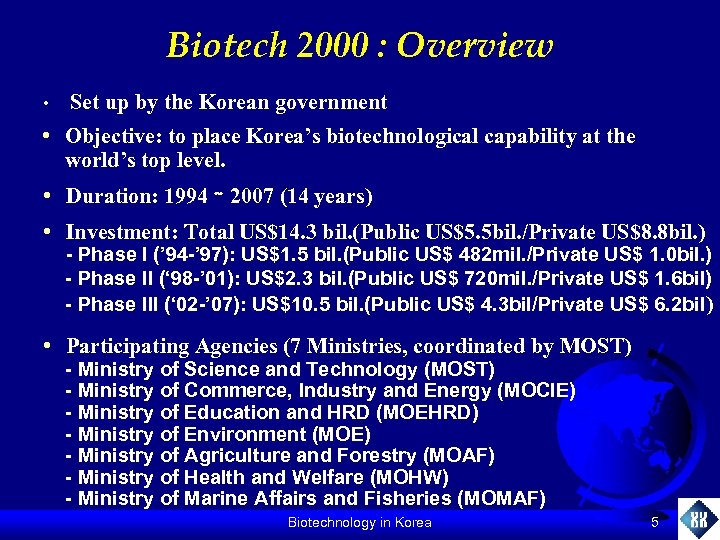
Biotech 2000 : Overview • Set up by the Korean government • Objective: to place Korea’s biotechnological capability at the world’s top level. • Duration: 1994 ∼ 2007 (14 years) • Investment: Total US$14. 3 bil. (Public US$5. 5 bil. /Private US$8. 8 bil. ) - Phase I (’ 94 -’ 97): US$1. 5 bil. (Public US$ 482 mil. /Private US$ 1. 0 bil. ) - Phase II (‘ 98 -’ 01): US$2. 3 bil. (Public US$ 720 mil. /Private US$ 1. 6 bil) - Phase III (‘ 02 -’ 07): US$10. 5 bil. (Public US$ 4. 3 bil/Private US$ 6. 2 bil) • Participating Agencies (7 Ministries, coordinated by MOST) - Ministry of Science and Technology (MOST) - Ministry of Commerce, Industry and Energy (MOCIE) - Ministry of Education and HRD (MOEHRD) - Ministry of Environment (MOE) - Ministry of Agriculture and Forestry (MOAF) - Ministry of Health and Welfare (MOHW) - Ministry of Marine Affairs and Fisheries (MOMAF) Biotechnology in Korea 5
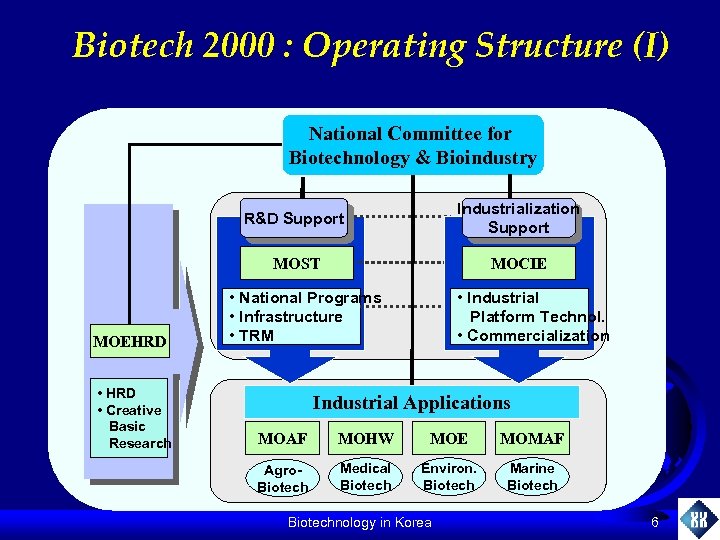
Biotech 2000 : Operating Structure (I) National Committee for Biotechnology & Bioindustry R&D Support MOST MOEHRD • Creative Basic Research Industrialization Support MOCIE • Industrial Platform Technol. • Commercialization • National Programs • Infrastructure • TRM Industrial Applications MOAF MOHW MOE MOMAF Agro. Biotech Medical Biotech Environ. Biotech Marine Biotechnology in Korea 6
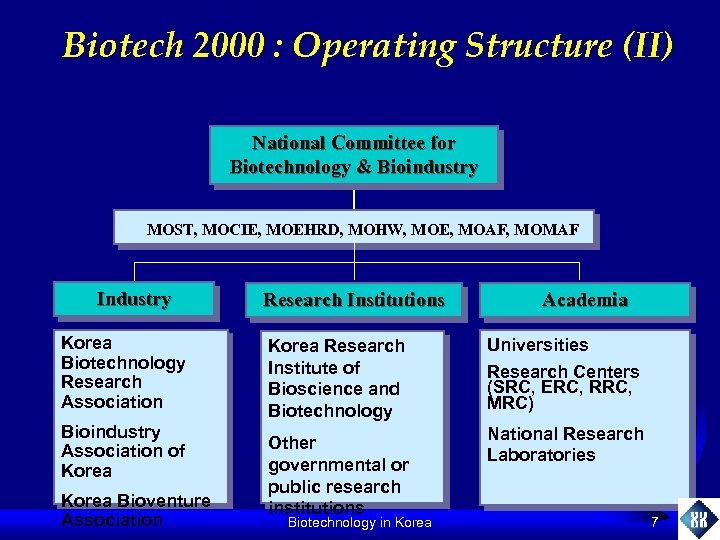
Biotech 2000 : Operating Structure (II) National Committee for Biotechnology & Bioindustry MOST, MOCIE, MOEHRD, MOHW, MOE, MOAF, MOMAF Industry Korea Biotechnology Research Association Bioindustry Association of Korea Bioventure Association Research Institutions Korea Research Institute of Bioscience and Biotechnology Other governmental or public research institutions Biotechnology in Korea Academia Universities Research Centers (SRC, ERC, RRC, MRC) National Research Laboratories 7
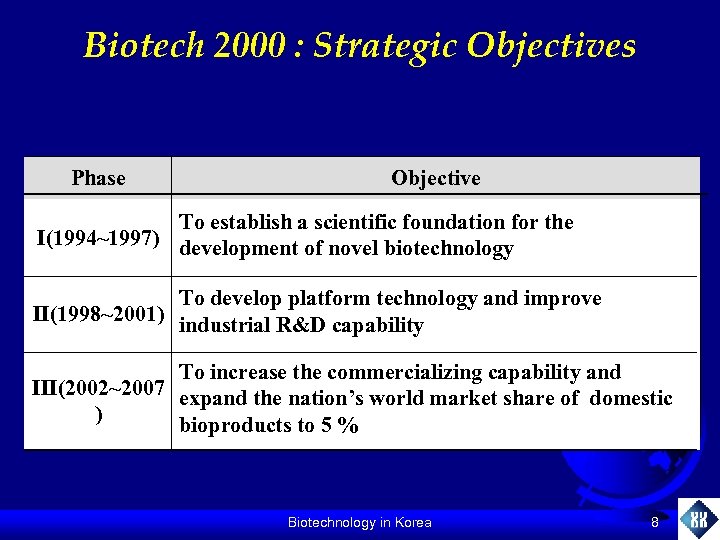
Biotech 2000 : Strategic Objectives Phase Objective To establish a scientific foundation for the I(1994~1997) development of novel biotechnology To develop platform technology and improve II(1998~2001) industrial R&D capability To increase the commercializing capability and III(2002~2007 expand the nation’s world market share of domestic ) bioproducts to 5 % Biotechnology in Korea 8
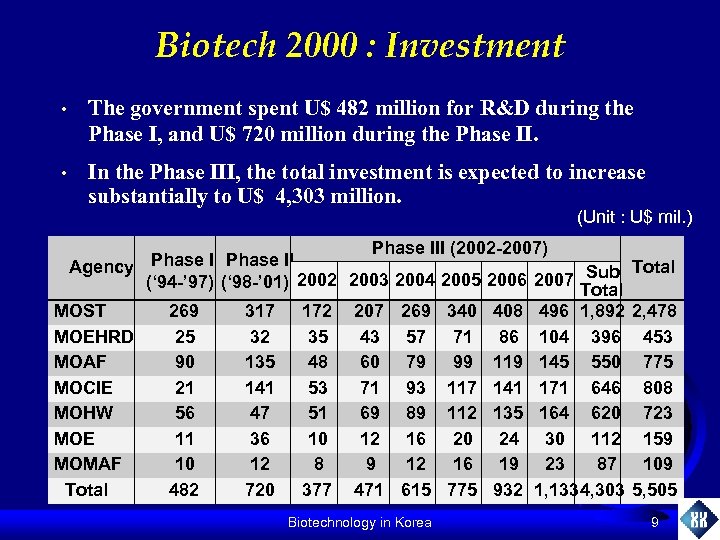
Biotech 2000 : Investment • The government spent U$ 482 million for R&D during the Phase I, and U$ 720 million during the Phase II. • In the Phase III, the total investment is expected to increase substantially to U$ 4, 303 million. (Unit : U$ mil. ) Phase III (2002 -2007) Phase II Agency Total (Unit U$ 2002 2003 2004 2005 2006 2007 : Submil. ) (‘ 94 -’ 97) (‘ 98 -’ 01) Total MOST MOEHRD MOAF MOCIE MOHW MOE MOMAF Total 269 25 90 21 56 11 10 482 317 32 135 141 47 36 12 720 172 35 48 53 51 10 8 377 207 269 340 408 496 1, 892 2, 478 43 57 71 86 104 396 453 60 79 99 119 145 550 775 71 93 117 141 171 646 808 69 89 112 135 164 620 723 12 16 20 24 30 112 159 9 12 16 19 23 87 109 471 615 775 932 1, 1334, 303 5, 505 Biotechnology in Korea 9
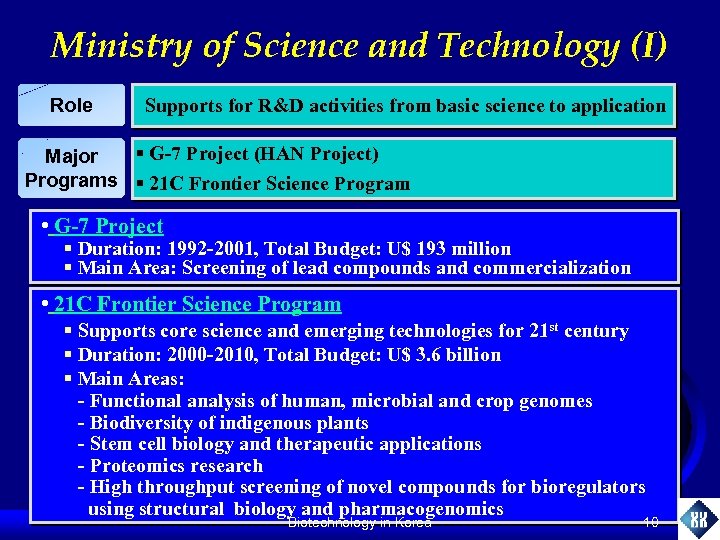
Ministry of Science and Technology (I) Role Supports for R&D activities from basic science to application § G-7 Project (HAN Project) Major Programs § 21 C Frontier Science Program • G-7 Project § Duration: 1992 -2001, Total Budget: U$ 193 million § Main Area: Screening of lead compounds and commercialization • 21 C Frontier Science Program § Supports core science and emerging technologies for 21 st century § Duration: 2000 -2010, Total Budget: U$ 3. 6 billion § Main Areas: - Functional analysis of human, microbial and crop genomes - Biodiversity of indigenous plants - Stem cell biology and therapeutic applications - Proteomics research - High throughput screening of novel compounds for bioregulators using structural biology and pharmacogenomics Biotechnology in Korea 10
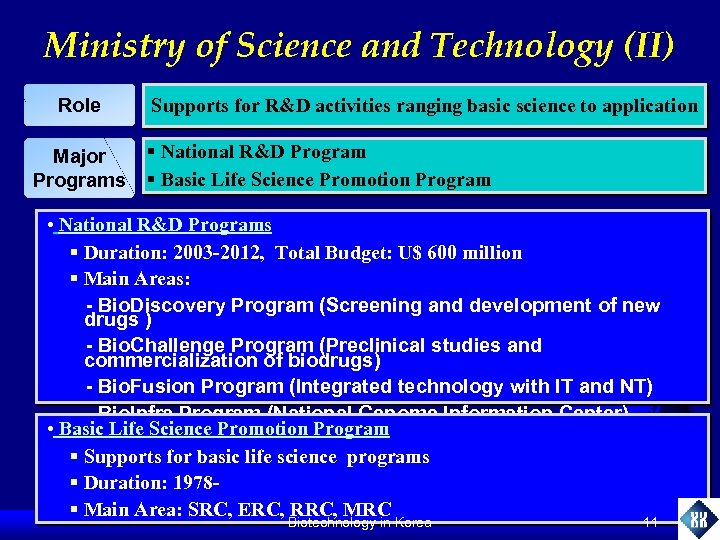
Ministry of Science and Technology (II) Role Major Programs Supports for R&D activities ranging basic science to application § National R&D Program § Basic Life Science Promotion Program • National R&D Programs § Duration: 2003 -2012, Total Budget: U$ 600 million § Main Areas: - Bio. Discovery Program (Screening and development of new drugs ) - Bio. Challenge Program (Preclinical studies and commercialization of biodrugs) - Bio. Fusion Program (Integrated technology with IT and NT) - Bio. Infra Program (National Genome Information Center) • Basic Life Science Promotion Program § Supports for basic life science programs § Duration: 1978§ Main Area: SRC, ERC, RRC, MRC Biotechnology in Korea 11
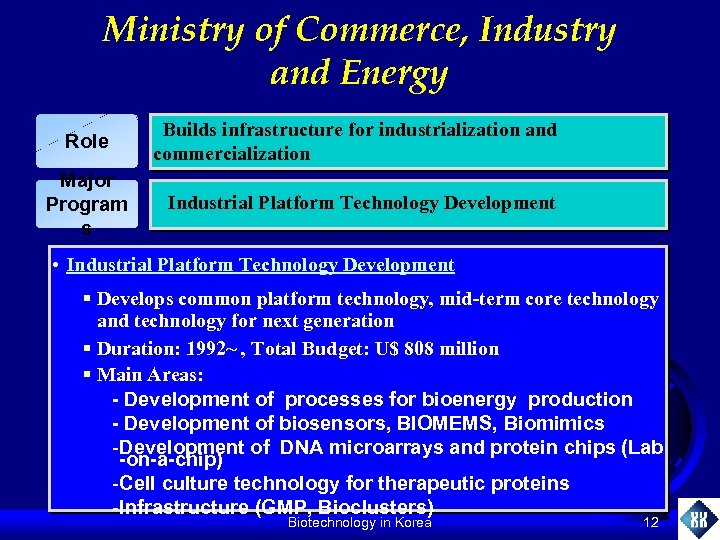
Ministry of Commerce, Industry and Energy Role Major Program s Builds infrastructure for industrialization and commercialization Industrial Platform Technology Development • Industrial Platform Technology Development § Develops common platform technology, mid-term core technology and technology for next generation § Duration: 1992~ , Total Budget: U$ 808 million § Main Areas: - Development of processes for bioenergy production - Development of biosensors, BIOMEMS, Biomimics - Development of DNA microarrays and protein chips (Lab -on-a-chip) - Cell culture technology for therapeutic proteins - Infrastructure (GMP, Bioclusters) Biotechnology in Korea 12
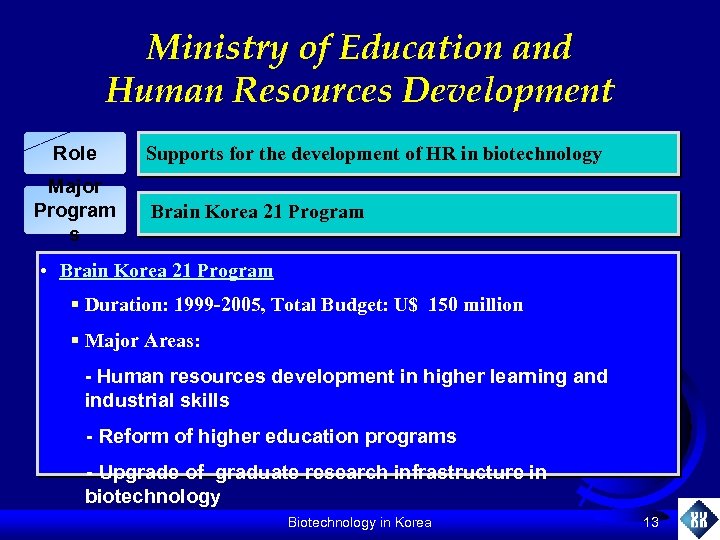
Ministry of Education and Human Resources Development Role Major Program s Supports for the development of HR in biotechnology Brain Korea 21 Program • Brain Korea 21 Program § Duration: 1999 -2005, Total Budget: U$ 150 million § Major Areas: - Human resources development in higher learning and industrial skills - Reform of higher education programs - Upgrade of graduate research infrastructure in biotechnology Biotechnology in Korea 13
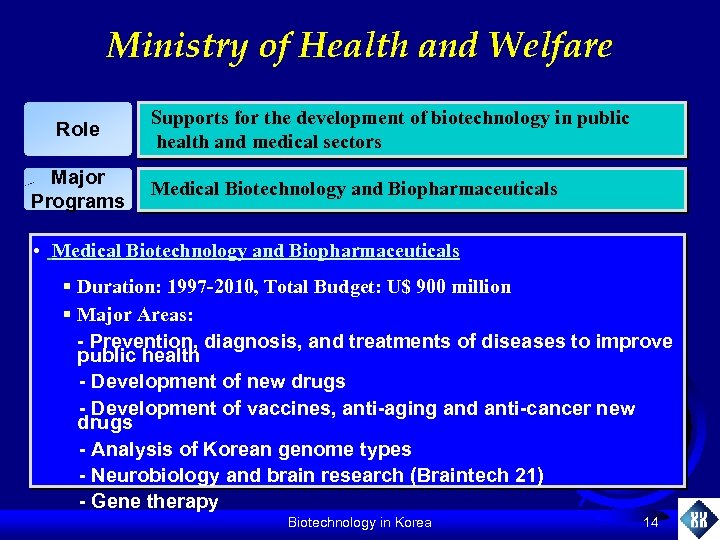
Ministry of Health and Welfare Role Major Programs Supports for the development of biotechnology in public health and medical sectors Medical Biotechnology and Biopharmaceuticals • Medical Biotechnology and Biopharmaceuticals § Duration: 1997 -2010, Total Budget: U$ 900 million § Major Areas: - Prevention, diagnosis, and treatments of diseases to improve public health - Development of new drugs - Development of vaccines, anti-aging and anti-cancer new drugs - Analysis of Korean genome types - Neurobiology and brain research (Braintech 21) - Gene therapy Biotechnology in Korea 14
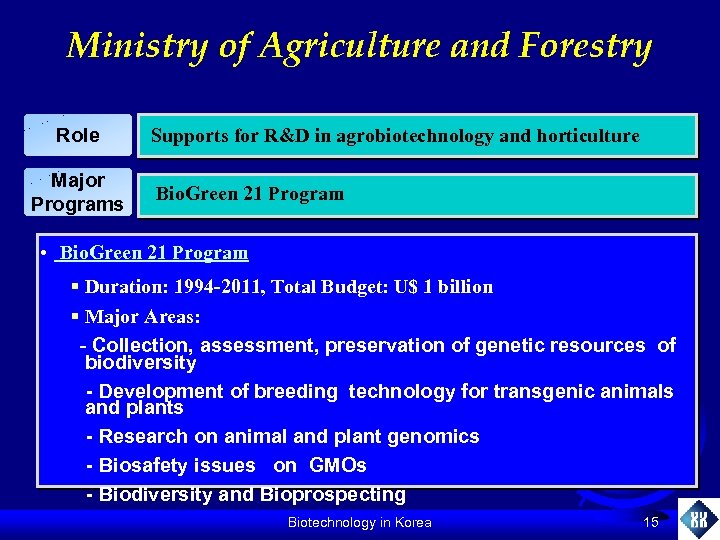
Ministry of Agriculture and Forestry Role Major Programs Supports for R&D in agrobiotechnology and horticulture Bio. Green 21 Program • Bio. Green 21 Program § Duration: 1994 -2011, Total Budget: U$ 1 billion § Major Areas: - Collection, assessment, preservation of genetic resources of biodiversity - Development of breeding technology for transgenic animals and plants - Research on animal and plant genomics - Biosafety issues on GMOs - Biodiversity and Bioprospecting Biotechnology in Korea 15
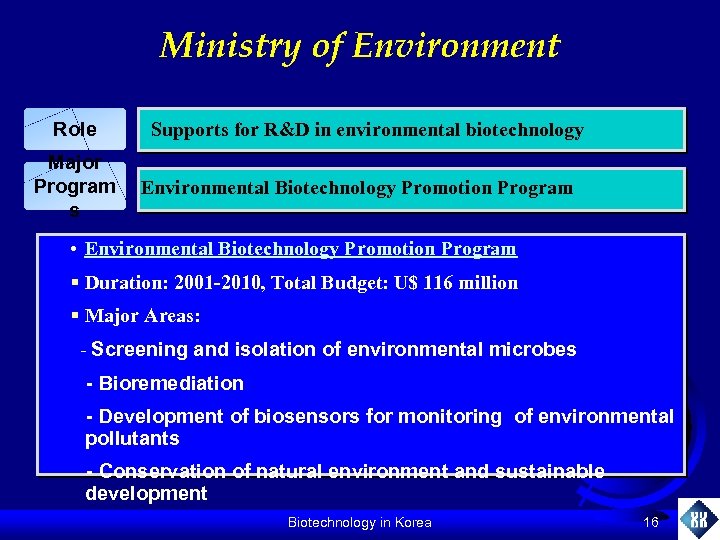
Ministry of Environment Role Major Program s Supports for R&D in environmental biotechnology Environmental Biotechnology Promotion Program • Environmental Biotechnology Promotion Program § Duration: 2001 -2010, Total Budget: U$ 116 million § Major Areas: - Screening and isolation of environmental microbes - Bioremediation - Development of biosensors for monitoring of environmental pollutants - Conservation of natural environment and sustainable development Biotechnology in Korea 16
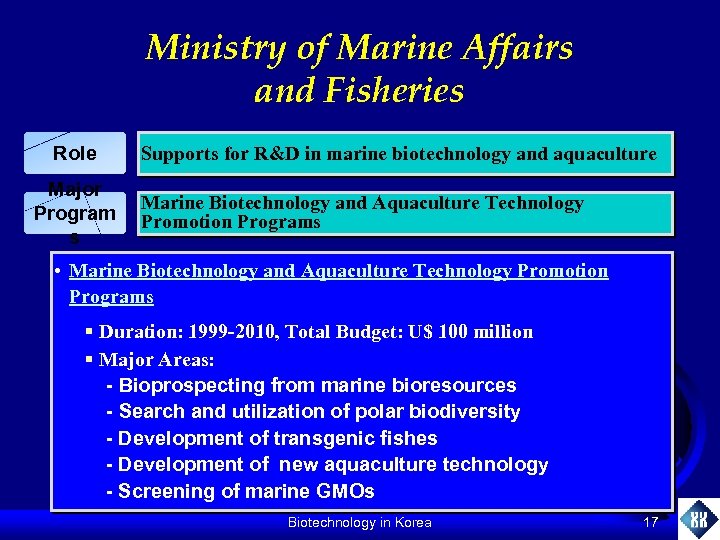
Ministry of Marine Affairs and Fisheries Role Major Program s Supports for R&D in marine biotechnology and aquaculture Marine Biotechnology and Aquaculture Technology Promotion Programs • Marine Biotechnology and Aquaculture Technology Promotion Programs § Duration: 1999 -2010, Total Budget: U$ 100 million § Major Areas: - Bioprospecting from marine bioresources - Search and utilization of polar biodiversity - Development of transgenic fishes - Development of new aquaculture technology - Screening of marine GMOs Biotechnology in Korea 17
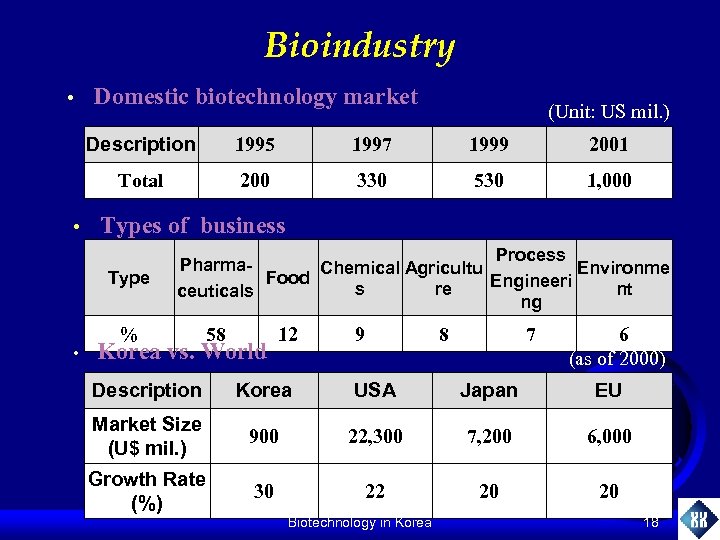
Bioindustry • Domestic biotechnology market (Unit: US mil. ) Description 1997 1999 2001 Total • 1995 200 330 530 1, 000 Types of business Type • Process Pharma. Chemical Agricultu Environme Food Engineeri s re nt ceuticals ng % 58 Korea vs. World 12 9 8 7 6 (as of 2000) Description Korea USA Japan EU Market Size (U$ mil. ) 900 22, 300 7, 200 6, 000 Growth Rate (%) 30 22 20 20 Biotechnology in Korea 18
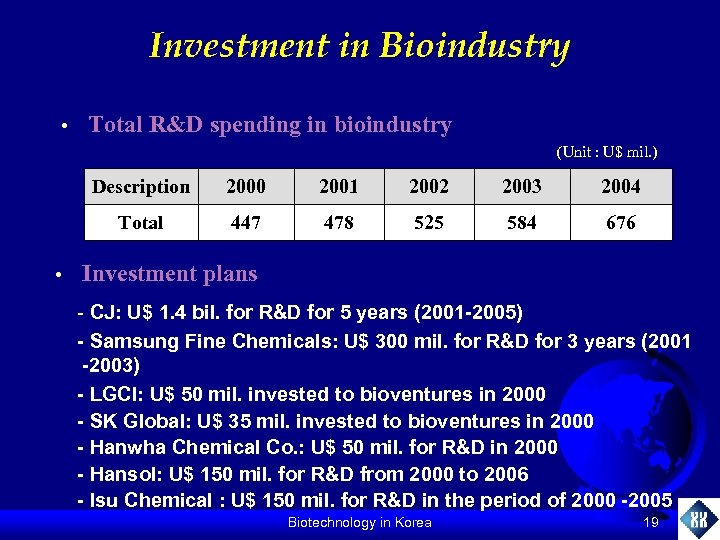
Investment in Bioindustry • Total R&D spending in bioindustry (Unit : U$ mil. ) Description 2001 2002 2003 2004 Total • 2000 447 478 525 584 676 Investment plans - CJ: U$ 1. 4 bil. for R&D for 5 years (2001 -2005) - Samsung Fine Chemicals: U$ 300 mil. for R&D for 3 years (2001 -2003) - LGCI: U$ 50 mil. invested to bioventures in 2000 - SK Global: U$ 35 mil. invested to bioventures in 2000 - Hanwha Chemical Co. : U$ 50 mil. for R&D in 2000 - Hansol: U$ 150 mil. for R&D from 2000 to 2006 - Isu Chemical : U$ 150 mil. for R&D in the period of 2000 -2005 Biotechnology in Korea 19
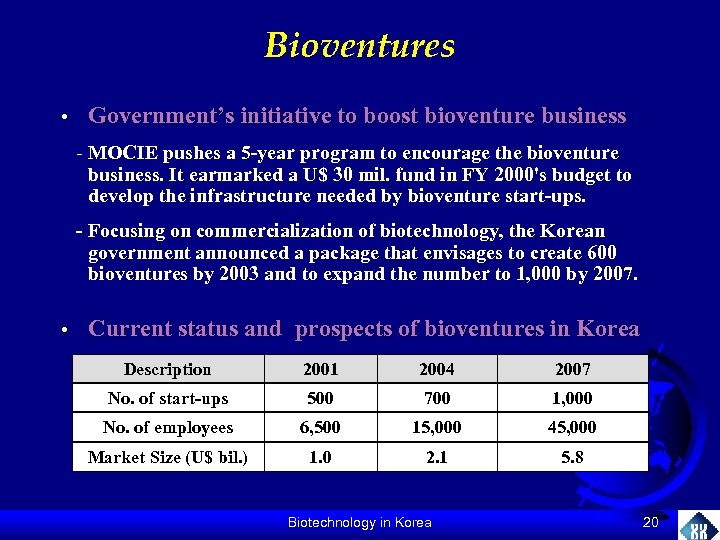
Bioventures • Government’s initiative to boost bioventure business - MOCIE pushes a 5 -year program to encourage the bioventure business. It earmarked a U$ 30 mil. fund in FY 2000's budget to develop the infrastructure needed by bioventure start-ups. - Focusing on commercialization of biotechnology, the Korean government announced a package that envisages to create 600 bioventures by 2003 and to expand the number to 1, 000 by 2007. • Current status and prospects of bioventures in Korea Description 2001 2004 2007 No. of start-ups 500 700 1, 000 No. of employees 6, 500 15, 000 45, 000 Market Size (U$ bil. ) 1. 0 2. 1 5. 8 Biotechnology in Korea 20
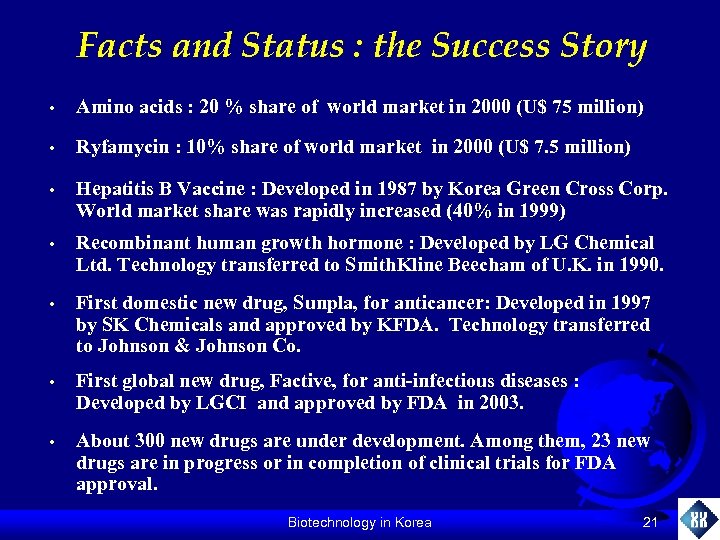
Facts and Status : the Success Story • Amino acids : 20 % share of world market in 2000 (U$ 75 million) • Ryfamycin : 10% share of world market in 2000 (U$ 7. 5 million) • Hepatitis B Vaccine : Developed in 1987 by Korea Green Cross Corp. World market share was rapidly increased (40% in 1999) • Recombinant human growth hormone : Developed by LG Chemical Ltd. Technology transferred to Smith. Kline Beecham of U. K. in 1990. • First domestic new drug, Sunpla, for anticancer: Developed in 1997 by SK Chemicals and approved by KFDA. Technology transferred to Johnson & Johnson Co. • First global new drug, Factive, for anti-infectious diseases : Developed by LGCI and approved by FDA in 2003. • About 300 new drugs are under development. Among them, 23 new drugs are in progress or in completion of clinical trials for FDA approval. Biotechnology in Korea 21
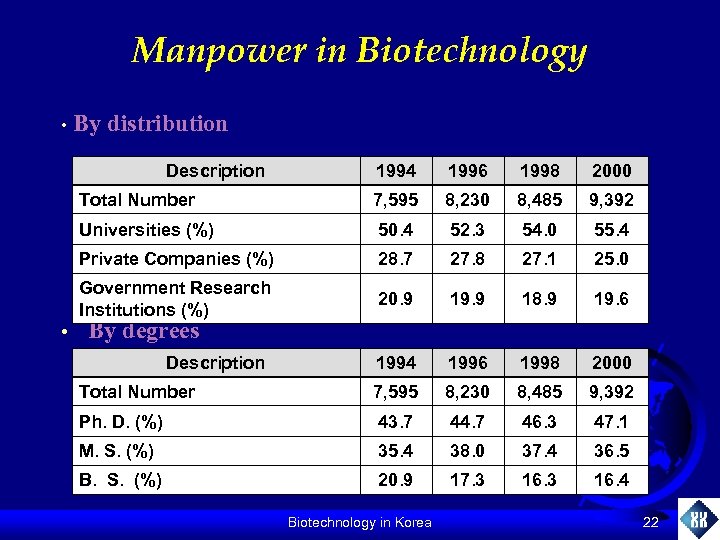
Manpower in Biotechnology • By distribution Description 1996 1998 2000 Total Number 7, 595 8, 230 8, 485 9, 392 Universities (%) 50. 4 52. 3 54. 0 55. 4 Private Companies (%) 28. 7 27. 8 27. 1 25. 0 Government Research Institutions (%) • 1994 20. 9 19. 9 18. 9 19. 6 1994 1996 1998 2000 Total Number 7, 595 8, 230 8, 485 9, 392 Ph. D. (%) 43. 7 44. 7 46. 3 47. 1 M. S. (%) 35. 4 38. 0 37. 4 36. 5 B. S. (%) 20. 9 17. 3 16. 4 By degrees Description Biotechnology in Korea 22
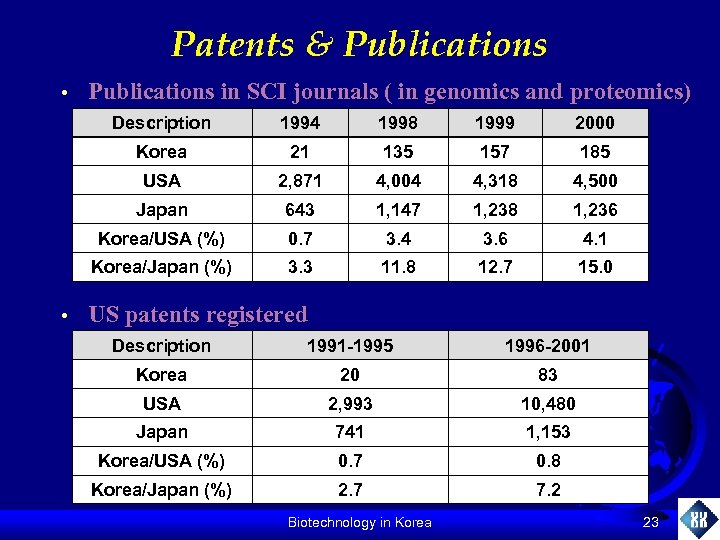
Patents & Publications • Publications in SCI journals ( in genomics and proteomics) Description 1998 1999 2000 Korea 21 135 157 185 USA 2, 871 4, 004 4, 318 4, 500 Japan 643 1, 147 1, 238 1, 236 Korea/USA (%) 0. 7 3. 4 3. 6 4. 1 Korea/Japan (%) • 1994 3. 3 11. 8 12. 7 15. 0 US patents registered Description 1991 -1995 1996 -2001 Korea 20 83 USA 2, 993 10, 480 Japan 741 1, 153 Korea/USA (%) 0. 7 0. 8 Korea/Japan (%) 2. 7 7. 2 Biotechnology in Korea 23
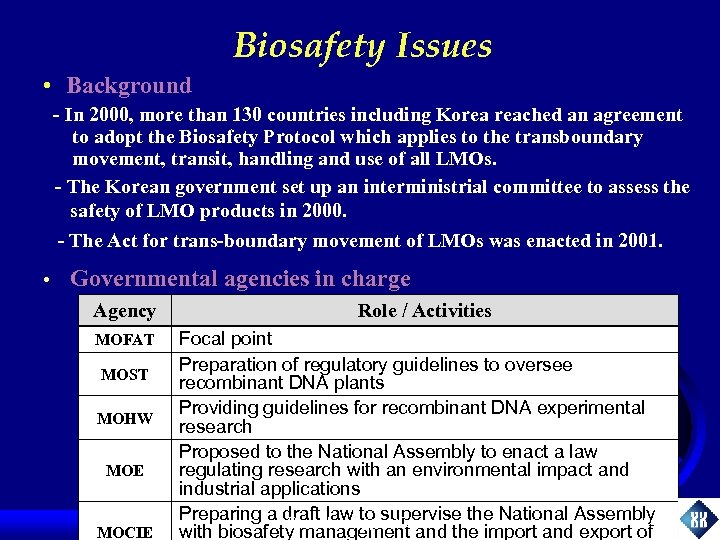
Biosafety Issues • Background - In 2000, more than 130 countries including Korea reached an agreement to adopt the Biosafety Protocol which applies to the transboundary movement, transit, handling and use of all LMOs. - The Korean government set up an interministrial committee to assess the safety of LMO products in 2000. - The Act for trans-boundary movement of LMOs was enacted in 2001. • Governmental agencies in charge Agency MOFAT MOST MOHW MOE MOCIE Role / Activities Focal point Preparation of regulatory guidelines to oversee recombinant DNA plants Providing guidelines for recombinant DNA experimental research Proposed to the National Assembly to enact a law regulating research with an environmental impact and industrial applications Preparing a draft law to in Korea supervise the National Assembly 24 Biotechnology with biosafety management and the import and export of
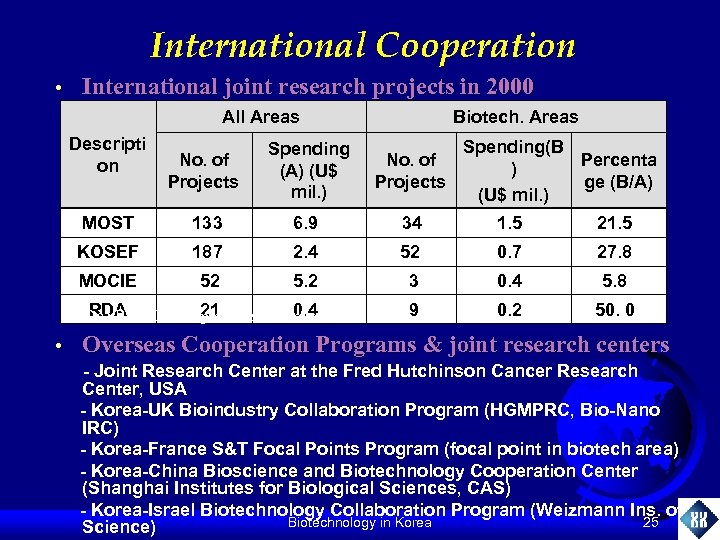
International Cooperation • International joint research projects in 2000 All Areas Descripti on Biotech. Areas Spending(B Percenta ) ge (B/A) (U$ mil. ) No. of Projects Spending (A) (U$ mil. ) No. of Projects MOST 133 6. 9 34 1. 5 21. 5 KOSEF 187 2. 4 52 0. 7 27. 8 MOCIE 52 5. 2 3 0. 4 5. 8 9 0. 2 50. 0 21 0. 4 RDA * RDA: Rural Development Administration • Overseas Cooperation Programs & joint research centers - Joint Research Center at the Fred Hutchinson Cancer Research Center, USA - Korea-UK Bioindustry Collaboration Program (HGMPRC, Bio-Nano IRC) - Korea-France S&T Focal Points Program (focal point in biotech area) - Korea-China Bioscience and Biotechnology Cooperation Center (Shanghai Institutes for Biological Sciences, CAS) - Korea-Israel Biotechnology Collaboration Program (Weizmann Ins. of 25 Biotechnology in Korea Science)
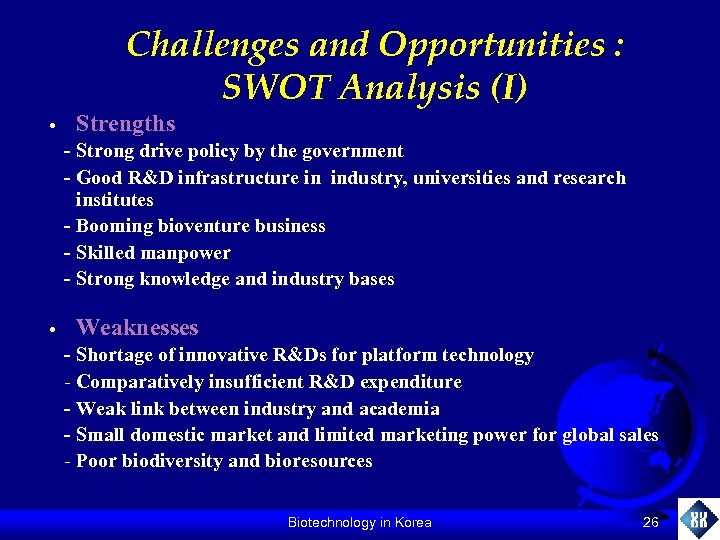
Challenges and Opportunities : SWOT Analysis (I) • Strengths - Strong drive policy by the government - Good R&D infrastructure in industry, universities and research institutes - Booming bioventure business - Skilled manpower - Strong knowledge and industry bases • Weaknesses - Shortage of innovative R&Ds for platform technology - Comparatively insufficient R&D expenditure - Weak link between industry and academia - Small domestic market and limited marketing power for global sales - Poor biodiversity and bioresources Biotechnology in Korea 26
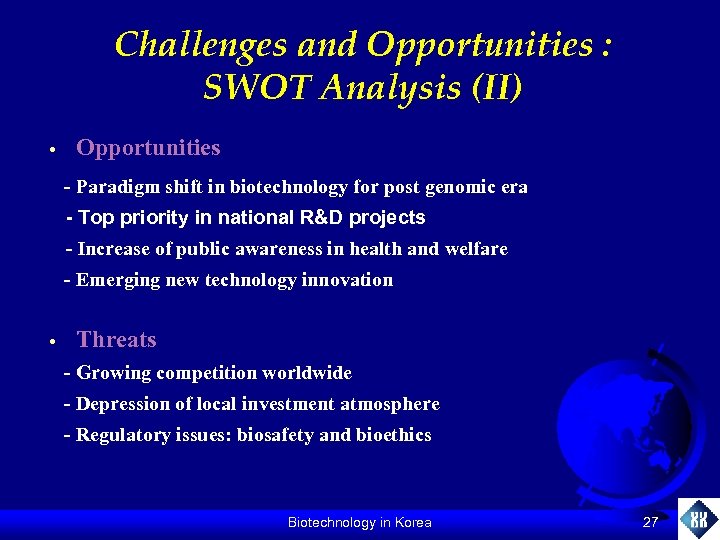
Challenges and Opportunities : SWOT Analysis (II) • Opportunities - Paradigm shift in biotechnology for post genomic era - Top priority in national R&D projects - Increase of public awareness in health and welfare - Emerging new technology innovation • Threats - Growing competition worldwide - Depression of local investment atmosphere - Regulatory issues: biosafety and bioethics Biotechnology in Korea 27
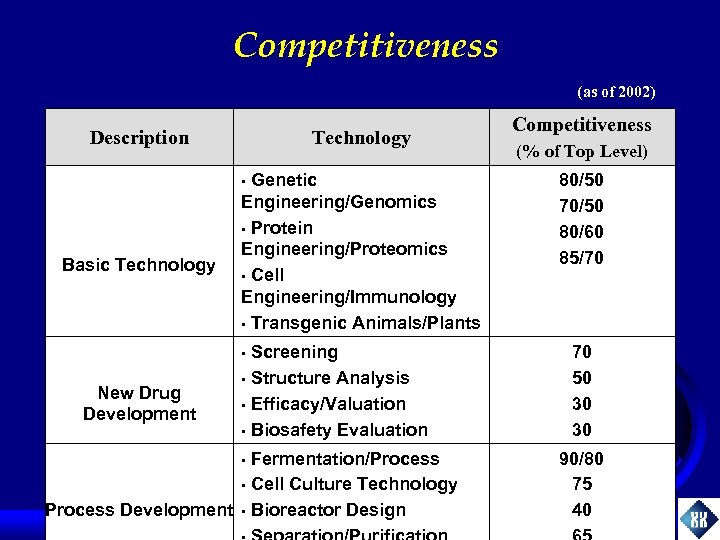
Competitiveness (as of 2002) Technology Description Genetic Engineering/Genomics • Protein Engineering/Proteomics • Cell Engineering/Immunology • Transgenic Animals/Plants • Basic Technology Screening • Structure Analysis • Efficacy/Valuation • Biosafety Evaluation • New Drug Development Fermentation/Process • Cell Culture Technology Process Development • Bioreactor Design • Biotechnology in Korea Competitiveness (% of Top Level) 80/50 70/50 80/60 85/70 70 50 30 30 90/80 75 40 28
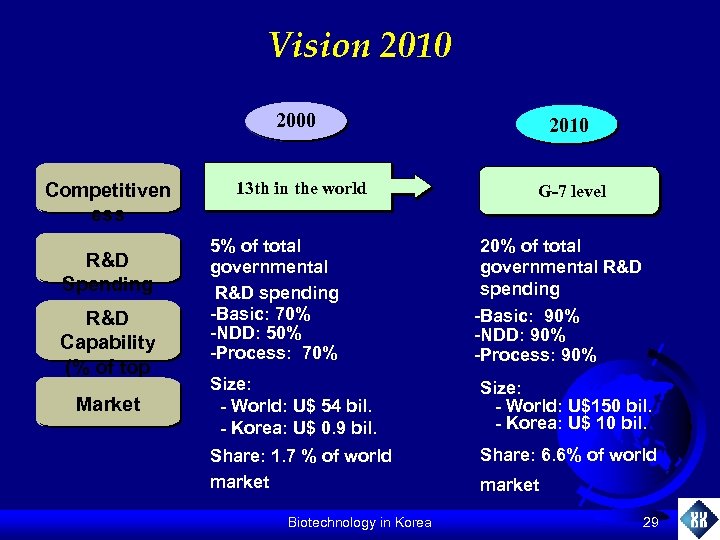
Vision 2010 2000 –현재 Competitiven 종 합 ess 종 R&D 합 Spending R&D 종 합 Capability (% of top level) 종 Market 합 2010 13 th in the world G-7 level –선진 – 7 개국 – 5% of total governmental R&D spending -Basic: 70% -NDD: 50% -Process: 70% 20% of total governmental R&D spending -Basic: 90% -NDD: 90% -Process: 90% Size: - World: U$ 54 bil. - Korea: U$ 0. 9 bil. Size: - World: U$150 bil. - Korea: U$ 10 bil. Share: 1. 7 % of world market Share: 6. 6% of world Biotechnology in Korea market 29
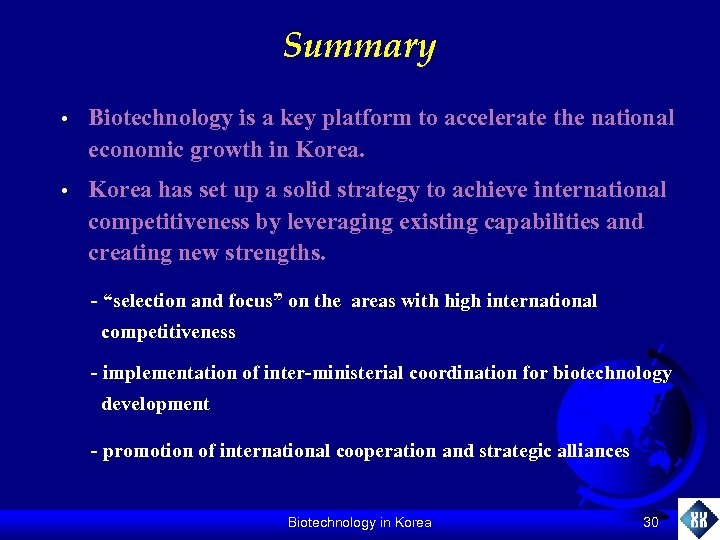
Summary • Biotechnology is a key platform to accelerate the national economic growth in Korea. • Korea has set up a solid strategy to achieve international competitiveness by leveraging existing capabilities and creating new strengths. - “selection and focus” on the areas with high international competitiveness - implementation of inter-ministerial coordination for biotechnology development - promotion of international cooperation and strategic alliances Biotechnology in Korea 30
Thank you ! Biotechnology in Korea 31
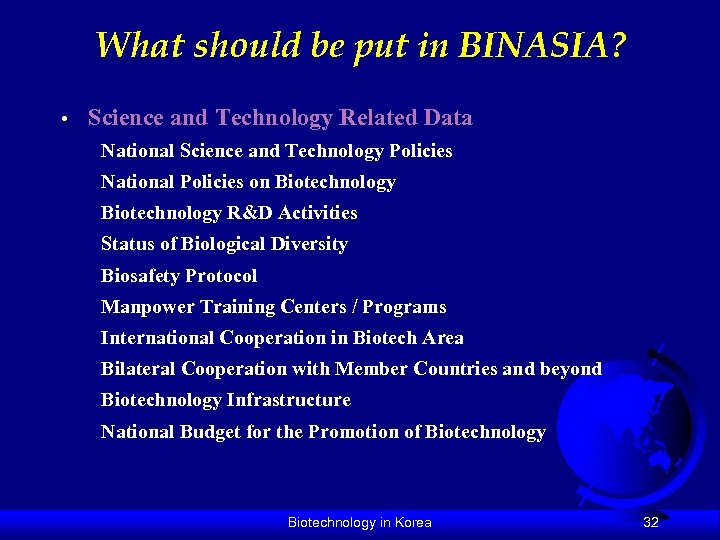
What should be put in BINASIA? • Science and Technology Related Data National Science and Technology Policies National Policies on Biotechnology R&D Activities Status of Biological Diversity Biosafety Protocol Manpower Training Centers / Programs International Cooperation in Biotech Area Bilateral Cooperation with Member Countries and beyond Biotechnology Infrastructure National Budget for the Promotion of Biotechnology in Korea 32
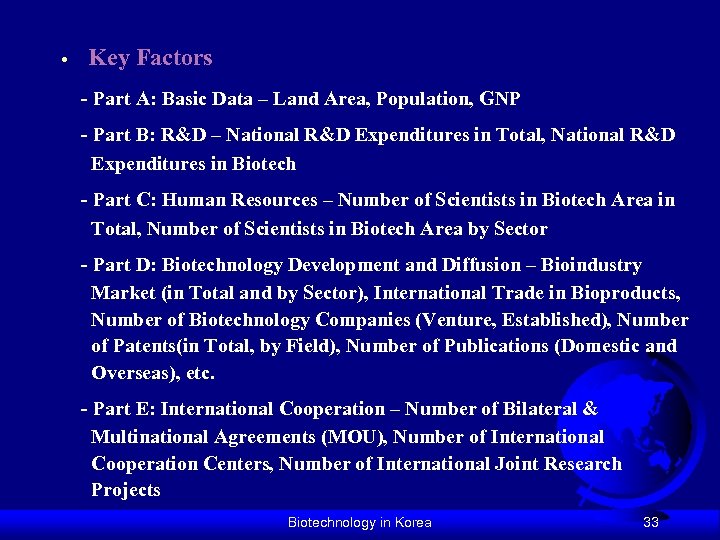
• Key Factors - Part A: Basic Data – Land Area, Population, GNP - Part B: R&D – National R&D Expenditures in Total, National R&D Expenditures in Biotech - Part C: Human Resources – Number of Scientists in Biotech Area in Total, Number of Scientists in Biotech Area by Sector - Part D: Biotechnology Development and Diffusion – Bioindustry Market (in Total and by Sector), International Trade in Bioproducts, Number of Biotechnology Companies (Venture, Established), Number of Patents(in Total, by Field), Number of Publications (Domestic and Overseas), etc. - Part E: International Cooperation – Number of Bilateral & Multinational Agreements (MOU), Number of International Cooperation Centers, Number of International Joint Research Projects Biotechnology in Korea 33
Скачать презентацию Korean Initiatives on Biotechnology Challenges and Opportunities Expert
819d929359c047e164d3195f03cc3486.ppt