


 Скачать презентацию Korea s Success Model of Industrialization and Roles of
6d51690d285028030610814c03e93966.ppt
- Количество слайдов: 65
 Korea’s Success Model of Industrialization and Roles of Deans Council in Economic Development 20 th October, 2010 Singapore Prof. Wonjong Joo Innovation Center for Engineering Education Seoul National Univ. of Science and Technology
 Contents I. Korea’s Compressed Development Model II. Innovation Center for Engineering Education III. Seoul Tech ICEE Operation 2
 I. Korea’s Compressed Development Model
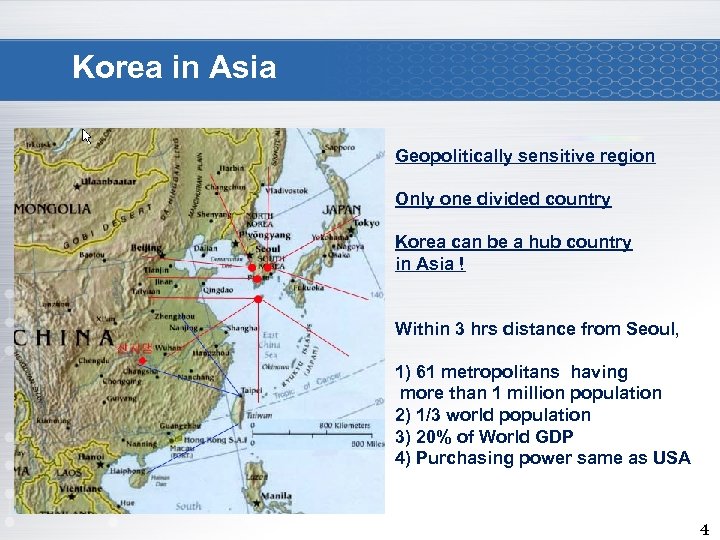 Korea in Asia Geopolitically sensitive region Only one divided country Korea can be a hub country in Asia ! Within 3 hrs distance from Seoul, 1) 61 metropolitans having more than 1 million population 2) 1/3 world population 3) 20% of World GDP 4) Purchasing power same as USA 4
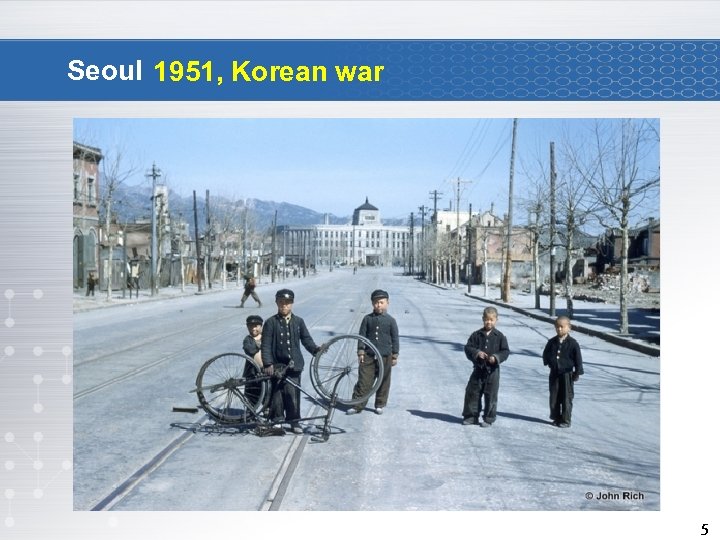 Seoul 1951, Korean war 5
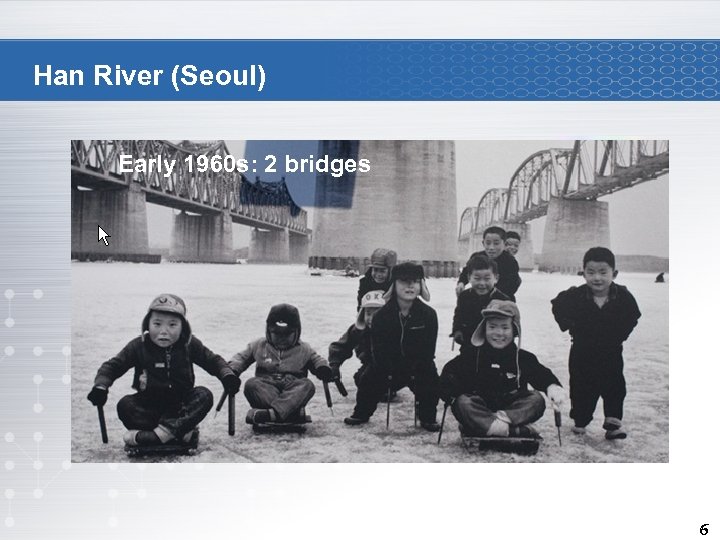 Han River (Seoul) Early 1960 s: 2 bridges 6
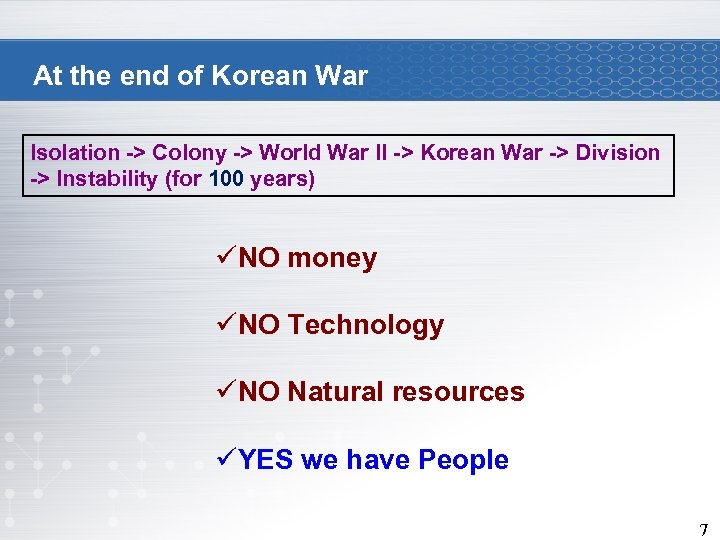 At the end of Korean War Isolation -> Colony -> World War II -> Korean War -> Division -> Instability (for 100 years) üNO money üNO Technology üNO Natural resources üYES we have People 7
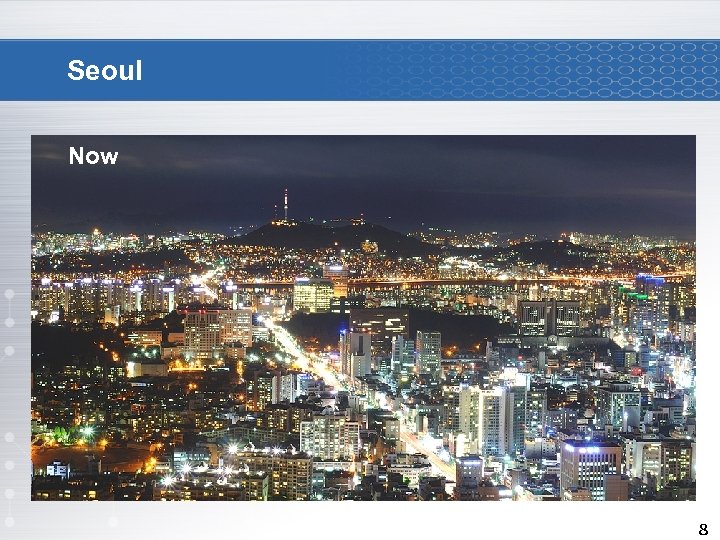 Seoul Now 8
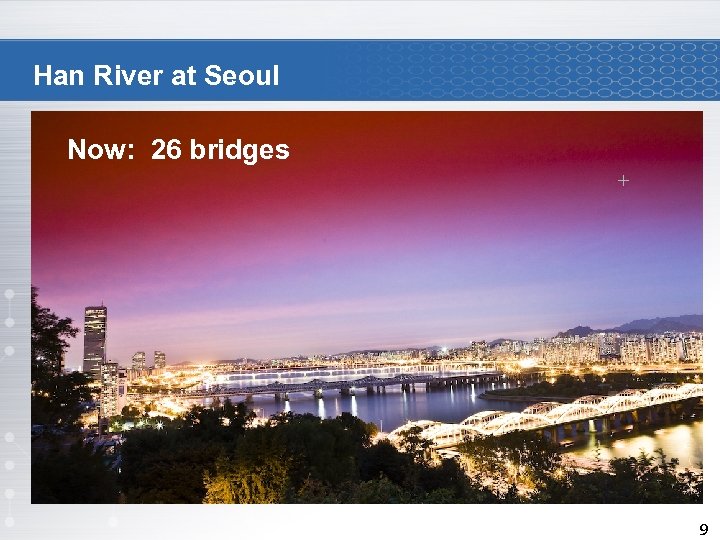 Han River at Seoul Now: 26 bridges 9
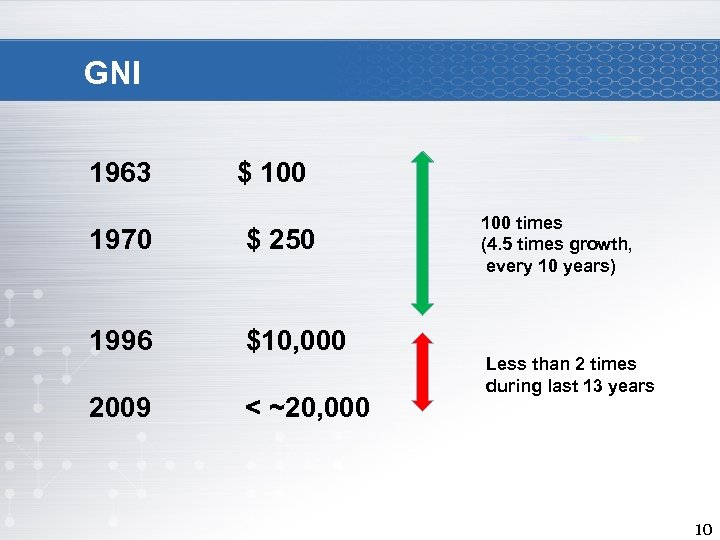 GNI 1963 $ 100 1970 $ 250 1996 $10, 000 2009 < ~20, 000 100 times (4. 5 times growth, every 10 years) Less than 2 times during last 13 years 10
 Strong Leadership 11
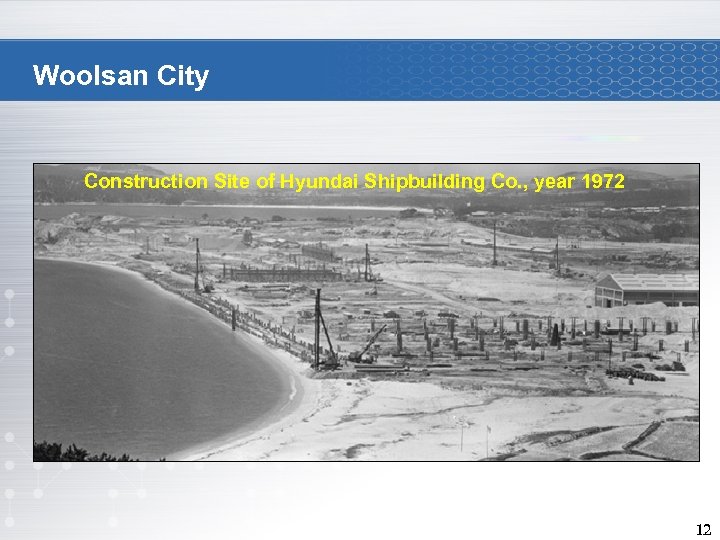 Woolsan City Construction Site of Hyundai Shipbuilding Co. , year 1972 12
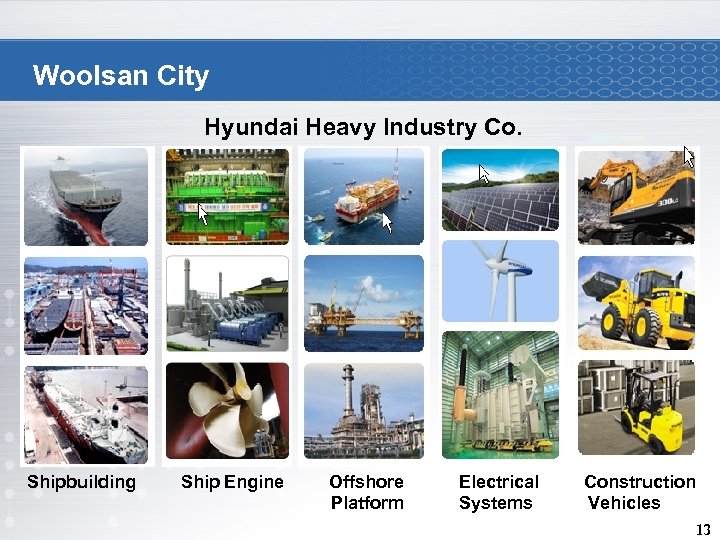 Woolsan City Hyundai Heavy Industry Co. Shipbuilding Ship Engine Offshore Platform Electrical Systems Construction Vehicles 13
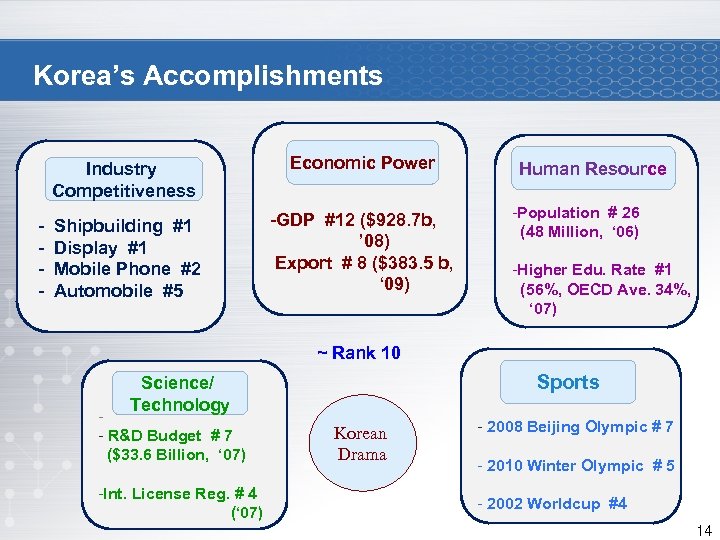 Korea’s Accomplishments Industry Competitiveness - Economic Power Shipbuilding #1 Display #1 Mobile Phone #2 Automobile #5 -GDP #12 ($928. 7 b, ’ 08) Export # 8 ($383. 5 b, ‘ 09) Human Resource -Population # 26 (48 Million, ‘ 06) -Higher Edu. Rate #1 (56%, OECD Ave. 34%, ‘ 07) ~ Rank 10 Sports Science/ Technology - R&D Budget # 7 ($33. 6 Billion, ‘ 07) -Int. License Reg. # 4 (‘ 07) Korean Drama - 2008 Beijing Olympic # 7 - 2010 Winter Olympic # 5 - 2002 Worldcup #4 14
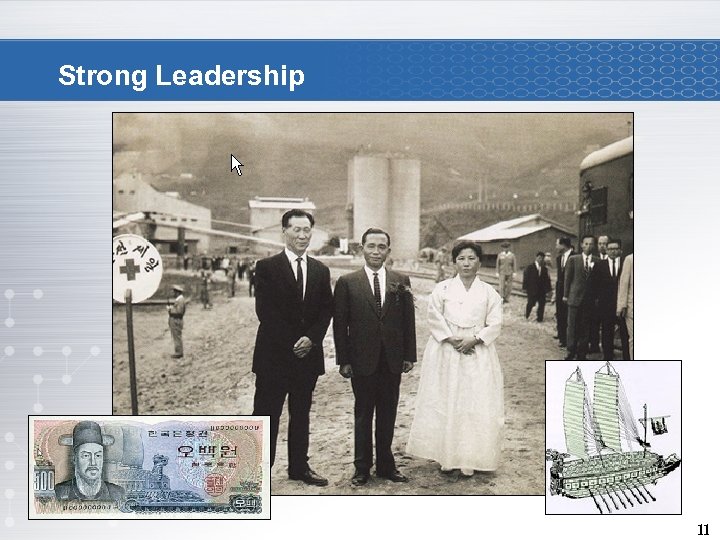
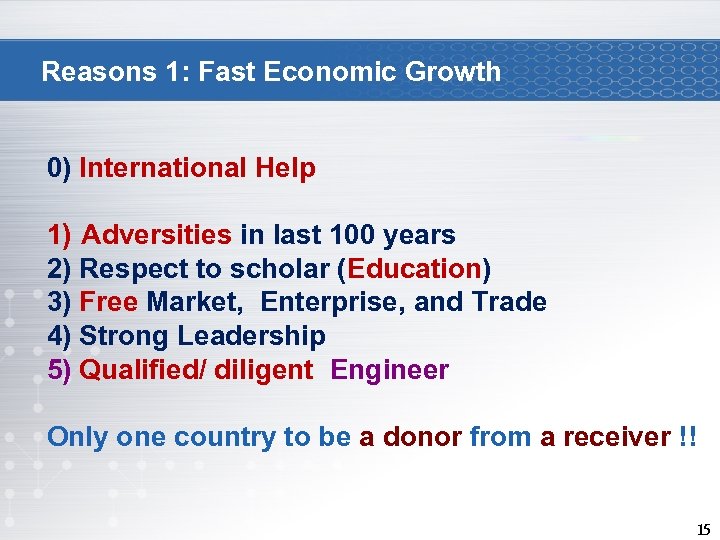 Reasons 1: Fast Economic Growth 0) International Help 1) Adversities in last 100 years 2) Respect to scholar (Education) 3) Free Market, Enterprise, and Trade 4) Strong Leadership 5) Qualified/ diligent Engineer Only one country to be a donor from a receiver !! 15
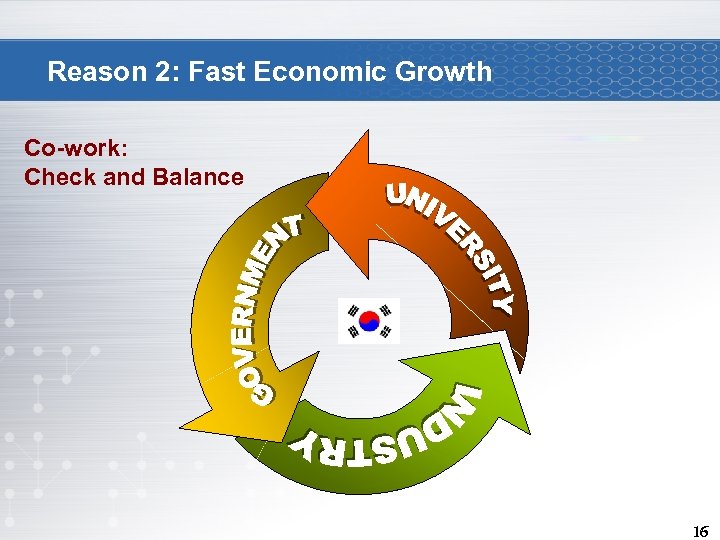 Reason 2: Fast Economic Growth Co-work: Check and Balance 16
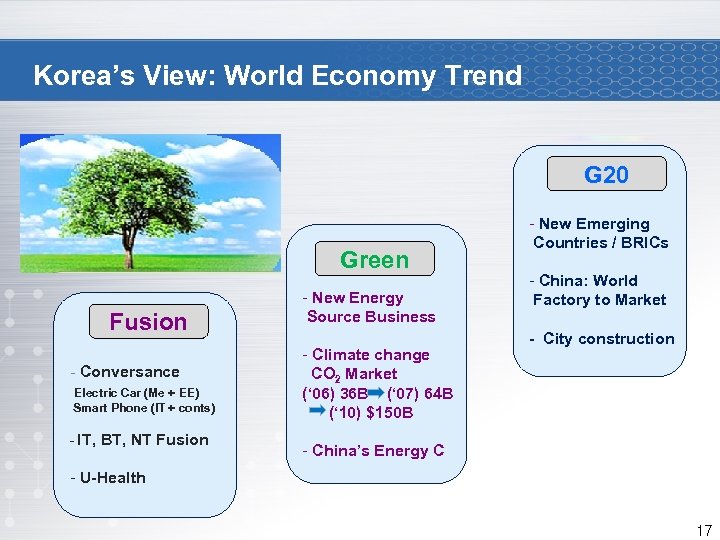 Korea’s View: World Economy Trend G 20 Green Fusion - Conversance Electric Car (Me + EE) Smart Phone (IT + conts) - IT, BT, NT Fusion - New Energy Source Business - Climate change CO 2 Market (‘ 06) 36 B (‘ 07) 64 B (‘ 10) $150 B - New Emerging Countries / BRICs - China: World Factory to Market - City construction - China’s Energy C - U-Health 17
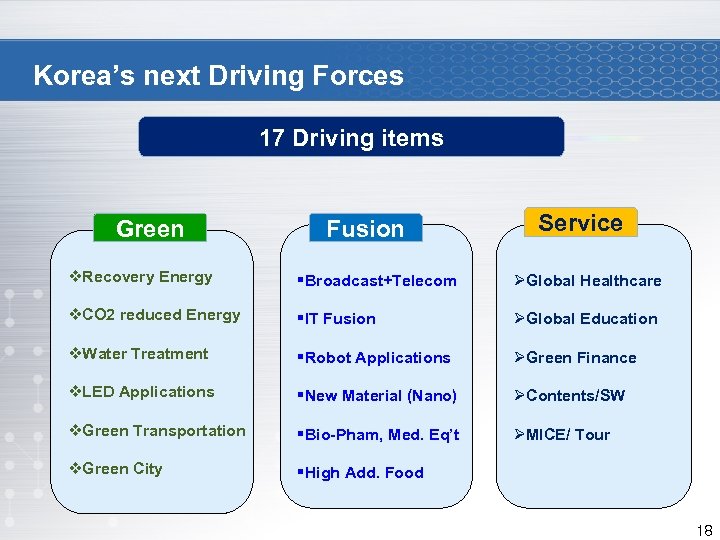 Korea’s next Driving Forces 17 Driving items Green Fusion Service v. Recovery Energy §Broadcast+Telecom ØGlobal Healthcare v. CO 2 reduced Energy §IT Fusion ØGlobal Education v. Water Treatment §Robot Applications ØGreen Finance v. LED Applications §New Material (Nano) ØContents/SW v. Green Transportation §Bio-Pham, Med. Eq’t ØMICE/ Tour v. Green City §High Add. Food 18
 II. Innovation Center for Engineering Education < Change everything except wife!> 19
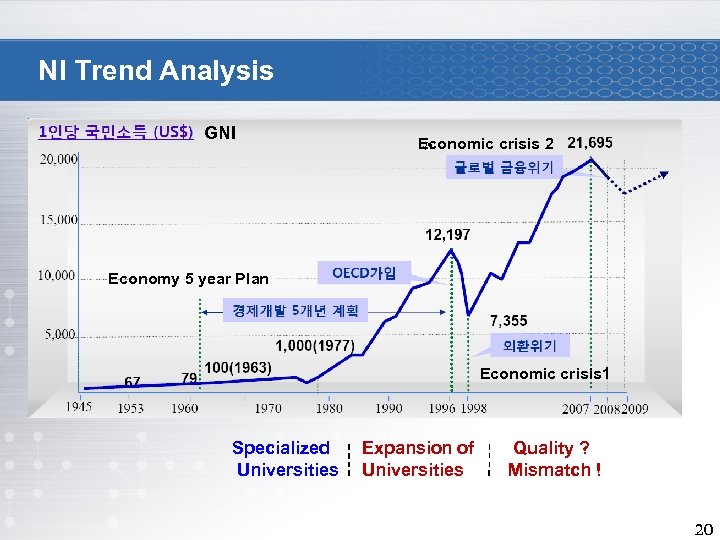 NI Trend Analysis GNI Economic crisis 2 Economy 5 year Plan Economic crisis 1 Specialized Universities Expansion of Universities Quality ? Mismatch ! 20
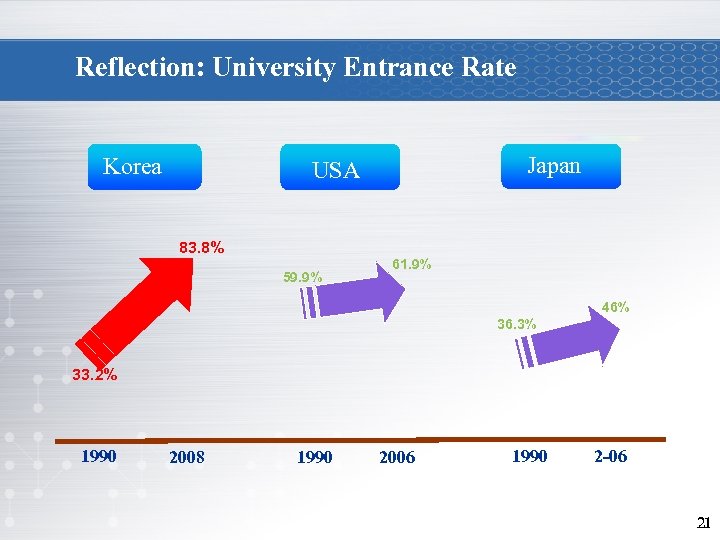 Reflection: University Entrance Rate Korea Japan USA 83. 8% 59. 9% 61. 9% 46% 36. 3% 33. 2% 1990 2008 1990 2006 1990 2 -06 21
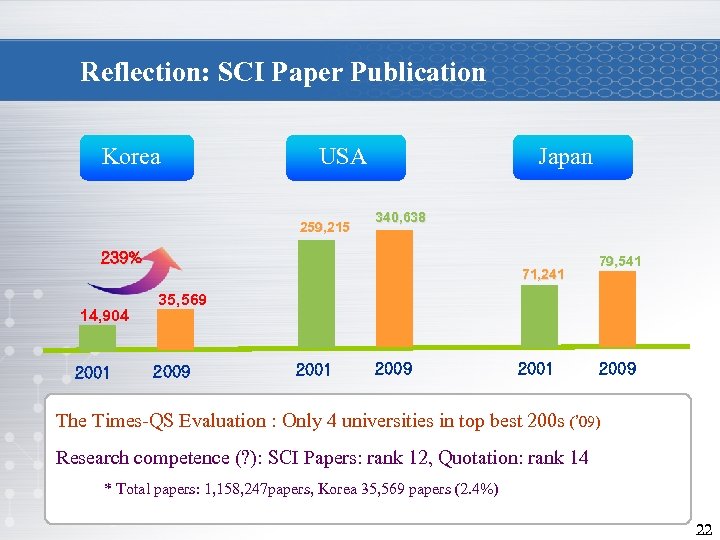 Reflection: SCI Paper Publication Korea Japan USA 259, 215 340, 638 239% 14, 904 2001 71, 241 79, 541 35, 569 2001 2009 The Times-QS Evaluation : Only 4 universities in top best 200 s (’ 09) Research competence (? ): SCI Papers: rank 12, Quotation: rank 14 * Total papers: 1, 158, 247 papers, Korea 35, 569 papers (2. 4%) 22
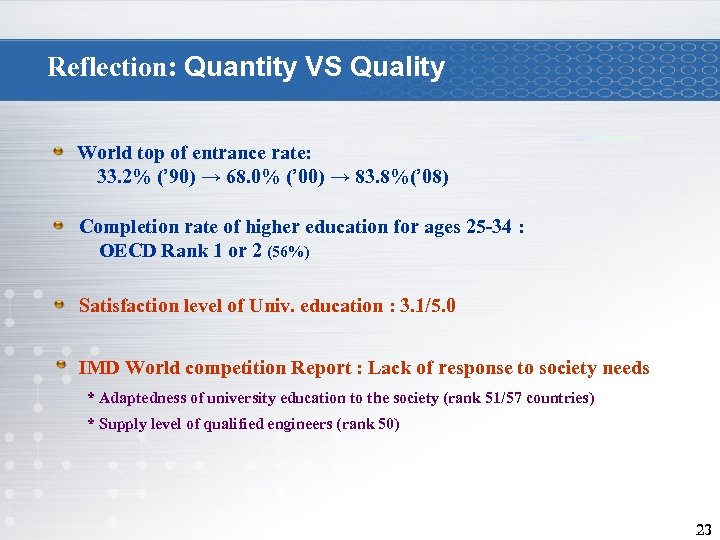 Reflection: Quantity VS Quality World top of entrance rate: 33. 2% (’ 90) → 68. 0% (’ 00) → 83. 8%(’ 08) Completion rate of higher education for ages 25 -34 : OECD Rank 1 or 2 (56%) Satisfaction level of Univ. education : 3. 1/5. 0 IMD World competition Report : Lack of response to society needs * Adaptedness of university education to the society (rank 51/57 countries) * Supply level of qualified engineers (rank 50) 23
 Innovation = Specialization 24 24
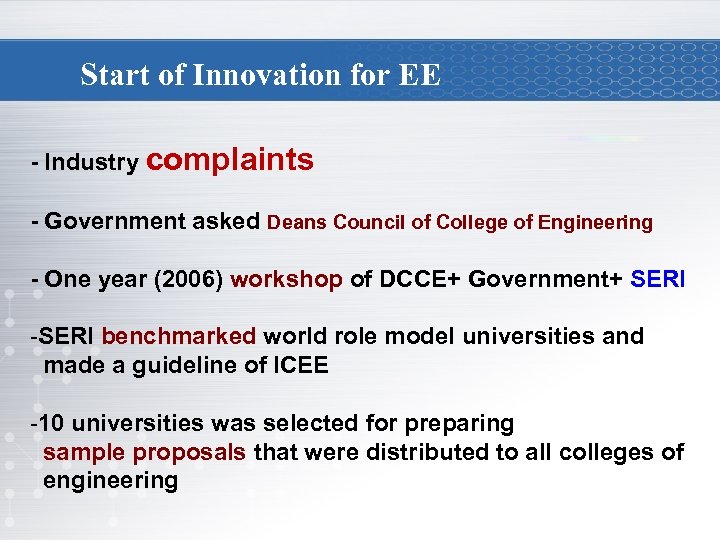 Start of Innovation for EE - Industry complaints - Government asked Deans Council of College of Engineering - One year (2006) workshop of DCCE+ Government+ SERI -SERI benchmarked world role model universities and made a guideline of ICEE -10 universities was selected for preparing sample proposals that were distributed to all colleges of engineering
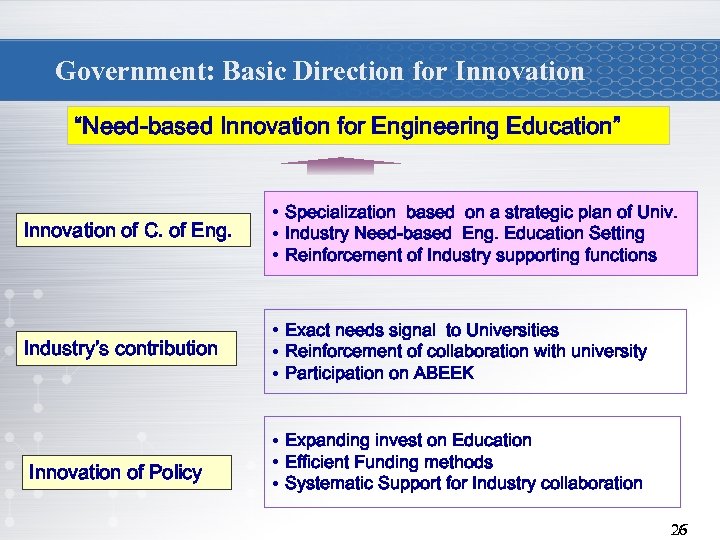 Government: Basic Direction for Innovation “Need-based Innovation for Engineering Education” Innovation of C. of Eng. • Specialization based on a strategic plan of Univ. • Industry Need-based Eng. Education Setting • Reinforcement of Industry supporting functions Industry’s contribution • Exact needs signal to Universities • Reinforcement of collaboration with university • Participation on ABEEK Innovation of Policy • Expanding invest on Education • Efficient Funding methods • Systematic Support for Industry collaboration 26
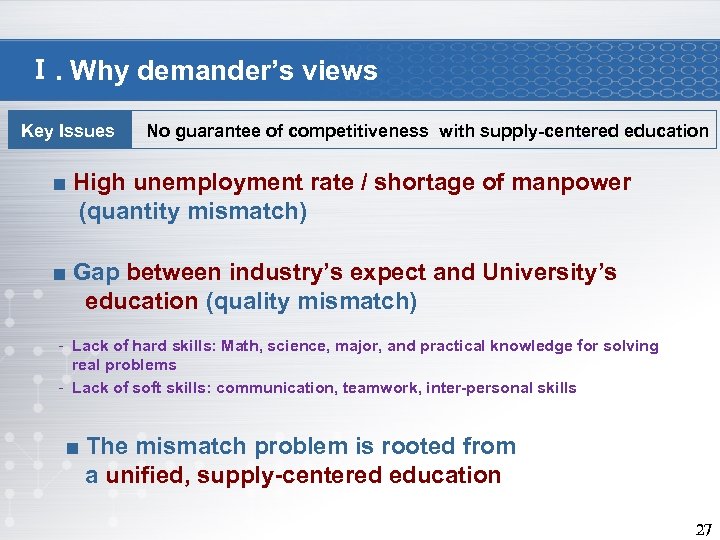 Ⅰ. Why demander’s views Key Issues No guarantee of competitiveness with supply-centered education ■ High unemployment rate / shortage of manpower (quantity mismatch) ■ Gap between industry’s expect and University’s education (quality mismatch) - Lack of hard skills: Math, science, major, and practical knowledge for solving real problems - Lack of soft skills: communication, teamwork, inter-personal skills ■ The mismatch problem is rooted from a unified, supply-centered education 27
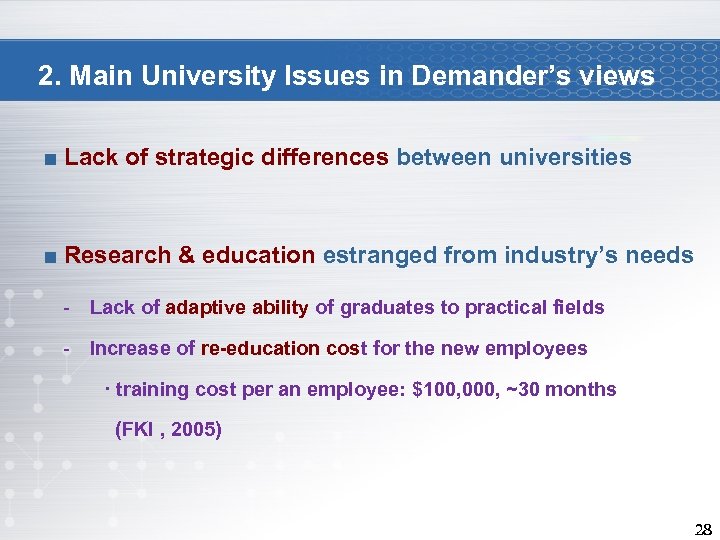 2. Main University Issues in Demander’s views ■ Lack of strategic differences between universities ■ Research & education estranged from industry’s needs - Lack of adaptive ability of graduates to practical fields - Increase of re-education cost for the new employees · training cost per an employee: $100, 000, ~30 months (FKI , 2005) 28
 Innovation = Our Own 29 29
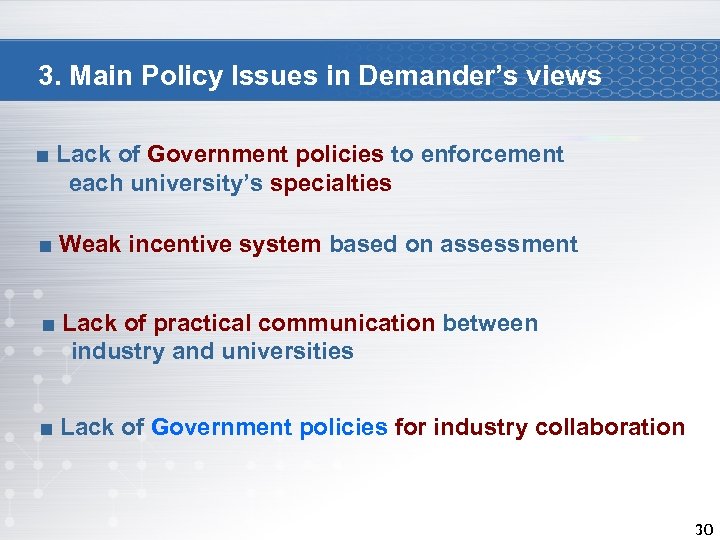 3. Main Policy Issues in Demander’s views ■ Lack of Government policies to enforcement each university’s specialties ■ Weak incentive system based on assessment ■ Lack of practical communication between industry and universities ■ Lack of Government policies for industry collaboration 30
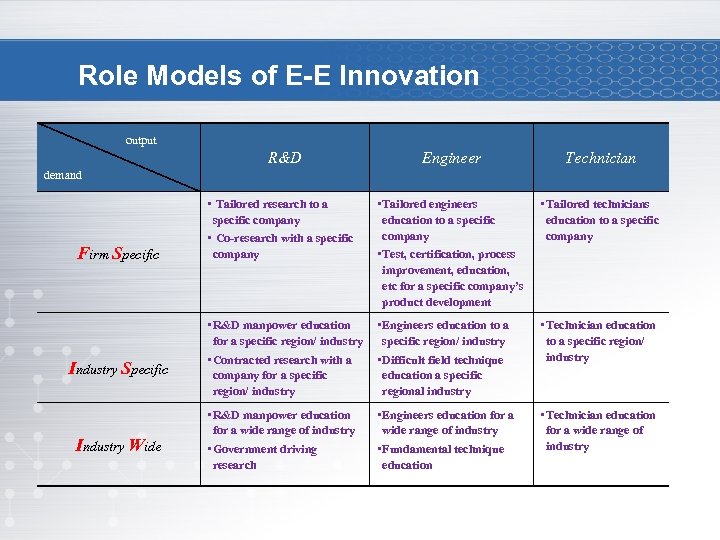
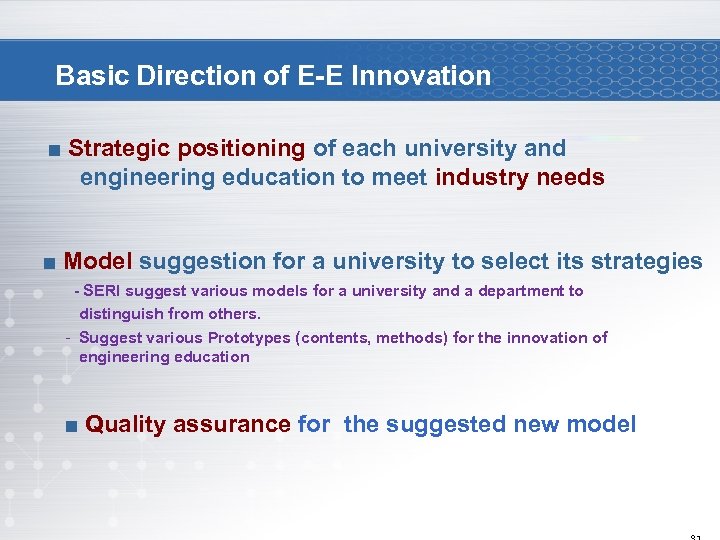 Basic Direction of E-E Innovation ■ Strategic positioning of each university and engineering education to meet industry needs ■ Model suggestion for a university to select its strategies - SERI suggest various models for a university and a department to distinguish from others. - Suggest various Prototypes (contents, methods) for the innovation of engineering education ■ Quality assurance for the suggested new model
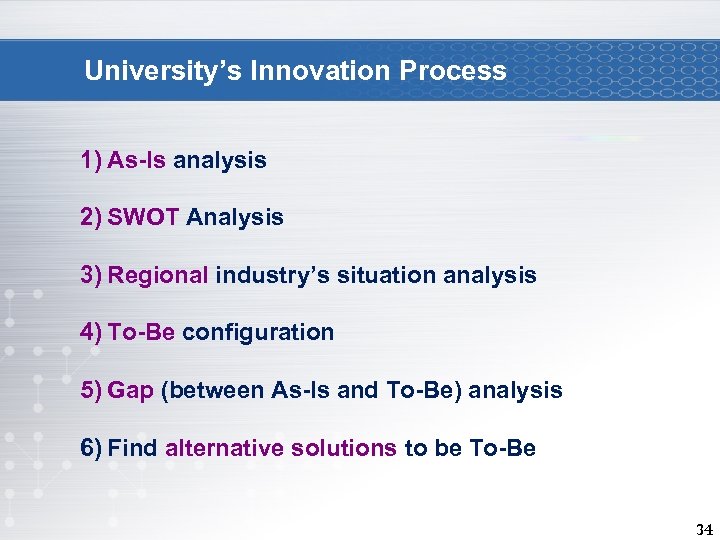
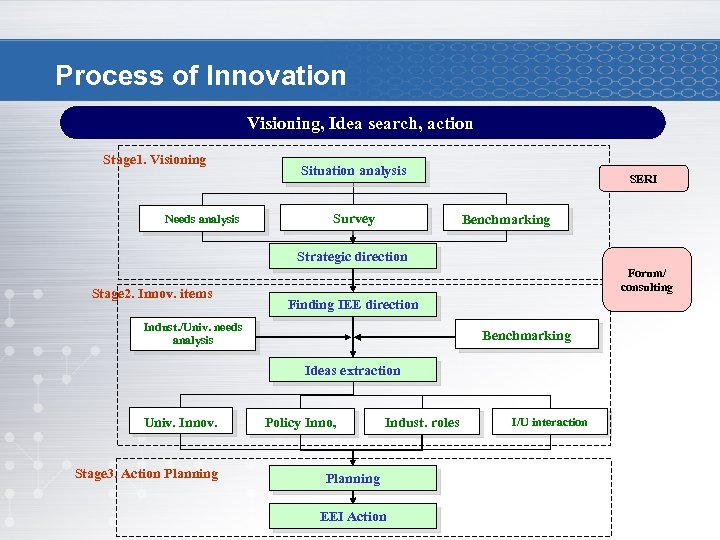 Process of Innovation Visioning, Idea search, action Stage 1. Visioning Needs analysis Situation analysis Survey SERI Benchmarking Strategic direction Stage 2. Innov. items Forum/ consulting Finding IEE direction Indust. /Univ. needs analysis Benchmarking Ideas extraction Univ. Innov. Stage 3. Action Planning Policy Inno, Indust. roles Planning EEI Action I/U interaction
 Innovation = Competition 33
 University’s Innovation Process 1) As-Is analysis 2) SWOT Analysis 3) Regional industry’s situation analysis 4) To-Be configuration 5) Gap (between As-Is and To-Be) analysis 6) Find alternative solutions to be To-Be 34
 Role Models of E-E Innovation output R&D Engineer Technician • Tailored research to a specific company • Co-research with a specific company • Tailored engineers education to a specific company • Test, certification, process improvement, education, etc for a specific company’s product development • Tailored technicians education to a specific company • R&D manpower education for a specific region/ industry • Contracted research with a company for a specific region/ industry • Engineers education to a specific region/ industry • Difficult field technique education a specific regional industry • Technician education to a specific region/ industry • R&D manpower education for a wide range of industry • Government driving research • Engineers education for a wide range of industry • Fundamental technique education • Technician education for a wide range of industry demand Firm Specific Industry Wide
 University A Configuration output R&D Engineer Technician demand B Configuration Firm Specific A-1 Department Industry Specific A-2 Department Industry Wide A-3 Department
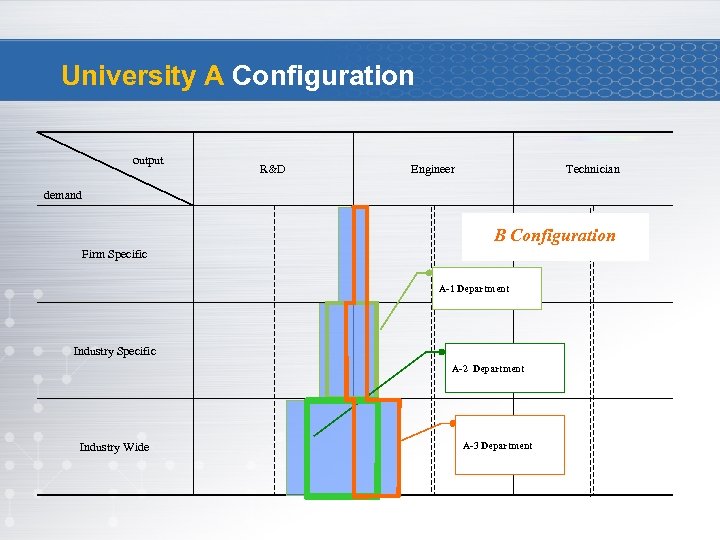
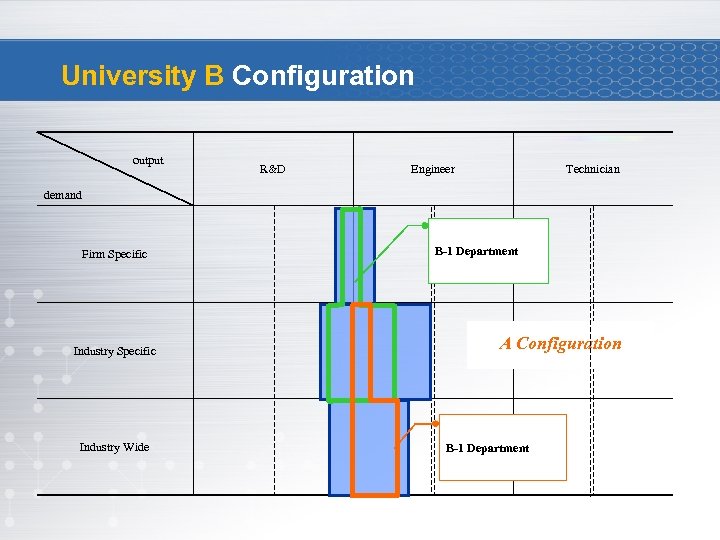 University B Configuration output R&D Engineer Technician demand Firm Specific Industry Wide B-1 Department A Configuration B-1 Department
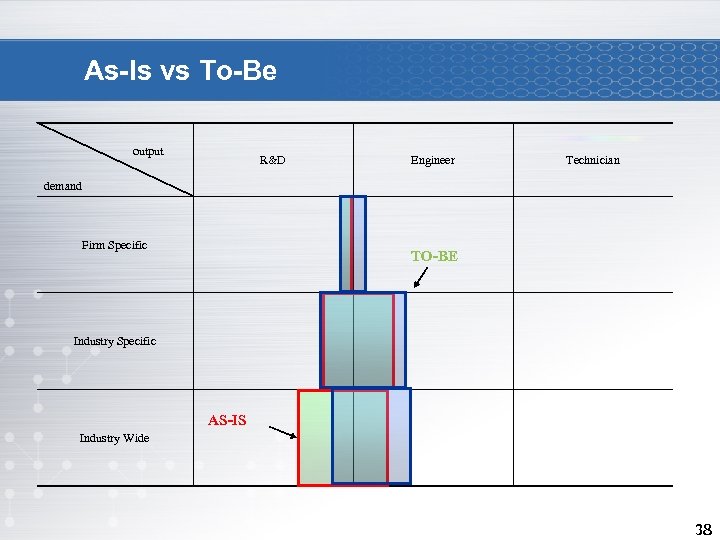 As-Is vs To-Be output R&D Engineer Technician demand Firm Specific TO-BE Industry Specific AS-IS Industry Wide 38
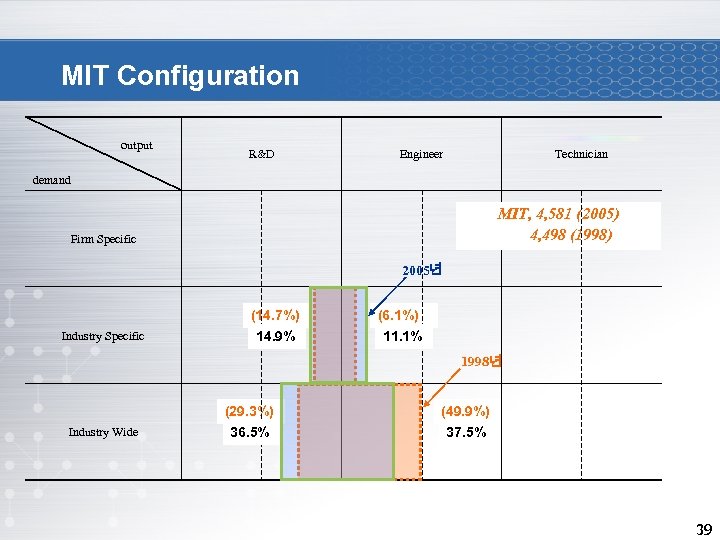 MIT Configuration output R&D Engineer Technician demand MIT, 4, 581 (2005) 4, 498 (1998) Firm Specific 2005년 (14. 7%) Industry Specific (6. 1%) 14. 9% 11. 1% 1998년 (29. 3%) Industry Wide (49. 9%) 36. 5% 37. 5% 39
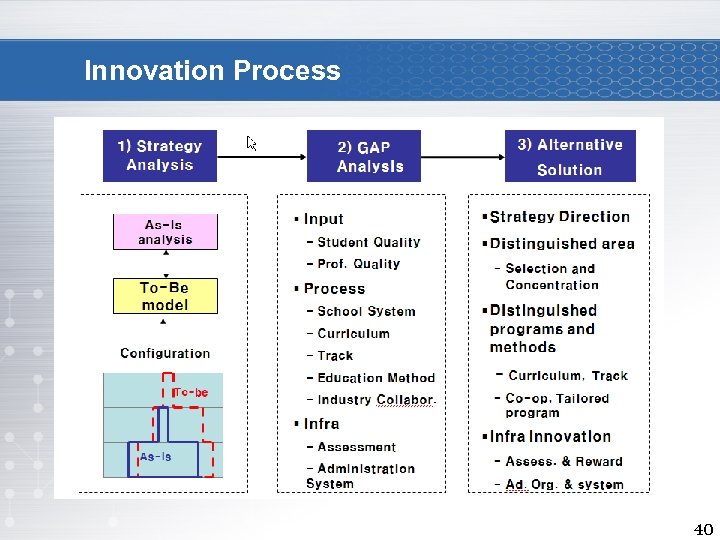 Innovation Process 40
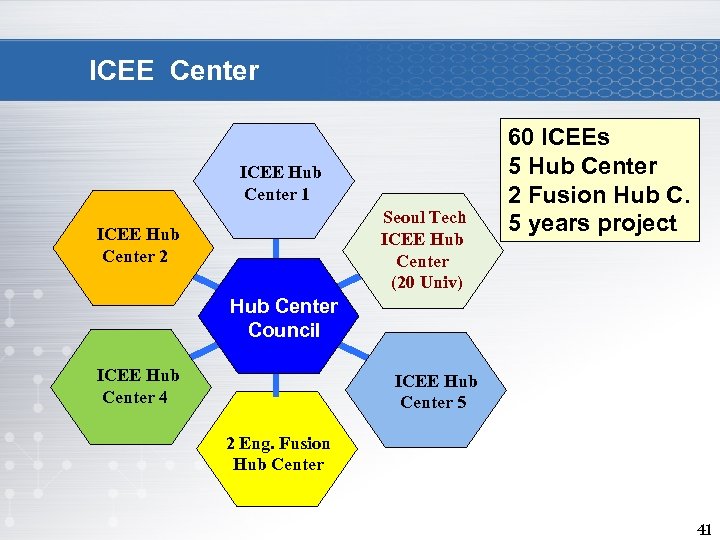 ICEE Center ICEE Hub Center 1 Seoul Tech ICEE Hub Center (20 Univ) ICEE Hub Center 2 60 ICEEs 5 Hub Center 2 Fusion Hub C. 5 years project Hub Center Council ICEE Hub Center 4 ICEE Hub Center 5 2 Eng. Fusion Hub Center 41
 III. Seoul Tech ICEE Operation
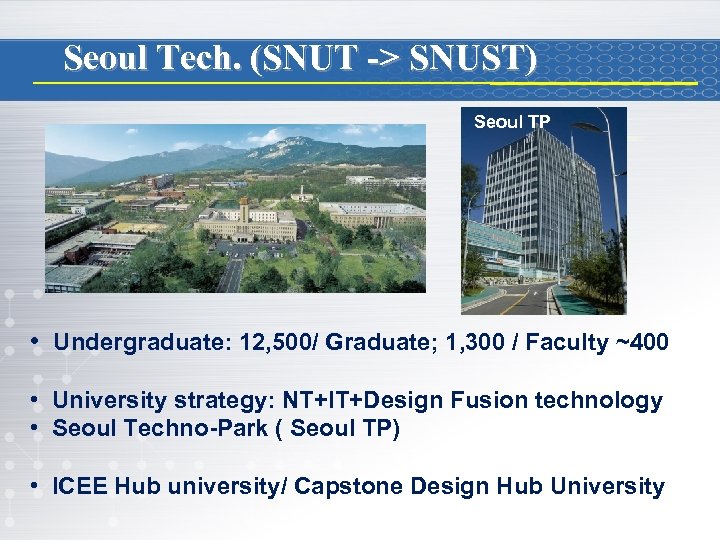 Seoul Tech. (SNUT -> SNUST) Seoul TP • Undergraduate: 12, 500/ Graduate; 1, 300 / Faculty ~400 • University strategy: NT+IT+Design Fusion technology • Seoul Techno-Park ( Seoul TP) • ICEE Hub university/ Capstone Design Hub University
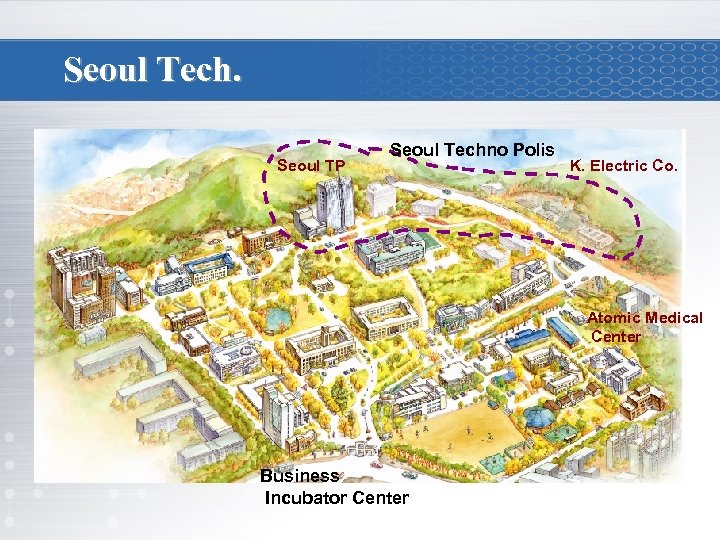 Seoul Tech. Seoul TP Seoul Techno Polis K. Electric Co. Atomic Medical Center Business Incubator Center
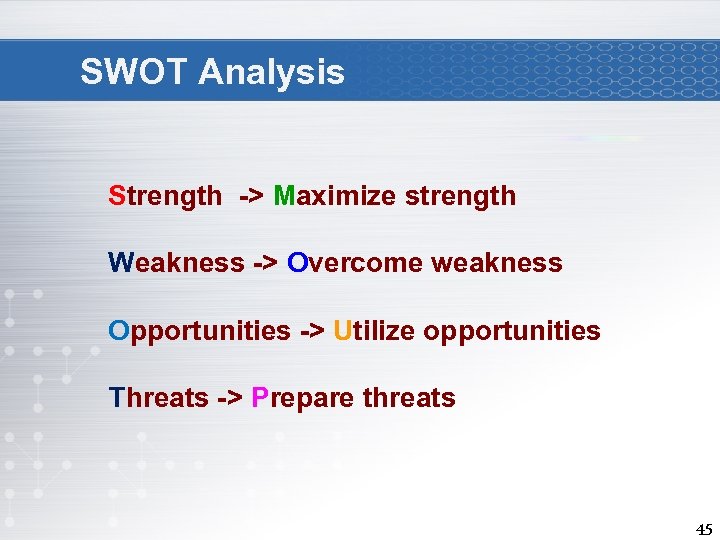 SWOT Analysis Strength -> Maximize strength Weakness -> Overcome weakness Opportunities -> Utilize opportunities Threats -> Prepare threats 45
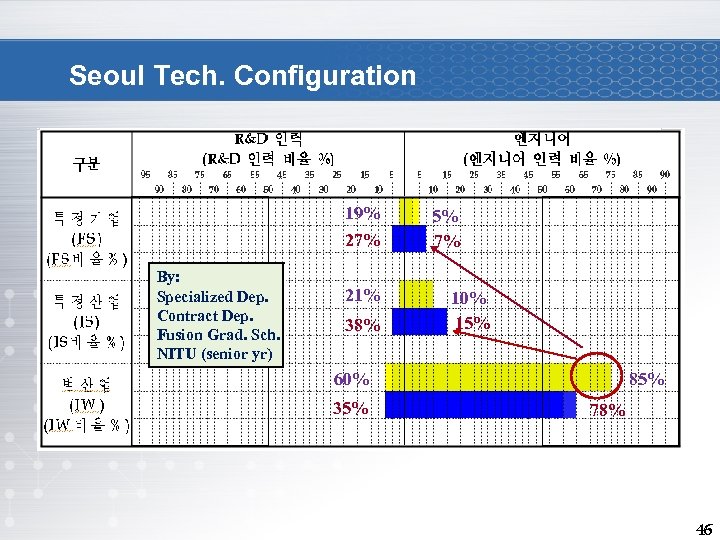 Seoul Tech. Configuration 19% 27% By: Specialized Dep. Contract Dep. Fusion Grad. Sch. NITU (senior yr) 21% 38% 5% 7% 10% 15% 60% 35% 85% 78% 46
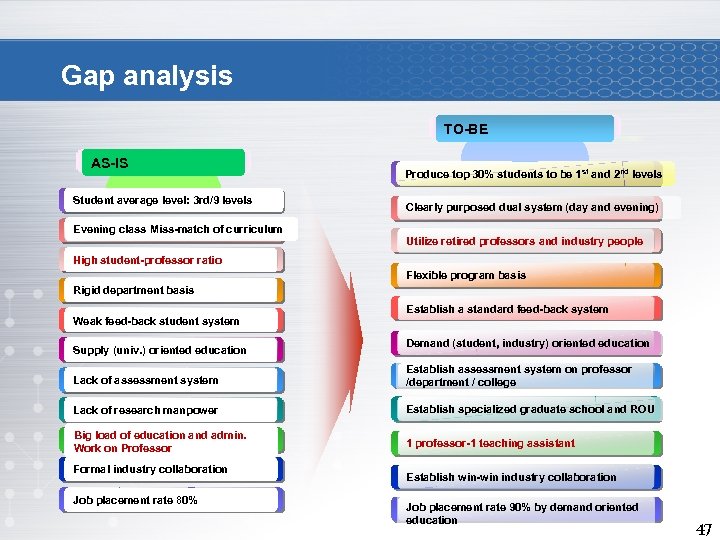 Gap analysis TO-BE AS-IS Student average level: 3 rd/9 levels Evening class Miss-match of curriculum Produce top 30% students to be 1 st and 2 nd levels Clearly purposed dual system (day and evening) Utilize retired professors and industry people High student-professor ratio Flexible program basis Rigid department basis Weak feed-back student system Supply (univ. ) oriented education Establish a standard feed-back system Demand (student, industry) oriented education Lack of assessment system Establish assessment system on professor /department / college Lack of research manpower Establish specialized graduate school and ROU Big load of education and admin. Work on Professor 1 professor-1 teaching assistant Formal industry collaboration Job placement rate 80% Establish win-win industry collaboration Job placement rate 90% by demand oriented education 47
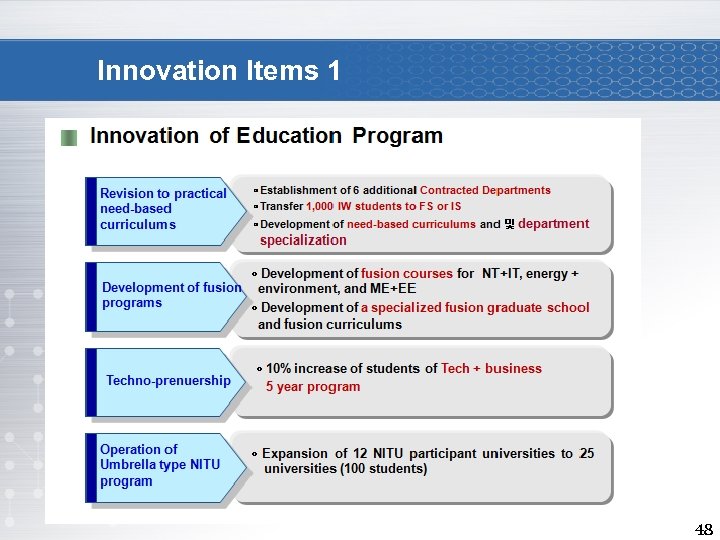 Innovation Items 1 48
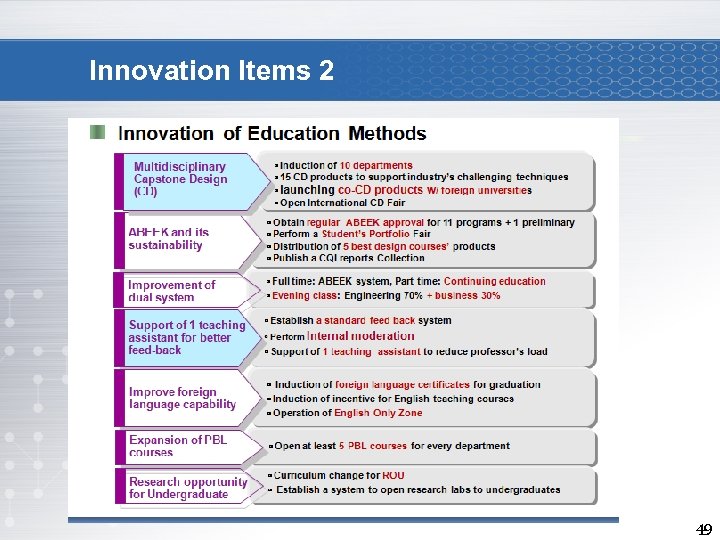 Innovation Items 2 49
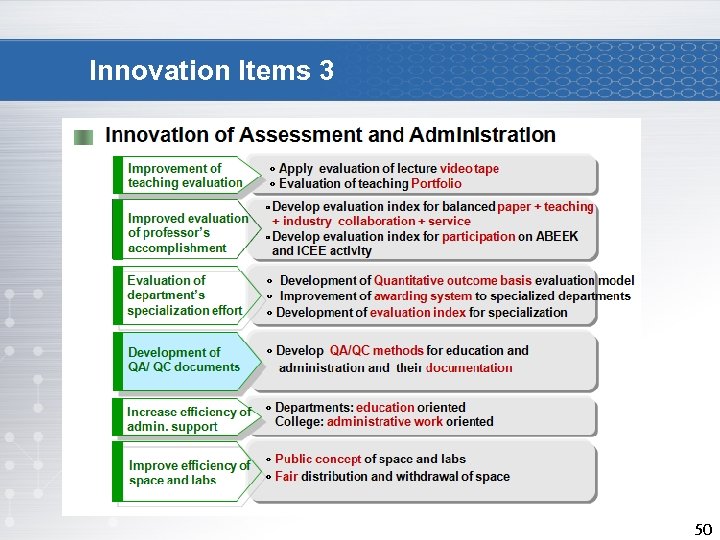 Innovation Items 3 50
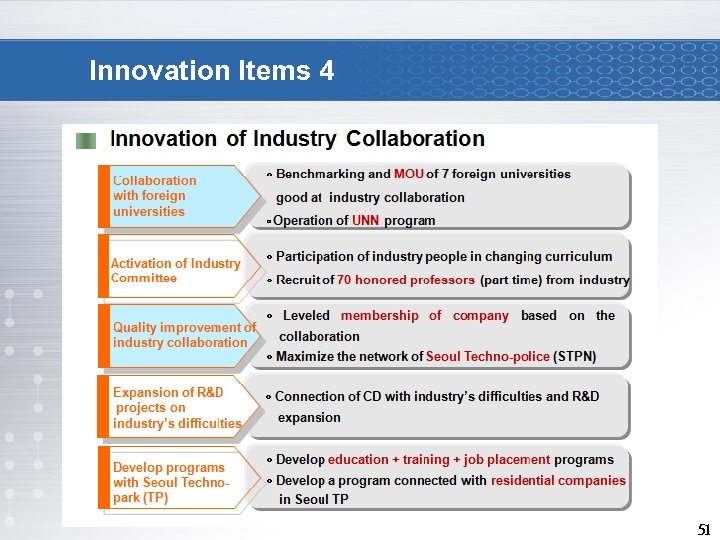 Innovation Items 4 51
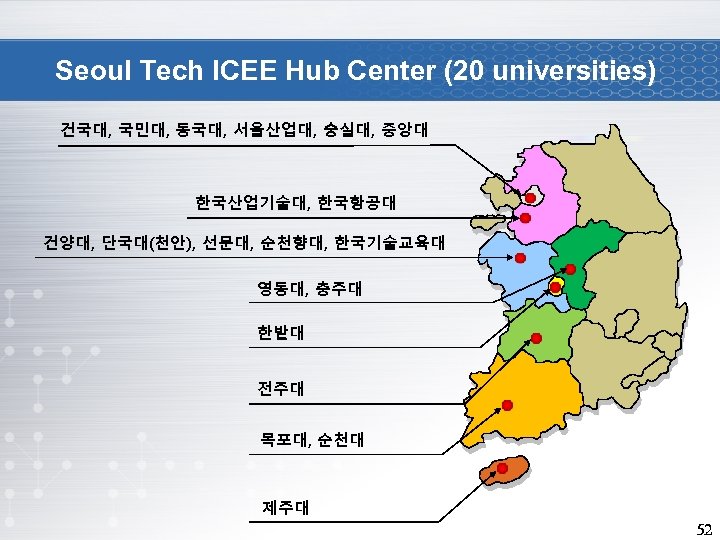 Seoul Tech ICEE Hub Center (20 universities) 건국대, 국민대, 동국대, 서울산업대, 숭실대, 중앙대 한국산업기술대, 한국항공대 건양대, 단국대(천안), 선문대, 순천향대, 한국기술교육대 영동대, 충주대 한밭대 전주대 목포대, 순천대 제주대 52
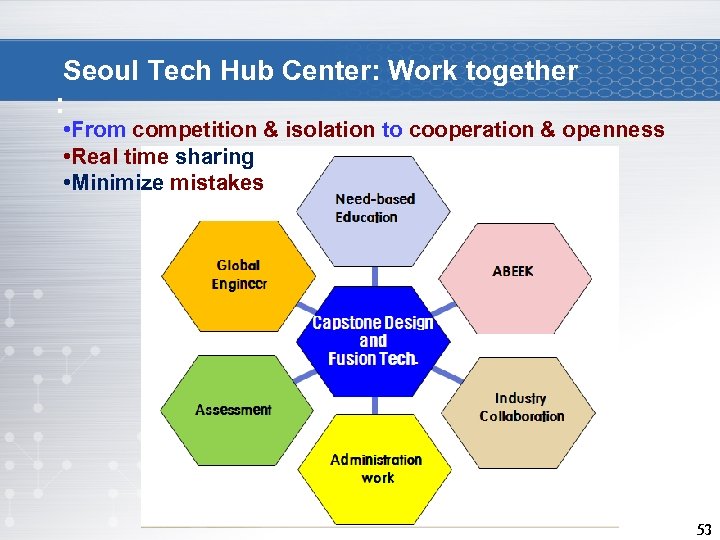 Seoul Tech Hub Center: Work together : • From competition & isolation to cooperation & openness • Real time sharing • Minimize mistakes 53
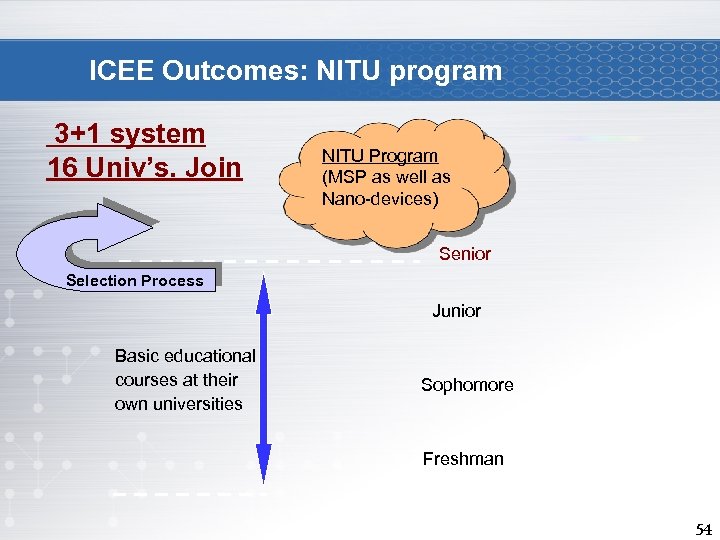 ICEE Outcomes: NITU program 3+1 system 16 Univ’s. Join NITU Program (MSP as well as Nano-devices) Senior Selection Process Junior Basic educational courses at their own universities Sophomore Freshman 54
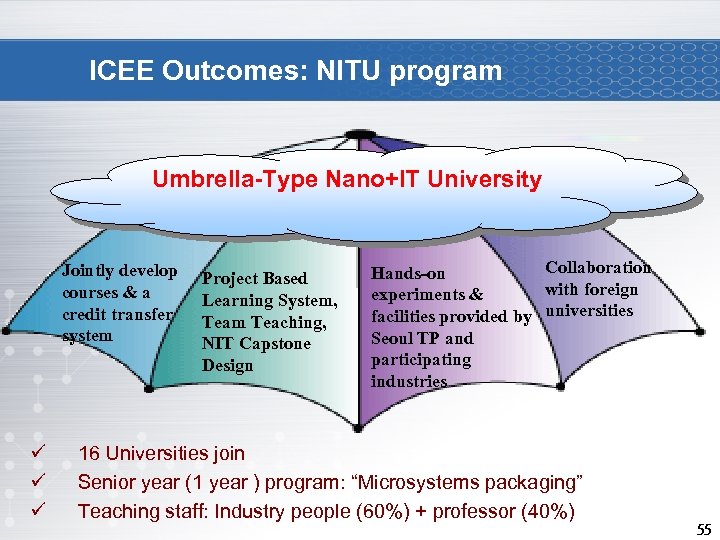 ICEE Outcomes: NITU program Umbrella-Type Nano+IT University Jointly develop courses & a credit transfer system ü ü ü Project Based Learning System, Team Teaching, NIT Capstone Design Collaboration Hands-on with foreign experiments & facilities provided by universities Seoul TP and participating industries 16 Universities join Senior year (1 year ) program: “Microsystems packaging” Teaching staff: Industry people (60%) + professor (40%) 55
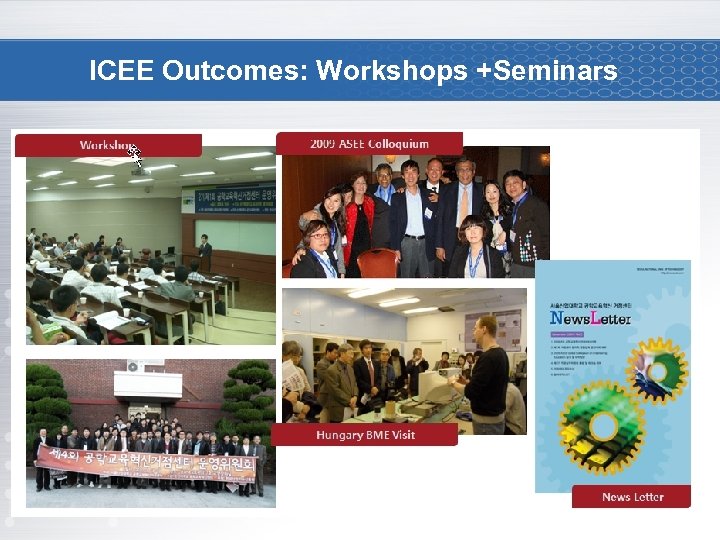 ICEE Outcomes: Workshops +Seminars
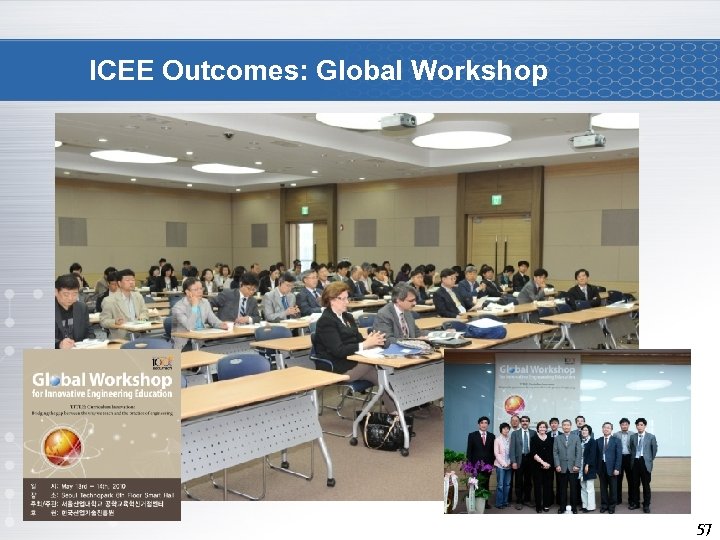 ICEE Outcomes: Global Workshop 57
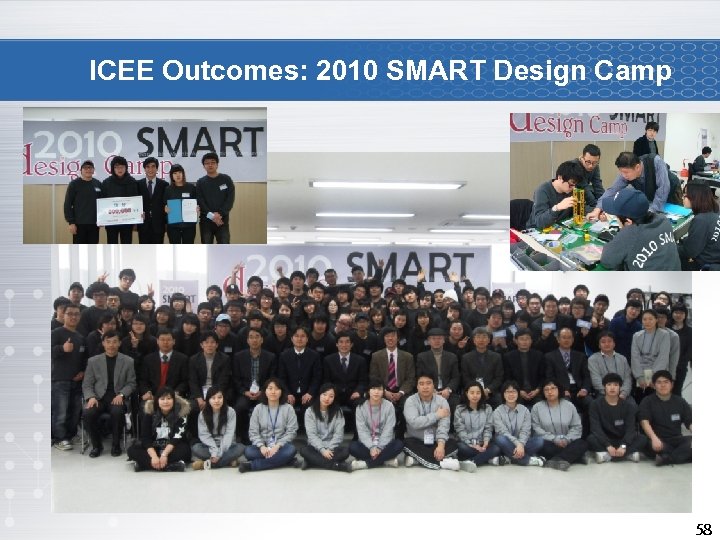 ICEE Outcomes: 2010 SMART Design Camp 58
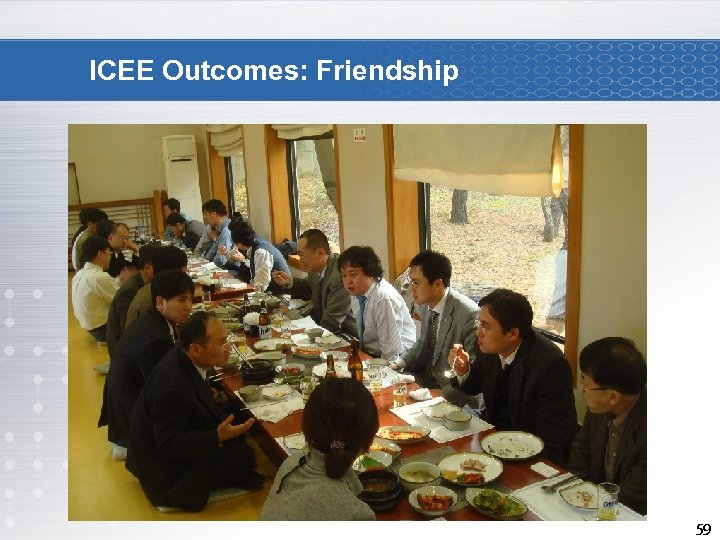 ICEE Outcomes: Friendship 59
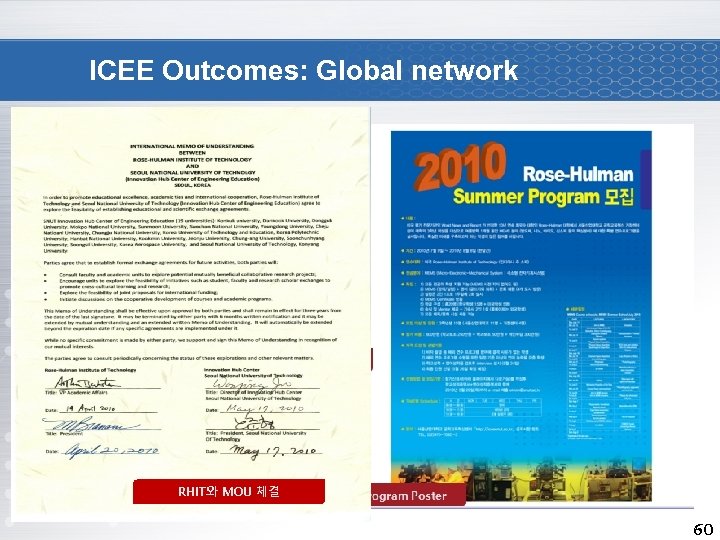 ICEE Outcomes: Global network On 17 th November, 2010 “International Capstone Design Fair” RHIT와 MOU 체결 60
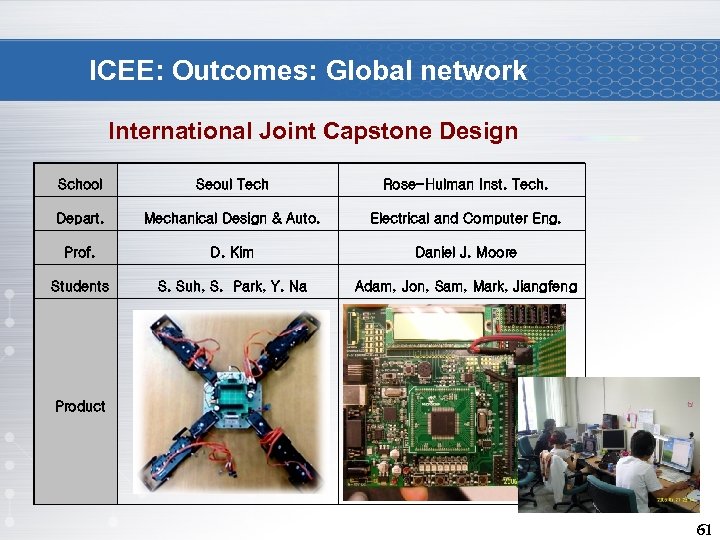 ICEE: Outcomes: Global network International Joint Capstone Design School Seoul Tech Rose-Hulman Inst. Tech. Depart. Mechanical Design & Auto. Electrical and Computer Eng. Prof. D. Kim Daniel J. Moore Students S. Suh, S. Park, Y. Na Adam, Jon, Sam, Mark, Jiangfeng Product 4족로봇 하드웨어 구현에 중점 Embedded system 구현에 중점 61
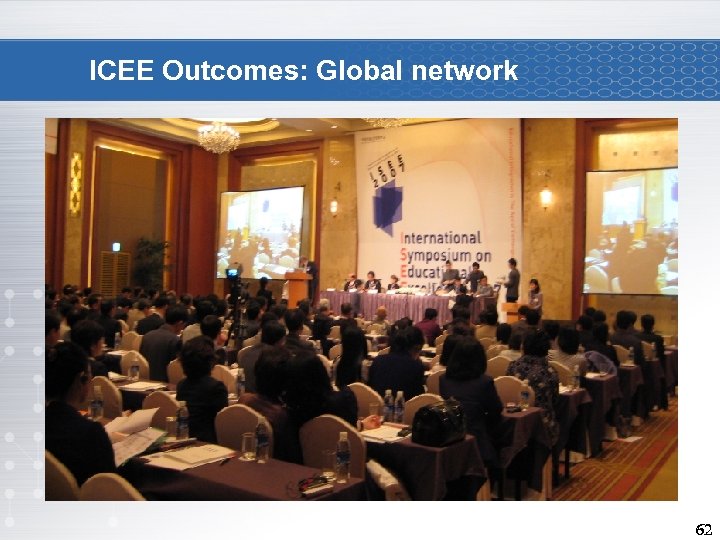 ICEE Outcomes: Global network 62
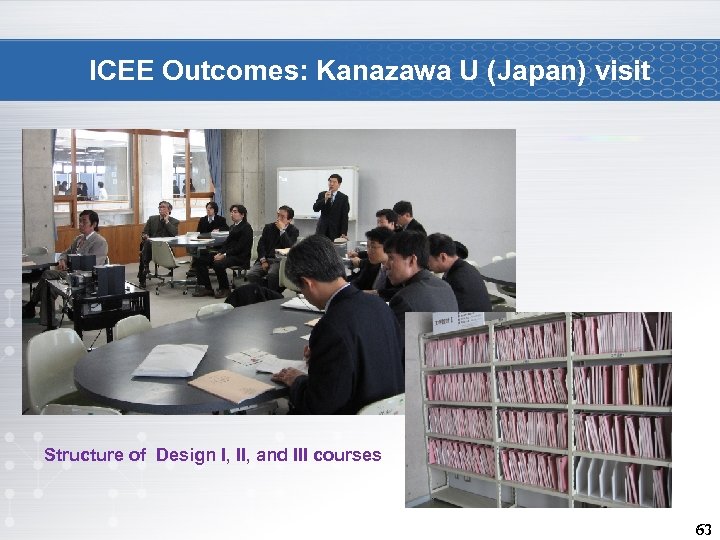 ICEE Outcomes: Kanazawa U (Japan) visit Structure of Design I, II, and III courses 63
 Vision to Action 64
 Thank You