 Скачать презентацию Konjunkturforschungsstelle Swiss Institute for Business Cycle Research Do
13b9fd47904e3059c875ddba1e89c2ad.ppt
- Количество слайдов: 16



Konjunkturforschungsstelle Swiss Institute for Business Cycle Research Do IMF and World Bank Influence Voting in the UN General Assembly? Axel Dreher and Jan-Egbert Sturm International Political Economy Society Inaugural Conference November 17 -18, 2006
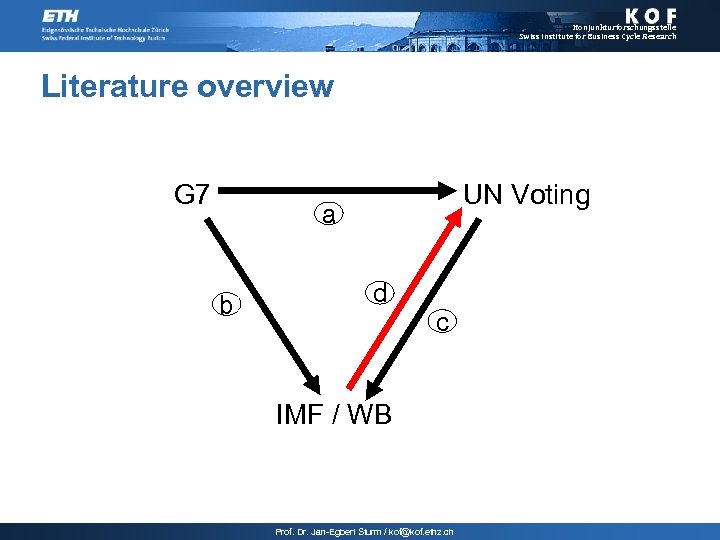
Konjunkturforschungsstelle Swiss Institute for Business Cycle Research Literature overview G 7 UN Voting a b d c IMF / WB Prof. Dr. Jan-Egbert Sturm / kof@kof. ethz. ch
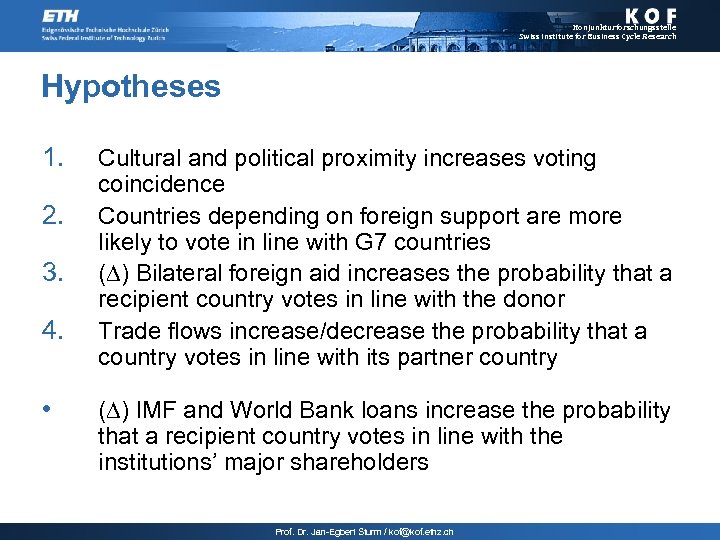
Konjunkturforschungsstelle Swiss Institute for Business Cycle Research Hypotheses 1. 2. 3. 4. • Cultural and political proximity increases voting coincidence Countries depending on foreign support are more likely to vote in line with G 7 countries ( ) Bilateral foreign aid increases the probability that a recipient country votes in line with the donor Trade flows increase/decrease the probability that a country votes in line with its partner country ( ) IMF and World Bank loans increase the probability that a recipient country votes in line with the institutions’ major shareholders Prof. Dr. Jan-Egbert Sturm / kof@kof. ethz. ch
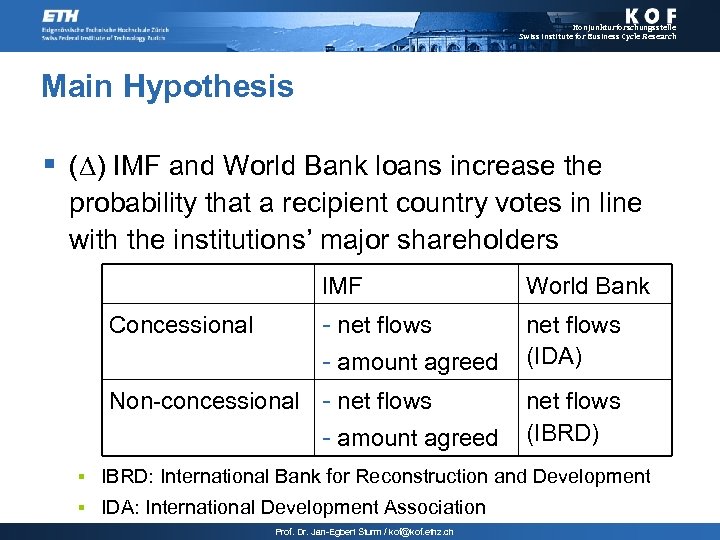
Konjunkturforschungsstelle Swiss Institute for Business Cycle Research Main Hypothesis § ( ) IMF and World Bank loans increase the probability that a recipient country votes in line with the institutions’ major shareholders IMF - net flows - amount agreed Non-concessional - net flows - amount agreed Concessional World Bank net flows (IDA) net flows (IBRD) § IBRD: International Bank for Reconstruction and Development § IDA: International Development Association Prof. Dr. Jan-Egbert Sturm / kof@kof. ethz. ch
Konjunkturforschungsstelle Swiss Institute for Business Cycle Research Main Hypothesis § ( ) IMF and World Bank loans increase the probability that a recipient country votes in line with the institutions’ major shareholders § World Bank § Number of technical loans programs starting § Number of adjustment programs starting § Number of other programs starting § IMF § Start of EFF and SBA program (non-conc. ) § Start of SAF and PRGF program (conc. ) Prof. Dr. Jan-Egbert Sturm / kof@kof. ethz. ch
Konjunkturforschungsstelle Swiss Institute for Business Cycle Research Data § Years: 1970 -2002 § Recipient-countries: up to 188 § Donor-countries: each individual G 7 country & weighted-average G 7 Prof. Dr. Jan-Egbert Sturm / kof@kof. ethz. ch
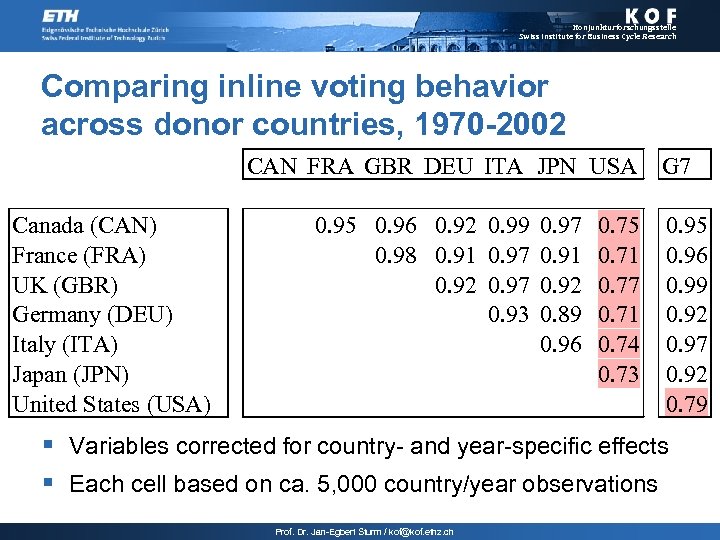
Konjunkturforschungsstelle Swiss Institute for Business Cycle Research Comparing inline voting behavior across donor countries, 1970 -2002 CAN FRA GBR DEU ITA JPN USA Canada (CAN) France (FRA) UK (GBR) Germany (DEU) Italy (ITA) Japan (JPN) United States (USA) 0. 95 0. 96 0. 92 0. 99 0. 98 0. 91 0. 97 0. 92 0. 97 0. 93 0. 97 0. 91 0. 92 0. 89 0. 96 0. 75 0. 71 0. 77 0. 71 0. 74 0. 73 G 7 0. 95 0. 96 0. 99 0. 92 0. 97 0. 92 0. 79 § Variables corrected for country- and year-specific effects § Each cell based on ca. 5, 000 country/year observations Prof. Dr. Jan-Egbert Sturm / kof@kof. ethz. ch
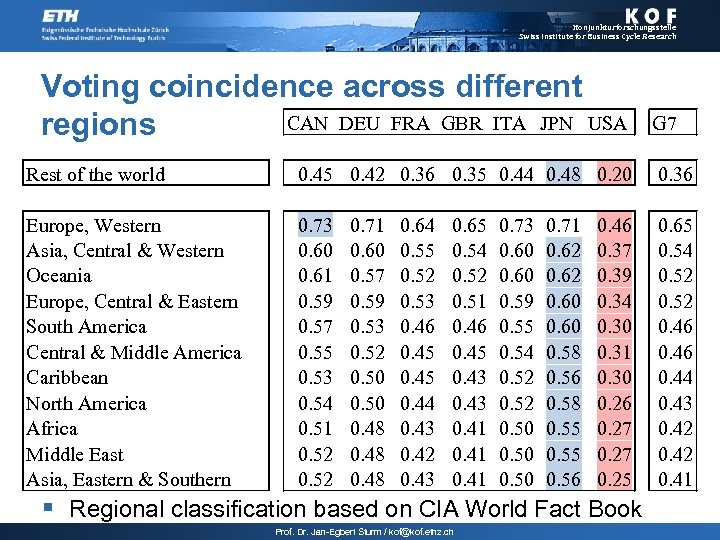
Konjunkturforschungsstelle Swiss Institute for Business Cycle Research Voting coincidence across different CAN DEU FRA GBR ITA JPN USA regions G 7 Rest of the world 0. 45 0. 42 0. 36 0. 35 0. 44 0. 48 0. 20 0. 36 Europe, Western Asia, Central & Western Oceania Europe, Central & Eastern South America Central & Middle America Caribbean North America Africa Middle East Asia, Eastern & Southern 0. 73 0. 60 0. 61 0. 59 0. 57 0. 55 0. 53 0. 54 0. 51 0. 52 0. 65 0. 54 0. 52 0. 46 0. 44 0. 43 0. 42 0. 41 0. 71 0. 60 0. 57 0. 59 0. 53 0. 52 0. 50 0. 48 0. 64 0. 55 0. 52 0. 53 0. 46 0. 45 0. 44 0. 43 0. 42 0. 43 0. 65 0. 54 0. 52 0. 51 0. 46 0. 45 0. 43 0. 41 0. 73 0. 60 0. 59 0. 55 0. 54 0. 52 0. 50 0. 71 0. 62 0. 60 0. 58 0. 56 0. 58 0. 55 0. 56 0. 46 0. 37 0. 39 0. 34 0. 30 0. 31 0. 30 0. 26 0. 27 0. 25 § Regional classification based on CIA World Fact Book Prof. Dr. Jan-Egbert Sturm / kof@kof. ethz. ch
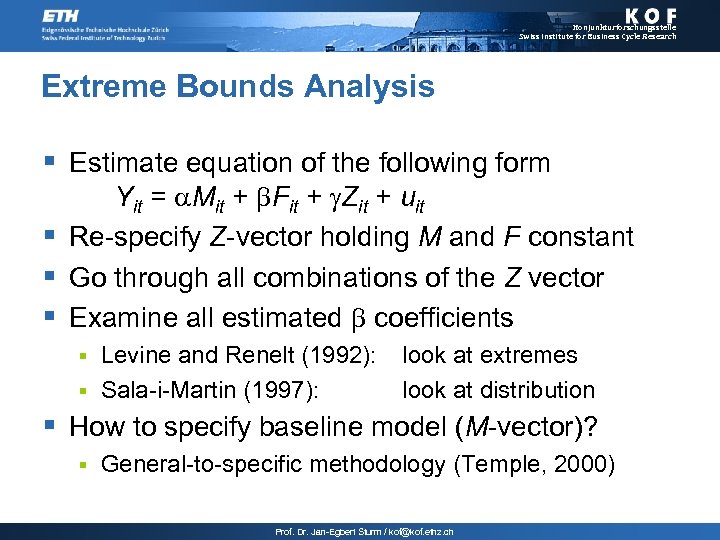
Konjunkturforschungsstelle Swiss Institute for Business Cycle Research Extreme Bounds Analysis § Estimate equation of the following form Yit = Mit + Fit + Zit + uit § Re-specify Z-vector holding M and F constant § Go through all combinations of the Z vector § Examine all estimated coefficients Levine and Renelt (1992): § Sala-i-Martin (1997): § look at extremes look at distribution § How to specify baseline model (M-vector)? § General-to-specific methodology (Temple, 2000) Prof. Dr. Jan-Egbert Sturm / kof@kof. ethz. ch
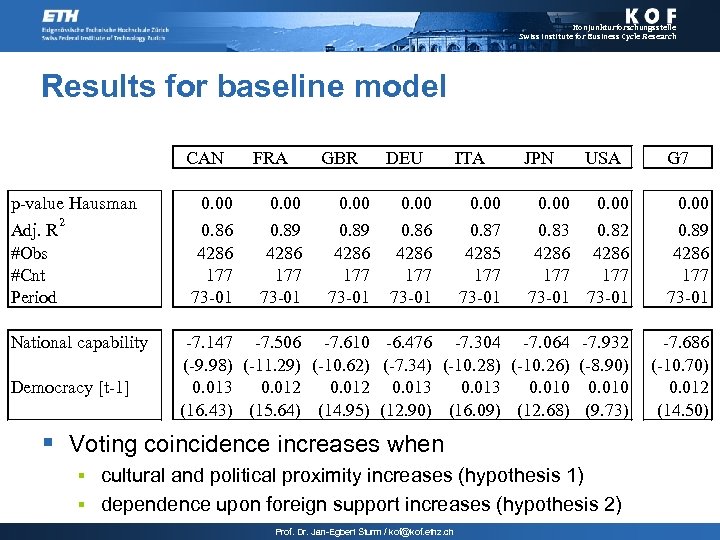
Konjunkturforschungsstelle Swiss Institute for Business Cycle Research Results for baseline model CAN p-value Hausman 2 Adj. R #Obs #Cnt Period National capability Democracy [t-1] DEU ITA JPN 0. 00 0. 86 4286 177 73 -01 0. 00 0. 87 4285 177 73 -01 0. 00 0. 83 0. 82 4286 177 73 -01 0. 00 0. 89 4286 177 73 -01 -7. 147 -7. 506 -7. 610 -6. 476 -7. 304 -7. 064 -7. 932 (-9. 98) (-11. 29) (-10. 62) (-7. 34) (-10. 28) (-10. 26) (-8. 90) 0. 013 0. 012 0. 013 0. 010 (16. 43) (15. 64) (14. 95) (12. 90) (16. 09) (12. 68) (9. 73) -7. 686 (-10. 70) 0. 012 (14. 50) 0. 00 0. 86 4286 177 73 -01 FRA 0. 00 0. 89 4286 177 73 -01 GBR 0. 00 0. 89 4286 177 73 -01 USA § Voting coincidence increases when cultural and political proximity increases (hypothesis 1) § dependence upon foreign support increases (hypothesis 2) § Prof. Dr. Jan-Egbert Sturm / kof@kof. ethz. ch G 7
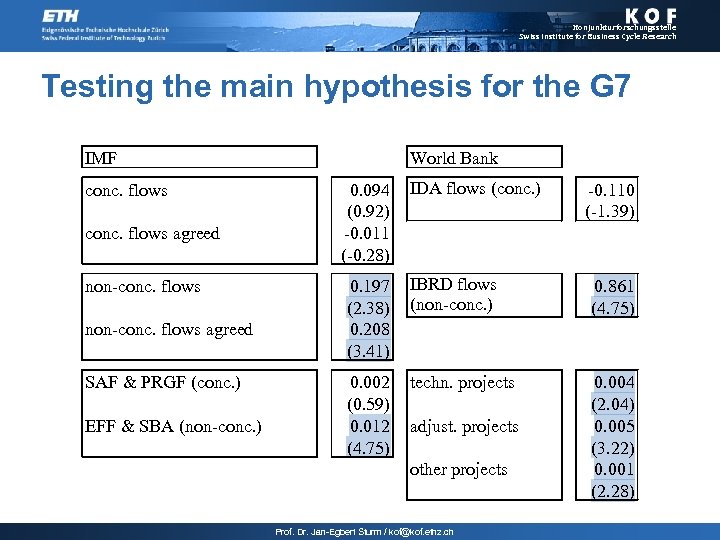
Konjunkturforschungsstelle Swiss Institute for Business Cycle Research Testing the main hypothesis for the G 7 IMF conc. flows agreed non-conc. flows agreed SAF & PRGF (conc. ) EFF & SBA (non-conc. ) World Bank 0. 094 (0. 92) -0. 011 (-0. 28) IDA flows (conc. ) -0. 110 (-1. 39) 0. 197 (2. 38) 0. 208 (3. 41) IBRD flows (non-conc. ) 0. 861 (4. 75) 0. 002 (0. 59) 0. 012 (4. 75) techn. projects 0. 004 (2. 04) 0. 005 (3. 22) 0. 001 (2. 28) adjust. projects other projects Prof. Dr. Jan-Egbert Sturm / kof@kof. ethz. ch
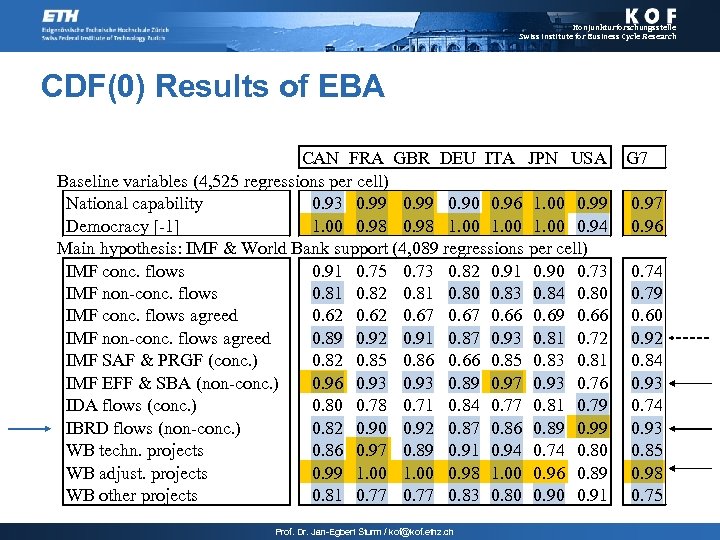
Konjunkturforschungsstelle Swiss Institute for Business Cycle Research CDF(0) Results of EBA CAN FRA GBR DEU ITA JPN USA G 7 Baseline variables (4, 525 regressions per cell) National capability 0. 93 0. 99 0. 90 0. 96 1. 00 0. 99 0. 97 Democracy [-1] 1. 00 0. 98 1. 00 0. 94 0. 96 Main hypothesis: IMF & World Bank support (4, 089 regressions per cell) IMF conc. flows 0. 91 0. 75 0. 73 0. 82 0. 91 0. 90 0. 73 0. 74 IMF non-conc. flows 0. 81 0. 82 0. 81 0. 80 0. 83 0. 84 0. 80 0. 79 IMF conc. flows agreed 0. 62 0. 67 0. 66 0. 69 0. 66 0. 60 IMF non-conc. flows agreed 0. 89 0. 92 0. 91 0. 87 0. 93 0. 81 0. 72 0. 92 IMF SAF & PRGF (conc. ) 0. 82 0. 85 0. 86 0. 66 0. 85 0. 83 0. 81 0. 84 IMF EFF & SBA (non-conc. ) 0. 96 0. 93 0. 89 0. 97 0. 93 0. 76 0. 93 IDA flows (conc. ) 0. 80 0. 78 0. 71 0. 84 0. 77 0. 81 0. 79 0. 74 IBRD flows (non-conc. ) 0. 82 0. 90 0. 92 0. 87 0. 86 0. 89 0. 93 WB techn. projects 0. 86 0. 97 0. 89 0. 91 0. 94 0. 74 0. 80 0. 85 WB adjust. projects 0. 99 1. 00 0. 98 1. 00 0. 96 0. 89 0. 98 WB other projects 0. 81 0. 77 0. 83 0. 80 0. 91 0. 75 Prof. Dr. Jan-Egbert Sturm / kof@kof. ethz. ch
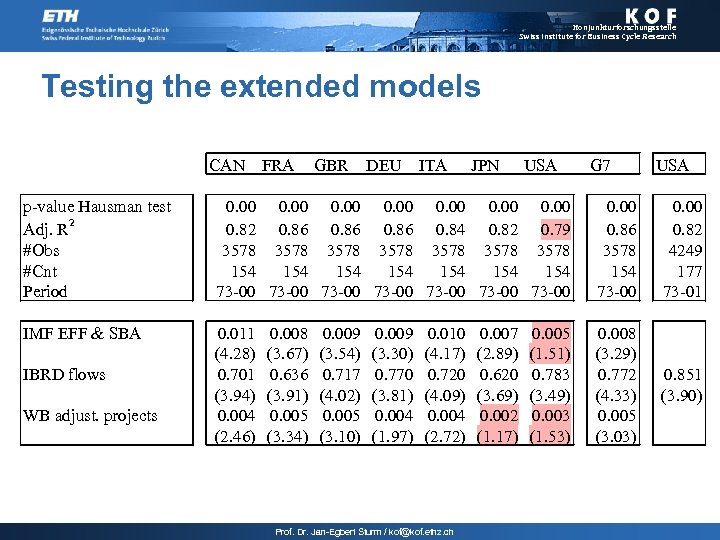
Konjunkturforschungsstelle Swiss Institute for Business Cycle Research Testing the extended models CAN FRA GBR DEU ITA JPN USA G 7 USA p-value Hausman test 2 Adj. R #Obs #Cnt Period 0. 00 0. 82 0. 86 0. 84 0. 82 0. 79 3578 3578 154 154 73 -00 73 -00 0. 86 3578 154 73 -00 0. 82 4249 177 73 -01 IMF EFF & SBA 0. 011 (4. 28) 0. 701 (3. 94) 0. 004 (2. 46) 0. 008 (3. 29) 0. 772 (4. 33) 0. 005 (3. 03) 0. 851 (3. 90) IBRD flows WB adjust. projects 0. 008 (3. 67) 0. 636 (3. 91) 0. 005 (3. 34) 0. 009 (3. 54) 0. 717 (4. 02) 0. 005 (3. 10) 0. 009 (3. 30) 0. 770 (3. 81) 0. 004 (1. 97) 0. 010 (4. 17) 0. 720 (4. 09) 0. 004 (2. 72) Prof. Dr. Jan-Egbert Sturm / kof@kof. ethz. ch 0. 007 (2. 89) 0. 620 (3. 69) 0. 002 (1. 17) 0. 005 (1. 51) 0. 783 (3. 49) 0. 003 (1. 53)
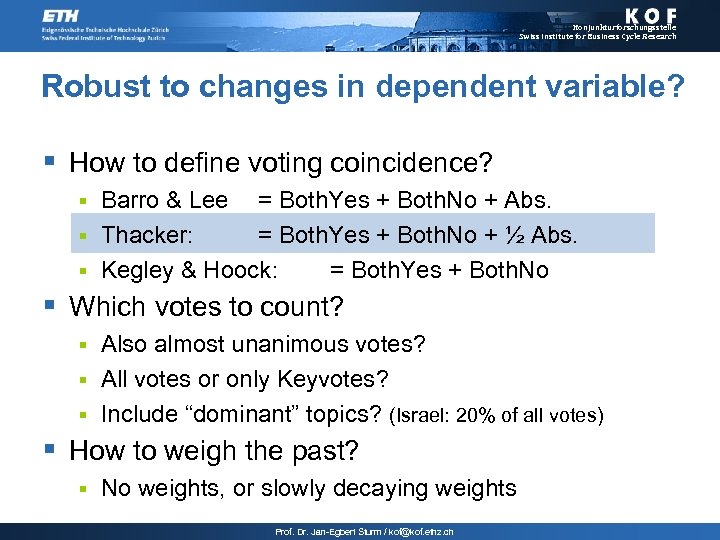
Konjunkturforschungsstelle Swiss Institute for Business Cycle Research Robust to changes in dependent variable? § How to define voting coincidence? Barro & Lee = Both. Yes + Both. No + Abs. § Thacker: = Both. Yes + Both. No + ½ Abs. § Kegley & Hoock: = Both. Yes + Both. No § § Which votes to count? Also almost unanimous votes? § All votes or only Keyvotes? § Include “dominant” topics? (Israel: 20% of all votes) § § How to weigh the past? § No weights, or slowly decaying weights Prof. Dr. Jan-Egbert Sturm / kof@kof. ethz. ch
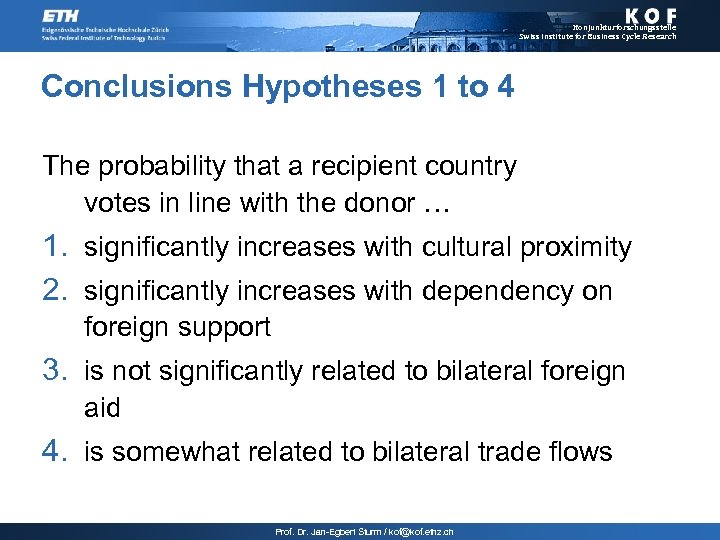
Konjunkturforschungsstelle Swiss Institute for Business Cycle Research Conclusions Hypotheses 1 to 4 The probability that a recipient country votes in line with the donor … 1. significantly increases with cultural proximity 2. significantly increases with dependency on foreign support 3. is not significantly related to bilateral foreign aid 4. is somewhat related to bilateral trade flows Prof. Dr. Jan-Egbert Sturm / kof@kof. ethz. ch
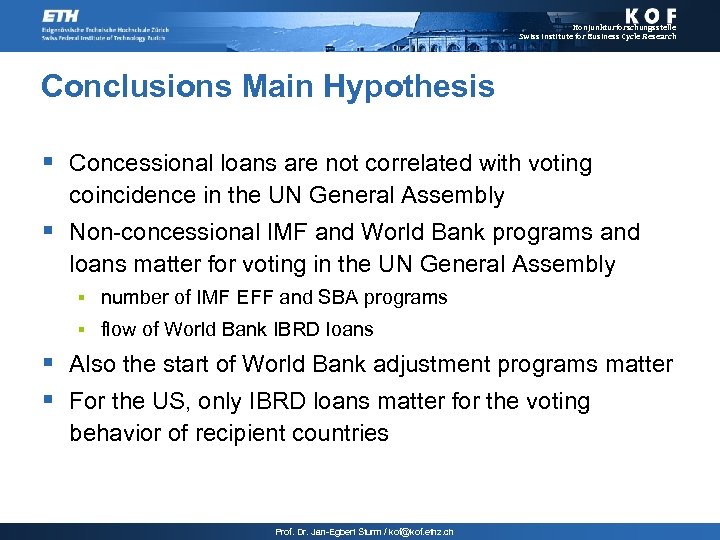
Konjunkturforschungsstelle Swiss Institute for Business Cycle Research Conclusions Main Hypothesis § Concessional loans are not correlated with voting coincidence in the UN General Assembly § Non-concessional IMF and World Bank programs and loans matter for voting in the UN General Assembly § number of IMF EFF and SBA programs § flow of World Bank IBRD loans § Also the start of World Bank adjustment programs matter § For the US, only IBRD loans matter for the voting behavior of recipient countries Prof. Dr. Jan-Egbert Sturm / kof@kof. ethz. ch
Скачать презентацию Konjunkturforschungsstelle Swiss Institute for Business Cycle Research Do
13b9fd47904e3059c875ddba1e89c2ad.ppt