 Скачать презентацию Kolossi Castle Probably the dinkiest castle you re ever
LIMASSOL SIGHTSEEING INTERACTIVE MAP.pptx
- Количество слайдов: 11



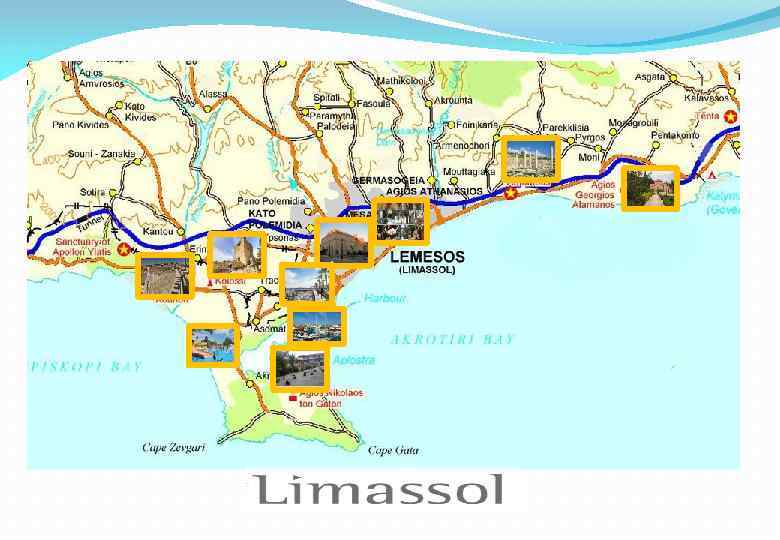
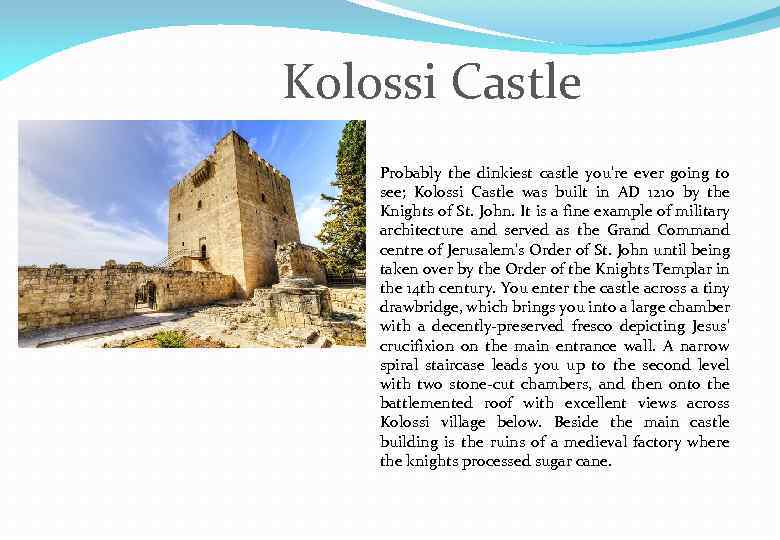
Kolossi Castle Probably the dinkiest castle you're ever going to see; Kolossi Castle was built in AD 1210 by the Knights of St. John. It is a fine example of military architecture and served as the Grand Command centre of Jerusalem's Order of St. John until being taken over by the Order of the Knights Templar in the 14 th century. You enter the castle across a tiny drawbridge, which brings you into a large chamber with a decently-preserved fresco depicting Jesus' crucifixion on the main entrance wall. A narrow spiral staircase leads you up to the second level with two stone-cut chambers, and then onto the battlemented roof with excellent views across Kolossi village below. Beside the main castle building is the ruins of a medieval factory where the knights processed sugar cane.
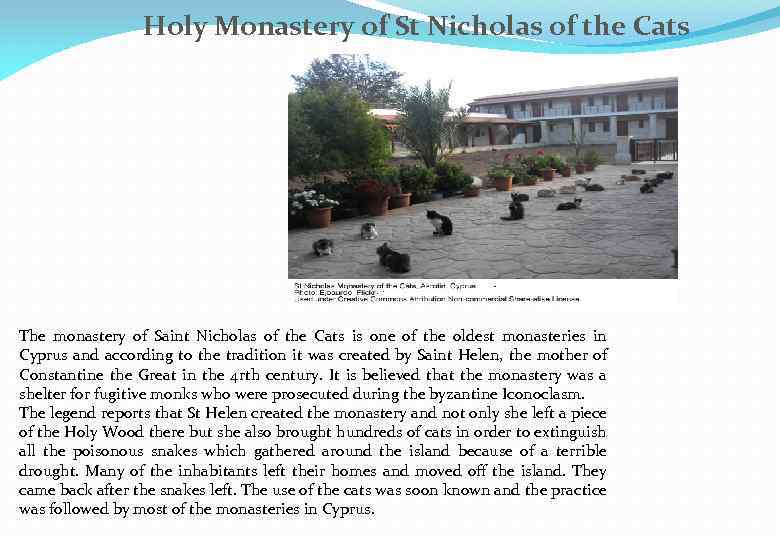
Holy Monastery of St Nicholas of the Cats The monastery of Saint Nicholas of the Cats is one of the oldest monasteries in Cyprus and according to the tradition it was created by Saint Helen, the mother of Constantine the Great in the 4 rth century. It is believed that the monastery was a shelter for fugitive monks who were prosecuted during the byzantine Iconoclasm. The legend reports that St Helen created the monastery and not only she left a piece of the Holy Wood there but she also brought hundreds of cats in order to extinguish all the poisonous snakes which gathered around the island because of a terrible drought. Many of the inhabitants left their homes and moved off the island. They came back after the snakes left. The use of the cats was soon known and the practice was followed by most of the monasteries in Cyprus.
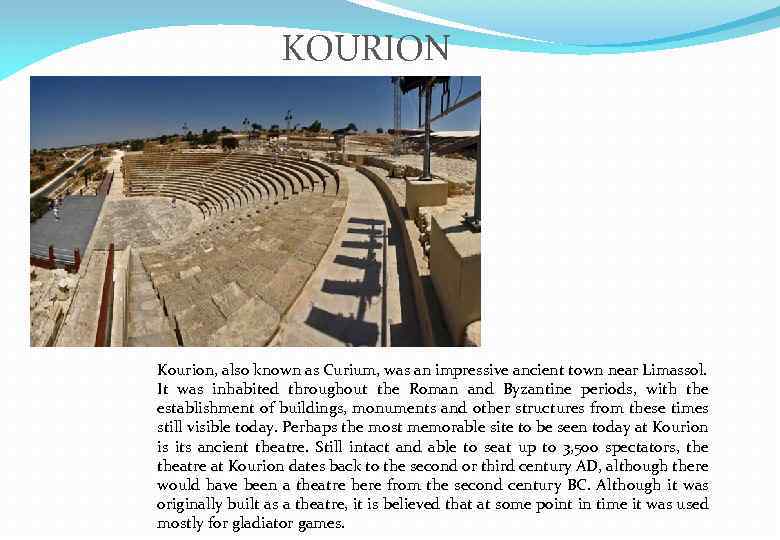
KOURION Kourion, also known as Curium, was an impressive ancient town near Limassol. It was inhabited throughout the Roman and Byzantine periods, with the establishment of buildings, monuments and other structures from these times still visible today. Perhaps the most memorable site to be seen today at Kourion is its ancient theatre. Still intact and able to seat up to 3, 500 spectators, theatre at Kourion dates back to the second or third century AD, although there would have been a theatre here from the second century BC. Although it was originally built as a theatre, it is believed that at some point in time it was used mostly for gladiator games.
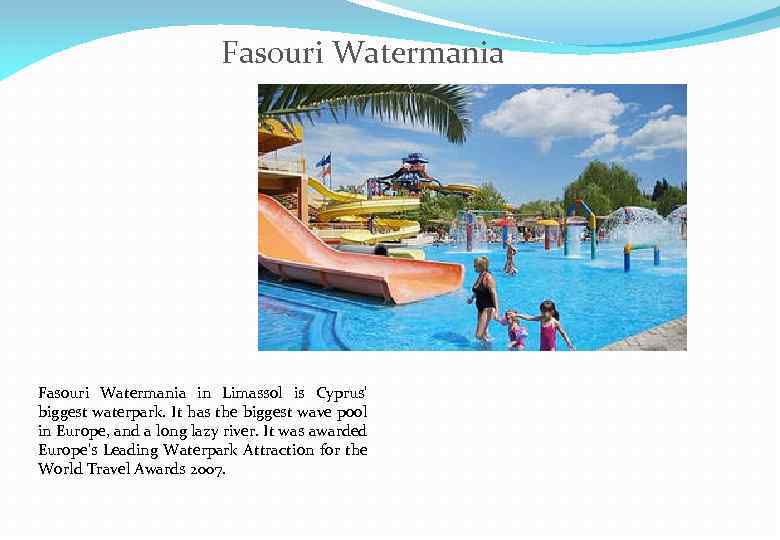
Fasouri Watermania in Limassol is Cyprus' biggest waterpark. It has the biggest wave pool in Europe, and a long lazy river. It was awarded Europe's Leading Waterpark Attraction for the World Travel Awards 2007.
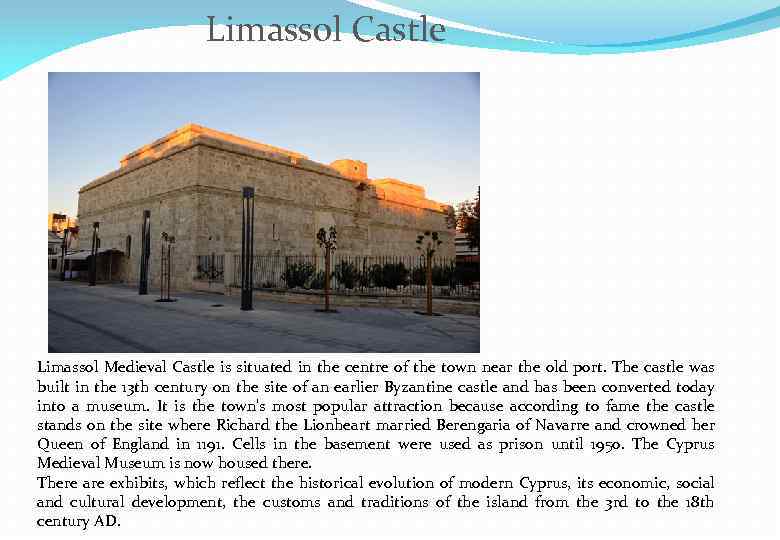
Limassol Castle Limassol Medieval Castle is situated in the centre of the town near the old port. The castle was built in the 13 th century on the site of an earlier Byzantine castle and has been converted today into a museum. It is the town's most popular attraction because according to fame the castle stands on the site where Richard the Lionheart married Berengaria of Navarre and crowned her Queen of England in 1191. Cells in the basement were used as prison until 1950. The Cyprus Medieval Museum is now housed there. There are exhibits, which reflect the historical evolution of modern Cyprus, its economic, social and cultural development, the customs and traditions of the island from the 3 rd to the 18 th century AD.
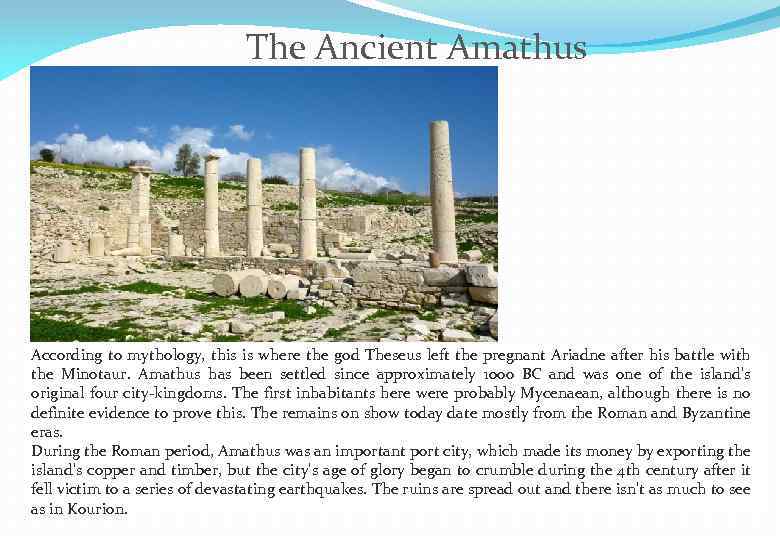
The Ancient Amathus According to mythology, this is where the god Theseus left the pregnant Ariadne after his battle with the Minotaur. Amathus has been settled since approximately 1000 BC and was one of the island's original four city-kingdoms. The first inhabitants here were probably Mycenaean, although there is no definite evidence to prove this. The remains on show today date mostly from the Roman and Byzantine eras. During the Roman period, Amathus was an important port city, which made its money by exporting the island's copper and timber, but the city's age of glory began to crumble during the 4 th century after it fell victim to a series of devastating earthquakes. The ruins are spread out and there isn't as much to see as in Kourion.
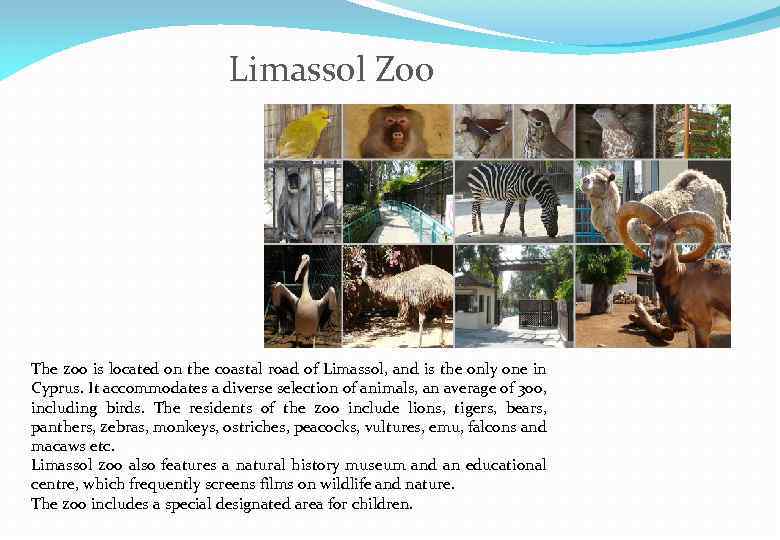
Limassol Zoo The zoo is located on the coastal road of Limassol, and is the only one in Cyprus. It accommodates a diverse selection of animals, an average of 300, including birds. The residents of the zoo include lions, tigers, bears, panthers, zebras, monkeys, ostriches, peacocks, vultures, emu, falcons and macaws etc. Limassol zoo also features a natural history museum and an educational centre, which frequently screens films on wildlife and nature. The zoo includes a special designated area for children.
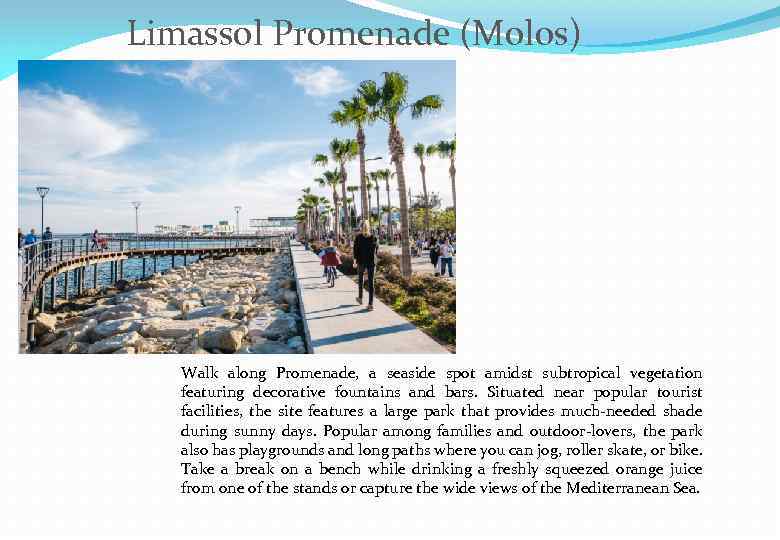
Limassol Promenade (Molos) Walk along Promenade, a seaside spot amidst subtropical vegetation featuring decorative fountains and bars. Situated near popular tourist facilities, the site features a large park that provides much-needed shade during sunny days. Popular among families and outdoor-lovers, the park also has playgrounds and long paths where you can jog, roller skate, or bike. Take a break on a bench while drinking a freshly squeezed orange juice from one of the stands or capture the wide views of the Mediterranean Sea.
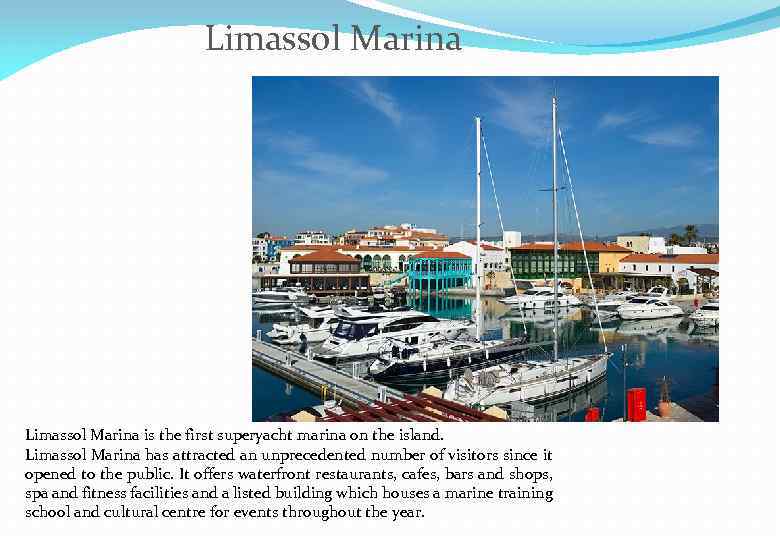
Limassol Marina is the first superyacht marina on the island. Limassol Marina has attracted an unprecedented number of visitors since it opened to the public. It offers waterfront restaurants, cafes, bars and shops, spa and fitness facilities and a listed building which houses a marine training school and cultural centre for events throughout the year.
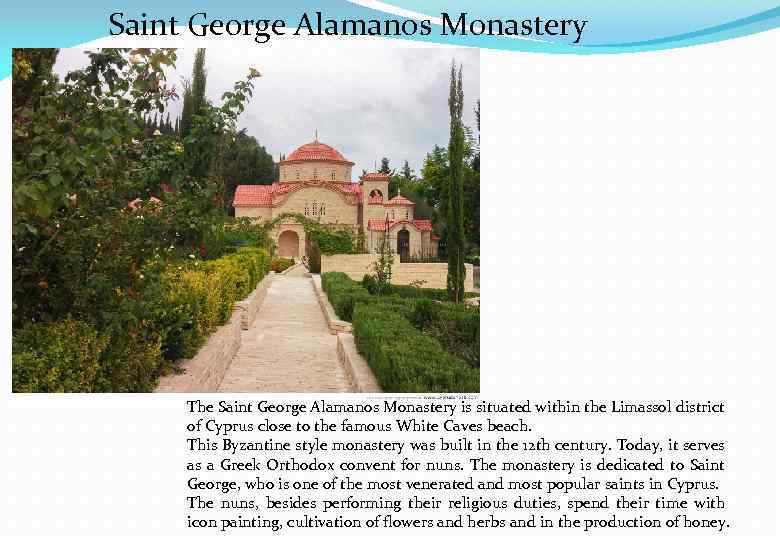
Saint George Alamanos Monastery The Saint George Alamanos Monastery is situated within the Limassol district of Cyprus close to the famous White Caves beach. This Byzantine style monastery was built in the 12 th century. Today, it serves as a Greek Orthodox convent for nuns. The monastery is dedicated to Saint George, who is one of the most venerated and most popular saints in Cyprus. The nuns, besides performing their religious duties, spend their time with icon painting, cultivation of flowers and herbs and in the production of honey.
Скачать презентацию Kolossi Castle Probably the dinkiest castle you re ever
LIMASSOL SIGHTSEEING INTERACTIVE MAP.pptx