 Скачать презентацию Knowledge Translation Conference KT Solutions for Overcoming Barriers
e61256d95576212aa0acfe22b4f0a2e6.ppt
- Количество слайдов: 18



Knowledge Translation Conference KT Solutions for Overcoming Barriers to Research Use Hosted by SEDL’s Center on Knowledge Translation for Disability and Rehabilitation Research (KTDRR) October 26 -28 -30, 2015 Translating Research Findings for Uptake and Use by Various Stakeholders KT Solutions for Overcoming Barriers to Research Use Conference KTDRR James A. Leahy Center on Knowledge Translation for Technology Transfer University at Buffalo October 26, 2015 716 -204 -8606 | http: //sphhp. buffalo. edu/cat/kt 4 tt. html Copyright © 2015 by KT 4 TT, University at Buffalo. All rights reserved.
Knowledge Translation Conference KT Solutions for Overcoming Barriers to Research Use Hosted by SEDL’s Center on Knowledge Translation for Disability and Rehabilitation Research (KTDRR) Acknowledgement: The contents of this presentation were developed under a grant from the National Institute on Disability, Independent Living, and Rehabilitation Research (NIDILRR grant number 90 DP 0054 -01 -00). NIDILRR is a Center within the Administration for Community Living (ACL), Department of Health and Human Services (HHS). The contents of this presentation do not necessarily represent the policy of NIDILRR, ACL, HHS, and you should not assume endorsement by the Federal Government.
Knowledge Translation Conference KT Solutions for Overcoming Barriers to Research Use Hosted by SEDL’s Center on Knowledge Translation for Disability and Rehabilitation Research (KTDRR) Translation of Research Findings • Background – Academic researchers have a traditional dissemination approach. – Few researchers undertake the task of translating their research findings. – Researchers will leave Knowledge Translation to University TTO’s or serendipity. – Quoting Stephen Covey – Researchers should “Begin with the end in mind. ”
Knowledge Translation Conference KT Solutions for Overcoming Barriers to Research Use Hosted by SEDL’s Center on Knowledge Translation for Disability and Rehabilitation Research (KTDRR) 6 Different Stakeholder Groups for Translation of Research Findings • Stakeholder groups are: – Clinicians / Practitioners – Manufacturing / Industry – Consumers – Policy Makers – Brokers – Researchers - other members of the Research community
Knowledge Translation Conference KT Solutions for Overcoming Barriers to Research Use Hosted by SEDL’s Center on Knowledge Translation for Disability and Rehabilitation Research (KTDRR) Need for Translation of Research Findings • Background – Each Stakeholder group needs research findings to be presented in a format in which they are conversant. – Each stakeholder group receives research findings through different mediums or venues. – Researcher must become conversant in these various methods of Knowledge Translation. – For each stakeholder group, you must learn what type of information is important to them and in what format they wish to receive it.
Knowledge Translation Conference KT Solutions for Overcoming Barriers to Research Use Hosted by SEDL’s Center on Knowledge Translation for Disability and Rehabilitation Research (KTDRR) Translation of Research Findings • Need to know What to Say, How to Say it, and When to Say it. • To answer those questions you must know your audience and what motivates them. • Need to do your due diligence research on your Stakeholder group. • Example for the Mfg. group, there are many questions to ask. • Next, what motivates this stakeholder group?
Knowledge Translation Conference KT Solutions for Overcoming Barriers to Research Use Hosted by SEDL’s Center on Knowledge Translation for Disability and Rehabilitation Research (KTDRR) Translation Terminology • ‘What to Say’ ? – what terminology will work in a certain industry or with a certain stakeholder group? • Universal Design – end goal • Term Transgenerational Design – used to increase accessibility and usability • Transgenerational Design – market broadening and creating a product that spans the ages from children to older adults.
Knowledge Translation Conference KT Solutions for Overcoming Barriers to Research Use Hosted by SEDL’s Center on Knowledge Translation for Disability and Rehabilitation Research (KTDRR) Key Element in a Translation Package • Key element is the ‘Hook’. • What is the ‘Hook’ and how do you develop it? • ‘Hook’ is something that gets your audience interested, invested, and enthused about what you are presenting. • ‘Hook’ is developed with knowledge of your research findings and what will motivate the stakeholder group you are targeting. Wallpaper 77. com
Knowledge Translation Conference KT Solutions for Overcoming Barriers to Research Use Hosted by SEDL’s Center on Knowledge Translation for Disability and Rehabilitation Research (KTDRR) Contextualized Knowledge Translation Packages • CKP examples are available on our web site. Each package had a specialized ‘Hook’ developed for a specific stakeholder group. • Packages were developed for an AAC research finding, a Wheeled Mobility research finding, and an Exercise Technology research finding. • Examples can be found under LOKUS Instrument at: http: //sphhp. buffalo. edu/cat/kt 4 tt/projects/past-projects/kt 4 tt-20082013/research-projects. html
Knowledge Translation Conference KT Solutions for Overcoming Barriers to Research Use Hosted by SEDL’s Center on Knowledge Translation for Disability and Rehabilitation Research (KTDRR) Knowledge Translation Packages • Do they work? • Yes!!! They do! • AAC Mfg. commented the following when he received a CKP on an AAC research finding we presented… • “The CKP is well written and structured in a way that relates to AAC manufacturers. The need is articulated very well. The Technology Description and the links to the website were helpful in giving a sense of the degree to which these topics have been researched and the breadth of the solution. ”
Knowledge Translation Conference KT Solutions for Overcoming Barriers to Research Use Hosted by SEDL’s Center on Knowledge Translation for Disability and Rehabilitation Research (KTDRR) Developing a Knowledge Translation Package • How does one go about writing a CKP? • First Step is to develop a 60 second or less ‘Elevator pitch’ on your research finding. • This short presentation will force you to present and make your case for you research findings in a brief, concise, manner. • Example of an ‘Elevator Pitch’ that was successfully used can be found on our website under Getting to Market at: http: //sphhp. buffalo. edu/cat/kt 4 tt/technical-assistance-andresources/resources-for-non-nidilrr-grantees. html
Knowledge Translation Conference KT Solutions for Overcoming Barriers to Research Use Hosted by SEDL’s Center on Knowledge Translation for Disability and Rehabilitation Research (KTDRR) Contextualized Knowledge Translation Packages • ‘How to Say It’ in a CKP? • Be cognizant of your approach methods… • Want to be Perceived as a resource… • Incorporate Scenarios or Examples… • Example: AAC Writer’s Brigade • AAC Writer’s Guide for Individuals and Organizations
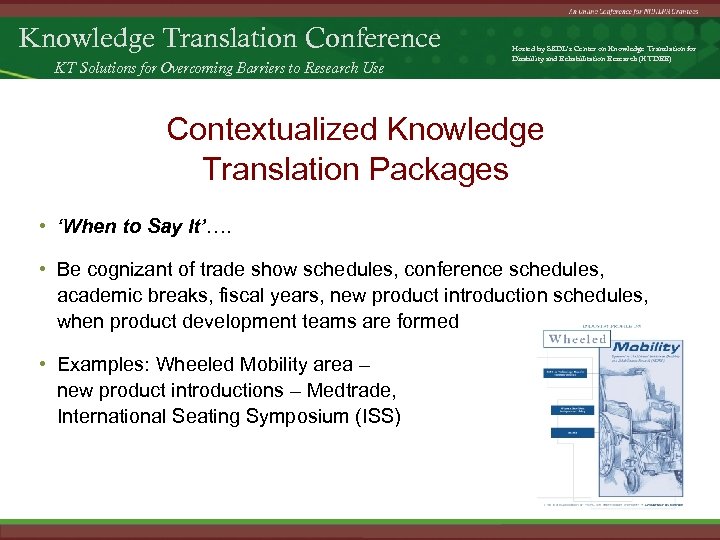
Knowledge Translation Conference KT Solutions for Overcoming Barriers to Research Use Hosted by SEDL’s Center on Knowledge Translation for Disability and Rehabilitation Research (KTDRR) Contextualized Knowledge Translation Packages • ‘When to Say It’…. • Be cognizant of trade show schedules, conference schedules, academic breaks, fiscal years, new product introduction schedules, when product development teams are formed • Examples: Wheeled Mobility area – new product introductions – Medtrade, International Seating Symposium (ISS)
Knowledge Translation Conference KT Solutions for Overcoming Barriers to Research Use Hosted by SEDL’s Center on Knowledge Translation for Disability and Rehabilitation Research (KTDRR) Executive Summary Section in a CKP • Variations of Summary dependent upon stakeholder group and purpose (license, information for consumer, etc. ) for CKP. • For a Manufacturer CKP brief paragraphs will include: – Product Need Area – Product Solution – your research findings, invention or methodology – Target Market / Market Size – Business Opportunity for Mfg. – Marketing Strategy – Intellectual Property Status – Consumer Information (involvement in development or purchase intent price point information)
Knowledge Translation Conference KT Solutions for Overcoming Barriers to Research Use Hosted by SEDL’s Center on Knowledge Translation for Disability and Rehabilitation Research (KTDRR) Background / Current Situation • Optional section – Details current status and current state of the science – For an invention, details how target market is currently addressing or not addressing the need – For an invention, details issues related to problems associated with the defined need – Requires target market interaction – primary market research
Knowledge Translation Conference KT Solutions for Overcoming Barriers to Research Use Hosted by SEDL’s Center on Knowledge Translation for Disability and Rehabilitation Research (KTDRR) Consumer Information • Details of Target Market Research • Primary Market Research Performed • Purchase Intent • Price Point
Knowledge Translation Conference KT Solutions for Overcoming Barriers to Research Use Hosted by SEDL’s Center on Knowledge Translation for Disability and Rehabilitation Research (KTDRR) Summary Translating Knowledge for the Benefit of Stakeholders is of paramount importance. Learning the method and medium for translating and disseminating new research findings is a necessary step in all research projects. Knowledge Translation should be planned and budgeted for by all researchers. Goal is to benefit the target population of the research in the first place. Make a Difference with your work!!!
Knowledge Translation Conference KT Solutions for Overcoming Barriers to Research Use Hosted by SEDL’s Center on Knowledge Translation for Disability and Rehabilitation Research (KTDRR) Summary • Visit the KT 4 TT web site for additional information, more examples and more resources. https: //sphhp. buffalo. edu/cat/kt 4 tt. html Thank you!
Скачать презентацию Knowledge Translation Conference KT Solutions for Overcoming Barriers
e61256d95576212aa0acfe22b4f0a2e6.ppt