 Скачать презентацию KNOWLEDGE SYSTEM SUPPORTING INNOVATIVE LEARNING Salvatore Garbellano Paris
d9d09b56a0398fed1e176fc08c62079f.ppt
- Количество слайдов: 22



KNOWLEDGE SYSTEM SUPPORTING INNOVATIVE LEARNING Salvatore Garbellano Paris, 10 th July 2008
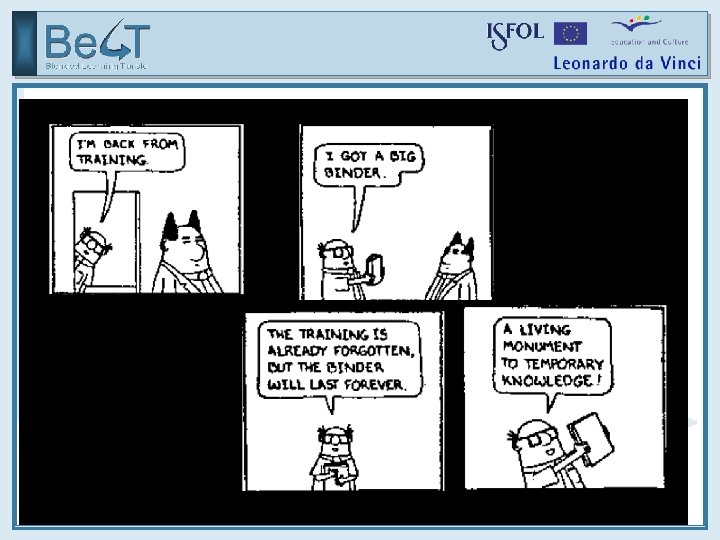
• Dilbert’s has a pessimistic (or cynical) point of view, but his opinion has something of true. Today, too many programs are focused: • More on training than on learning • More on individual learning than on organizational learning • More on “old” knowledge (business as usual) than on competencies and qualities necessaries to compete in global arena and in a so high dynamic environment Scarce integration between (formal or informal) knowledge management system and many programs
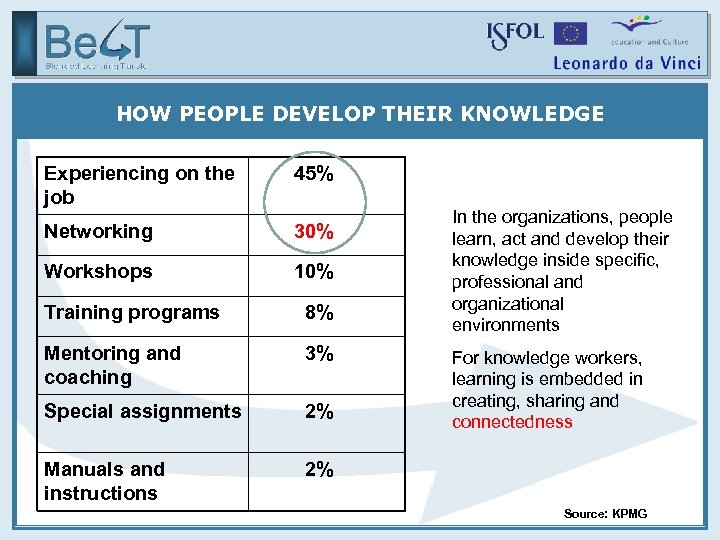
HOW PEOPLE DEVELOP THEIR KNOWLEDGE Experiencing on the job 45% Networking 30% Workshops 10% Training programs 8% Mentoring and coaching 3% Special assignments 2% Manuals and instructions In the organizations, people learn, act and develop their knowledge inside specific, professional and organizational environments 2% For knowledge workers, learning is embedded in creating, sharing and connectedness Source: KPMG
THE CHALLANGES FOR EFFECTIVE KNOWLEDGE SYSTEM 1. Most learning takes place on the job 2. Most learning is informal 3. We learn in different ways: • Instruction • Reading and listening • Doing and observing • Trial, error, adjust and adapt • Guided and unguided 4. We (may) learn from different sources • Courses and instructors • Experts • Web sites • Documents • Colleagues • Experience 5. Some people are not happy to share knowledge, insights, perceptions
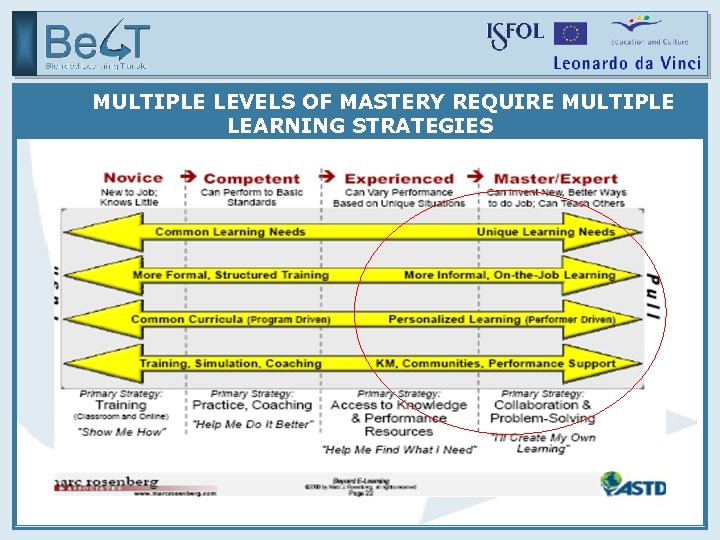
MULTIPLE LEVELS OF MASTERY REQUIRE MULTIPLE LEARNING STRATEGIES
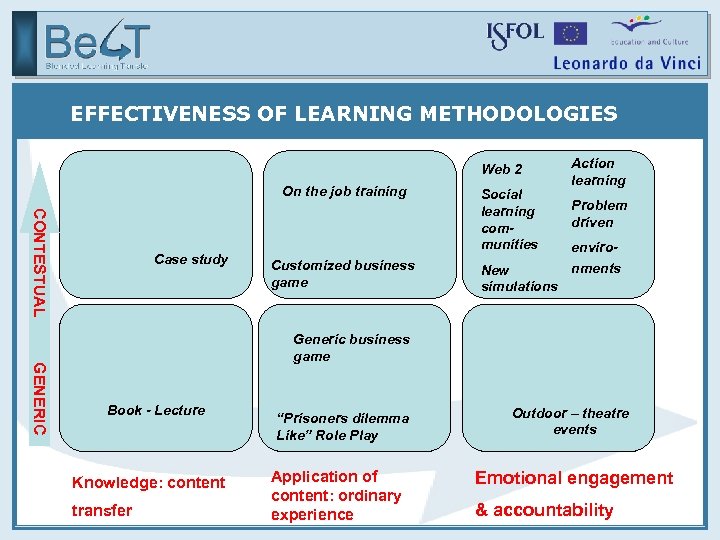
EFFECTIVENESS OF LEARNING METHODOLOGIES Web 2 On the job training CONTESTUAL Case study Customized business game Social learning communities New simulations Action learning Problem driven environments GENERIC Generic business game Book - Lecture Knowledge: content transfer “Prisoners dilemma Like” Role Play Application of content: ordinary experience Outdoor – theatre events Emotional engagement & accountability
LEARNING METHODOLOGIES ARE NOT ENOUGH • There are no shortcuts when it comes to innovation and change • GE's strength is not in breakthrough innovation but, it is a highly structured process that involves a mix of management training, increased exposure to outside ideas, venture capital to get “early visibility” of clever inventions, continuous funding for the development of new ideas (Immelt, 2007) • Last, but not least, the acceptance of failure is an integral part of the effort, as long as it is “fast failing”.
SOME EXAMPLES
IBM: INNOVATION JAM (1) • • • IBM has invited all the 330. 000 employees (from the CEO to the young graduates, coming from 160 countries) and leaders from science and technology, customers, business partners, and even family members to join in a new form of collaborative innovation: Innovation Jam. Innovation. Jam was more than just a large on-line brainstorm: the main aim was to identify new market opportunities. IBM has committed up to $100 million in development funding for the best ideas that arise out of this Jam process Innovation. Jam discussions explored some of most promising areas: Going Places — Transforming travel, transportation, recreation and entertainment Finance & Commerce — The changing nature of global business and commerce Staying Healthy — The science and business of well-being A Better Planet — Balancing economic and environmental priorities
IBM: INNOVATION JAM (2) The Jam takes place in two distinct phases. • During the first (Idea Generation), IBM concentrated on creating new ideas for innovation. Over the course of 72 hours, IBM examined key dimensions of business and society along with emerging technologies to spark and build ideas and robust proposal for products, services, business processes and model innovation. • During the second phase (Idea Refinement), IBM focused the efforts on a subset of top ideas from the first phase, to test and refine them by asking simple questions such as: • Who might be likely to buy such a product or service? • Through what channels might it be offered? • Would existing technologies be combined to make it possible, or would new inventions be required? • What might the societal impact of this innovation be? IBMers rated which ones they believe have the most impact and potential for near-term success.
IBM: TIPS FOR SUCCESSFUL JAMMERS (3) 1. Don’t be shy — you’re the expert. 2. Take a look around and see what’s happening first: You’ll likely find inspiration — and some healthy grounding — in the ideas already posted by your fellow Jammers. 3. Build your case with data: Supplying facts, data and trend analysis for your idea, or to support the ideas of others 4. There’s a time to think big and a time to do a reality-check: when starting out, don’t let the feasibility of your ideas stop you from expressing them. 5. Be constructive: Jamming is about building on good ideas to make them great. Rather than criticize, improve an idea by adding to it. 6. Don’t get on a soapbox: keep in mind the goals and objectives of the Jam. IBMers first “jammed” in 1998, high commitment of CEO, workshops, communications, program managers, leadership model, HR management, etc.
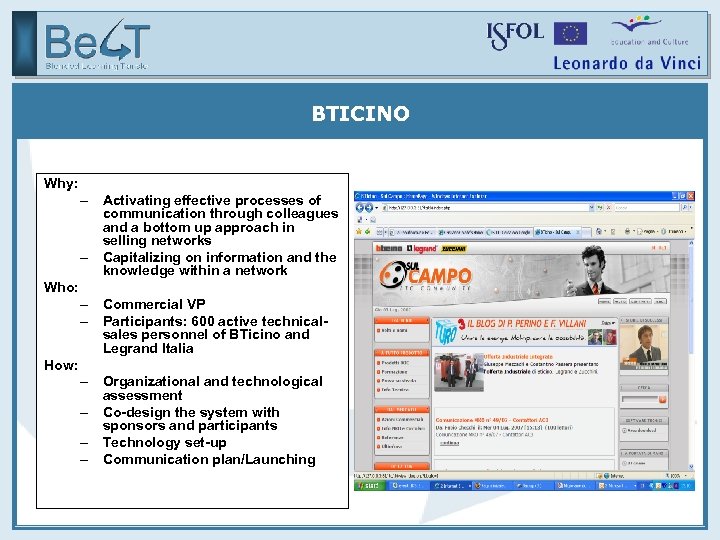
BTICINO Why: – Activating effective processes of communication through colleagues and a bottom up approach in selling networks – Capitalizing on information and the knowledge within a network Who: – Commercial VP – Participants: 600 active technicalsales personnel of BTicino and Legrand Italia How: – Organizational and technological assessment – Co-design the system with sponsors and participants – Technology set-up – Communication plan/Launching
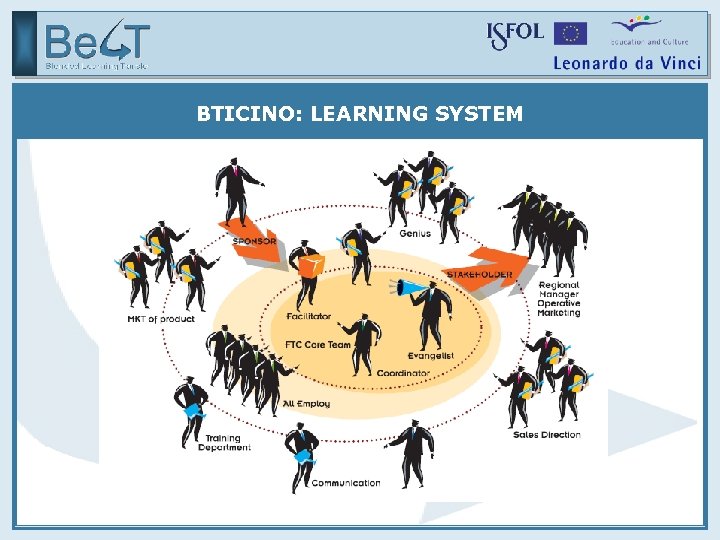
BTICINO: LEARNING SYSTEM
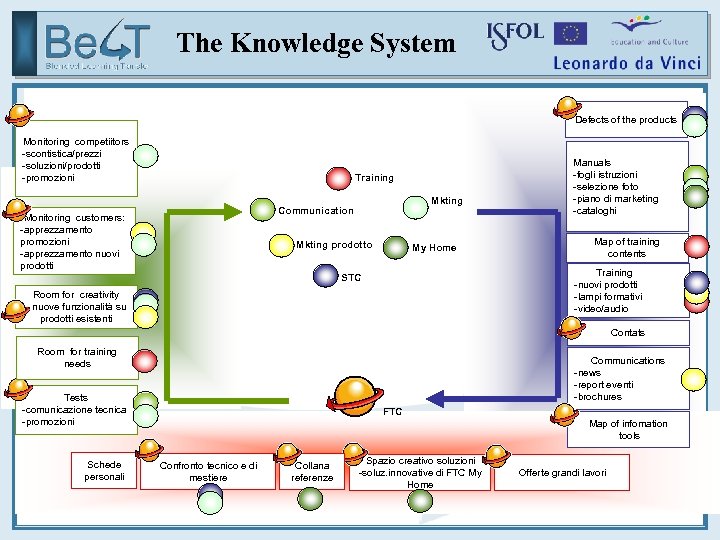
The Knowledge System Defects of the products Monitoring competiitors -scontistica/prezzi -soluzioni/prodotti -promozioni Training Mkting Communication Monitoring customers: -apprezzamento promozioni -apprezzamento nuovi prodotti Mkting prodotto My Home Manuals -fogli istruzioni -selezione foto -piano di marketing -cataloghi Map of training contents Training -nuovi prodotti -lampi formativi -video/audio STC Room for creativity - nuove funzionalità su prodotti esistenti Contats Room for training needs Communications -news -report eventi -brochures Tests -comunicazione tecnica -promozioni Schede personali FTC Map of infomation tools Confronto tecnico e di mestiere Collana referenze Spazio creativo soluzioni -soluz. innovative di FTC My Home Offerte grandi lavori
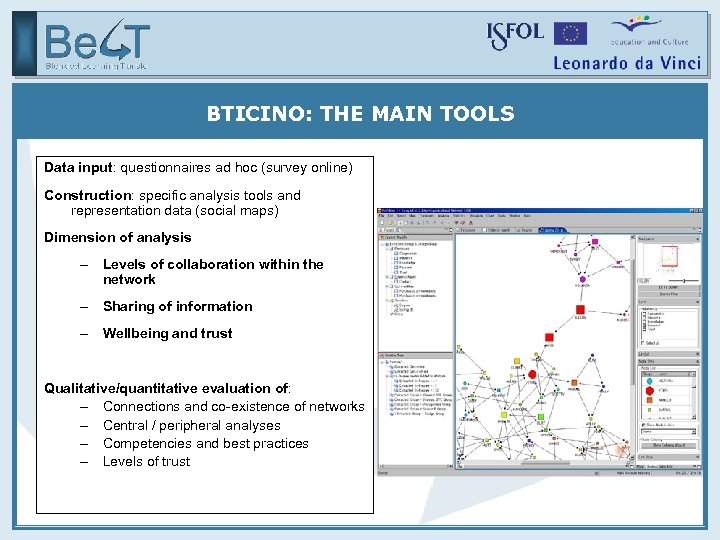
BTICINO: THE MAIN TOOLS Data input: questionnaires ad hoc (survey online) Construction: specific analysis tools and representation data (social maps) Dimension of analysis – Levels of collaboration within the network – Sharing of information – Wellbeing and trust Qualitative/quantitative evaluation of: – Connections and co-existence of networks – Central / peripheral analyses – Competencies and best practices – Levels of trust
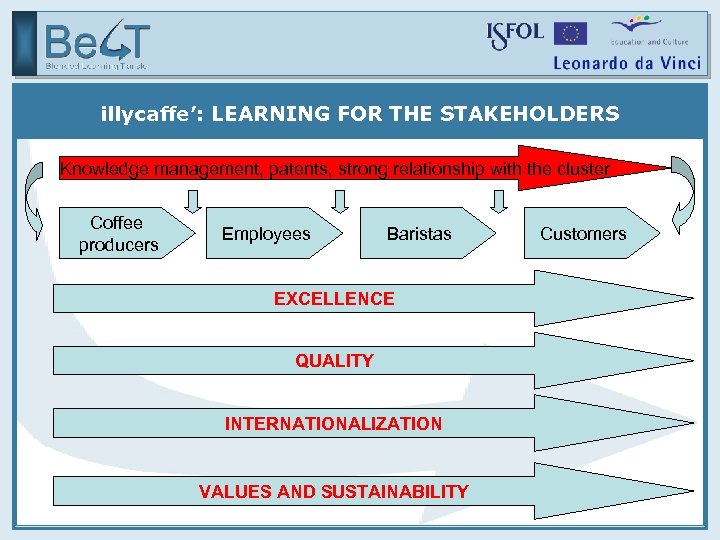
illycaffe’: LEARNING FOR THE STAKEHOLDERS Knowledge management, patents, strong relationship with the cluster Coffee producers Employees Baristas EXCELLENCE QUALITY INTERNATIONALIZATION VALUES AND SUSTAINABILITY Customers
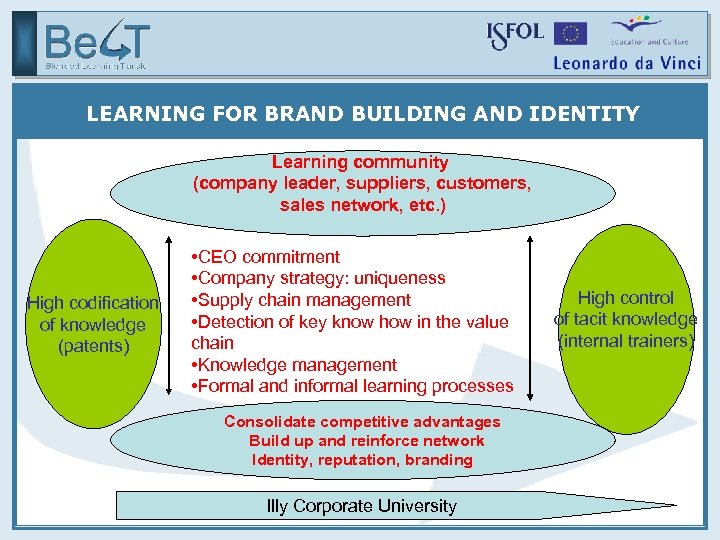
LEARNING FOR BRAND BUILDING AND IDENTITY Learning community (company leader, suppliers, customers, sales network, etc. ) High codification of knowledge (patents) • CEO commitment • Company strategy: uniqueness • Supply chain management • Detection of key know how in the value chain • Knowledge management • Formal and informal learning processes Consolidate competitive advantages Build up and reinforce network Identity, reputation, branding Illy Corporate University High control of tacit knowledge (internal trainers)
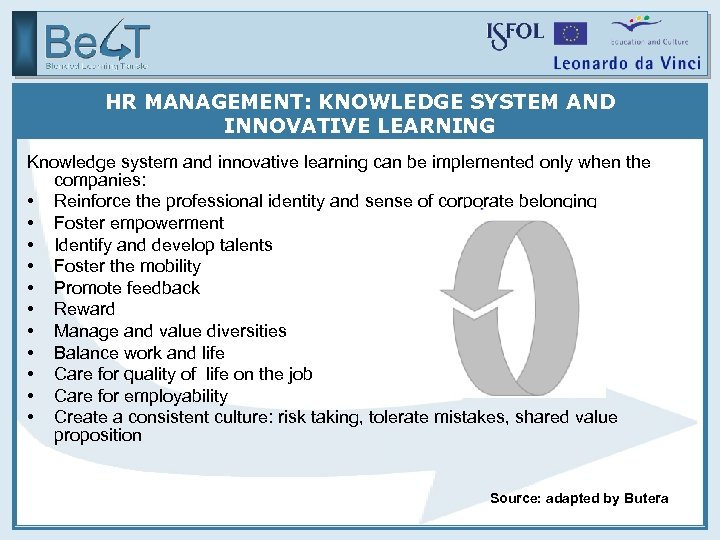
HR MANAGEMENT: KNOWLEDGE SYSTEM AND INNOVATIVE LEARNING Knowledge system and innovative learning can be implemented only when the companies: • Reinforce the professional identity and sense of corporate belonging • Foster empowerment • Identify and develop talents • Foster the mobility • Promote feedback • Reward • Manage and value diversities • Balance work and life • Care for quality of life on the job • Care for employability • Create a consistent culture: risk taking, tolerate mistakes, shared value proposition Source: adapted by Butera
SOME FINAL REMARKS Innovation is more than technology, innovation in business concern how we think about and do management, how we organize, solve problems, make strategy, lead people.
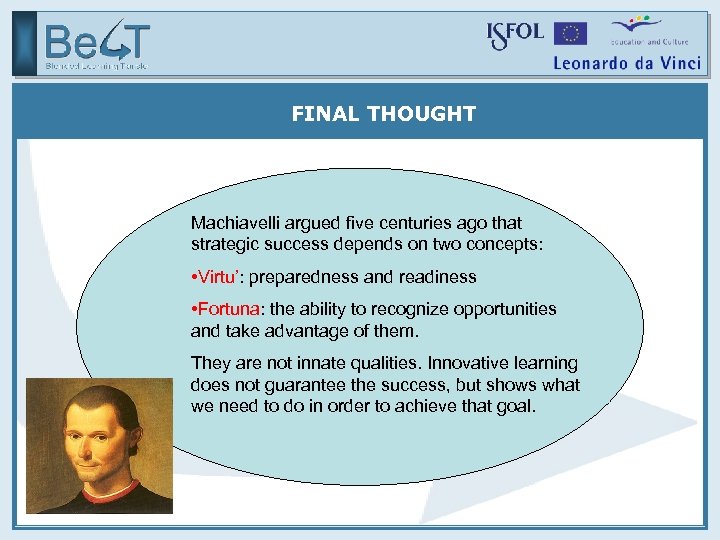
FINAL THOUGHT Machiavelli argued five centuries ago that strategic success depends on two concepts: • Virtu’: preparedness and readiness • Fortuna: the ability to recognize opportunities and take advantage of them. They are not innate qualities. Innovative learning does not guarantee the success, but shows what we need to do in order to achieve that goal.
THANK YOU rgarbellano@istud. it
Скачать презентацию KNOWLEDGE SYSTEM SUPPORTING INNOVATIVE LEARNING Salvatore Garbellano Paris
d9d09b56a0398fed1e176fc08c62079f.ppt