 Скачать презентацию KNOWLEDGE SHARING WORKSHOPS Bureau for Legislative and Public
68087488316a4fc2133d42a98b491901.ppt
- Количество слайдов: 31



KNOWLEDGE SHARING WORKSHOPS Bureau for Legislative and Public Affairs It’s Our Story, Now Tell it Well How to Write right for Front. Lines, Impact Blog and other USAID publications
Workshop Outline • How to Write for USAID • USAID’s Different Communications Vehicles • Story, Not a Story? • The Submission Process KNOWLEDGE SHARING WORKSHOPS Bureau for Legislative and Public Affairs
Why tell the USAID/Development story? • It’s a fantastic, humanitarian activity. • Unless it’s understood, the public and Congress may not continue to support it. • To communicate clearly and simply to a mass audience how USAID uses taxpayer money to help people develop and improve their lives. • The better we communicate, the more support we’ll generate, and the more lives we’ll save. KNOWLEDGE SHARING WORKSHOPS Bureau for Legislative and Public Affairs
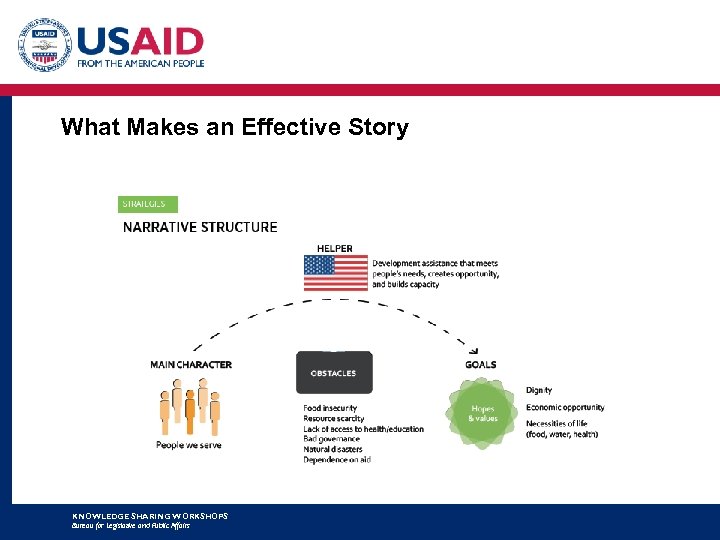
What Makes an Effective Story KNOWLEDGE SHARING WORKSHOPS Bureau for Legislative and Public Affairs
General Story-Telling Must Haves • Have a narrowly focused pitch (a good way to measure this is if you can explain your story in one sentence), • Use powerful statistics; communicate progress; • Tie your story to USAID’s larger Mission, and • Bring it to life with a personal narrative. KNOWLEDGE SHARING WORKSHOPS Bureau for Legislative and Public Affairs
AID-Speak and Communication Gayle Smith, Senior NSC advisor, speaking June 9 at a meeting of the Advisory Committee on Voluntary Foreign Aid, said: • “We need translation at the NSC – I asked USAID people not to speak ‘USAID-ease’ at meetings. ” • “There is a lot of jargon in use. The more development is seen as boring” the less support it gets. • “We need to translate. ” • “We need to figure out how to talk about [foreign aid] with colleagues in the foreign policy community so we do not come across as money movers. ” KNOWLEDGE SHARING WORKSHOPS Bureau for Legislative and Public Affairs
Magazine/Narrative Writing vs. Contracts, Dissertations • • • Not academic Not technical Considers how people read, maintains attention Uses anecdotes Uses a specific example to illustrate a larger issue Clear writing, but can use floral language KNOWLEDGE SHARING WORKSHOPS Bureau for Legislative and Public Affairs
USAID’s Main Communications Vehicles • Frontlines • The Impact Blog • Transforming Lives KNOWLEDGE SHARING WORKSHOPS Bureau for Legislative and Public Affairs
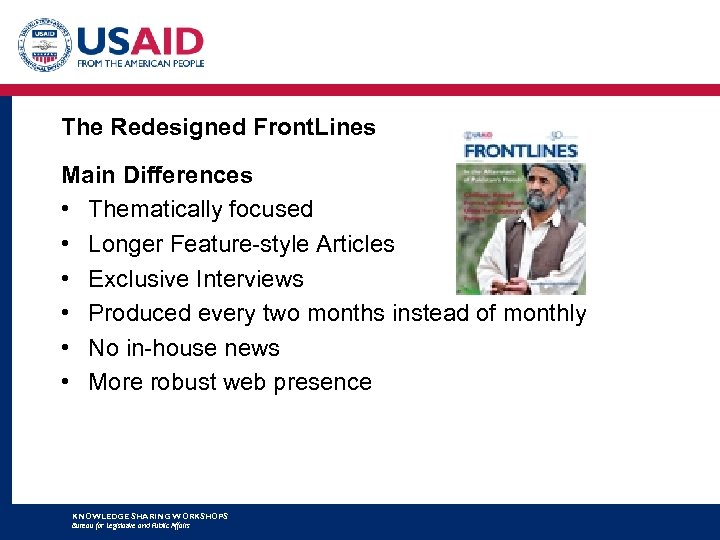
The Redesigned Front. Lines Main Differences • Thematically focused • Longer Feature-style Articles • Exclusive Interviews • Produced every two months instead of monthly • No in-house news • More robust web presence KNOWLEDGE SHARING WORKSHOPS Bureau for Legislative and Public Affairs
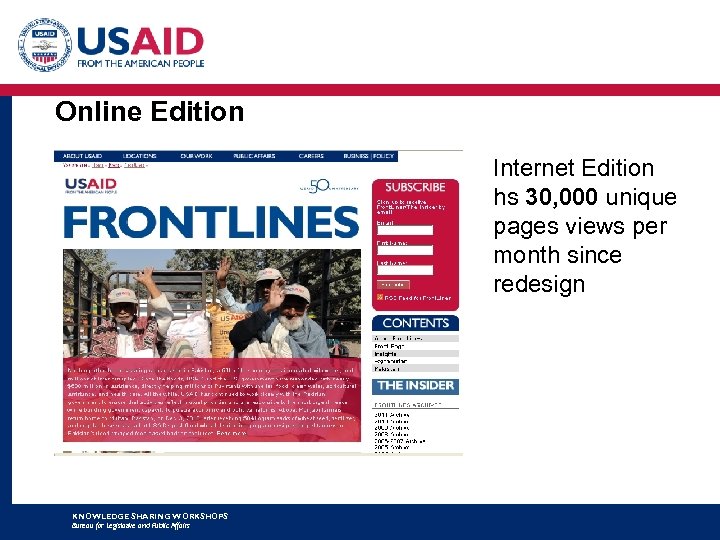
Online Edition Internet Edition hs 30, 000 unique pages views per month since redesign KNOWLEDGE SHARING WORKSHOPS Bureau for Legislative and Public Affairs
Front. Lines: What Are We Looking For? • Interesting, creative angles that highlight our important work in long, “feature” form • Powerful statistics/Results • Human Interest Angles, Good, non-technical Quotes, • Descriptive Language. Make the reader feel like he/she is there KNOWLEDGE SHARING WORKSHOPS Bureau for Legislative and Public Affairs
What are we NOT Looking For? • No technical papers • No “Process Stories” or “Inside Baseball” • No mere program descriptions or a laundry list of achievements. KNOWLEDGE SHARING WORKSHOPS Bureau for Legislative and Public Affairs
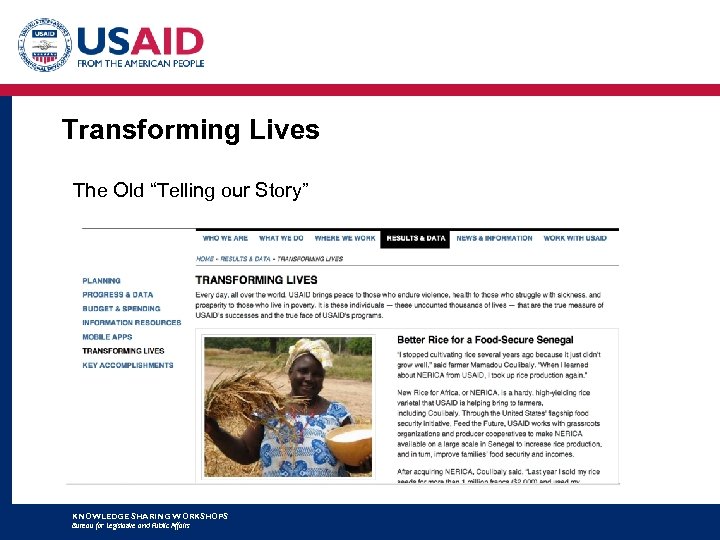
Transforming Lives The Old “Telling our Story” KNOWLEDGE SHARING WORKSHOPS Bureau for Legislative and Public Affairs
Transforming Lives: What Are We Looking For? ● Stories that show broad-scale sustainable development projects, [no one-offs, and nothing that is not being or cannot be scaled ● Stories that relate to Presidential Initiatives, FTF, GHI or GCC; ● Stories that highlight new, cutting-edge development innovations; and/or • Stories that highlight the USAID Forward Reform KNOWLEDGE SHARING WORKSHOPS Bureau for Legislative and Public Affairs
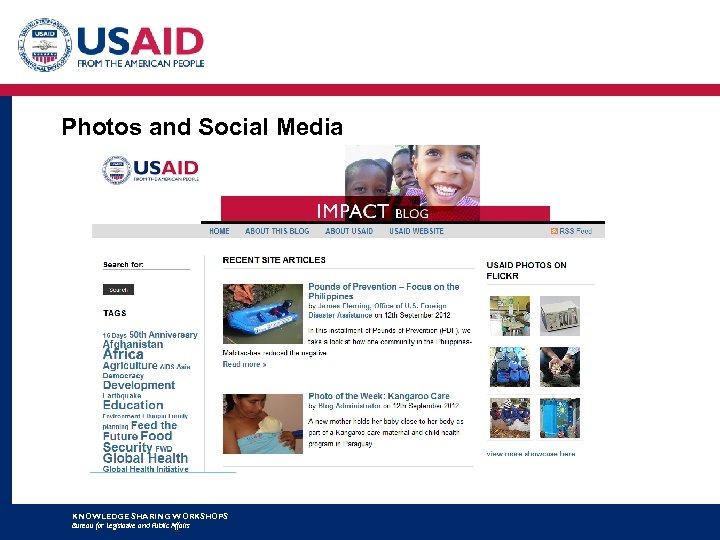
Photos and Social Media KNOWLEDGE SHARING WORKSHOPS Bureau for Legislative and Public Affairs
What makes a good sharable blog? • Timeliness, why is this relevant right now? • Write for the general public- using plain language (i. e. avoid acronyms, technical jargon, and AID-speak) • How many lives were changed? Focus on impact, not budgets • Tell the larger story of why aid matters- you know better than anyone! Have a hook, show results • Is it relatable? Use quotes and first-hand accounts of aid recipients • Don’t make your reader search for more information: always include links KNOWLEDGE SHARING WORKSHOPS Bureau for Legislative and Public Affairs
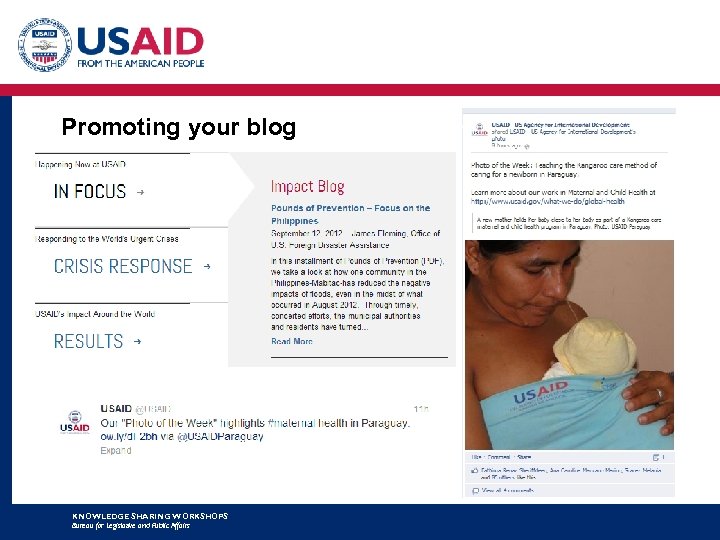
Promoting your blog KNOWLEDGE SHARING WORKSHOPS Bureau for Legislative and Public Affairs
Story? Not a story? KNOWLEDGE SHARING WORKSHOPS Bureau for Legislative and Public Affairs
Ethiopian Burial Societies Join Fight Against HIV/AIDS KNOWLEDGE SHARING WORKSHOPS Bureau for Legislative and Public Affairs
Eggplant Grafting Transforms Life In Guatemala KNOWLEDGE SHARING WORKSHOPS Bureau for Legislative and Public Affairs
“Magic Traps” Increase Farmers’ Profits in Bangladesh Method uses chemical that mimics pheromone of the female melon fly KNOWLEDGE SHARING WORKSHOPS Bureau for Legislative and Public Affairs
Strategic Development Communication Impact Expands Development USAID’s K Program and World Bank Affected KNOWLEDGE SHARING WORKSHOPS Bureau for Legislative and Public Affairs
Sandy Smith Sworn In as Kundu Mission Director KNOWLEDGE SHARING WORKSHOPS Bureau for Legislative and Public Affairs
Afghanistan Infant Mortality Rate Falls 25 Percent after USAID Intervention, Hopkins Study Shows KNOWLEDGE SHARING WORKSHOPS Bureau for Legislative and Public Affairs
Poor’s Participation in Mainstreaming Gender Empowerment for Civil Society Stakeholders Promotes Country Ownership of Good Governance for Community. Driven Sustainable Development KNOWLEDGE SHARING WORKSHOPS Bureau for Legislative and Public Affairs
Economic Development Expert Paul Collier Meets with Senior USAID Officials KNOWLEDGE SHARING WORKSHOPS Bureau for Legislative and Public Affairs
When Aid is Blocked, Can Nations Intervene? KNOWLEDGE SHARING WORKSHOPS Bureau for Legislative and Public Affairs
Partnership Alliance with Major Oil Co. Launches $300 M Initiative in Ghana KNOWLEDGE SHARING WORKSHOPS Bureau for Legislative and Public Affairs
Front. Lines: Submission Guidelines • Generally, stories should be submitted through USAID Communications POC according to themes • Send your 2 -sentence “pitch” for your article to Front. Lines at (LPASCPMail. List. USAID@usaid. gov). • For the subject heading, use a brief slug for your article followed by the word “pitch” (i. e. , India Mealyworm Pitch) KNOWLEDGE SHARING WORKSHOPS Bureau for Legislative and Public Affairs
Blog: Submission Guidelines All blog submissions must be directed to socialmedia@usaid. gov and should be submitted at least two days before desired post date. Please include the following: • Title of the article • Author’s name & title or bureau • Links leading to relevant content (Read USAID’s linking guidelines) • An image with caption & photo credit • Clearance sheet (Must include LPA Strat Lead) If you would like to include additional multimedia (like a photo slideshow or video) please contact us in advance for guidance on accessibility compliance (section 508). KNOWLEDGE SHARING WORKSHOPS Bureau for Legislative and Public Affairs
Transforming Lives: Submission Guidelines • Stories must be submitted through your USAID communications contact at either the mission (the DOC), or Washington. • No template needed; word doc ok • 300 -600 words. • Must contain a title, subtitle, pull-quote, and photo with caption and credit KNOWLEDGE SHARING WORKSHOPS Bureau for Legislative and Public Affairs
Скачать презентацию KNOWLEDGE SHARING WORKSHOPS Bureau for Legislative and Public
68087488316a4fc2133d42a98b491901.ppt