


 Скачать презентацию Knowledge Sharing and Learning in Virtual Communities Michael
8e49a21f4f23c7d9648a0101d02dc279.ppt
- Количество слайдов: 38
 Knowledge Sharing and Learning in Virtual Communities Michael Bieber 1 Ricki Goldman 1 Roxanne Hiltz 1 Il Im 1 Ravi Paul 1 Jenny Preece 2 Ron Rice 3 Ted Stohr 4 Murray Turoff 1 1 New Jersey Institute of Technology 3 Rutgers University (SCILS) 2 University of Maryland, Baltimore County 4 Stevens Technical University
 Outline • • • Motivation Virtuality Research Approach Knowledge & Community Learning & Community Virtual Community Issues Research Questions C-KLASS Tools & Prototype Evaluation Conclusion
 Motivation Why do people participate in virtual communities? – to attract customers/clients – for amusement – to socialize; find comfort (medical communities) – to network, build contacts – to improve what you do (job, personal) – find information/solve problems/learn from others ==> collaboration, knowledge-sharing and learning underlies most of these directly or indirectly Research Question: How best to support this?
 Goal Increase effectiveness by helping people share knowledge and learn through virtual communities
 Virtuality • = “distance” (requires asynchronous communication) • computer representation of information different from reality (alternate representations increase comprehension and exploration) • sharing experiences and perspectives • flexible organizational structure to meet changing conditions [Mowshowitz 1995]
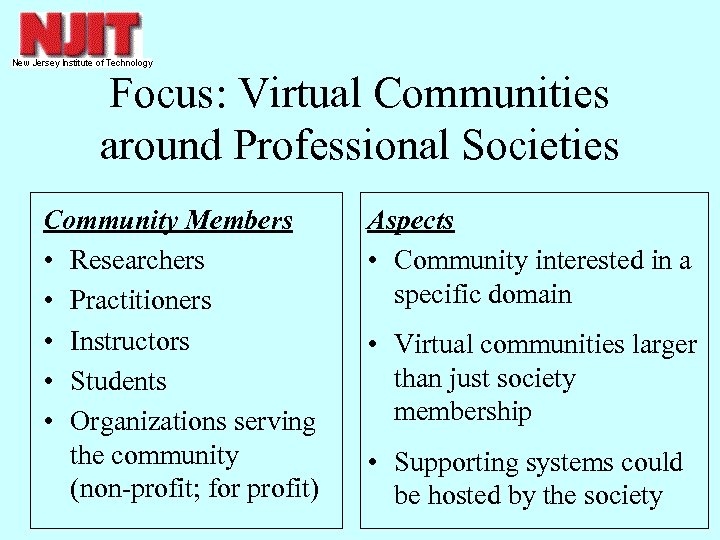 Focus: Virtual Communities around Professional Societies Community Members • Researchers • Practitioners • Instructors • Students • Organizations serving the community (non-profit; for profit) Aspects • Community interested in a specific domain • Virtual communities larger than just society membership • Supporting systems could be hosted by the society
 Example Tasks (of individuals) • • learning about the community domain learning about relevant people in the community teaching a course finding materials on a research topic mentoring members in research or learning developing software using community research developing/selling software to serve community
 Example Community Tasks (e. g. , within a professional society) • • • running a conference conducting elections writing newsletter / submitting to the newsletter making the budget proposing & running a task force recruiting new society members
 Outline • • • Motivation Virtuality Research Approach Knowledge & Community Learning & Community Virtual Community Issues Research Questions C-KLASS Tools & Prototype Evaluation Conclusion
 Approach • Concept Building regarding knowledge and learning within virtual communities • Study testbed communities • Prototype tools • Prototype procedures • Evaluate – virtual communities – learning and effectiveness – the prototype tools and procedures
 Outline • • • Motivation Virtuality Research Approach Knowledge & Community Learning & Community Virtual Community Issues Research Questions C-KLASS Tools & Prototype Evaluation Conclusion
 Community Knowledge Resides in. . . • documents (published papers, reports, photos, videos, lesson plans, syllabi, etc. ) • discussions • decisions • conceptual models • formal educational modules • workflows/processes • people’s expertise • links/relationships among all these
 Knowledge & Community is important for knowledge • Social Network Theory: – people develop through exposure to others [Wellman 83] • Socially Distributed Cognition: – sharing generates new, more complex knowledge [Cicourel 1990] – shared knowledge becomes a public good [Kollock 1999]
 Learning & Community • constructivist, social activity • occurs through collaboration [Mc. Cown & Driscoll 1995] • occurs through knowledge building [Vygotsky 1962] • Knowledge Building: contributing to, authoring, discussing, sharing, exploring, deploying collective knowledge base [O’Neill & Gomez 1994; Perkins 1993]
![Virtual Community Issues Sustainability Communities need: • a clear purpose [Preece 2000] • sufficient](https://present5.com/presentation/8e49a21f4f23c7d9648a0101d02dc279/image-15.jpg "Virtual Community Issues Sustainability Communities need: • a clear purpose [Preece 2000] • sufficient") Virtual Community Issues Sustainability Communities need: • a clear purpose [Preece 2000] • sufficient social value (users, information, resources) • continued adoption, use and contribution by a critical mass [Rice 1990; others]
Virtual Community Issues Sustainability Communities need: • a clear purpose [Preece 2000] • sufficient social value (users, information, resources) • continued adoption, use and contribution by a critical mass [Rice 1990; others]
 Virtual Community Issues continued • size (scaling up) • diverse membership (time in community, experience, skills, education, language, …) • requires effective user interface & tools • how to promote virtual community infrastructure? • how to manage infrastructure?
 Outline • • • Motivation Virtuality Research Approach Knowledge & Community Learning & Community Virtual Community Issues Research Questions C-KLASS Tools & Prototype Evaluation Conclusion
 Research Questions: Virtual Community Structure • What structural components characterize a healthy community? • How should VC be structured to promote knowledge sharing & learning? • How to adapt technologies to support structural components?
 Research Questions: Knowledge and Learning • How do different people create, understand, reuse, and learn from knowledge? • Kinds of knowledge & memory to support? • How do knowledge & learning improve effectiveness? • How to support knowledge-sharing, learning and memory?
 Research Questions: Improving Effectiveness • What activities do members do? • Barriers to knowledge-sharing and learning? • Interfaces and media to improve activities?
 Research Questions: Sustainability & Scalability • • How to promote? How will members “buy in”? How to scale? How the community should manage the infrastructure? • Factors for sustainability? • Providing on-going feedback for managing and sustaining?
 Testbed Communities • Asynchronous Learning Networks • ALN Research Site - pilot site • Hypermedia • ACM SIGWEB • Human-Computer Interaction • ACM SIGCHI, British HCI Group • Human Sciences (formally Home Economics) • Kappa Omicron Nu Honor Society • Pennsylvania Dept. of Education
 Outline • • • Motivation Virtuality Research Approach Knowledge & Community Learning & Community Virtual Community Issues Research Questions C-KLASS Tools & Prototype Evaluation Conclusion
 Developmental Research • No integrated tools to handle the diverse forms of knowledge sharing and learning. • No procedures for how to use such an infrastructure effectively. --> Community-KLASS prototype (knowledge, learning and sharing support)
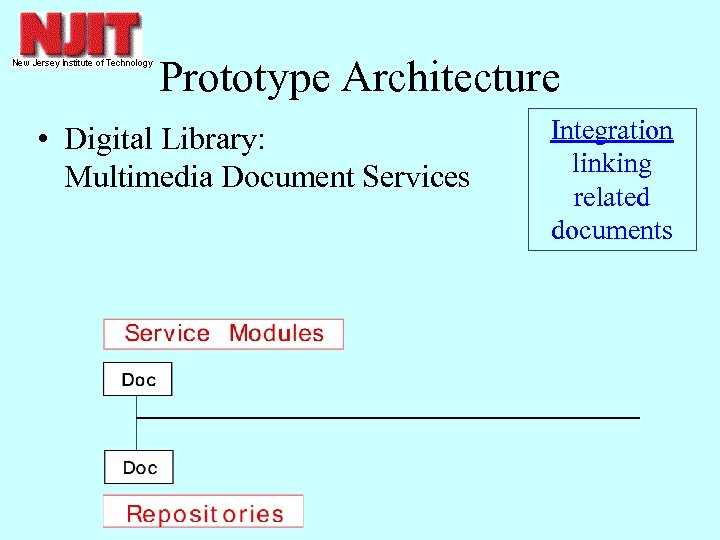 Prototype Architecture • Digital Library: Multimedia Document Services Integration linking related documents
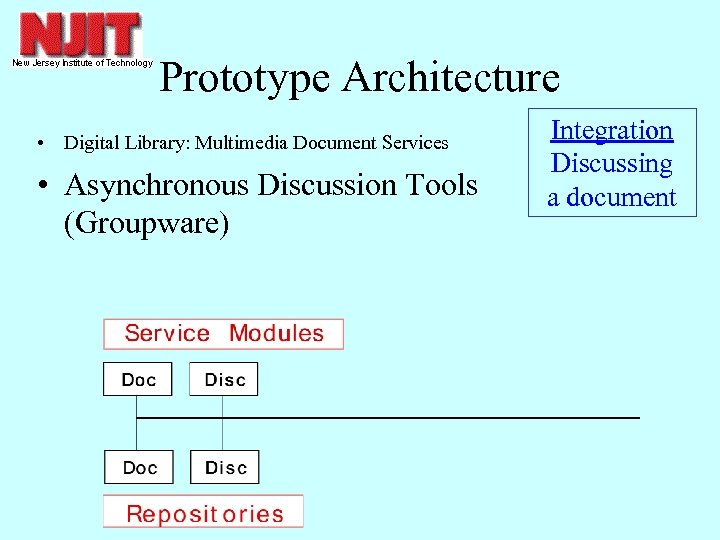 Prototype Architecture • Digital Library: Multimedia Document Services • Asynchronous Discussion Tools (Groupware) Integration Discussing a document
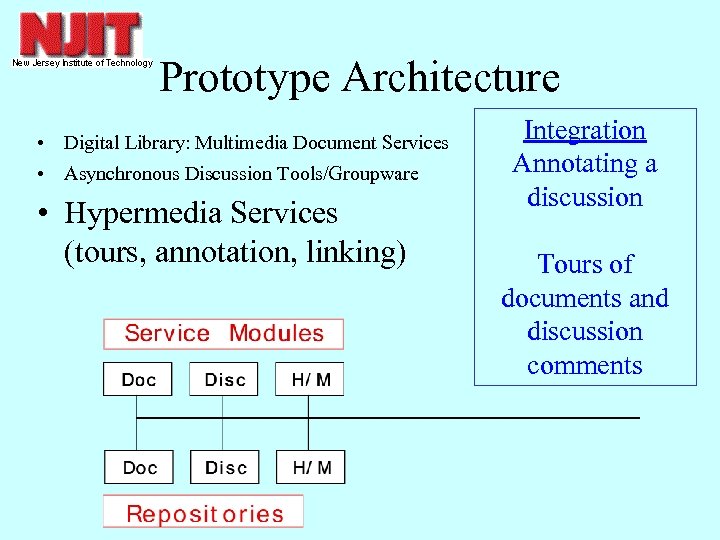 Prototype Architecture • Digital Library: Multimedia Document Services • Asynchronous Discussion Tools/Groupware • Hypermedia Services (tours, annotation, linking) Integration Annotating a discussion Tours of documents and discussion comments
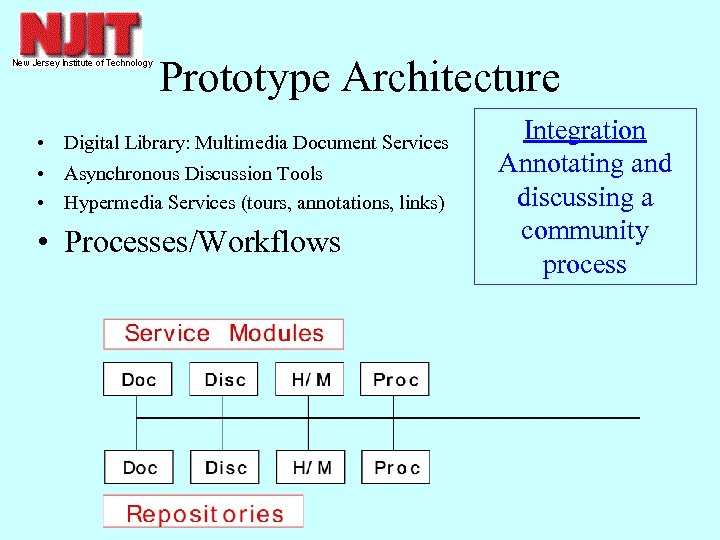 Prototype Architecture • Digital Library: Multimedia Document Services • Asynchronous Discussion Tools • Hypermedia Services (tours, annotations, links) • Processes/Workflows Integration Annotating and discussing a community process
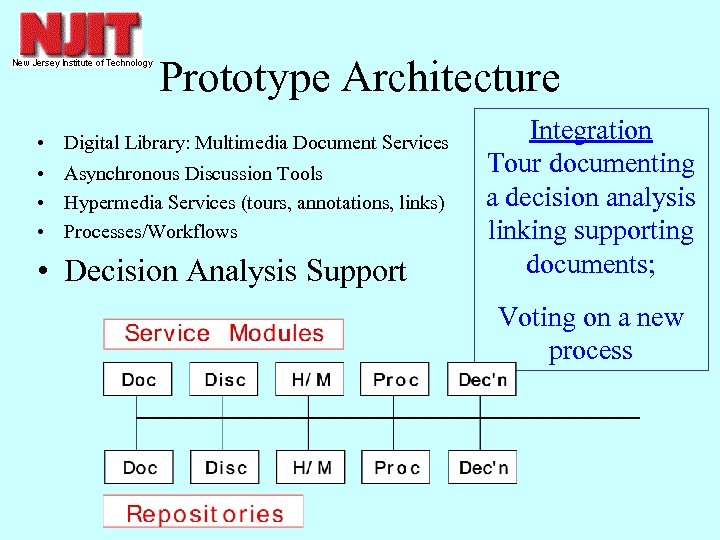 Prototype Architecture • Digital Library: Multimedia Document Services • Asynchronous Discussion Tools • Hypermedia Services (tours, annotations, links) • Processes/Workflows • Decision Analysis Support Integration Tour documenting a decision analysis linking supporting documents; Voting on a new process
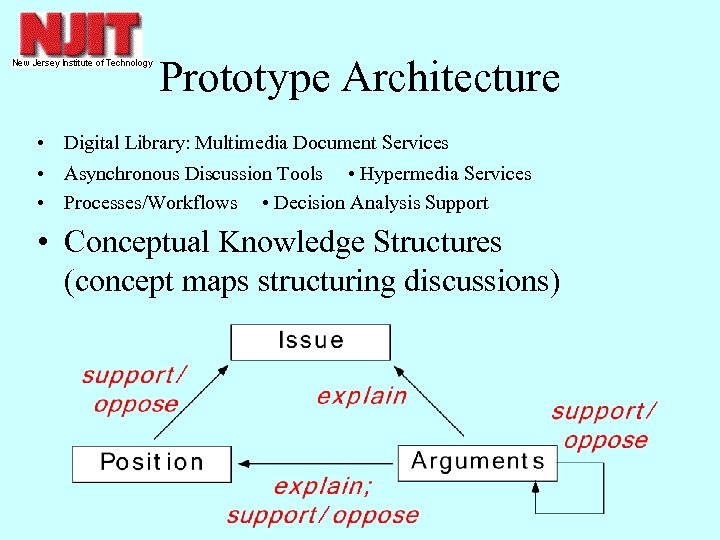 Prototype Architecture • Digital Library: Multimedia Document Services • Asynchronous Discussion Tools • Hypermedia Services • Processes/Workflows • Decision Analysis Support • Conceptual Knowledge Structures (concept maps structuring discussions)
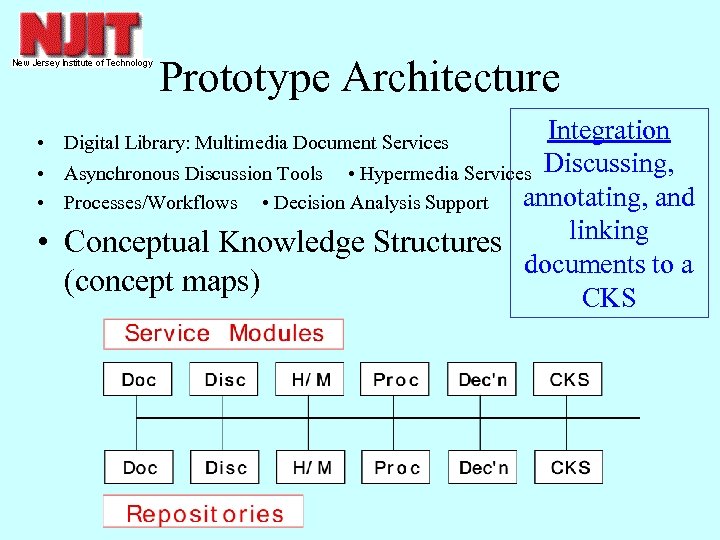 Prototype Architecture Integration • Asynchronous Discussion Tools • Hypermedia Services Discussing, annotating, and • Processes/Workflows • Decision Analysis Support linking • Conceptual Knowledge Structures documents to a (concept maps) CKS • Digital Library: Multimedia Document Services
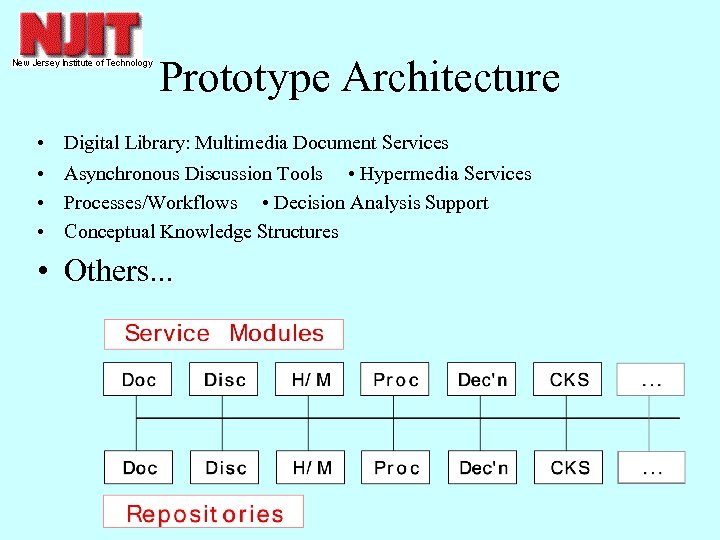 Prototype Architecture • Digital Library: Multimedia Document Services • Asynchronous Discussion Tools • Hypermedia Services • Processes/Workflows • Decision Analysis Support • Conceptual Knowledge Structures • Others. . .
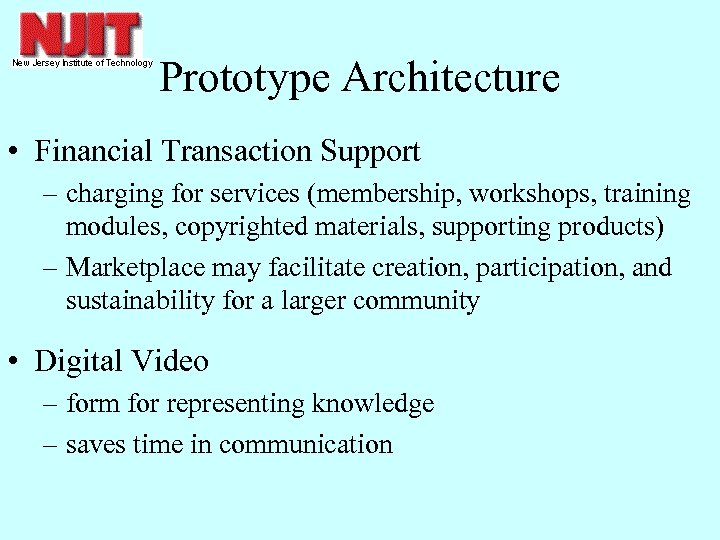 Prototype Architecture • Financial Transaction Support – charging for services (membership, workshops, training modules, copyrighted materials, supporting products) – Marketplace may facilitate creation, participation, and sustainability for a larger community • Digital Video – form for representing knowledge – saves time in communication
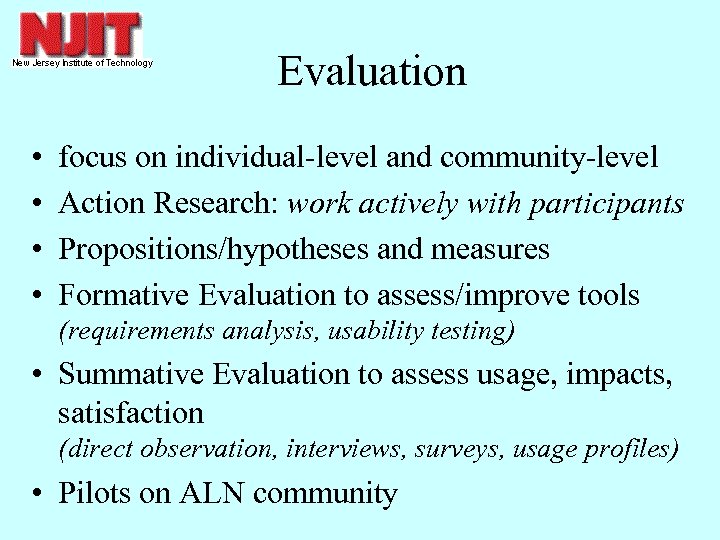 Evaluation • • focus on individual-level and community-level Action Research: work actively with participants Propositions/hypotheses and measures Formative Evaluation to assess/improve tools (requirements analysis, usability testing) • Summative Evaluation to assess usage, impacts, satisfaction (direct observation, interviews, surveys, usage profiles) • Pilots on ALN community
 Contributions • in-depth technical and social analysis of supporting knowledge-sharing and learning within virtual communities • tools: integrated C-KLASS environment • procedures • approach for evaluating virtual communities
 Further Research • room for lots of collaboration regarding issues and tools • approach applies to other communities (educational, within companies, governmentsponsored) • synergies with geo-local community informatics
 In Conclusion Why do people participate in virtual communities? – to attract customers/clients – for amusement – to socialize; find comfort (medical communities) – to network, build contacts – to improve what you do (job, personal) – find information/solve problems/learn from others ==> collaboration, knowledge-sharing and learning underlies most of these directly or indirectly Research Question: How best to support this?
 References – Cicourel, A. (1990). The integration of distributed knowledge in collaborative medical diagnosis. In J. Galegher, R. Kraut & C. Egido (Eds. ) Intellectual teamwork: Social and technological foundations of cooperative work. (pp. 221 -242. ) Hillsdale, NJ: Erlbaum. – Kollock. P. (1999) The economies of online cooperation: gifts and public goods in cyberspace. In. M. A. Smith and P. Kollock Communities in Cyberspace. Routledge London. 220 -239. – Mc. Cown, R. R. & Driscoll, M. P. (1995). Using Collaborative Writing and Problem. Based Learning in the College Classroom. Proceedings of the Computer Supported Collaborative Learning Conference, 1995. – O'Neill, D. K. , & Gomez, L. M. (1994). The collaboratory notebook: A distributed knowledge-building environment for project-enhanced learning. In Proceedings of Ed. Media '94, Vancouver, BC. – Perkins, D. N. (1993). Person-plus: A distributed view of thinking and learning. In G. Salomon (Ed). Distributed Cognitions: Psychological and Educational Considerations pp. 88 -111. Cambridge: Cambridge University Press. – Vygotsky, L. (1962). Thought and language. Cambridge, MA. MIT Press. – Wellman, (1997) An electronic group is virtually a social network. In S. Kiesler Culture of the Internet. Lawrence Earlbaum Associates: Mahwah, NJ. 179 -208.