 Скачать презентацию KNOWLEDGE RETENTION BY ASSOC DR SUSANNE DURST SOUTH
5 201216 английский.pptx
- Количество слайдов: 46



KNOWLEDGE RETENTION BY ASSOC. DR. SUSANNE DURST SOUTH URAL STATE UNIVERSITY – 20 DECEMBER 2016 UNIVERSITY OF SKÖVDE – WWW. HIS. SE/EN Bild

AGENDA 1. Knowledge retention Bild 2 2
BACKGROUND KM should also involve activities related to knowledge retention Knowledge retention is defined as “maintaining, not losing, knowledge that exists in the minds of people (tacit, not easily documented) and knowing (experiential action manifesting in behavior) that is vital to the organization´s overall functioning” (Martins & Meyer, 2012, p. 80). Knowledge retention “deals with cases where expert knowledge workers leave organizations after long periods of time” (Levy, 2011, p. 582). Bild 3 3
BACKGROUND Delong (2004) assumes that knowledge retention consists of three activities which are knowledge acquisition, storage and retrieval. • Acquisition is about the practices, processes, and routines used to move knowledge into state where it is kept available for future use. • Storage refers to processes and facilities used to keep knowledge and information until it is needed. • Retrieval is about behaviors, routines, and processes used to access and reuse information and knowledge in new situation. If organizations fail to address this challenge, they may lose their capacity to act (worst case scenario) Bild 4 4
WHAT IS CRITICAL KNOWLEDGE? • As not all knowledge is critical to organizations, initial activities should strive for the determination of critical knowledge that is most at risk of being lost (De Long & Davenport, 2003). • Critical knowledge is more complex, abstract, and context dependent, so the knowledge to be retained is implicit or tacit (Delong, 2004). • Organizations have difficulties in specifying which specific knowledge and skills different individuals actually possess (Van Zolingen et al. , 2001). • And: knowledge that is valuable today may hold little value tomorrow Bild 5 5
BARRIERS TO KNOWLEDGE RETENTION • • • Lost knowledge costs are usually hidden Leaders don’t know where the organization is vulnerable No one owns the problem of lost knowledge There is no slack for knowledge-sharing activities Management must do more than just capture knowledge (De. Long, 2004) • Also, time, other competing priorities, missing understanding of how to retain knowledge (Blankenship & Brueck, 2008) and lacking job satisfaction and talent management (Bessick & Naicker, 2013) Bild 6 15
SOME RESEARCH INSIGHTS Bild 7 19
RESEARCH AIM AND QUESTIONS Aim • To increase our understanding of how SMEs retain critical knowledge. Questions • How is knowledge treated in the company? • How is critical knowledge retained? • What methods are applied in order to retain relevant knowledge? • How is knowledge shared in the company? Bild 8 20
METHODOLOGY Qualitative research approach Semi-structured interviews • managing directors and other staff members of small firms from Vorarlberg (Austria) operating in the building and construction industry • conducted in March 2014 • with-in case and cross-case analysis of all interview transcripts for the identification of patterns Bild 9 21
FINDINGS – WHAT MAKES THE BUILDING AND CONSTRUCTION SECTOR SPECIAL WITH REGARD TO KNOWLEDGE “Knowledge is publicly available on the sites and thus it can easily be copied” (MD 3) SM 1 declared “manufacturing firms in other industries have relatively few factors that affect operations. In our industry, there are many different factors, why it is not possible to write down everything. There is mass production, whereas we have individual production or special production”. Bild 10 22
FINDINGS – WHAT IS MEANT BY KNOWLEDGE RETENTION? SM 4 and MD 3 claimed that knowledge retention helps in keeping knowledge within the company and thus in not disclosing it to third parties. MD 5 described knowledge retention as "storage and easy retrieval of experiences and knowledge that are relevant to the company's success. " MD 2 said that “it is the knowledge that is stored so that it can be found again. “ Bild 11 23
FINDINGS – INTERNAL AND EXTERNAL FACTORS THAT MAY INFLUENCE KNOWLEDGE RETENTION As internal factors fluctuation and the retention of old ways of doing things were named. As external factors fast-paced developments in the industry, more elaborate and complex documentation, labor market’s development and lack of control in the industry were named. Bild 12 24
FINDINGS - IS KNOWLEDGE COLLECTED AND ORGANIZED IN A SYSTEMATIC WAY? Knowledge is at least partially organized in the firms. “This takes place verbally, of course also by databases, but more often verbally“ (SM 4). “That we develop in the company is in the computers, then it is filed on CDs and hard disks. Otherwise, there are talks every day or it happens just according to demand” (MD 3). Bild 13 25
FINDINGS – CONSEQUENCES OF KNOWLEDGE RETENTION THAT HAS NOT BEEN CARRIED OUT? I Most interviewees stated that no financial losses were incurred. SM 2 mentioned negative experiences because of the death of an employee. A loss of knowledge and know-how was the consequence. It was also claimed that the company did not suffer any financial loss, as no jobs and customer relationships were lost. He also mentioned the massive effort needed to close the knowledge gap that had been created by the former employee. MD 3 mentioned a crash of the entire computer system a few years ago and spoke of the financial impact of € 12. 000 -15. 000, it also resulted in a partial loss of knowledge. Bild 14 26
FINDINGS – CONSEQUENCES OF KNOWLEDGE RETENTION THAT HAS NOT BEEN CARRIED OUT? II MD 2 reported a positive effect of knowledge loss: “Even if one leaves the company without a malicious intent, such as a retirement, there is of course a certain amount of experience and knowledge loss. This does not mean that this is necessarily a bad thing. If an employee is longer there, many rely on him and for them it is then not necessary to think for themselves and to acquire knowledge. However, after he is gone, the remaining ones have to acquire knowledge on their own. ” Bild 15 27
FINDINGS – KNOWLEDGE SHARING AS ESSENTIAL PART OF KNOWLEDGE RETENTION "We are actually so small that knowledge more or less shares itself, rather by talking. For entering new knowledge in databases we are too small. But usually we read something, talk about it and then pass it on. This is quite appropriate for our company size"(MD 2). The larger firms use more sophisticated systems: "As a rule, after each meeting written protocols are filed under a given data path. Then everyone can access the log under that path"(MD 5). SM 4 declared “it’s just simply much faster to explain something to someone, than to write it down somewhere. " Bild 16 28
FINDINGS – EFFECTIVE METHODS FOR KNOWLEDGE SHARING I Most respondents indicated that mutual communication by team members achieve the best results. SM 1 pointed to the “Lesson Learned" method: “There are so many factors which you can never write down or which are not applicable one-to-one. This is why teamwork on the construction site is the most effective way. ” SM 4 explained the effectiveness of conversations as follows: "Effectiveness is for me, if you can explain and give an example at the same time. " Bild 17 29
FINDINGS – EFFECTIVE METHODS FOR KNOWLEDGE SHARING II MD 3 specified his distrust towards electronic data storage. He said “emails are too impersonal to me - it’s better if I can look someone in the eyes. ” SM 3 stated that “it's just more pleasant to talk to someone, as to save the knowledge somewhere. " SM 2 mentioned the use of smartphones. They are used “to serve as a contact point between the sites and the office. ” Company C 5 uses a CRM system on tablet computers for their sales activities “to make the necessary data available with the least effort. ” (MD 5). C 2 and C 5 employ retired former employees on a part time basis to have their knowledge available at a certain time. Bild 18 30
CONCLUSIONS I The findings show that the most common measures for knowledge retention are data storage, personal communication and Lesson Learned approaches. As regards negative consequences of missing knowledge retention activities, the participants are not willing to admit or unaware of the indirect costs, i. e. time and resources needed to reduce the knowledge gap, involved in knowledge loss. As regards the industry, the challenge for any KM activities will be to find a proper trade-off between losing and retaining knowledge. Bild 19 31
CONCLUSIONS II From a theoretical point of view the findings provide some fresh insights into how smaller firms deal with the issue of knowledge retention; specifically in SMEs operating in the building and construction industry. From a practical point of view this study points out the need for firms to engage in activities related to knowledge retention to ensure the firm’s well-being. Bild 20 32
Knowledge transfer Bild 21
BACKGROUND The retention of critical knowledge, first requires a transfer. According to Argote and Ingram (2000), knowledge transfer in organizations “is the process through which one unit (e. g. , group, department, or division) is affected by the experience of another” (p. 151). Bild 22 22
METHODS FOR KNOWLEDGE TRANSFER De Long and Davenport (2003) highlight five frequently used methods for knowledge transfer and capture which are Interviews/Videotaping, Mentoring, Storytelling, Communities of Practice, and Training and Education. Storytelling, mentoring and coaching are considered effective ways for transferring both implicit and tacit knowledge (Delong, 2004). Bild 23 23
FACTORS PROMOTING THE RETENTION AND TRANSFER OF KNOWLEDGE I • Relational competence. This refers to the ability of a party to initiate and maintain relationships (Hatak & Roessl, 2013). Hatak and Roessl (2013), who studied the relationship between relational competence and knowledge transfer in the context of intrafamily succession, showed a high correlation between the two aspects and also that this relationship is highly significant. Bild 24 24
FACTORS PROMOTING THE RETENTION AND TRANSFER OF KNOWLEDGE II • Trust. It is argued that the transfer and sharing of knowledge is facilitated by the existence of a trusting relationship between the persons concerned (Hislop, 2009). • Willingness to cooperate and participate. The study by Fong and Lee (2009) has indicated the meaning of colleagues’ preparedness to cooperate and participate in knowledge transfer processes. • Type of knowledge. Given the nature of different types of knowledge, explicit knowledge is easier to capture than tacit knowledge (Grant, 1996; Levy, 2011). Bild 25 25
FACTORS PROMOTING THE RETENTION AND TRANSFER OF KNOWLEDGE III • Common language. Without a common language, individuals “will neither understand nor trust one another” (Davenport & Prusak, 1998, p. 98). • Culture is believed to be the main factor of putting knowledge management activities into action (Alavi et al. , 2006). There is a need for a working environment that decreases attrition of high performing employees, given the close link between turnover and knowledge retention (Delong, 2004). A sharing culture should be strived for to reach the intended objectives. Bild 26 26
FACTORS PROMOTING THE RETENTION AND TRANSFER OF KNOWLEDGE IV • Management makes available resources and time for knowledge sharing activities. It’s is not only about emphasising the relevance of knowledge management, it is primarily about creating space for activities related to KM (Van Zolingen et al. , 2001) and providing access to resources supporting knowledge sharing activities (Fong & Lee, 2009). • Time. This may not only refer to the actual transfer process but to any preparatory measures as well. Additionally, studies have suggested that the process of elicitation takes longer than the process of encoding (Jackson, 2010). Bild 27 27
FACTORS PROMOTING THE RETENTION AND TRANSFER OF KNOWLEDGE V • Senior management directive. Studies have shown the critical link between management commitment and implementation of knowledge management approaches (e. g. Alavi et al. , 2006; Jackson, 2010). • Motivation. Knowledge transfer will also be influenced by the motivation of both the source and recipient (Szulanski, 2000; von Krogh et al. , 2001). • Stickiness. The term refers to the difficulties encountered in the knowledge transfer process (Szulanski, 1996). Bild 28 28
FACTORS PROMOTING THE RETENTION AND TRANSFER OF KNOWLEDGE VI • Absorptive capacity. Despite high motivation, the individuals concerned may fail to understand each other or express their tacit knowledge (Cohen & Levinthal, 1990). • Context. Any knowledge transfer (and retention activity) is expected to be facilitated by having involved the context surrounding the activities (Alavi & Leidner, 2001), as otherwise the danger of knowledge being lost is high. • Incentives. They may be needed to increase the individual’s willingness to contribute (Geisler, 2007). Bild 29 29
FACTORS PROMOTING THE RETENTION AND TRANSFER OF KNOWLEDGE VII • Structure. Knowledge that is embedded in rules and routines has been found to be less vulnerable in the case of turnover (Rao & Argote, 2006). • Work can be standardized. Research suggests that the standardization of work reduces the likelihood that turnover will have a negative effect on organization performance (Rao & Argote, 2006). • Characteristics of the task. Research suggests that similarity regarding the number of elements across the tasks increases the likelihood of transfer (Argote & Ingram, 2000). Bild 30 30
FACTORS PROMOTING THE RETENTION AND TRANSFER OF KNOWLEDGE VIII • Moving individuals. This activity is considered a suitable approach to facilitating knowledge transfer. By this the individual concerned is not only able to acquire new explicit and tacit knowledge but also able to transfer both types of knowledge to new contexts (Argote & Ingram, 2000). Bild 31 31
Knowledge loss Bild 32
BACKGROUND I Lost knowledge can occur at individual, group, or organizational levels, have either anticipated or unanticipated effects, have tangible or intangible impacts and create immediate or delayed costs (De. Long, 2004). De. Long further specifies five ways as to how lost knowledge can undermine organizational strategies: a) Reduced capacity to innovate; b) Ability to pursue growth strategies threatened; c) Reduced efficiency undermines low-cost strategies; d) Losing knowledge can give competitors an advantage; e) Losing specific knowledge at the wrong time increases vulnerability. Bild 33 33
BACKGROUND II In a recent study, Daghfous et al. (2013) identified as drivers of knowledge loss, employee turnover, rushed reallocation of workforce, rushed handovers, heavy workloads, outsourcing, resistance to learning, and reluctance to share knowledge. Bild 34 34
BACKGROUND III When it comes to the issue of knowledge loss, most firms do not have a systematic approach and the approaches used are few, ad hoc and reactive (Daghfous et al. , 2013). In addition, despite the apparent meaning of employees (including managers) to organizations, it is still observable that workforce is considered as easily replaceable (Geisler, 2007). Considering the demographic challenges ahead this proceeding is rather dangerous and organizations are requested to change their approach. Bild 35 35
SOME RESEARCH INSIGHTS Bild 36 36
CENTRAL RESEARCH AIM To obtain a better understanding of how a smaller firm copes with the danger of knowledge loss caused by exit or long-term absence of employees/business partners Focus on: Identification of critical organization members and their relationships with other staff/partners in an German medium-sized business Bild 37 37
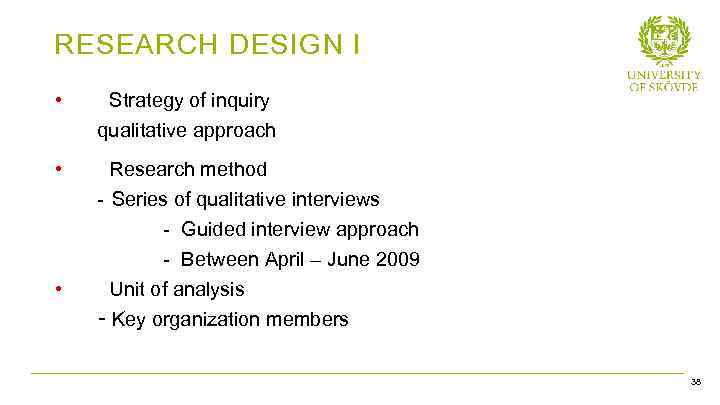
RESEARCH DESIGN I • Strategy of inquiry qualitative approach • • Research method - Series of qualitative interviews - Guided interview approach - Between April – June 2009 Unit of analysis - Key organization members Bild 38 38
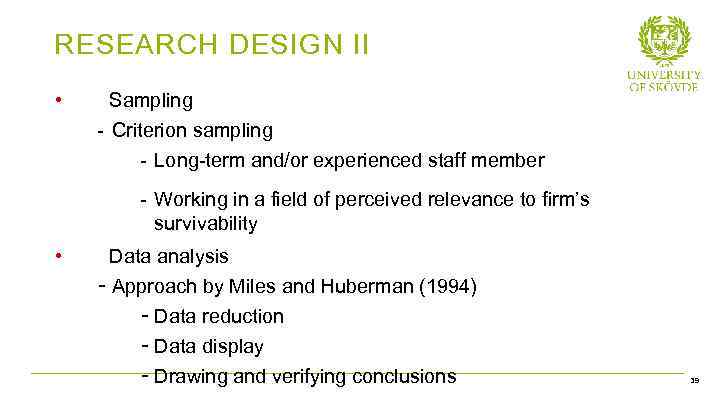
RESEARCH DESIGN II • Sampling - Criterion sampling - Long-term and/or experienced staff member - Working in a field of perceived relevance to firm’s survivability • Data analysis - Approach by Miles and Huberman (1994) - Data reduction - Data display - Drawing and verifying conclusions Bild 39 39
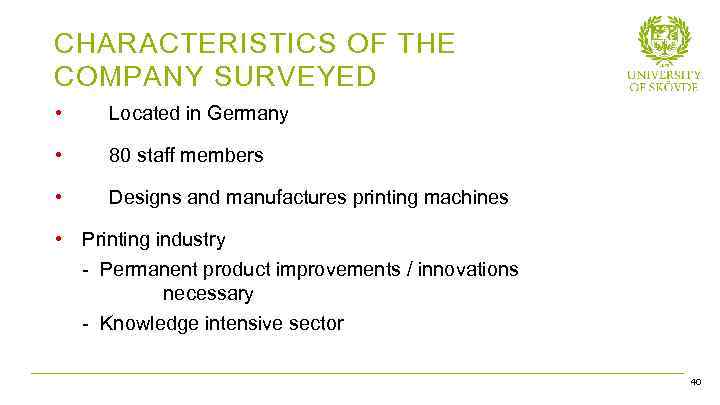
CHARACTERISTICS OF THE COMPANY SURVEYED • Located in Germany • 80 staff members • Designs and manufactures printing machines • Printing industry - Permanent product improvements / innovations necessary - Knowledge intensive sector Bild 40 40
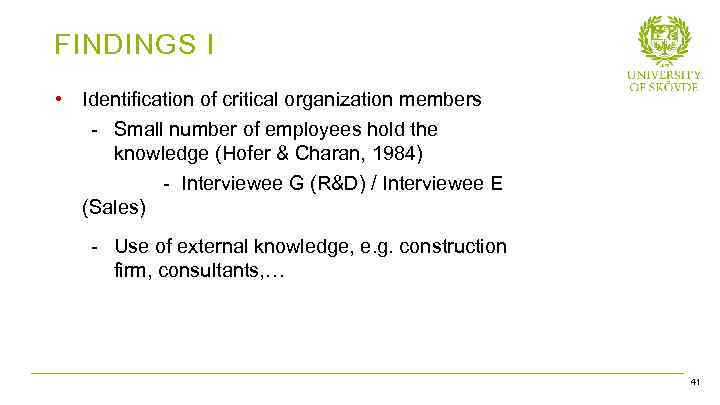
FINDINGS I • Identification of critical organization members - Small number of employees hold the knowledge (Hofer & Charan, 1984) - Interviewee G (R&D) / Interviewee E (Sales) - Use of external knowledge, e. g. construction firm, consultants, … Bild 41 41
FINDINGS II • Collaboration among critical organization members - Communication process is usually informal - Based on long-term and close collaboration Trust is key Bild 42 42
FINDINGS III • Effect of turnover and/or long-term absence Apparent knowledge gap - Interviewee G (R&D Director) - Interviewee E (Sales Director) - Problem at time of investigation: - Understaffed department: Service & Process Planning - Focus of consideration is primarily on internal members External partners seem to be neglected Bild 43 43
RELATIONSHIP KNOWLEDGE MAP Bild 44 44
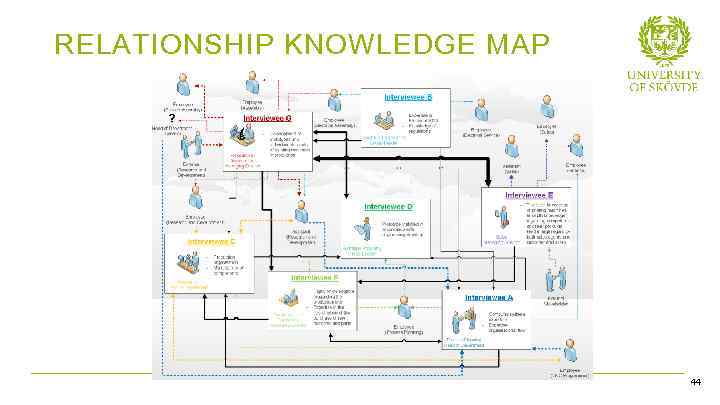
CONCLUSION I • Study provides improved insights into how a medium-sized enterprise copes with the potential danger of knowledge loss - Organization members are aware of this danger. But: action is missing and focus on rather “obvious” persons • Knowledge map proposed as a diagnostic tool - shows relevant members (internal & external) and their relationships - existing knowledge and potential knowledge gaps can be identified • Knowledge management in smaller firms has to be discussed from a people-perspective rather than role-perspective Bild 45 45
CONCLUSION II • Implications for theory - Provides transparency needed to tackle the issue of knowledge loss and its influence on smaller firm’s human, relational and financial capital • Implications for managerial practice - Creation of stronger awareness in terms of risks related to knowledge loss and their implications • Future research avenues - Inclusion of other staff members (broader perspective) - Large-scale study - similar companies (industry and/or structure) - Focus on other processes of KM e. g. storage and dissemination Bild 46 46
Скачать презентацию KNOWLEDGE RETENTION BY ASSOC DR SUSANNE DURST SOUTH
5 201216 английский.pptx