 Скачать презентацию Knowledge Representation Issues for the Semantic Web Jeff
2959389a71f26a6ebc19e135437097f9.ppt
- Количество слайдов: 48



Knowledge Representation Issues for the Semantic Web Jeff Heflin Lehigh University
Outline u Introduction – History – OWL Overview u Selected Research Issues – Semantics of Distributed Ontologies – Reasoning and Scalability u Overview of Other Key Research Topics
The Semantic Web u Definition – The Semantic Web is not a separate Web but an extension of the current one, in which information is given well-defined meaning, better enabling computers and people to work in cooperation. (Berners-Lee et al. , Scientific American, May 2001) u Applications – – – managing corporate web sites (intranets) more automatic generation of web portals better indexing of multimedia resources web agents and web services ubiquitous computing
Semantic Web Challenges u The Web is distributed – many sources, varying authority – inconsistency u The Web is dynamic – representational needs may change u The Web is enormous – systems must scale well u The Web is an open-world
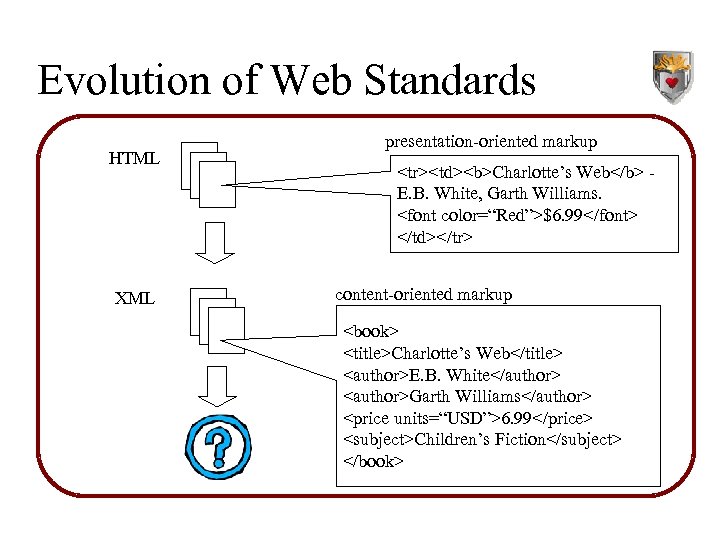
Evolution of Web Standards HTML XML presentation-oriented markup <tr><td><b>Charlotte’s Web</b> E. B. White, Garth Williams. <font color=“Red”>$6. 99</font> </td></tr> content-oriented markup <book> <title>Charlotte’s Web</title> <author>E. B. White</author> <author>Garth Williams</author> <price units=“USD”>6. 99</price> <subject>Children’s Fiction</subject> </book>
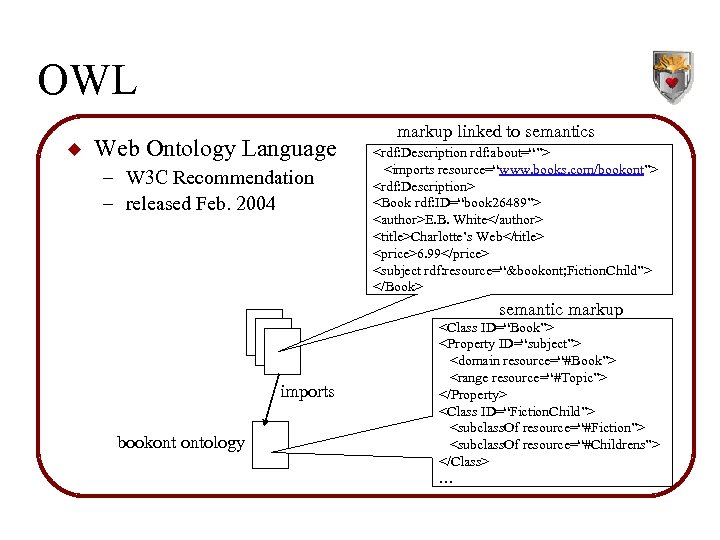
OWL u Web Ontology Language – W 3 C Recommendation – released Feb. 2004 markup linked to semantics <rdf: Description rdf: about=“”> <imports resource=“www. books. com/bookont”> <rdf: Description> <Book rdf: ID=“book 26489”> <author>E. B. White</author> <title>Charlotte’s Web</title> <price>6. 99</price> <subject rdf: resource=“&bookont; Fiction. Child”> </Book> semantic markup imports bookont ontology <Class ID=“Book”> <Property ID=“subject”> <domain resource=“#Book”> <range resource=“#Topic”> </Property> <Class ID=“Fiction. Child”> <subclass. Of resource=“#Fiction”> <subclass. Of resource=“#Childrens”> </Class> …
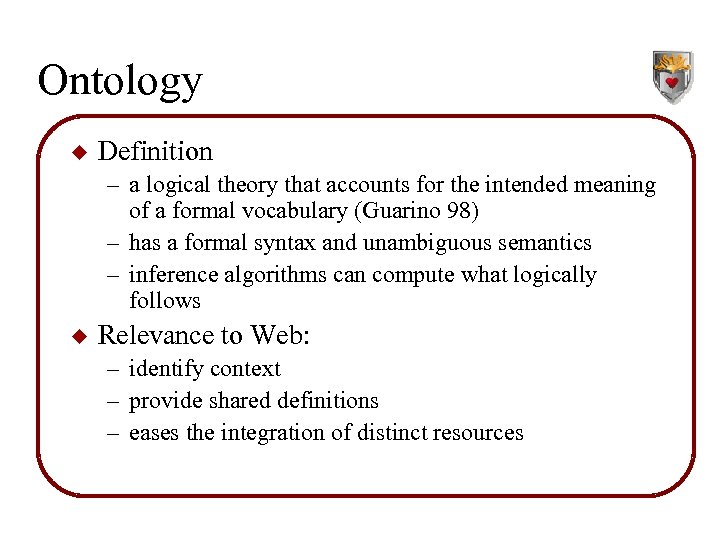
Ontology u Definition – a logical theory that accounts for the intended meaning of a formal vocabulary (Guarino 98) – has a formal syntax and unambiguous semantics – inference algorithms can compute what logically follows u Relevance to Web: – identify context – provide shared definitions – eases the integration of distinct resources
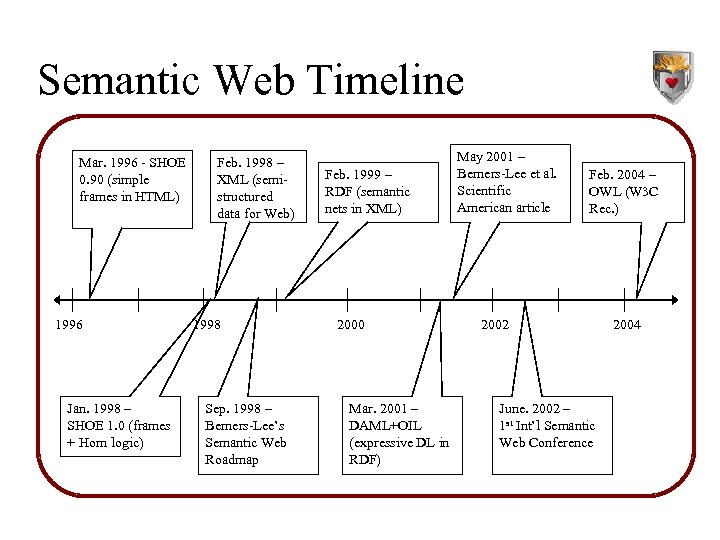
Semantic Web Timeline Mar. 1996 - SHOE 0. 90 (simple frames in HTML) 1996 Jan. 1998 – SHOE 1. 0 (frames + Horn logic) Feb. 1998 – XML (semistructured data for Web) 1998 Sep. 1998 – Berners-Lee’s Semantic Web Roadmap Feb. 1999 – RDF (semantic nets in XML) 2000 Mar. 2001 – DAML+OIL (expressive DL in RDF) May 2001 – Berners-Lee et al. Scientific American article Feb. 2004 – OWL (W 3 C Rec. ) 2002 June. 2002 – 1 st Int’l Semantic Web Conference 2004
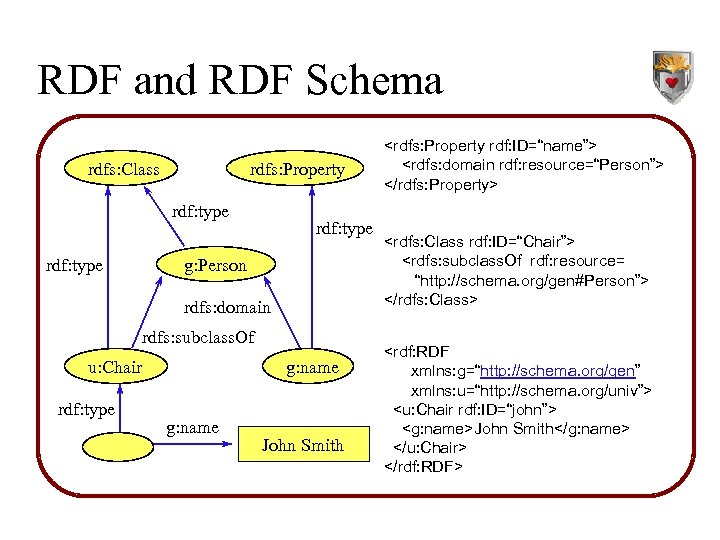
RDF and RDF Schema rdfs: Class rdfs: Property rdf: type g: Person rdfs: domain rdfs: subclass. Of u: Chair rdf: type g: name John Smith <rdfs: Property rdf: ID=“name”> <rdfs: domain rdf: resource=“Person”> </rdfs: Property> <rdfs: Class rdf: ID=“Chair”> <rdfs: subclass. Of rdf: resource= “http: //schema. org/gen#Person”> </rdfs: Class> <rdf: RDF xmlns: g=“http: //schema. org/gen” xmlns: u=“http: //schema. org/univ”> <u: Chair rdf: ID=“john”> <g: name>John Smith</g: name> </u: Chair> </rdf: RDF>
URIs and Namespaces u URI – Uniform Resource Identifier – includes URLs – but also anything that you can design an identification scheme for – helps to prevent collision of names – all the “symbols” in RDF are either URIs or Literals u Namespace – a mechanism for abbreviating URIs – by assigning a prefix for a URI fragment
OWL u RDF is a data language – OWL adds ontologies to RDF – used to define RDF classes and properties OWL ontologies are written in RDF syntax u semantically, OWL is based on description logics u – tradeoff between expressivity and computability
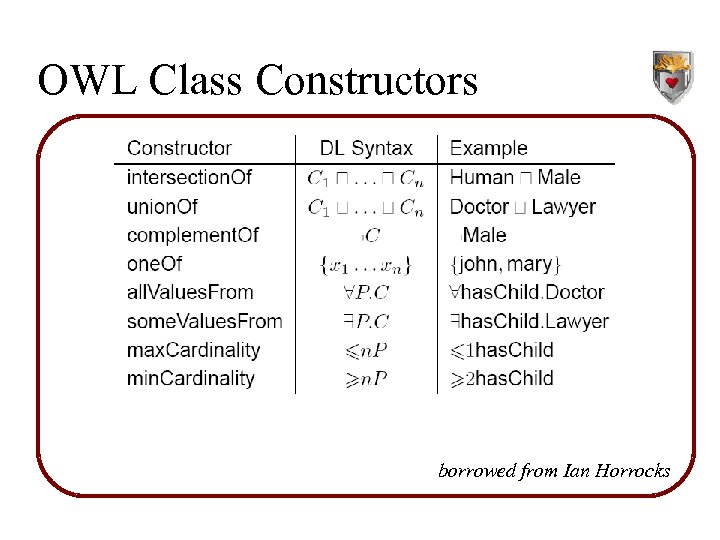
OWL Class Constructors borrowed from Ian Horrocks
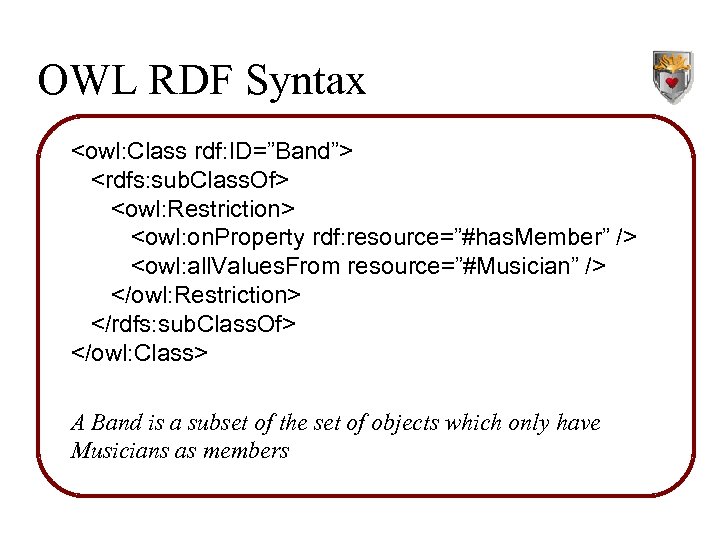
OWL RDF Syntax <owl: Class rdf: ID=”Band”> <rdfs: sub. Class. Of> <owl: Restriction> <owl: on. Property rdf: resource=”#has. Member” /> <owl: all. Values. From resource=”#Musician” /> </owl: Restriction> </rdfs: sub. Class. Of> </owl: Class> A Band is a subset of the set of objects which only have Musicians as members
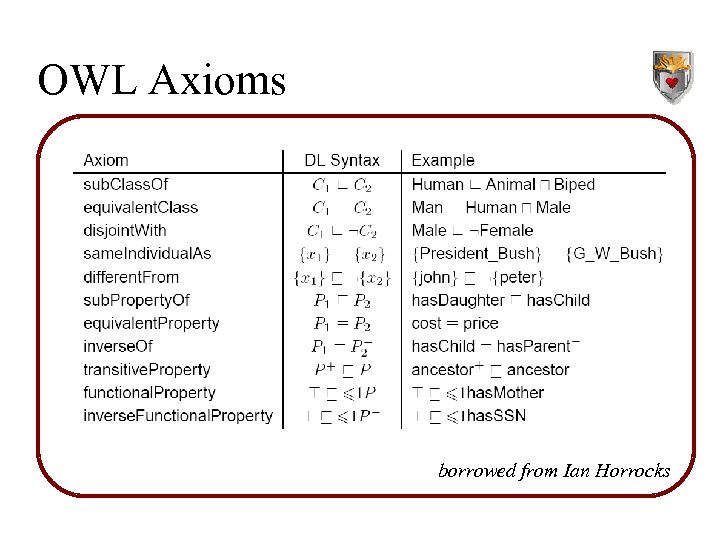
OWL Axioms borrowed from Ian Horrocks
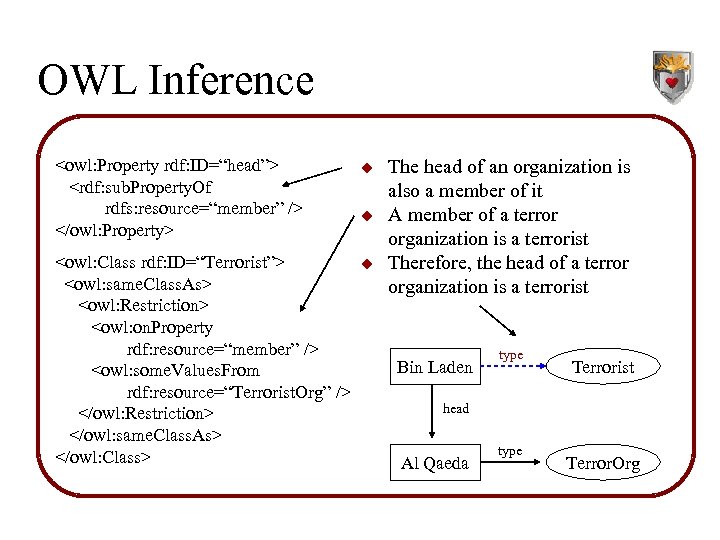
OWL Inference <owl: Property rdf: ID=“head”> <rdf: sub. Property. Of rdfs: resource=“member” /> </owl: Property> u u <owl: Class rdf: ID=“Terrorist”> u <owl: same. Class. As> <owl: Restriction> <owl: on. Property rdf: resource=“member” /> <owl: some. Values. From rdf: resource=“Terrorist. Org” /> </owl: Restriction> </owl: same. Class. As> </owl: Class> The head of an organization is also a member of it A member of a terror organization is a terrorist Therefore, the head of a terror organization is a terrorist Bin Laden type Terrorist head Al Qaeda type Terror. Org
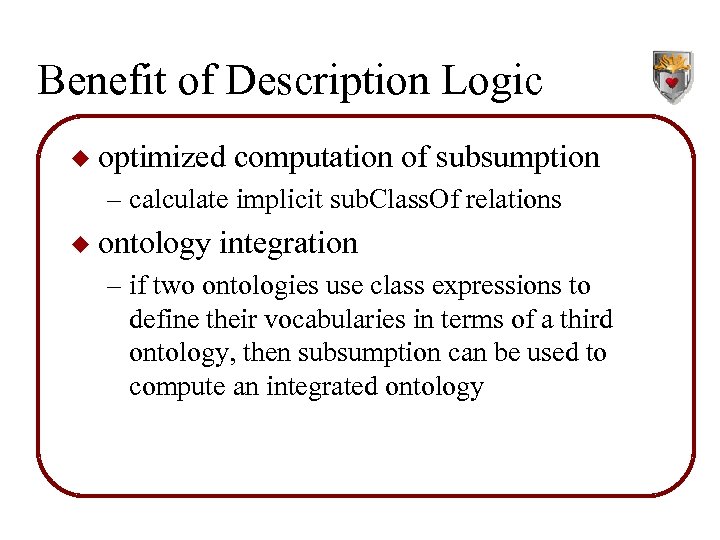
Benefit of Description Logic u optimized computation of subsumption – calculate implicit sub. Class. Of relations u ontology integration – if two ontologies use class expressions to define their vocabularies in terms of a third ontology, then subsumption can be used to compute an integrated ontology
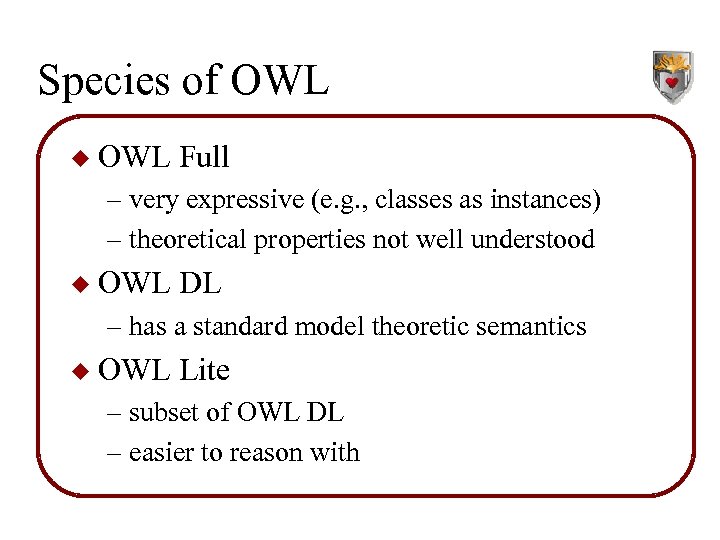
Species of OWL u OWL Full – very expressive (e. g. , classes as instances) – theoretical properties not well understood u OWL DL – has a standard model theoretic semantics u OWL Lite – subset of OWL DL – easier to reason with
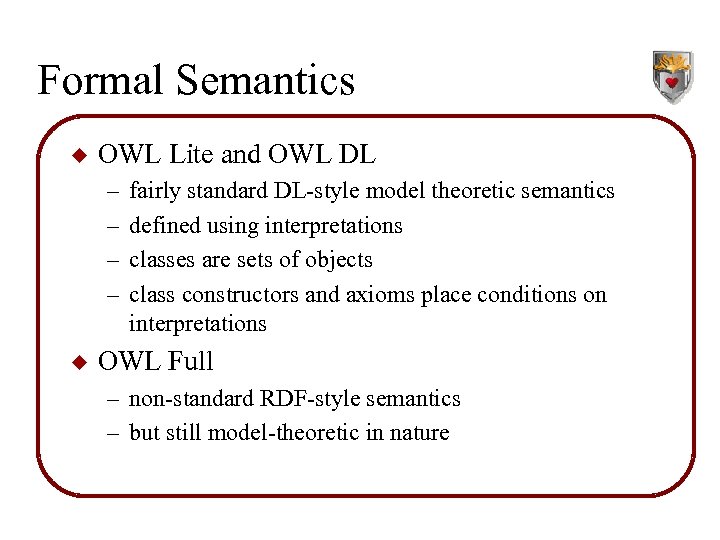
Formal Semantics u OWL Lite and OWL DL – – u fairly standard DL-style model theoretic semantics defined using interpretations classes are sets of objects class constructors and axioms place conditions on interpretations OWL Full – non-standard RDF-style semantics – but still model-theoretic in nature
Selected Research Issues u Work by the SWAT lab at Lehigh – students » Yuanbo Guo » Zhengxiang Pan Semantics for distributed ontologies u Reasoning and scalability u
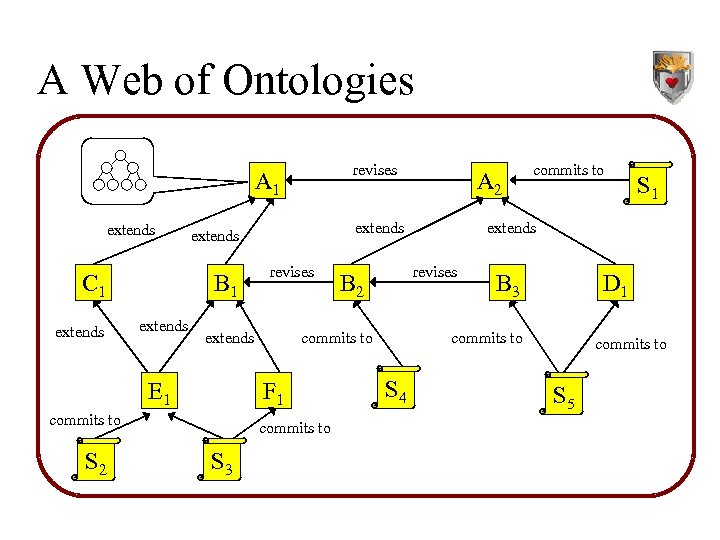
A Web of Ontologies revises A 1 extends C 1 extends revises extends E 1 commits to S 3 B 3 D 1 commits to S 4 S 1 extends revises B 2 commits to F 1 commits to S 2 extends B 1 A 2 commits to S 5
Semantics of Ontology “Links” u Brachman (1983) regarding links between concepts in early semantic networks –. . . the meaning of the link was often relegated to “what the code does with it”- neither an appropriate notion of semantics nor a useful guide for figuring out what the link, in fact means. u u DLs were one solution to this problem In Semantic Web, links between ontologies now suffer from a similar lack of clear semantics
owl: imports ontology extension / commitment u semantics u – in order to satisfy an ontology, an interpretation must also satisfy all ontologies that it imports u only provides semantics for each document in isolation!
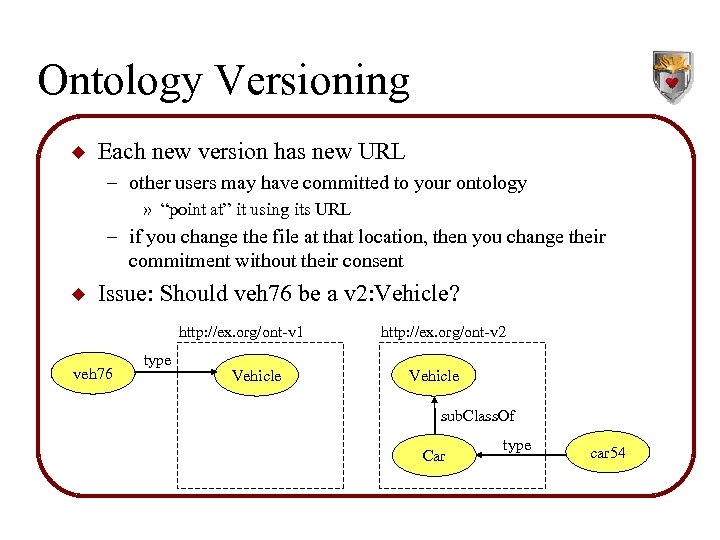
Ontology Versioning u Each new version has new URL – other users may have committed to your ontology » “point at” it using its URL – if you change the file at that location, then you change their commitment without their consent u Issue: Should veh 76 be a v 2: Vehicle? http: //ex. org/ont-v 1 veh 76 type Vehicle http: //ex. org/ont-v 2 Vehicle sub. Class. Of Car type car 54
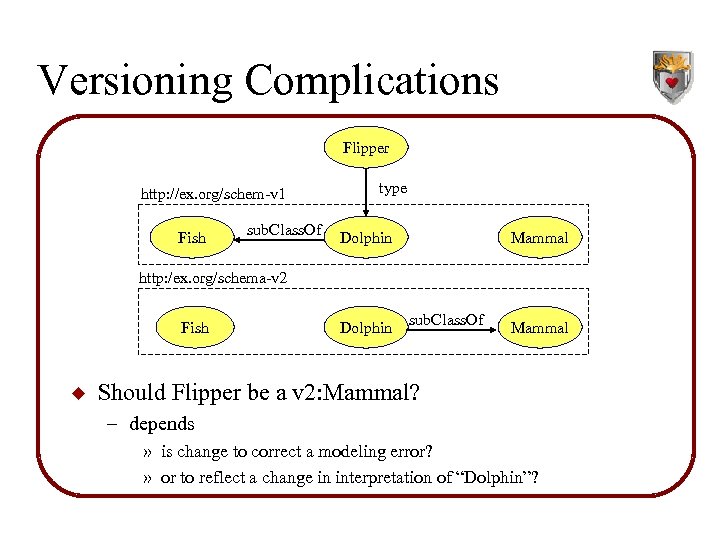
Versioning Complications Flipper http: //ex. org/schem-v 1 Fish sub. Class. Of type Dolphin Mammal http: /ex. org/schema-v 2 Fish u Dolphin sub. Class. Of Mammal Should Flipper be a v 2: Mammal? – depends » is change to correct a modeling error? » or to reflect a change in interpretation of “Dolphin”?
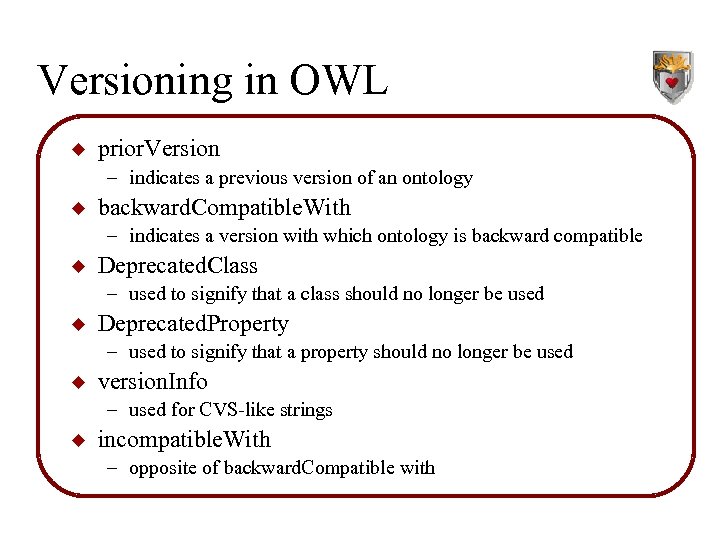
Versioning in OWL u prior. Version – indicates a previous version of an ontology u backward. Compatible. With – indicates a version with which ontology is backward compatible u Deprecated. Class – used to signify that a class should no longer be used u Deprecated. Property – used to signify that a property should no longer be used u version. Info – used for CVS-like strings u incompatible. With – opposite of backward. Compatible with
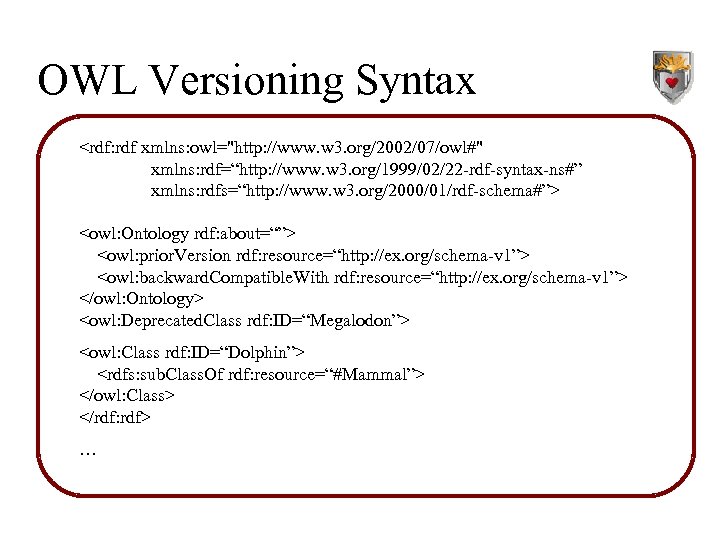
OWL Versioning Syntax <rdf: rdf xmlns: owl="http: //www. w 3. org/2002/07/owl#" xmlns: rdf=“http: //www. w 3. org/1999/02/22 -rdf-syntax-ns#” xmlns: rdfs=“http: //www. w 3. org/2000/01/rdf-schema#”> <owl: Ontology rdf: about=“”> <owl: prior. Version rdf: resource=“http: //ex. org/schema-v 1”> <owl: backward. Compatible. With rdf: resource=“http: //ex. org/schema-v 1”> </owl: Ontology> <owl: Deprecated. Class rdf: ID=“Megalodon”> <owl: Class rdf: ID=“Dolphin”> <rdfs: sub. Class. Of rdf: resource=“#Mammal”> </owl: Class> </rdf: rdf> …
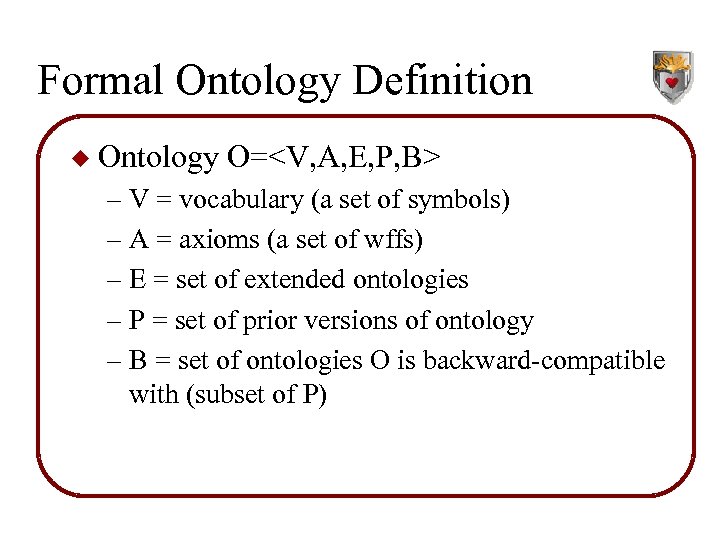
Formal Ontology Definition u Ontology O=<V, A, E, P, B> – V = vocabulary (a set of symbols) – A = axioms (a set of wffs) – E = set of extended ontologies – P = set of prior versions of ontology – B = set of ontologies O is backward-compatible with (subset of P)
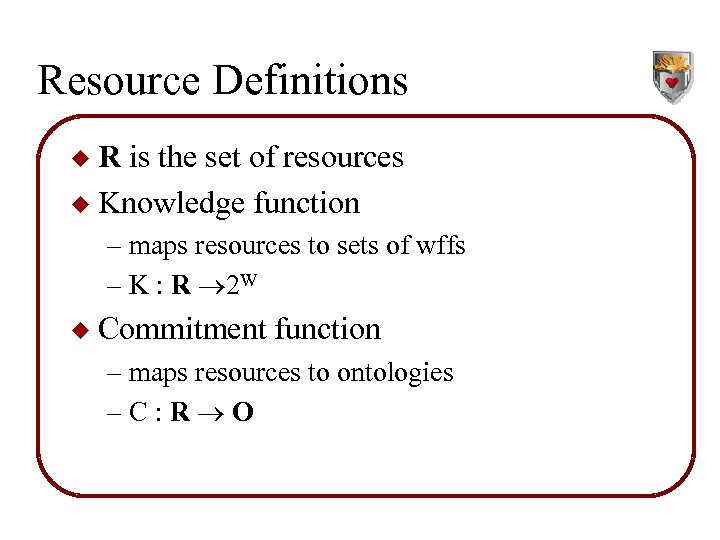
Resource Definitions R is the set of resources u Knowledge function u – maps resources to sets of wffs – K : R 2 W u Commitment function – maps resources to ontologies –C: R O
Ontology Perspectives u Users may wish to view data through viewpoint of different ontologies – versioning is a special case of this u u An ontology specifies a set of axioms Ontology perspectives specify a logical theory based on an ontology and a set of data sources – combine axioms and ground atoms – queries are with respect to a perspective
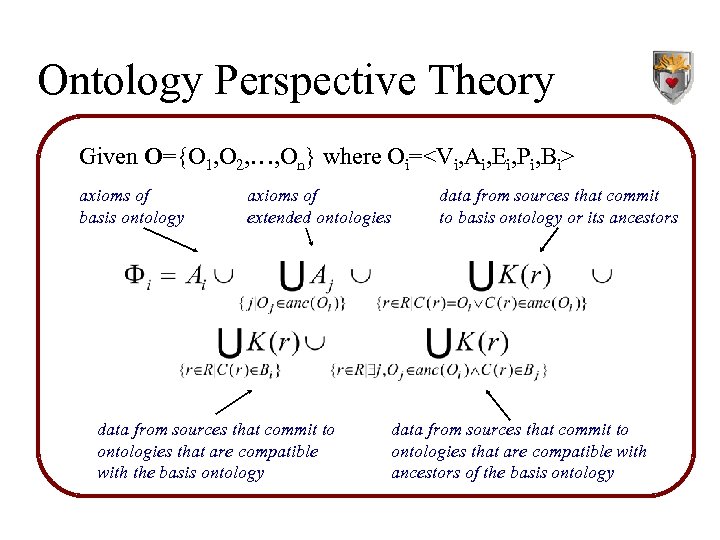
Ontology Perspective Theory Given O={O 1, O 2, …, On} where Oi=<Vi, Ai, Ei, Pi, Bi> axioms of basis ontology axioms of extended ontologies data from sources that commit to ontologies that are compatible with the basis ontology data from sources that commit to basis ontology or its ancestors data from sources that commit to ontologies that are compatible with ancestors of the basis ontology
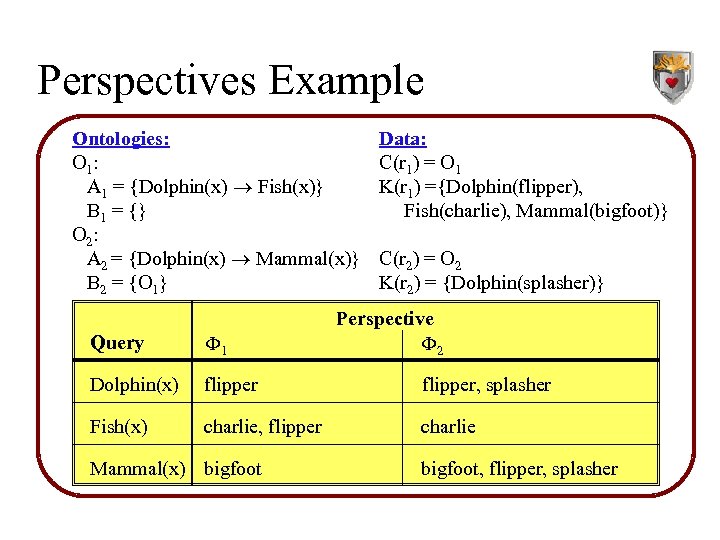
Perspectives Example Ontologies: O 1 : A 1 = {Dolphin(x) Fish(x)} B 1 = {} O 2 : A 2 = {Dolphin(x) Mammal(x)} B 2 = {O 1} Data: C(r 1) = O 1 K(r 1) ={Dolphin(flipper), Fish(charlie), Mammal(bigfoot)} C(r 2) = O 2 K(r 2) = {Dolphin(splasher)} Perspective 2 Query 1 Dolphin(x) flipper, splasher Fish(x) charlie, flipper charlie Mammal(x) bigfoot, flipper, splasher
Scalable Systems u Motivation – the Web is large » it won’t fit in main memory! – current systems don’t scale u DLDB – DB: Relational Database (Microsoft®Access) » scalable technology for querying data – DL: Description Logics (Fa. CT reasoner) » rich inference capability » close correspondence to semantics of OWL
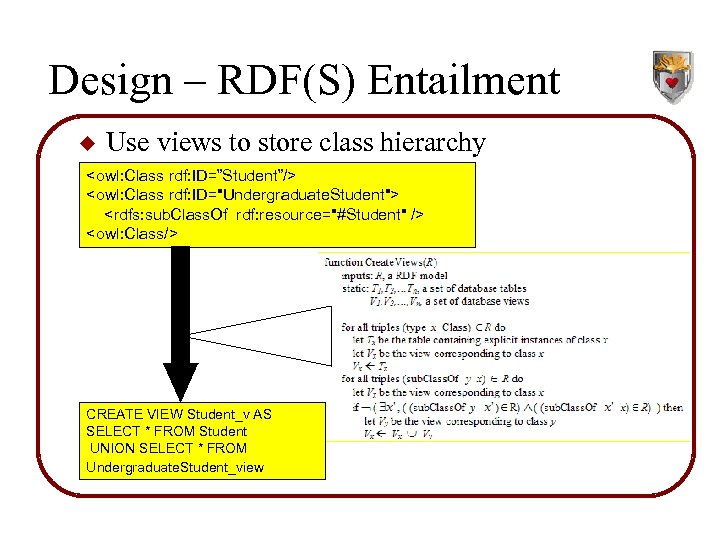
Design – RDF(S) Entailment u Use views to store class hierarchy <owl: Class rdf: ID=”Student”/> <owl: Class rdf: ID="Undergraduate. Student"> <rdfs: sub. Class. Of rdf: resource="#Student" /> <owl: Class/> CREATE VIEW Student_v AS SELECT * FROM Student UNION SELECT * FROM Undergraduate. Student_view
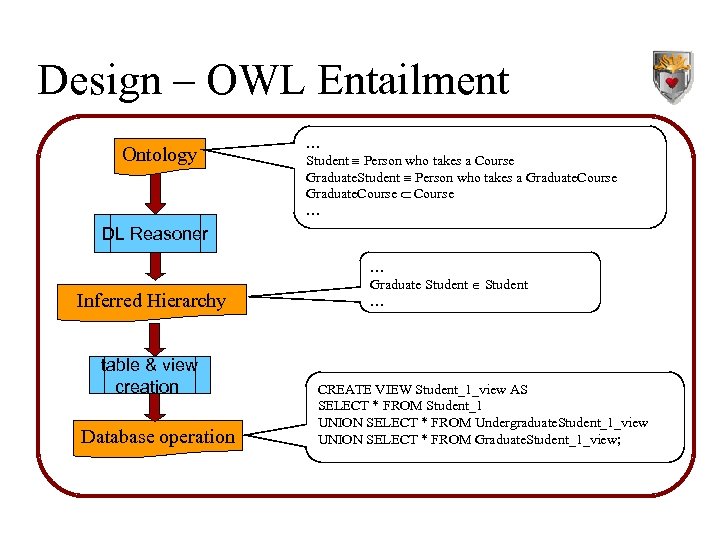
Design – OWL Entailment Ontology … Student Person who takes a Course Graduate. Student Person who takes a Graduate. Course … DL Reasoner Inferred Hierarchy table & view creation Database operation … Graduate Student … CREATE VIEW Student_1_view AS SELECT * FROM Student_1 UNION SELECT * FROM Undergraduate. Student_1_view UNION SELECT * FROM Graduate. Student_1_view;
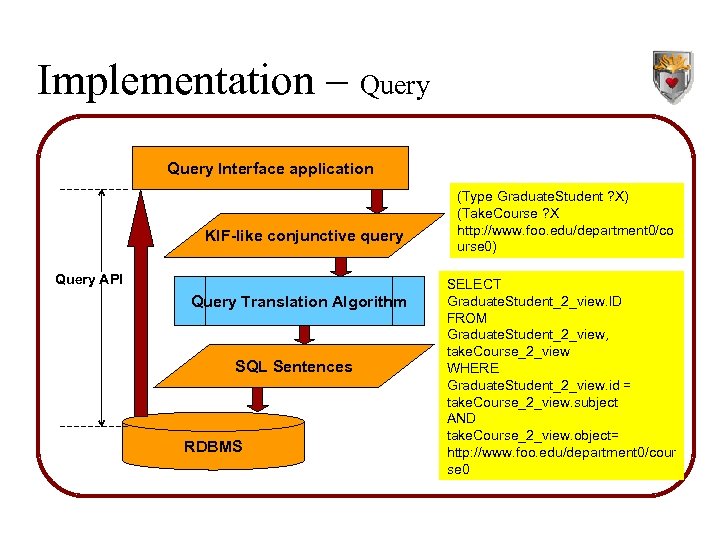
Implementation – Query Interface application KIF-like conjunctive query Query API Query Translation Algorithm SQL Sentences RDBMS (Type Graduate. Student ? X) (Take. Course ? X http: //www. foo. edu/department 0/co urse 0) SELECT Graduate. Student_2_view. ID FROM Graduate. Student_2_view, take. Course_2_view WHERE Graduate. Student_2_view. id = take. Course_2_view. subject AND take. Course_2_view. object= http: //www. foo. edu/department 0/cour se 0
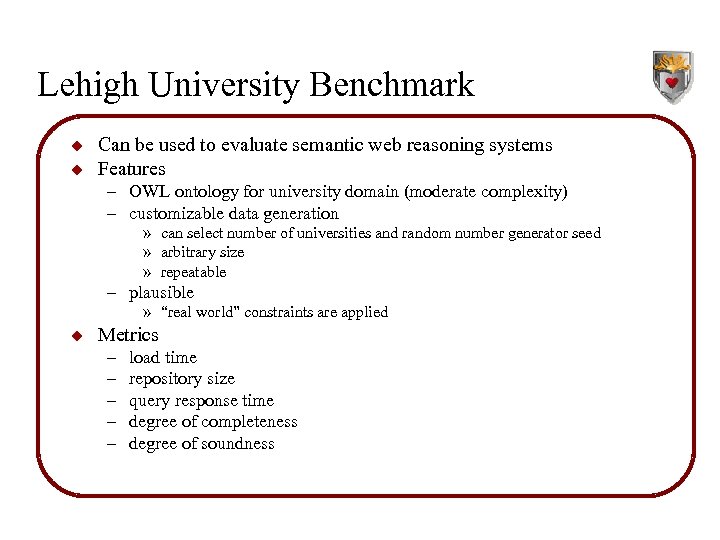
Lehigh University Benchmark u u Can be used to evaluate semantic web reasoning systems Features – OWL ontology for university domain (moderate complexity) – customizable data generation » can select number of universities and random number generator seed » arbitrary size » repeatable – plausible » “real world” constraints are applied u Metrics – – – load time repository size query response time degree of completeness degree of soundness
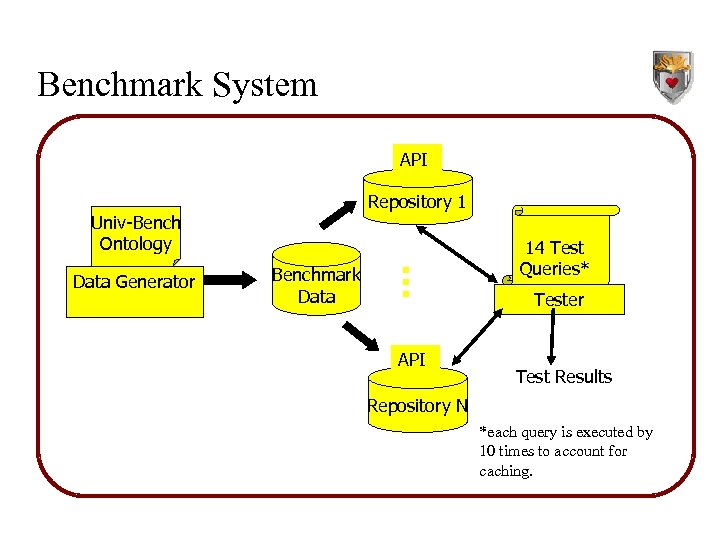
Benchmark System API Repository 1 Univ-Bench Ontology Data Generator 14 Test Queries* Benchmark Data Tester API Test Results Repository N *each query is executed by 10 times to account for caching.
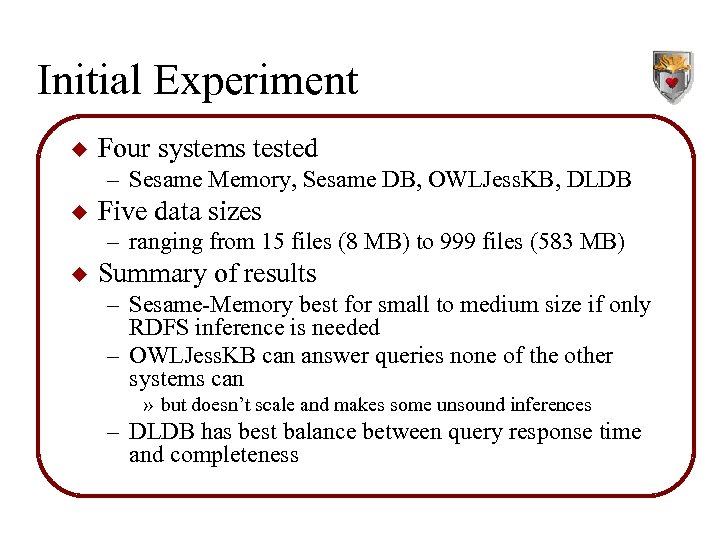
Initial Experiment u Four systems tested – Sesame Memory, Sesame DB, OWLJess. KB, DLDB u Five data sizes – ranging from 15 files (8 MB) to 999 files (583 MB) u Summary of results – Sesame-Memory best for small to medium size if only RDFS inference is needed – OWLJess. KB can answer queries none of the other systems can » but doesn’t scale and makes some unsound inferences – DLDB has best balance between query response time and completeness
Some Other Research Topics Knowledge acquisition u Language design u Semantic Web services u
Knowledge Acquisition u data – create or find relevant ontology – then either » convert existing forms to RDF u e. g. , XML, relational DBs, CGs, etc. » information extraction » natural language processing » controlled English? (Sowa, yesterday) u ontologies – – import existing ontologies manual creation (e. g. , Protogé) machine learning formal concept analysis? (Rudolph, yesterday)
Language Design DL is insufficient for some applications u Significant demand for “rules” u – Combining logic programming with DL (Grosof et al. 2003) u SWRL (Semantic Web Rule Language) – proposal to add Horn logic to OWL u However, must consider expressivity / scalability tradeoff
Semantic Web Services u Web service – a web-accessible program that provides information or performs an action u OWL-S – ontology for describing web services » consists of profile, process model, and grounding u Current research includes: – matchmaking (e. g. , see work of Sycara) – automated composition (e. g. , see work of Mc. Ilraith) – much more …
Conclusion The Semantic Web is concerned with interoperability of distributed information u OWL is a standard that allows for sharing of ontologies u – if you want your ontologies to be used by the world, then export (what you can) to OWL u There is much research to do before the Semantic Web problem is solved – we need all the help we can get!
For more information. . . u Useful websites – http: //www. semwebcentral. org/ – http: //www. w 3. org/2001/sw/ – http: //www. daml. org/ – http: //www. semanticweb. org/ u My information – heflin@cse. lehigh. edu – http: //www. cse. lehigh. edu/~heflin/
The End
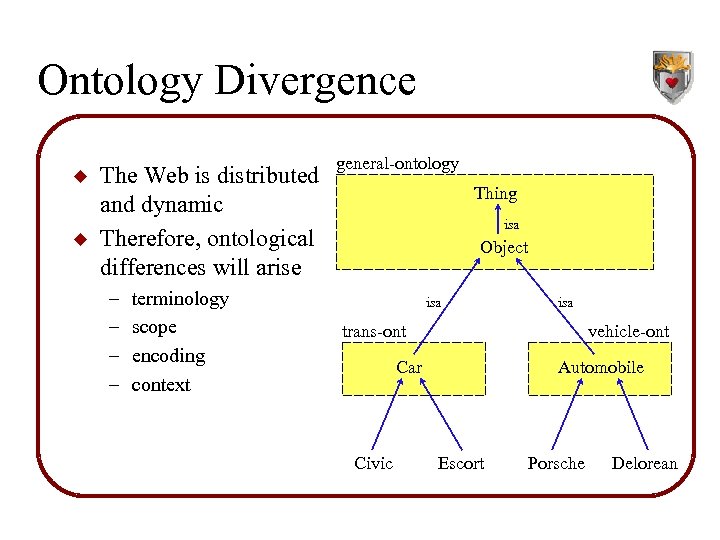
Ontology Divergence u u The Web is distributed and dynamic Therefore, ontological differences will arise – – terminology scope encoding context general-ontology Thing isa Object isa trans-ont vehicle-ont Car Civic Automobile Escort Porsche Delorean
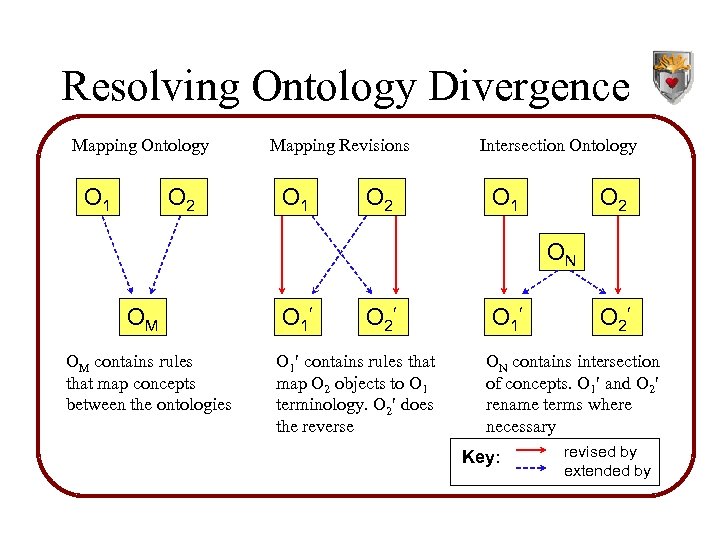
Resolving Ontology Divergence Mapping Ontology O 1 O 2 Mapping Revisions O 1 O 2 Intersection Ontology O 1 O 2 ON OM OM contains rules that map concepts between the ontologies O 1¢ O 2¢ O 1¢ contains rules that map O 2 objects to O 1 terminology. O 2¢ does the reverse O 1¢ O 2¢ ON contains intersection of concepts. O 1¢ and O 2¢ rename terms where necessary Key: revised by extended by
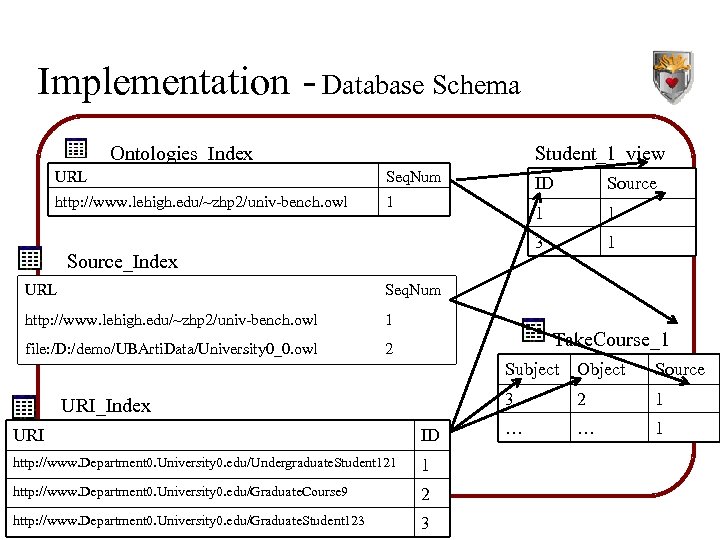
Implementation - Database Schema Ontologies_Index Student_1_view URL Seq. Num http: //www. lehigh. edu/~zhp 2/univ-bench. owl 1 ID 1 URL 1 file: /D: /demo/UBArti. Data/University 0_0. owl 2 1 Seq. Num http: //www. lehigh. edu/~zhp 2/univ-bench. owl 1 3 Source_Index Source Take. Course_1 Subject URI ID http: //www. Department 0. University 0. edu/Undergraduate. Student 121 1 http: //www. Department 0. University 0. edu/Graduate. Course 9 2 http: //www. Department 0. University 0. edu/Graduate. Student 123 3 Source 3 URI_Index Object 2 1 … … 1
Скачать презентацию Knowledge Representation Issues for the Semantic Web Jeff
2959389a71f26a6ebc19e135437097f9.ppt