


 Скачать презентацию Knowledge Management Module IV KM Review and Critique
a81c0b031d215d4012a3685a6474c5fc.ppt
- Количество слайдов: 58
 Knowledge Management Module IV KM Review and Critique 1
 Goals To be aware of the different views to KM 2
 Learning Outcomes Trainees will be able to ~ Run a critical discussion of the views on KM 3
 The Knowledge Attributes Knowledge have many attributes We could identify 25 of them 4
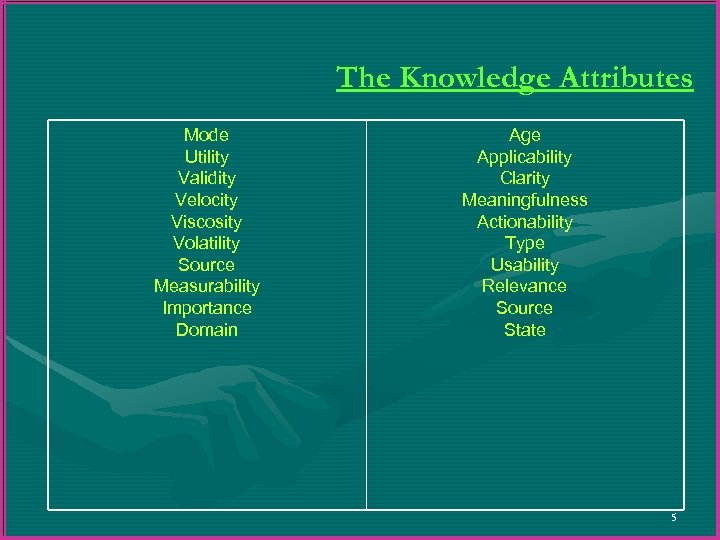 The Knowledge Attributes Mode Utility Validity Velocity Viscosity Volatility Source Measurability Importance Domain Age Applicability Clarity Meaningfulness Actionability Type Usability Relevance Source State 5
 Knowledge Modes According to many authors, knowledge could assume one of two modes: ~ Tacit ~ Explicit 6
 Knowledge Modes Tacit Knowledge residing in the minds of employees that has not been documented 7
 Knowledge Modes Explicit Knowledge residing in the minds of employees that has been documented 8
 Knowledge Modes Tacit vs. Explicit Tacit knowledge includes insights, intuitions and hunches. This knowledge is difficult to express and formalize and therefore difficult to share. Tacit knowledge is more likely to be personal and based on individual expressions and activities. Explicit and tacit forms of knowledge are quite distinct. However, it is possible to convert explicit knowledge into tacit, as occurs, for example, when an individual reads a book and learns from it, thereby converting the explicit knowledge contained in the book into tacit knowledge in the individual’s mind. Similarly, tacit knowledge can sometimes be converted into explicit knowledge, as happens when an individual with considerable tacit knowledge about a topic writes a book formalizing that knowledge. 9
 The SECI Model Tacit vs. Explicit The SECI model (Nonaka and Takeuchi) 10
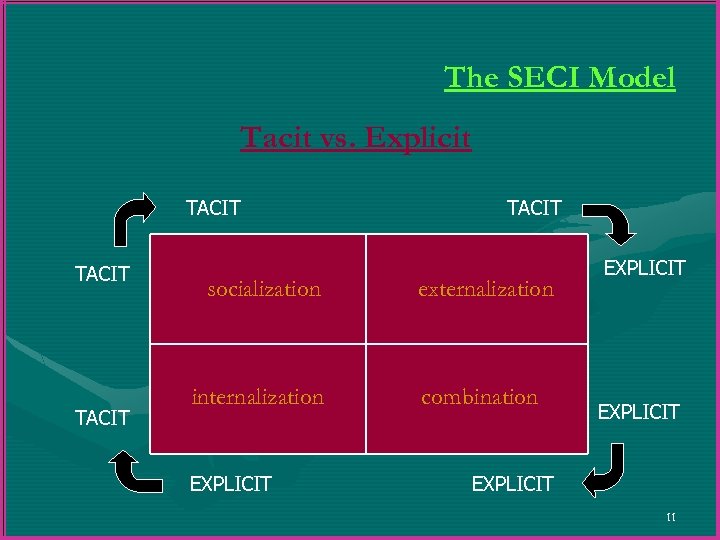 The SECI Model Tacit vs. Explicit TACIT socialization externalization internalization combination EXPLICIT 11
 The SECI Model Externalization requires the expression of tacit knowledge and its translation into comprehensible forms that can be understood by others. In philosophical terms, the individual transcends the inner and outer boundaries of the self. During the externalization stage of the knowledge-creation process, and individual commits to the group and thus becomes one with the group. The sum of the individuals' intentions and ideas fuse and become integrated with the. group's mental world 12
 The SECI Model Internalization The internalization of newly created knowledge is the conversion of explicit knowledge into the organization's tacit knowledge. This requires the individual to identify the knowledge relevant for one’s self within the organizational knowledge. That again requires finding one’s self in a larger entity. Learning by doing, training and exercises allow the individual to access the knowledge realm of the group and. the entire organization 13
 The SECI Model Socialization This mode enables the conversion of tacit knowledge through interaction between individuals. One important point to note here is that an individual can acquire tacit knowledge without language. Apprentices work with their mentors and learn craftsmanship not through language but by observation, imitation and practice. In a business setting, on job training (OJT) uses the same principle. The key to acquiring tacit knowledge is experience. Without some form of shared experience, it is extremely difficult for people to share. each other’ thinking process 14
 The SECI Model Combination involves the conversion of explicit knowledge into more complex sets of explicit knowledge. In this stage, the key issues are communication and diffusion processes and the systemization of knowledge. Here, new knowledge generate in the externalization stage transcends the ground in analogues or digital signals 15
 The SECI Model Critique According to color theory, there are three primary colors: Red Yellow Blue All other colors are combinations of the primary colors 16
 The SECI Model Primary Knowledge Processes What are the primary knowledge processes ? ~ knowledge representation ~ knowledge storage ~ knowledge transfer ~ knowledge sharing ~ Knowledge creation ~ knowledge acquisition ~ knowledge application 17
 The SECI Model Primary Knowledge Processes What are the primary knowledge processes ? ~ knowledge representation ~ knowledge storage ~ knowledge transfer ~ knowledge sharing ~ Knowledge creation ~ knowledge acquisition ~ knowledge application 18
 The SECI Model Secondary Knowledge Processes All knowledge processes are either combinations of knowledge representation and knowledge acquisition or are a special case of these two processes 19
 The SECI Model Secondary Knowledge Processes Knowledge Creation: Is knowledge acquisition with a special case where the acquirer is the first individual to acquire this knowledge 20
 The SECI Model Secondary Knowledge Processes Knowledge Storage: Is knowledge representation with a special case where the represented knowledge is stored in a repository 21
 The SECI Model Secondary Knowledge Processes Knowledge Sharing: Is knowledge representation with communication of represented knowledge or allowing access to knowledge storage 22
 The SECI Model Secondary Knowledge Processes Knowledge Transfer: Is a synonym to knowledge sharing 23
 The SECI Model Secondary Knowledge Processes Knowledge Application: Is knowledge acquisition put into action (problem solving) 24
 The SECI Model Analogy with SECI Externalization = knowledge representation Internalization = knowledge acquisition 25
 The SECI Model Analogy with SECI Externalization = knowledge representation Internalization = knowledge acquisition WHY two more conversions ? 26
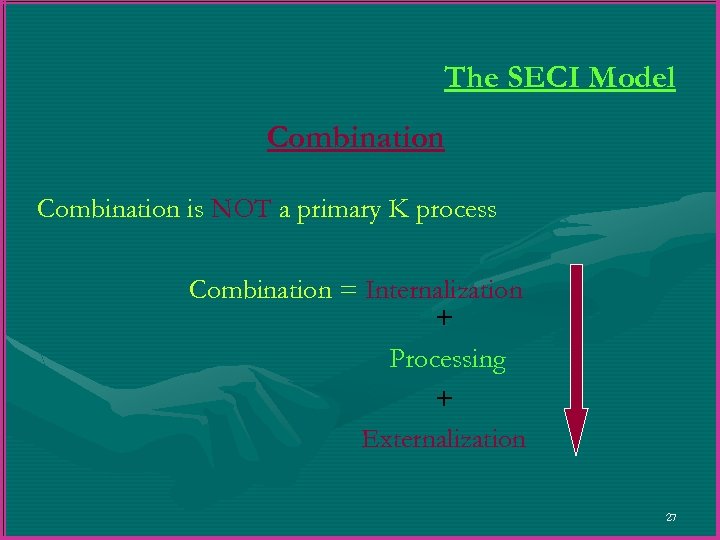 The SECI Model Combination is NOT a primary K process Combination = Internalization + Processing + Externalization 27
 The SECI Model Combination Primary K Process vs. organizational culture It is more appropriate to think of combination as an organizational culture. Combination is actually an inferior name to learning organization where every employee is encouraged to be creative and innovative 28
 The SECI Model Socialization is NOT a primary K process Socialization = Externalization + Communication + Internalization 29
 The SECI Model Socialization Primary K Process vs. K sharing setup It is more appropriate to think of socialization as a knowledge sharing setup. Socialization is appropriate when knowledge does not lend itself easily to storage techniques and thus requires direct sharing techniques 30
 The SECI Model Information vs. Explicit Knowledge Since the SECI model introduces the concept of explicit knowledge, then it has to explain how explicit knowledge is different from information 31
 The SECI Model Information vs. Explicit Knowledge Since the SECI model introduces the concept of explicit knowledge, then it has to explain how explicit knowledge is different from information Amazingly, no one attempts even to pose this question 32
 The SECI Model Information vs. Explicit Knowledge If we were to adopt the definition of information as structured data, then there is a difference between information and explicit knowledge 33
 The SECI Model Information vs. Explicit Knowledge The origin of information is data, but the origin of explicit knowledge is tacit knowledge 34
 The SECI Model Information vs. Explicit Knowledge The origin of information is data, but the origin of explicit knowledge is tacit knowledge Do we really need to emphasize this detail ? 35
 The SECI Model Information vs. Explicit Knowledge The origin of information is data, but the origin of explicit knowledge is tacit knowledge Do we really need to emphasize this detail ? Try writing a page on any subject taking into consideration this detail !! 36
 The SECI Model Information vs. Explicit Knowledge Why not adopt the definition of information as Input from any source that has the potential to affect, reduce, or supplement a state of uncertainty to allow decisions to be made or communication to occur 37
 The SECI Model Information vs. Explicit Knowledge This definition of information would embrace information originating from data or that originating from persons; as well as information originating from our environment 38
 The SECI Model Information vs. Explicit Knowledge This definition of information would embrace information originating from data or that originating from persons; as well as information originating from our environment In this case all knowledge would be naturally tacit and we would simply refer to it as knowledge 39
 The SECI Model Information vs. Explicit Knowledge The SECI model adds neither value nor clarity, ONLY CONFUSION 40
 The SECI Model Example I Matsushita Electric Industrial Co. was unsuccessful developing an automated bread-making machine. They knew the best bread came from the Osaka International Hotel. So, a few team members apprenticed themselves to the hotel’s head baker. What category of K conversion was Matsushita emphasizing? 41
 The SECI Model Example II Honda used a metaphor of “Automobile Evolution” in the design of the Honda City by asking the question: “what will the automobile eventually evolve into? ” What category of K conversion was Honda emphasizing? 42
 The SECI Model Example III To be successful in personal copiers, Canon needed a highly reliable, disposable cartridge instead of huge field mx force for conventional copiers. One innovator got a case of beer for team. When consumed he asked: how much does it cost to manufacture this can? Team then compared process of making the beer can to making the drum cylinder. What category of K conversion was Canon emphasizing? 43
 The SECI Model Example IV Craft General Foods utilizes data from its POS not only to find out what does and what does not sell but also to create new ways to sell – that is new sales systems and methods. What category of K conversion was Craft emphasizing? 44
 The SECI Model Example V Asahi Breweries forced a corporate vision on its new-product concept. What category of K conversion was Asahi emphasizing? 45
 The SECI Model Example VI GE documents all customer complaints and inquiries which can be used by members of a new product development team to re-experience what the telephone operator experienced. What category of K conversion was GE emphasizing? 46
 The SECI Model Example I Matsushita Electric Industrial Co. was unsuccessful developing an automated bread-making machine. They knew the best bread came from the Osaka International Hotel. So, a few team members apprenticed themselves to the hotel’s head baker. SOCIALIZATION 47
 The SECI Model Critique: Example I Matsushita Electric needed to acquire knowledge on dough kneading. If no one has created this knowledge then Matsushita has to create it through experimentation. If this knowledge already exists, then Matsushita needs to get access to where this knowledge is stored. If the knowledge exists but not stored, then Matsushita needs a knowledge sharing setup up that allows direct transfer of knowledge. This is what eventually happened; a mentor-apprentice set up for knowledge sharing. 48
 The SECI Model Example II Honda used a metaphor of “Automobile Evolution” in the design of the Honda City by asking the question: “what will the automobile eventually evolve into? ” EXTERNALIZATION 49
 The SECI Model Critique: Example II Honda wanted an innovative design of a car; a design that has not been produced by any car manufacturer. Instead of forcing the designers to think within boundaries, Honda encouraged creativity. The designers had freedom to create new knowledge and they did. Learning organizations are characterized by encouraging creativity in all jobs. 50
 The SECI Model Example III To be successful in personal copiers, Canon needed a highly reliable, disposable cartridge instead of huge field mx force for conventional copiers. One innovator got a case of beer for team. When consumed he asked: how much does it cost to manufacture this can? Team then compared process of making the beer can to making the drum cylinder. EXTERNALIZATION 51
 The SECI Model Critique: Example III Why not consider this case an example on socialization? The new knowledge was a result of a team effort. Why do we need to classify the case as externalization or socialization? Why not simply call it a case of encouraging knowledge creation. Since a team is collaborating, then the creation process involves rounds of internalization and externalization until the new knowledge gets created 52
 The SECI Model Example IV Craft General Foods utilizes data from its POS not only to find out what does and what does not sell but also to create new ways to sell – that is new sales systems and methods. COMBINATION 53
 The SECI Model Critique: Example IV Companies have TPSs that collect transactional data. These data would feed different systems: MISs, DSSs, CRMs, SCMs, as well as data warehouses where the data can be mined. Each system would utilize the data in a different way, thus creating different new knowledge. Again, the extent to which data is to be utilized depends on how much a company intends to invest in knowledge creation. Why do we need to call this combination ? 54
 The SECI Model Example V Asahi Breweries forced a corporate vision on its new-product concept. COMBINATION 55
 The SECI Model Example VI GE documents all customer complaints and inquiries which can be used by members of a new product development team to re-experience what the telephone operator experienced. INTERNALIZATION 56
 Conclusions ~ The literature on KM has many gaps ~ The SECI model is very famous, yet not robust ~ The SECI model adds no value ~ KM is about effective and efficient management of the knowledge processes ~ KM revolves around generating and sharing rich information ~ Many information technologies support rich information ~ KM requires proper work environment 57
 END MODULE IV 58