 Скачать презентацию Knowledge Management in the Public Sector April 2009
90b751310d91d1e63f22144f3cb32737.ppt
- Количество слайдов: 105



Knowledge Management in the Public Sector April, 2009 Paul Mc. Dowall Knowledge Management Advisor Canada School of Public Service
“The purpose of management is the productivity of knowledge. ” Peter Drucker 2
Agenda • How does Knowledge Management apply to the Canadian public sector? • How has Knowledge Management been applied across the Canadian public sector? • Lessons Learned in applying KM • Where are we headed? 3
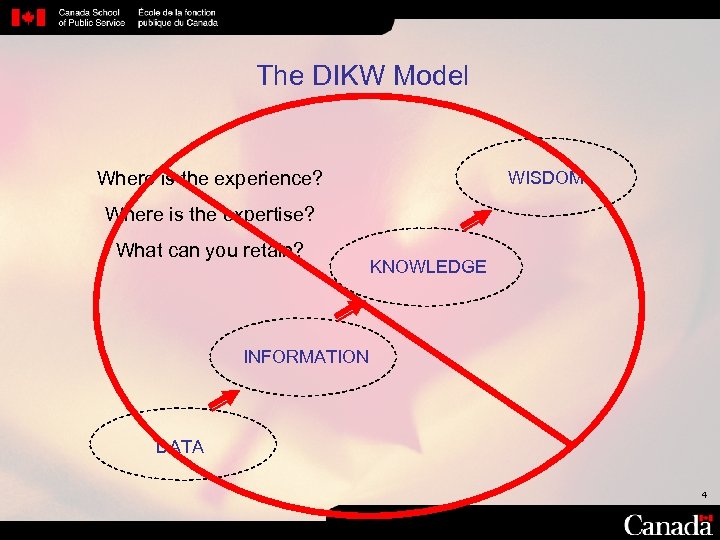
The DIKW Model Where is the experience? WISDOM Where is the expertise? What can you retain? KNOWLEDGE INFORMATION DATA 4
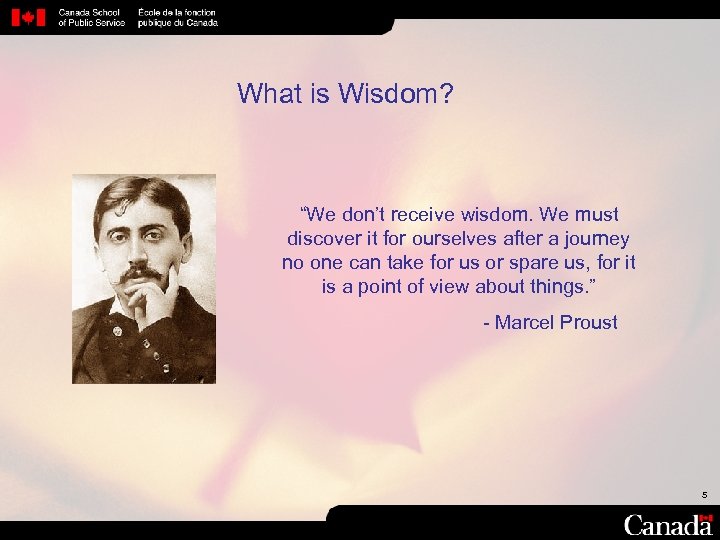
What is Wisdom? “We don’t receive wisdom. We must discover it for ourselves after a journey no one can take for us or spare us, for it is a point of view about things. ” Marcel Proust 5 5
Knowledge in Two Forms (M. Polanyi) Explicit knowledge: knowledge that is articulated in formal language and which can be easily transmitted among individuals. It can be expressed in scientific formulae, codified procedures or a variety of other forms. It includes codified information, data, facts, records and documents, text, etc and is held in many different types of media. Tacit knowledge: knowledge that is embedded in individual experience such as perspective and inferential knowledge. Tacit knowledge includes insights, hunches, intuitions, and skills that are highly personal and hard to formalize, making them difficult to communicate or share with others. It can be ‘learned’ from someone often only by close association with them for a period of time. It represents the cognitive abilities of people. 6
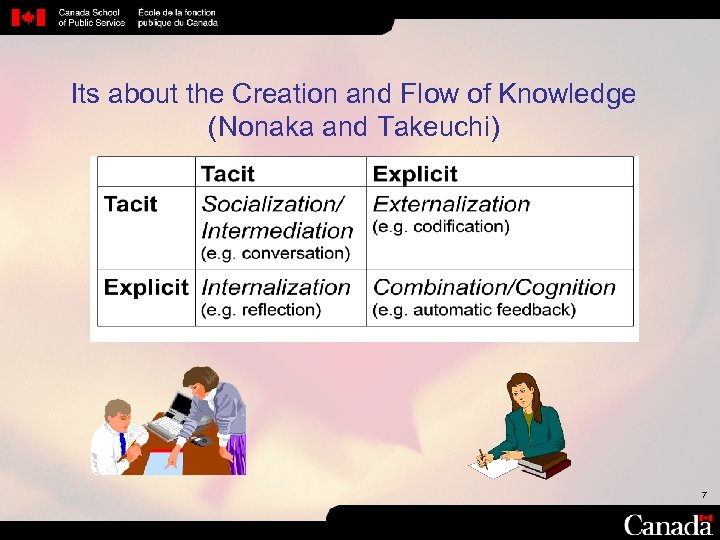
Its about the Creation and Flow of Knowledge (Nonaka and Takeuchi) 7
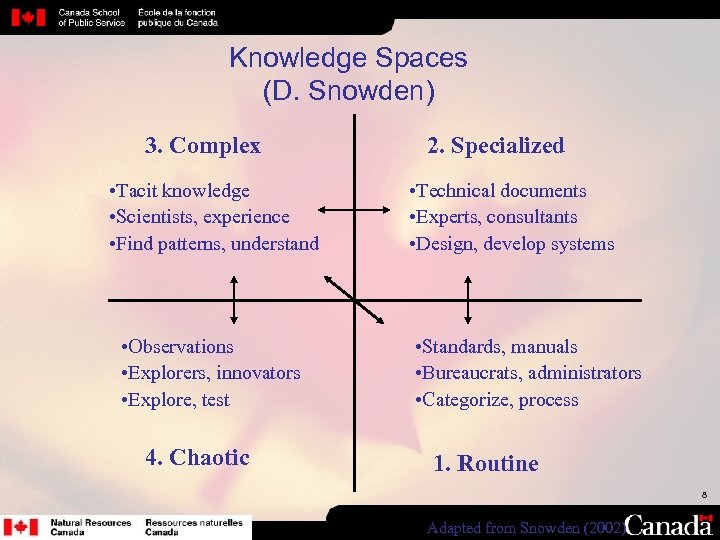
Knowledge Spaces (D. Snowden) 3. Complex • Tacit knowledge • Scientists, experience • Find patterns, understand • Observations • Explorers, innovators • Explore, test 4. Chaotic 2. Specialized • Technical documents • Experts, consultants • Design, develop systems • Standards, manuals • Bureaucrats, administrators • Categorize, process 1. Routine 8 Adapted from Snowden (2002)
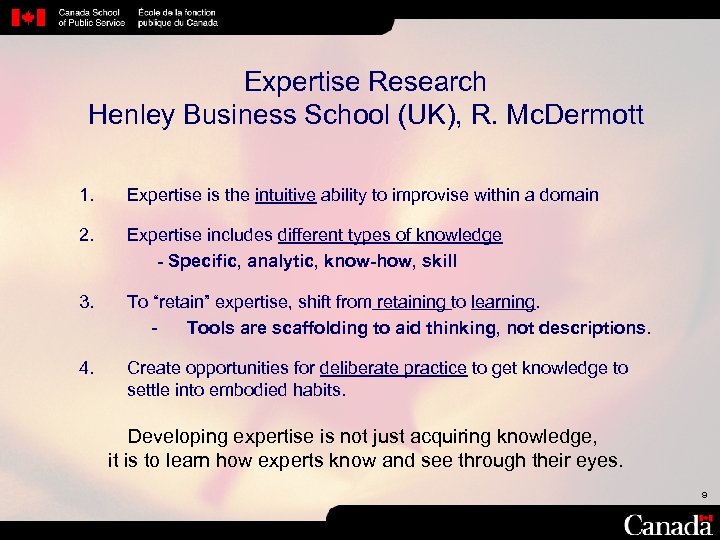
Expertise Research Henley Business School (UK), R. Mc. Dermott 1. Expertise is the intuitive ability to improvise within a domain 2. Expertise includes different types of knowledge - Specific, analytic, know-how, skill 3. To “retain” expertise, shift from retaining to learning. Tools are scaffolding to aid thinking, not descriptions. 4. Create opportunities for deliberate practice to get knowledge to settle into embodied habits. Developing expertise is not just acquiring knowledge, it is to learn how experts know and see through their eyes. 9 9
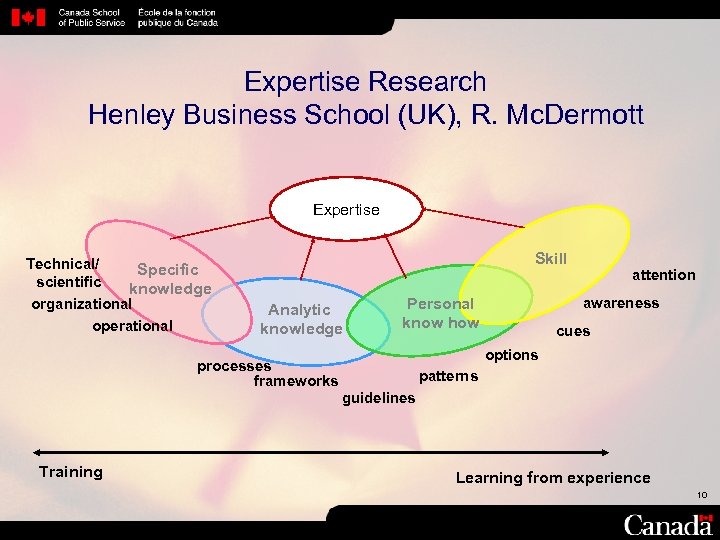
Expertise Research Henley Business School (UK), R. Mc. Dermott Expertise Technical/ Specific scientific knowledge organizational operational Skill awareness Personal know how Analytic knowledge attention cues options processes frameworks patterns guidelines Training Learning from experience 10 10
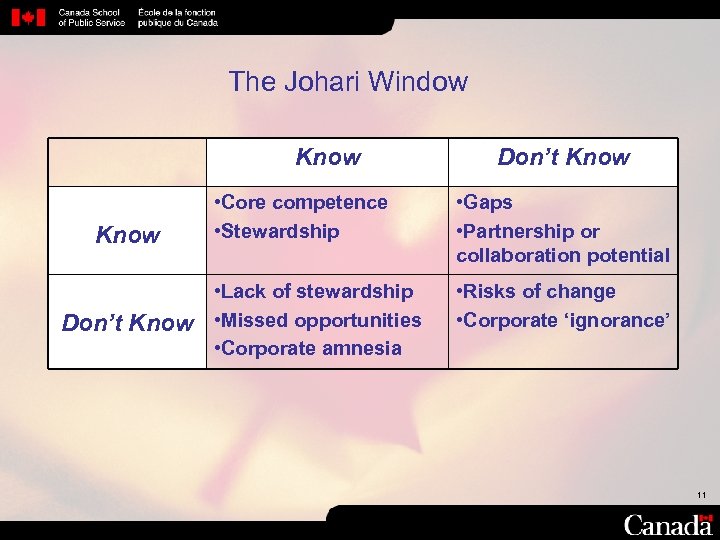
The Johari Window Know • Core competence • Stewardship • Lack of stewardship Don’t Know • Missed opportunities • Corporate amnesia Don’t Know • Gaps • Partnership or collaboration potential • Risks of change • Corporate ‘ignorance’ 11
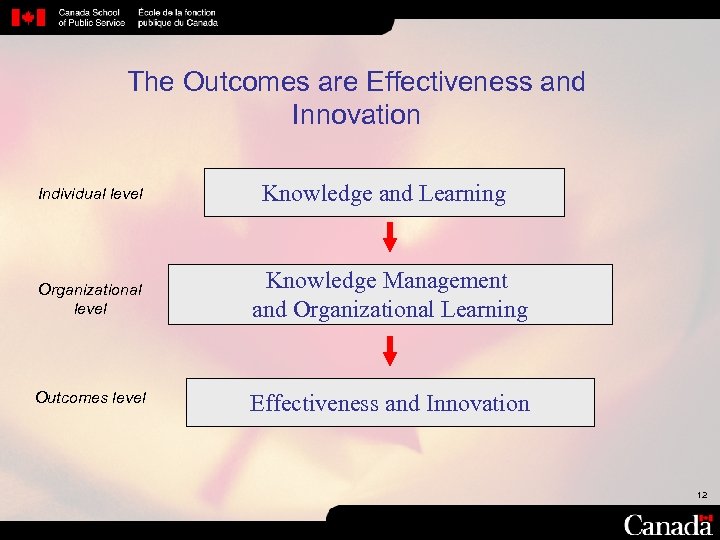
The Outcomes are Effectiveness and Innovation Individual level Knowledge and Learning Organizational level Knowledge Management and Organizational Learning Outcomes level Effectiveness and Innovation 12
What is Knowledge Management? Knowledge Management, or the management of an environment to facilitate the creation and use of knowledge for increased innovation and value, is a multi disciplinary field that draws from theories in economics, sociology, philosophy, and psychology. It also engages the applied fields of information technology, information and library science, and business. This matrix gives KM dimensions that other management approaches lack and thus can provide comprehensive and practical management solutions. S. Mc. Intyre and I. Moen, Vanguard, Issue 4, 2002 13
What is Knowledge Management? Knowledge management refers to the processes of creating, capturing, transferring and using knowledge to enhance organizational performance. Knowledge management is most frequently associated with two particular types of activities: - those activities that attempt to document and appropriate knowledge that individuals have (sometimes called the codification of knowledge) and activities to disseminate that knowledge throughout the organization, and those activities that facilitate human exchanges in which knowledge that is not codified (tacit knowledge) can be shared. Public Service Commission of Canada, 1998 14
What is Knowledge Management? Knowledge Management is a multi disciplinary approach to using and managing organizational knowledge that is based on sound Information management practices, focussed on organizational learning, recognizing the contribution and value of employees, and is enabled by technology. It is primarily concerned with the content of knowledge within the organization and how that knowledge can improve organizational performance. Interdepartmental Knowledge Management Forum, 1999 15
Knowledge Management Principles Davenport/Prusak: ü Knowledge originates and resides in people's minds ü Knowledge sharing requires trust ü Knowledge sharing must be encouraged and rewarded ü Management support and resources are essential ü Knowledge is creative and should be encouraged to develop in unexpected ways ü Technology enables new knowledge behaviours Snowden: ü We know more than we say and we say more than we write down ü Knowledge can never be conscripted, it is only volunteered ü We only know what we know when we need to know it 16
A Knowledge based Public Sector ü A Changing Service Agenda program effectiveness – results! efficiency and innovation required – expenditure review accountability increased risk sensitivity ü A Changing Policy Agenda policy re focussing and rationalization ü A Changing Workforce demographics ü A Changing Workforce Management Agenda new legislation public service renewal core learning and professional development recruitment and staffing Talent Management retention and workplace well being 17
Some Common Myths There’s no problem replacing those departing employees, just hire more university recruits We just need to get people to document everything they know and store it in the knowledgebase We just need everyone to have personal training plans to become a learning organization Now that we have a training policy we will become a learning organization We need more technology for us to communicate better You can’t “manage” something as ephemeral as knowledge, so Knowledge Management doesn’t exist 18
Some Common Truths We need to break down the barriers between silos We need to function more like a team We need to improve the decision making process We need to be more responsive to changes in situations, drivers and priorities – knowledge mobilization We need to know how to deal with the HR issues of the future, and start to take action now – knowledge retention We need to be more efficient and effective in times of shrinking budgets We need to become more innovative and less risk averse We need to collaborate on horizontal issues 19
The Role of Knowledge in the Public Sector • A strategic organizational asset resident in people. e. g. human capital/capacity • A major ingredient in strategy and policy formulation. e. g. insight, expertise, evidence, research, and intelligence • A critical resource in program development and delivery. e. g. know-how, skills, competencies, capacities, experience • A high value added component of products and services. e. g. information, analysis, guidance, support to decision-making • Knowledge is a part of our legacy - e. g. history, archives, records, library, wisdom, judgment 20
The Knowledge Advantage for the Canadian Public Service • • • Cultural and Societal advantage – public policy Collaborative advantage – working horizontally Creative advantage – innovation, R&D, S&T Citizen Client advantage – service delivery, e govt Co opetition advantage – knowledge based economy Cosmopolitan advantage – Canada and the world 21
A Knowledge based Public Sector “We don’t make widgets, we manage knowledge, that’s what government people, public sector people do and when you are managing knowledge your number one tool is learning. “ Clerk of the Privy Council’s Sixth Annual Report, 1998 “Traditional organizations built around activities and inputs are getting in the way of results and outcomes. A results based organization requires a new management model. People and Knowledge Management are two essential cornerstones of a new public sector management model” COSO Learning and Development Committee Progress Report, July 2002 22
The Challenge for the Public Sector “Loss of vital knowledge and experience is taking its toll on Canada’s cherished institutions – the Public Service of Canada in particular. Veteran employees are retiring in unprecedented numbers. Continual change and organizational churn are now the norm. New technologies allow us to store vast amounts of information, but also to misplace vast amounts of information. We, as an institution, are forgetting important lessons from the past… Preserving knowledge is a core responsibility of every manager… There are no longer any excuses for doing nothing. ” François Guimont, Chair, CSPS Action-Research Roundtable on Organizational Memory (from Lost & Found A Smart-Practice Guide to Managing Organizational Memory, April, 2007) 23
A Knowledge based Public Sector “In the coming years, I will be looking to deputies and agency heads to ensure that newly recruited public servants can benefit from the accumulated knowledge of their more experienced colleagues through more effective programs of Knowledge Management and knowledge transfer. This is another area where departments and agencies have much to learn from one another. “ Clerk of the Privy Council’s Sixteenth Annual Report, 2009 24
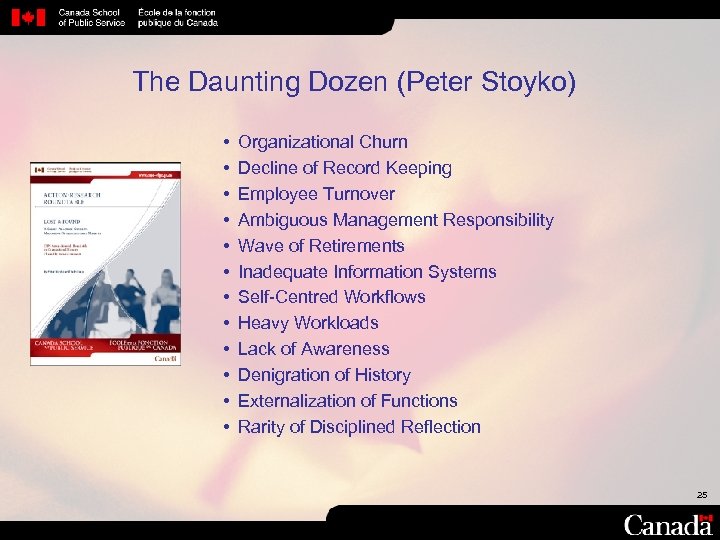
The Daunting Dozen (Peter Stoyko) • • • Organizational Churn Decline of Record Keeping Employee Turnover Ambiguous Management Responsibility Wave of Retirements Inadequate Information Systems Self Centred Workflows Heavy Workloads Lack of Awareness Denigration of History Externalization of Functions Rarity of Disciplined Reflection 25
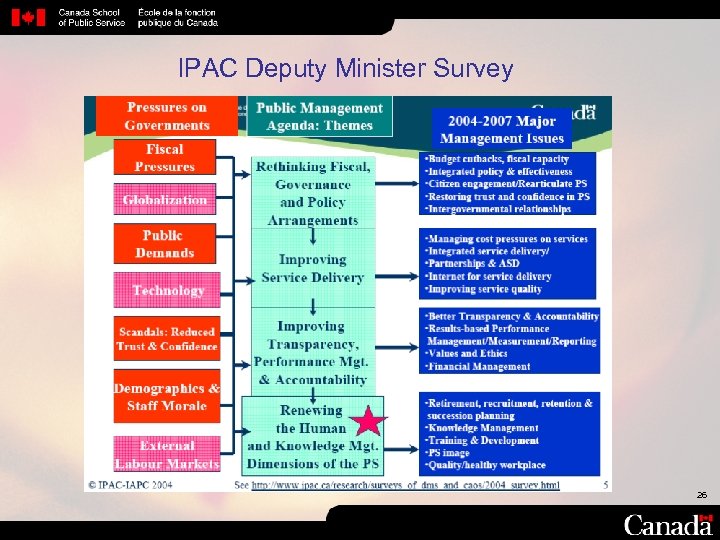
IPAC Deputy Minister Survey 26
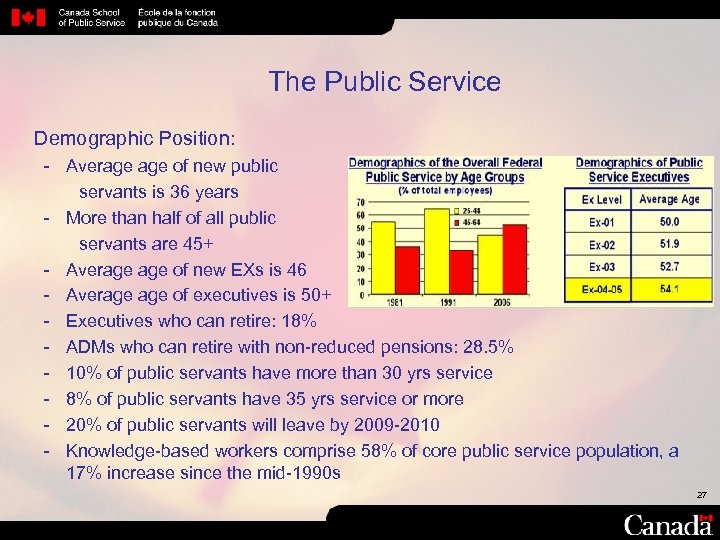
The Public Service Demographic Position: Average of new public servants is 36 years More than half of all public servants are 45+ Average of new EXs is 46 Average of executives is 50+ Executives who can retire: 18% ADMs who can retire with non reduced pensions: 28. 5% 10% of public servants have more than 30 yrs service 8% of public servants have 35 yrs service or more 20% of public servants will leave by 2009 2010 Knowledge based workers comprise 58% of core public service population, a 17% increase since the mid 1990 s 27
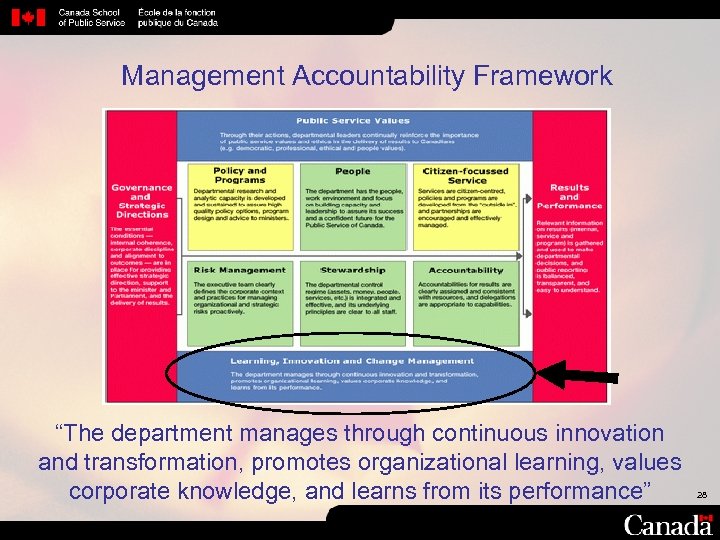
Management Accountability Framework “The department manages through continuous innovation and transformation, promotes organizational learning, values corporate knowledge, and learns from its performance” 28
Agenda ü How does Knowledge Management apply to the Canadian public sector? • How has Knowledge Management been applied across the Canadian public sector? • Lessons Learned in applying KM • Where are we headed? 29
Interdepartmental Knowledge Management Forum Our Raison d’être: The Interdepartmental Knowledge Management Forum (IKMF) creates an exploratory environment that stimulates Knowledge Management (KM) practice in the public sector. As a community of practice, the IKMF creates a safe environment for reflection, discovery, dialogue and innovation through the sharing of experiences, practices and insights between practitioners and those interested in KM. The objectives of the Forum are: to encourage dialogue and collaboration between colleagues from knowledge intensive communities to focus on and share experiences in the implementation of knowledge management in the public sector to be a centre of excellence and expertise in the development and use of knowledge management in the public sector 30
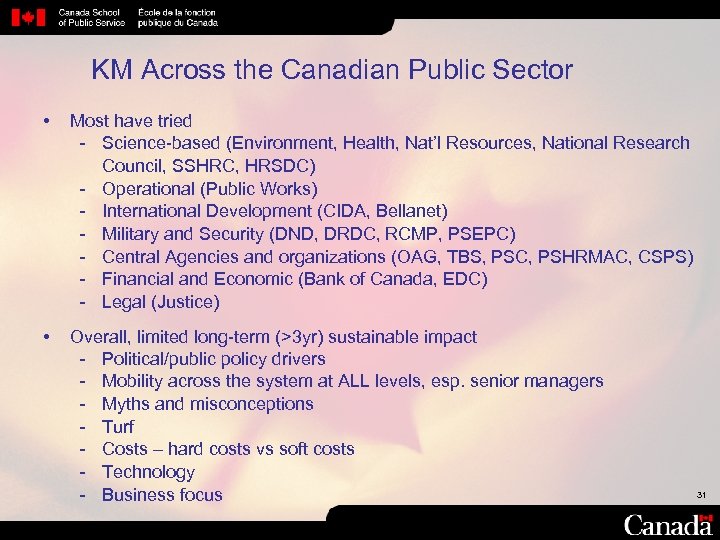
KM Across the Canadian Public Sector • Most have tried Science based (Environment, Health, Nat’l Resources, National Research Council, SSHRC, HRSDC) Operational (Public Works) International Development (CIDA, Bellanet) Military and Security (DND, DRDC, RCMP, PSEPC) Central Agencies and organizations (OAG, TBS, PSC, PSHRMAC, CSPS) Financial and Economic (Bank of Canada, EDC) Legal (Justice) • Overall, limited long term (>3 yr) sustainable impact Political/public policy drivers Mobility across the system at ALL levels, esp. senior managers Myths and misconceptions Turf Costs – hard costs vs soft costs Technology Business focus 31
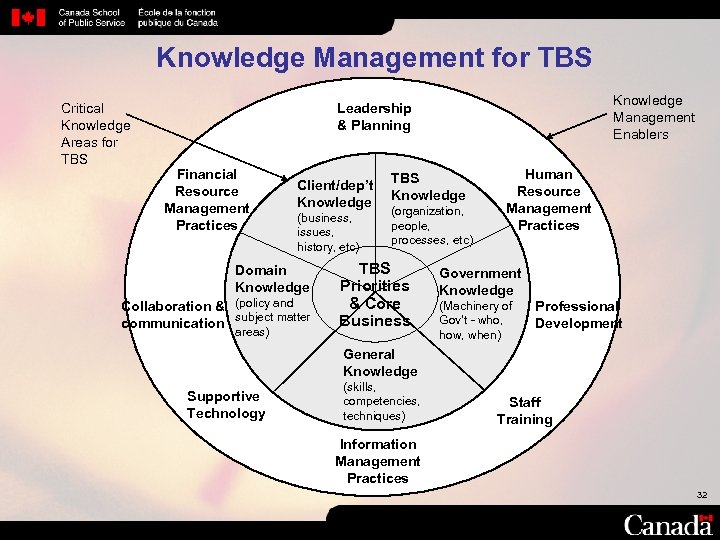
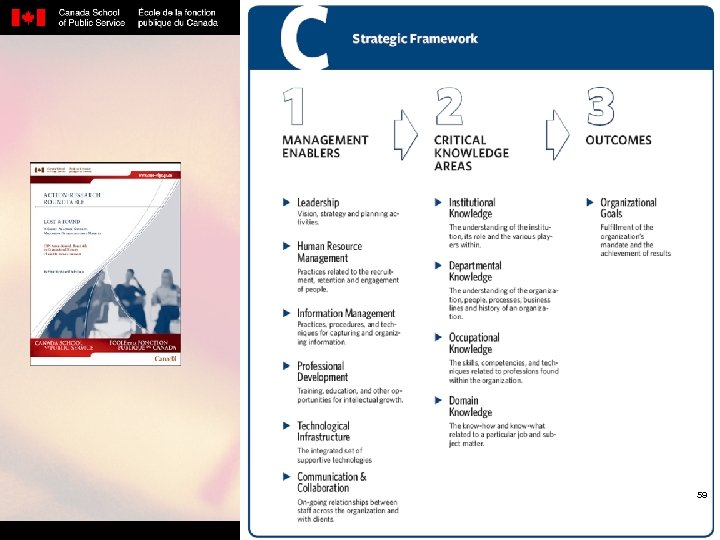
Knowledge Management for TBS Critical Knowledge Areas for TBS Knowledge Management Enablers Leadership & Planning Financial Resource Management Practices Client/dep’t TBS Knowledge (business, issues, history, etc) Domain Knowledge Collaboration & (policy and communication subject matter areas) (organization, people, processes, etc) TBS Priorities & Core Business Human Resource Management Practices Government Knowledge (Machinery of Gov’t who, how, when) Professional Development General Knowledge Supportive Technology (skills, competencies, techniques) Staff Training Information Management Practices 32
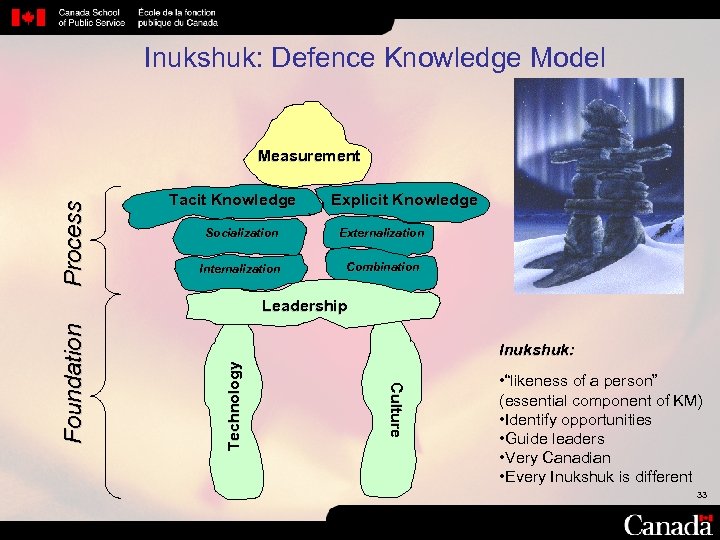
Inukshuk: Defence Knowledge Model Process Measurement Tacit Knowledge Explicit Knowledge Socialization Externalization Internalization Combination Technology Inukshuk: Culture Foundation Leadership • “likeness of a person” (essential component of KM) • Identify opportunities • Guide leaders • Very Canadian • Every Inukshuk is different 33
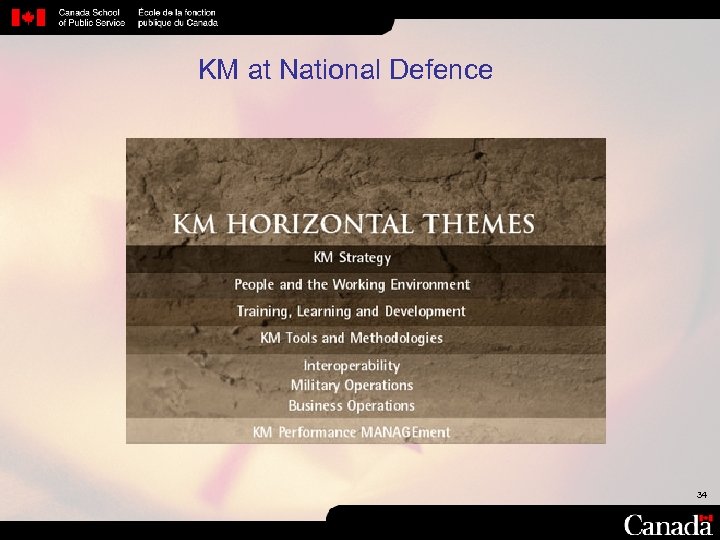
KM at National Defence 34
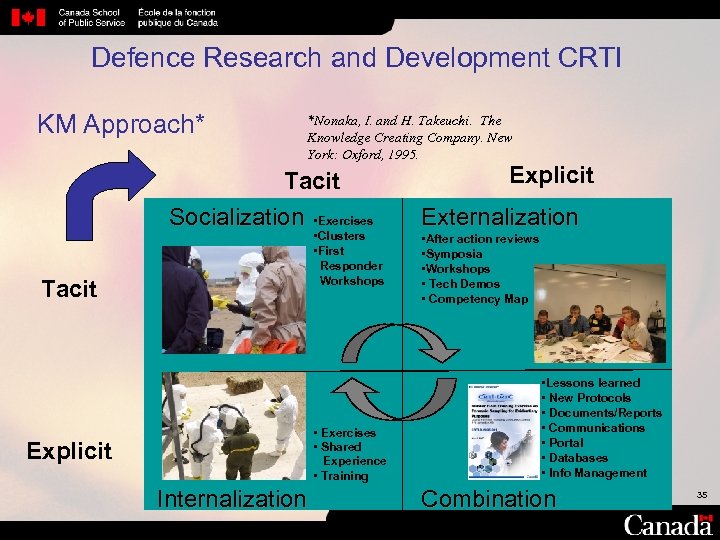
Defence Research and Development CRTI KM Approach* *Nonaka, I. and H. Takeuchi. The Knowledge Creating Company. New York: Oxford, 1995. Tacit Socialization • Exercises • Clusters • First Responder Workshops Tacit Explicit Externalization • After action reviews • Symposia • Workshops • Tech Demos • Competency Map Tacit Explicit • Exercises • Shared Experience • Training Internalization: Internalization • Lessons learned • New Protocols • Documents/Reports • Communications • Portal • Databases • Info Management Combination: 35
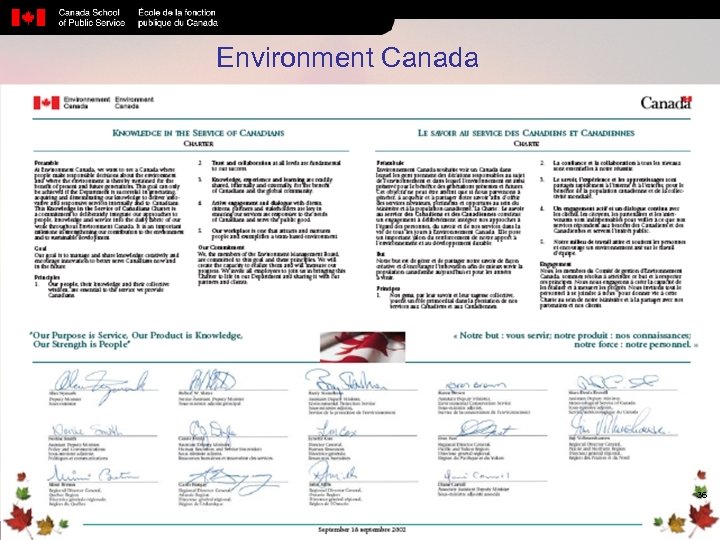
Environment Canada 36
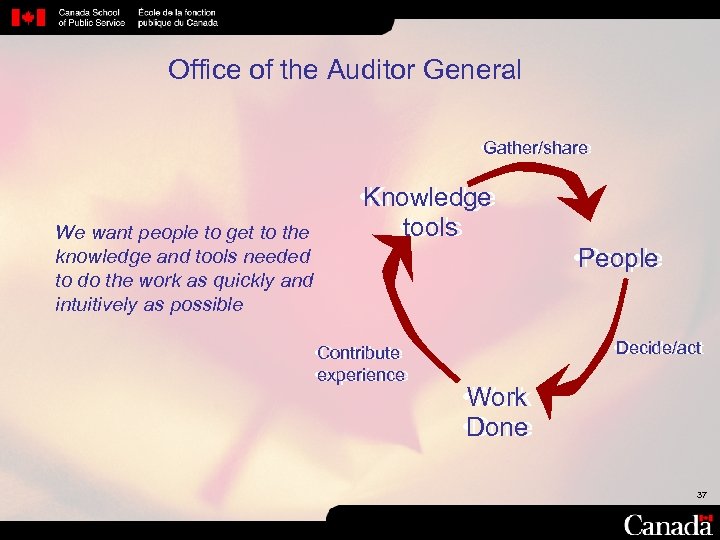
Office of the Auditor General • Gather/share We want people to get to the knowledge and tools needed to do the work as quickly and intuitively as possible • Knowledge • tools • People • Contribute • experience • Decide/act • Work • Done 37
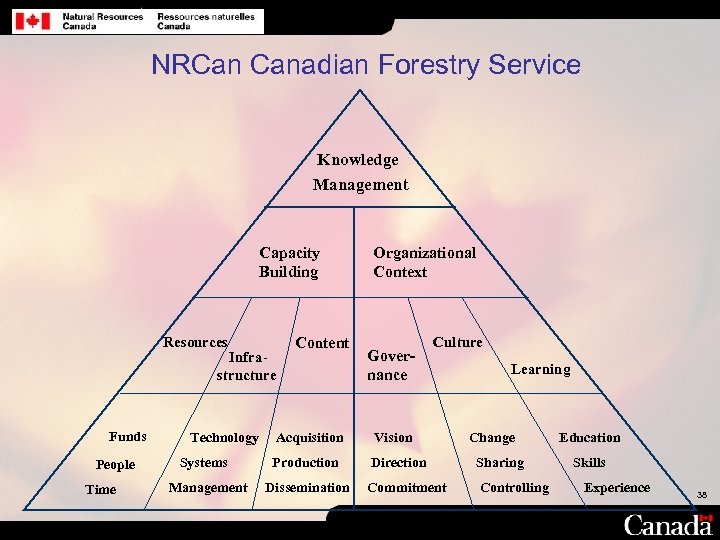
NRCan Canadian Forestry Service Knowledge Management Capacity Building Resources Infrastructure Funds People Time Technology Systems Management Content Organizational Context Governance Culture Learning Acquisition Vision Production Direction Sharing Commitment Controlling Dissemination Change Education Skills Experience 38
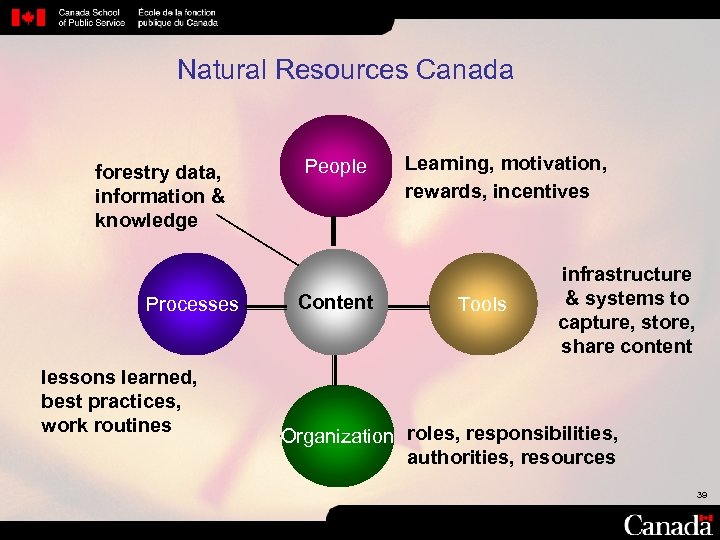
Natural Resources Canada forestry data, information & knowledge Processes lessons learned, best practices, work routines People Learning, motivation, rewards, incentives Content Tools infrastructure & systems to capture, store, share content Organization roles, responsibilities, authorities, resources 39
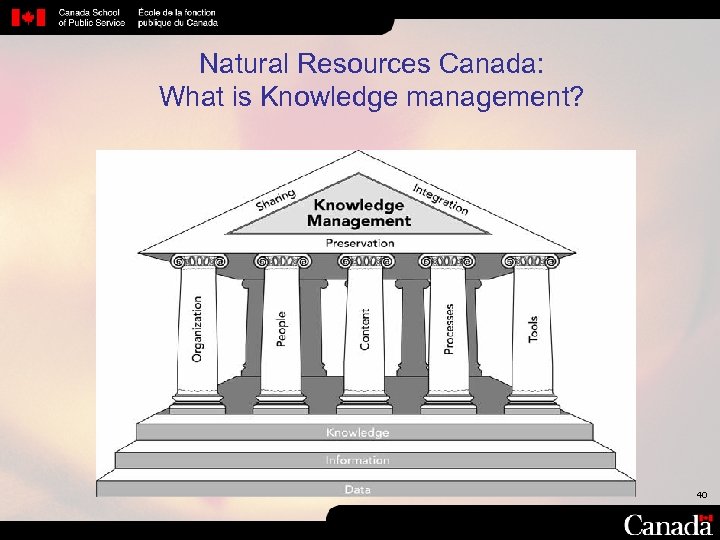
Natural Resources Canada: What is Knowledge management? 40
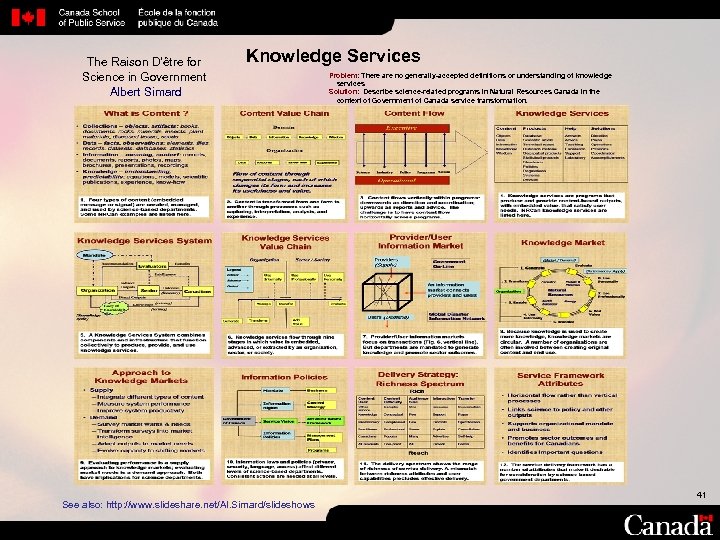
The Raison D’être for Science in Government Albert Simard Knowledge Services See also: http: //www. slideshare. net/Al. Simard/slideshows Problem: There are no generally-accepted definitions or understanding of knowledge services Solution: Describe science-related programs in Natural Resources Canada in the context of Government of Canada service transformation. 41
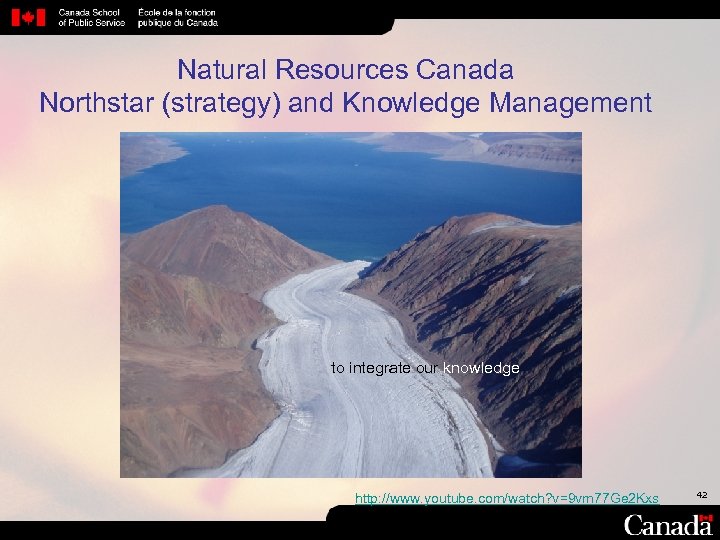
Natural Resources Canada Northstar (strategy) and Knowledge Management to integrate our knowledge http: //www. youtube. com/watch? v=9 vm 77 Ge 2 Kxs 42
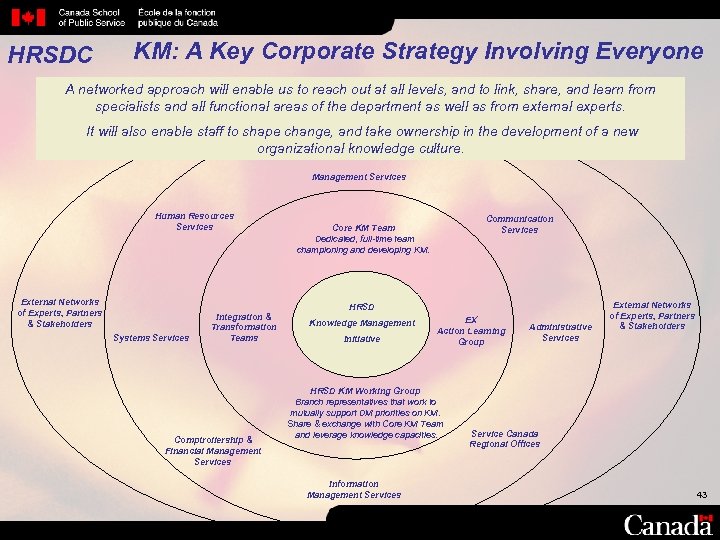
HRSDC KM: A Key Corporate Strategy Involving Everyone A networked approach will enable us to reach out at all levels, and to link, share, and learn from specialists and all functional areas of the department as well as from external experts. It will also enable staff to shape change, and take ownership in the development of a new organizational knowledge culture. Management Services Human Resources Services External Networks of Experts, Partners & Stakeholders Systems Services Integration & Transformation Teams Comptrollership & Financial Management Services Communication Services Core KM Team Dedicated, full-time team championing and developing KM. HRSD Knowledge Management Initiative EX Action Learning Group HRSD KM Working Group Branch representatives that work to mutually support DM priorities on KM. Share & exchange with Core KM Team and leverage knowledge capacities. Information Management Services Administrative Services External Networks of Experts, Partners & Stakeholders Service Canada Regional Offices 43
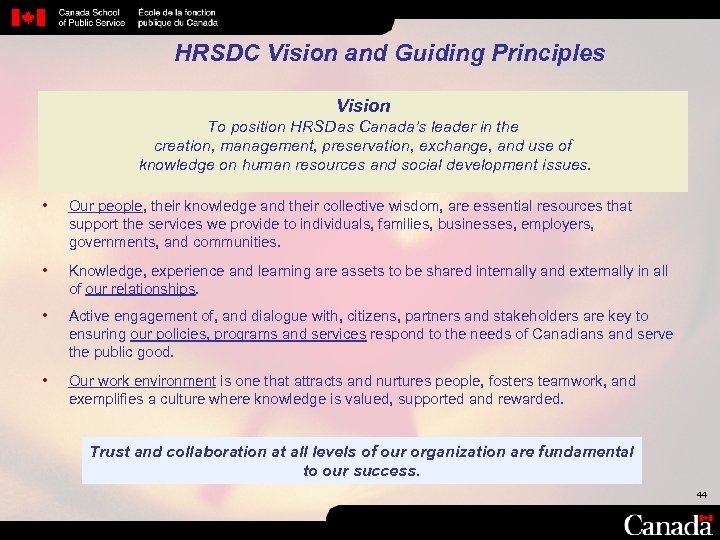
HRSDC Vision and Guiding Principles Vision To position HRSD as Canada’s leader in the creation, management, preservation, exchange, and use of knowledge on human resources and social development issues. • Our people, their knowledge and their collective wisdom, are essential resources that support the services we provide to individuals, families, businesses, employers, governments, and communities. • Knowledge, experience and learning are assets to be shared internally and externally in all of our relationships. • Active engagement of, and dialogue with, citizens, partners and stakeholders are key to ensuring our policies, programs and services respond to the needs of Canadians and serve the public good. • Our work environment is one that attracts and nurtures people, fosters teamwork, and exemplifies a culture where knowledge is valued, supported and rewarded. Trust and collaboration at all levels of our organization are fundamental to our success. 44
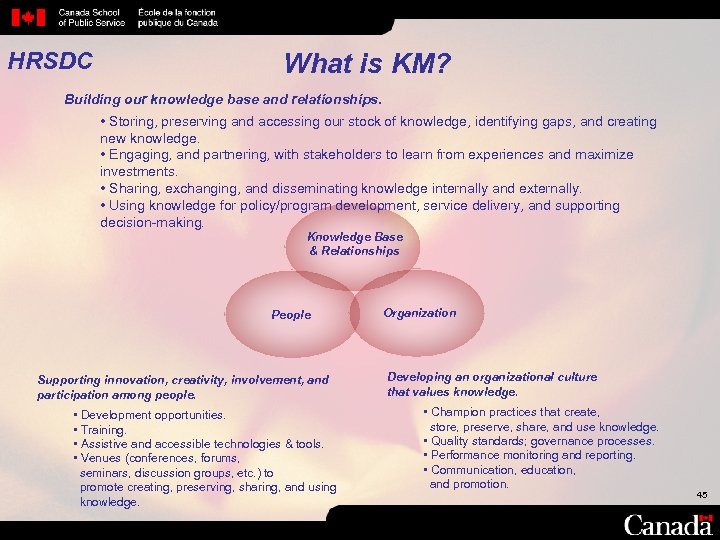
HRSDC What is KM? Building our knowledge base and relationships. • Storing, preserving and accessing our stock of knowledge, identifying gaps, and creating new knowledge. • Engaging, and partnering, with stakeholders to learn from experiences and maximize investments. • Sharing, exchanging, and disseminating knowledge internally and externally. • Using knowledge for policy/program development, service delivery, and supporting decision making. Knowledge Base & Relationships People Supporting innovation, creativity, involvement, and participation among people. • Development opportunities. • Training. • Assistive and accessible technologies & tools. • Venues (conferences, forums, seminars, discussion groups, etc. ) to promote creating, preserving, sharing, and using knowledge. Organization Developing an organizational culture that values knowledge. • Champion practices that create, store, preserve, share, and use knowledge. • Quality standards; governance processes. • Performance monitoring and reporting. • Communication, education, and promotion. 45
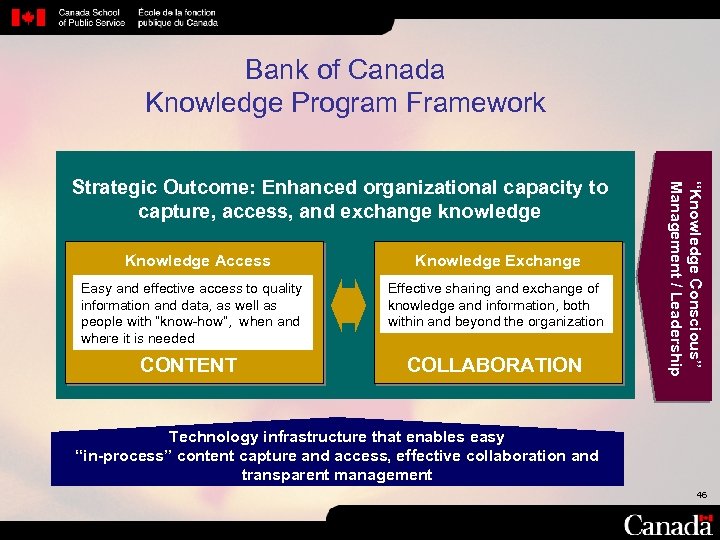
Bank of Canada Knowledge Program Framework Knowledge Access Knowledge Exchange Easy and effective access to quality information and data, as well as people with “know how”, when and where it is needed Effective sharing and exchange of knowledge and information, both within and beyond the organization CONTENT COLLABORATION “Knowledge Conscious” Management / Leadership Strategic Outcome: Enhanced organizational capacity to capture, access, and exchange knowledge Technology infrastructure that enables easy “in-process” content capture and access, effective collaboration and transparent management 46
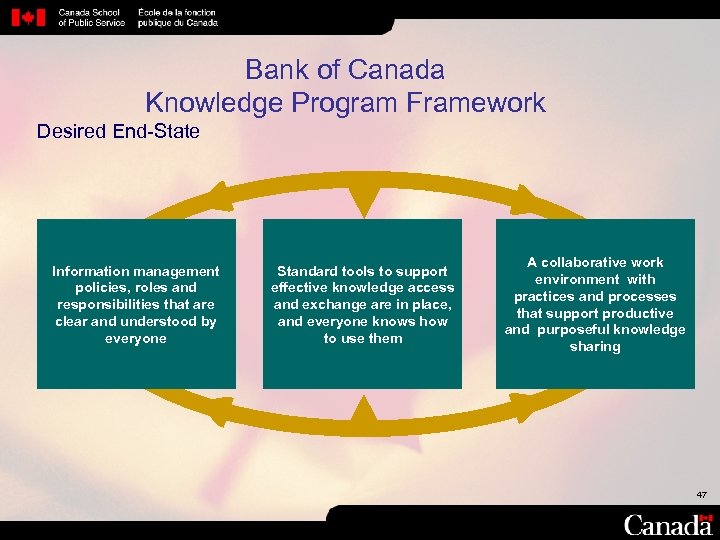
Bank of Canada Knowledge Program Framework Desired End State Information management policies, roles and responsibilities that are clear and understood by everyone Standard tools to support effective knowledge access and exchange are in place, and everyone knows how to use them A collaborative work environment with practices and processes that support productive and purposeful knowledge sharing 47
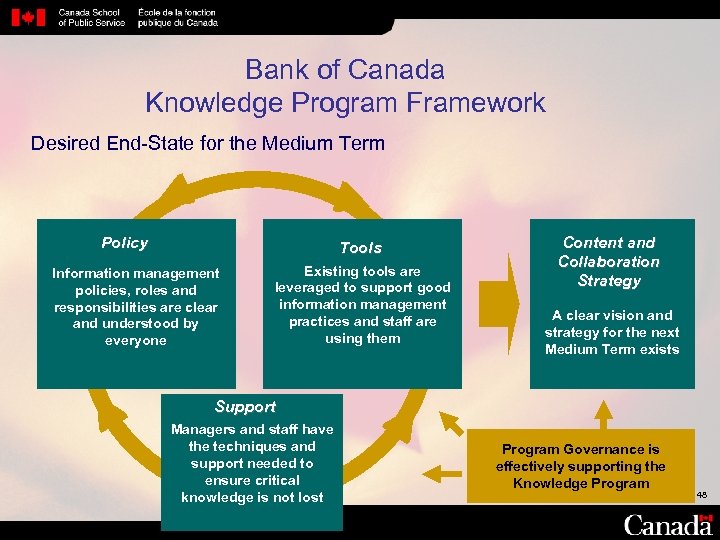
Bank of Canada Knowledge Program Framework Desired End State for the Medium Term Policy Tools Information management policies, roles and responsibilities are clear and understood by everyone Existing tools are leveraged to support good information management practices and staff are using them Content and Collaboration Strategy A clear vision and strategy for the next Medium Term exists Support Managers and staff have the techniques and support needed to ensure critical knowledge is not lost Program Governance is effectively supporting the Knowledge Program 48
Mandate and Objectives of the National Crime Prevention Centre – Public Safety • The NCPC uses a crime prevention through social development approach, which aims to tackle crime by addressing its root causes. • NCPC Objectives: Increase sustainable community action in support of CPSD Develop and share knowledge of effective crime prevention strategies Coordinate multi-level support for crime prevention efforts 49
NCPC Knowledge Functions Backdrop Background • Increasing demand for evidence based practice • Increasing requirement for accountability • Increasing need for clear federal role • 8 years of experience and 4000+ funded projects • Belief that every project funded has something to add to the body of evidence on crime prevention • Little attention in past to results and lessons learned • Organization downsize and reorganization Challenges • Knowledge identified as one of three key pillars • Outcomes: improved knowledge of effective crime prevention approaches improved integration of evidence-based crime prevention into policies and practices • NCPC as knowledge broker and champion of evidence based solutions for community safety problems 50
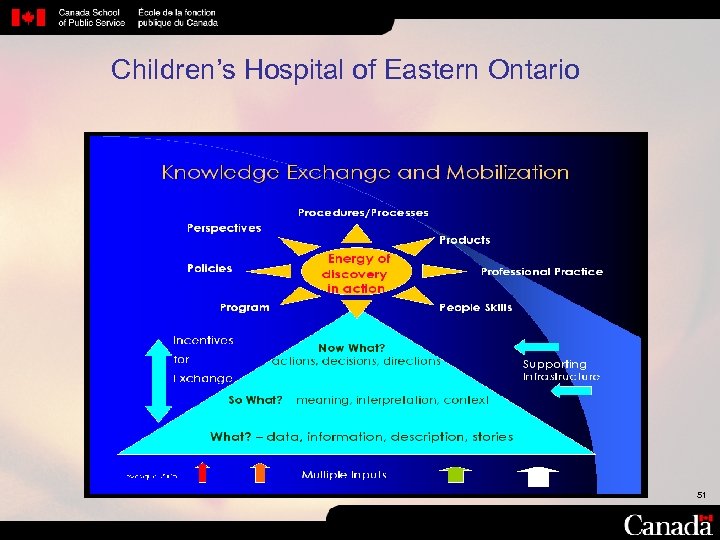
Children’s Hospital of Eastern Ontario 51
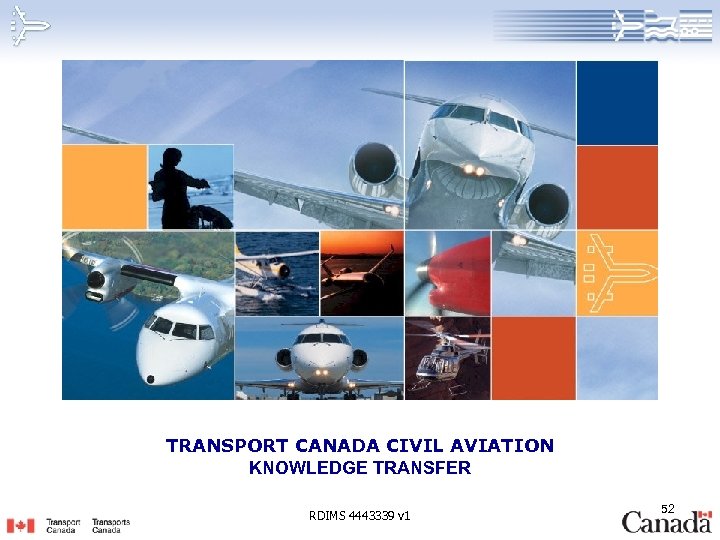
TRANSPORT CANADA CIVIL AVIATION KNOWLEDGE TRANSFER RDIMS 4443339 v 1 52
Objectives • Overview: – Transport Canada’s Knowledge Transfer (KT) Project (1999 – 2002) – Civil Aviation’s Knowledge Transfer (KT) Project (2008 – ) 53
Transport Canada’s KT Project – Major Findings “An important conclusion of the KT project was that TC’s knowledge transfer efforts should not rely exclusively on informatics. ” (How to Prevent Knowledge Collapse – Transport Canada’s approach to its critical subject matter experts: knowledge transfer and succession planning challenges, 2004) 54
Civil Aviation’s KT Project How it Started • Study “An Exploration of Knowledge Transfer in Transport Canada Civil Aviation” presented to National Civil Aviation Management Executive (NCAMX) (May, 2007) • Terms of Reference approved by NCAMX (Oct, 2007) • 1 st Working Group Face-to-Face Workshop (Oct, 2008) • 2 nd Working Group Face-to-Face Workshop (scheduled for mid Jan, 2009) 55
Civil Aviation’s KT Project – Strategic Plan • Mission: To develop a knowledge transfer program within TCCA to enhance the effectiveness and efficiency of our current and future program • Vision: Knowledge transfer is integrated in our way of doing business • Goals: – Define knowledge transfer pressures – Obtain on-going management commitment – Engage employees 56
Civil Aviation’s KT Project Deliverables • The Working Group will develop: – a methodology for the identification of TCCA critical SMEs and their successors (i. e. a succession planning system). – a methodology for the transfer of critical knowledge from SMEs to their successors (i. e. KT tools). – a tracking mechanism. – a performance measurement tool. – a communication plan, including education on the benefits for knowledge transfer – an implementation plan 57
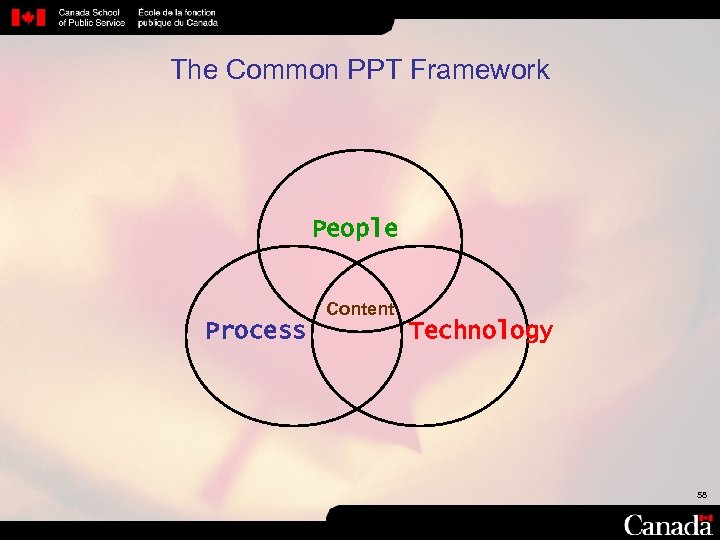
The Common PPT Framework People Content Process Technology 58
59
Agenda ü How does Knowledge Management apply to the Canadian public sector? ü How has Knowledge Management been applied across the Canadian public sector? • Lessons Learned in applying KM • Where are we headed? 60
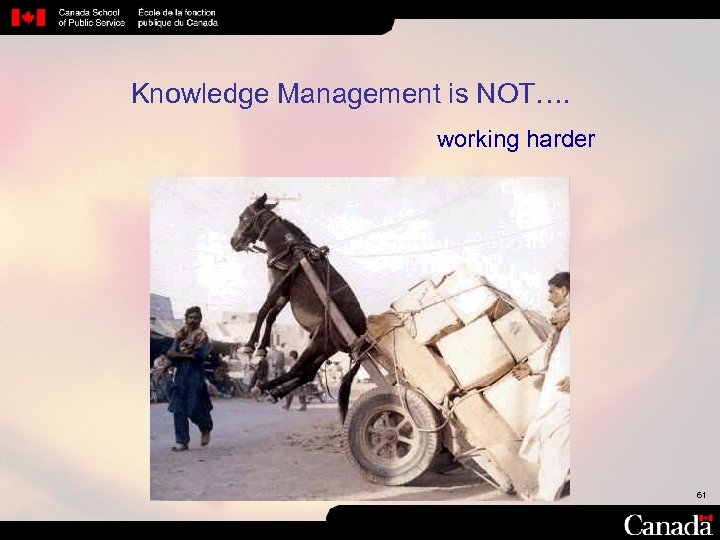
Knowledge Management is NOT…. working harder 61
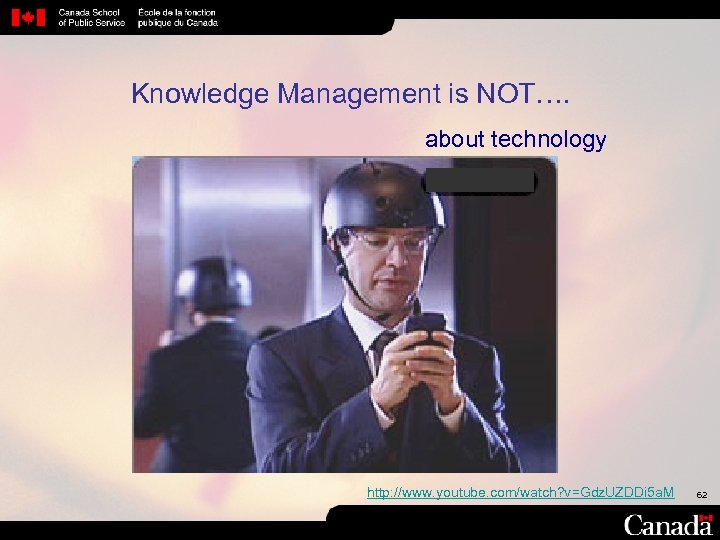
Knowledge Management is NOT…. about technology http: //www. youtube. com/watch? v=Gdz. UZDDi 5 a. M 62
KM Value Chain Who is involved in the KM Value Chain? » Leaders » Managers » Staff/employees » Support groups » Clients/customers » Suppliers » Stakeholders 63
KM Approaches – the Good, the Bad, … • • • Strategic and/or tactical KM communities of practice, learning networks, functional communities, collaborative arrangements organizational learning & knowledge sharing (Lessons learned, debriefs, AARs, coaching, organizational learning events) organizational analysis (knowledge mapping/auditing, Social Network Analysis) knowledge creation/innovation – knowledge capture, knowledge transfer team based management process improvement HR/workplace and workforce initiatives (succession planning, Workplace Well being) IT (intranets, group/collaborative software, portals, yellow pages, expert locators, virtual teams, conferencing, search tools) Training & Dev (individual, team) d. M/IM/RM/DM (data, information, records and document management) 64
Smart Practice Tools (Peter Stoyko) • • • After Action Reviews Exit Interviews Learning Histories Lessons Learned Inventories Communities of Practice Guided Learning (Action Learning, etc) Learning Events (Organizational Learning, etc) Job Overlap Phased Retirement Network Based Solutions (Expert Locator systems) Externalization of Functions • Document Repositories and Portals • Automation Self Service • Knowledge Centres 65
Some Other Practices/Tools • • • • Visualization Storytelling Social Network Analysis Succession Planning/mentoring/coaching K risk assessment, knowledge audits KM Maturity Assessment and benchmarking Concept Mapping Mindmapping Business Process A/R/M Simulation techniques Knowledge Retention Learning Labs Expert location/’Ask the Expert” Data mining/email analysis… … 66
Communities of Practice What are they? “a group of people who share a concern, a set of problems or a passion about a topic and who deepen their knowledge and expertise in this area by interacting on an ongoing basis” Wenger, Mc. Dermott and Snyder • • A group of people that shares knowledge, learns together and develops common / improved practices. They have committed themselves to the exploration and advancement of the ‘practice’ of the community. They recognize the value in what each other knows and they need to stay current on the topic. The sense of ‘community’ enables a learning environment to exist where practitioners of varying knowledge, skill, or experience levels can openly share and build on each others’ knowledge and ideas in a climate of trust and respect. 67
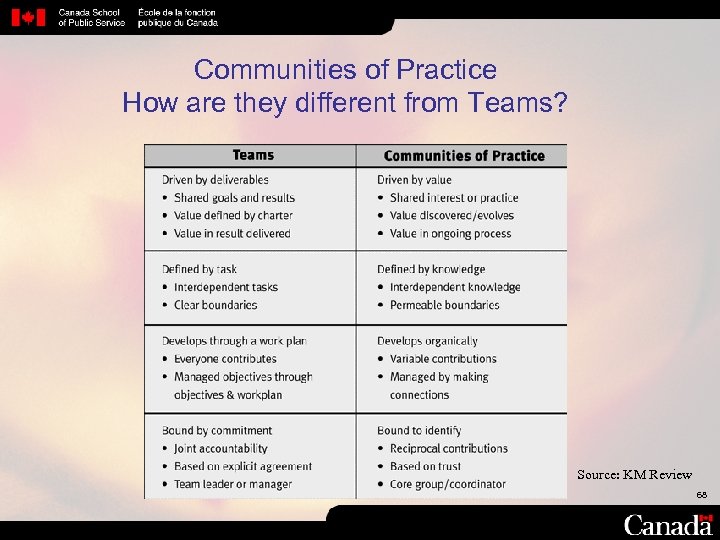
Communities of Practice How are they different from Teams? Source: KM Review 68
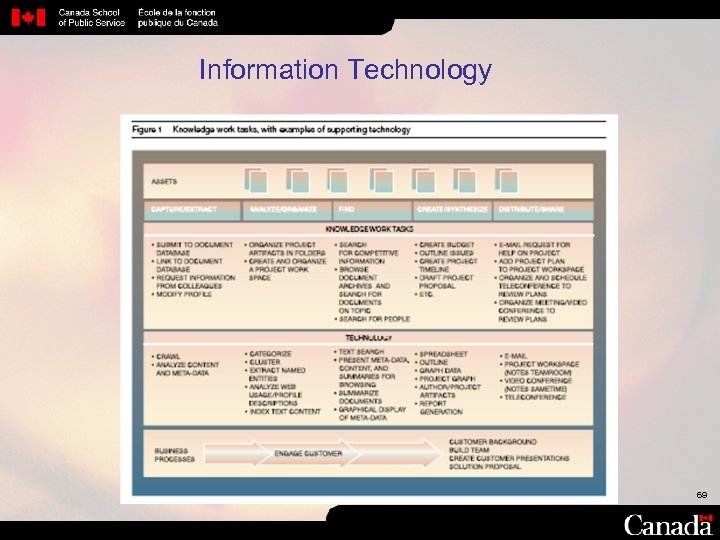
Information Technology 69
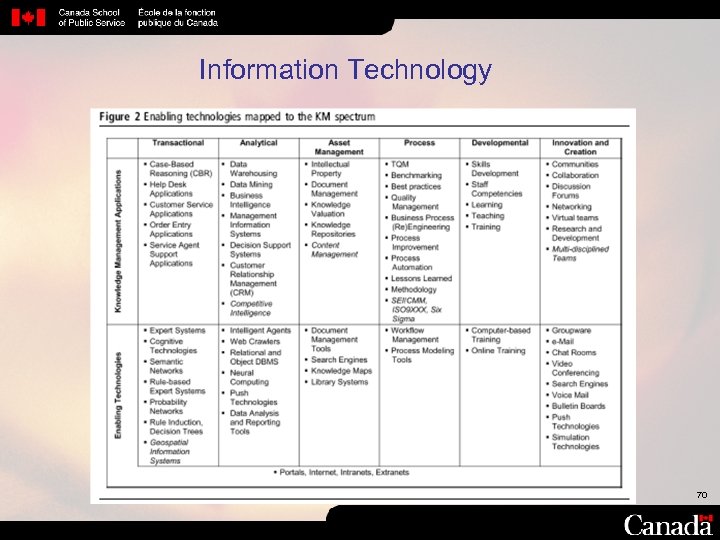
Information Technology 70
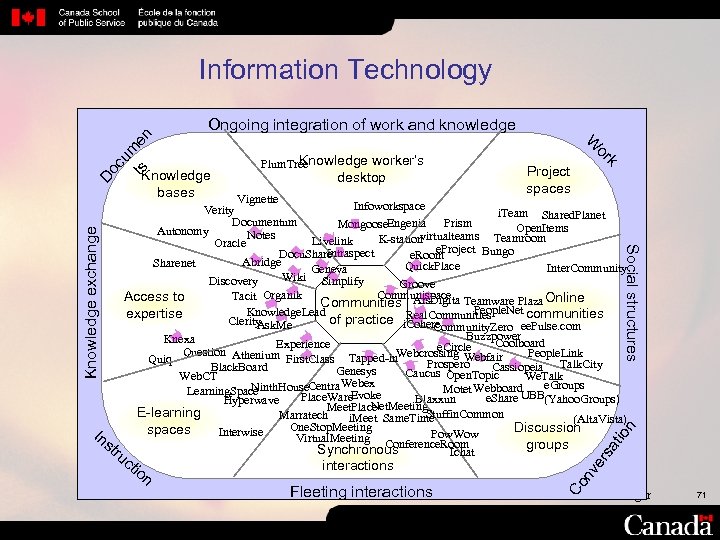
cu ts men Information Technology Ongoing integration of work and knowledge Do Knowledge bases Knowledge worker’s Plum. Tree desktop W or Project spaces k interactions Fleeting interactions er n nv io Co ct sa tio n Social structures Knowledge exchange Vignette Infoworkspace Verity i. Team Shared. Planet Documentum Mongoose. Engenia Prism Open. Items Autonomy Notes virtualteams Teamroom K-station Livelink Oracle e. Project Bungo Intraspect Docu. Share e. Room Abridge Sharenet Quick. Place Inter. Community Geneva Wiki Simplify Discovery Groove Communispace Tacit Organik Access to Communities Ars. Digita Teamware Plaza Online People. Net communities Knowledge. Lead expertise Real. Communities of practice i. Cohere Clerity Ask. Me Community. Zero ee. Pulse. com Buzzpower Knexa Coolboard Experience e. Circle Question Athenium Webcrossing Webfair People. Link Quiq First. Class Tapped-in Prospero Black. Board Cassiopeia Talk. City Genesys Caucus Open. Topic Web. CT We. Talk e. Groups Ninth. House. Centra Webex Motet Webboard Learning. Space Place. Ware. Evoke e. Share UBB(Yahoo. Groups) Blaxxun Hyperwave Net. Meeting Meet. Place E learning Stuffin. Common Marratech i. Meet Same. Time (Alta. Vista) One. Stop. Meeting Discussion spaces Interwise Pow. Wow In Virtual. Meeting Conference. Room st groups Synchronous ru Ichat © Etienne Wenger 71
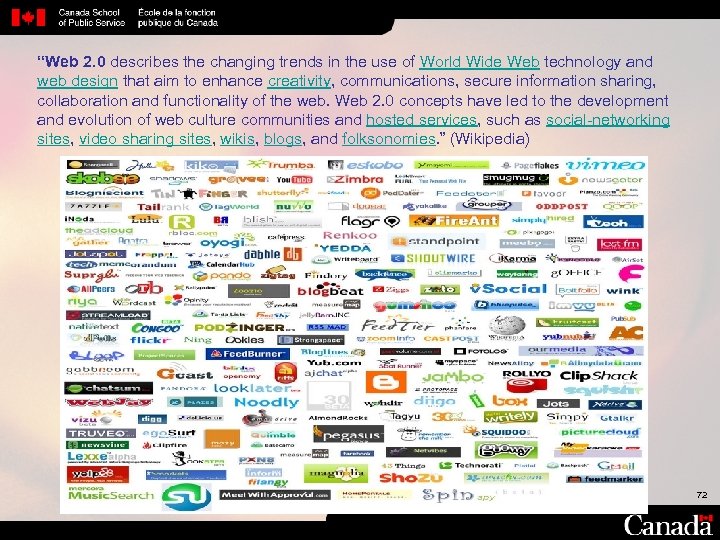
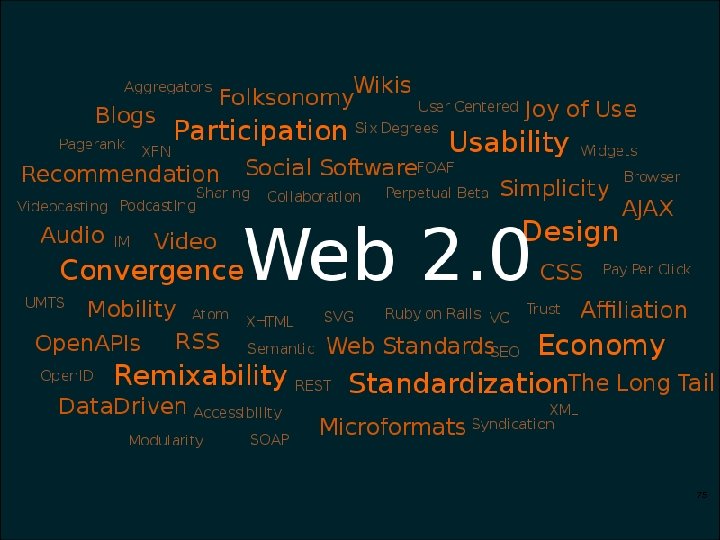
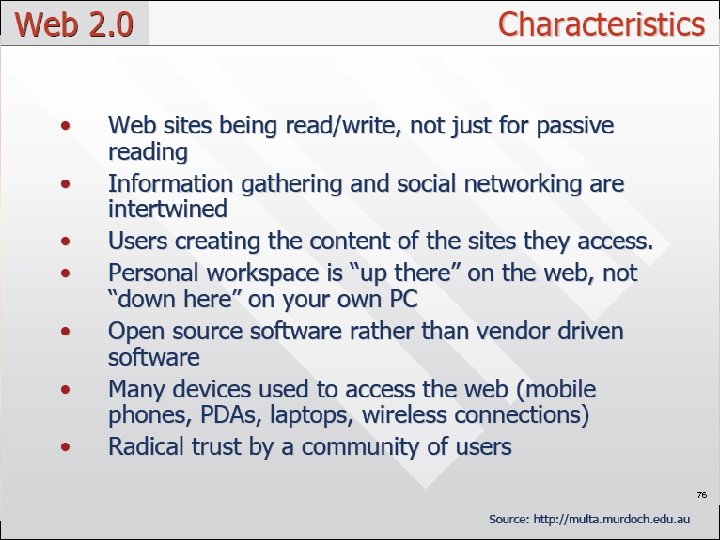
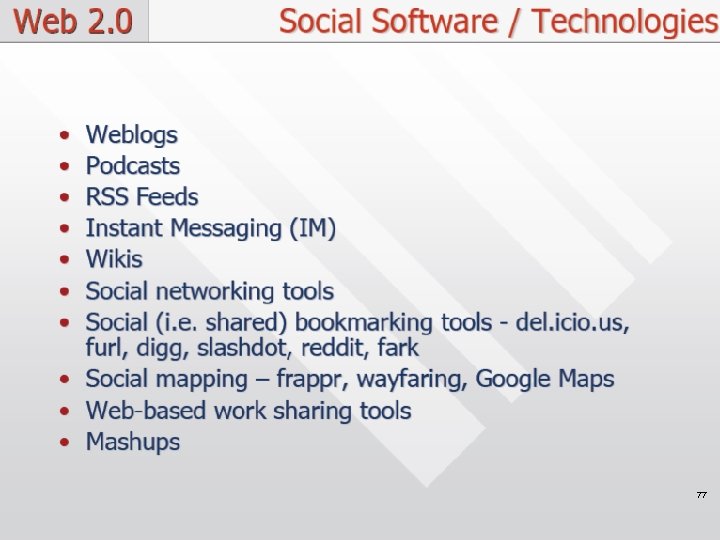
“Web 2. 0 describes the changing trends in the use of World Wide Web technology and web design that aim to enhance creativity, communications, secure information sharing, collaboration and functionality of the web. Web 2. 0 concepts have led to the development and evolution of web culture communities and hosted services, such as social networking sites, video sharing sites, wikis, blogs, and folksonomies. ” (Wikipedia) 72
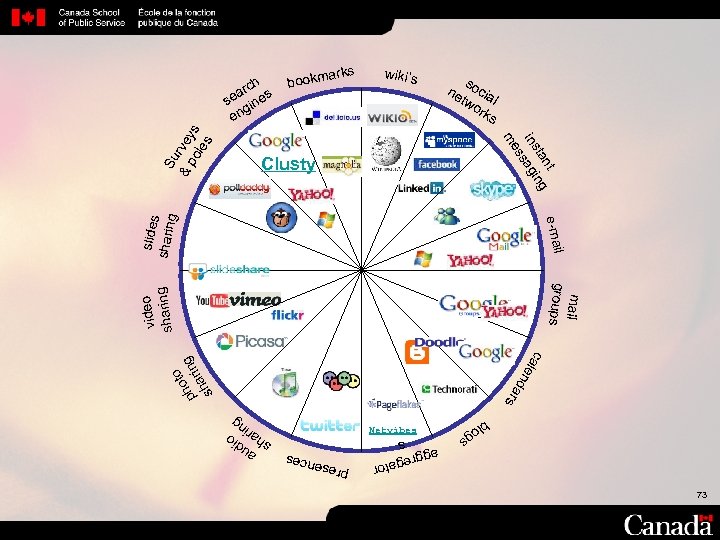
arks bookm wiki’s s ne ocia tw l ork s t tan ng ins sagi s me Clusty il e ma slides sharin g Su & rvey po s les h arc es se in g en video sharing mail groups oto ph ring a sh ca len d ars blo gs Netvibes 73 aggr o egat s r pre senc es a sh udio a rin g
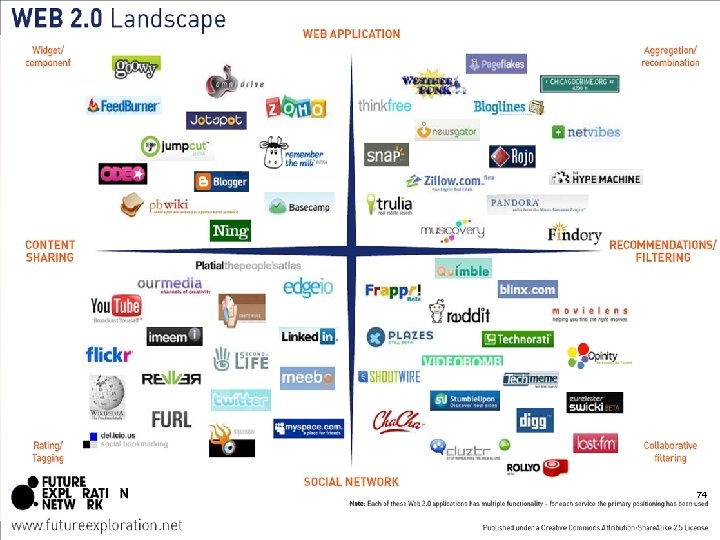
74
75
76
77
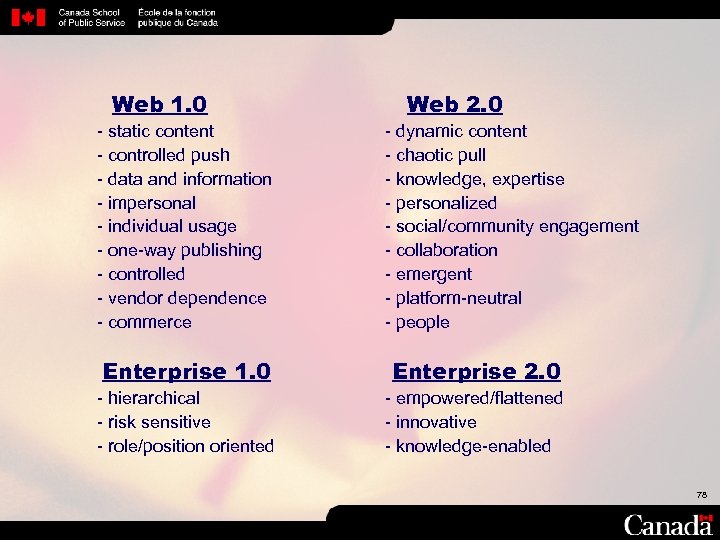
Web 1. 0 static content controlled push data and information impersonal individual usage one way publishing controlled vendor dependence commerce Enterprise 1. 0 hierarchical risk sensitive role/position oriented Web 2. 0 dynamic content chaotic pull knowledge, expertise personalized social/community engagement collaboration emergent platform neutral people Enterprise 2. 0 empowered/flattened innovative knowledge enabled 78
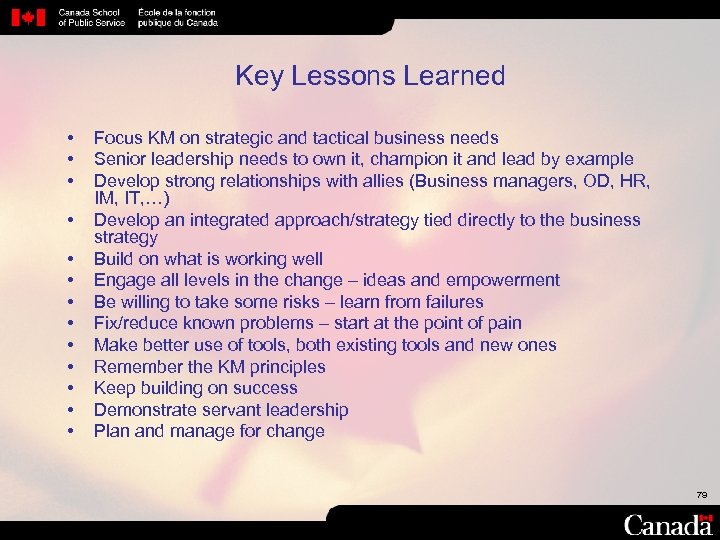
Key Lessons Learned • • • • Focus KM on strategic and tactical business needs Senior leadership needs to own it, champion it and lead by example Develop strong relationships with allies (Business managers, OD, HR, IM, IT, …) Develop an integrated approach/strategy tied directly to the business strategy Build on what is working well Engage all levels in the change – ideas and empowerment Be willing to take some risks – learn from failures Fix/reduce known problems – start at the point of pain Make better use of tools, both existing tools and new ones Remember the KM principles Keep building on success Demonstrate servant leadership Plan and manage for change 79
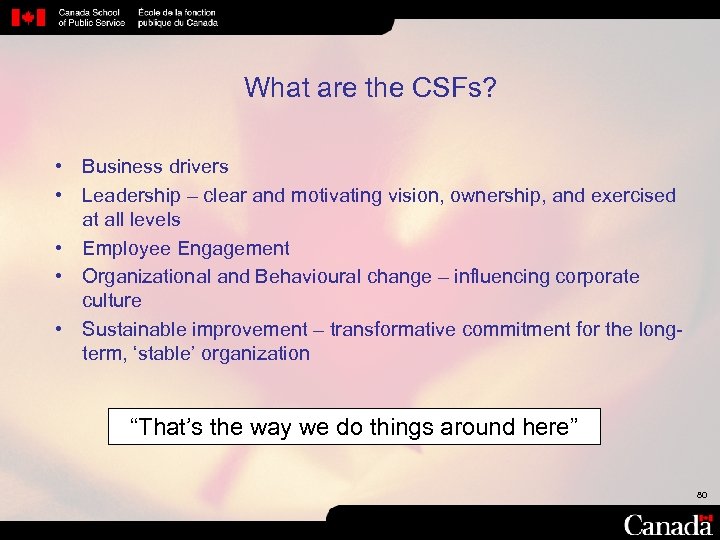
What are the CSFs? • Business drivers • Leadership – clear and motivating vision, ownership, and exercised at all levels • Employee Engagement • Organizational and Behavioural change – influencing corporate culture • Sustainable improvement – transformative commitment for the long term, ‘stable’ organization “That’s the way we do things around here” 80
“Don’ts” for Knowledge Management • Don’t treat KM as a project, a one off, an IT “solution”, or a pilot it’s part of the management discipline! • Don’t focus on KM; focus on the business needs and use KM as a means to help you manage your way there (only if needed) • Don’t underestimate the scope, timeframes and effort, depending upon your needs this is organizational change towards maturity as a knowledge intensive organization 81
Knowledge Retention/Transfer Knowledge Transfer => Pre-retirement knowledge capture (e. g. Office of the Commission of Official Languages, TBS, CPSA) APQC: Benchmarking Best-Practice Research Study • The best way to retain valuable knowledge in the face of attrition or downsizing is to build and sustain systemic knowledge management approaches. • To identify what knowledge was critical to capture, 89 percent of the partners had discussions with senior management and interviews with employees or subject matter experts. 82
Knowledge Retention/Transfer APQC • The most effective way to capture, retain, and transfer valuable knowledge is to embed that process into the work flow. • The study partners rely on communities of practice to embed and transfer organizational knowledge. Partners remarked that tacit knowledge-the most valuable and difficult knowledge to distil in any organization-is best retained through communities of practice and networks. • Cultural changes require understanding the impact of formal evaluation and performance, creating rewards and awards for teamwork, understanding the need for knowledge expositions and fairs (the creation of an innovation marketplace), and sharing stories that emphasize the desired knowledge-sharing behavior. • Most organizations use common basic tools, such as collaborative applications, data repositories, e-mail, and videoconferencing for knowledge retention. • Best-practice organizations typically have three critical elements in their knowledge management and retention support structures: senior management support, a central knowledge management support group, and the involvement of different business units or functions in the initiative. 83
Knowledge Retention/Transfer APQC • The reported costs for knowledge retention initiatives are less than knowledge management initiatives in APQC's prior studies, apparently due to the fact that best-practice organizations build on knowledge management tools and skills already in place and often build retention activities into the existing work flow. • The knowledge management groups at study partners often work closely with human resources teams to design and implement knowledge retention strategies, including hiring employees who will work effectively in a knowledgesharing environment. . • Partners and sponsors reported that the most effective methods to measure the success of knowledge transfer are conducting user surveys, tracking the number of knowledge objects accessed and used, tracking knowledge transfer activities, and capturing KM success meaningful stories. • Best-practice organizations demonstrate a link between knowledge management and organizational learning. 84
Knowledge Retention/Transfer Keys • What is the problem? • What needs to be done? • What can I do? • What can we do? 85
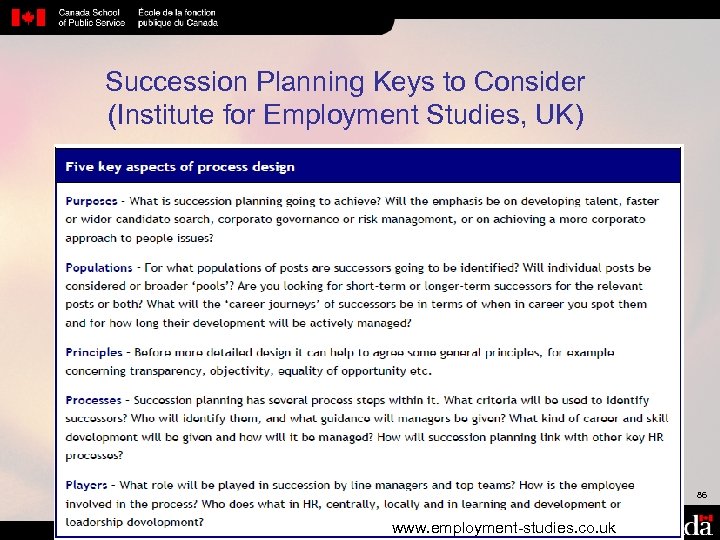
Succession Planning Keys to Consider (Institute for Employment Studies, UK) 86 www. employment studies. co. uk
Ten Practical Tips for Succession Planning (IES) 1. Engage with senior managers at the start 2. Focus on easily defined groups 3. Start with a fairly small population 4. Design in how information flows 5. Don’t go overboard on assessing potential 6. Ensure collective management agreement 7. Communicate 8. Tailor career development 9. HR leaders should take a serious role 10. Hang in there. 87 www. employment studies. co. uk
Agenda ü How does Knowledge Management apply to the Canadian public sector? ü How has Knowledge Management been applied across the Canadian public sector? ü Lessons Learned in applying KM • Where are we headed? 88
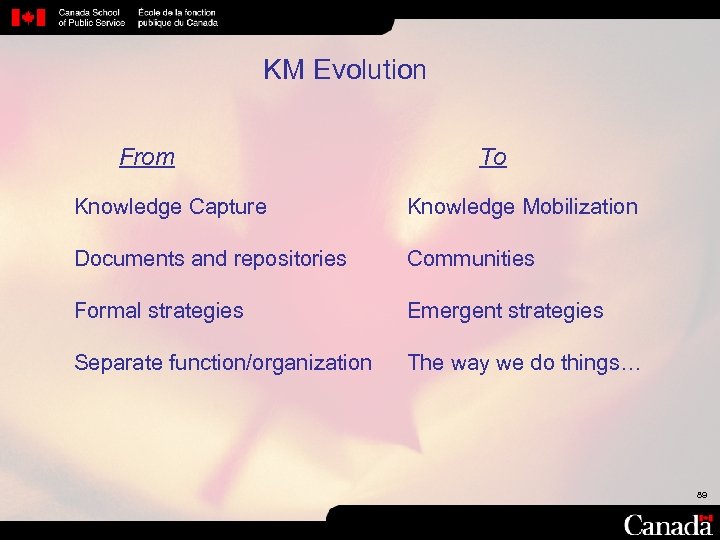
KM Evolution From To Knowledge Capture Knowledge Mobilization Documents and repositories Communities Formal strategies Emergent strategies Separate function/organization The way we do things… 89
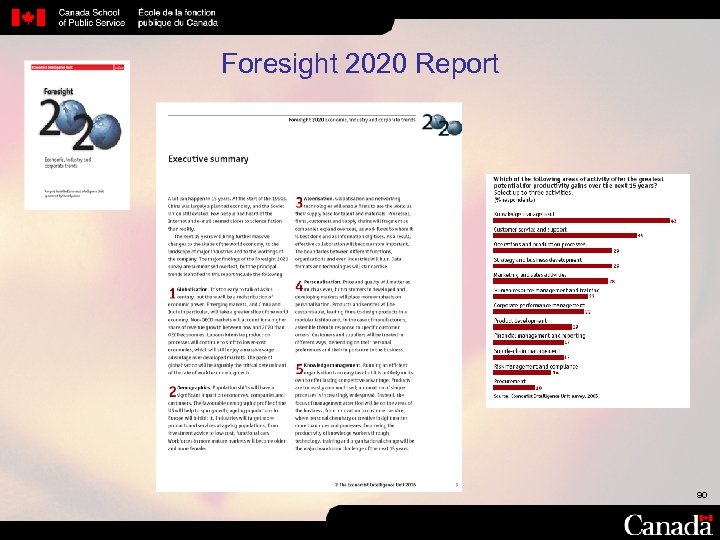
Foresight 2020 Report 90
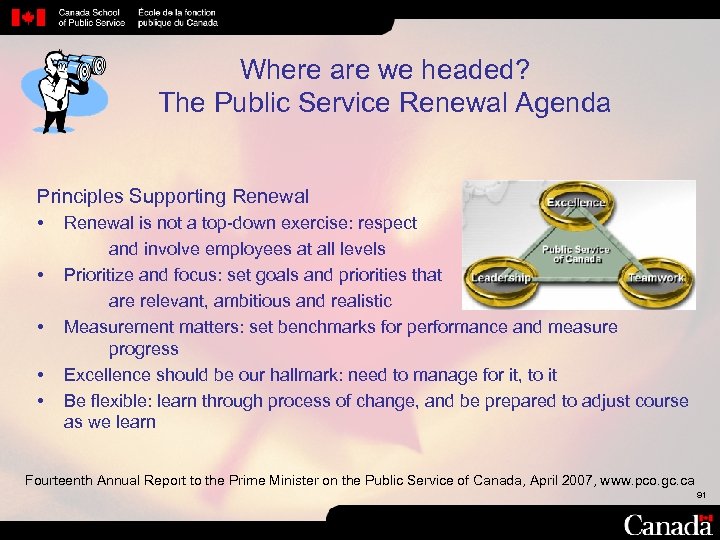
Where are we headed? The Public Service Renewal Agenda Principles Supporting Renewal • • • Renewal is not a top down exercise: respect and involve employees at all levels Prioritize and focus: set goals and priorities that are relevant, ambitious and realistic Measurement matters: set benchmarks for performance and measure progress Excellence should be our hallmark: need to manage for it, to it Be flexible: learn through process of change, and be prepared to adjust course as we learn Fourteenth Annual Report to the Prime Minister on the Public Service of Canada, April 2007, www. pco. gc. ca 91
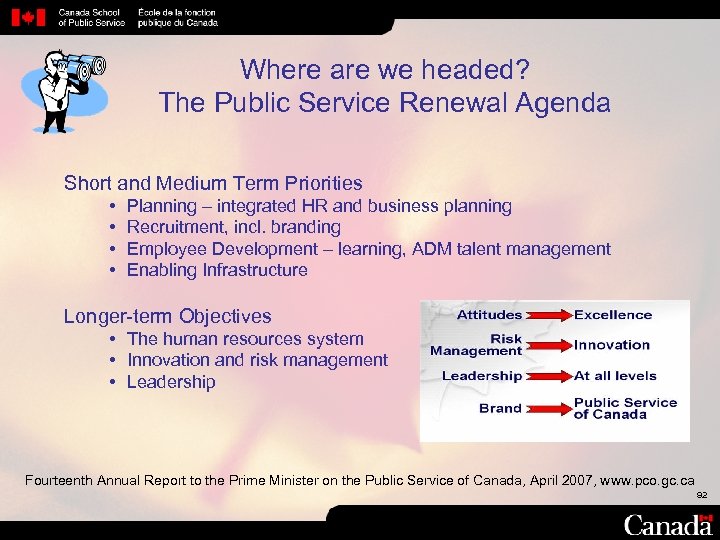
Where are we headed? The Public Service Renewal Agenda Short and Medium Term Priorities • • Planning – integrated HR and business planning Recruitment, incl. branding Employee Development – learning, ADM talent management Enabling Infrastructure Longer term Objectives • The human resources system • Innovation and risk management • Leadership Fourteenth Annual Report to the Prime Minister on the Public Service of Canada, April 2007, www. pco. gc. ca 92
Where are we headed? The Public Service Renewal Agenda “To be successful, our approach to renewal has to be targeted, pragmatic, and results oriented. We need to: rethink our recruitment model; the Public Service of Canada cannot be a passive recruiter of talent; rethink our development model; to manage for excellence and focus on leadership; rethink the jobs for life and one size fits all model; to encourage more interchanges with the private sector; more mid career and end of first career recruitment; and, rethink the public service brand; focus on excellence, unique careers and the opportunity to make a difference for your country. ” The Clerk of the Privy Council and Secretary to the Cabinet Mc. Master-Ottawa Alumni Fall Speaker Series, October 26, 2006 93
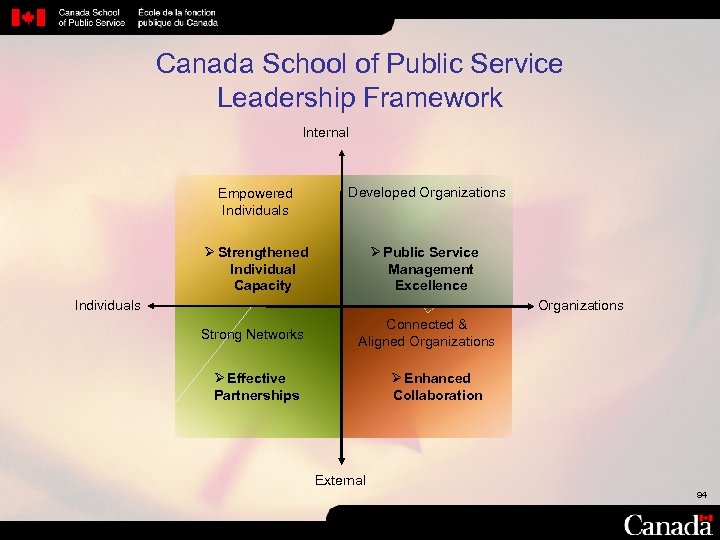
Canada School of Public Service Leadership Framework Internal Empowered Individuals Developed Organizations Ø Strengthened Individual Capacity Ø Public Service Management Excellence Individuals Organizations Strong Networks Connected & Aligned Organizations Ø Effective Partnerships Ø Enhanced Collaboration External 94
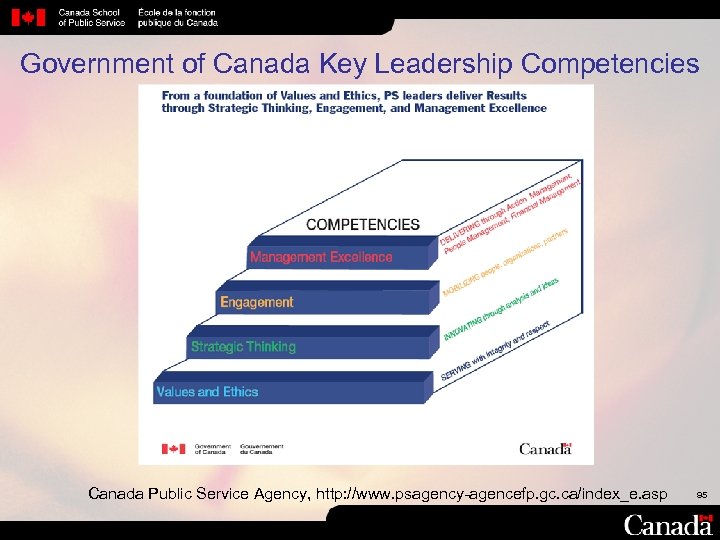
Government of Canada Key Leadership Competencies Canada Public Service Agency, http: //www. psagency agencefp. gc. ca/index_e. asp 95
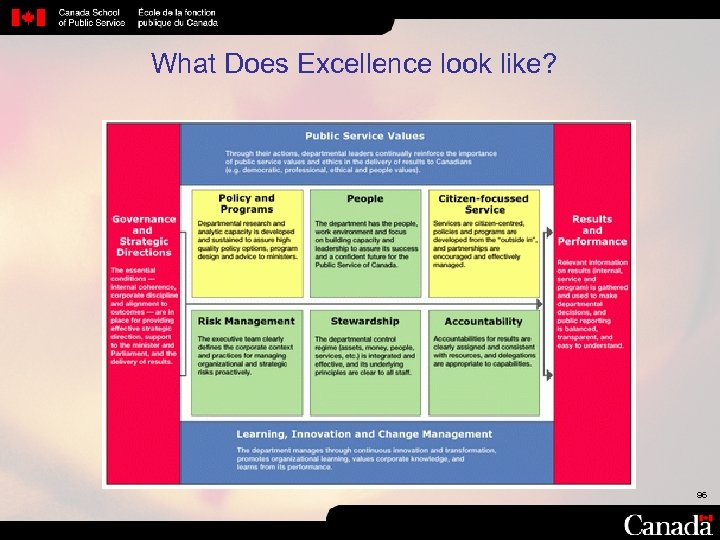
What Does Excellence look like? 96
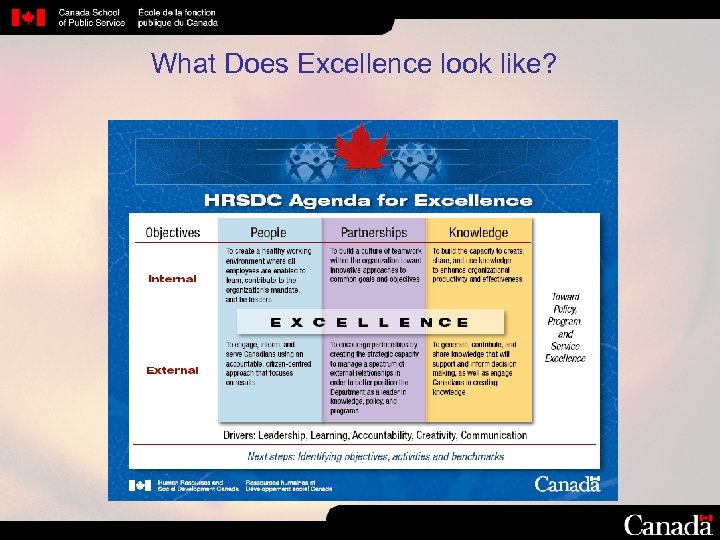
What Does Excellence look like?
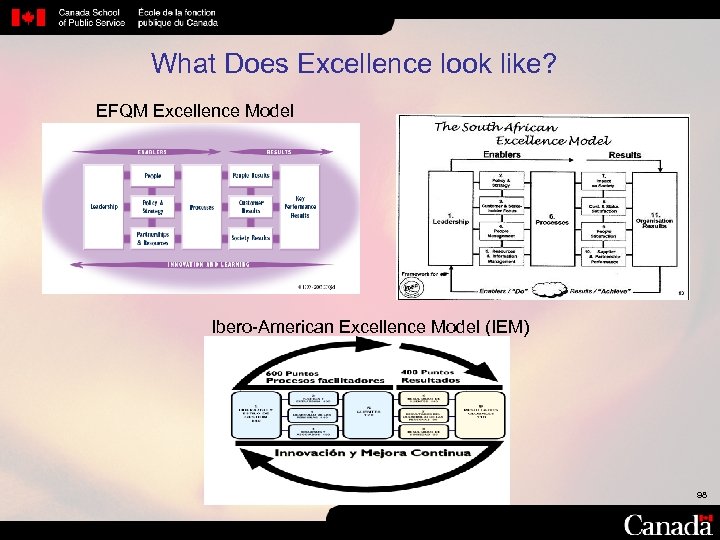
What Does Excellence look like? EFQM Excellence Model Ibero American Excellence Model (IEM) 98
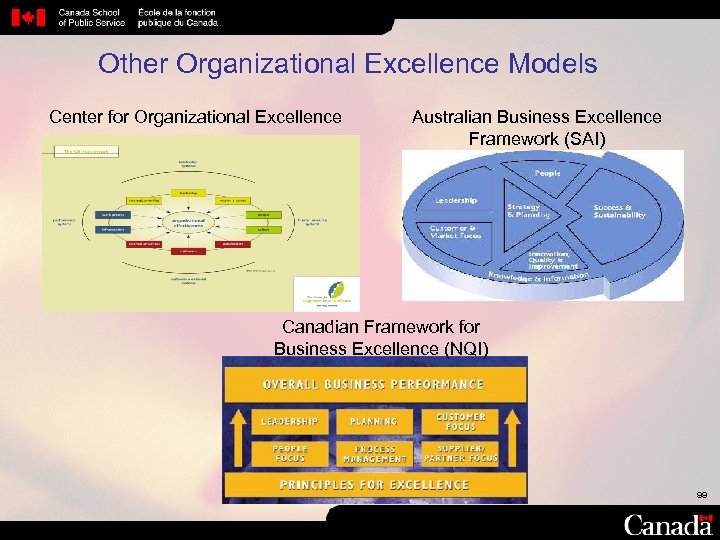
Other Organizational Excellence Models Center for Organizational Excellence Australian Business Excellence Framework (SAI) Canadian Framework for Business Excellence (NQI) 99
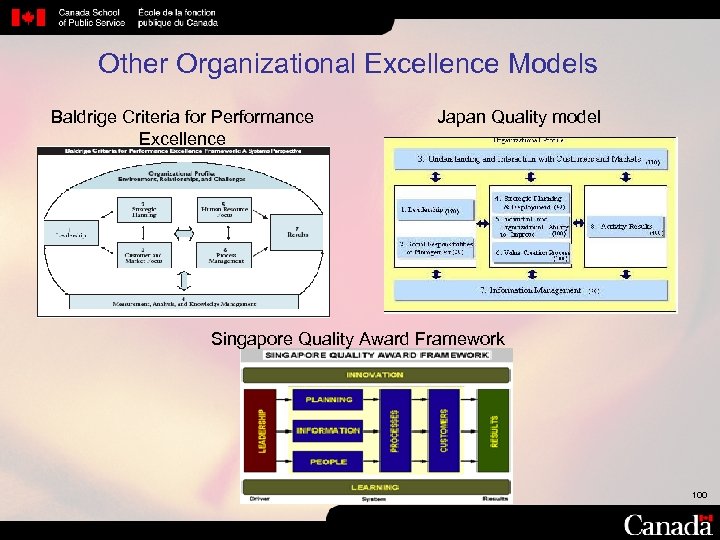
Other Organizational Excellence Models Baldrige Criteria for Performance Excellence Japan Quality model Singapore Quality Award Framework 100
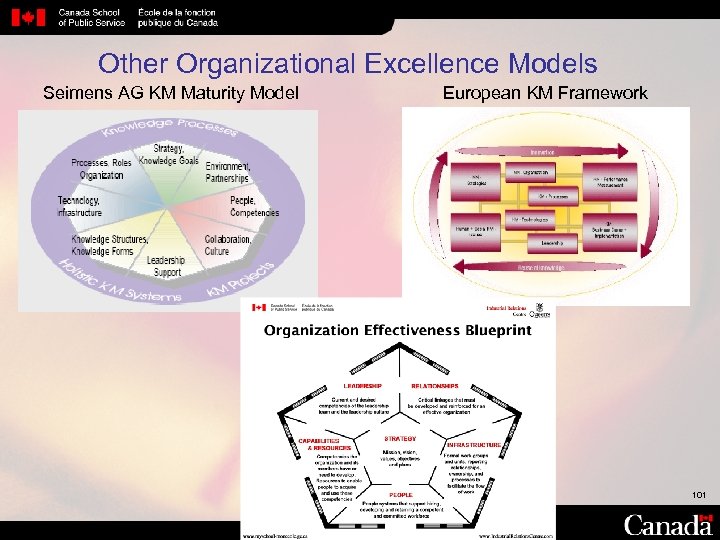
Other Organizational Excellence Models Seimens AG KM Maturity Model European KM Framework 101
Key Characteristics of Excellence Models • The models are integrative and holistic in nature The focus is on the organization as a whole (a ‘systems’ view) All components have a dynamic interplay in the strategic change approach to achieve results • Leadership is a key component The Leadership function is embedded and fostered at all levels Leadership development is as closely linked to operations as it is to strategy Leadership typically entails modern facilitative approaches vs control oriented doctrinal approaches • Knowledge and Learning are key enablers knowledge and the contribution of people as knowledge workers is essential for knowledge based results Knowledge Management is an enabling strategy for organizational excellence Organizational learning vs individual learning; formal and informal learning; blended learning; experiential learning; community learning; etc 102
“In the future, we won’t call it ‘Knowledge Management’, …” Gartner Group 103
“In the future, we won’t call it Knowledge Management, … …we’ll call it Management” Gartner Group 104
Paul Mc. Dowall Knowledge Management Advisor Canada School of Public Service 373 Sussex Drive, Ottawa, Ontario, K 1 N 6 Z 2, Canada 613 995 3705 Paul. mcdowall@csps efpc. gc. ca Interdepartmental Knowledge Management Forum: www. groups. yahoo. com/group/ikmf_figs 105
Скачать презентацию Knowledge Management in the Public Sector April 2009
90b751310d91d1e63f22144f3cb32737.ppt