


 Скачать презентацию Knowledge management in mental health services the role
e65f1ba09acdb4aa11eaf7f86f343e1f.ppt
- Количество слайдов: 51
 Knowledge management in mental health services: the role of NHS libraries Catherine Ebenezer CISPB September 13 th 2002
 What is KM? A re-working /re-thinking of familiar concepts: Information management The “learning organisation” “info-mapping” Resourced-based theories of the organisation etc. § § (Corrall 1999)
 The roots of KM Japanese management philosophies: § § § Total Quality Management (TQM) Kaizen Just in Time all rely on § Sharing of tacit and explicit knowledge § Teamworking § Management of change § Exploitation of knowledge as a capital asset Keeling, Carole and Lambert, Siân (2000)
 Definitions of KM (1) “KM is a strategy employed by an organisation wherein its collective information resources, acquired knowledge and personal talents are shared and managed in order to increase productivity, create new knowledge and new value, and improve competitiveness” (Lindsey-King 1998)
 Definitions of KM (2) • “Knowledge management involves efficiently connecting those who need to know, and converting personal knowledge into organisational knowledge” (Godbolt 2002, after Yankee Group 2000)
 Definitions of KM (3) “Knowledge management is the task of developing and exploiting an organisation’s tangible and intangible knowledge assets” (DH 2001)
 …but… “People who define knowledge management are charlatans and carpetbaggers” David Snowden, IBM Global Services
 Aspects of knowledge (1) § § Data Information Knowledge Wisdom …with apologies to T S Eliot
 Aspects of knowledge (2) § Explicit § what we may “know about” via an articulated and recorded “body of knowledge” § Tacit/implicit § acquired through personal learning and experience § reflected in an individual’s capacity for action § could be articulated – but usually isn’t
 Aspects of knowledge (3) § Knowledge as individual or social construct § The organisational environment in which people are encouraged to learn and to share knowledge § Aspects of organisational “intelligence” that are amenable to planning and management processes (Streatfield and Wilson 1999)
 A caveat § KM concept often associated particularly with the adoption of automated methods for capturing information and making it accessible BUT – need to understand: § representation and organisation of knowledge § behaviour of information users KM is not solely about IM&T § (Perez 1999)
 Aspects of KM (1) § Content § Infrastructure § Skills § Culture (Haines 2001)
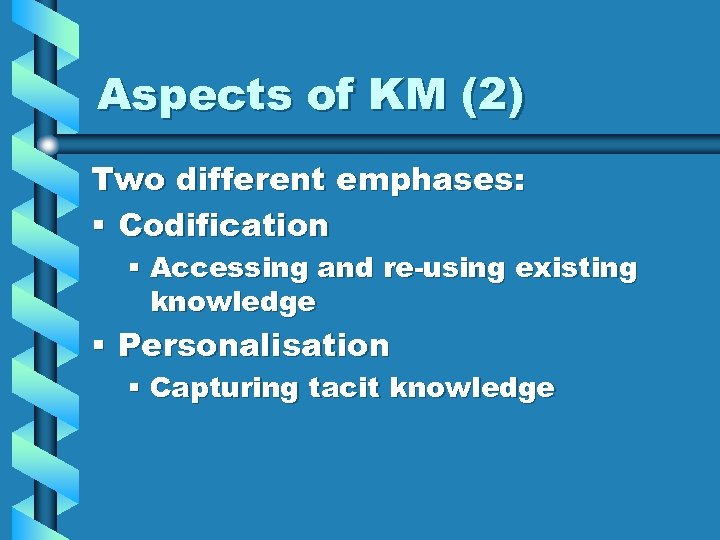 Aspects of KM (2) Two different emphases: § Codification § Accessing and re-using existing knowledge § Personalisation § Capturing tacit knowledge
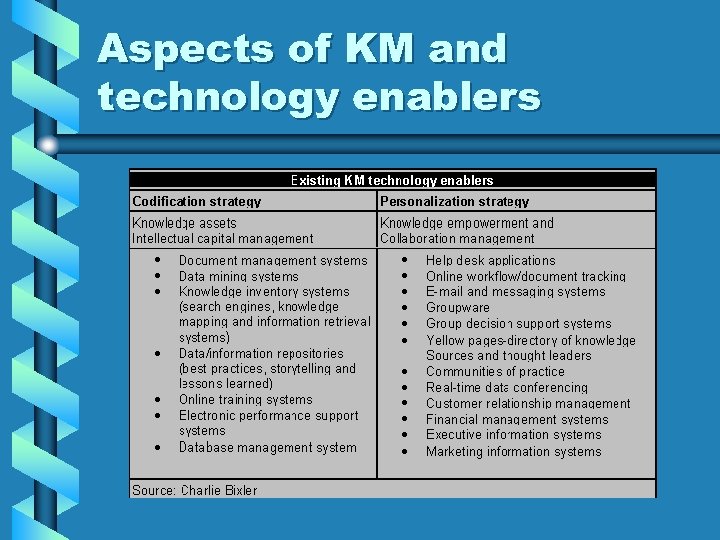 Aspects of KM and technology enablers
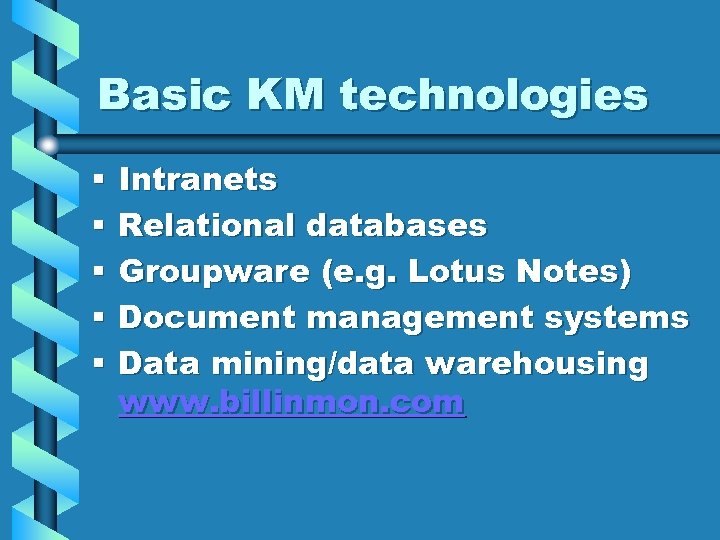 Basic KM technologies § § § Intranets Relational databases Groupware (e. g. Lotus Notes) Document management systems Data mining/data warehousing www. billinmon. com
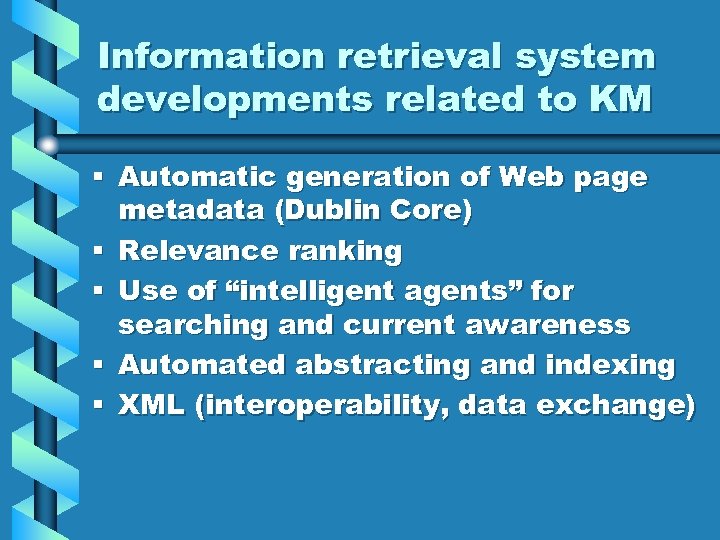 Information retrieval system developments related to KM § Automatic generation of Web page metadata (Dublin Core) § Relevance ranking § Use of “intelligent agents” for searching and current awareness § Automated abstracting and indexing § XML (interoperability, data exchange)
 Cf. the (traditional) role of the information professional § Acquiring and organising information § Making it available for use § Disseminating it § Disposing of it “Librarians have always been knowledge managers” (Lindsey-King 1998)
 N. B. the information worker’s (tacit) knowledge… § The organisational context of a practitioner’s work § The patient population § What type of information would be relevant § How the practitioner works § How the information would be used (Fennessy 2001)
 NHS “knowledge paradox” § Richness in content/poverty in infrastructure Ne. LH, guidelines output cf. access to NHSnet § Richness in skills programmes/poverty of KM culture ECDL, CASP cf. lack of organisational development or HR policies to encourage knowledge sharing (after Haines 2001)
 The “bad old days” (1) Locating an answer to a clinical question required: § A visit in person to the library § A literature search using library facilities § Locating articles/books within the stacks § Placing an ILL request if the items not available locally
 The “bad old days” (2) Major disadvantages: § Involved time away from the clinical area § A poor use of a busy clinician’s time
 Mooer’s law “An information retrieval system will tend not to be used whenever it is more painful and troublesome for clients to retrieve the information than to live without it”
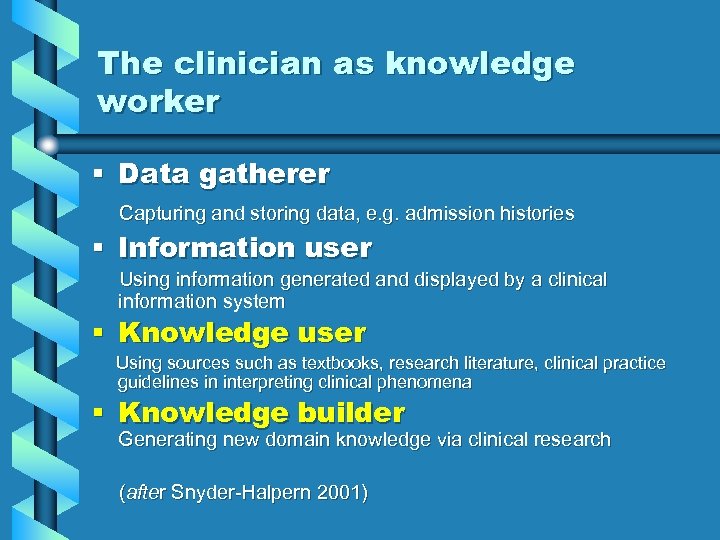 The clinician as knowledge worker § Data gatherer Capturing and storing data, e. g. admission histories § Information user Using information generated and displayed by a clinical information system § Knowledge user Using sources such as textbooks, research literature, clinical practice guidelines in interpreting clinical phenomena § Knowledge builder Generating new domain knowledge via clinical research (after Snyder-Halpern 2001)
 Factors involved in seeking answers to clinical questions § § § “Cost” factors (see previous) Urgency of a patient’s problem Expectation that an answer exists § KM skills literature searching critical appraisal bibliographic management -- a major issue
 The national policy context §A First Class Service 1997 ØClinical governance concept §Information for Health 1998 ØNe. LH and VBLs §Building the Information Core 2001 Ø IM&T implications of NHS Plan §HSG(97)47 guidance on library services §Mental Health NSF
 Role of KM in EBP As knowledge users, clinicians and managers have questions about: § What is best practice? § Is it effective? § How do interventions compare in terms of their relative effectiveness?
 Wider KM initiatives in health care: (1) Many related to EBP, e. g. § Specialised bibliographic databases § § § Drug. Scope, Health. Promis Systematic reviews Secondary EBM literature Effective Health Care, evidence bulletins e. g. Bandolier, abstracting journals e. g. EBMH TRIP guidelines database www. tripdatabase. org. uk Clinical trials databases Research gateways e. g. TRIAGE
 Wider KM initiatives in health care: (2) § Centre for Evidence-Based Mental Health – gateway to evidence-based mental health resources www. psychiatry. ox. ac. uk/cebmh/ § Critically Appraised Topics: CATbank www. jr 2. ox. ac. uk/cebm/docs/catbank. html § Info. POEMS clinical awareness system www. infopoems. com/index. cfm § DIPEX patient experiences database www. dipex. org/ § CLIP: database of clinical effectiveness initiatives etc…. .
 Priorities for information system and service development…. § locate decision support tools as near as possible to the clinical decision maker, so as to reduce the perceived resource costs § provide reliable, high-quality information resources that are userfriendly and convenient § integrate information resources with clinical information systems
 The National electronic Library for Health (Ne. LH) § Knowledge § Know-how ØExplicit ØTacit Cochrane Library etc. Clinical guidelines (development process) § Knowledge management www. nelh. nhs. uk
 The National electronic Library for Health (Ne. LH) § Main Ne. LH to integrate with local intranet content § Virtual Branch Libraries (VBLs) e. g. Ne. LMH, Ne. LLD, Ne. LKM § Professional portals for PAMs and librarians now available -- Link to and support (not replace) existing NHS libraries
 Ne. LH developments 1999 -2003 § Integrating knowledge resources at the point of care § Access to answers to questions at the point of care from with the EHR/EPR www. nhsia. nhs. uk/nelh/ § National Knowledge Service Further integration of Ne. LH and nationally purchased information resources with NHS libraries
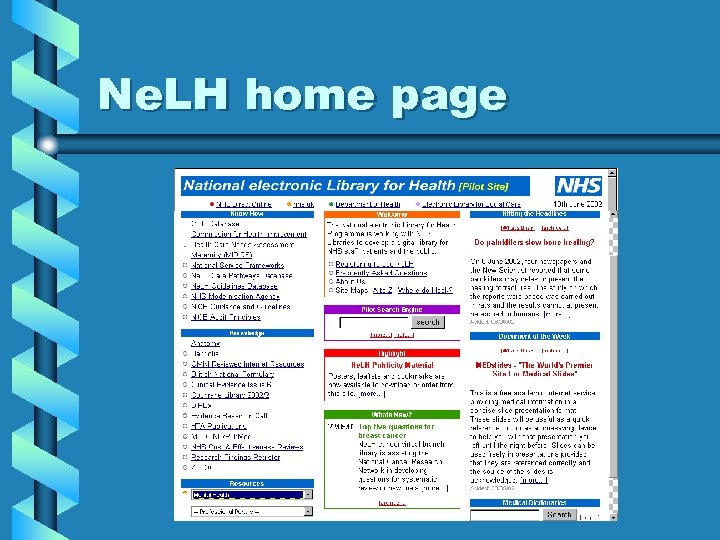 Ne. LH home page
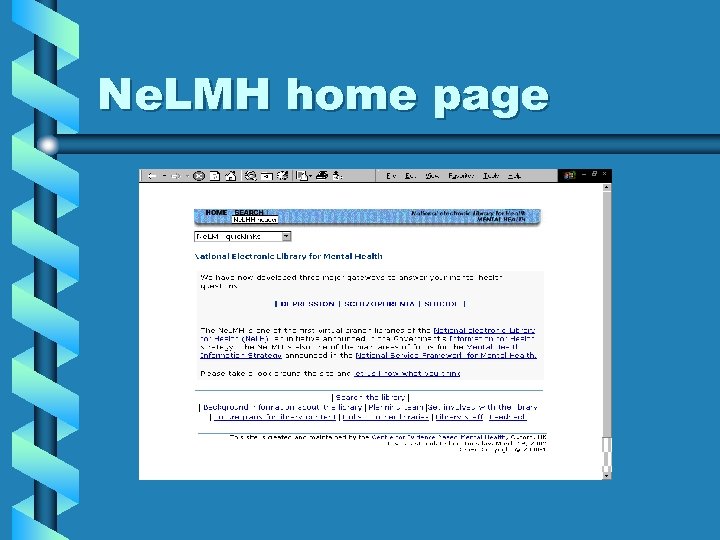 Ne. LMH home page
 Maximising access to explicit knowledge: the clinical intranet § Organisational information generated locally – “corporate memory” Ø directories (e. g. services, courses) Ø databases ( e. g. vacancies) Ø documents (e. g. newsletters, policies, protocols) Ø other systems (e. g. IT helpdesk) § Training delivery generated nationally or internationally Ø Virtual Learning Centre
 The clinical intranet: cont’d §“Soft” clinical information generated locally, nationally, internationally ØBibliographic databases Pub. Med, Cochrane Library etc. ØOther research evidence BMJ Clinical Evidence, Bandolier etc. ØClinical databases e. g. OMIM ØReference sources e. g. e. BNF ØClinical guidelines e. g. TRIP ØCare pathways ØPatient information leaflets
 The clinical intranet: cont’d § “Hard” clinical information: computerised patient record generated locally Clinical intranet provides seamless access e. g Oxford Clinical Intranet CCS soon to be available via SLAM intranet
 The clinical intranet: future developments? § How can clinical intranets provide context-sensitive linking to external information sources? § How useful are decision support systems (DSS)? ?
 Using and harvesting implicit knowledge § Promoting collaborative working in project teams using networked applications Ø groupware Ø bibliographic management systems § Fostering professional networks via communication facilities Ø web logs (“blogs”) Ø mailing lists/listservs Ø discussion boards Ø newsgroups § Auditing skills/building expertise databases (after Lacey Bryant 2001, Corrall 1999)
 Roles of the librarian in supporting EBP § Evidence locator § Educator § Disseminator § Critical appraiser § Resource provider § Quality filter After Booth (2000)
 Common health library KM activities: (1) Information services need to act as intermediaries between health practitioners and the knowledge available § Working to improve networked access to the knowledge base, e. g. by building web/intranet sites § Information skills training/outreach: locating and using clinical evidence --access to knowledge does not change clinician behaviour by itself § Compiling lists of/guides to resources § Providing current awareness services
 Common health library KM activities: (2) Reay House library intranet pages include: Web subject guides Lists of freely-accessible Web databases Presentations on health information topics Links to full text electronic journals and books § Advice on sources of research information, critical appraisal, PDA use, pay-per-use document supply etc. § Networked access to indexing/abstracting services (proposed) e. g. HMIC, EMBASE § §
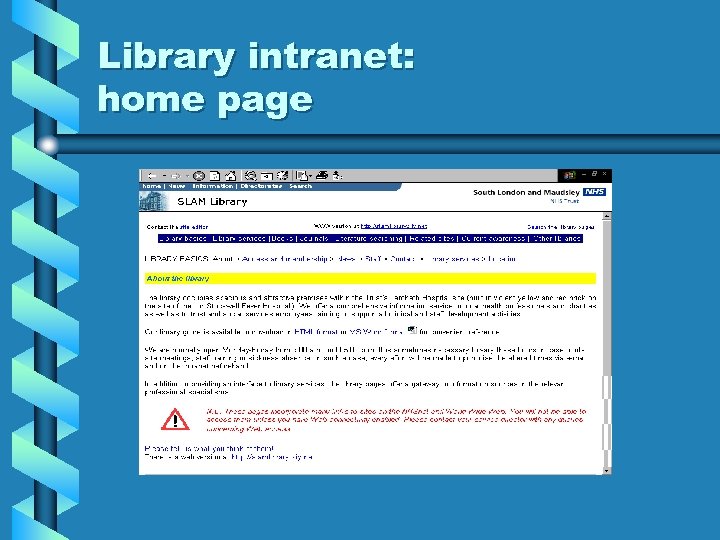 Library intranet: home page
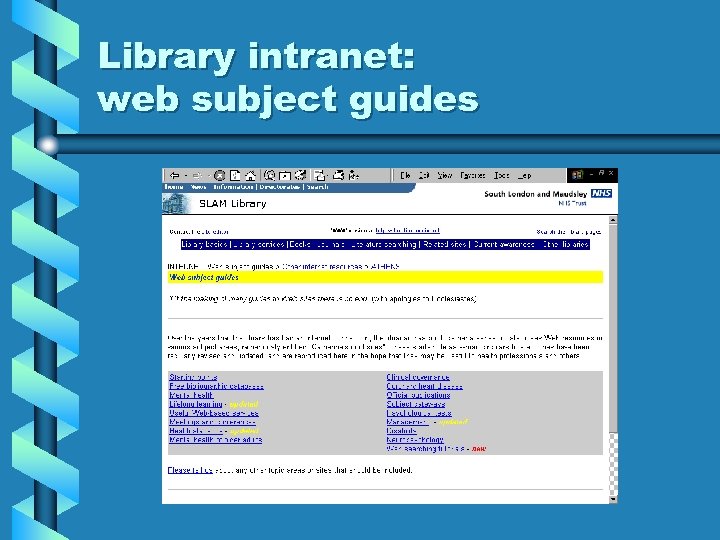 Library intranet: web subject guides
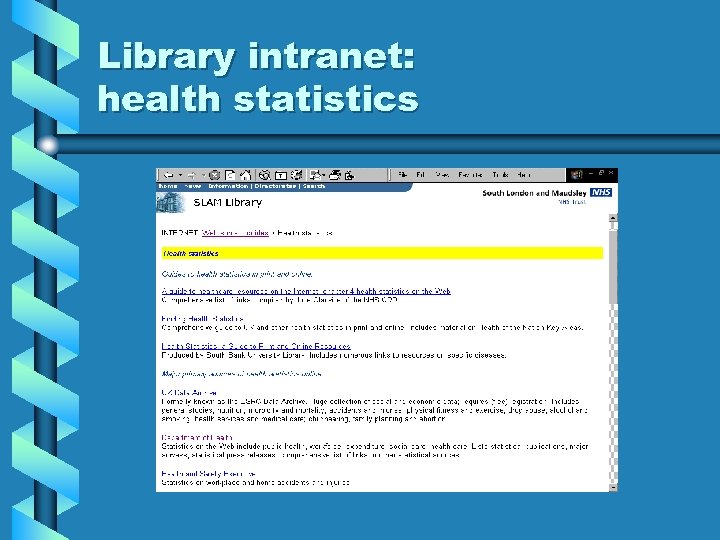 Library intranet: health statistics
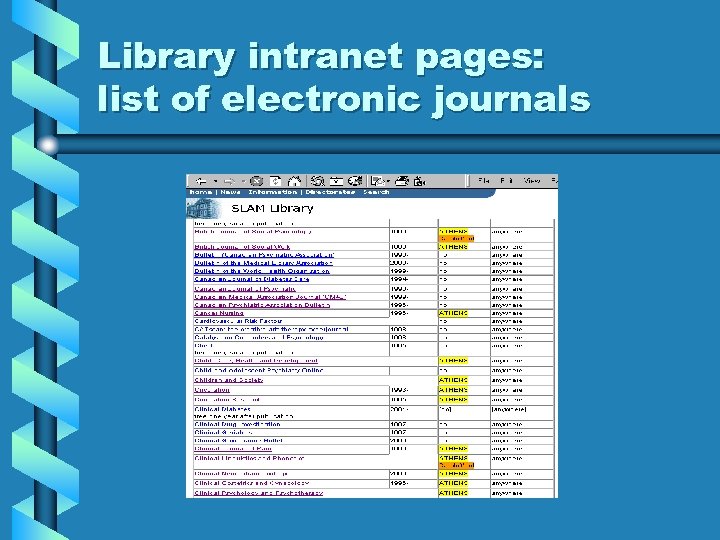 Library intranet pages: list of electronic journals
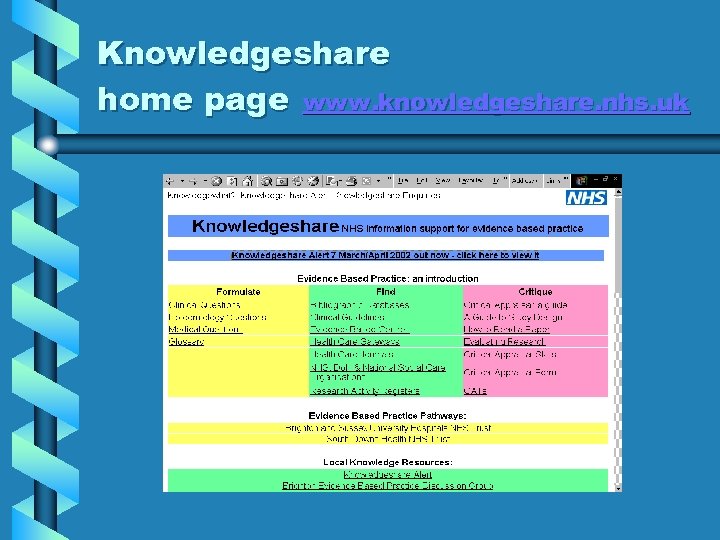 Knowledgeshare home page www. knowledgeshare. nhs. uk
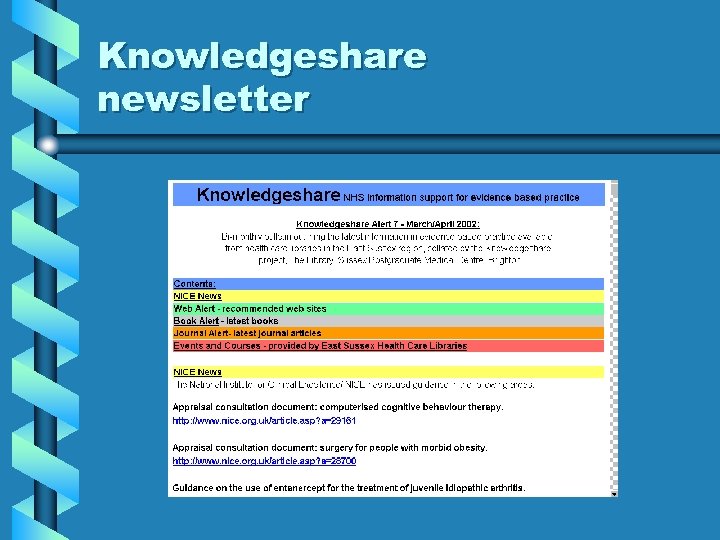 Knowledgeshare newsletter
 References Berkman, Eric. (2001) When bad things happen to good ideas. Darwin Online, April. At http: //www. darwinmag. com/ Bixler, Charlie. KM in ever-changing times. Application Development Trends October 2001. At http: //www. adtmag. com Corrall, Sheila (1999). Are we in the knowledge management business? Ariadne 18. At www. ariadne. ac. uk/issue 18/ Fennessy, Gabby (2001). Knowledge management in evidence-based healthcare: issues raised when specialist information services search for the evidence. Health Informatics Journal 7 4 -7 Godbolt, Shane (2002) Knowledge management: a practical approach. Presentation given at Research, Evidence and Knowledge in Health conference February 2002. At http: //www. londonlinks. ac. uk/
 References (cont’d. ) Graeber, Stefan and Geib, Dieter. Clinical workstations supporting evidence based medicine. In Hasman, A ed. Medical Infobahn for Europe. IOS 2000; pp. 14 -17. Haines, Maggie (2001) Knowledge management in the NHS – platform for change. Presentation given at NHSIA conference, Birmingham, 26/11/01. At http: //www. nhsia. nhs. uk Keeling, Carole and Lambert, Siân (2000). Knowledge management in the NHS: positioning the healthcare librarian at the knowledge intersection. Health Libraries Review 17 136 -143 Lacey Bryant, Sue (2001) Putting the knowledge base to work. Clinical Governance Bulletin 2(5) 14 -15) Lindsey-King, Cathy. Knowledge management: your link to the future. Bibliotheca Medica Canadiana 20(2) 74 -75
 References (cont’d. ) Perez, Ernest (1999). Knowledge management in the library – not. Database 22(2) 75 f. Shortliffe, Edward H (1999). The evolution of electronic medical records. Academic Medicine 74(4) 414 -419 Streatfield, David and Wilson, Tom (1999). Deconstructing ‘knowledge management’. Aslib Proceedings 51(3) 67 -71 Snyder-Halpern, Rita et al. (2001) Developing clinical practice environments supporting the knowledge work of nurses. Computers in Nursing 19(1) 17 -26