


 Скачать презентацию Knowledge Management and Innovation The Transformation of 21
b87294a585607739fedd94e6d45e40c5.ppt
- Количество слайдов: 18
 Knowledge Management and Innovation: The Transformation of 21 st Century Library Services Librarians? Or Knowledge Services Professionals? Changing Trends in the Profession Nerisa Kamar (Lead Presenter) KM/Knowledge Services Consultant for Sub-Sahara Africa SMR International, Nairobi Kenya Guy St. Clair President and Founder SMR International, New York NY IFLA WLIC Cape Town, Republic of South Africa 14 August, 2015
 Introduction The role of libraries has notably shifted from what is generally thought of as “traditional library services” (that is, reactive service delivery) to the current proactive and – in many cases – interactive or integrated library service delivery status, as in the popular “embedded” library and research services in many organizations with specialized libraries.
 What is Knowledge Management (KM)? • KM is the systematic management of an organization's knowledge assets for the purpose of: – creating value – meeting tactical & strategic requirements. • It consists of the initiatives, processes, strategies, and systems that sustain and enhance the storage, assessment, sharing, refinement, and creation of knowledge. • KM therefore implies a strong tie to organizational goals and strategy, and it involves the management of knowledge that is useful for some purpose and which creates value for the organization. 3
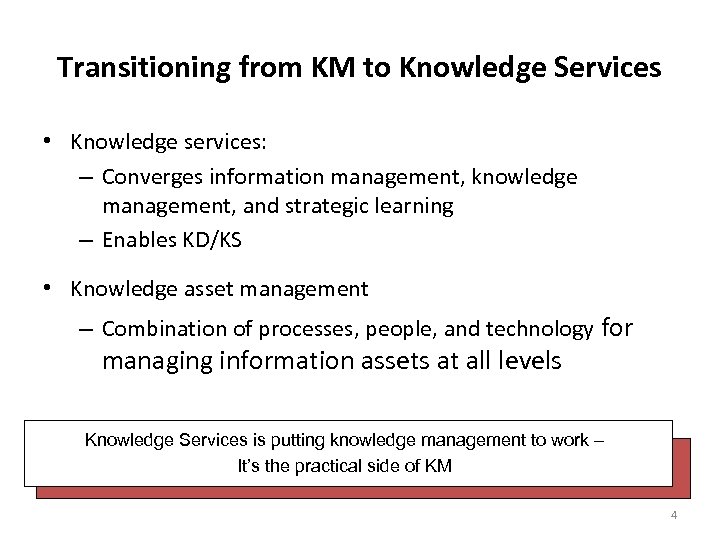 Transitioning from KM to Knowledge Services • Knowledge services: – Converges information management, knowledge management, and strategic learning – Enables KD/KS • Knowledge asset management – Combination of processes, people, and technology for managing information assets at all levels Knowledge Services is putting knowledge management to work – It’s the practical side of KM 4
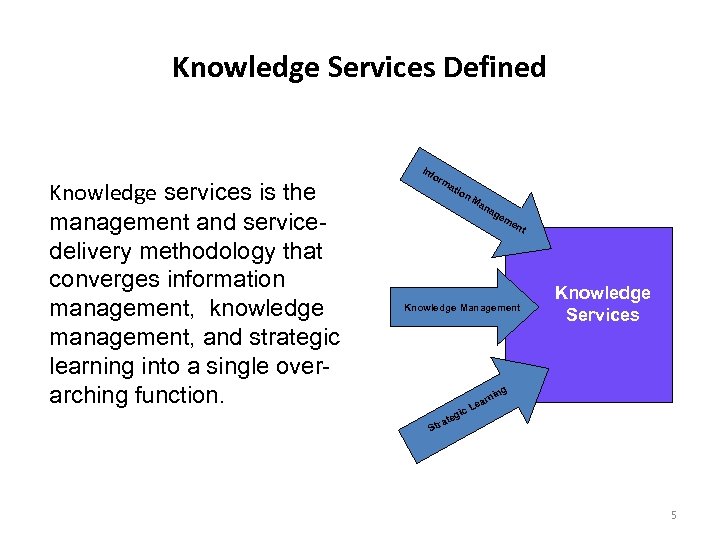 Knowledge Services Defined Knowledge services is the management and servicedelivery methodology that converges information management, knowledge management, and strategic learning into a single overarching function. Inf or ma tio n. M an ag em e nt Knowledge Management Knowledge Services ing ic eg rat rn ea L St 5
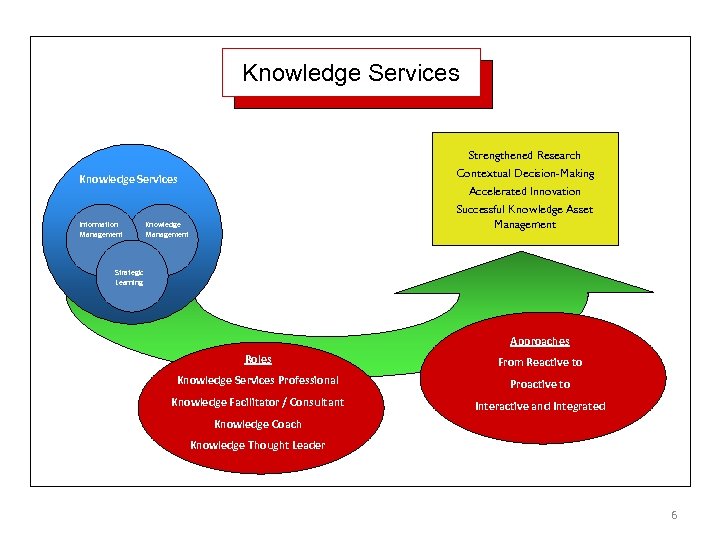 Knowledge Services Strengthened Research Contextual Decision-Making Knowledge Services Information Management Accelerated Innovation Successful Knowledge Asset Management Knowledge Management Strategic Learning Approaches Roles From Reactive to Knowledge Services Professional Proactive to Knowledge Facilitator / Consultant Interactive and Integrated Knowledge Coach Knowledge Thought Leader 6
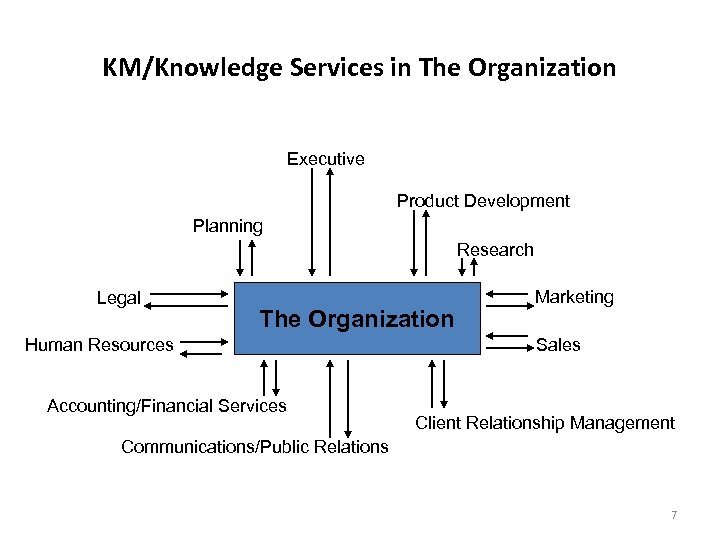 KM/Knowledge Services in The Organization Executive Product Development Planning Research Legal The Organization Human Resources Accounting/Financial Services Marketing Sales Client Relationship Management Communications/Public Relations 7
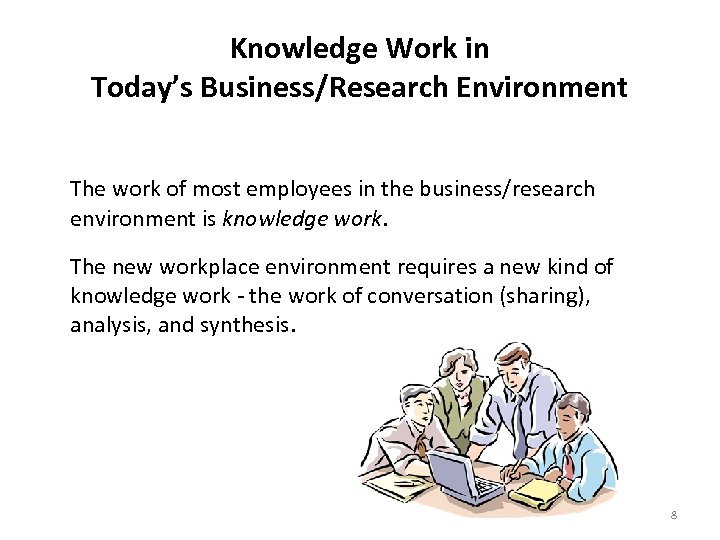 Knowledge Work in Today’s Business/Research Environment The work of most employees in the business/research environment is knowledge work. The new workplace environment requires a new kind of knowledge work - the work of conversation (sharing), analysis, and synthesis. 8
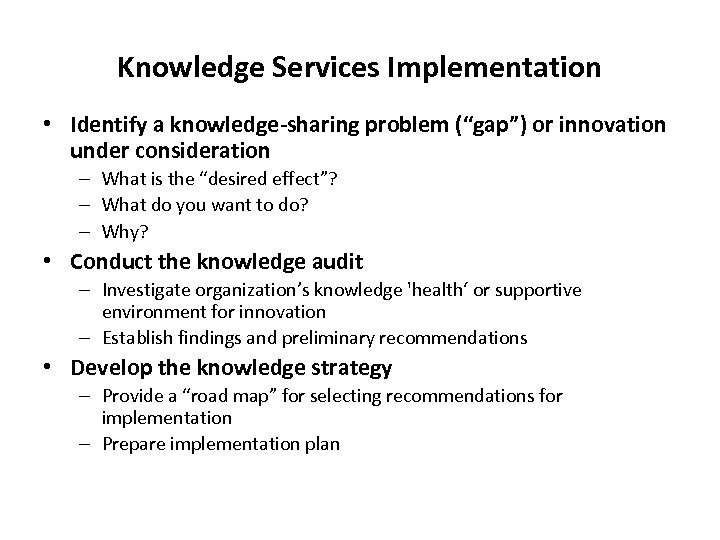 Knowledge Services Implementation • Identify a knowledge-sharing problem (“gap”) or innovation under consideration – What is the “desired effect”? – What do you want to do? – Why? • Conduct the knowledge audit – Investigate organization’s knowledge 'health‘ or supportive environment for innovation – Establish findings and preliminary recommendations • Develop the knowledge strategy – Provide a “road map” for selecting recommendations for implementation – Prepare implementation plan
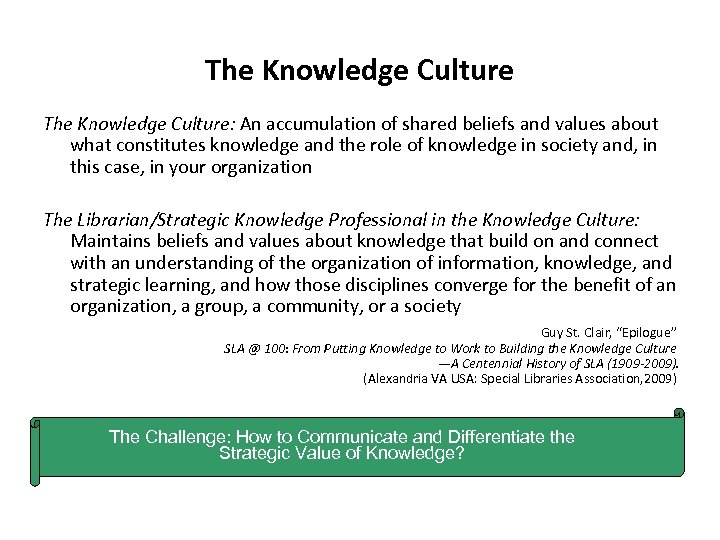 The Knowledge Culture: An accumulation of shared beliefs and values about what constitutes knowledge and the role of knowledge in society and, in this case, in your organization The Librarian/Strategic Knowledge Professional in the Knowledge Culture: Maintains beliefs and values about knowledge that build on and connect with an understanding of the organization of information, knowledge, and strategic learning, and how those disciplines converge for the benefit of an organization, a group, a community, or a society Guy St. Clair, “Epilogue” SLA @ 100: From Putting Knowledge to Work to Building the Knowledge Culture —A Centennial History of SLA (1909 -2009). (Alexandria VA USA: Special Libraries Association, 2009) The Challenge: How to is Achieved Through the Development, Organizational Success. Communicate and Differentiate the Strategic Value of Knowledge? Implementation, and Utilization of a Knowledge Culture.
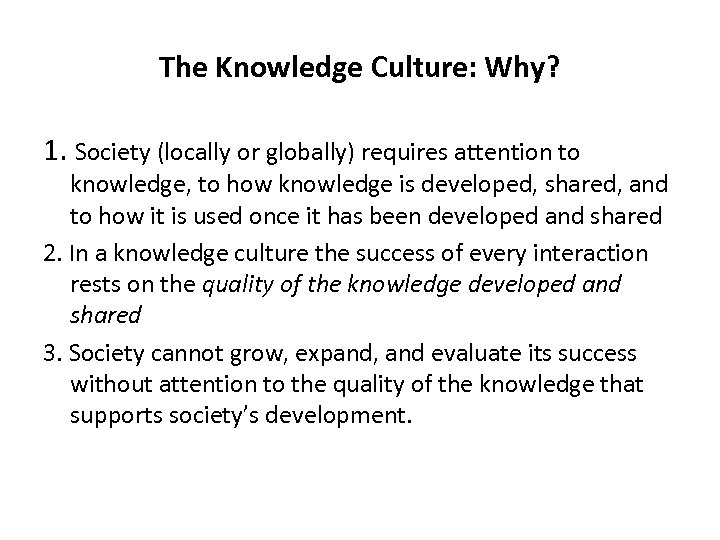 The Knowledge Culture: Why? 1. Society (locally or globally) requires attention to knowledge, to how knowledge is developed, shared, and to how it is used once it has been developed and shared 2. In a knowledge culture the success of every interaction rests on the quality of the knowledge developed and shared 3. Society cannot grow, expand, and evaluate its success without attention to the quality of the knowledge that supports society’s development.
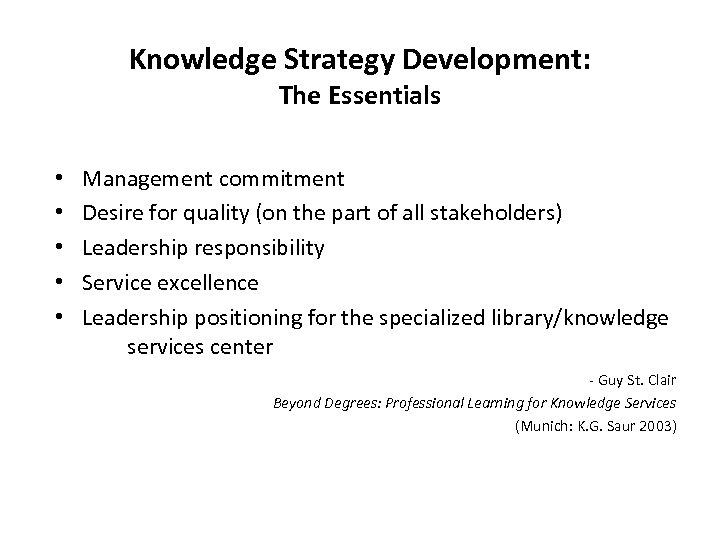 Knowledge Strategy Development: The Essentials • • • Management commitment Desire for quality (on the part of all stakeholders) Leadership responsibility Service excellence Leadership positioning for the specialized library/knowledge services center - Guy St. Clair Beyond Degrees: Professional Learning for Knowledge Services (Munich: K. G. Saur 2003)
 Library webpages mash ups • Mashup is a web application that uses content from more than one source to create a single new service, displayed in a single graphical interface. • Mashable bodies of knowledge creates a unique opportunity to embrace openness, develop methods, standards and tools to enhance towards an open universe of knowledge and knowledge sharing. • popular types of mashups Google Maps (maps. google. com)
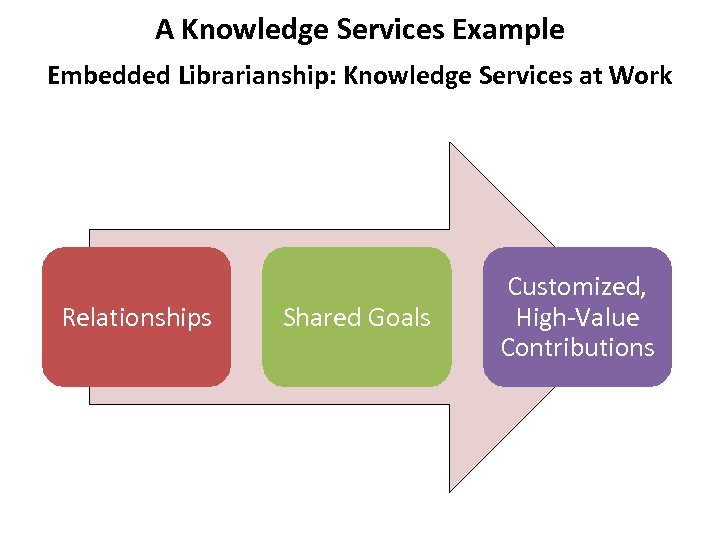 A Knowledge Services Example Embedded Librarianship: Knowledge Services at Work Relationships Shared Goals Customized, High-Value Contributions
 Literacy curriculum development & delivery • Information literacy provides a foundation for life-long learning. • Develop and deliver the learning support strategies which will be significant culture change agents in an organization. • leads to increased communication, improved services and the cooperative leveraging of knowledge/information resources in an organization. • pedagogical guides to facilitate the successful delivery of information literacy content in organizations.
 Development of institutional repositories • The Institutional Repository (IR) is an information system whose initiatives capture, preserve, and make digitally accessible the intellectual & scientific output • To sustain-requires embedment of IR in the institutional knowledge management culture. • Need - embed standard operating procedures and policies, practices, rules, to knowledge databases in the form of best practices. • This knowledge can then be used as repositories of the shared, organization wide “structural intellectual capital” (Stewart, 1997).
 Knowledge Services as Catalyst: Creating Knowledge Value in the Organization “Knowledge services is about Knowledge Catalysis, the creation of knowledge value through knowledge development, knowledge sharing, and knowledge utilization (KD/KS/KU)— finding and leveraging opportunities to produce strengthened research, contextual decision-making, accelerated innovation and successful knowledge asset management. ” Dale Stanley Senior Consultant and Marketing and Operations Manager SMR International New York NY USA
 Conclusion • In the 21 st century, librarians, information professionals, and strategic knowledge professionals function in a workplace environment that is vastly different from that of previous generations • The workplace (and society at large) require attention and leadership in strengthening knowledge sharing • Practitioners in librarianship are the “natural” professionals for leading the way to the knowledge culture.