


 Скачать презентацию Knowledge Economy Forum VI 17 April 2007 The
6466b392597346b6337b3b3dbcb9d9a0.ppt
- Количество слайдов: 18

 Knowledge Economy Forum VI 17 April 2007 The Role of Government in Building Absorptive Capacity Ken Warwick DTI
 Ken Warwick Knowledge Economy Forum VI What is absorptive capacity? • The capacity to acquire, understand, develop and exchange knowledge from external sources (competitors, collaborators, customers, public research base) • Concept relevant to both individual businesses/organisations and to regions/nations.
 Ken Warwick Knowledge Economy Forum VI How do we measure absorptive capacity? • Firm level: – Technological capability (R&D, people) – Engagement with external knowledge sources (e. g. Higher Education, metrology system, networks) • Regional/national level: – Business R&D • Researchers – Highly skilled labour • Employment of S&T graduates – Degree of interaction between business and external knowledge sources • • Knowledge sourcing Depth and scale of networks
 Ken Warwick Knowledge Economy Forum VI Measures show considerable variation even within developed economies • We will insert couple of charts for OECD/EU, perhaps researchers and CIS data on collaboration with HEIs
 Ken Warwick Knowledge Economy Forum VI What is the role of Government? • Create the conditions for businesses to succeed (e. g. macro stability, consistent competition policies) • Invest in knowledge creation and innovation infrastructure (e. g. funding of education and research system, measurement system, IP agencies, standard setting) • Targeted interventions to address incentive, information, co-ordination failures
 Ken Warwick Knowledge Economy Forum VI Rationale for Government's role • Increasing integration of international economy presents challenges and opportunities for all businesses • Considerable amount of analysis across Whitehall on the drivers and impacts of globalisation on the UK economy • Primary role for government in setting framework conditions within which businesses themselves can respond • Key policy challenge to ensure government also provides the right kinds of support
 Ken Warwick Knowledge Economy Forum VI Economic evidence - trade • Entry into exporting gives firms a step productivity boost – average 34%; e. g. learning from overseas customers, exposure to new ideas, technologies, up-grading approach • Trade and inward investment can give rise to beneficial knowledge spillovers • Importance of networks and reputation effects – Difficulties in gaining access to key knowledge networks can lead to lower levels of investment in R&D – Young innovative and high-growth potential firms unable to fulfil potential without capabilities and access to networks needed for internationalisation
 Ken Warwick Knowledge Economy Forum VI SME access to international markets • Barriers to trade exist • Some evidence SME exporters experience problems accessing finance • Market failures: – information problems – missing markets – coordination failures • Wider benefits (e. g. reputation effects, knowledge spillovers)
 Ken Warwick Knowledge Economy Forum VI UKTI role in providing support • Strengthening internationalisation capabilities of innovative and high growth SMEs • Access to information and advice which private sector would not or could not provide • Access to contacts overseas, strengthening social networks for trade, including support for group participation in overseas trade fairs and missions • Facilitate beneficial co-operation – e. g. showcasing UK capabilities, building UK reputation overseas
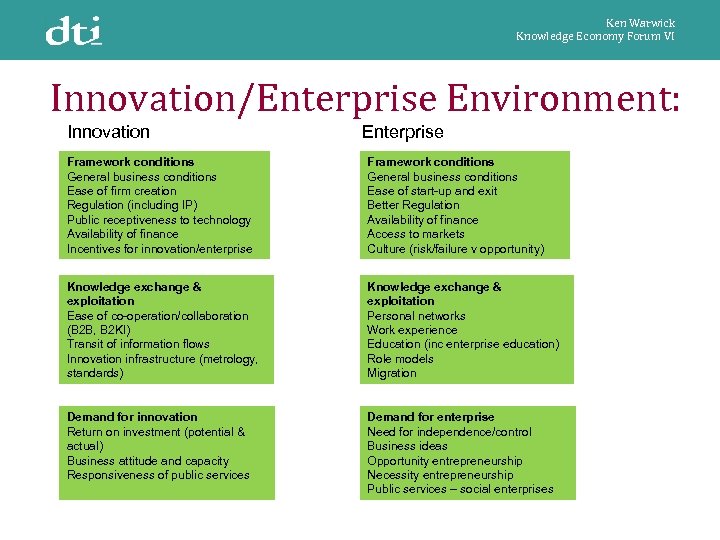 Ken Warwick Knowledge Economy Forum VI Innovation/Enterprise Environment: Innovation Enterprise Framework conditions General business conditions Ease of firm creation Regulation (including IP) Public receptiveness to technology Availability of finance Incentives for innovation/enterprise Framework conditions General business conditions Ease of start-up and exit Better Regulation Availability of finance Access to markets Culture (risk/failure v opportunity) Knowledge exchange & exploitation Ease of co-operation/collaboration (B 2 B, B 2 KI) Transit of information flows Innovation infrastructure (metrology, standards) Knowledge exchange & exploitation Personal networks Work experience Education (inc enterprise education) Role models Migration Demand for innovation Return on investment (potential & actual) Business attitude and capacity Responsiveness of public services Demand for enterprise Need for independence/control Business ideas Opportunity entrepreneurship Necessity entrepreneurship Public services – social enterprises
 Ken Warwick Knowledge Economy Forum VI Policies to raise absorptive capacity in businesses • Address market failure that leads to private underinvestment in R&D: – Tax incentives present in many OECD economies – Most economies supplement with targeted programmes providing support for individual projects [UK example: Collaborative Research and Development programme].
 Ken Warwick Knowledge Economy Forum VI Policies to raise absorptive capacity in businesses • Build business awareness of value of interaction with external knowledge sources (possible information asymmetries): – Initiatives to demonstrate the value that skilled researchers can add to a business (UK example: Knowledge Transfer Partnerships). – Reduce the initial “transaction costs” of engaging with research base, especially for SMEs (Netherlands example: Innovation Vouchers).
 Ken Warwick Knowledge Economy Forum VI Policies to increase capacity of research base to engage with business & other users • Provide incentives for Higher Education Institutions and other research organisations to engage with business and users: – Financial support to develop capacity (Technology Transfer personnel, staff training) – UK example: Higher Education Innovation Fund – Collaborations to reduce costs of collaboration (UK example: “Lambert” model IP agreements).
 Ken Warwick Knowledge Economy Forum VI UK Technology Strategy Board • Responsibility for delivery of Government programme of financial support through collaborative R&D and knowledge transfer • Objective - to promote and support research into, and development and exploitation of, science and technology for business benefit for economic growth and quality of life • Knowledge Transfer Networks part of technology programme strategy
 Ken Warwick Knowledge Economy Forum VI Role of international institutions • International institutions also play number of important roles • Traditional role – helping countries cooperate to reach international agreements • Helping build support for good governance/policies in member countries • Role around building absorptive capacity
 Ken Warwick Knowledge Economy Forum VI International institutions - building absorptive capacity • Can take a number of forms: – Undertaking global studies (economies of scale) – Providing third party expertise – e. g. experts visiting a country and providing expert opinion on a policy area – Facilitating exchange of best practice between countries • Important challenges in this work
 Ken Warwick Knowledge Economy Forum VI Signs of progress in developing UK capacity • [chart of HEBCI outputs of business-university collaboration] • [chart of increased innovation activity from UK Innovation survey]