


 Скачать презентацию KNOWLEDGE CREATION AND KNOWLEDGE MANAGEMENT ARCHITECTURE Lecture Three
32533ec28255666245b31166fceaa958.ppt
- Количество слайдов: 31
 KNOWLEDGE CREATION AND KNOWLEDGE MANAGEMENT ARCHITECTURE Lecture Three (Chapter 3, Notes; Chapter 4, Textbook)
 Chapter 3: Knowledge Creation and Knowledge Architecture Review of Lecture 2 ® Challenges in building KM Systems ® Compare KMSLC and CSLC ® Knowledge Management System Life Cycle (8 Stages) 3 -2
 Chapter 3: Knowledge Creation and Knowledge Architecture This Week’s Topics ® Knowledge Creation and Sharing ® Knowledge Infrastructure ® Knowledge Management Architecture ® Build versus Buy Decision 3 -3
 Chapter 3: Knowledge Creation and Knowledge Architecture KNOWLEDGE CREATION ® Dynamic activity that can enhance organization success and economic well -being ® Driver of innovation ® Involves knowledge acquisition, selection, generation and sharing ® Maturation - translates experience into knowledge 3 -4
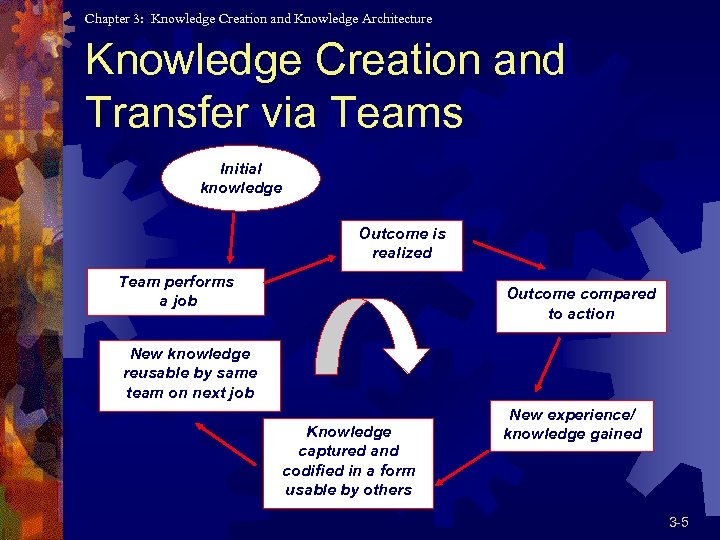 Chapter 3: Knowledge Creation and Knowledge Architecture Knowledge Creation and Transfer via Teams Initial knowledge Outcome is realized Team performs a job Outcome compared to action New knowledge reusable by same team on next job Knowledge captured and codified in a form usable by others New experience/ knowledge gained 3 -5
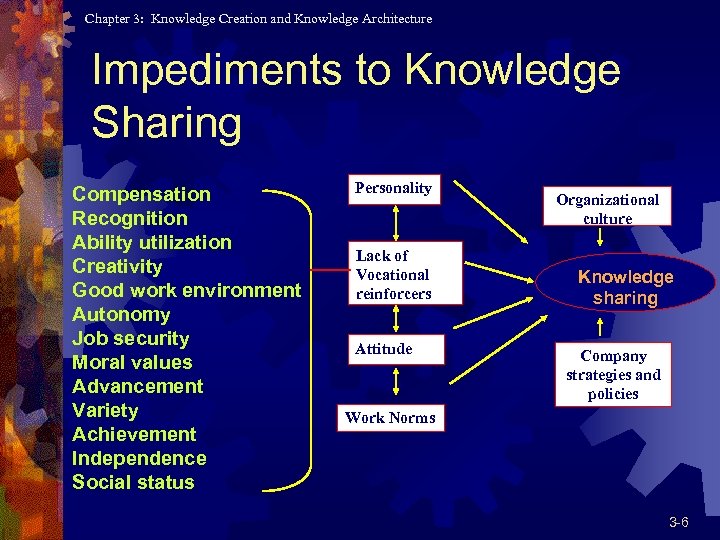 Chapter 3: Knowledge Creation and Knowledge Architecture Impediments to Knowledge Sharing Compensation Recognition Ability utilization Creativity Good work environment Autonomy Job security Moral values Advancement Variety Achievement Independence Social status Personality Lack of Vocational reinforcers Attitude Organizational culture Knowledge sharing Company strategies and policies Work Norms 3 -6
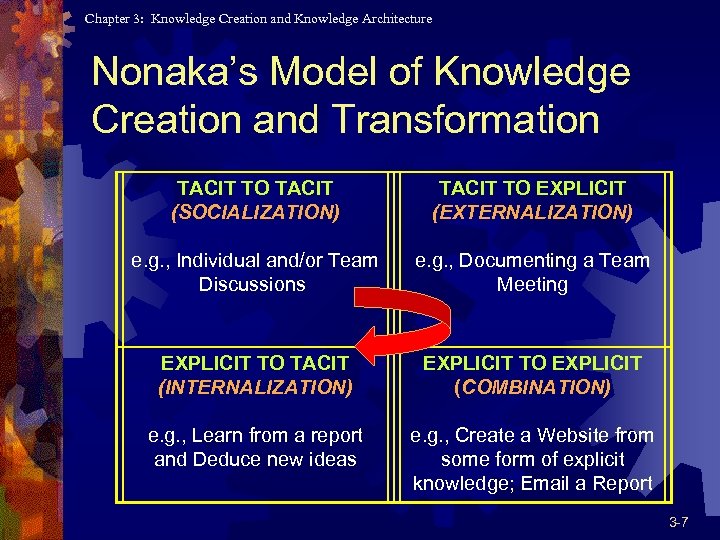 Chapter 3: Knowledge Creation and Knowledge Architecture Nonaka’s Model of Knowledge Creation and Transformation TACIT TO TACIT (SOCIALIZATION) e. g. , Individual and/or Team Discussions TACIT TO EXPLICIT (EXTERNALIZATION) e. g. , Documenting a Team Meeting EXPLICIT TO TACIT (INTERNALIZATION) e. g. , Learn from a report and Deduce new ideas EXPLICIT TO EXPLICIT (COMBINATION) e. g. , Create a Website from some form of explicit knowledge; Email a Report 3 -7
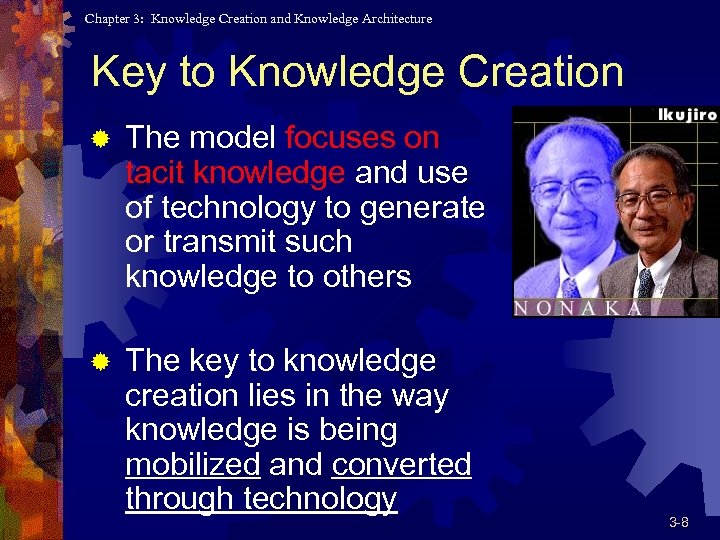 Chapter 3: Knowledge Creation and Knowledge Architecture Key to Knowledge Creation ® The model focuses on tacit knowledge and use of technology to generate or transmit such knowledge to others ® The key to knowledge creation lies in the way knowledge is being mobilized and converted through technology 3 -8
 Chapter 3: Knowledge Creation and Knowledge Architecture KNOWLEDGE INFRASTRUCTURE ® Content core: Identify knowledge centres People ® People core: Evaluate Content Technology employee profiles ® Technical core: The totality of technology (S/W and H/W) required to operate the knowledge environment 3 -9
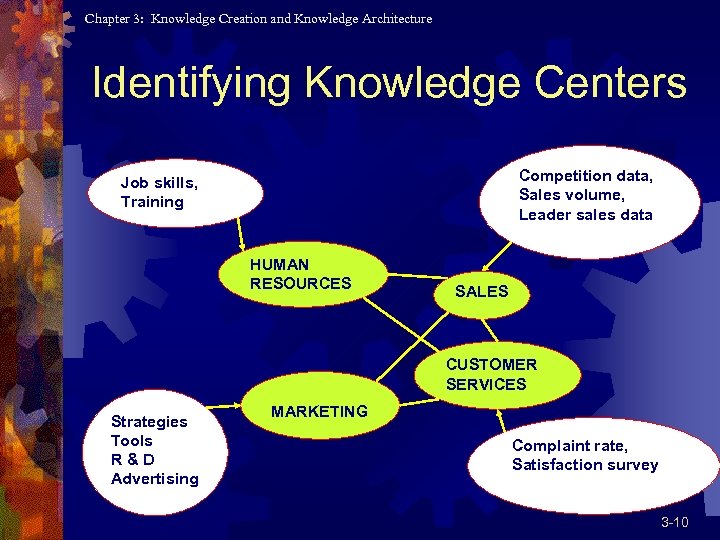 Chapter 3: Knowledge Creation and Knowledge Architecture Identifying Knowledge Centers Competition data, Sales volume, Leader sales data Job skills, Training HUMAN RESOURCES SALES CUSTOMER SERVICES Strategies Tools R & D Advertising MARKETING Complaint rate, Satisfaction survey 3 -10
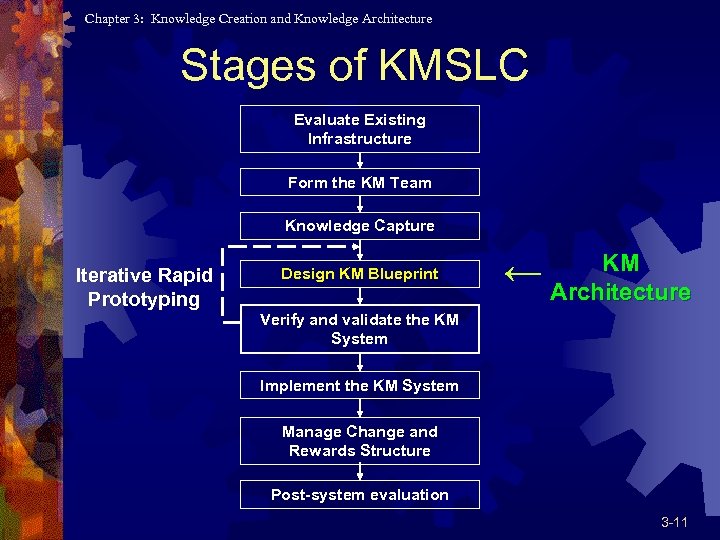 Chapter 3: Knowledge Creation and Knowledge Architecture Stages of KMSLC Evaluate Existing Infrastructure Form the KM Team Knowledge Capture Iterative Rapid Prototyping Design KM Blueprint KM ← Architecture Verify and validate the KM System Implement the KM System Manage Change and Rewards Structure Post-system evaluation 3 -11
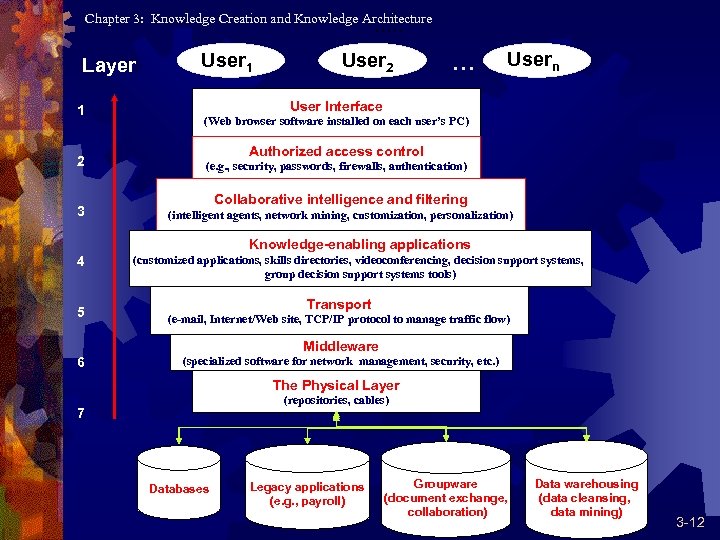 Chapter 3: Knowledge Creation and Knowledge Architecture. . . Layer 1 2 3 User 1 User 2 … Usern User Interface (Web browser software installed on each user’s PC) Authorized access control (e. g. , security, passwords, firewalls, authentication) Collaborative intelligence and filtering (intelligent agents, network mining, customization, personalization) Knowledge-enabling applications 4 5 (customized applications, skills directories, videoconferencing, decision support systems, group decision support systems tools) Transport (e-mail, Internet/Web site, TCP/IP protocol to manage traffic flow) Middleware 6 (specialized software for network management, security, etc. ) The Physical Layer (repositories, cables) 7 Databases Legacy applications (e. g. , payroll) Groupware (document exchange, collaboration) Data warehousing (data cleansing, data mining) 3 -12
 Chapter 3: Knowledge Creation and Knowledge Architecture KM Architecture ® Visualize the building blocks of a KM system in the form of layers ® User Interface being the least technical, and data repository the most technical ® These layers represent internal technologies of the company 3 -13
 Chapter 3: Knowledge Creation and Knowledge Architecture The User Interface (Layer 1) ® Interface between users and the KM system ® Usually as a web browser ® The goal is to remove barriers to information and tacit (made explicit) knowledge represented in the data repositories 3 -14
 Chapter 3: Knowledge Creation and Knowledge Architecture The User Interface (Layer 1) ® User interface should be consistent, relevant, visually clear, easy to navigate, and easy to use ® Usability testing by the actual users is the final test of acceptability 3 -15
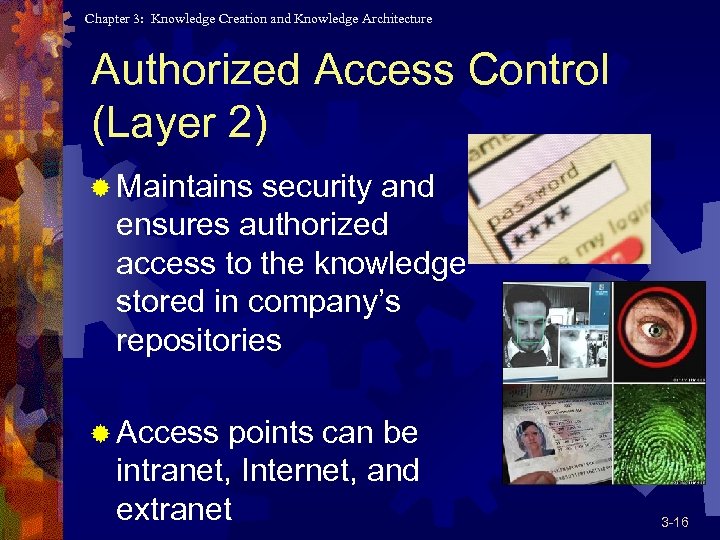 Chapter 3: Knowledge Creation and Knowledge Architecture Authorized Access Control (Layer 2) ® Maintains security and ensures authorized access to the knowledge stored in company’s repositories ® Access points can be intranet, Internet, and extranet 3 -16
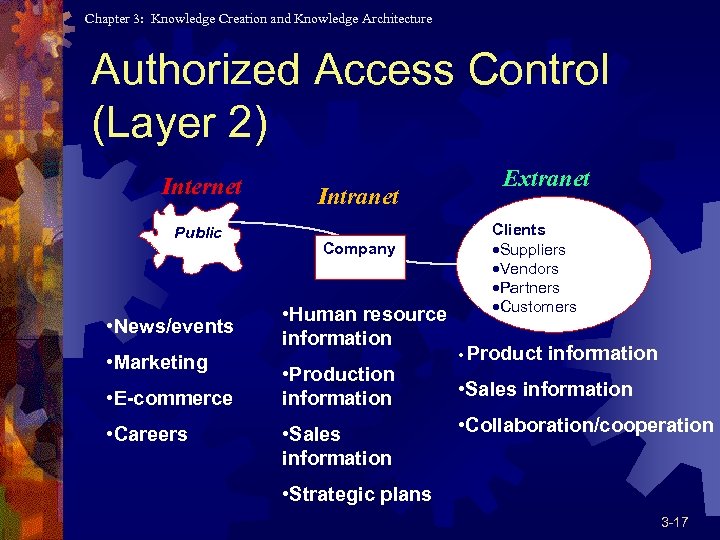 Chapter 3: Knowledge Creation and Knowledge Architecture Authorized Access Control (Layer 2) Internet Public • News/events • Marketing • E-commerce • Careers Intranet Company • Human resource information • Production information • Sales information Extranet Clients ·Suppliers ·Vendors ·Partners ·Customers • Product information • Sales information • Collaboration/cooperation • Strategic plans 3 -17
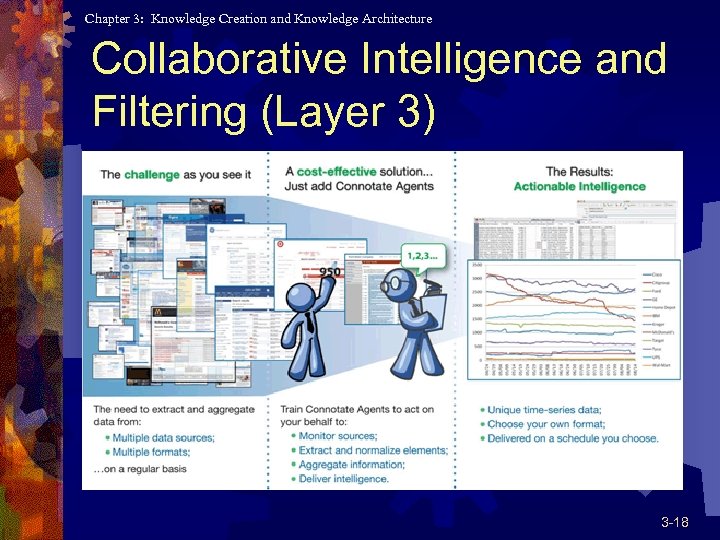 Chapter 3: Knowledge Creation and Knowledge Architecture Collaborative Intelligence and Filtering (Layer 3) ® Personalized views based on roles and stored knowledge ® Intelligent agents to reduce search time for needed information 3 -18
 Chapter 3: Knowledge Creation and Knowledge Architecture Knowledge-Enabling Application (Layer 4) ® Referred to as value-added layer ® Provides knowledge bases, discussion databases, automation tools, etc. ® Ultimate goal: demonstrate by knowledge sharing how employees’ performances are improved 3 -19
 Chapter 3: Knowledge Creation and Knowledge Architecture Transport Layer (Layer 5) ® Most technical layer to implement ® Includes LANs, WANs, intranets, extranets, and the Internet ® Ensures that the company will become a network of relationships ® Considers multimedia, URLs, graphics, connectivity speeds, and bandwidths 3 -20
 Chapter 3: Knowledge Creation and Knowledge Architecture Middleware (Layer 6) ® Focus on interfacing with legacy systems and programs residing on other platforms ® Designer should address databases and applications with which KM system interfaces ® Makes it possible to connect between old and new data formats 3 -21
 Chapter 3: Knowledge Creation and Knowledge Architecture Physical Repositories (Layer 7) ® Bottom layer in the KM architecture ® Represents the physical layer where repositories are installed ® Includes data warehouses, legacy applications, operational databases, and special applications for security and traffic management 3 -22
 Chapter 3: Knowledge Creation and Knowledge Architecture Build In-House, Buy, or Outsource? Trend is toward ready-to-use, generalized software packages ® Outsourcing is also a trend, releasing technological design to outsiders ® Regardless of choice, it is important to set criteria for the selection ® Question of who owns the KM system should be seriously considered ® 3 -23
 Chapter 3: Knowledge Creation and Knowledge Architecture End of Lecture Three 3 -24
 Chapter 3: Knowledge Creation and Knowledge Architecture In Class Discussion Exercise Assume you are the person responsible for making decision on a KM project ® How would you decide to build or buy? ® Based on the key elements compared, and ® The current state of your organization preparedness (thinking in terms of maturity in layers of KM architecture) ® 3 -25
 Chapter 3: Knowledge Creation and Knowledge Architecture CHALLENGES IN BUILDING KM SYSTEMS ® Culture — getting people to share knowledge ® Knowledge evaluation — assessing the worth of knowledge across the firm ® Knowledge processing — documenting how decisions are reached ® Knowledge implementation — organizing knowledge and integrating it with the processing strategy for final deployment 3 -26
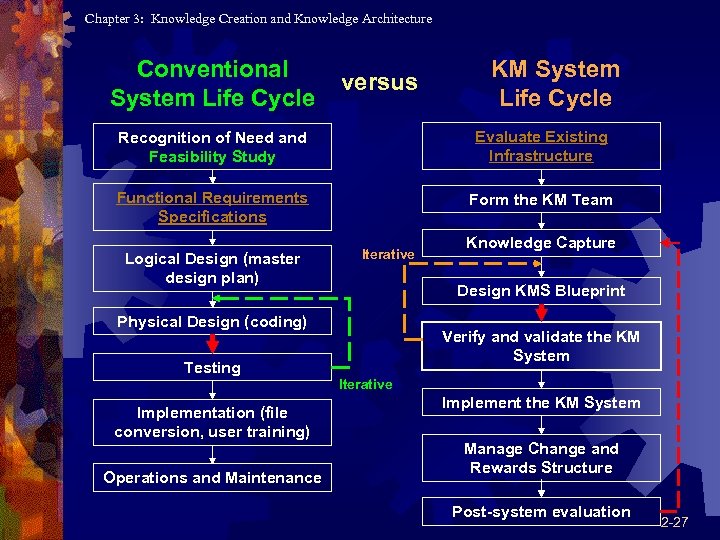 Chapter 3: Knowledge Creation and Knowledge Architecture Conventional System Life Cycle versus KM System Life Cycle Recognition of Need and Feasibility Study Evaluate Existing Infrastructure Functional Requirements Specifications Form the KM Team Logical Design (master design plan) Iterative Knowledge Capture Design KMS Blueprint Physical Design (coding) Verify and validate the KM System Testing Iterative Implementation (file conversion, user training) Operations and Maintenance Implement the KM System Manage Change and Rewards Structure Post-system evaluation 2 -27
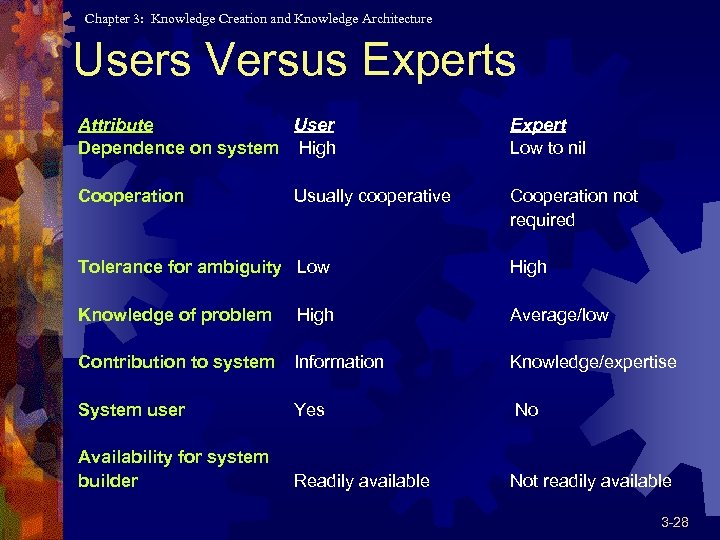 Chapter 3: Knowledge Creation and Knowledge Architecture Users Versus Experts Attribute User Dependence on system High Expert Low to nil Cooperation Usually cooperative Cooperation not required Tolerance for ambiguity Low High Knowledge of problem High Average/low Contribution to system Information Knowledge/expertise System user Yes No Availability for system builder Readily available Not readily available 3 -28
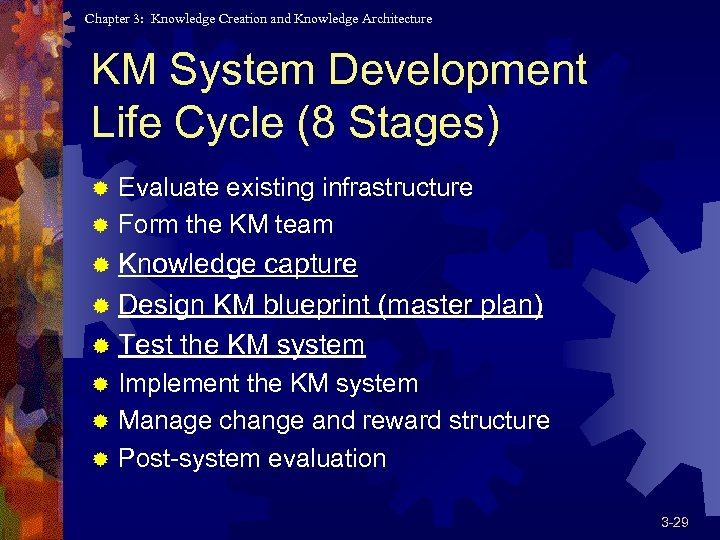 Chapter 3: Knowledge Creation and Knowledge Architecture KM System Development Life Cycle (8 Stages) Evaluate existing infrastructure ® Form the KM team ® ® Knowledge capture ® Design KM blueprint (master plan) ® Test the KM system Implement the KM system ® Manage change and reward structure ® Post-system evaluation ® 3 -29
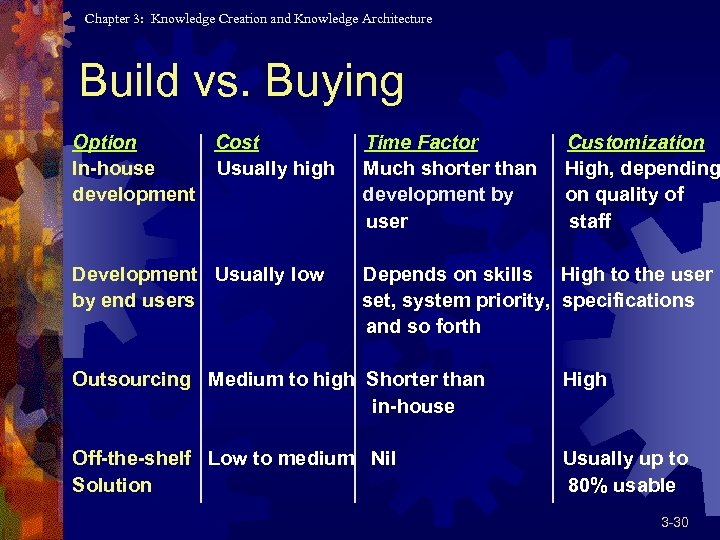 Chapter 3: Knowledge Creation and Knowledge Architecture Build vs. Buying Option Cost Time Factor Customization In-house Usually high Much shorter than High, depending development development by on quality of user staff Development Usually low Depends on skills High to the user by end users set, system priority, specifications and so forth Outsourcing Medium to high Shorter than High in-house Off-the-shelf Low to medium Nil Usually up to Solution 80% usable 3 -30
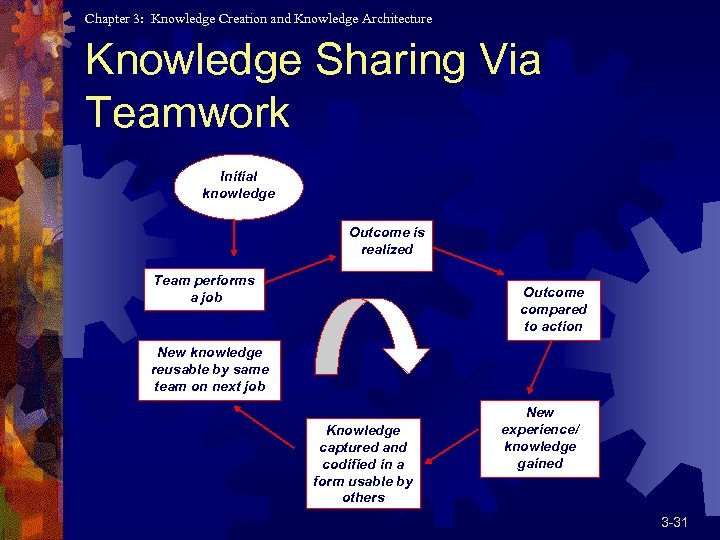 Chapter 3: Knowledge Creation and Knowledge Architecture Knowledge Sharing Via Teamwork Initial knowledge Outcome is realized Team performs a job Outcome compared to action New knowledge reusable by same team on next job Knowledge captured and codified in a form usable by others New experience/ knowledge gained 3 -31