


 Скачать презентацию Knowledge and Expert Systems So far we
43dbc7d934fe22025dd5a3e4303f2cc4.ppt
- Количество слайдов: 37
 Knowledge and Expert Systems • So far, we have examined weak methods – approaches and algorithms that are generic across problems, ones that do not take advantage of domainspecific knowledge or problem-specific methods • note: method here is used a bit differently than in OOP, a method is a problem solving strategy, but not necessarily a specific implementation, or an algorithm tied to a class – in this chapter, we examine how expertise can be used to both specify the knowledge needed to solve a problem as well as the process(es) required to solve the problem • thus, we have strong methods, problem specific in some ways, and knowledge-intensive processes • we will use this approach to solve problems that are themselves knowledge-intensive: diagnosis, planning/design, etc
 Expert System • An expert system is an AI system that – solves a problem like a human expert – or that requires the use of expert knowledge • Today, we refer to these systems as knowledge-based systems – because the emphasis is on the knowledge that they employ, not necessarily on expert knowledge or expert problem solving • some systems require knowledge but not expert knowledge • for instance, we may create a naïve medical reasoner that applies knowledge of a parent rather than knowledge learned through years of study and practice • or, we might want to implementing a daily activity planning system which requires no expertise to solve the problem – we will use the term “expert system” throughout the chapter but think of it as synonymous with knowledge-based system • Expert systems in general – support inspection of their reasoning process (can explain or justify their conclusions) – allow easy modification through adding and deleting skills from the knowledge base – reason heuristically (with imperfect knowledge)
 Expert System Problem Categories • Interpretation – given raw data, draw conclusion – data analysis, test result interpretation, forms of recognition • Diagnosis – determine the cause of the malfunction(s) given observables • Recognition – identify the specific item(s) from the data (visual, auditory or other) – the above three problems seem similar because they are all forms of credit assignment problems • Monitoring – form of interpretation to make sure a system’s behavior matches the expectations • Control – related to monitoring, making changes to a system so to correct and/or maintain expected behavior • Planning/Design – devise a sequence of actions/configurations of plan steps/component parts to achieve some set of goals – a plan is an abstract design or a design uses physical components rather than plan steps – designs accomplish goals when the artifact is used – both have constraints and specifications • Prediction – projecting probably outcomes of given situations • Instruction – or tutorial, assisting in the education process
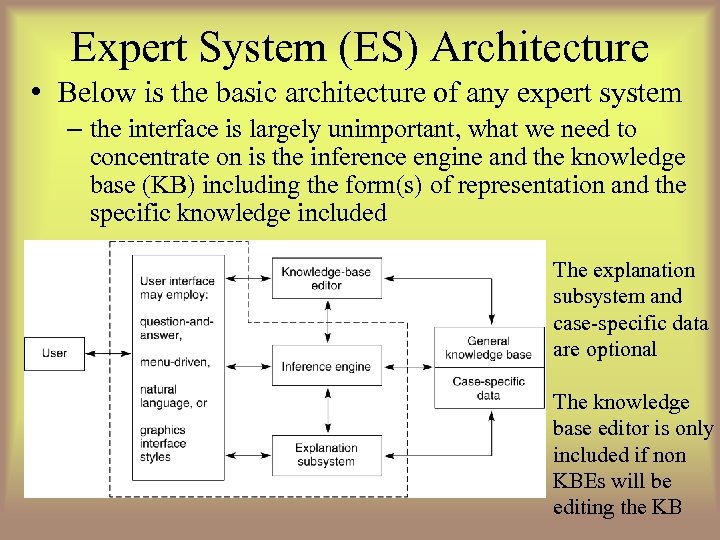 Expert System (ES) Architecture • Below is the basic architecture of any expert system – the interface is largely unimportant, what we need to concentrate on is the inference engine and the knowledge base (KB) including the form(s) of representation and the specific knowledge included The explanation subsystem and case-specific data are optional The knowledge base editor is only included if non KBEs will be editing the KB
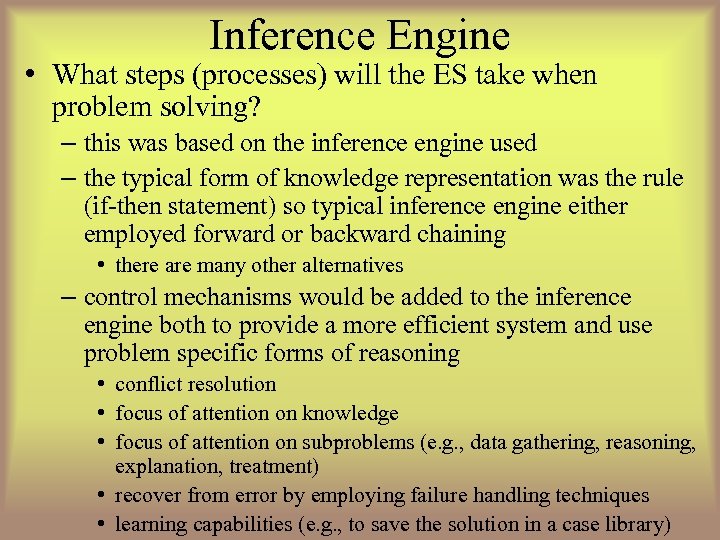 Inference Engine • What steps (processes) will the ES take when problem solving? – this was based on the inference engine used – the typical form of knowledge representation was the rule (if-then statement) so typical inference engine either employed forward or backward chaining • there are many other alternatives – control mechanisms would be added to the inference engine both to provide a more efficient system and use problem specific forms of reasoning • conflict resolution • focus of attention on knowledge • focus of attention on subproblems (e. g. , data gathering, reasoning, explanation, treatment) • recover from error by employing failure handling techniques • learning capabilities (e. g. , to save the solution in a case library)
 The Rule Based Approach • Whether explicitly enumerated as if-then statements, or captured as predicate clauses, much knowledge comes in the form of a rule – so much of AI revolved around rule-based systems – as already noted, Mycin was such a success that the Emycin shell was developed (and later, OPS 5 and others) • ES construction could be as simple as: – collect all domain knowledge in the form or rules – decide on forward or backward chaining (and thus select OPS 5 or Emycin) – enumerate the rules in the selected language – run, test, debug, enhance until done • Many systems were developed in this fashion from SACON to R 1/XCON to GUIDON (based on MYCIN, taught medical students about performing diagnosis) to ONCONCIN (drug treatment prescription and management for cancer patients) to TATR (tactical air targeting system for the Air Force)
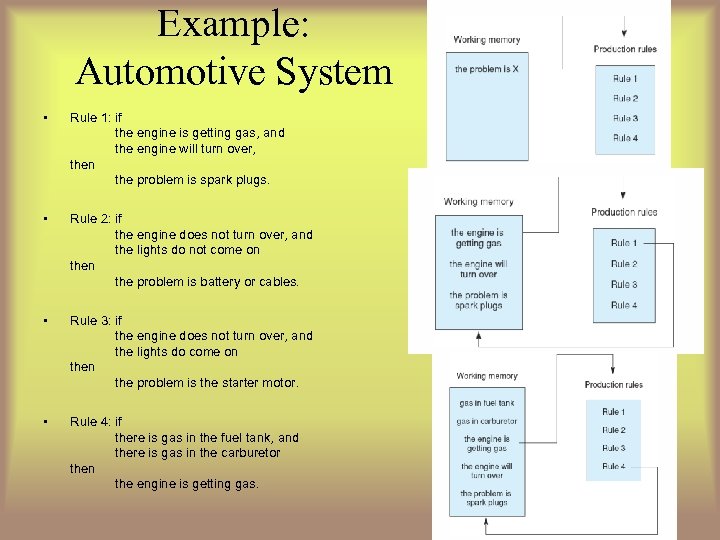 Example: Automotive System • Rule 1: if the engine is getting gas, and the engine will turn over, then the problem is spark plugs. • Rule 2: if the engine does not turn over, and the lights do not come on the problem is battery or cables. • Rule 3: if the engine does not turn over, and the lights do come on the problem is the starter motor. • Rule 4: if there is gas in the fuel tank, and there is gas in the carburetor then the engine is getting gas.
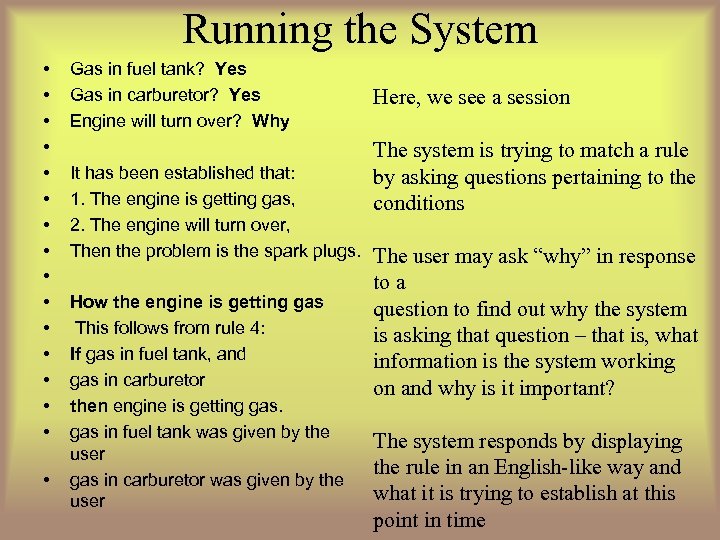 Running the System • • • • Gas in fuel tank? Yes Gas in carburetor? Yes Engine will turn over? Why It has been established that: 1. The engine is getting gas, 2. The engine will turn over, Then the problem is the spark plugs. How the engine is getting gas This follows from rule 4: If gas in fuel tank, and gas in carburetor then engine is getting gas in fuel tank was given by the user gas in carburetor was given by the user Here, we see a session The system is trying to match a rule by asking questions pertaining to the conditions The user may ask “why” in response to a question to find out why the system is asking that question – that is, what information is the system working on and why is it important? The system responds by displaying the rule in an English-like way and what it is trying to establish at this point in time
 Data-Driven vs. Goal-Driven • Most diagnostic systems take a data-driven approach – start with the known data (observations, symptoms) and chain through the rules to conclusions – what caused those symptoms? • Mycin is an exception, it performed Goal-driven reasoning with the goal of treating an illness, so the main goals were diagnose and treat, but we won’t worry about that • Planning is often a goal-driven approach – start with the goals (what are trying to plan or design? ) and then select rules to help us select the actual plan steps or design components, and then configure them always working from larger concepts to more specific components/steps • R 1/XCON is an exception being data-driven by starting with the data – the user specs • So, in general, we will use data-driven for problems that start with data (diagnosis, interpretation) and goal-driven for problems that start with goals (planning, design)
 Rule-based Control • The simple Rule-based system relies solely on a conflict resolution strategy for control, this may not be sufficient and may not adequately mimic the expert problem solver – the best idea is to break the problem into phases and have rule groupings that model this • in a diagnostic situation, it might be – – – data gathering and completion initial hypothesization further test ordering hypothesis refinement and confirmation treatment – Mycin had phases like this, but were implicitly posed by organizing rules so that the system would not move on until a rule had stated that the current phase was over – we saw that HEARSAY used a blackboard an agenda scheduler, other systems will use an approach like this
 Alternatives to Rules • Rule-base is the only one way to implement a diagnostic reasoner – most diagnostic reasoners will contain rules, but they do not have to be constructed solely of rules • Object (frame) approach – PUFF – to diagnose pulmonary disorders, each disorder was represented as an object and organized in a hierarchy – each frame had rules to determine that particular disorder’s relevance (ask these questions and if the answers are as expected, continue down that branch of the class hierarchy) • Classification – organize diagnostic categories as nodes in a hierarchy – associate with each node the questions necessary to establish that category – perform a top-down search, pruning away categories and their subtrees that cannot be established • Decision trees – diagnostic categories are leaf nodes of a tree, each interior node is a decision made based on the response of a question (e. g. , “does the motor start? ”, “do the lights come on? ”
 Knowledge Acquisition and Modeling • ES construction used to be a trial-and-error sort of approach with the KEs – once they had knowledge from the experts, they would fill in their KB and test it out • By the end of the 80 s, it was discovered that creating an actual domain model was the way to go – build a model of the knowledge before implementing anything • A model might be – a dependency graph of what can cause what to happen – or an associational model which is a collection of malfunctions and the manifestations we would expect to see from those malfunctions – or a functional model where component parts are enumerated and described by function and behavior • The emphasis changed to knowledge acquisition tools (KADS) – domain experts enter their knowledge as a graphical model that contains the component parts of the item being diagnosed/designed, their functions, and rules for deciding how to diagnose or design each one
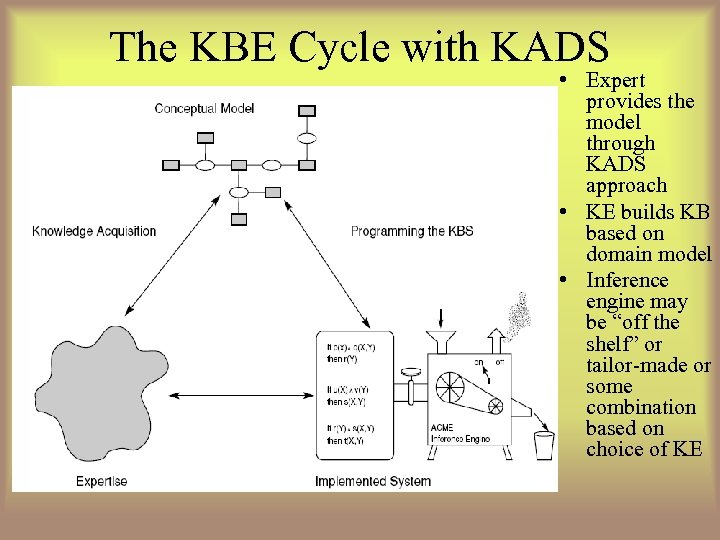 The KBE Cycle with KADS • Expert provides the model through KADS approach • KE builds KB based on domain model • Inference engine may be “off the shelf” or tailor-made or some combination based on choice of KE
 Case-Based Reasoning • Another form of reasoning is to draw on an actual previously existing solution and adapt it as much as possible to fit the new problem – the process works like this, given a problem • select from among a library of previous cases (solutions), one that meets the same specifications • compare the selected case’s results to the desired results and find the differences • modify the case appropriately • apply the transformed case • if successful, capture the new solution as a case and save it in the library otherwise repeat the entire process by selecting another case to try • The original CBR system was Chef – given a library of recipes – input a desired meal specification (type of dish to prepare, taste, texture, method of cooking) – select a previous recipe and alter it to meet the new specification(s) – test the new recipe and if successful, save it otherwise modify it until it passes the test • you will read more about Chef in the accompanying notes
 Indexing and Retrieval of Cases • Kolodner, one of the leading CBR researchers, proposes the following heuristics – goal-directed preference – organize cases (at least in part) by goal descriptions and retrieve cases with the same goals as the current situation – salient-feature preference – prefer cases that match the most important features or the largest number of matching features – specify preference – look for as exact a match as possible – frequency preference – check the most frequently matched cases first – recency preference – check the most recently matched cases first – ease of adaption preference – use the cases that are most easily adapted to the current situation • the last one is very similar to salient-feature preference where the salient features are those that require the greatest amount of modification – that is, if we find a case that matches those features that would be the most significant to change, then it is both the most salient and easiest to adapt
 Comparing Approaches • So we have now looked at rule-based, case-based and model-based approaches – while there might be some overlap between them, they have enough differences that a KBE needs to make an early choice of the approach to use – so what approach should be used? • Rule-based approach – easy to capture knowledge as rules, rules lead to an easy explanation facility which can help with debugging, rules allow a clean separation between knowledge and process to control the system – but, rules are only useful when they can be kept to a reasonable number (no more than a few thousand) and/or can be clearly subdivided into groups, they tend to be brittle (an ES based on rules can break easily because it has no underlying knowledge) and the system’s accuracy will degrade rapidly when tested at the limits of its knowledge and rules tend to be more associational than functional and this can lead to faulty reasoning
 Comparison Continued – rules also do not permit easy expansion of knowledge – you have to have a very thorough knowledge of the previous rules before you can add to them or else you might add contradictory knowledge • CBR – no need for knowledge acquisition, merely provide the system with an ample set of initial cases, system can learn and improve, allows shortcuts in reasoning, and exploit past successes to get past potential erroneous situations and does not require an extensive amount of domain knowledge – but cases do not deepen the knowledge of the system, only provide alternative choices, and a large number of cases can lead to poorer performance and finally, indexing and retrieval remain large problems
 Comparison Continued • Model-based – the application of functional/structural knowledge is superior to associational knowledge and increases the robustness of the system (less brittleness), being able to reason from first principles, and such a system can provide an even better explanation than a rule-based system – creating an explicit domain model is very challenging and in many domains, not possible (e. g. , we do not understand the human body well enough for an appropriate diagnostic model!), and such a model can be highly complex leading to poor efficiency and/or poor accuracy and in some cases, exceptional situations, that could be handled by a simple rule, cannot be modeled
 Diagnosis vs. Planning • As already described, diagnosis is typically a data-driven problem and planning is goal-driven • The idea behind planning is to generate a sequence of operations that, when taken, will fulfill the given goals – so the process is one of given goals and generating operators in a proper sequence – like previous problems, we can view this as a state space to search, but we can be more intelligent about how we generate our plan to reduce the complexity – instead of viewing it as a state space like a tree, we will instead use a production-system type of approach – all of our operations will have • preconditions to tell us if the given action is applicable at this state of the problem • postconditions to tell us what goals they can fulfill when applied
 Planning by Subgoaling • This lets us view planning as a process of subgoaling – given a goal • find an operator that accomplishes that goal • but the operator must first be in the proper state before it can be selected – generate the conditions that need to be true to select that operator • these are new goals, or subgoals • add these subgoals to our list of goals – repeat until the conditions are met by the initial state • We may use a goal stack – to accomplish goal g 1, we select operator o 1, which itself requires goals g 2 and g 3, so we push g 2 and g 3 on to the stack – when we eventually solve g 3, we pop it off the stack, when we accomplish g 2, we pop it off the stack, now we can pop g 1 off the stack because we accomplished the preconditions for o 1 and thus g 1
 Example: Blocks World Robot • Operators: – goto(x, y, z) – move robot to location x, y, z – pickup(w) – pickup the block w, block w must be clear and robotic hand empty to apply this operator – putdown(w) – place w on the table, block w must already be in the robotic hand – stack(u, v) – stack block u on top of block v, block u must already be in the robotic hand v must be clear – unstack(u, v) – place block u in the robotic hand, block u must be clear and on top of v and the robotic hand must be empty • A state of the world may be given using predicates like – on(b, a), on(c, b), ontable(a), clear(c), gripping( ) • To accomplish unstack(b, a) we must first achieve clear(b), – so clear(b) becomes a subgoal of unstack(b, a)
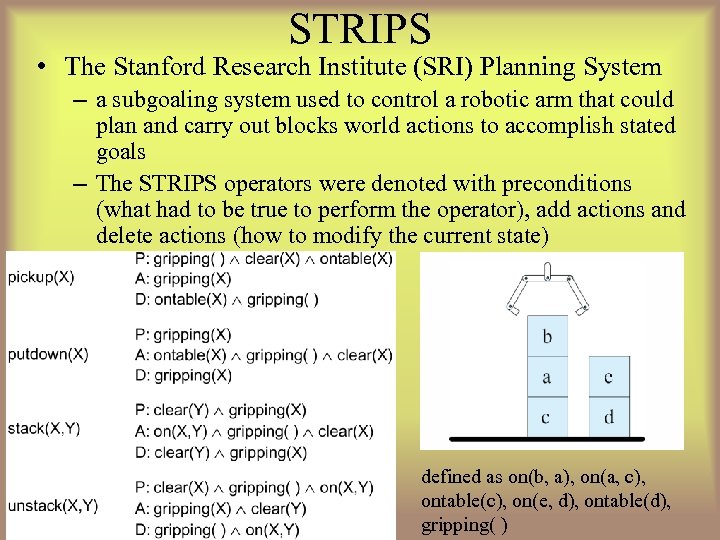 STRIPS • The Stanford Research Institute (SRI) Planning System – a subgoaling system used to control a robotic arm that could plan and carry out blocks world actions to accomplish stated goals – The STRIPS operators were denoted with preconditions (what had to be true to perform the operator), add actions and delete actions (how to modify the current state) defined as on(b, a), on(a, c), ontable(c), on(e, d), ontable(d), gripping( )
 Non-Linear Planning • STRIPS uses simple linear planning which means that the selection of one operator to accomplish a goal could “clobber” a previously obtained goal – non-linear planning does not generate the plan in a sequence but instead generates plan solution segments, and then attempts to order them – in the previous example, imagine that we want to achieve the goal on(e, b), on(b, a), on(a, c), on(c, d), ontable(d) – we might place e on top of b as an early step only to have to remove b from e when it is realized that we have to remove b from a and a from c so that we can place c on d • Another example is cleaning your kitchen – Consider operators like “move X”, “clean X”, “mop X” • you would not want to clean the floor, mop the floor, then move the refrigerator and clean and mop under the fridge because moving the refrigerator will most likely make the rest of the floor dirty again
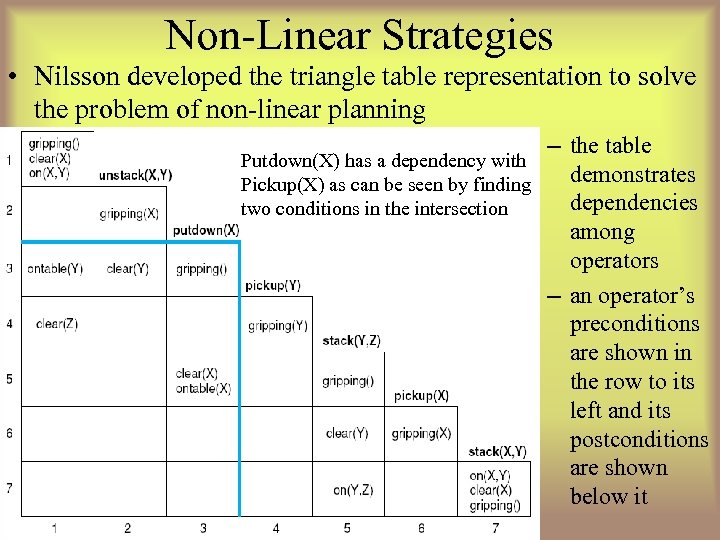 Non-Linear Strategies • Nilsson developed the triangle table representation to solve the problem of non-linear planning Putdown(X) has a dependency with Pickup(X) as can be seen by finding two conditions in the intersection – the table demonstrates dependencies among operators – an operator’s preconditions are shown in the row to its left and its postconditions are shown below it
 Least Commitment • Another strategy is least commitment where operators are selected but their sequence (order) is not determined until necessary – first, generate all operators (or as many as possible) – next, generate any needed operators and sequence those that can clearly be sequenced – continue until all operators and sequences are sequenced • Example: daily planning – your daily goals include going to class, work, running errands (grocery store and dry cleaners) and the typical tasks of showering, getting dressed, eating, etc
 Continued • Some aspects of your day are dictated by hard constraints – you have to be at work from 8 am to 12 pm – you have to be on campus from 1 -2 pm and 6: 15 -7: 30 pm for classes and you need an extra 15 -20 minutes to park and 15 minutes to drive there from work – grocery shopping will take you 45 minutes (including travel time) – the dry cleaners will take you 20 minutes (including travel time) • While the various tasks dictate the operators – drive to work, drive to campus, go to class, drive to the grocery store, do shopping, drive home, put groceries away • Pre- and post-conditions dictate some of the ordering – you won’t go from the grocery store right to campus, or you won’t go to work, go to campus, and then go home to shower
 Other Planning Strategies • Constraint satisfaction – apply constraints whenever possible to prune away possible choices – for instance, some operators would not be applicable because they would take too much time or cost too much • consider that you need to pick up your lawnmower, but you brought your small car to work, so this constrains when you can pick up the lawnmower – you must first go home from work to get your larger car • Operator Preference – operators that are more likely to be of use, or to succeed, might be tried first – operator preference might be dictated by the programmer or it might be specified as part of user input – operator preference might also be learned, for instance based on statistical usage (operator X has been used more often in the past so X is considered before Y)
 Hierarchical Planning/Plan Decomposition • Planning (and design) often require that a given plan step be solved by decomposing it into lesser steps – consider a plan of taking a trip – to generate our solution, rather than generating specific steps, we first generate a broader solution • select city to visit and time to visit • check on air fare and hotel availability and price • rent car – this makes more sense than spending a lot of time figuring out the city first – what if there are no available hotels during the time of our planned visit? it makes the first step useless • Design, in general, requires plan decomposition so that each component part can be individually designed – after plan/design decomposition, we then must combine the component parts/operators into a linear sequence
 Rule-based Planning • R 1/XCON demonstrated that planning (design) could be done strictly by rules (R 1 had about 10, 000 rules) – to build a planning system with rules, a great amount of domain knowledge is needed, unlike the STRIPS approach with just a few operators • Another rule-based planning system was VT (Vertical Transportation) for elevator design – the design components are shown on the next slide – design requires establishing values for various physical dimensions, weights, component parts and the materials used for the parts • decisions were made first based on user constraints/specifications and later by constraints from already established components – many rules were “failure-handling” rules, that is, solutions when constraints would be exceeded such as • if traction-ratio is exceeded then increase car-supplement-weight • if machine-groove-pressure is exceeded then decrease car-supplement-weight – note that the above two rules can contradict each other, this was corrected when VT was re-implemented using a KADS-based approach
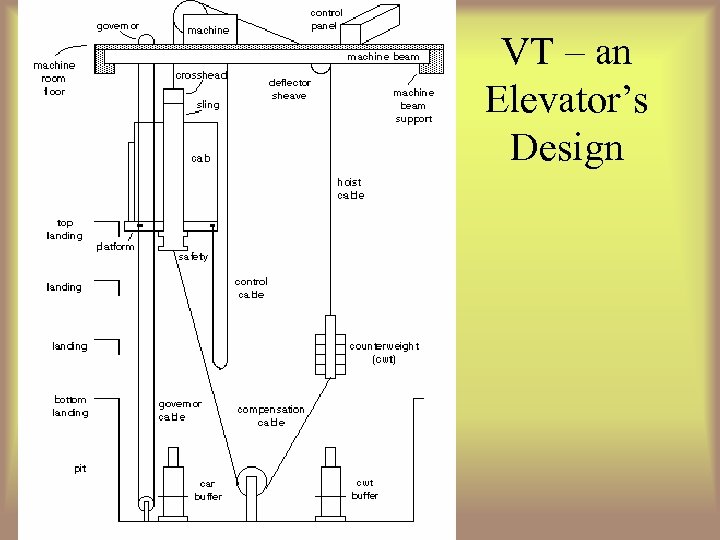 VT – an Elevator’s Design
 Meta-Planning • MOLGEN – expert system to design laboratory genetics experiments • A plan would work through 3 levels of reasoning – strategy steps – deciding what part of a lab to develop next, uses meta knowledge that dictate which of the general planning strategies should be applied (such as focus on a specific operation, undo a previous choice, and resume a previous partial plan) – design steps – meta knowledge which contain design knowledge to sequence steps and check to see that a given step’s preconditions are met or goal satisfies other steps’ preconditions, etc – lab steps – contain domain knowledge for performing an experiment • MOLGEN used least commitment and moves between plan stages using meta-knowledge – so unlike previous forms of planning, MOLGEN would spend part of its time reasoning about what to work on next
 Other Forms of Planning • These are left for the additional notes – Case-based planning • You will explore Chef in detail in the notes – Model based planning • You will explore a NASA rocket model used for both diagnosis and planning (reconfiguration) – these two forms are distributed in the notes, the following two forms are presented at the end of the notes – Reactive planning • How robots often have to plan in real time based on unexpected situations or emergencies – Transformational analogy • Although this is actually a form of learning, it could potentially be applied to planning
 The Generic Task Approach • With the various approaches to diagnosis and planning/design available, what should you use? – many preferred the rule-based approach because it required little programming – others found rules to lead to difficulties in debugging so opted for frame-based or model-based approaches • In the mid 1980 s, a series of tasks were identified that seemed to be present across problems – classification – matching – assembly (we discuss this briefly in the next chapter) – plan decomposition
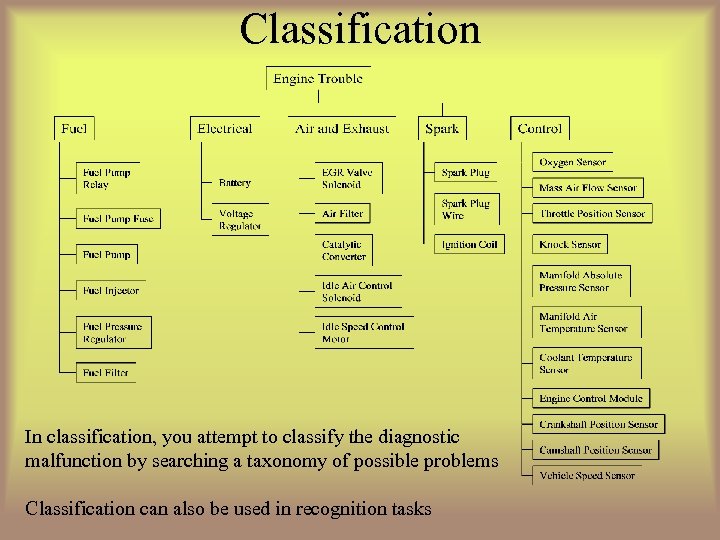 Classification In classification, you attempt to classify the diagnostic malfunction by searching a taxonomy of possible problems Classification can also be used in recognition tasks

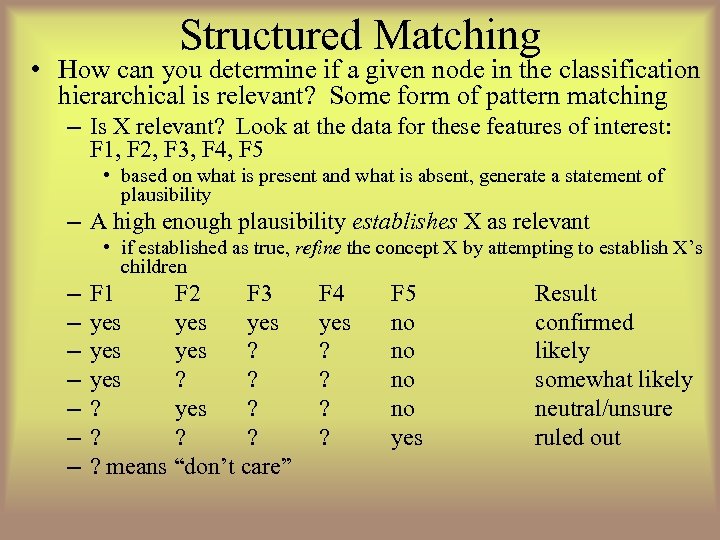 Structured Matching • How can you determine if a given node in the classification hierarchical is relevant? Some form of pattern matching – Is X relevant? Look at the data for these features of interest: F 1, F 2, F 3, F 4, F 5 • based on what is present and what is absent, generate a statement of plausibility – A high enough plausibility establishes X as relevant • if established as true, refine the concept X by attempting to establish X’s children – – – – F 1 F 2 F 3 yes yes yes ? ? ? means “don’t care” F 4 yes ? ? F 5 no no yes Result confirmed likely somewhat likely neutral/unsure ruled out
 More on GTs • Instead of implementing a problem solver by a specific approach like rules, might it be better to perform a task decomposition and then identify which generic task(s) should be applied? – this approach was found to be very successful in construction diagnostic, interpretation, design/planning and perception systems – some argued, much like Schank’s 11 primitive actions, that tasks should be defined at a different level (e. g. , proponents of the SOAR architecture thought that tasks were lower level derived through basic rule chaining and learning) • GT tools were constructed: – – – CSRL – classification DSPL – routine design Peirce – abductive assembly Hyper/RA – hypothesis matching/structured matching Fun. Rep – functional representation for simulation and what would happen if reasoning