 Скачать презентацию Kitakyushu Initiative Seminar on URBAN AIR QUALITY MANAGEMENT
c4d0ec3b2dc4eb375b7ca81a86b7e0c0.ppt
- Количество слайдов: 36



Kitakyushu Initiative Seminar on URBAN AIR QUALITY MANAGEMENT February 20 – 21, 2003 Bangkok, Thailand organized by UNITED NATIONS ECONOMIC AND SOCIAL COMMISSION FOR ASIA AND THE PACIFIC (UNESCAP) INSTITUTE FOR GLOBAL ENVIRONMENTAL STRATEGIES (IGES) presented by M. A. Khan, Chief, Environment Section Environmental and Sustainable Development Division 1

URBAN AIR QUALITY MANAGEMENT IN ASIA AND THE PACIFIC 1. Status of urban air pollution 2. Impacts of urban air pollution 3. Steps taken to control urban air pollution (a) Curative (b) Preventive 4. BEST PRACTICES i. KITAKYUSHU, JAPAN Reduction of SO 2 emissions & sulphur content of fuels ii. LANZHOU, CHINA Reduction of SO 2 & NOX emissions iii. GUIYANG, CHINA Reduction of SO 2 & TSP emissions iv. DALIAN, CHINA Reduction of SO 2, NO 2 & TSP emissions 2
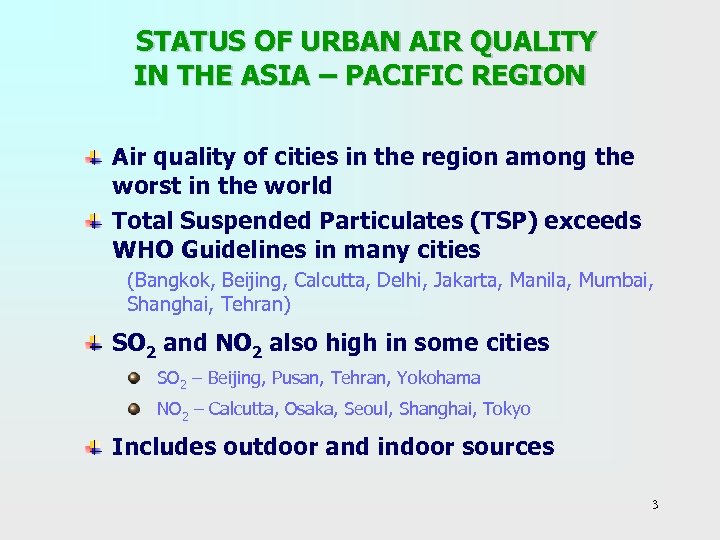
STATUS OF URBAN AIR QUALITY IN THE ASIA – PACIFIC REGION Air quality of cities in the region among the worst in the world Total Suspended Particulates (TSP) exceeds WHO Guidelines in many cities (Bangkok, Beijing, Calcutta, Delhi, Jakarta, Manila, Mumbai, Shanghai, Tehran) SO 2 and NO 2 also high in some cities SO 2 – Beijing, Pusan, Tehran, Yokohama NO 2 – Calcutta, Osaka, Seoul, Shanghai, Tokyo Includes outdoor and indoor sources 3
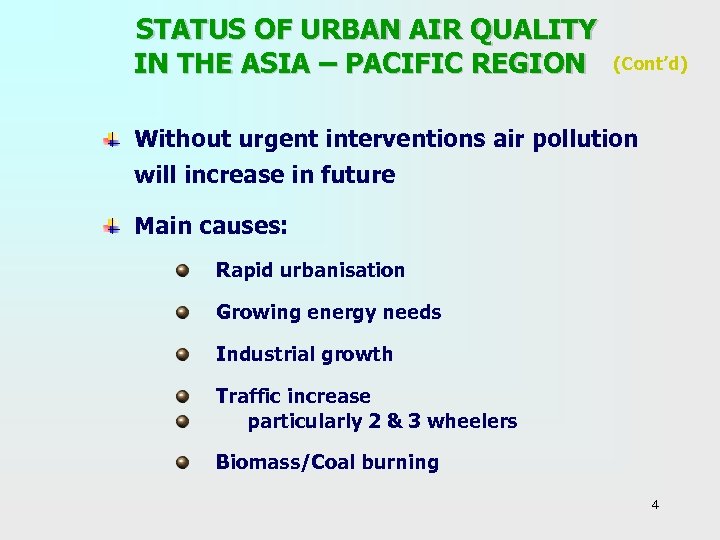
STATUS OF URBAN AIR QUALITY IN THE ASIA – PACIFIC REGION (Cont’d) Without urgent interventions air pollution will increase in future Main causes: Rapid urbanisation Growing energy needs Industrial growth Traffic increase particularly 2 & 3 wheelers Biomass/Coal burning 4
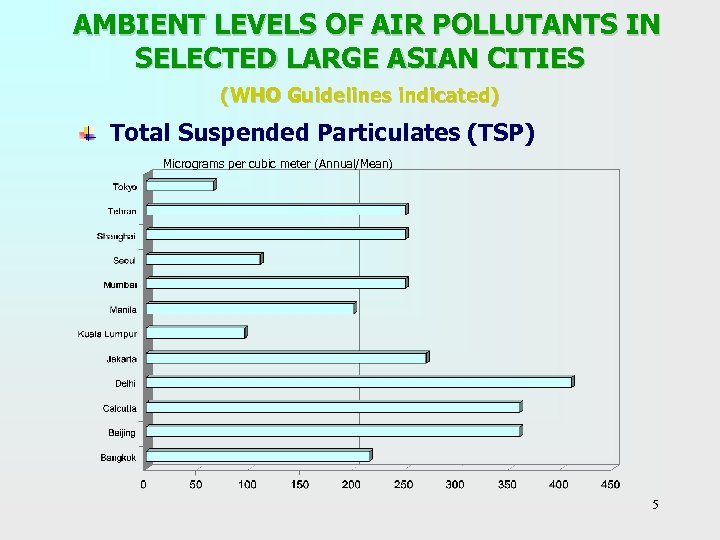
AMBIENT LEVELS OF AIR POLLUTANTS IN SELECTED LARGE ASIAN CITIES (WHO Guidelines indicated) Total Suspended Particulates (TSP) Micrograms per cubic meter (Annual/Mean) 5
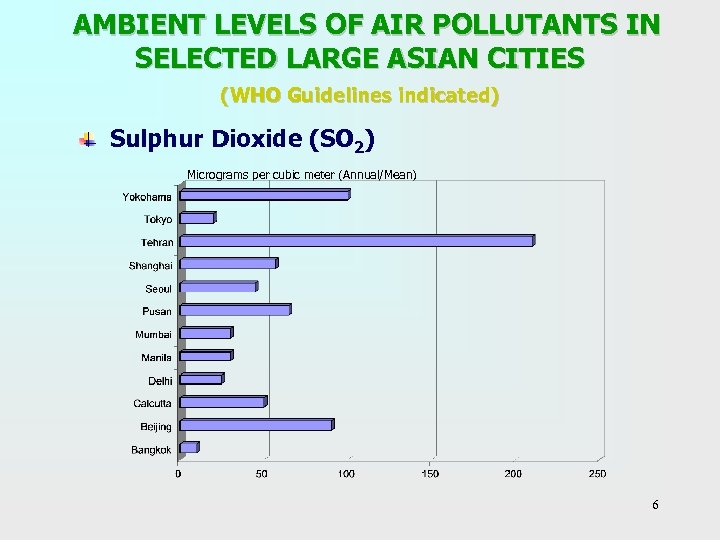
AMBIENT LEVELS OF AIR POLLUTANTS IN SELECTED LARGE ASIAN CITIES (WHO Guidelines indicated) Sulphur Dioxide (SO 2) Micrograms per cubic meter (Annual/Mean) 6
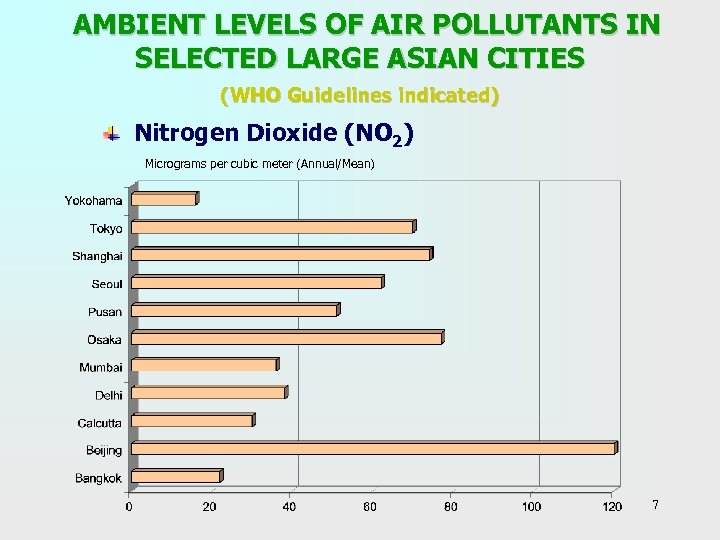
AMBIENT LEVELS OF AIR POLLUTANTS IN SELECTED LARGE ASIAN CITIES (WHO Guidelines indicated) Nitrogen Dioxide (NO 2) Micrograms per cubic meter (Annual/Mean) 7
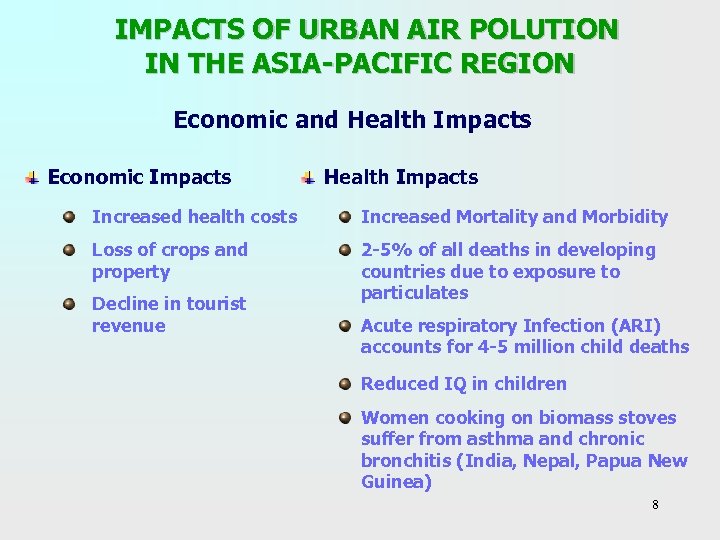
IMPACTS OF URBAN AIR POLUTION IN THE ASIA-PACIFIC REGION Economic and Health Impacts Economic Impacts Health Impacts Increased health costs Increased Mortality and Morbidity Loss of crops and property 2 -5% of all deaths in developing countries due to exposure to particulates Decline in tourist revenue Acute respiratory Infection (ARI) accounts for 4 -5 million child deaths Reduced IQ in children Women cooking on biomass stoves suffer from asthma and chronic bronchitis (India, Nepal, Papua New Guinea) 8
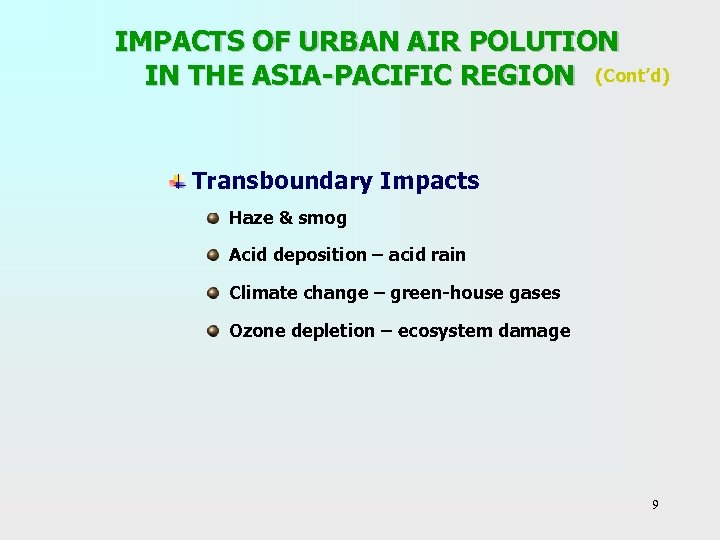
IMPACTS OF URBAN AIR POLUTION IN THE ASIA-PACIFIC REGION (Cont’d) Transboundary Impacts Haze & smog Acid deposition – acid rain Climate change – green-house gases Ozone depletion – ecosystem damage 9
STEPS TAKEN TO CONTROL URBAN AIR POLLUTION IN THE ASIA-PACIFIC REGION RESPONSES: Regulatory Measures Economic Instruments Technological Improvements 10

STEPS TAKEN TO CONTROL URBAN AIR POLLUTION IN THE ASIA-PACIFIC REGION (Cont’d) REGULATORY MEASURES Standards and Regulatory Authorities Enforcement-Stringent (Japan and Singapore) Phased (People’s Republic of China, India, Indonesia, Republic of Korea, Thailand) Public Awareness and Judicial Action (India) Environmental Impact Assessments (EIA’s) (People’s Republic of China, India, Japan, Pakistan, Thailand) Zoning Regulations (India, Japan, Singapore) 11
STEPS TAKEN TO CONTROL URBAN AIR POLLUTION IN THE ASIA-PACIFIC REGION (Cont’d) ECONOMIC INSTRUMENTS Taxes Based on Pollution Load Taxes for Using Leaded Gasoline Subsidies Tax Incentives for Cleaner Fuel Use 12
STEPS TAKEN TO CONTROL URBAN AIR POLLUTION (Cont’d) TECHNOLOGICAL IMPROVEMENTS/ CLEANER PRODUCTION ECONOMIC INSTRUMENTS Energy Efficient Industrial Processes Fuel-efficient Stoves Energy Efficient Appliances and Lighting Electrostatic Precipitators in Power Plants Cleaner Alternative Fuels Unleaded and low sulphur motor fuels Liquefied natural gas (LNG) 13
STEPS TAKEN TO CONTROL URBAN AIR POLLUTION (Cont’d) TECHNOLOGICAL IMPROVEMENTS/ CLEANER PRODUCTION ECONOMIC INSTRUMENTS Catalytic Converters Electric Vehicles Wind Power Photovoltaics 14
EFFORTS AT AMELIORATION AND CONTROL OF URBAN AIR POLLUTION (A) CURATIVE Enforce regulations stringently Adopt suitable best practices from other cities Identify and reduce air pollution loads by source Encourage public transport use Make cleaner fuel use mandatory - ban leaded gasoline and high sulphur diesel Encourage bi-fuel, electric and LNG vehicles Identify and reduce sources of indoor air pollution 15
EFFORTS AT AMELIORATION AND CONTROL OF URBAN AIR POLLUTION (A) CURATIVE (Cont’d) Ensure local industries have adopted cleaner production methods are not feasible Strengthen local authority initiatives and enhance partnerships Encourage intercity cooperation Enhance cooperation between local and national governments Enforce vehicle inspection and maintenance Institute better traffic management and procedures 16
EFFORTS AT AMELIORATION AND CONTROL OF URBAN AIR POLLUTION (B) PREVENTIVE Obtain political commitment (macro policy) Draft and adopt suitable regulations and standards Identify and adopt appropriate technologies Promote environmental education and public awareness Invite stakeholder participation in pollution reduction activities Seek consensus on actions 17
EFFORTS AT AMELIORATION AND CONTROL OF URBAN AIR POLLUTION (B) PREVENTIVE (Cont’d) Ensure proper project component appraisals Ensure adequate training of local environmental administration staff Encourage private sector participation in air quality management initiatives Identify key pollutants, sources, institutions, stakeholders Supervise implementation and draw upon experiences from lessons learned 18
EFFORTS AT AMELIORATION AND CONTROL OF URBAN AIR POLLUTION (B) PREVENTIVE (Cont’d) Promote pro-active land-use planning Explore least cost solutions - undertake economic analysis of options Reduce open burning Reduce dust on roads 19
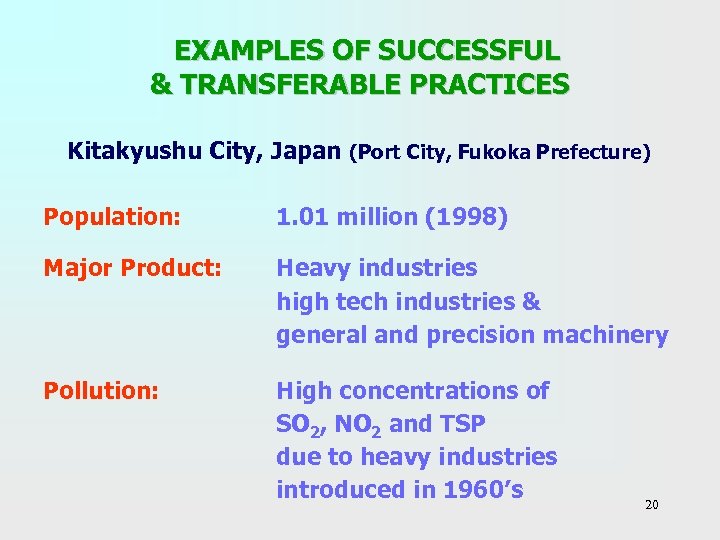
EXAMPLES OF SUCCESSFUL & TRANSFERABLE PRACTICES Kitakyushu City, Japan (Port City, Fukoka Prefecture) Population: 1. 01 million (1998) Major Product: Heavy industries high tech industries & general and precision machinery Pollution: High concentrations of SO 2, NO 2 and TSP due to heavy industries introduced in 1960’s 20

ion: - esp sour. in ce d Publ eple ic - P tion rivat e - C om m unit al re
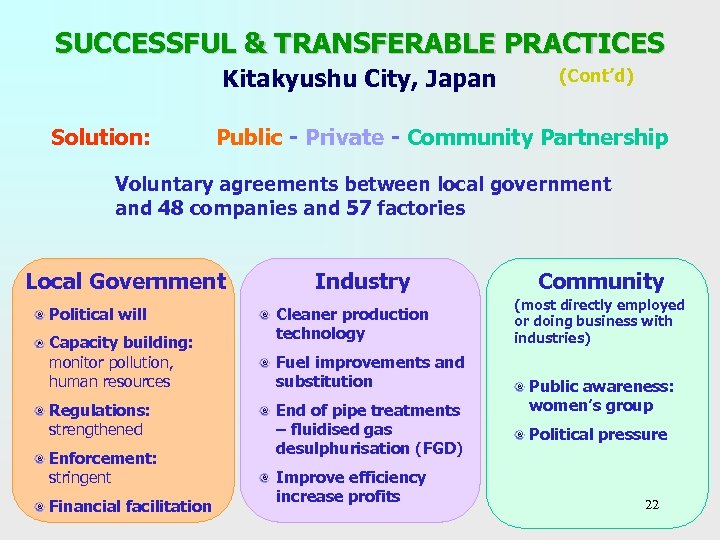
SUCCESSFUL & TRANSFERABLE PRACTICES Kitakyushu City, Japan Solution: (Cont’d) Public - Private - Community Partnership Voluntary agreements between local government and 48 companies and 57 factories Local Government Political will Capacity building: monitor pollution, human resources Regulations: strengthened Enforcement: stringent Financial facilitation Industry Cleaner production technology Fuel improvements and substitution End of pipe treatments – fluidised gas desulphurisation (FGD) Improve efficiency increase profits Community (most directly employed or doing business with industries) Public awareness: women’s group Political pressure 22
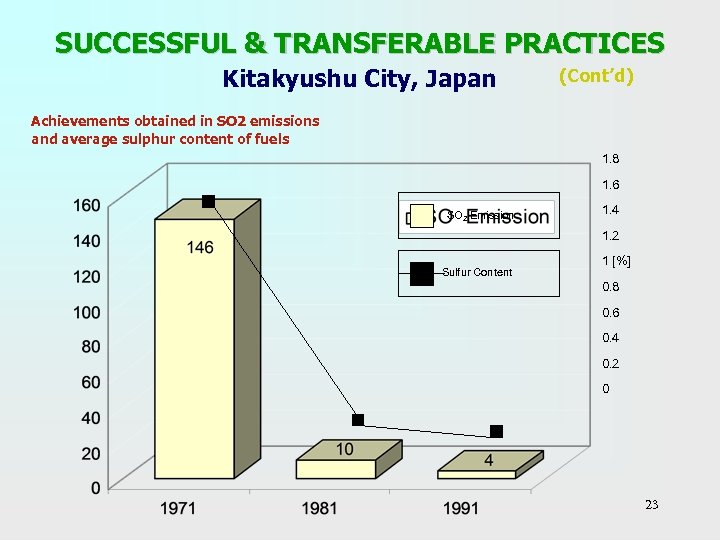
SUCCESSFUL & TRANSFERABLE PRACTICES Kitakyushu City, Japan (Cont’d) Achievements obtained in SO 2 emissions and average sulphur content of fuels 1. 8 1. 6 SO 2 Emission 1. 4 1. 2 Sulfur Content 1 [%] 0. 8 0. 6 0. 4 0. 2 0 23
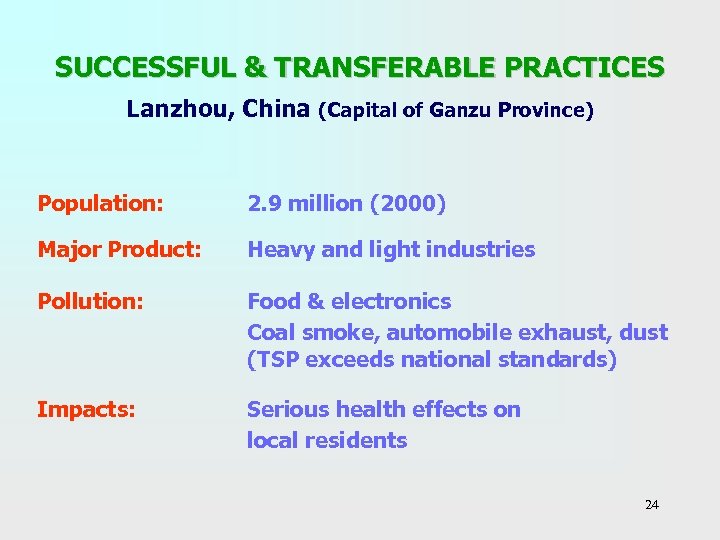
SUCCESSFUL & TRANSFERABLE PRACTICES Lanzhou, China (Capital of Ganzu Province) Population: 2. 9 million (2000) Major Product: Heavy and light industries Pollution: Food & electronics Coal smoke, automobile exhaust, dust (TSP exceeds national standards) Impacts: Serious health effects on local residents 24
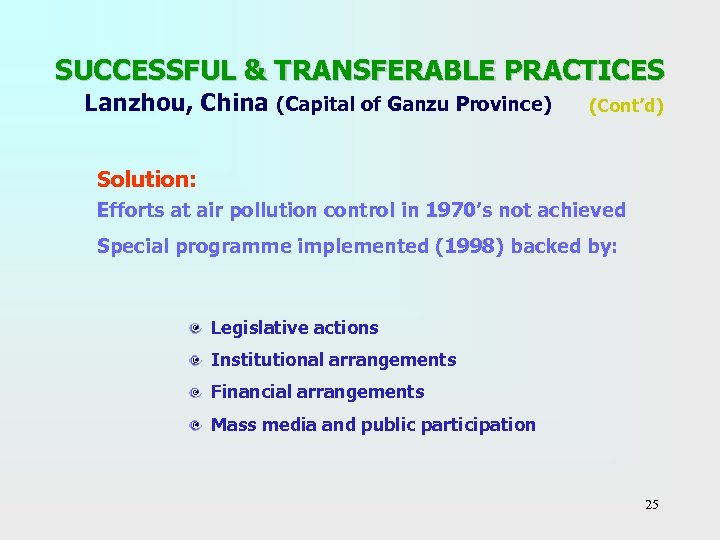
SUCCESSFUL & TRANSFERABLE PRACTICES Lanzhou, China (Capital of Ganzu Province) (Cont’d) Solution: Efforts at air pollution control in 1970’s not achieved Special programme implemented (1998) backed by: Legislative actions Institutional arrangements Financial arrangements Mass media and public participation 25
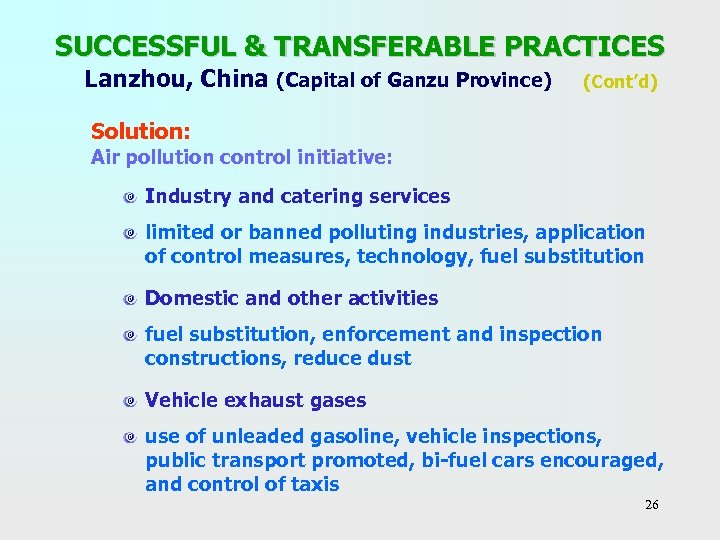
SUCCESSFUL & TRANSFERABLE PRACTICES Lanzhou, China (Capital of Ganzu Province) (Cont’d) Solution: Air pollution control initiative: Industry and catering services limited or banned polluting industries, application of control measures, technology, fuel substitution Domestic and other activities fuel substitution, enforcement and inspection constructions, reduce dust Vehicle exhaust gases use of unleaded gasoline, vehicle inspections, public transport promoted, bi-fuel cars encouraged, and control of taxis 26
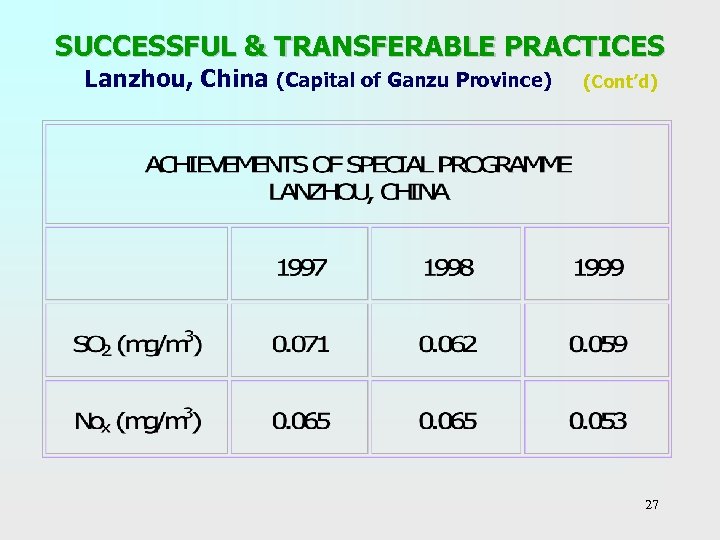
SUCCESSFUL & TRANSFERABLE PRACTICES Lanzhou, China (Capital of Ganzu Province) (Cont’d) 27
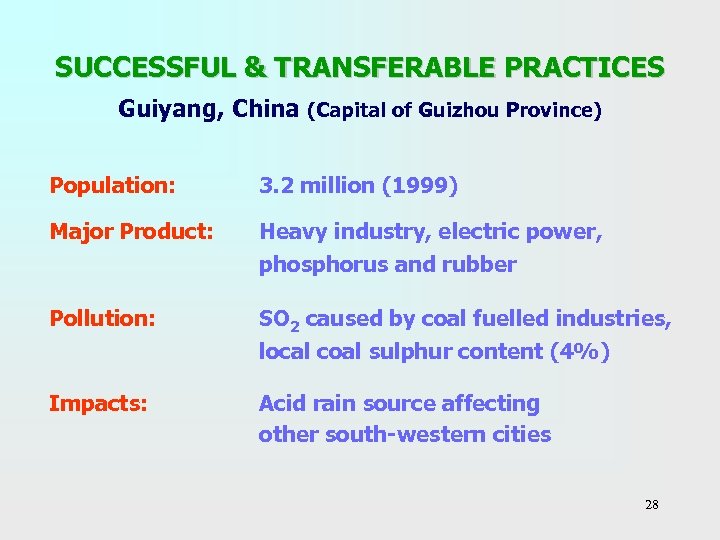
SUCCESSFUL & TRANSFERABLE PRACTICES Guiyang, China (Capital of Guizhou Province) Population: 3. 2 million (1999) Major Product: Heavy industry, electric power, phosphorus and rubber Pollution: SO 2 caused by coal fuelled industries, local coal sulphur content (4%) Impacts: Acid rain source affecting other south-western cities 28
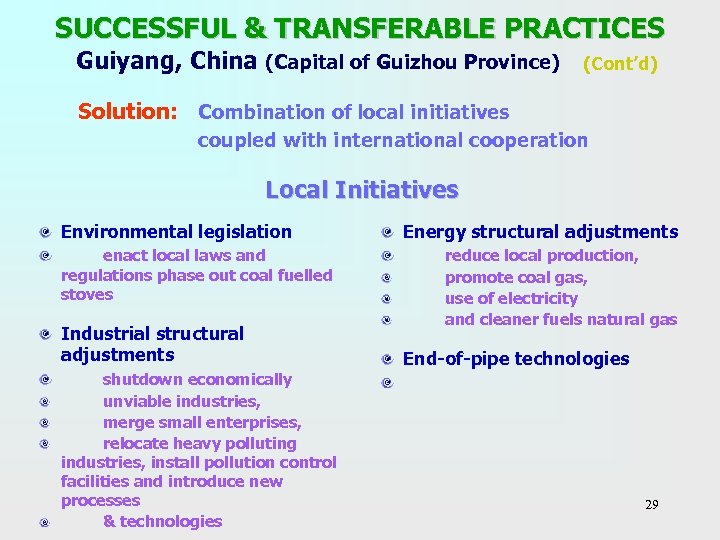
SUCCESSFUL & TRANSFERABLE PRACTICES Guiyang, China (Capital of Guizhou Province) (Cont’d) Solution: Combination of local initiatives coupled with international cooperation Local Initiatives Environmental legislation enact local laws and regulations phase out coal fuelled stoves Industrial structural adjustments shutdown economically unviable industries, merge small enterprises, relocate heavy polluting industries, install pollution control facilities and introduce new processes & technologies Energy structural adjustments reduce local production, promote coal gas, use of electricity and cleaner fuels natural gas End-of-pipe technologies 29
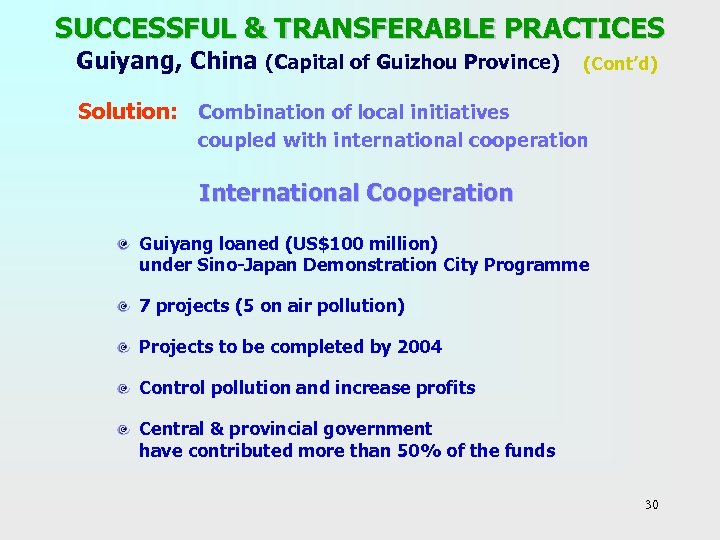
SUCCESSFUL & TRANSFERABLE PRACTICES Guiyang, China (Capital of Guizhou Province) (Cont’d) Solution: Combination of local initiatives coupled with international cooperation International Cooperation Guiyang loaned (US$100 million) under Sino-Japan Demonstration City Programme 7 projects (5 on air pollution) Projects to be completed by 2004 Control pollution and increase profits Central & provincial government have contributed more than 50% of the funds 30
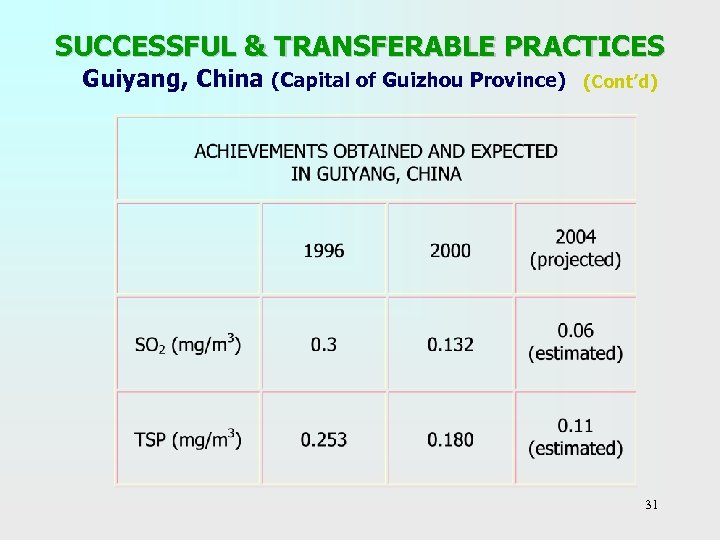
SUCCESSFUL & TRANSFERABLE PRACTICES Guiyang, China (Capital of Guizhou Province) (Cont’d) 31
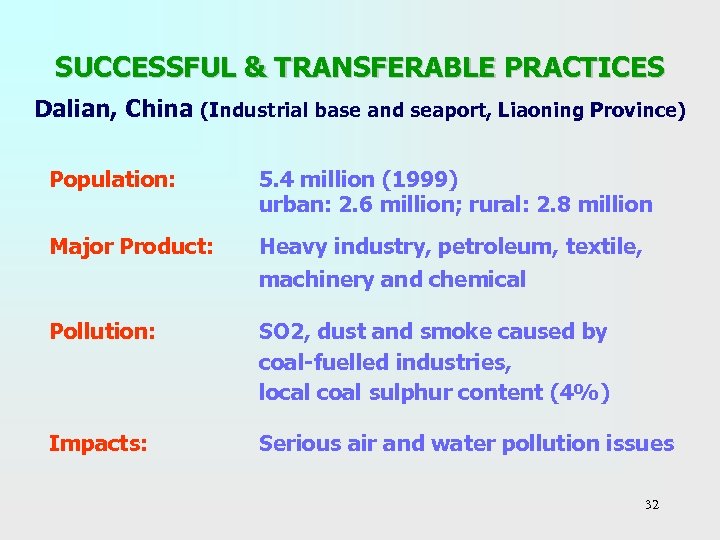
SUCCESSFUL & TRANSFERABLE PRACTICES Dalian, China (Industrial base and seaport, Liaoning Province) Population: 5. 4 million (1999) urban: 2. 6 million; rural: 2. 8 million Major Product: Heavy industry, petroleum, textile, machinery and chemical Pollution: SO 2, dust and smoke caused by coal-fuelled industries, local coal sulphur content (4%) Impacts: Serious air and water pollution issues 32
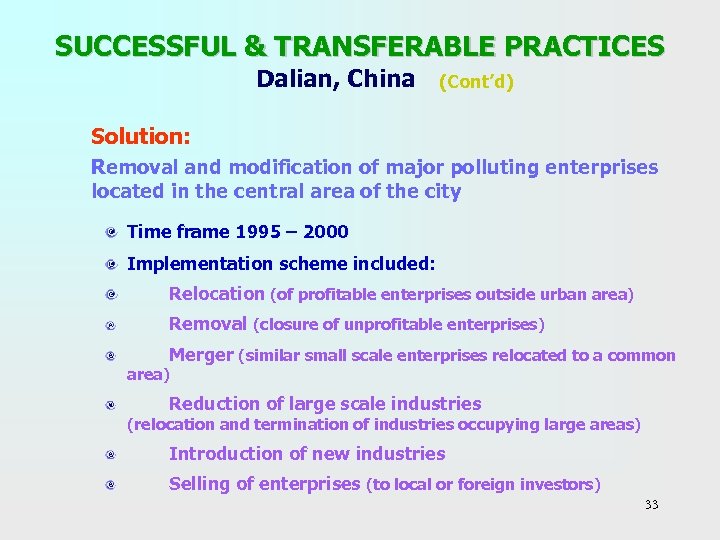
SUCCESSFUL & TRANSFERABLE PRACTICES Dalian, China (Cont’d) Solution: Removal and modification of major polluting enterprises located in the central area of the city Time frame 1995 – 2000 Implementation scheme included: Relocation (of profitable enterprises outside urban area) Removal (closure of unprofitable enterprises) Merger (similar small scale enterprises relocated to a common area) Reduction of large scale industries (relocation and termination of industries occupying large areas) Introduction of new industries Selling of enterprises (to local or foreign investors) 33
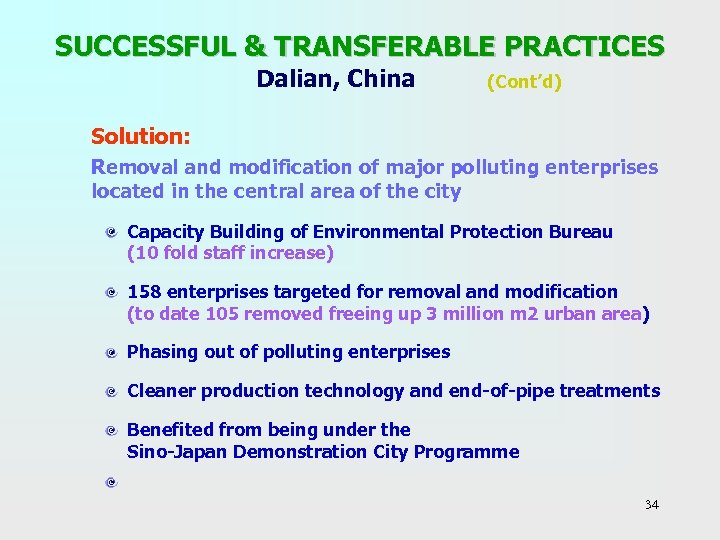
SUCCESSFUL & TRANSFERABLE PRACTICES Dalian, China (Cont’d) Solution: Removal and modification of major polluting enterprises located in the central area of the city Capacity Building of Environmental Protection Bureau (10 fold staff increase) 158 enterprises targeted for removal and modification (to date 105 removed freeing up 3 million m 2 urban area) Phasing out of polluting enterprises Cleaner production technology and end-of-pipe treatments Benefited from being under the Sino-Japan Demonstration City Programme 34
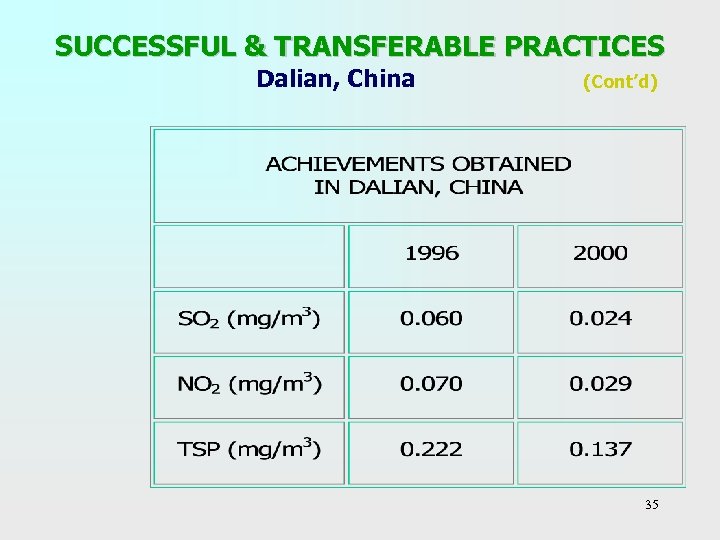
SUCCESSFUL & TRANSFERABLE PRACTICES Dalian, China (Cont’d) 35

36
Скачать презентацию Kitakyushu Initiative Seminar on URBAN AIR QUALITY MANAGEMENT
c4d0ec3b2dc4eb375b7ca81a86b7e0c0.ppt