


 Скачать презентацию Kirchoff s Laws Chapter 3 Circuit Definitions
5afe6a1fd6108a097ee2b65bf510b09f.ppt
- Количество слайдов: 36
 Kirchoff’s Laws Chapter 3
 Circuit Definitions • Node – any point where 2 or more circuit elements are connected together – Wires usually have negligible resistance – Each node has one voltage (w. r. t. ground) • Branch – a circuit element between two nodes • Loop – a collection of branches that form a closed path returning to the same node without going through any other nodes or branches twice
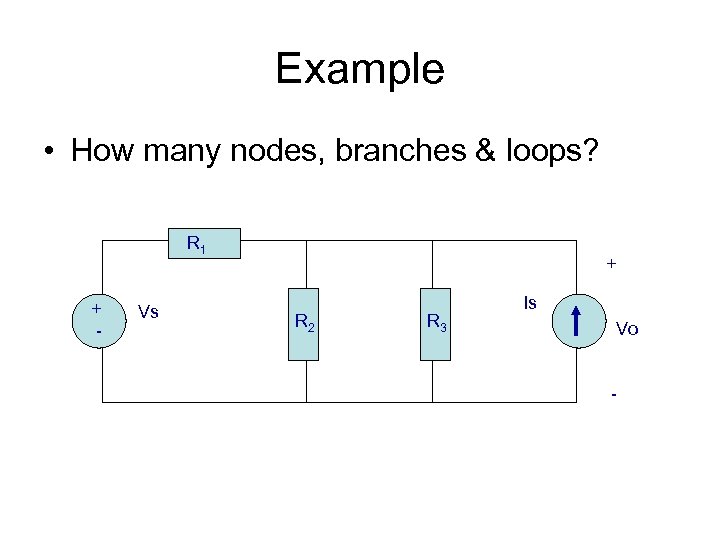 Example • How many nodes, branches & loops? R 1 + - Vs + R 2 R 3 Is Vo -
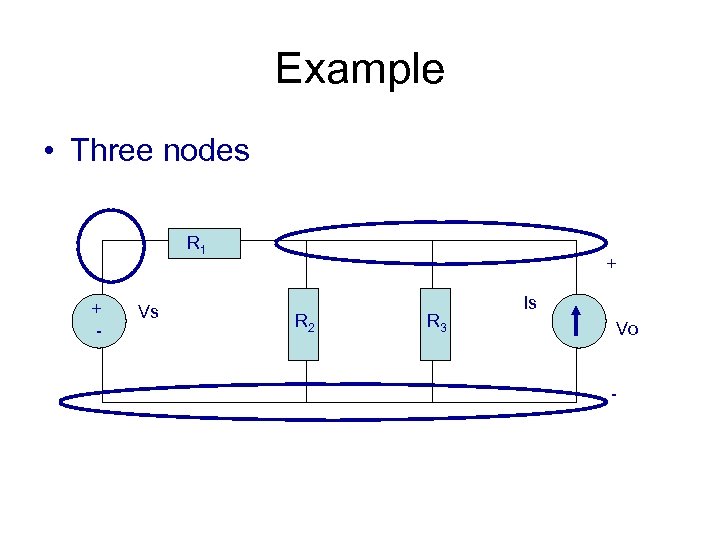 Example • Three nodes R 1 + - Vs + R 2 R 3 Is Vo -
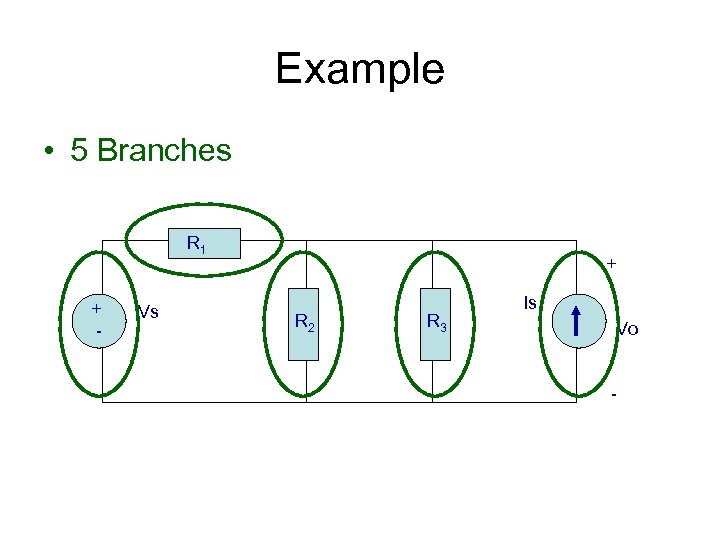 Example • 5 Branches R 1 + - Vs + R 2 R 3 Is Vo -
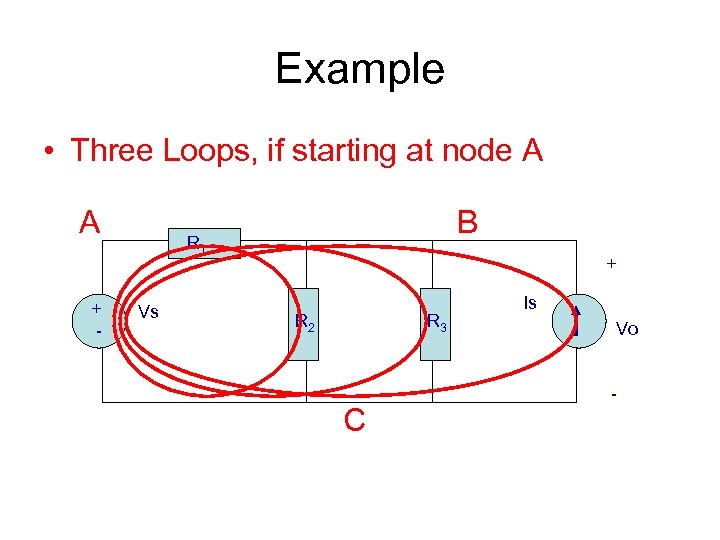 Example • Three Loops, if starting at node A A + - B R 1 Vs + R 2 R 3 C Is Vo -
 Kirchoff’s Voltage Law (KVL) • The algebraic sum of voltages around each loop is zero – Beginning with one node, add voltages across each branch in the loop (if you encounter a + sign first) and subtract voltages (if you encounter a – sign first) • Σ voltage drops - Σ voltage rises = 0 • Or Σ voltage drops = Σ voltage rises
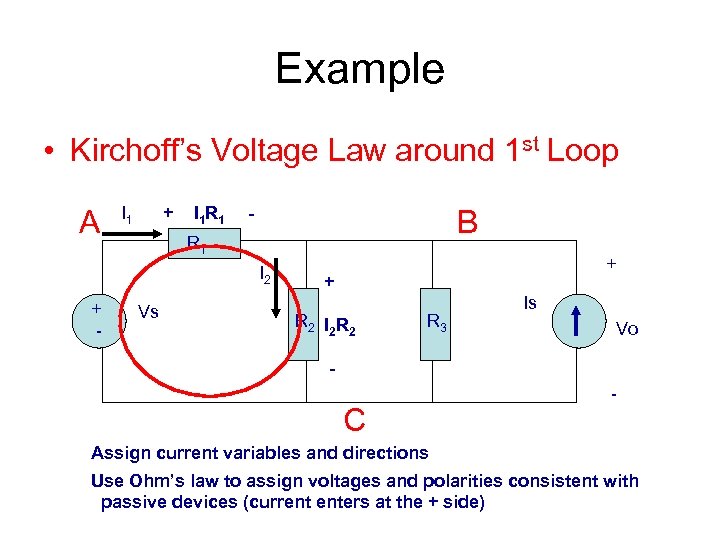 Example • Kirchoff’s Voltage Law around 1 st Loop A I 1 + I 1 R 1 - B R 1 I 2 + - Vs + + R 2 I 2 R 3 Is Vo - C - Assign current variables and directions Use Ohm’s law to assign voltages and polarities consistent with passive devices (current enters at the + side)
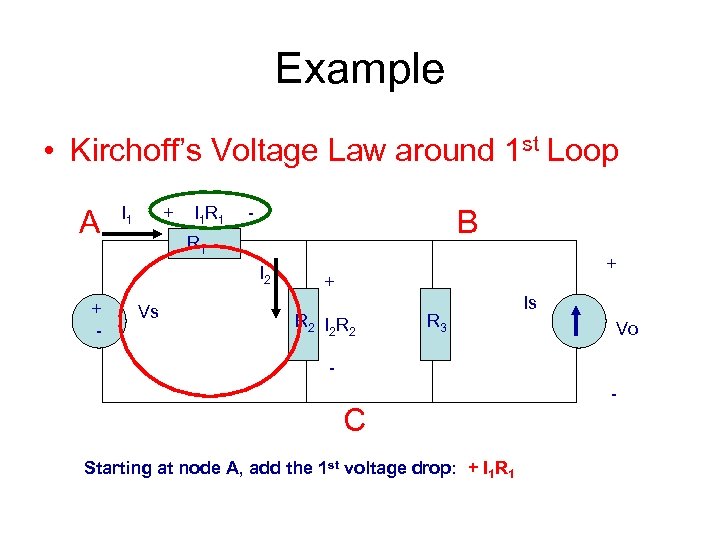 Example • Kirchoff’s Voltage Law around 1 st Loop A I 1 + I 1 R 1 - B R 1 I 2 + - Vs + + R 2 I 2 R 3 Is Vo - C Starting at node A, add the 1 st voltage drop: + I 1 R 1 -
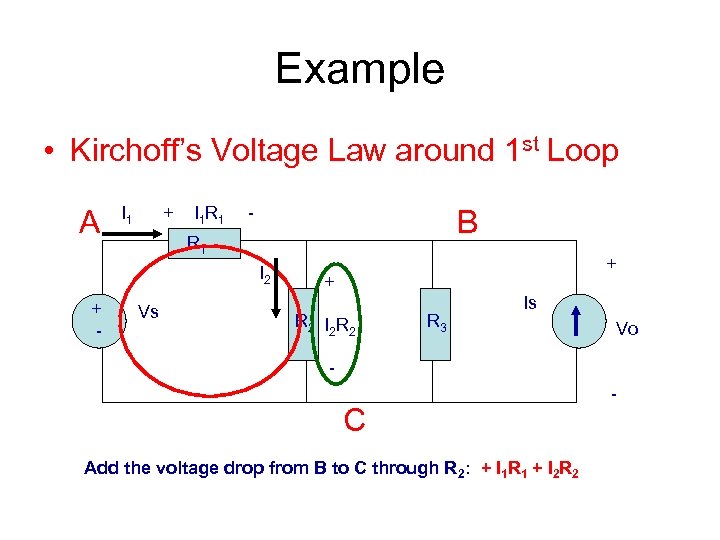 Example • Kirchoff’s Voltage Law around 1 st Loop A I 1 + I 1 R 1 - B R 1 I 2 + - Vs + + R 2 I 2 R 3 Is Vo - C Add the voltage drop from B to C through R 2: + I 1 R 1 + I 2 R 2 -
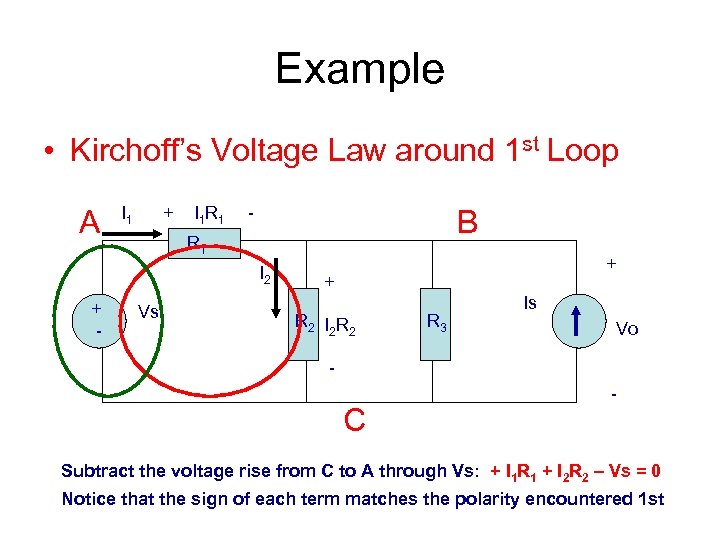 Example • Kirchoff’s Voltage Law around 1 st Loop A I 1 + I 1 R 1 - B R 1 I 2 + - Vs + + R 2 I 2 R 3 Is Vo - C - Subtract the voltage rise from C to A through Vs: + I 1 R 1 + I 2 R 2 – Vs = 0 Notice that the sign of each term matches the polarity encountered 1 st
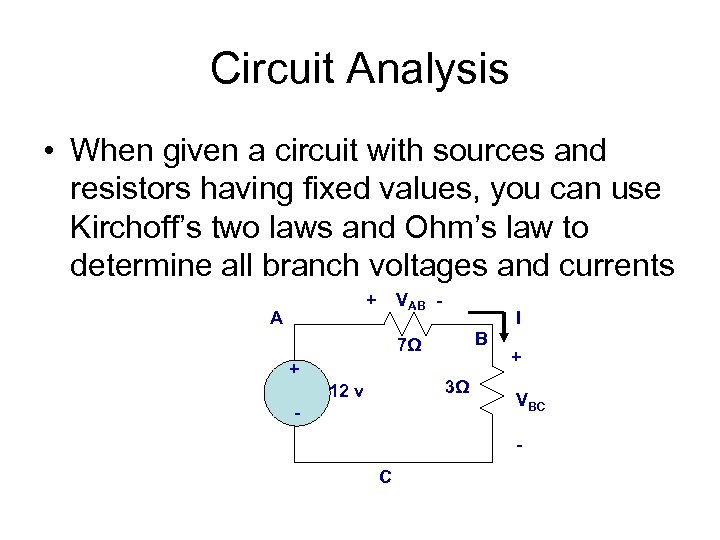 Circuit Analysis • When given a circuit with sources and resistors having fixed values, you can use Kirchoff’s two laws and Ohm’s law to determine all branch voltages and currents + A VAB - I B 7Ω + 3Ω 12 v - + VBC - C
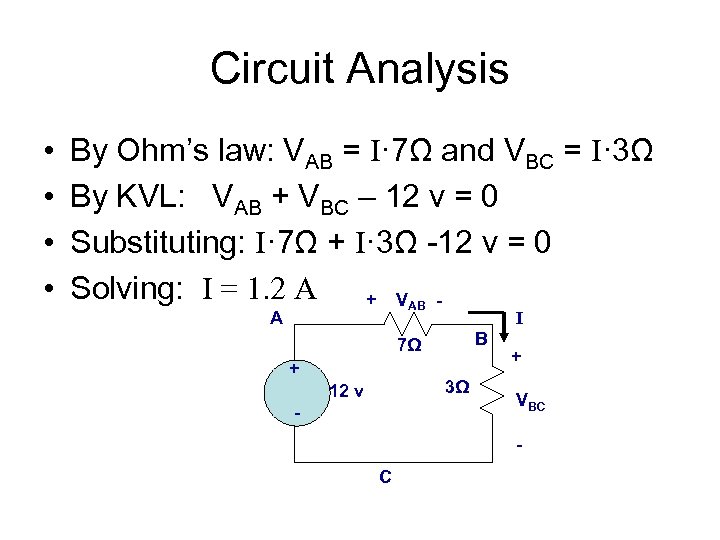 Circuit Analysis • • By Ohm’s law: VAB = I· 7Ω and VBC = I· 3Ω By KVL: VAB + VBC – 12 v = 0 Substituting: I· 7Ω + I· 3Ω -12 v = 0 Solving: I = 1. 2 A + V AB A I B 7Ω + 3Ω 12 v - + VBC - C
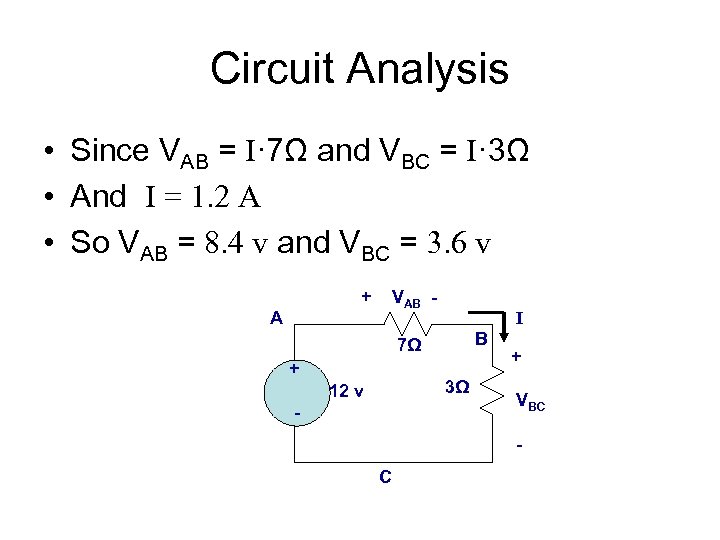 Circuit Analysis • Since VAB = I· 7Ω and VBC = I· 3Ω • And I = 1. 2 A • So VAB = 8. 4 v and VBC = 3. 6 v + A VAB - I B 7Ω + 3Ω 12 v - + VBC - C
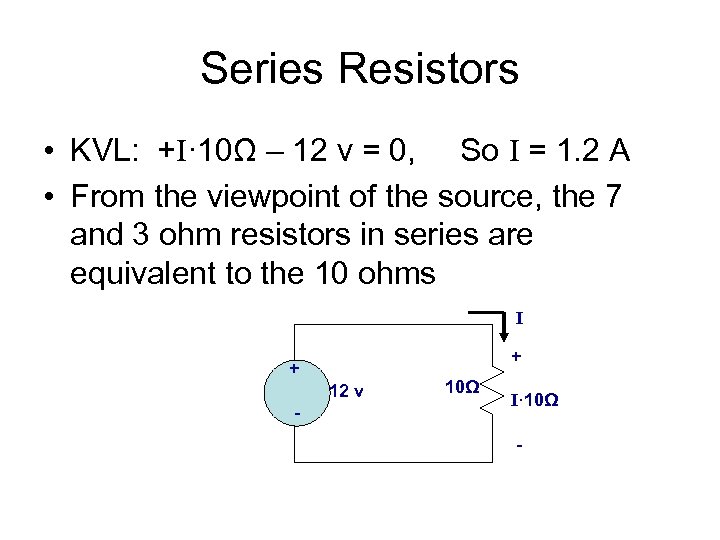 Series Resistors • KVL: +I· 10Ω – 12 v = 0, So I = 1. 2 A • From the viewpoint of the source, the 7 and 3 ohm resistors in series are equivalent to the 10 ohms I + + 12 v - 10Ω I· 10Ω -
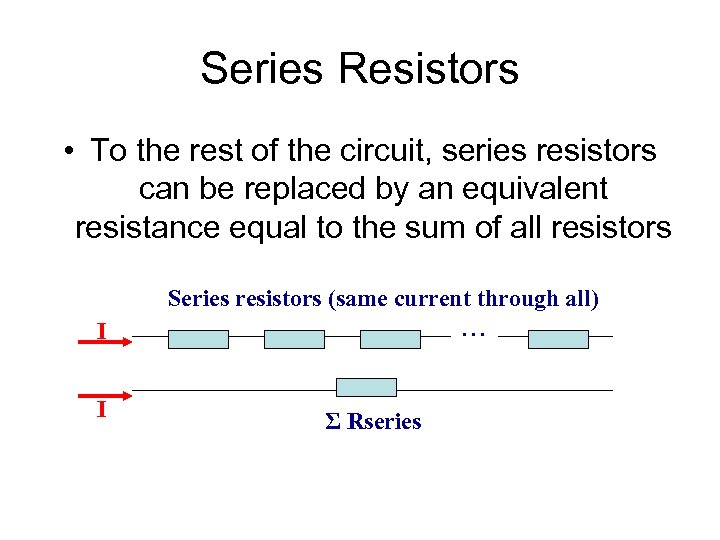 Series Resistors • To the rest of the circuit, series resistors can be replaced by an equivalent resistance equal to the sum of all resistors Series resistors (same current through all) I I . . . Σ Rseries
 Kirchoff’s Current Law (KCL) • The algebraic sum of currents entering a node is zero – Add each branch current entering the node and subtract each branch current leaving the node • Σ currents in - Σ currents out = 0 • Or Σ currents in = Σ currents out
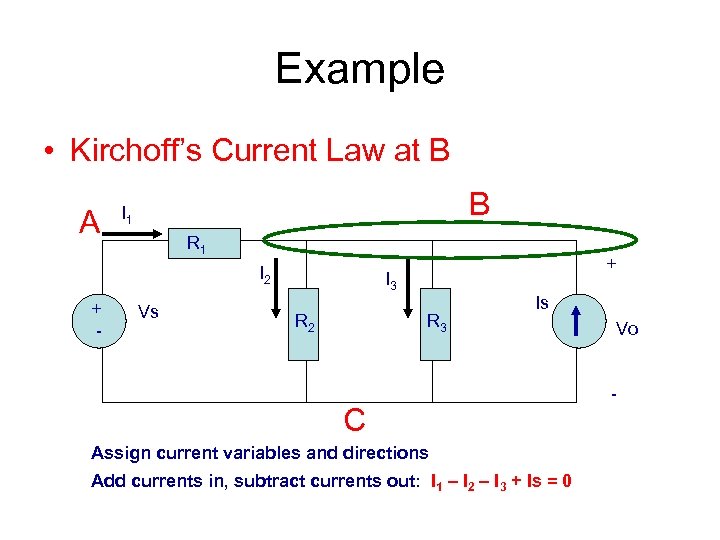 Example • Kirchoff’s Current Law at B A B I 1 R 1 I 2 + - Vs + I 3 R 2 R 3 Is C Assign current variables and directions Add currents in, subtract currents out: I 1 – I 2 – I 3 + Is = 0 Vo -
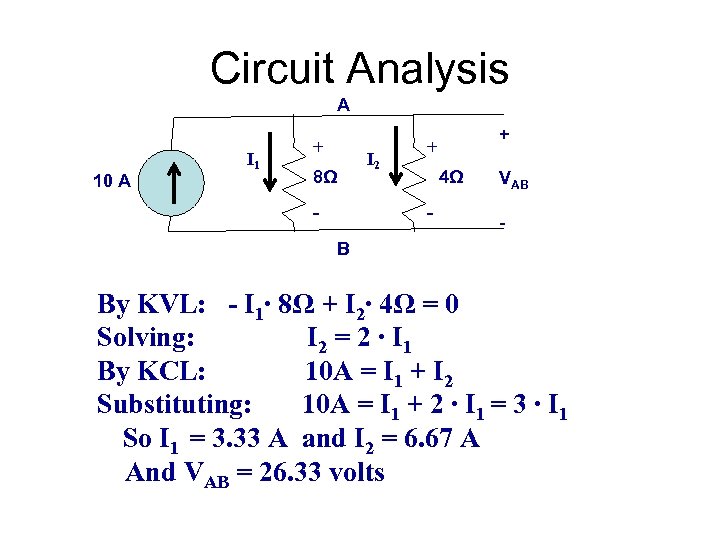 Circuit Analysis A 10 A I 1 + 8Ω - I 2 + + 4Ω - VAB - B By KVL: - I 1∙ 8Ω + I 2∙ 4Ω = 0 Solving: I 2 = 2 ∙ I 1 By KCL: 10 A = I 1 + I 2 Substituting: 10 A = I 1 + 2 ∙ I 1 = 3 ∙ I 1 So I 1 = 3. 33 A and I 2 = 6. 67 A And VAB = 26. 33 volts
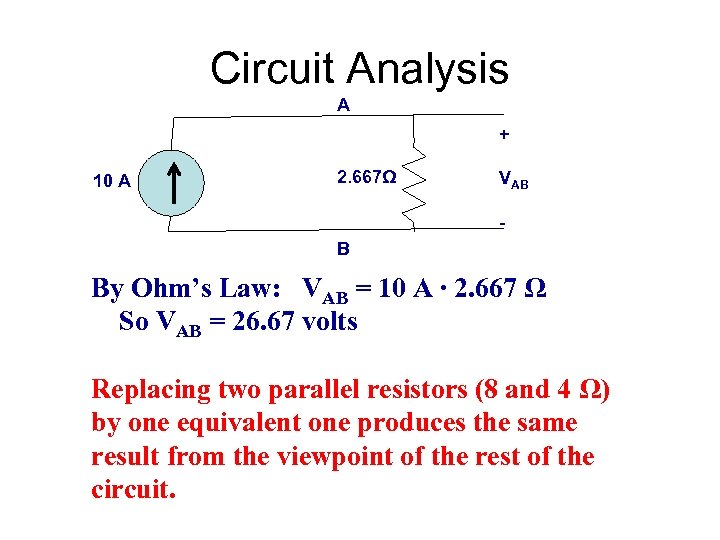 Circuit Analysis A + 10 A 2. 667Ω VAB - B By Ohm’s Law: VAB = 10 A ∙ 2. 667 Ω So VAB = 26. 67 volts Replacing two parallel resistors (8 and 4 Ω) by one equivalent one produces the same result from the viewpoint of the rest of the circuit.
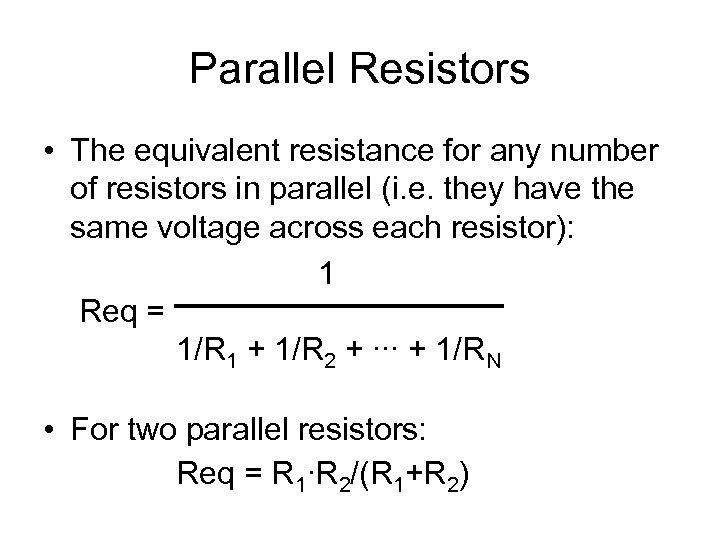 Parallel Resistors • The equivalent resistance for any number of resistors in parallel (i. e. they have the same voltage across each resistor): 1 Req = 1/R 1 + 1/R 2 + ∙∙∙ + 1/RN • For two parallel resistors: Req = R 1∙R 2/(R 1+R 2)
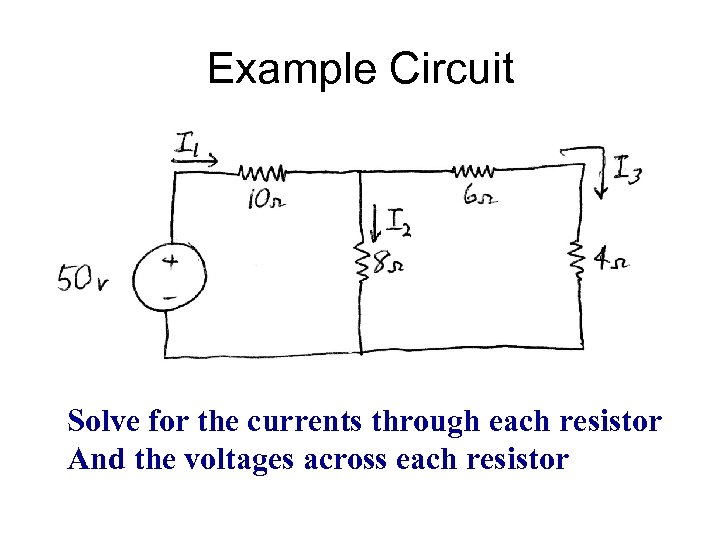 Example Circuit Solve for the currents through each resistor And the voltages across each resistor
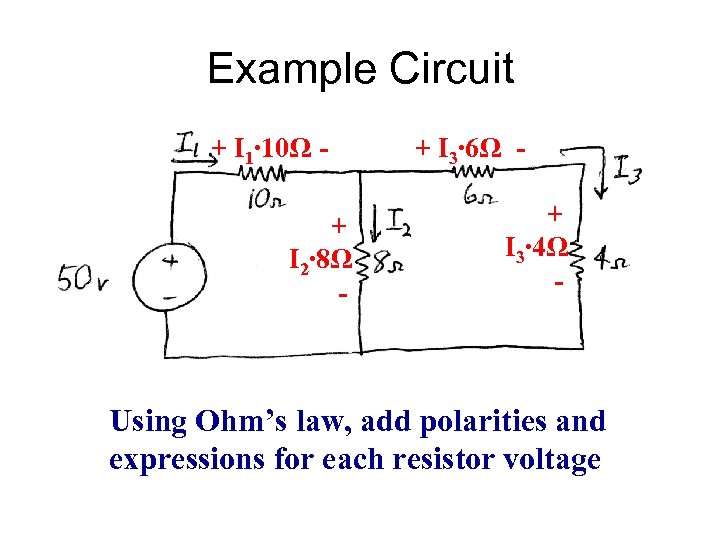 Example Circuit + I 1∙ 10Ω + I 2∙ 8Ω - + I 3∙ 6Ω + I 3∙ 4Ω - Using Ohm’s law, add polarities and expressions for each resistor voltage
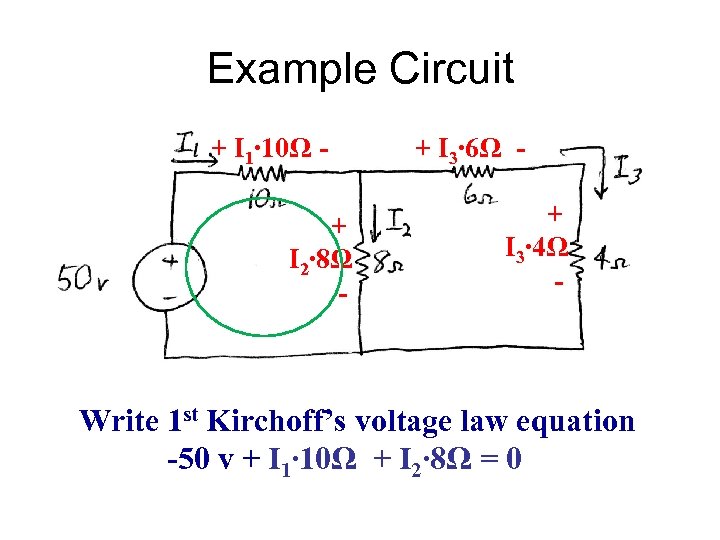 Example Circuit + I 1∙ 10Ω + I 2∙ 8Ω - + I 3∙ 6Ω + I 3∙ 4Ω - Write 1 st Kirchoff’s voltage law equation -50 v + I 1∙ 10Ω + I 2∙ 8Ω = 0
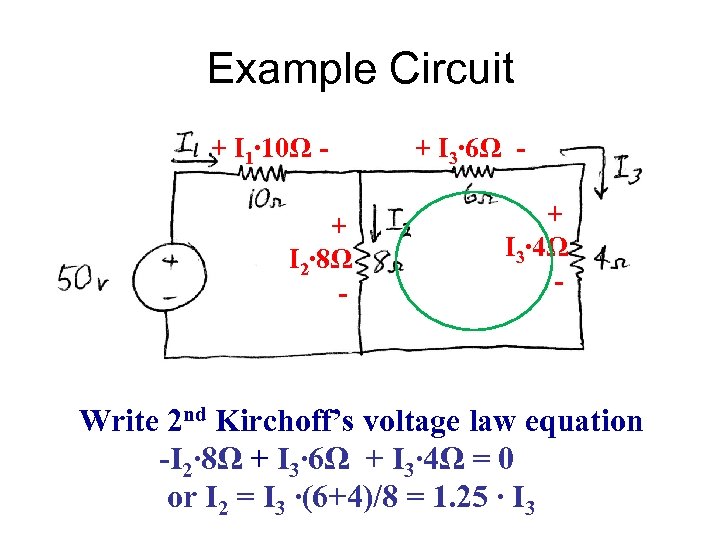 Example Circuit + I 1∙ 10Ω + I 2∙ 8Ω - + I 3∙ 6Ω + I 3∙ 4Ω - Write 2 nd Kirchoff’s voltage law equation -I 2∙ 8Ω + I 3∙ 6Ω + I 3∙ 4Ω = 0 or I 2 = I 3 ∙(6+4)/8 = 1. 25 ∙ I 3
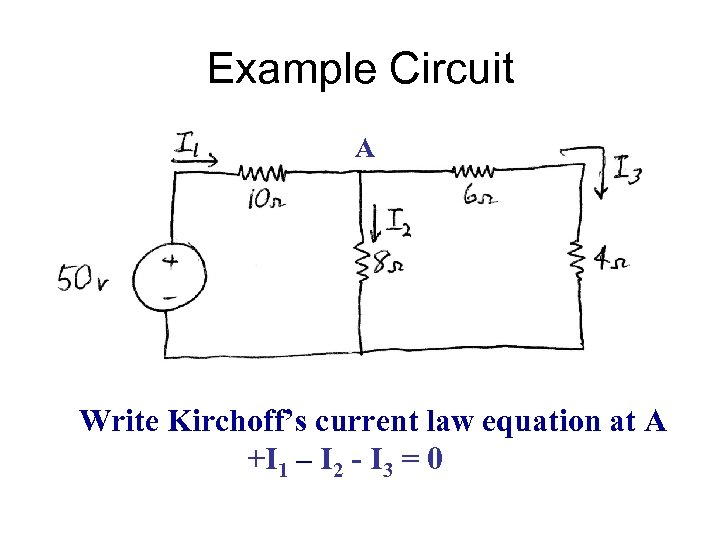 Example Circuit A Write Kirchoff’s current law equation at A +I 1 – I 2 - I 3 = 0
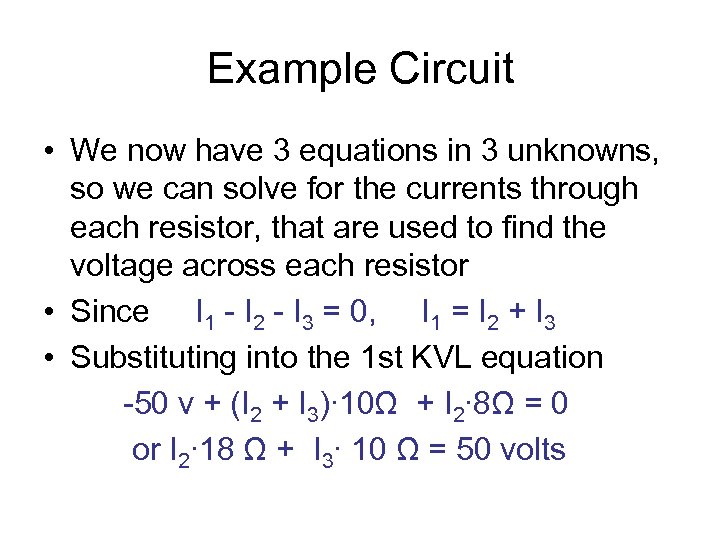 Example Circuit • We now have 3 equations in 3 unknowns, so we can solve for the currents through each resistor, that are used to find the voltage across each resistor • Since I 1 - I 2 - I 3 = 0, I 1 = I 2 + I 3 • Substituting into the 1 st KVL equation -50 v + (I 2 + I 3)∙ 10Ω + I 2∙ 8Ω = 0 or I 2∙ 18 Ω + I 3∙ 10 Ω = 50 volts
 Example Circuit • But from the 2 nd KVL equation, I 2 = 1. 25∙I 3 • Substituting into 1 st KVL equation: (1. 25 ∙ I 3)∙ 18 Ω + I 3 ∙ 10 Ω = 50 volts Or: I 3 ∙ 22. 5 Ω + I 3 ∙ 10 Ω = 50 volts Or: I 3∙ 32. 5 Ω = 50 volts Or: I 3 = 50 volts/32. 5 Ω Or: I 3 = 1. 538 amps
 Example Circuit • Since I 3 = 1. 538 amps I 2 = 1. 25∙I 3 = 1. 923 amps • Since I 1 = I 2 + I 3, I 1 = 3. 461 amps • The voltages across the resistors: I 1∙ 10Ω = 34. 61 volts I 2∙ 8Ω = 15. 38 volts I 3∙ 6Ω = 9. 23 volts I 3∙ 4Ω = 6. 15 volts
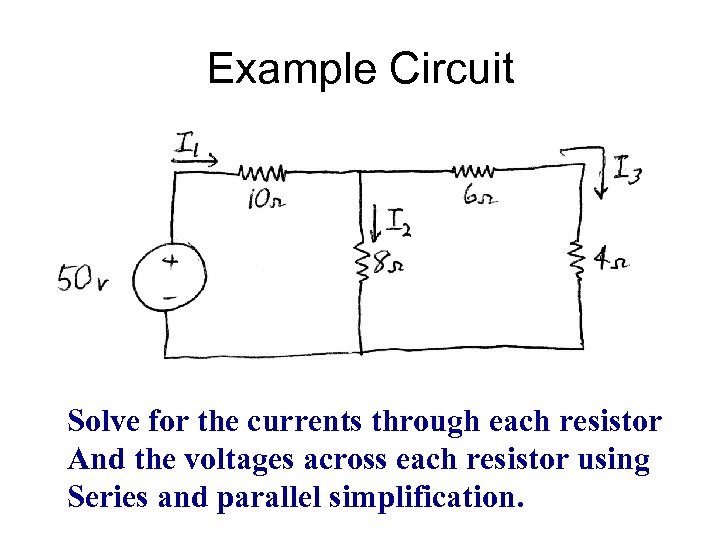 Example Circuit Solve for the currents through each resistor And the voltages across each resistor using Series and parallel simplification.
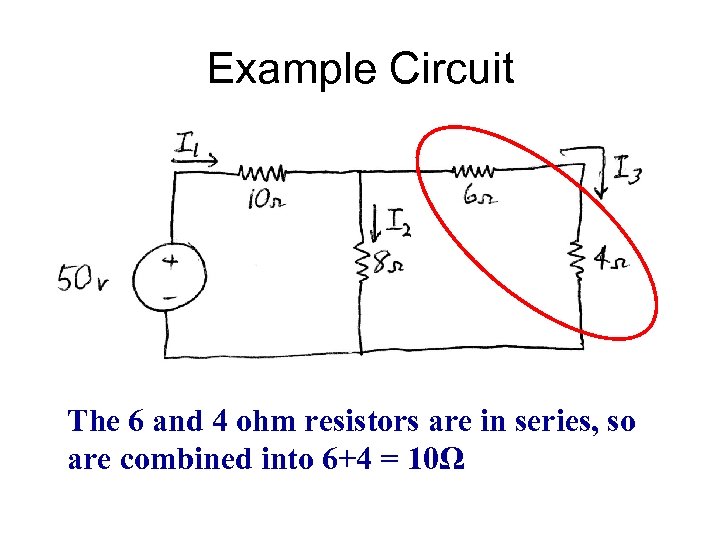 Example Circuit The 6 and 4 ohm resistors are in series, so are combined into 6+4 = 10Ω
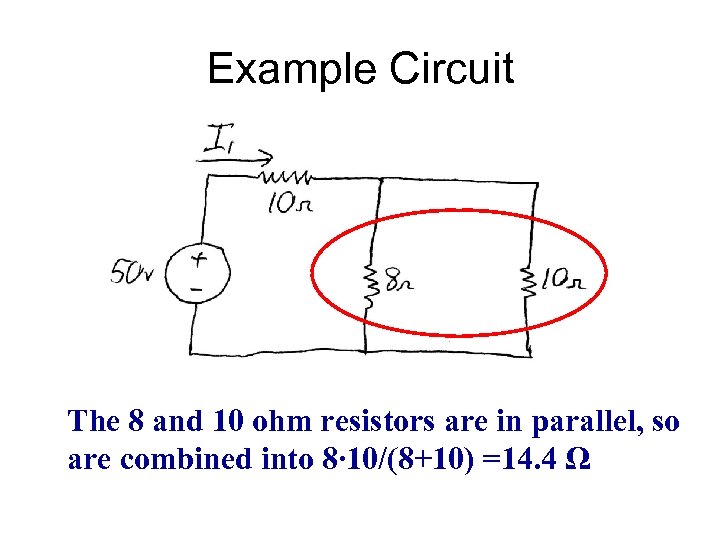 Example Circuit The 8 and 10 ohm resistors are in parallel, so are combined into 8∙ 10/(8+10) =14. 4 Ω
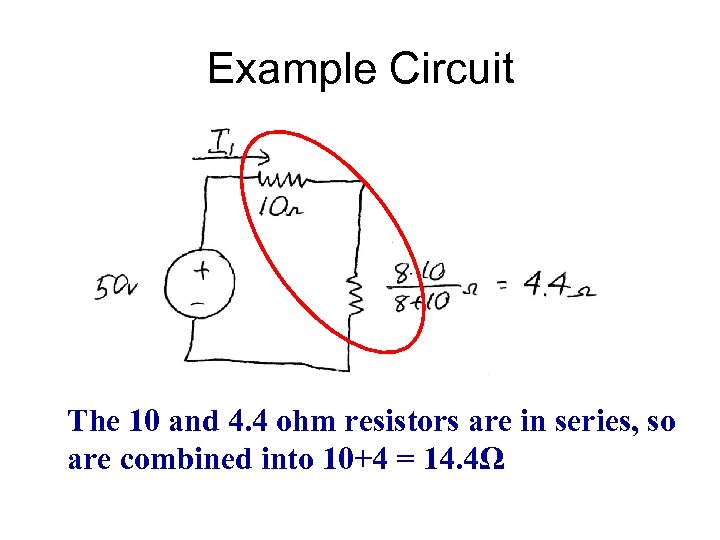 Example Circuit The 10 and 4. 4 ohm resistors are in series, so are combined into 10+4 = 14. 4Ω
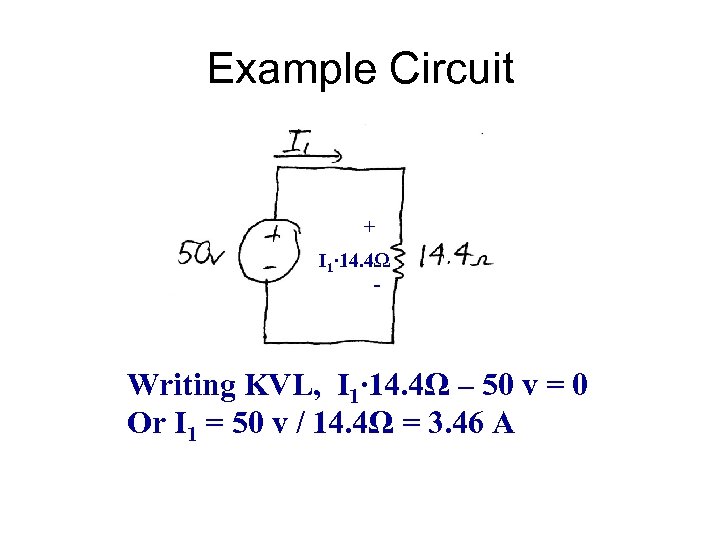 Example Circuit + I 1∙ 14. 4Ω - Writing KVL, I 1∙ 14. 4Ω – 50 v = 0 Or I 1 = 50 v / 14. 4Ω = 3. 46 A
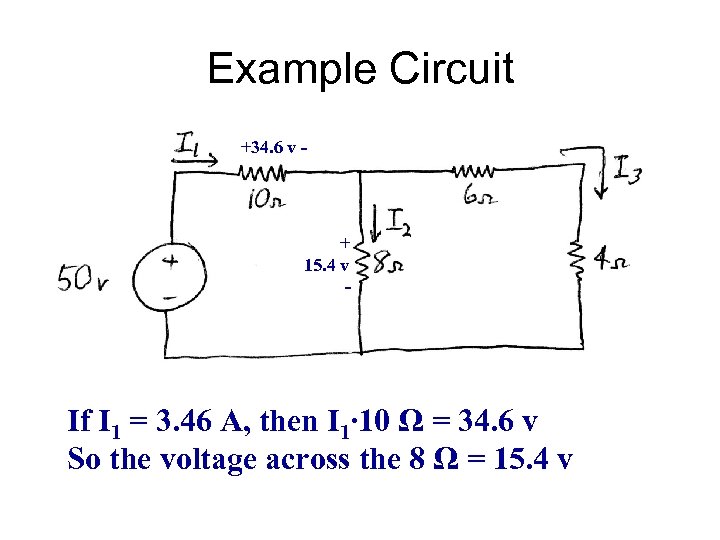 Example Circuit +34. 6 v - + 15. 4 v - If I 1 = 3. 46 A, then I 1∙ 10 Ω = 34. 6 v So the voltage across the 8 Ω = 15. 4 v
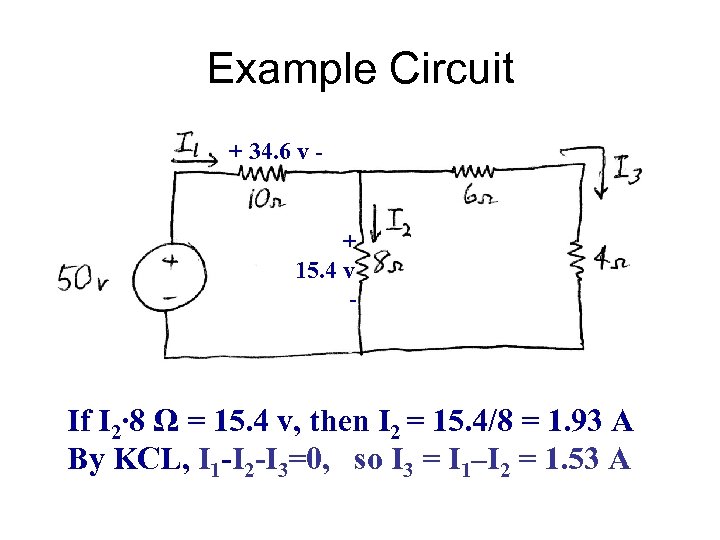 Example Circuit + 34. 6 v - + 15. 4 v - If I 2∙ 8 Ω = 15. 4 v, then I 2 = 15. 4/8 = 1. 93 A By KCL, I 1 -I 2 -I 3=0, so I 3 = I 1–I 2 = 1. 53 A