


 Скачать презентацию King Fahd University of Petroleum and Minerals Computer
76c9bb7ef912474ce58c0d5db8bac4f4.ppt
- Количество слайдов: 39
 King Fahd University of Petroleum and Minerals, Computer Engineering Department Product Development • A short Guide • By • Dr. Muhammad Elrabaa 1
 Contents n Introduction To product Development n Design Specifications n Cost Estimation 2
 Introduction n Product development starts with defining the specs. This is the most important phase. The developer has to think carefully about the product potential markets and users (demographics). This requires market surveys, surveying similar products (sizing up the competition) to make one’s product competitive enough to ensure profitability. n Then we proceed with an initial design targeting these specs. n After that comes the cost/price estimation. If the cost does not match the demographics, then we have to redesign to meet the cost needs. In any engineering product, a basic trade-off exists between cost and performance, one can always be traded for the other. 3
 Product Specifications Points to be discussed • • • Types. Structure. Forms. Typical Content of specification. Preparation of specification. Continual improvement. 4
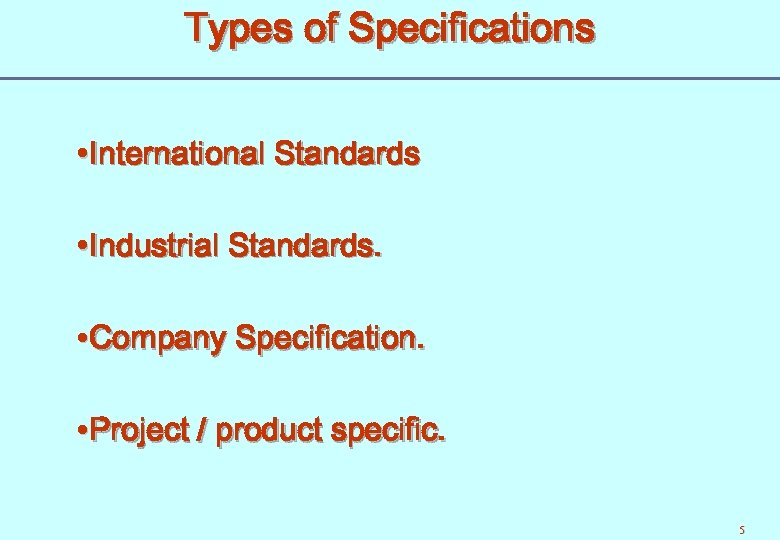 Types of Specifications International Standards Industrial Standards. Company Specification. Project / product specific. 5
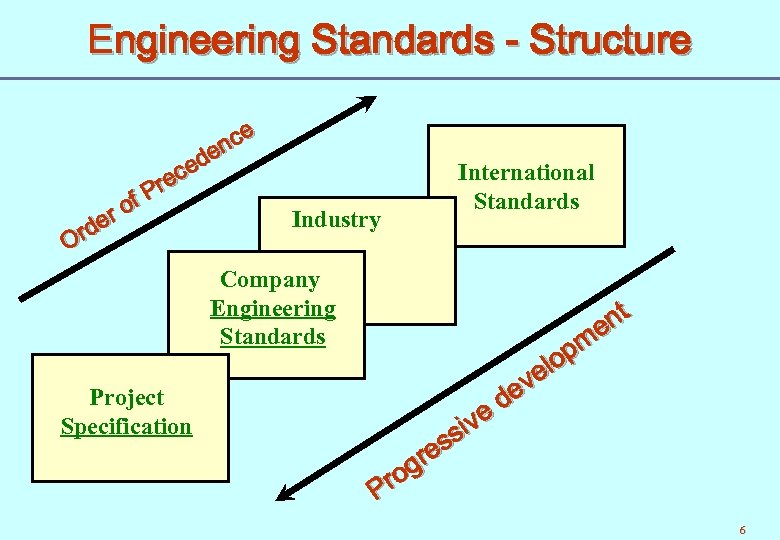 Engineering Standards - Structure e nc e ed rec P of Industry er d Or Company Engineering Standards Project Specification International Standards ive ss re g ro P nt e pm elo ev d 6
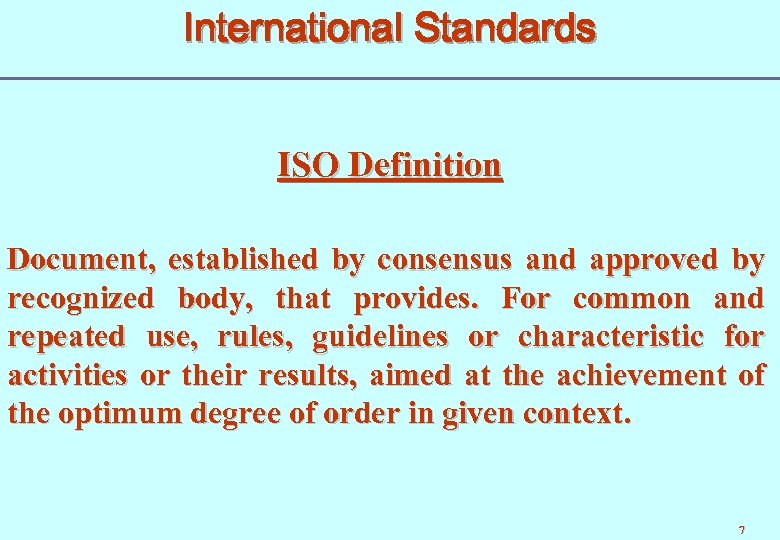 International Standards ISO Definition Document, established by consensus and approved by recognized body, that provides. For common and repeated use, rules, guidelines or characteristic for activities or their results, aimed at the achievement of the optimum degree of order in given context. 7
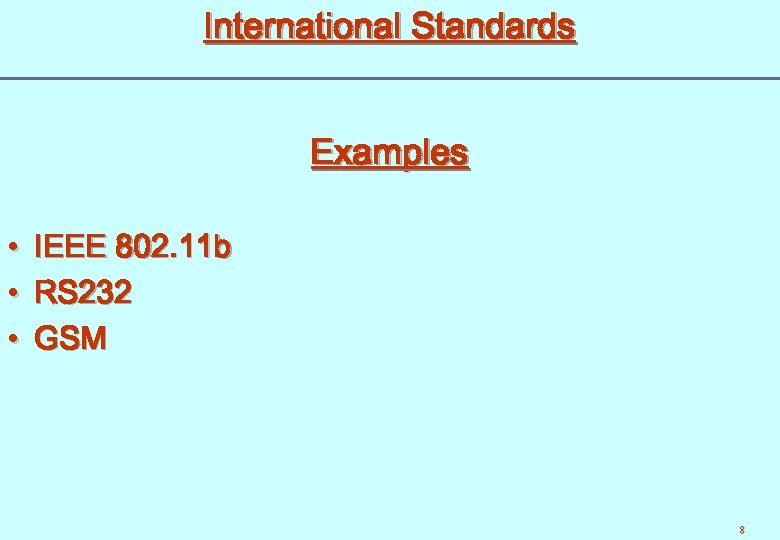 International Standards Examples • • • IEEE 802. 11 b RS 232 GSM 8
 Industry Standards Document developed by a recognized international industrial organization operating in specific industry to formalizes polices and provide rules and guidance for the initiation, generation and maintenance of design and Engineering practices, learned over a period of time and resulted from diversified application. 9
 Local / Company Standard Document developed by an operating company to provide technical guidance and recommendations based on the experience gained in the company, for specific operation, over a considerable period of time and in a specific geographical location. 10
 Project / Product Specification Document developed to define the technical requirements that apply for specific project or product. 11
 Forms of Specification. Stand-alone specifications Fully elaborated document contains all technical requirement. They requires extensive efforts to prepare and maintain with lot of repetition. Amendment to applicable standards Brief document referring to the existing standards and specify changes as applicable Functional specifications. It is a statement of requirement. 12
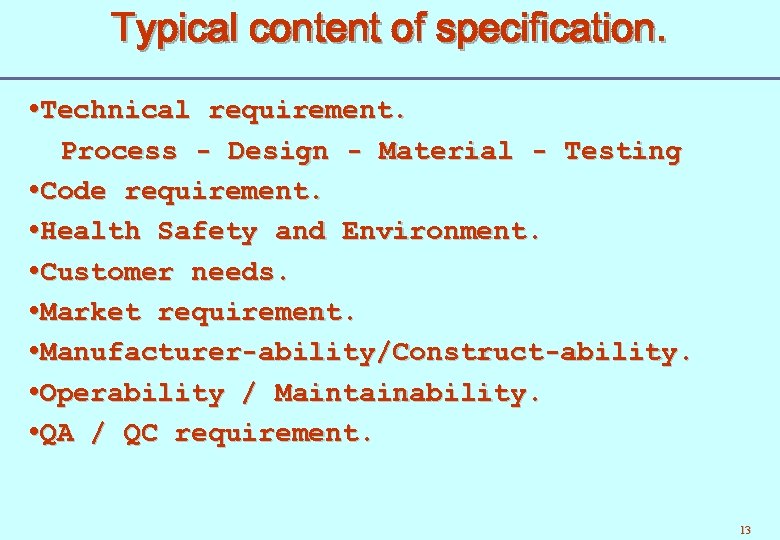 Typical content of specification. Technical requirement. Process - Design - Material - Testing Code requirement. Health Safety and Environment. Customer needs. Market requirement. Manufacturer-ability/Construct-ability. Operability / Maintainability. QA / QC requirement. 13
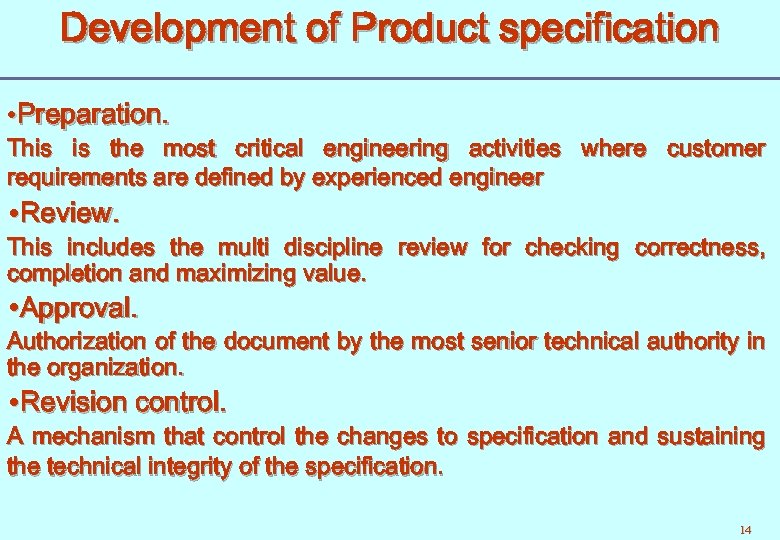 Development of Product specification • Preparation. This is the most critical engineering activities where customer requirements are defined by experienced engineer Review. This includes the multi discipline review for checking correctness, completion and maximizing value. Approval. Authorization of the document by the most senior technical authority in the organization. Revision control. A mechanism that control the changes to specification and sustaining the technical integrity of the specification. 14
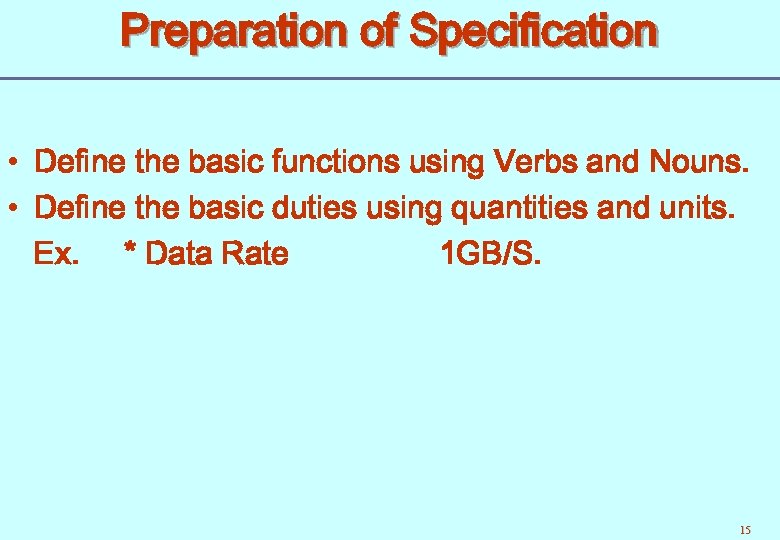 Preparation of Specification • Define the basic functions using Verbs and Nouns. • Define the basic duties using quantities and units. Ex. * Data Rate 1 GB/S. 15
 Preparation of Specification • Check process conditions. • Operation conditions. • Determine design features. 16
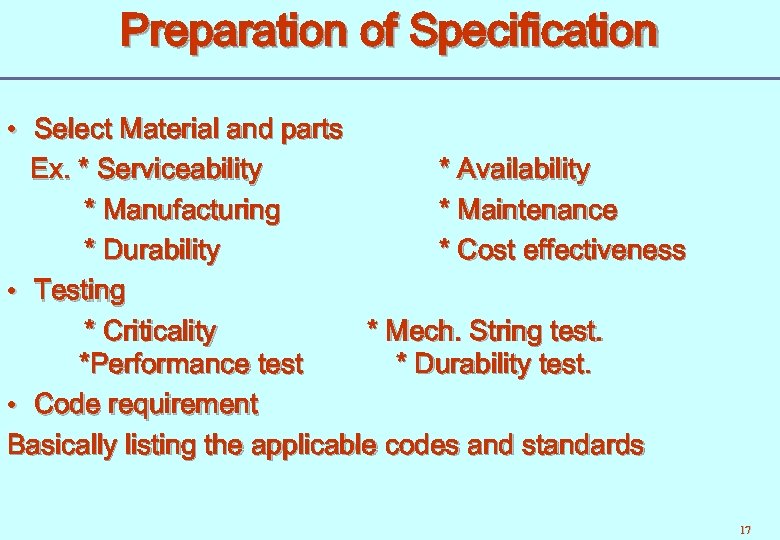 Preparation of Specification • Select Material and parts Ex. * Serviceability * Availability * Manufacturing * Maintenance * Durability * Cost effectiveness • Testing * Criticality * Mech. String test. *Performance test * Durability test. • Code requirement Basically listing the applicable codes and standards 17
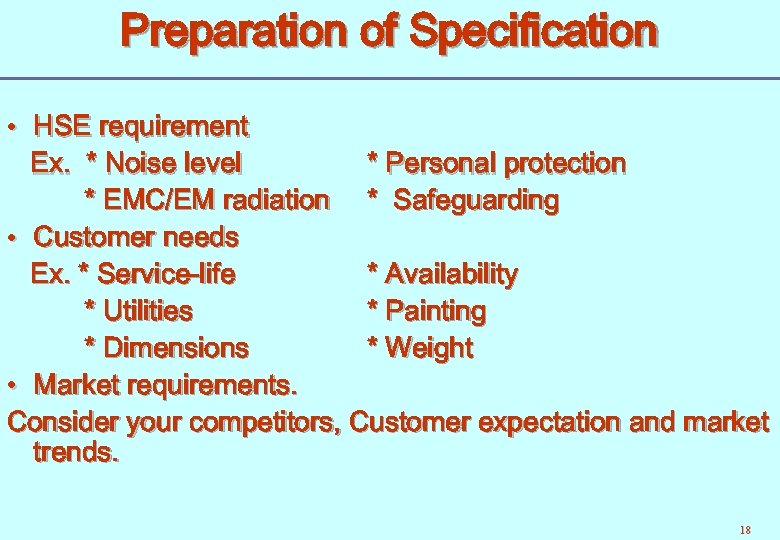 Preparation of Specification • HSE requirement Ex. * Noise level * Personal protection * EMC/EM radiation * Safeguarding • Customer needs Ex. * Service-life * Availability * Utilities * Painting * Dimensions * Weight • Market requirements. Consider your competitors, Customer expectation and market trends. 18
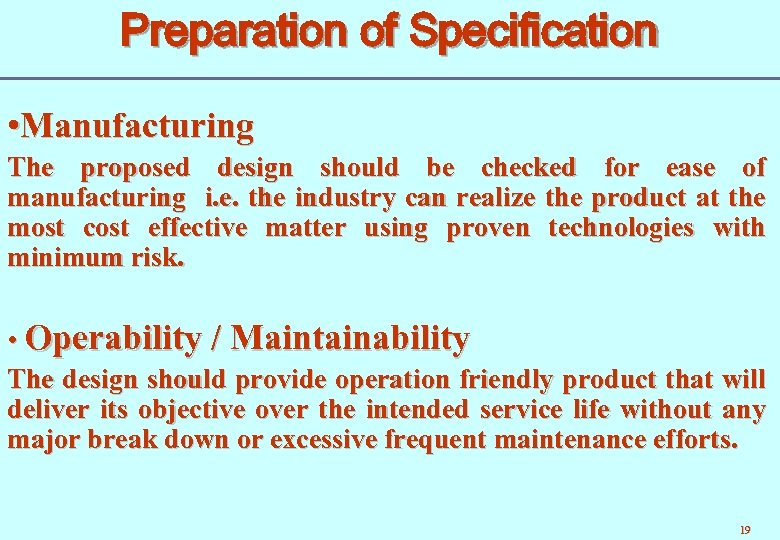 Preparation of Specification • Manufacturing The proposed design should be checked for ease of manufacturing i. e. the industry can realize the product at the most cost effective matter using proven technologies with minimum risk. • Operability / Maintainability The design should provide operation friendly product that will deliver its objective over the intended service life without any major break down or excessive frequent maintenance efforts. 19
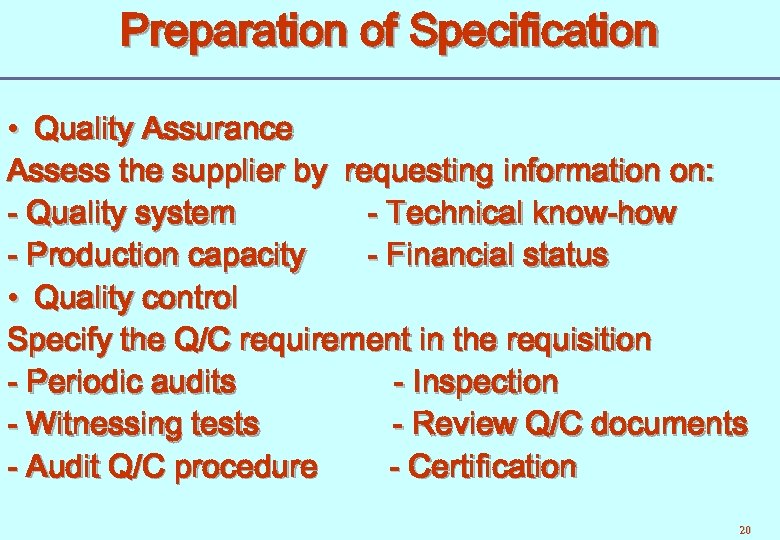 Preparation of Specification • Quality Assurance Assess the supplier by requesting information on: - Quality system - Technical know-how - Production capacity - Financial status • Quality control Specify the Q/C requirement in the requisition - Periodic audits - Inspection - Witnessing tests - Review Q/C documents - Audit Q/C procedure - Certification 20
 Continual Improvement • New Technology. Latest development that enhance value Customer feedback. User feed back is the most valuable information for improvement Competitive specification. Benchmark with others to be the world class Market trends. Reading the future market trends will make you the front runner. 21
 Remember • Standards exist * to be used * to be critically examined * to be modified if not suitable • We are most at risk with complex systems whether during manufacturing, use or modify. Standards are our save guarding system. 22
 Product Cost Estimation Points to be considered n BASIC DEFINITIONS n COST PRICE MODULE (FOR CONSTRUCTION CONTRACTS) n COST ESTIMATING PROCESS & PROCEDURE n COST ESTIMATING CLASSIFICATION n COST ESTIMATING METHODOLOGIES n FACTORS AFFECTING COST ESTIMATING ACCURACY n CASE STUDIES 23
 Basic Definitions CAPITAL COST ESTIMATE (CAPEX) n REPRESENTS THE TOTAL CAPITAL COST OF THE PROJECT, INCLUDING ENGINEERING, MATERIAL, CONSTRUCTION, AND MANAGEMENT COSTS. ALLOWANCES n USED TO REDUCE THE RISK OF OVERRUN DUE TO “KNOWN” UNCERTAINTIES = DESIGN GROWTH / DESIGN DEVELOPMENT = EXTRAORDINARY FREIGHT COST (AIR FREIGHT, SPECIAL CARGO. . . etc) = FORWARD ESCALATION = CUT / WASTE (BULK MATERIALS) 24
 Basic Definitions CONTINGENCIES n USED TO REDUCE THE RISK OF OVERRUN DUE TO “POTENTIAL” UNCERTAINTIES = INCOMPLETE PROJECT DEFINITION = CURRENCY FLUCTUATION = ERRORS = DOES NOT COVER FORCE MAJEURE, SCOPE CHANGES, CLAIMS ETC. DIRECT COSTS n COSTS DIRECTLY ATTRIBUTED TO A JOB OR A PIECE OF PROJECT EQUIPMENT 25
 Basic Definitions INDIRECT COSTS n THESE ARE OFTEN REFERRED TO AS “OVERHEAD” COSTS AND CANNOT EASILY BE ALLOCATED TO ONE JOB OR PROJECTS. FIXED COSTS n COSTS ARE SAID TO BE FIXED WHEN THEY REMAIN UNCHANGED AND MUST CONTINUE TO BE INCURRED, EVEN THOUGH THE WORKLOAD FLUCTUATES, (EG. MANAGEMENT SALARIES , RENT INSURANCE…. ETC. 26
 Basic Definitions VARIABLE COST n THESE ARE COSTS WHICH ARE INCURRED AT A RATE DEPENDING ON THE LEVEL OF THE WORK ACTIVITY. E. G - MATERIAL CONSUMABLES SPARE PARTS UTILITIES (POWER, WATER, SYSTEM) 27
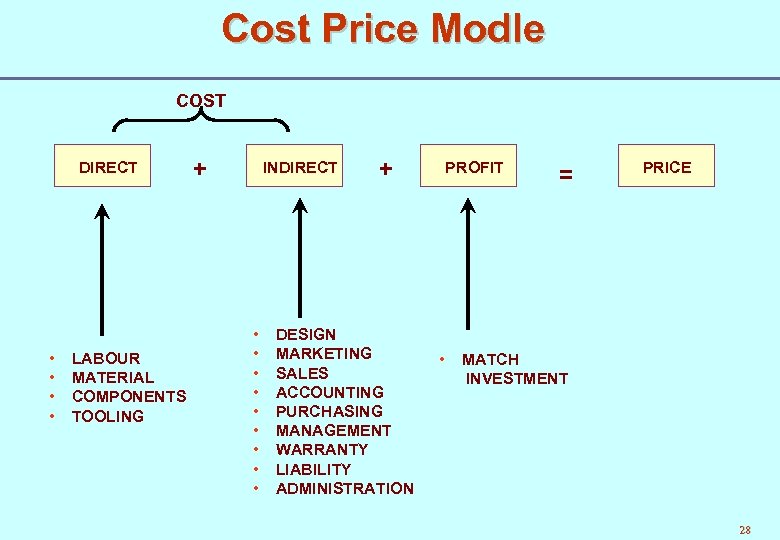 Cost Price Modle COST DIRECT • • LABOUR MATERIAL COMPONENTS TOOLING + INDIRECT • • • + DESIGN MARKETING SALES ACCOUNTING PURCHASING MANAGEMENT WARRANTY LIABILITY ADMINISTRATION PROFIT • = PRICE MATCH INVESTMENT 28
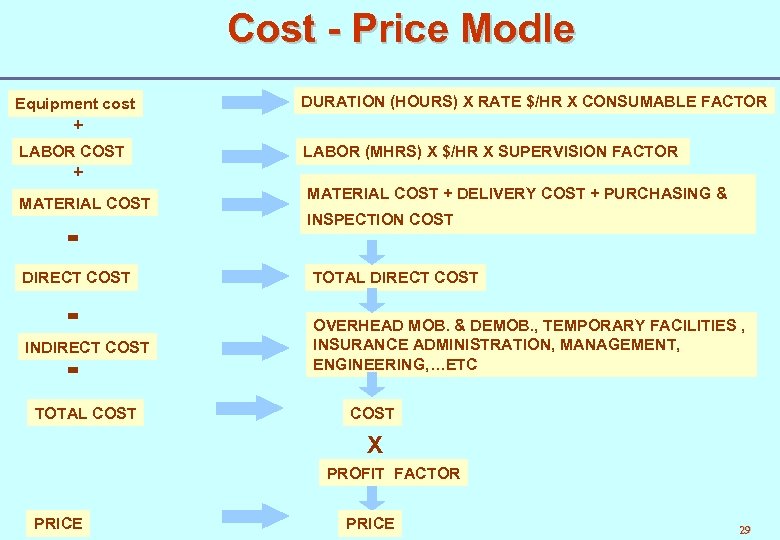 Cost - Price Modle Equipment cost DURATION (HOURS) X RATE $/HR X CONSUMABLE FACTOR + LABOR COST LABOR (MHRS) X $/HR X SUPERVISION FACTOR + MATERIAL COST = DIRECT COST = INDIRECT COST = TOTAL COST MATERIAL COST + DELIVERY COST + PURCHASING & INSPECTION COST TOTAL DIRECT COST OVERHEAD MOB. & DEMOB. , TEMPORARY FACILITIES , INSURANCE ADMINISTRATION, MANAGEMENT, ENGINEERING, …ETC COST X PROFIT FACTOR PRICE 29
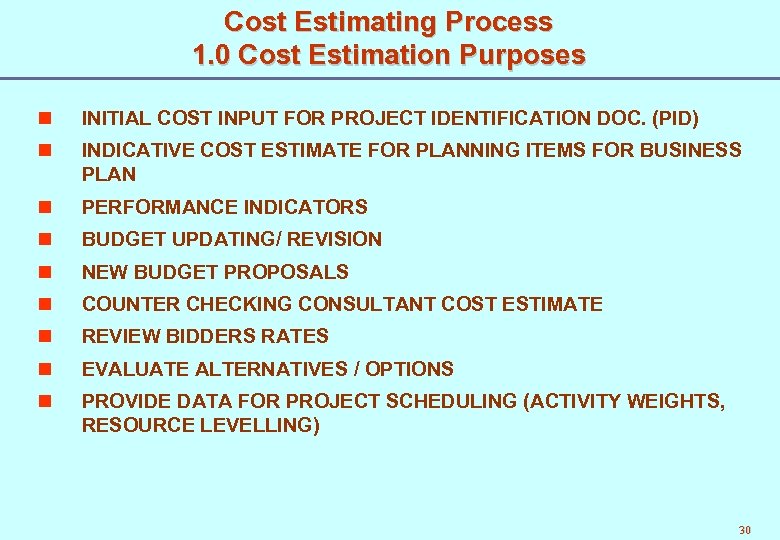 Cost Estimating Process 1. 0 Cost Estimation Purposes n INITIAL COST INPUT FOR PROJECT IDENTIFICATION DOC. (PID) n INDICATIVE COST ESTIMATE FOR PLANNING ITEMS FOR BUSINESS PLAN n PERFORMANCE INDICATORS n BUDGET UPDATING/ REVISION n NEW BUDGET PROPOSALS n COUNTER CHECKING CONSULTANT COST ESTIMATE n REVIEW BIDDERS RATES n EVALUATE ALTERNATIVES / OPTIONS n PROVIDE DATA FOR PROJECT SCHEDULING (ACTIVITY WEIGHTS, RESOURCE LEVELLING) 30
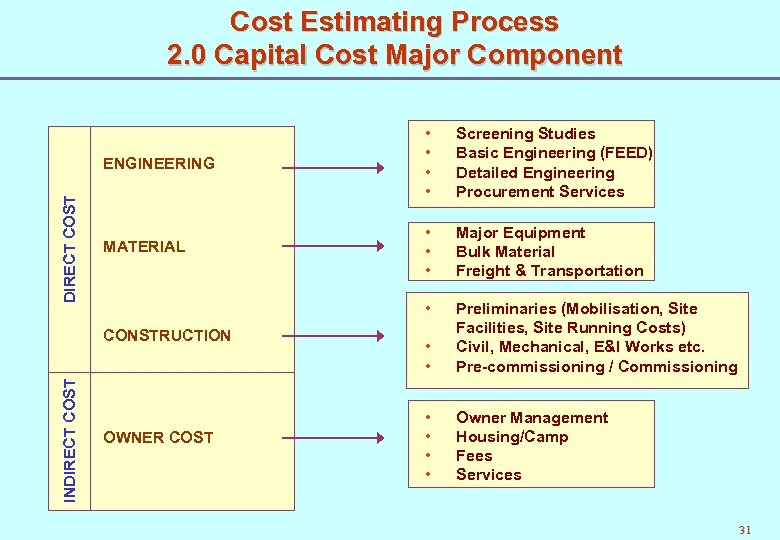 Cost Estimating Process 2. 0 Capital Cost Major Component DIRECT COST ENGINEERING • • Screening Studies Basic Engineering (FEED) Detailed Engineering Procurement Services MATERIAL • • • Major Equipment Bulk Material Freight & Transportation • • • Preliminaries (Mobilisation, Site Facilities, Site Running Costs) Civil, Mechanical, E&I Works etc. Pre-commissioning / Commissioning • • Owner Management Housing/Camp Fees Services INDIRECT COST CONSTRUCTION OWNER COST 31
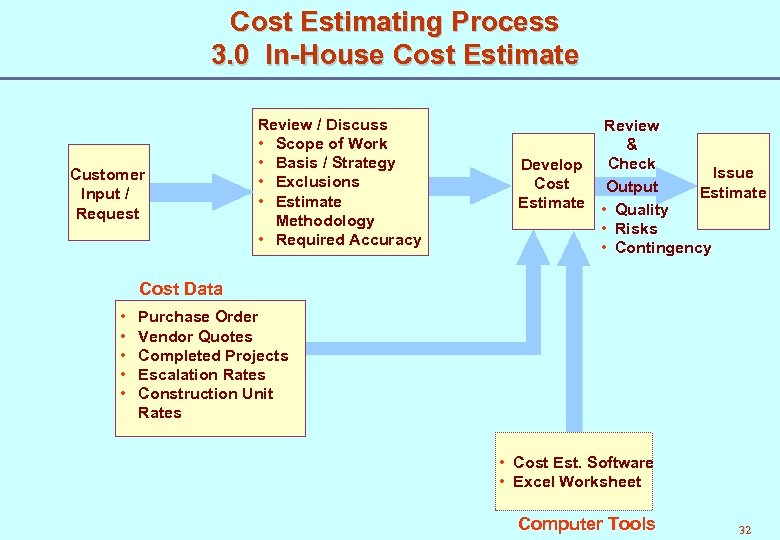 Cost Estimating Process 3. 0 In-House Cost Estimate Customer Input / Request Review / Discuss • Scope of Work • Basis / Strategy • Exclusions • Estimate Methodology • Required Accuracy Develop Cost Estimate Review & Check Issue Output Estimate • Quality • Risks • Contingency Cost Data • • • Purchase Order Vendor Quotes Completed Projects Escalation Rates Construction Unit Rates • Cost Est. Software • Excel Worksheet Computer Tools 32
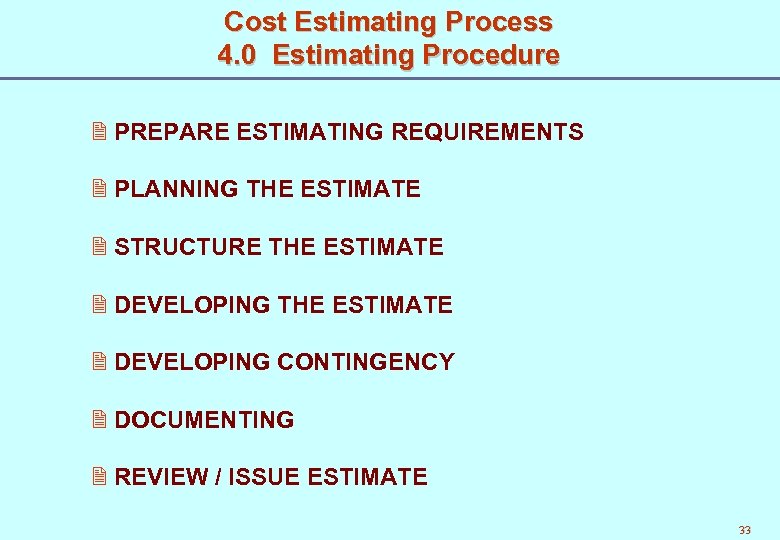 Cost Estimating Process 4. 0 Estimating Procedure 2 PREPARE ESTIMATING REQUIREMENTS 2 PLANNING THE ESTIMATE 2 STRUCTURE THE ESTIMATE 2 DEVELOPING CONTINGENCY 2 DOCUMENTING 2 REVIEW / ISSUE ESTIMATE 33
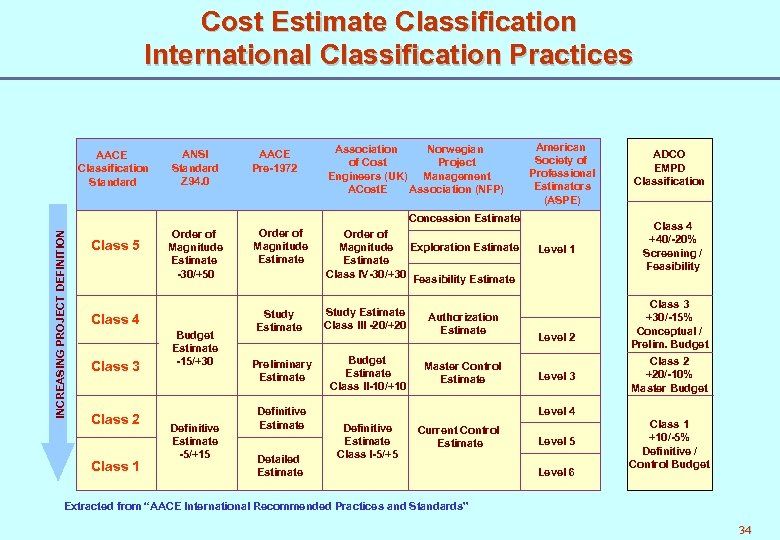 Cost Estimate Classification International Classification Practices AACE Classification Standard ANSI Standard Z 94. 0 AACE Pre-1972 Association Norwegian of Cost Project Engineers (UK) Management ACost. E Association (NFP) American Society of Professional Estimators (ASPE) INCREASING PROJECT DEFINITION Concession Estimate Class 5 Order of Magnitude Estimate -30/+50 Class 4 Class 3 Class 2 Class 1 Budget Estimate -15/+30 Definitive Estimate -5/+15 Order of Magnitude Estimate Order of Magnitude Exploration Estimate Class IV-30/+30 Feasibility Estimate Study Estimate Class III -20/+20 Authorization Estimate Preliminary Estimate Budget Estimate Class II-10/+10 Master Control Estimate Definitive Estimate Detailed Estimate Level 1 Level 2 Level 3 ADCO EMPD Classification Class 4 +40/-20% Screening / Feasibility Class 3 +30/-15% Conceptual / Prelim. Budget Class 2 +20/-10% Master Budget Level 4 Definitive Estimate Class I-5/+5 Current Control Estimate Level 5 Level 6 Class 1 +10/-5% Definitive / Control Budget Extracted from “AACE International Recommended Practices and Standards” 34
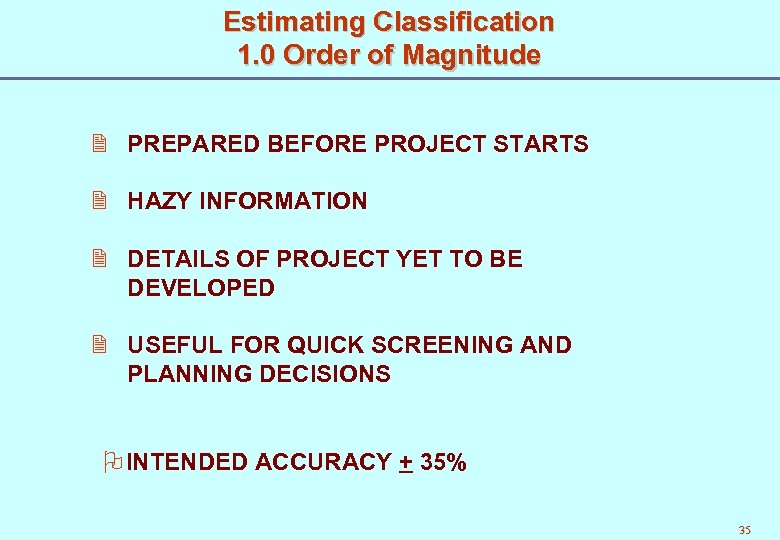 Estimating Classification 1. 0 Order of Magnitude 2 PREPARED BEFORE PROJECT STARTS 2 HAZY INFORMATION 2 DETAILS OF PROJECT YET TO BE DEVELOPED 2 USEFUL FOR QUICK SCREENING AND PLANNING DECISIONS O INTENDED ACCURACY + 35% 35
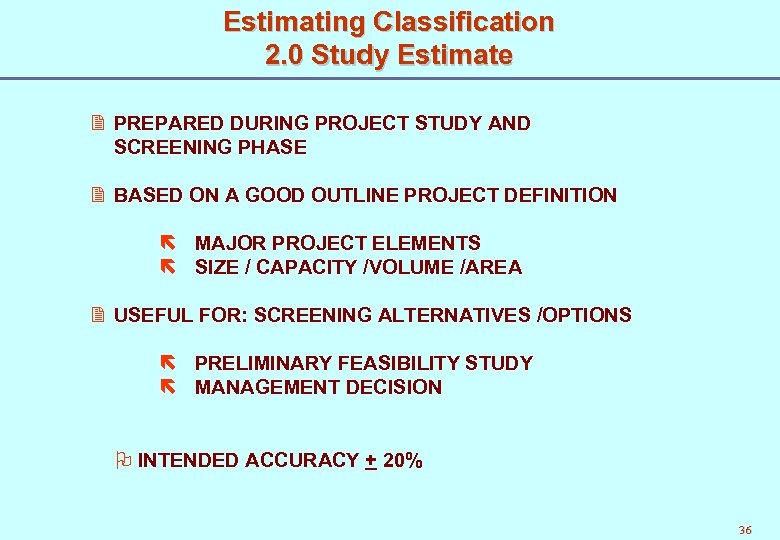 Estimating Classification 2. 0 Study Estimate 2 PREPARED DURING PROJECT STUDY AND SCREENING PHASE 2 BASED ON A GOOD OUTLINE PROJECT DEFINITION ë MAJOR PROJECT ELEMENTS ë SIZE / CAPACITY /VOLUME /AREA 2 USEFUL FOR: SCREENING ALTERNATIVES /OPTIONS ë PRELIMINARY FEASIBILITY STUDY ë MANAGEMENT DECISION O INTENDED ACCURACY + 20% 36
 Estimating Classification 3. 0 Study Estimate 2 DEVELOPED DURING ENGINEERING PHASE 10 -20% OF ENGINEERING 2 BASED ON - WELL DEFINED DESIGN CRITERIA. O INTENDED ACCURACY + 15% 37
 Estimating Classification 4. 0 Definitive Estimate 2 MOST DESIGN WORK COMPLETED. 2 ALL MAJOR CONTRACTS / PURCHASE ORDER HAVE BEEN PLACED. 2 USED TO UPDATE BUDGET FOR THE PURPOSE OF COST CONTROL. O INTENDED ACCURACY + 5 -10% 38
 Factors Affecting Project Final Cost 1. 0 SCOPE OF WORK n CLARITY OF SCOPE DEFINITION n CHANGES IN SCOPE 2. 0 TECHNICAL FACTORS n DESIGN STANDARDS & PRACTICES n SKILLS/COMPETENCIES 3. 0 OTHERS n PROJECT TIME FRAME/SCHEDULE n INTERFACES WITH OTHER OPCOS n PROJECT ORGANIZATION n CURRENCY EXCHANGE RATES n MARKET CONDITIONS 39