


 Скачать презентацию Kinesio Taping An Introduction on Technique and Results
kinesiotaping-12664466836492-phpapp02.ppt
- Количество слайдов: 37
 Kinesio Taping: An Introduction on Technique and Results Chris Keating SPT Thomas Jefferson University
 Overview n Introduction to Kinesio Taping q q n Properties Theoretical Benefits Types of Application Guidelines Current Evidence q q Shoulder Pain Lower Trunk ROM Lateral Patella Dislocation Acute Pediatrics Population n n Clinical Implications Application of Kinesio Tape q q RTC Impingement Taping Quadriceps Facilitation Taping
 Kinesio Tape Properties
 Properties of Kinesio Tape n n Mimics skin qualities Tape is replicating hands on the patient q n n n Sensiomotor stimulation Allows longitudinal stretch of 30 -40% of its resting length n Effective for 3 -5 days of constant use Latex free and heat activated adhesive Acrylic adhesive applied in wave fashion to allow for moisture escape
 Theoretical Benefits
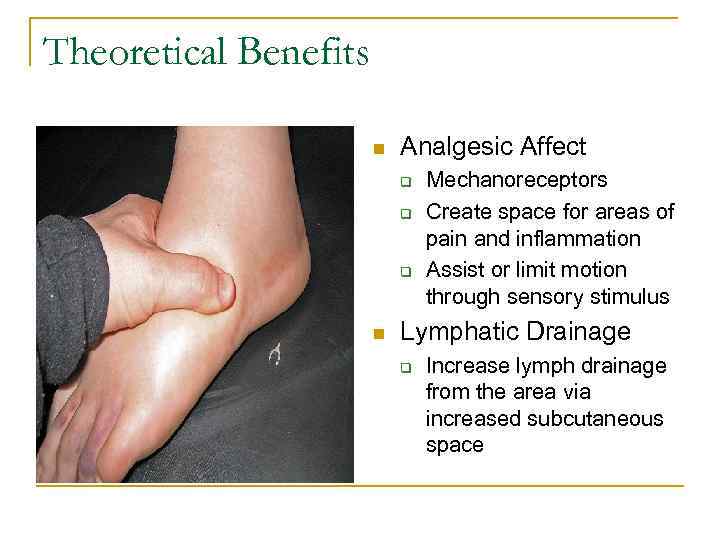 Theoretical Benefits n Analgesic Affect q q q n Mechanoreceptors Create space for areas of pain and inflammation Assist or limit motion through sensory stimulus Lymphatic Drainage q Increase lymph drainage from the area via increased subcutaneous space
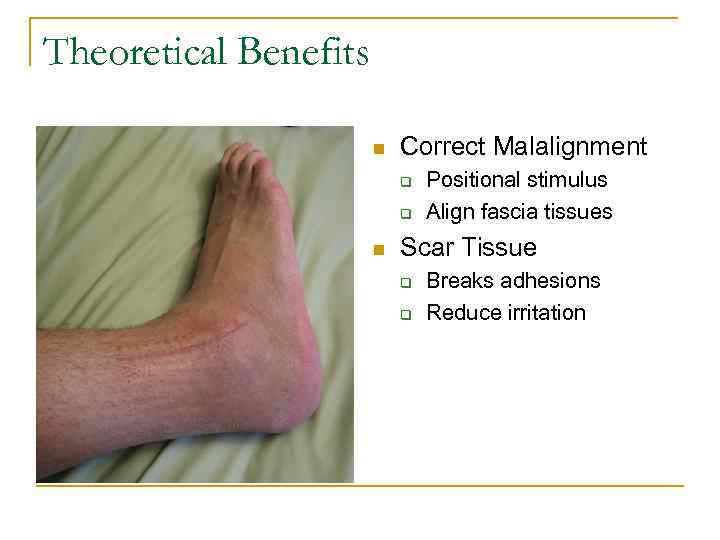 Theoretical Benefits n Correct Malalignment q q n Positional stimulus Align fascia tissues Scar Tissue q q Breaks adhesions Reduce irritation
 Types of Application
 Types of Application n n n Y I X Fan Web Donut
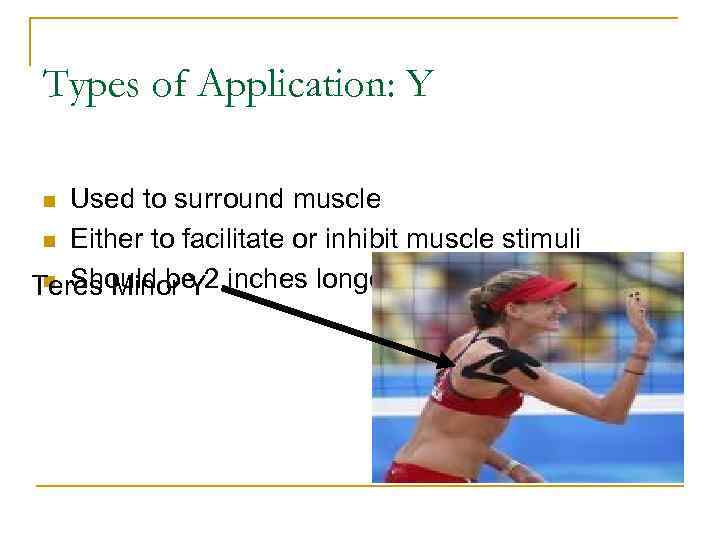 Types of Application: Y Used to surround muscle n Either to facilitate or inhibit muscle stimuli n Should be Teres Minor Y 2 inches longer than target muscle n
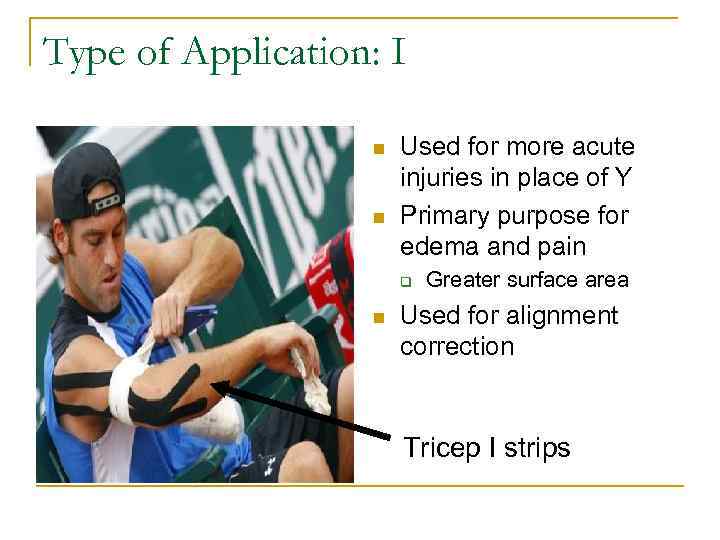 Type of Application: I n n Used for more acute injuries in place of Y Primary purpose for edema and pain q n Greater surface area Used for alignment correction Tricep I strips
 Type of Application: X and Donut n X q n Used when origin and insertion change depending on movement (Rhomboids) Donut q q Specifically used for edema Use overlapping strips and the center is cut over area of focus
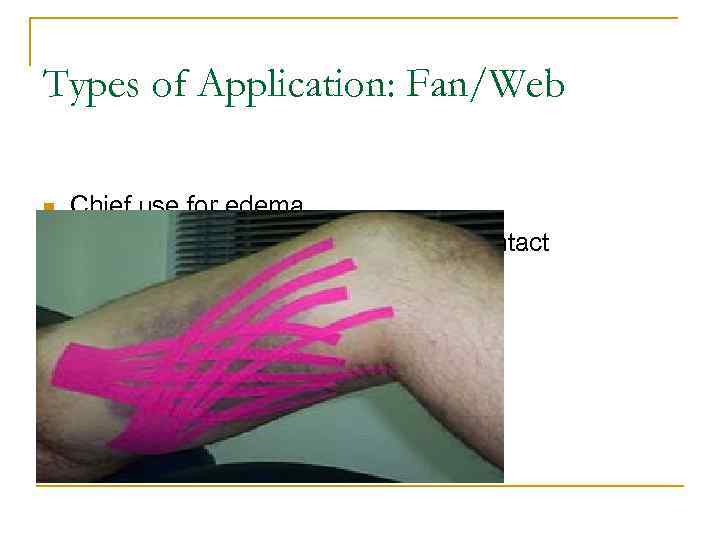 Types of Application: Fan/Web n n Chief use for edema Web different because ends remain intact
 Type of Application Stretch n n n Muscle should be elongated prior to application KT requires none to partial stretch Stretch results in skin convolutions whether they are visible or not they are present Would rather have too little than too much stretch This is not athletic taping, do not take up full stretch*
 Types of Application Stretch n n n Full- 100% Severe- 75% Moderate- 50% Light- 15 -25% None- 0% Percentage stretch refer to percentage of available stretch
 Type of Application Direction n Insertion to Origin q q n Used to inhibit overused or stretched muscles Light stretch required to achieve this goal Origin to Insertion q q Used to facilitate weak or under performing muscles Light to moderate stretch required
 Application Guidelines
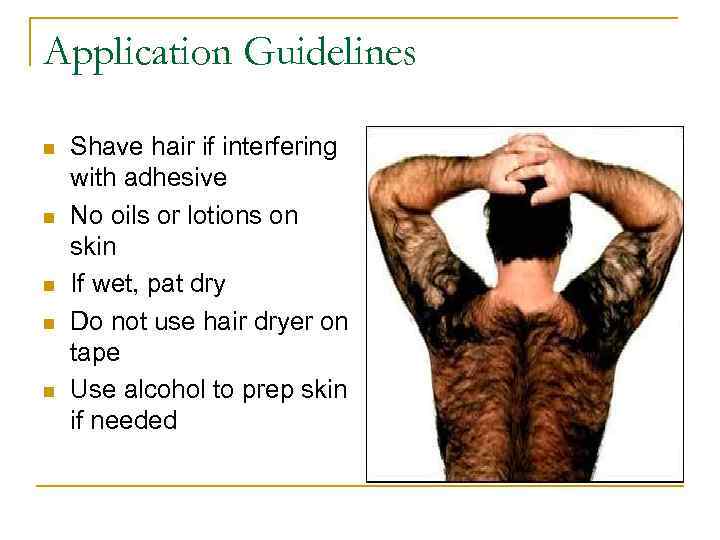 Application Guidelines n n n Shave hair if interfering with adhesive No oils or lotions on skin If wet, pat dry Do not use hair dryer on tape Use alcohol to prep skin if needed
 Application Guidelines n n n Measure appropriate length- allowing for desired stretch Remove tape carefully in order not to touch or increase application difficulty Rub tape after application to activate adhesive Allow 20 mins for adhesive to take effect If KT doesn’t reduce pain than D/C treatment after 20 mins
 Evidence Based Practice
 Shoulder Pain Thelen et al. n Purpose q n To compare the short-term effect of a therapeutic KT application on reducing pain and disability in subjects with RTC tendonitis/impingement versus sham KT taping Population q q q 18 -24 yo College Students; (n = 27) + Hawkins-Kennedy, + Empty Can, + Pain Before 150° elevation in any plane - Fracture, - GH Disloction/Subluxation, - Cervical Involvement, - Shoulder Surgery < 12 months
 n Intervention q q q n 15 -25% Stretch Y-Strip for Supraspinatus 15 -25% Stretch Y-Strip for Deltoid 50 -75% Stretch Y or I-Strip Coracoid Process -> Posterior Deltoid Outcome q q q Only significant difference between groups found on day 1 with treatment group achieving greater abduction (19°) Both groups over 6 days demonstrated improvements in all outcome measures Attrition was high 7/27, due to scheduling conflicts
 Lower Trunk ROM Yoshida et al. n Purpose q n To determine the effects of KT on lower trunk flexion, extension and lateral flexion Population q q 30 healthy subjects (15 f, 15 m) Average (26, 20) Volunteered Were excluded if had LBP within 6 months of trial
 n Intervention q q n Cross-over Study 15 -25% stretch with Y-Strip Place base above sacrum Attach tails on each erector spinae group with light tension Outcomes q q q Taping significantly increased flexion (17 cm) over non-taping No control group Needs more detailed measurements
 Traumatic Patellar Dislocation Osterhues n Purpose q n To demonstrate the use of KT for control of pain, restriction of quadriceps muscle contraction and altered sense of weight bearing stability in patella dislocation rehabilitation Population q 49 yo female PT who sustained a traumatic left knee patella lateral dislocation while cross country skiing
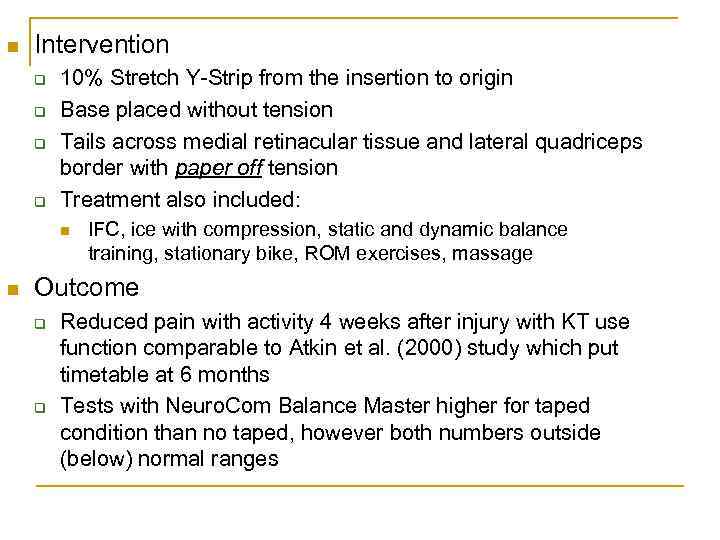 n Intervention q q 10% Stretch Y-Strip from the insertion to origin Base placed without tension Tails across medial retinacular tissue and lateral quadriceps border with paper off tension Treatment also included: n n IFC, ice with compression, static and dynamic balance training, stationary bike, ROM exercises, massage Outcome q q Reduced pain with activity 4 weeks after injury with KT use function comparable to Atkin et al. (2000) study which put timetable at 6 months Tests with Neuro. Com Balance Master higher for taped condition than no taped, however both numbers outside (below) normal ranges
 KT effect on Peds Yasukawa et al n Purpose q n To describe the functional arm and hand skills for children admitted into a rehab program subsequent use of KT Population q 15 Children (10 f, 5 m) Ages 4 -16 n q + muscle weakness or abnormal muscle tone n n q 4 SCI, 2 TBI, 3 Brain Tumor, 2 CVA, Seizure, CP, 2 Birth Defects Grades of 3 or more on Mod. Ashworth were excluded Trace on MMT or sensory issues were also excluded No cognitive or motivation issues
 n Intervention q n Wide variety of KT techniques, Individualized Outcome q Melbourne Assessment n n q q q 16 pt questionnaire measuring upper limb function Designed for CP population Scores significantly improve pre-test to post-test as well as 3 days after taping Its hard to draw specific treatment from study Overall function improved in group average immediately after taping limiting learning curve n n Increase of 5 on MA immediately after application Increase of 10 on MA 3 days after application
 Clinical Implications
 Clinical Implications n Level of evidence q q n Weak- only one RCT found (via Medline, Cinahl, Cochrane, DARE, ACP) Mainly case studies, presented were a sample of the most PT relevant What does the evidence support q q Increase in ROM Increase in function
 Clinical Implications n Why use it q q q Tool in the toolbox Treats patient for 72 consecutive hours Feeling of treatment -> encourage movement n q q q Placebo or Treatment? Versatile Pros q n Some evidence proves theories PTs provide treatment Applicable to multiple pt populations Constant treatment Cons q q Some evidence proves theories Expensive Requires practice Skin reaction
 Clinical Implications n Athletic Taping v Kinesio Taping q q n Bragg article demonstrates AT decrease in support within an hour of use Since KT does not focus on support its means of sensory stimulus to enforce movement may just be a better form of AT Clinical Opinion q q q Kinesio Taping could be a useful tool for therapist who see patients only a handful of times during rehab Little evidence supports its multiple theories, more research needed May be a way to facilitate and encourage movement
 RTC Impingement Taping
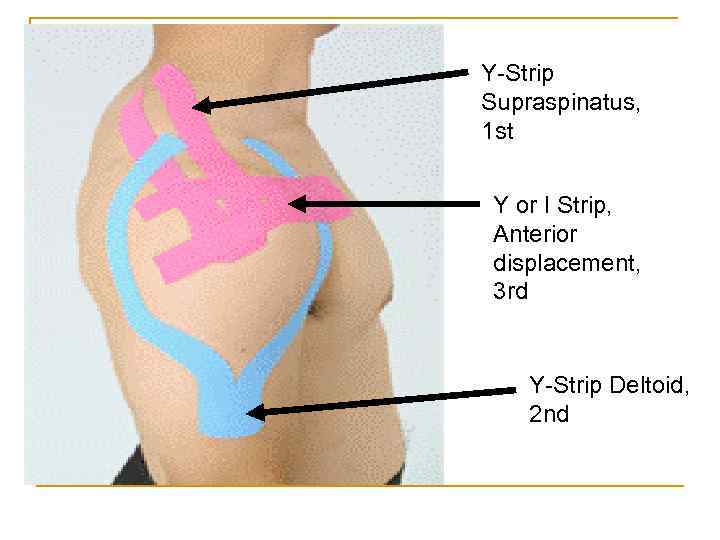 Y-Strip Supraspinatus, 1 st Y or I Strip, Anterior displacement, 3 rd Y-Strip Deltoid, 2 nd
 Quadriceps Taping
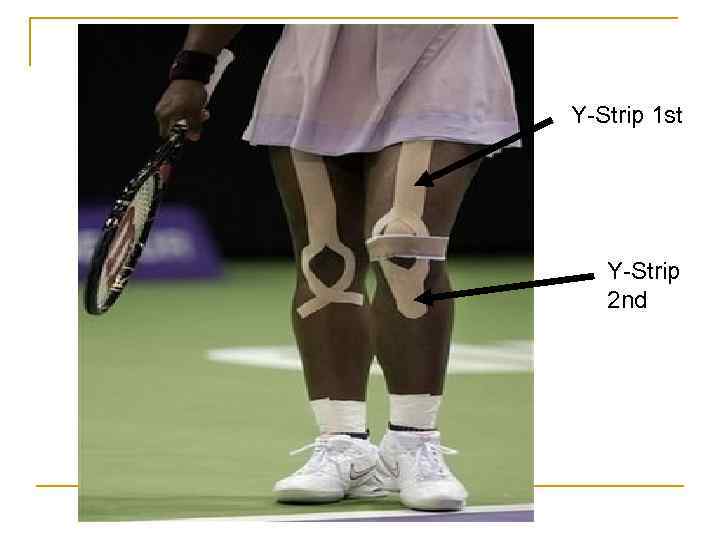 Y-Strip 1 st Y-Strip 2 nd
 References n n n n Clinical Theraputic Applications of the Kinesio Taping Method; K. Kaze, J. Wallis, T. Kase; Tokyo, Japan, 2003 The Clinical Efficacy of Kinesio Tape for Shoulder Pain: A Randomized, Double-Blinded, Clinical Trial; M. Thelen, J. Dauber, P. Stoneman; Journal of Orthopaedic and Sports Physical Therapy, 38: 7 2008 Pilot Study: Investigating the Effects of Kinesio Taping in an Acute Pediatic Rehabilitation Setting; A. Yasukawa, P. Patel, C Sisung; American Journal of Occupational Therapy, 60: 1 2006 The Use of Kinesio Taping in the Management of Traumatic Patella Dislocation. A Case Study; D. Osterhues; Physiotherapy Theory and Practice; 20: 4 2004 The Effect of Kinesio-Taping on Lower Trunk Range of Motions; A. Yoshida, L Kahanov; Research in Sports Medicine, 15 2007 Characteristics of Patients with Primary Acute Lateral Patellar Dislocation and Their Recovery Within the First Six Months of Injury; DM. Atkins, Dc Fithian, KS Marangi; The American Journal of Sports Medicine; 28: 4 2000 Failure and Fatigue Characteristics of Adhesive Athletic Tape; Bragg, R. W, Macmahon, J. M, Medicine and Science in Sports and Exercise 34: 3 2002