



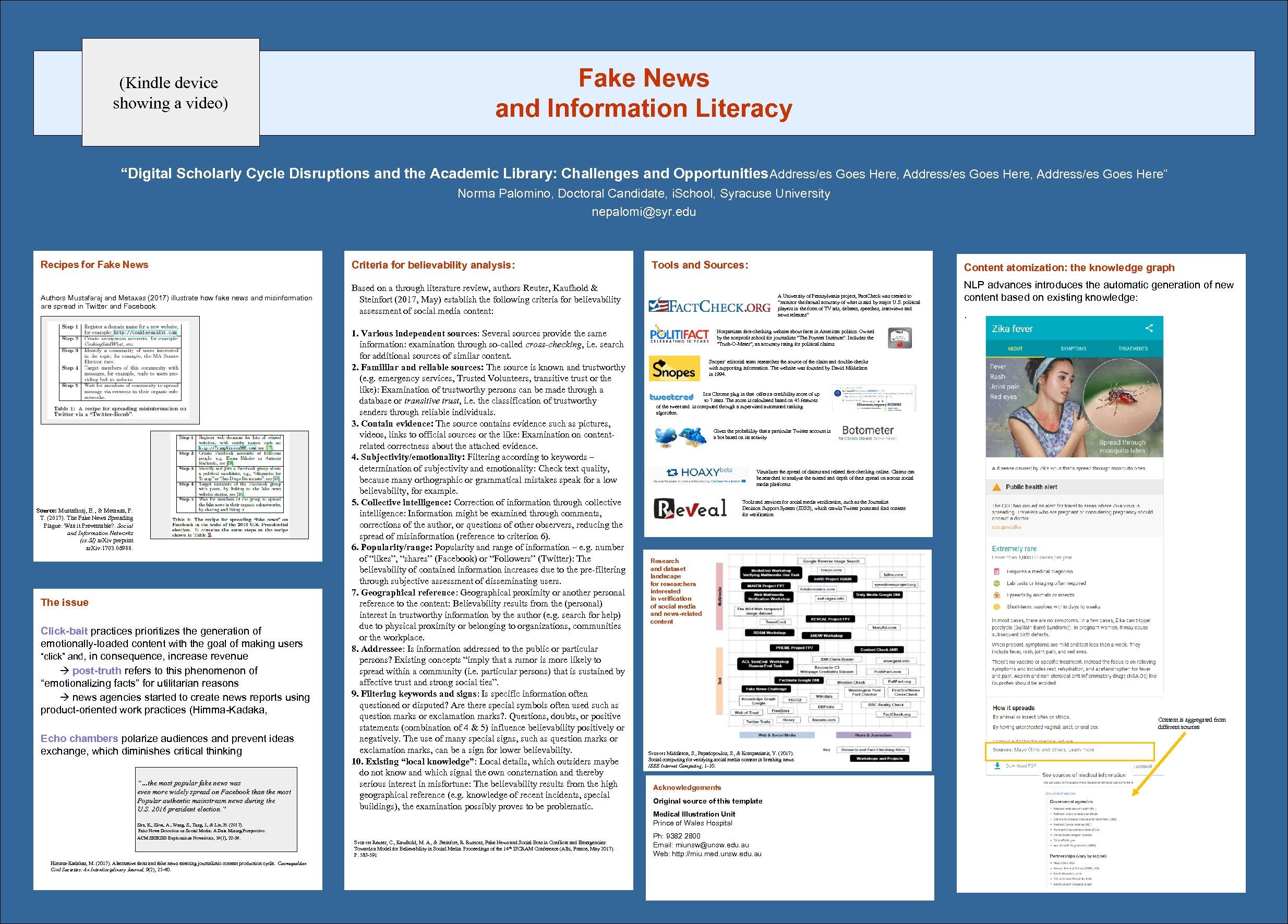
 (Kindle device showing a video) Fake News and Information Literacy “Digital Scholarly Cycle Disruptions and the Academic Library: Challenges and Opportunities Address/es Goes Here, Address/es Goes Here” Norma Palomino, Doctoral Candidate, i. School, Syracuse University nepalomi@syr. edu Recipes for Fake News Criteria for believability analysis: Authors Mustafaraj and Metaxas (2017) illustrate how fake news and misinformation are spread in Twitter and Facebook: Based on a through literature review, authors Reuter, Kaufhold & Steinfort (2017, May) establish the following criteria for believability assessment of social media content: Source: Mustafaraj, E. , & Metaxas, P. T. (2017). The Fake News Spreading Plague: Was it Preventable? . Social and Information Networks (cs. SI) ar. Xiv preprint ar. Xiv: 1703. 06988. The issue Click-bait practices prioritizes the generation of emotionally-loaded content with the goal of making users “click” and, in consequence, increase revenue post-truth refers to this phenomenon of “emotionalizing facts” for utilitarian reasons news agencies started to create news reports using product-oriented work practices (Himma-Kadaka, Echo chambers polarize audiences and prevent ideas exchange, which diminishes critical thinking “…the most popular fake news was even more widely spread on Facebook than the most Popular authentic mainstream news during the U. S. 2016 president election. ” 1. Various independent sources: Several sources provide the same information: examination through so-called cross-checking, i. e. search for additional sources of similar content. 2. Famililar and reliable sources: The source is known and trustworthy (e. g. emergency services, Trusted Volunteers, transitive trust or the like): Examination of trustworthy persons can be made through a database or transitive trust, i. e. the classification of trustworthy senders through reliable individuals. 3. Contain evidence: The source contains evidence such as pictures, videos, links to official sources or the like: Examination on contentrelated correctness about the attached evidence. 4. Subjectivity/emotionality: Filtering according to keywords – determination of subjectivity and emotionality: Check text quality, because many orthographic or grammatical mistakes speak for a low believability, for example. 5. Collective intelligence: Correction of information through collective intelligence: Information might be examined through comments, corrections of the author, or questions of other observers, reducing the spread of misinformation (reference to criterion 6). 6. Popularity/range: Popularity and range of information – e. g. number of “likes”, “shares” (Facebook) or “Followers” (Twitter): The believability of contained information increases due to the pre-filtering through subjective assessment of disseminating users. 7. Geographical reference: Geographical proximity or another personal reference to the content: Believability results from the (personal) interest in trustworthy information by the author (e. g. search for help) due to physical proximity or belonging to organizations, communities or the workplace. 8. Addressee: Is information addressed to the public or particular persons? Existing concepts “imply that a rumor is more likely to spread within a community (i. e. particular persons) that is sustained by affective trust and strong social ties”. 9. Filtering keywords and signs: Is specific information often questioned or disputed? Are there special symbols often used such as question marks or exclamation marks? . Questions, doubts, or positive statements (combination of 4 & 5) influence believability positively or negatively. The use of many special signs, such as question marks or exclamation marks, can be a sign for lower believability. 10. Existing “local knowledge”: Local details, which outsiders maybe do not know and which signal the own consternation and thereby serious interest in misfortune: The believability results from the high geographical reference (e. g. knowledge of recent incidents, special buildings), the examination possibly proves to be problematic. Shu, K. , Sliva, A. , Wang, S. , Tang, J. , & Liu, H. (2017). Fake News Detection on Social Media: A Data Mining Perspective. ACM SIGKDD Explorations Newsletter, 19(1), 22 -36. Himma-Kadakas, M. (2017). Alternative facts and fake news entering journalistic content production cycle. Cosmopolitan Civil Societies: An Interdisciplinary Journal, 9(2), 25 -40. Source: Reuter, C. , Kaufhold, M. A. , & Steinfort, R. Rumors, Fake News and Social Bots in Conflicts and Emergencies: Towards a Model for Believability in Social Media. Proceedings of the 14 th ISCRAM Conference (Albi, France, May 2017). P. 583 -591 Tools and Sources: Content atomization: the knowledge graph A University of Pennsylvania project, Fact. Check was created to “monitor the factual accuracy of what is said by major U. S. political players in the form of TV ads, debates, speeches, interviews and news releases” NLP advances introduces the automatic generation of new content based on existing knowledge: . Nonpartisan fact-checking website about facts in American politics. Owned by the nonprofit school for journalists “The Poynter Institute”. Includes the “Truth-O-Meter”, an accuracy rating for political claims. Snopes’ editorial team researches the source of the claim and double-checks with supporting information. The website was founded by David Mikkelson in 1994. Is a Chrome plug in that offers a credibility score of up to 7 stars. The score is calculated based on 45 features of the tweet and is computed through a supervised automated ranking algorithm. Gives the probability that a particular Twitter account is a bot based on its activity Visualizes the spread of claims and related fact checking online. Claims can be searched to analyze the extend and depth of their spread on across social media platforms Tools and services for social media verification, such as the Journalist Decision Support System (JDSS), which crawls Twitter posts and find content for verification Research and dataset landscape for researchers interested in verification of social media and news-related content Content is aggregated from different sources Source: Middleton, S. , Papadopoulos, S. , & Kompatsiaris, Y. (2017). Social computing for verifying social media content in breaking news. IEEE Internet Computing, 1 -10. Acknowledgements Original source of this template Medical Illustration Unit Prince of Wales Hospital Ph: 9382 2800 Email: miunsw@unsw. edu. au Web: http: //miu. med. unsw. edu. au