


 Скачать презентацию Kindergarten Read Well Initial Training Part 1 Kelly
8cdf2eaa0aae2f0988db202d378f3b22.ppt
- Количество слайдов: 73
 Kindergarten Read Well Initial Training Part 1 Kelly Pruitt kpruitt@tacoma. k 12. wa. us
 Introduction and Overview Read Well Level K is a comprehensive and fully integrated language arts program designed specifically for kindergarten students. It is research based and field tested. Whole Class Component… Get them ready. Small group Component… Get them reading.
 Who is Read Well K for? Kindergarten Students
 Features of a Quality Kindergarten Program Phonemic Awareness: Student’s ability to hear, identify, and manipulate individual sounds in words. Phonics: Students’ understanding of the alphabetic principle-that is, the relationships between written sounds and spoken words. Fluency: Student’s ability to read a text accurately and quickly enough to ensure understanding.
 Features of a Quality Kindergarten Program (cont. ) Vocabulary: The words students must know to communicate - includes both oral and reading vocabulary. Text Comprehension: Students’ ability to understand what they read, I. e. the purpose of reading.
 The Big Picture 1 complete program with 2 separate components Whole Class activities provide a foundation for the Small Group lessons. Content in Whole Class and Small Group components is reciprocal. (Same themes, characters, and skills are found in both. ) Consistent, repeating formats within and across the Whole Class and Small Group routines and activities allow children to become familiar and comfortable with what they are expected to do.
 Factors Influencing Implementation Students (Predictors: Phonemic Awareness; Knowledge of Letter Names) Time (Administrative Support; Scheduling; Coordination between programs) Teacher (Management; Attitudes & Beliefs; Use of time) *** Low performing students make the best progress when double dosed in the SAME research based program.
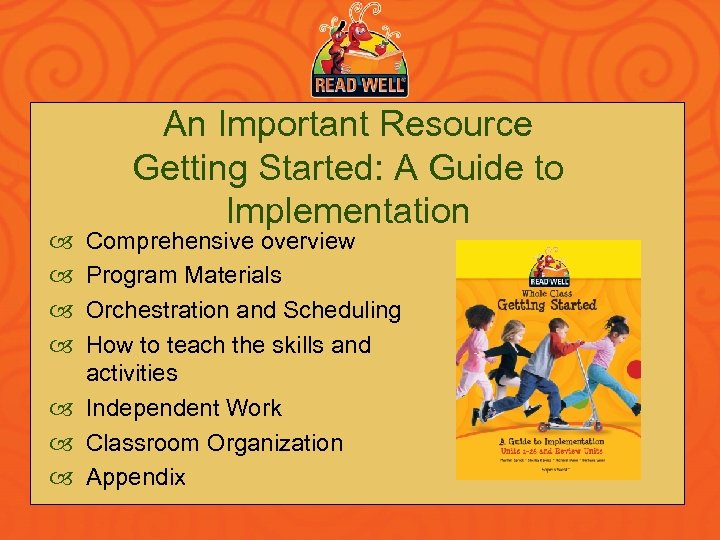 An Important Resource Getting Started: A Guide to Implementation Comprehensive overview Program Materials Orchestration and Scheduling How to teach the skills and activities Independent Work Classroom Organization Appendix
 Initial Placement Purpose: To ensure that each student enters Read Well at the appropriate level When: After week 3, and before week 9 Transfer students Who: Assessment teams/any trained professional
 Initial Placement Part 1 Capital letter names Small letter sounds High-frequency words Pattern Words Part 2 Sounds Blending Irregular Words Sentences Passages read with accuracy and fluency
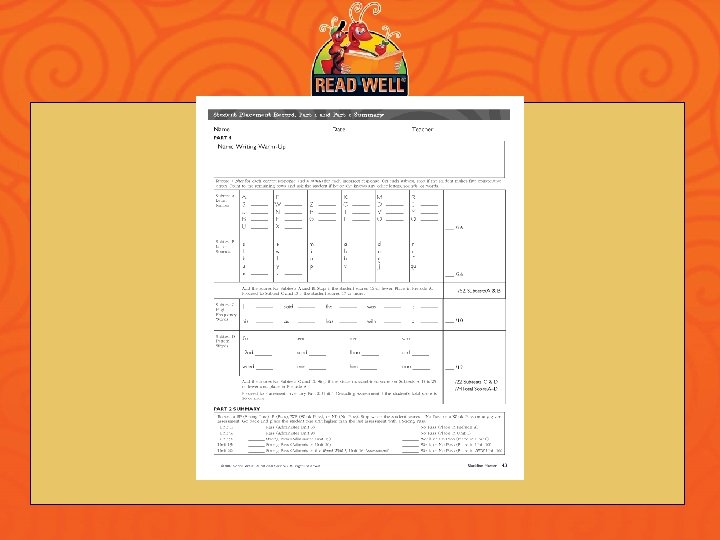
 A walk through of initial placement Your Assessment Manuals please……
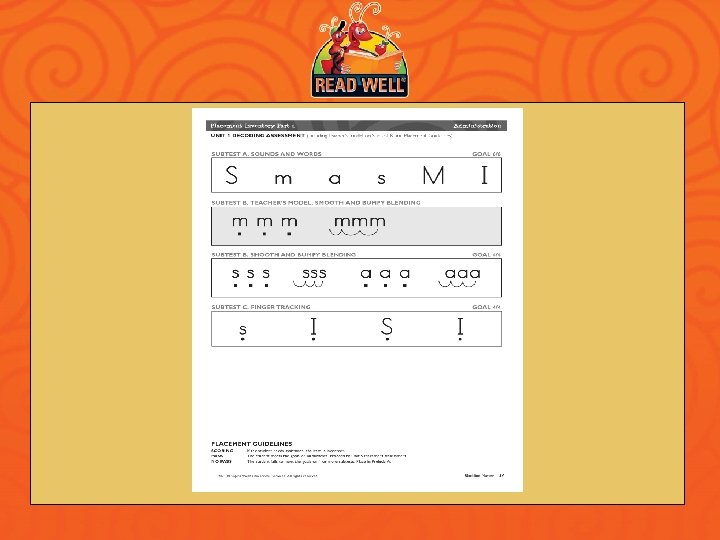
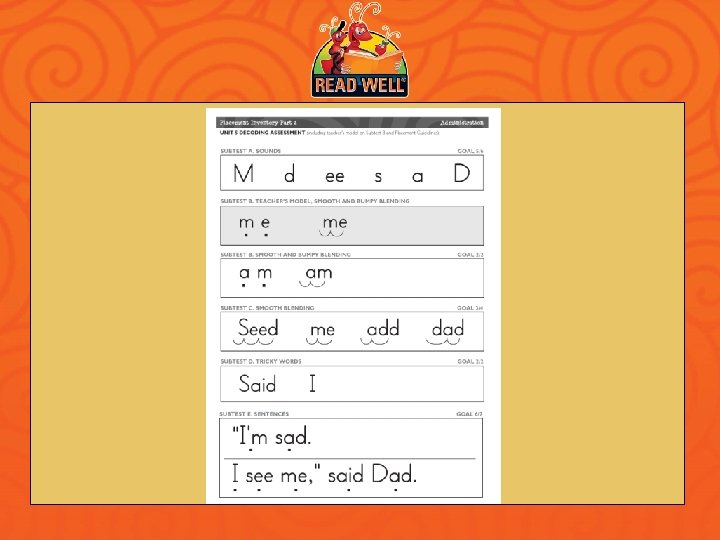
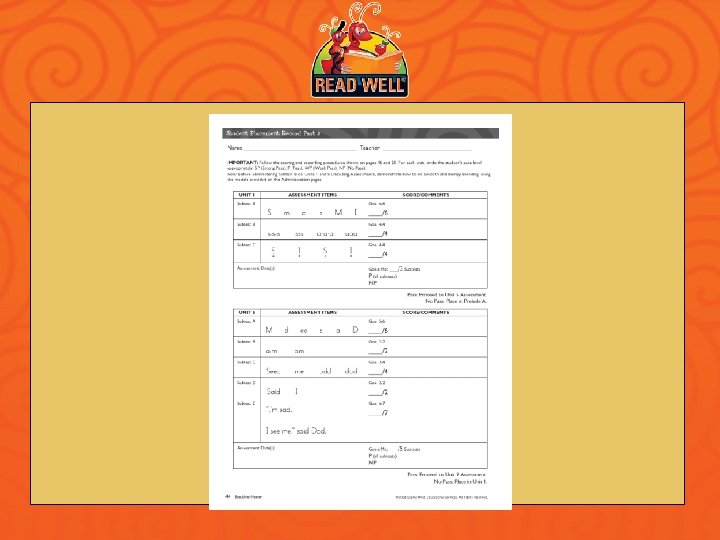
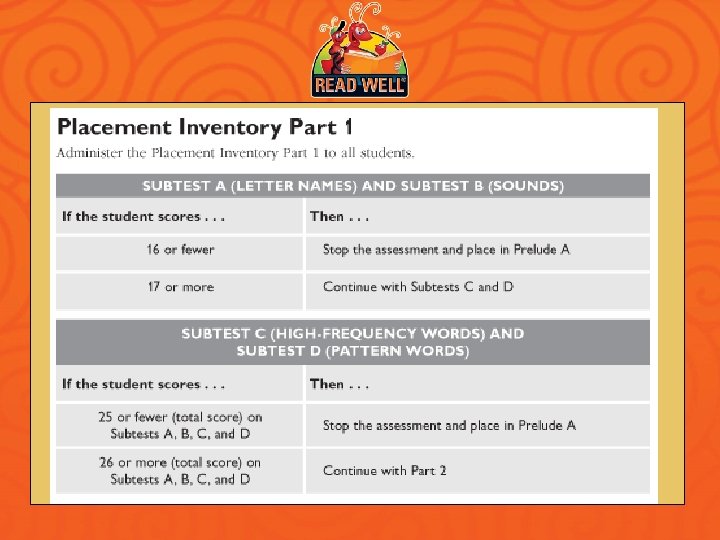
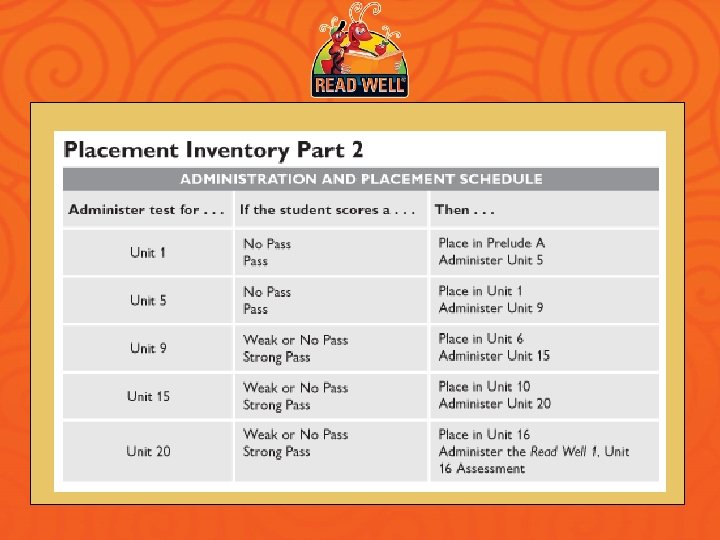
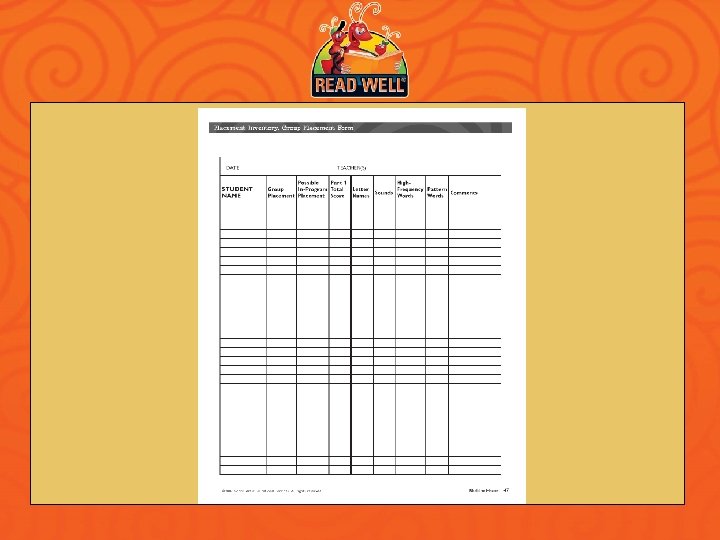
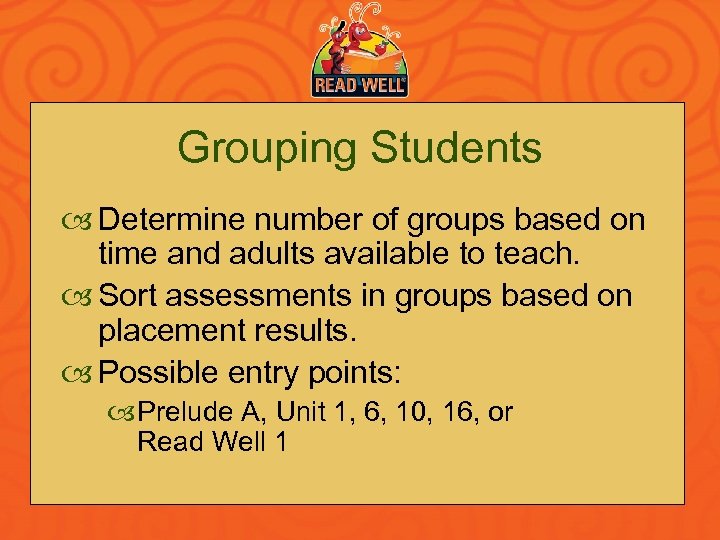 Grouping Students Determine number of groups based on time and adults available to teach. Sort assessments in groups based on placement results. Possible entry points: Prelude A, Unit 1, 6, 10, 16, or Read Well 1
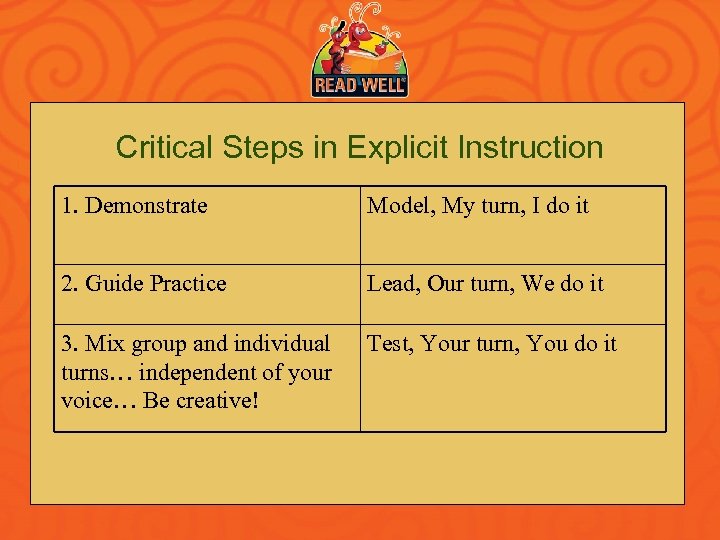 Critical Steps in Explicit Instruction 1. Demonstrate Model, My turn, I do it 2. Guide Practice Lead, Our turn, We do it 3. Mix group and individual turns… independent of your voice… Be creative! Test, Your turn, You do it
 Critical Steps in Explicit Instruction 4. Provide mastery based instruction 5. Acknowledge students’ efforts Be diagnostic as you teach, What are the errors? Repeat steps 1, 2, and 3 Return to the difficult skill at least 3 times. Highlight and give specific praise.
 When do you model? Model when skills are NEW or DIFFICULT. Model when students make a mistake. Do not model everything, all the time.
 Making Small Groups Work Teach students the expectations regularly and as needed. Use 4 or 5 positively stated expectations. Demonstrate as needed, and have children role play each expectation. Provide ongoing, positive, descriptive feedback.
 Teaching Expectations “When your expectations are clear, students never have to guess how you expect them to behave. ” TEAM- Talk, Effort, Ask, Movement T Charts Provide positive and corrective feedback
 Seating Arrange seating so that each student is in the teacher’s line of vision. Teacher should be able to reach student’s materials to help in tracking while reading. U shaped and kidney tables work best If using rectangle tables, sit in the middle on the long side.
 Students working independently Prior to beginning small group instruction, teach and practice how to transition and work independently. Review choices and expectations for independent time, frequently. While teaching, give feedback to the students working independently.
 Understanding Preludes and Units Preludes A, B, C For students who have age-appropriate language development and some alphabetic knowledge, but who are not ready for “formalized” reading instruction. Units 1 -20 For students with advanced language development and some alphabetic knowledge. For students when they complete the preludes.
 Small Group Materials Teacher Guides Assessment Manual Blending Cards Teach and support Oral Language, Phonemic Awareness (Blending and Segmenting) Sound and Tricky Word Cards Teach Phonics (letter/sound fluency) and Irregular Words
 Small Group Materials (cont. ) Decoding Magazines (consumable) Teach Oral Language, Phonemic Awareness, Phonics Student Storybooks Teach and support Phonics, Vocabulary, Comprehension, Fluency Homework Blackline Masters Support Fluency, Comprehension, and the Home. School connection
 Teacher’s Guides Organization of the guides New and Important Objectives Language Priming Detailed Lesson Plans Language and Vocabulary Practice End of Unit Assessment Making Decisions Extra Practice
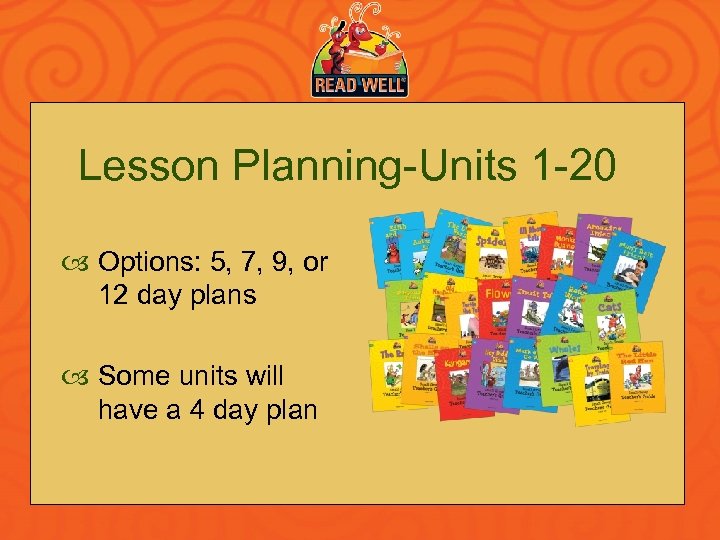 Lesson Planning-Units 1 -20 Options: 5, 7, 9, or 12 day plans Some units will have a 4 day plan
 Small Group Instruction Recommendations Every group Every day 20 -30 minutes Double dose for the lower performing students
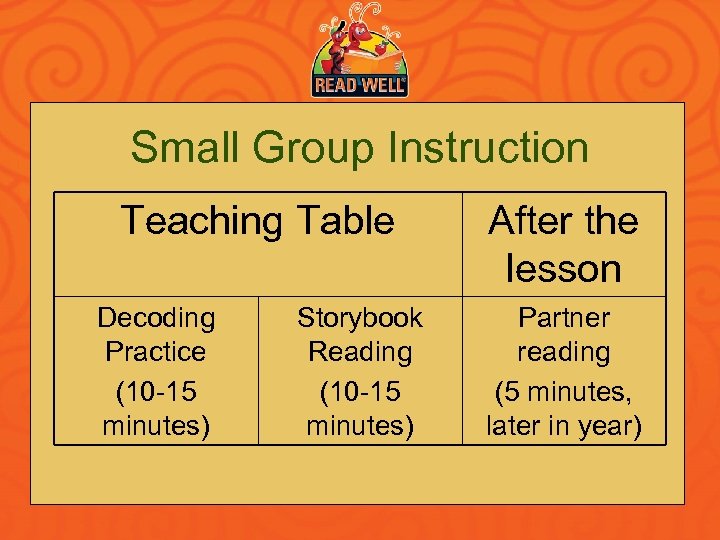 Small Group Instruction Teaching Table Decoding Practice (10 -15 minutes) Storybook Reading (10 -15 minutes) After the lesson Partner reading (5 minutes, later in year)
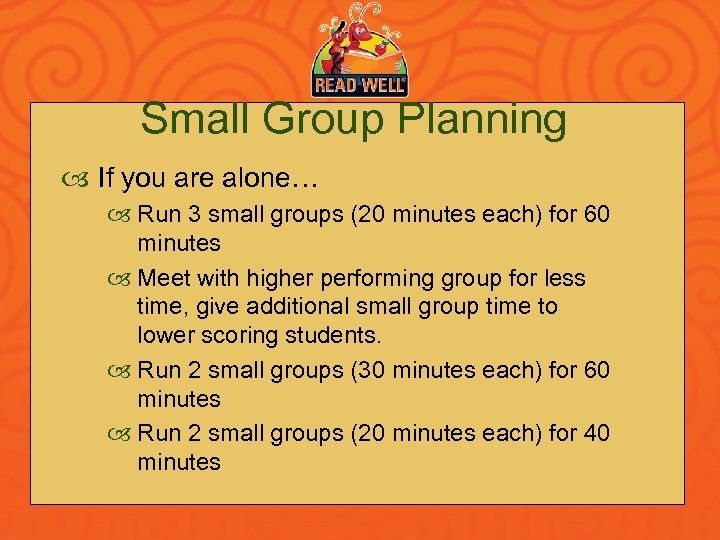 Small Group Planning If you are alone… Run 3 small groups (20 minutes each) for 60 minutes Meet with higher performing group for less time, give additional small group time to lower scoring students. Run 2 small groups (30 minutes each) for 60 minutes Run 2 small groups (20 minutes each) for 40 minutes
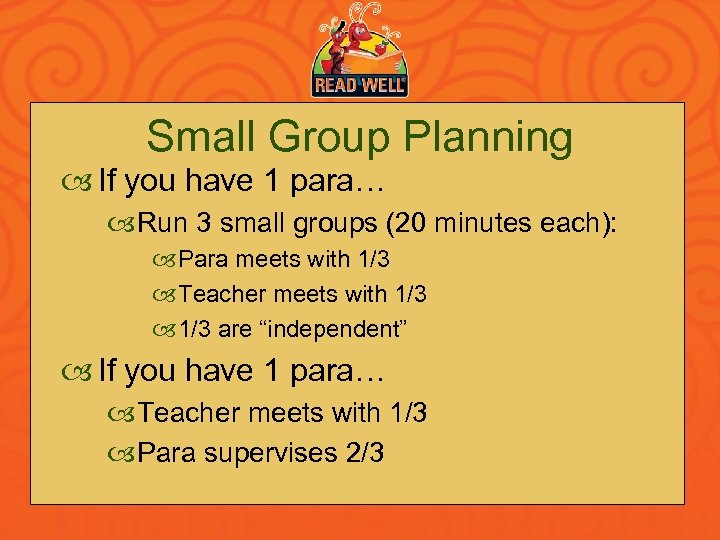 Small Group Planning If you have 1 para… Run 3 small groups (20 minutes each): Para meets with 1/3 Teacher meets with 1/3 are “independent” If you have 1 para… Teacher meets with 1/3 Para supervises 2/3
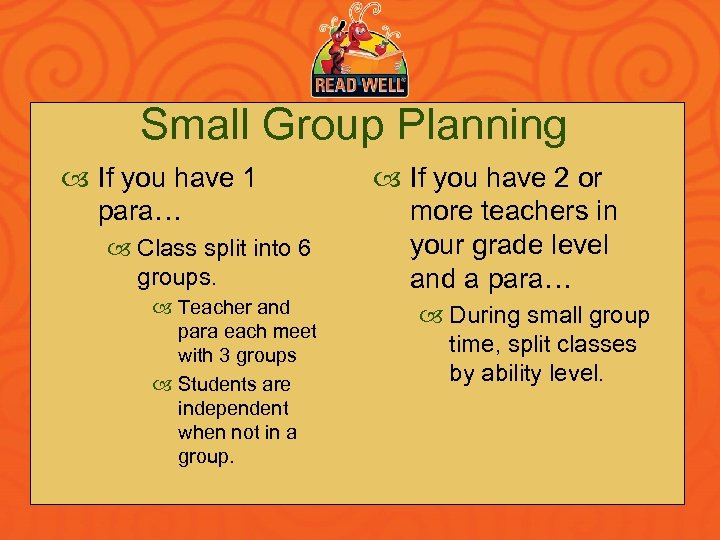 Small Group Planning If you have 1 para… Class split into 6 groups. Teacher and para each meet with 3 groups Students are independent when not in a group. If you have 2 or more teachers in your grade level and a para… During small group time, split classes by ability level.
 Daily Lesson Format 10 -15 minutes Decoding 10 -15 minutes Story Reading Partner Reading/Independent Work Extra Practice Activities Homework
 Decoding Lessons Include: Warm-Ups-Magazine covers, Sound and word cards, Smooth and Bumpy Blending Cards New Sound Introduction/New Sound Practice Introduced with a poem and tracing letter Smooth and Bumpy Blending Stretch and Shrink Sounding out Smoothly Accuracy and Fluency Building Tricky Words
 Model and Practice a decoding lesson…
 Story Reading Fully Decodable Text (Duet & Solo Stories) Priming Background Knowledge Vocabulary Introduction Procedures Finger Tracking First Reading Second Reading Correcting Errors Repeated Readings Expressive Reading
 Model and Practice a duet and solo story…
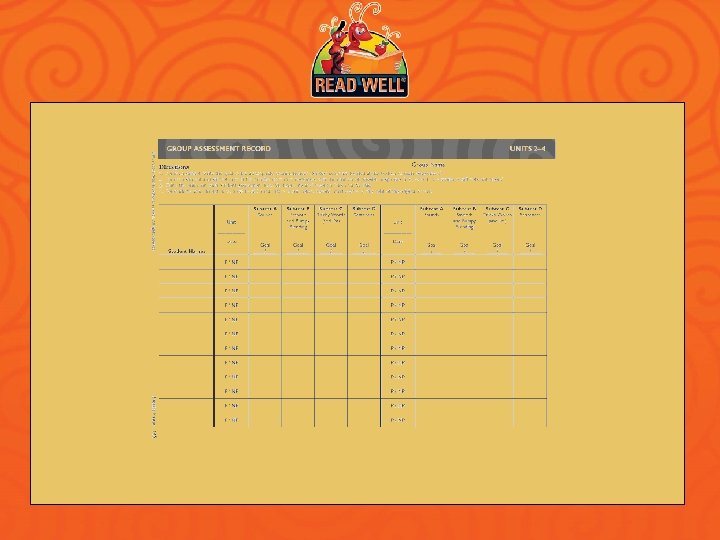
 Assessment-End of Unit Efficient, individually administered measures of each student’s mastery of newly taught skills, and retention of previously learned skills. Assessment at the end of every prelude or unit. Assessment Activity for students to complete while you are assessing. (Blackline Masters)
 Practice administering Assessment
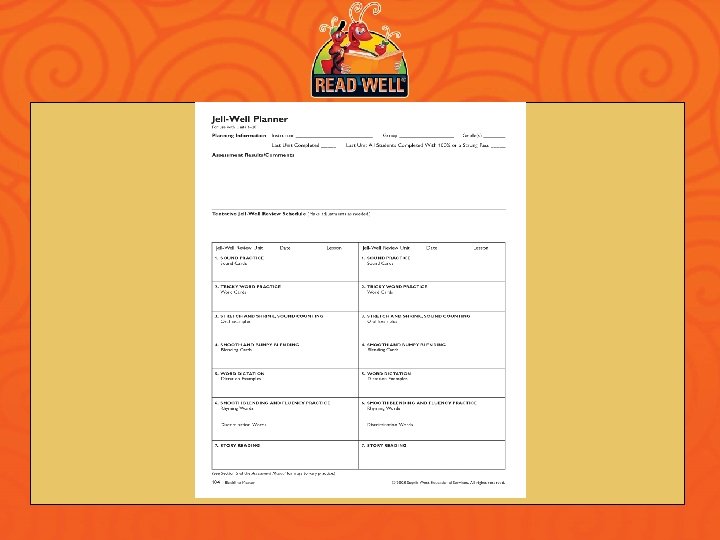
 Jell-Well Review Periodic review of earlier units Strengthens foundational skills, avoids overloads, builds confidence
 Maintaining Home-School Connections Found in the back of every Teacher’s Guide Certificate of Achievement
 Appendix Checklists Lesson Planner Additional Blackline Masters
 Whole Class Materials 26 thematic 5 day units with 4 review units Teacher’s Guides CD of Songs ABC Wall Cards ABC Poem Posters Read Aloud Books Literature Book Package RW Lap Book Set
 Whole Class Materials (cont. ) Pocket Chart Cards Blending Cards Art Related Activities Unit Art Projects ABC Scrapbook Art Pages Independent Work (BLM or Workbooks) Homework Activities
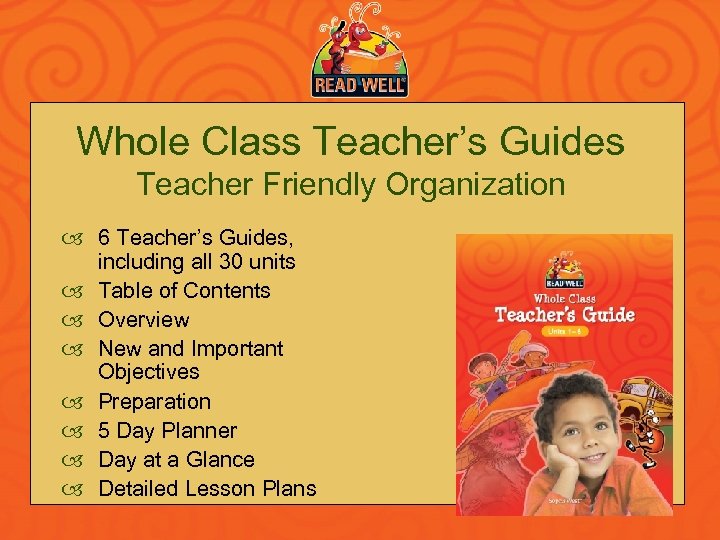 Whole Class Teacher’s Guides Teacher Friendly Organization 6 Teacher’s Guides, including all 30 units Table of Contents Overview New and Important Objectives Preparation 5 Day Planner Day at a Glance Detailed Lesson Plans
 Teacher’s Guides Black text= Required Activity Red text= Recommended but nonessential activities Step by step “scripted” directions Purpose: To visualize a quality lesson Not to be memorized or read verbatim Important notes, tips, and reminders A star = a new skill, activity, or story
 Teaching Whole Class Lessons Teacher support of student learning is gently scaffolded: Teacher demonstrates or overtly models the skill for students. In Teacher’s Guide = blue text Teacher guides practice of the skill with students. In Teacher’s Guides = gray text Teacher gives students independent practice (group & individual turns) with the skill. In Teacher’s Guides= gray text in parentheses
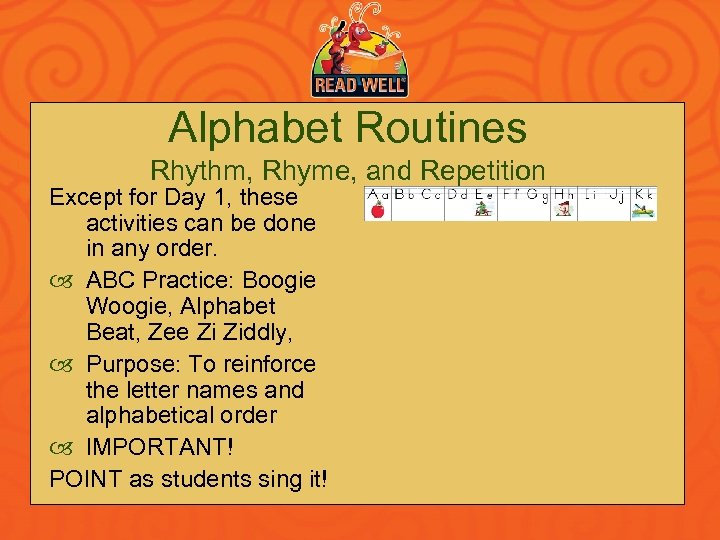 Alphabet Routines Rhythm, Rhyme, and Repetition Except for Day 1, these activities can be done in any order. ABC Practice: Boogie Woogie, Alphabet Beat, Zee Zi Ziddly, Purpose: To reinforce the letter names and alphabetical order IMPORTANT! POINT as students sing it!
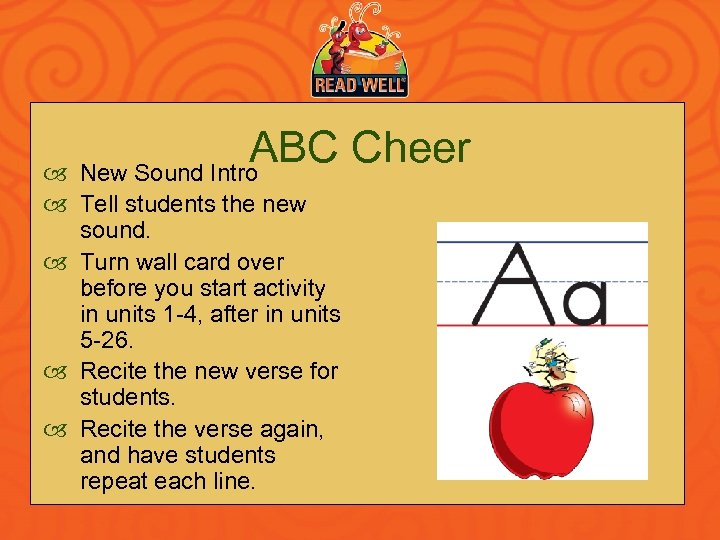 ABC Cheer New Sound Intro Tell students the new sound. Turn wall card over before you start activity in units 1 -4, after in units 5 -26. Recite the new verse for students. Recite the verse again, and have students repeat each line.
 ABC Cheer (continued) Point to appropriate wall card. Units 1 -8 Verses only Units 9 -26 Use all the wall cards If the wall card has a picture, students say the verse. If the wall card only has letters, students say the name of the letter. After completing “cheer”, review known beginning sounds.
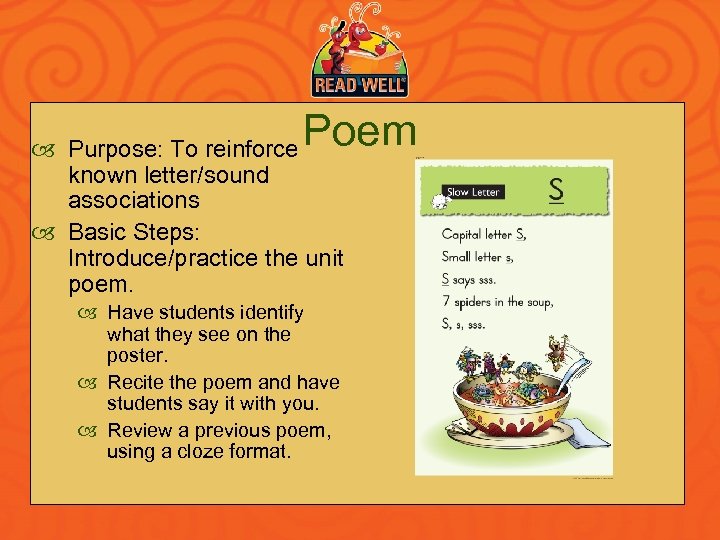 Poem Purpose: To reinforce known letter/sound associations Basic Steps: Introduce/practice the unit poem. Have students identify what they see on the poster. Recite the poem and have students say it with you. Review a previous poem, using a cloze format.
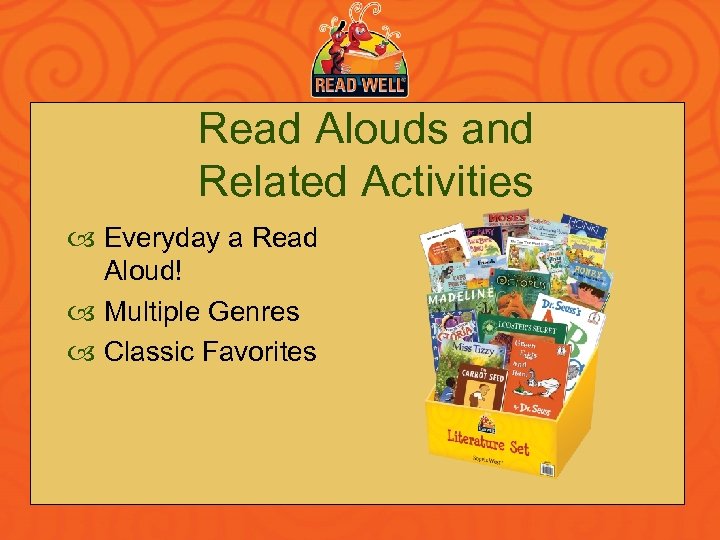 Read Alouds and Related Activities Everyday a Read Aloud! Multiple Genres Classic Favorites
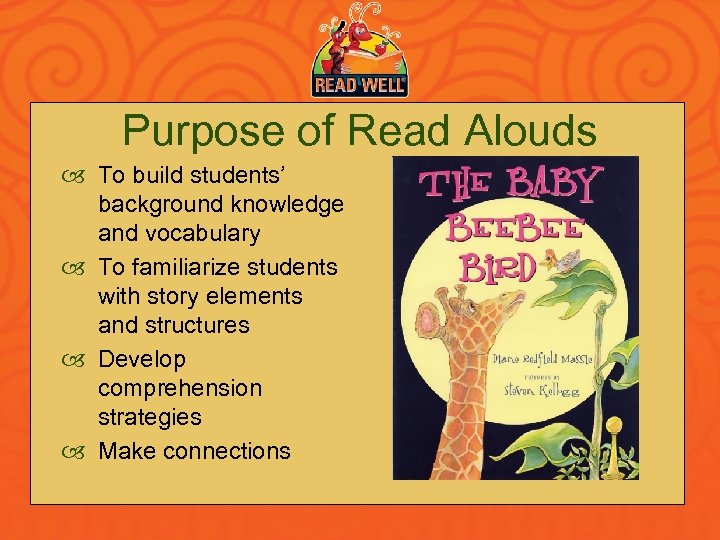 Purpose of Read Alouds To build students’ background knowledge and vocabulary To familiarize students with story elements and structures Develop comprehension strategies Make connections
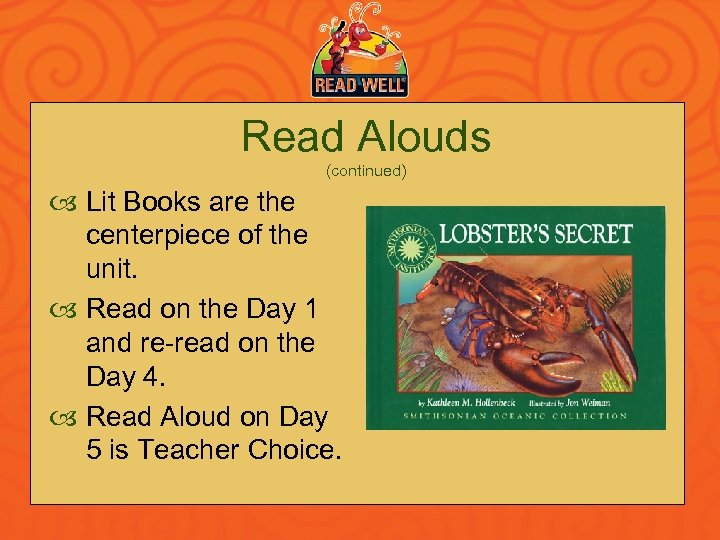 Read Alouds (continued) Lit Books are the centerpiece of the unit. Read on the Day 1 and re-read on the Day 4. Read Aloud on Day 5 is Teacher Choice.
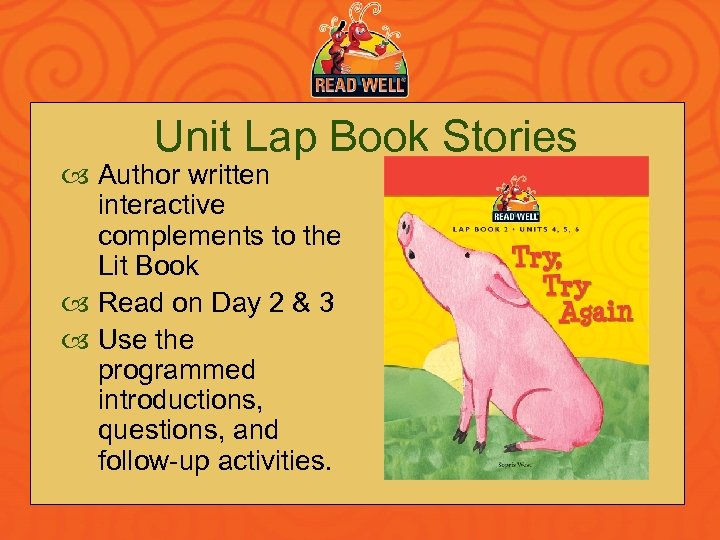 Unit Lap Book Stories Author written interactive complements to the Lit Book Read on Day 2 & 3 Use the programmed introductions, questions, and follow-up activities.
 Stretch and Shrink Oral blending/Oral language Purpose: Primes students for sounding out words Provides practice with basic oral language patterns
 Stretch and Shrink (continued) Steps Say the word. Use the word in a sentence. Demonstrate stretching out the word, then shrinking up the word. Guide practice Have students practice independent of your voice. Don’t forget the oral language practice.
 Smooth & Bumpy Blending CRITICAL blending and segmenting practice Purpose: Provides practice in identifying sounds in words. Helps students distinguish between “sounding out smoothly” and “stopping between sounds”.
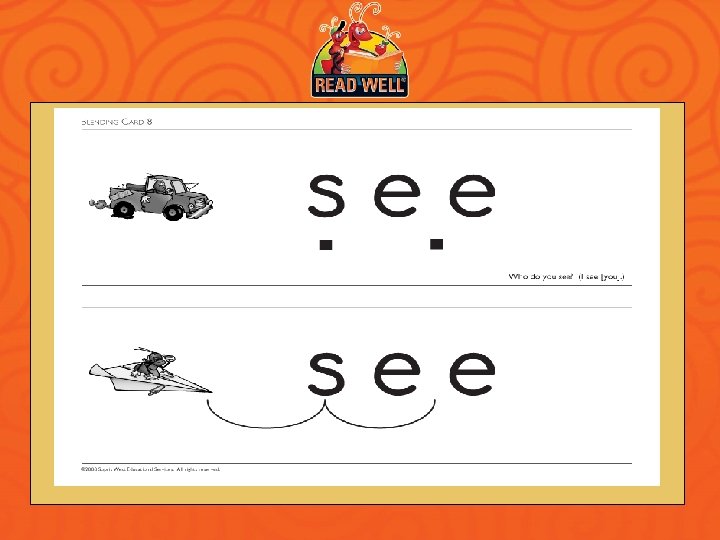
 White Board Dictation Age appropriate spelling and drawing practice. Purpose: Provides practice in hearing and writing sounds, pattern words, Tricky Words, and sentences. Gently introduces early writing conventions.
 White Board Dictation Basic Steps: Sounds: Have students identify the sound at the beginning of the word. Demonstrate writing the letter/sound association. Have students identify the beginning sound again. Dictate the sound and have students write it.
 White Board Dictation Basic Steps: Pattern Words: Say the word; then use it in a sentence. Have students say the word. Segment the word into sounds, with the students. Hold up one finger for each sound as it is said. Have students identify each sound as you write it. Have students blend the word and read it. Have students identify and write each sound. Have students blend and or read the word.
 White Board Dictation Tricky Words and Sentences See Teacher’s Guides for specific directions. IMPORTANT MANAGEMENT TIPS: First teach students how to use their white boards. Develop a “routine” for handing out and collecting the white boards, markers, and erasers.
 Independent Work Purposes: To help students develop work habits. To foster home-school connections. To improve handwriting and fine motor skills. To reinforce learned skills To provide work for students to do while teacher does small group instruction.
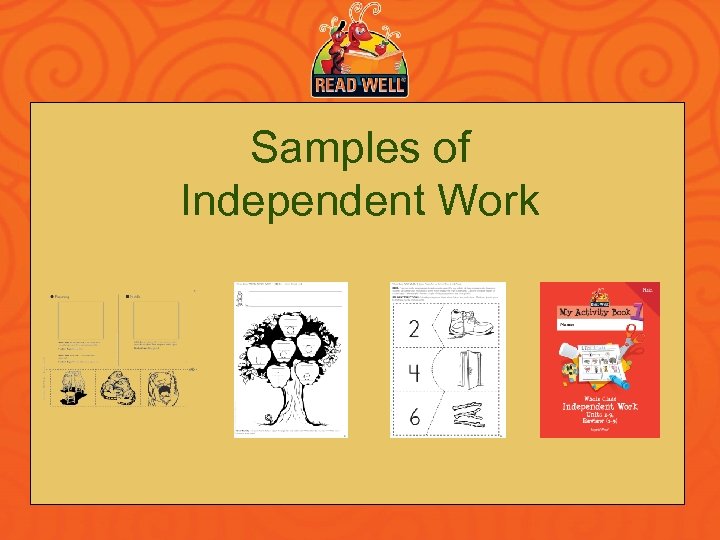 Samples of Independent Work
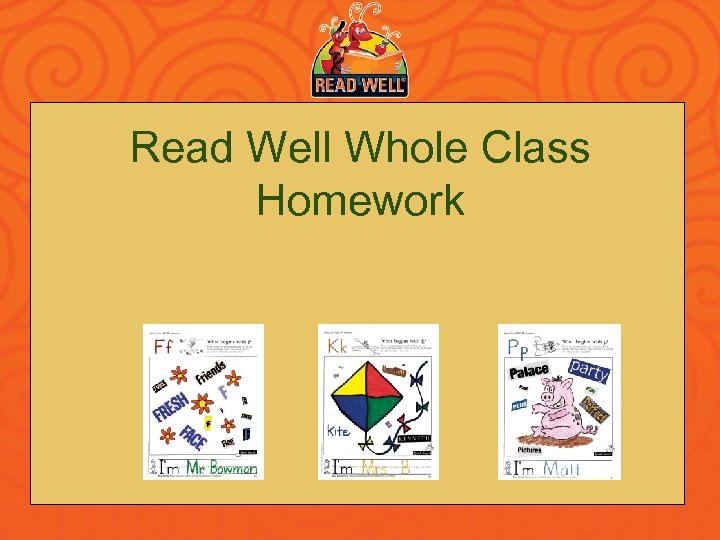 Read Well Whole Class Homework
 Final Thoughts Teach a complete lesson Decoding Story Reading Comprehension and Skill pages Homework Assess at the end of every unit Teach with fidelity Teach diagnostically – Assessments inform instruction