


 Скачать презентацию Khe Sanh 5 th Platoon Offense Class 1
3fb78891b829f6adb3f18d036ad3e61b.ppt
- Количество слайдов: 68
 Khe Sanh 5 th Platoon “Offense” Class 1 -06 Advanced Course
 OVERVIEW þ þ þ þ Operational Context Organization Strength Armament Doctrine of Forces Weather and Terrain Significant Leaders Lessons Learned
 OPERATIONAL CONTEXT Gy. Sgt Parker
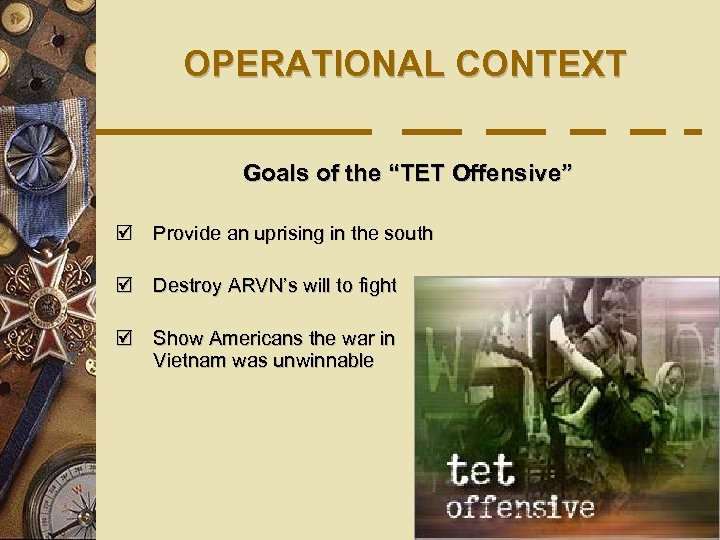 OPERATIONAL CONTEXT Goals of the “TET Offensive” þ Provide an uprising in the south þ Destroy ARVN’s will to fight þ Show Americans the war in Vietnam was unwinnable
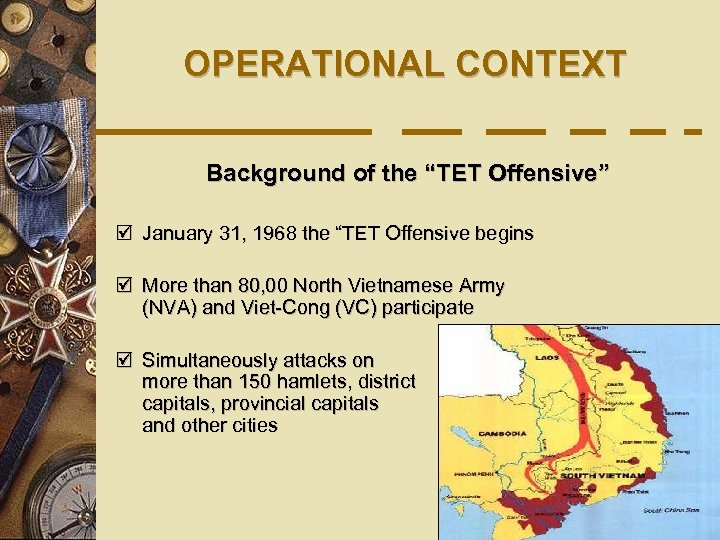 OPERATIONAL CONTEXT Background of the “TET Offensive” þ January 31, 1968 the “TET Offensive begins þ More than 80, 00 North Vietnamese Army (NVA) and Viet-Cong (VC) participate þ Simultaneously attacks on more than 150 hamlets, district capitals, provincial capitals and other cities
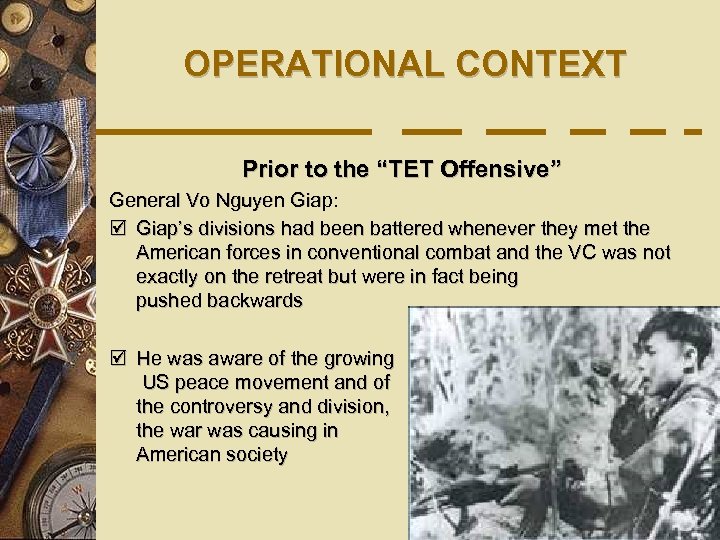 OPERATIONAL CONTEXT Prior to the “TET Offensive” General Vo Nguyen Giap: þ Giap’s divisions had been battered whenever they met the American forces in conventional combat and the VC was not exactly on the retreat but were in fact being pushed backwards þ He was aware of the growing US peace movement and of the controversy and division, the war was causing in American society
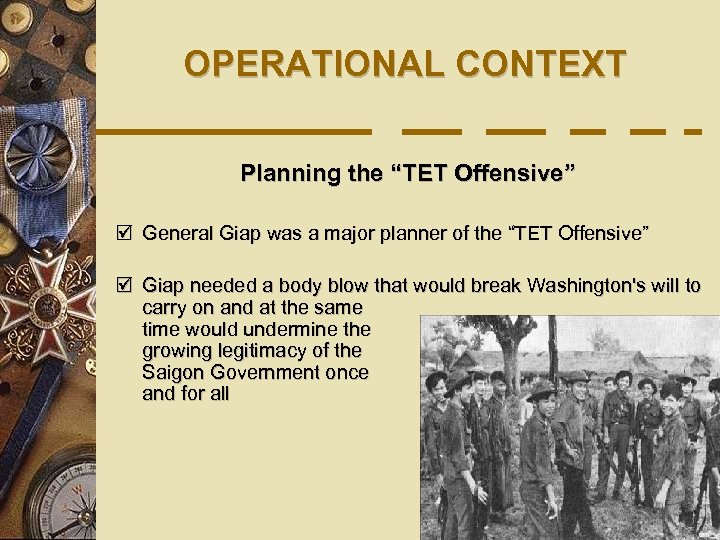 OPERATIONAL CONTEXT Planning the “TET Offensive” þ General Giap was a major planner of the “TET Offensive” þ Giap needed a body blow that would break Washington's will to carry on and at the same time would undermine the growing legitimacy of the Saigon Government once and for all
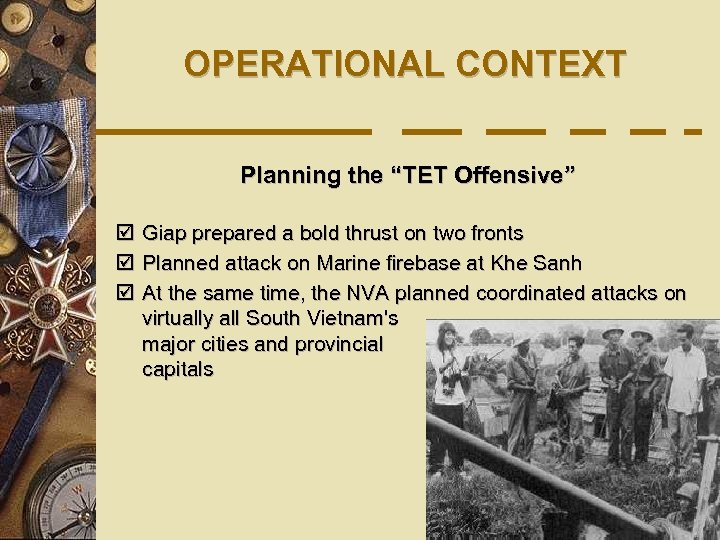 OPERATIONAL CONTEXT Planning the “TET Offensive” þ þ þ Giap prepared a bold thrust on two fronts Planned attack on Marine firebase at Khe Sanh At the same time, the NVA planned coordinated attacks on virtually all South Vietnam's major cities and provincial capitals
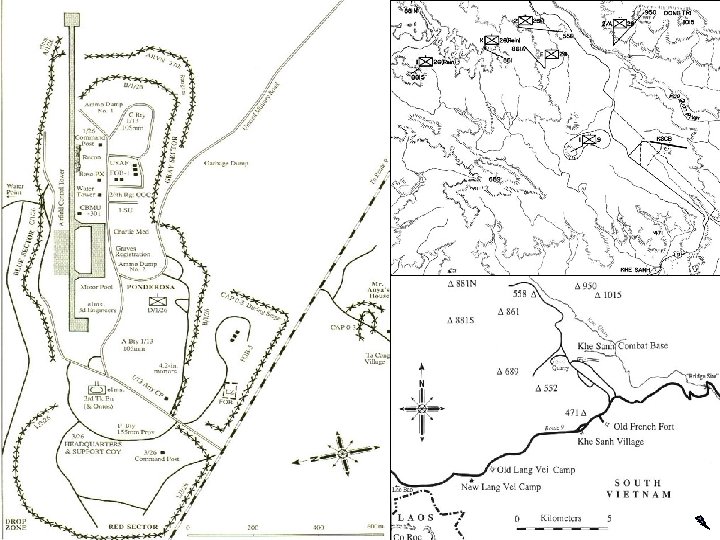
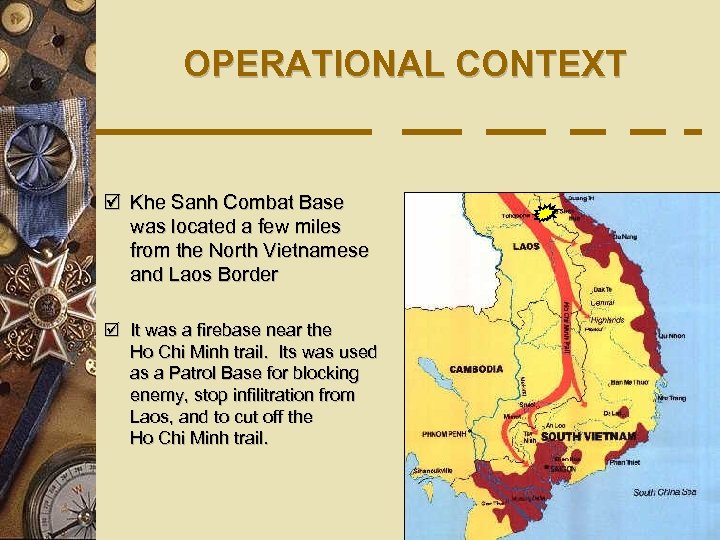 OPERATIONAL CONTEXT þ Khe Sanh Combat Base was located a few miles from the North Vietnamese and Laos Border þ It was a firebase near the Ho Chi Minh trail. Its was used as a Patrol Base for blocking enemy, stop infilitration from Laos, and to cut off the Ho Chi Minh trail.
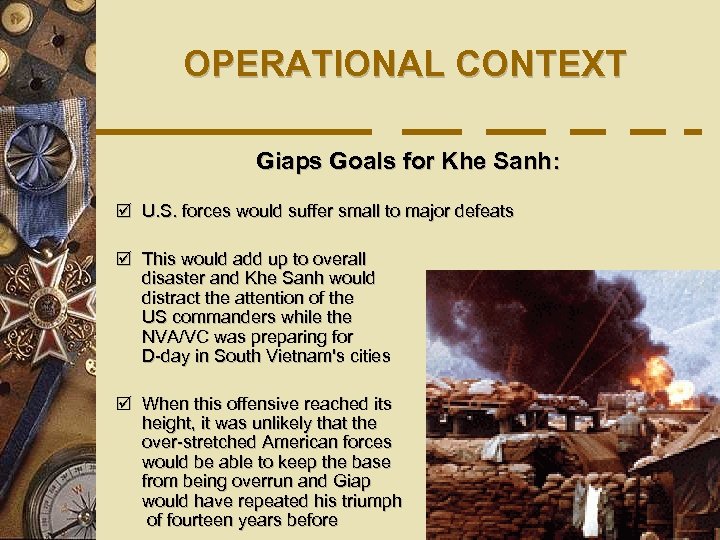 OPERATIONAL CONTEXT Giaps Goals for Khe Sanh: þ U. S. forces would suffer small to major defeats þ This would add up to overall disaster and Khe Sanh would distract the attention of the US commanders while the NVA/VC was preparing for D-day in South Vietnam's cities þ When this offensive reached its height, it was unlikely that the over-stretched American forces would be able to keep the base from being overrun and Giap would have repeated his triumph of fourteen years before
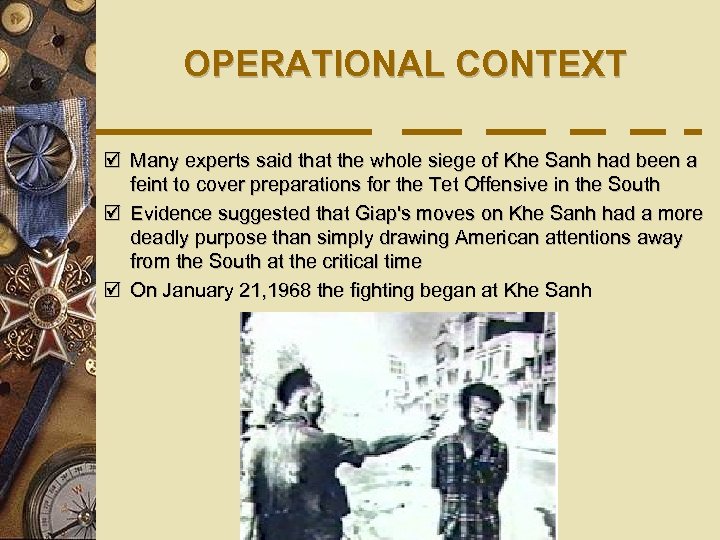 OPERATIONAL CONTEXT þ Many experts said that the whole siege of Khe Sanh had been a feint to cover preparations for the Tet Offensive in the South þ Evidence suggested that Giap's moves on Khe Sanh had a more deadly purpose than simply drawing American attentions away from the South at the critical time þ On January 21, 1968 the fighting began at Khe Sanh
 ORGANIZATION STRENGTH Gy. Sgt Lamey
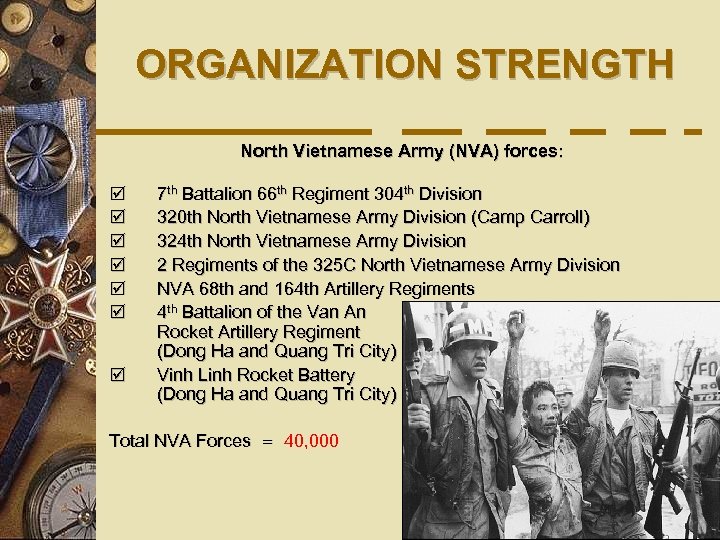 ORGANIZATION STRENGTH North Vietnamese Army (NVA) forces: þ þ þ þ 7 th Battalion 66 th Regiment 304 th Division 320 th North Vietnamese Army Division (Camp Carroll) 324 th North Vietnamese Army Division 2 Regiments of the 325 C North Vietnamese Army Division NVA 68 th and 164 th Artillery Regiments 4 th Battalion of the Van An Rocket Artillery Regiment (Dong Ha and Quang Tri City) Vinh Linh Rocket Battery (Dong Ha and Quang Tri City) Total NVA Forces = 40, 000
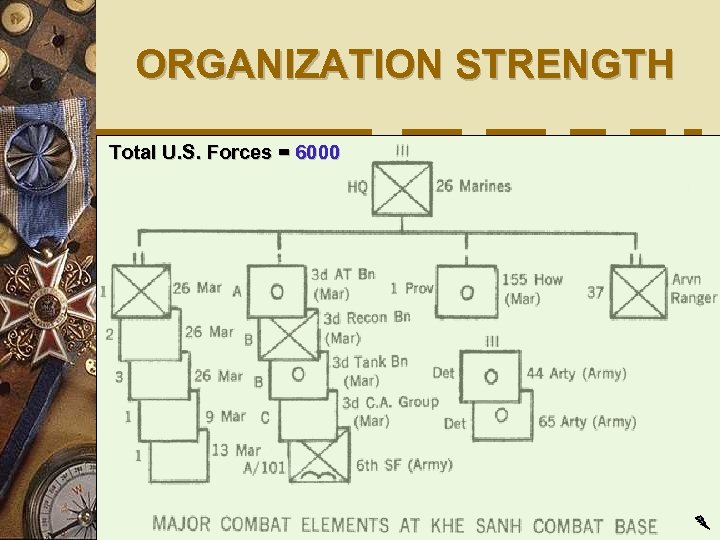 ORGANIZATION STRENGTH Total U. S. Forces = 6000
 ARMAMENT SSgt De. Leon
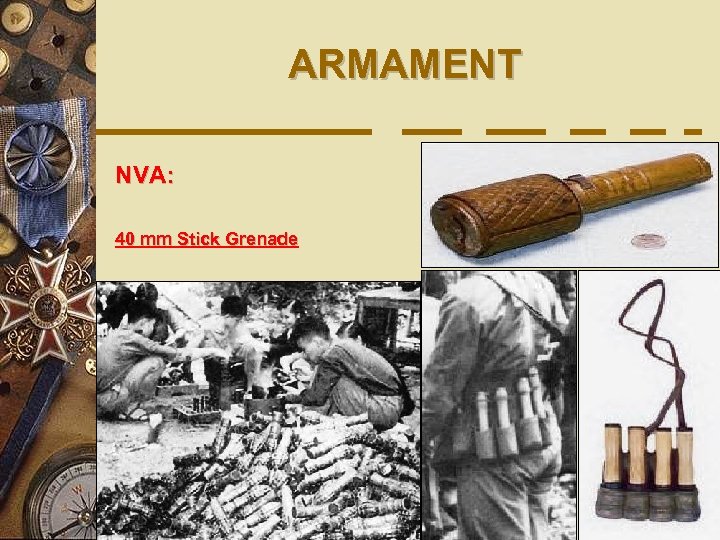 ARMAMENT NVA: 40 mm Stick Grenade
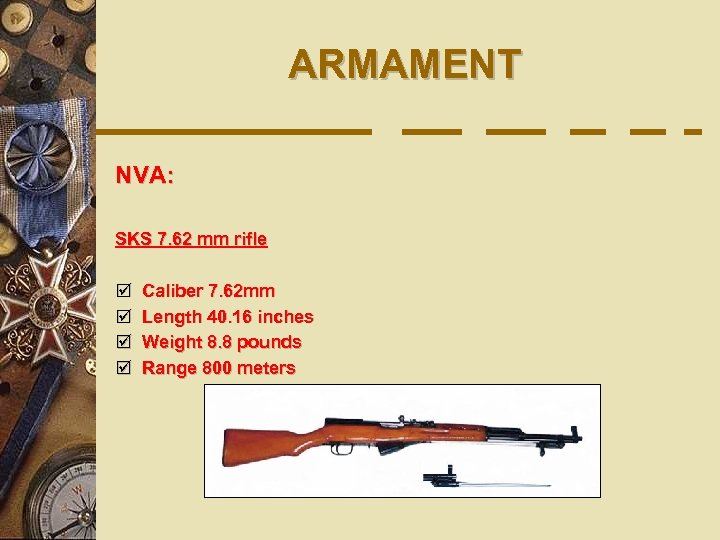 ARMAMENT NVA: SKS 7. 62 mm rifle þ þ Caliber 7. 62 mm Length 40. 16 inches Weight 8. 8 pounds Range 800 meters
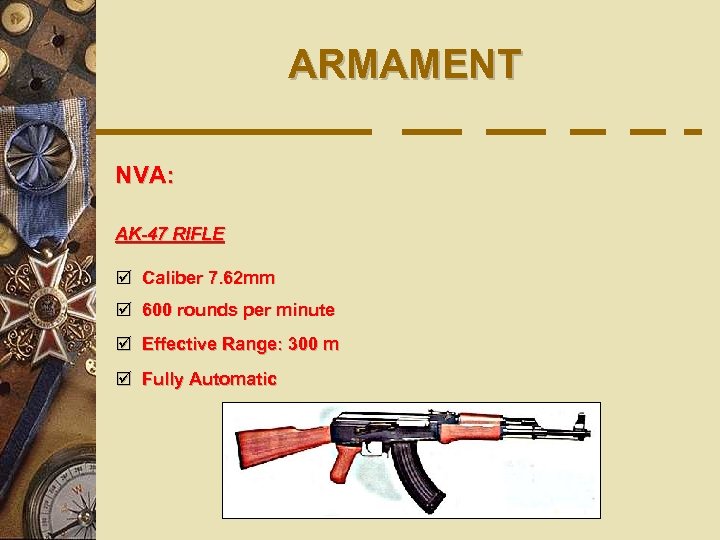 ARMAMENT NVA: AK-47 RIFLE þ Caliber 7. 62 mm þ 600 rounds per minute þ Effective Range: 300 m þ Fully Automatic
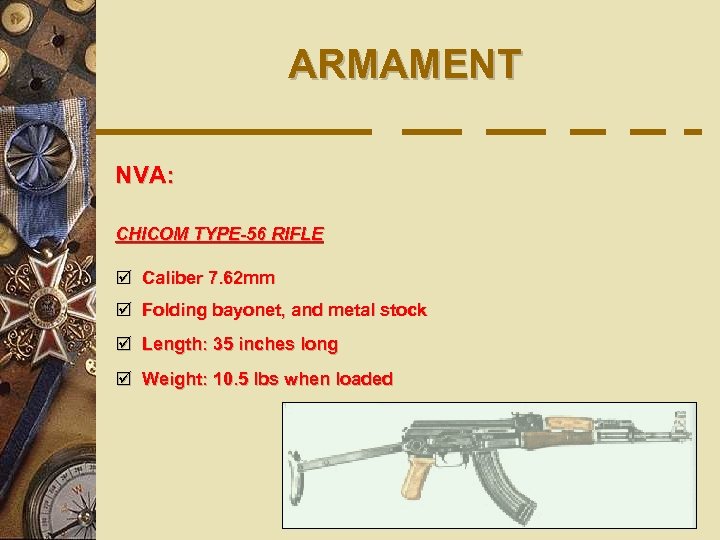 ARMAMENT NVA: CHICOM TYPE-56 RIFLE þ Caliber 7. 62 mm þ Folding bayonet, and metal stock þ Length: 35 inches long þ Weight: 10. 5 lbs when loaded
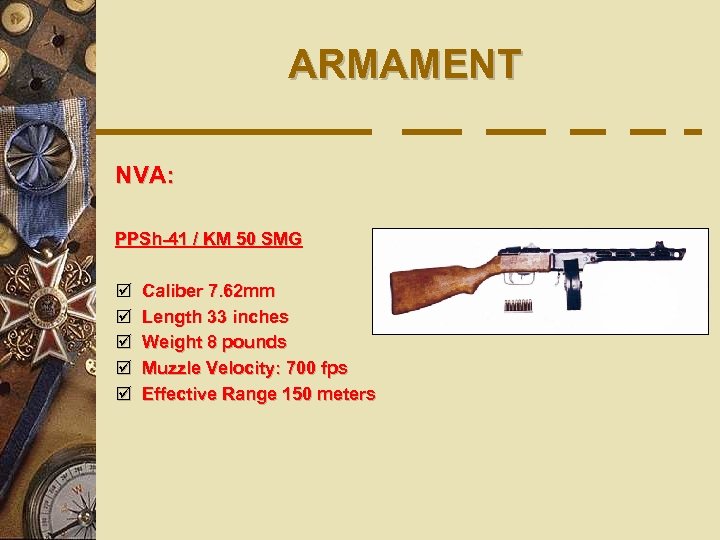 ARMAMENT NVA: PPSh-41 / KM 50 SMG þ þ þ Caliber 7. 62 mm Length 33 inches Weight 8 pounds Muzzle Velocity: 700 fps Effective Range 150 meters
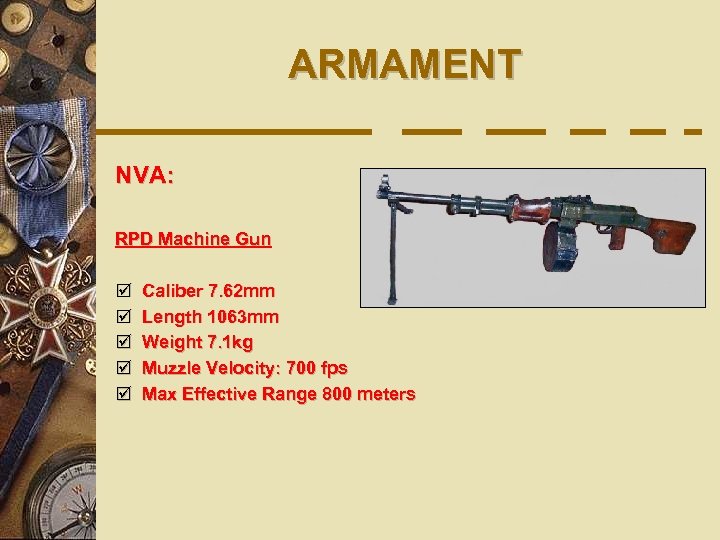 ARMAMENT NVA: RPD Machine Gun þ þ þ Caliber 7. 62 mm Length 1063 mm Weight 7. 1 kg Muzzle Velocity: 700 fps Max Effective Range 800 meters
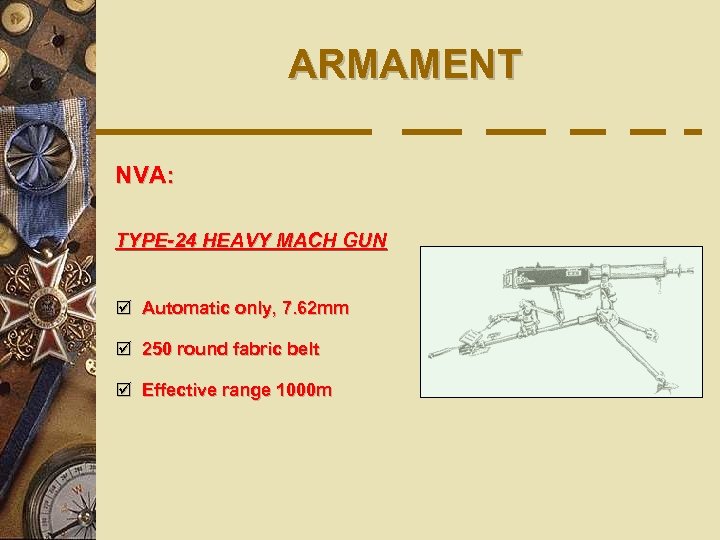 ARMAMENT NVA: TYPE-24 HEAVY MACH GUN þ Automatic only, 7. 62 mm þ 250 round fabric belt þ Effective range 1000 m
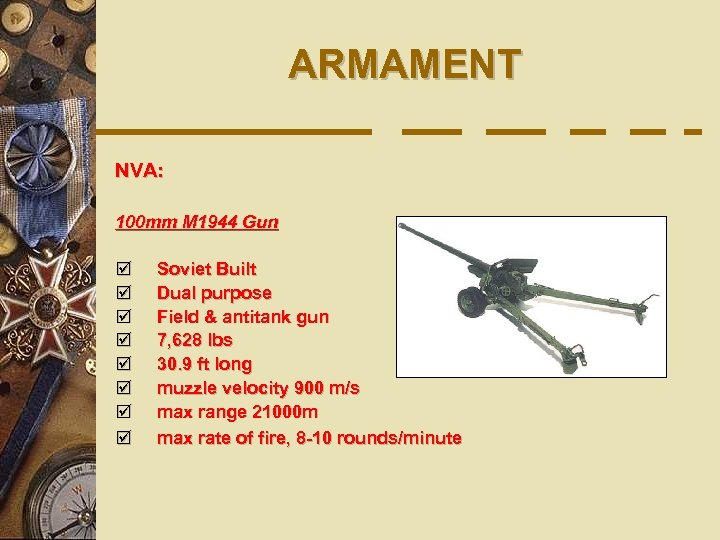 ARMAMENT NVA: 100 mm M 1944 Gun þ þ þ þ Soviet Built Dual purpose Field & antitank gun 7, 628 lbs 30. 9 ft long muzzle velocity 900 m/s max range 21000 m max rate of fire, 8 -10 rounds/minute
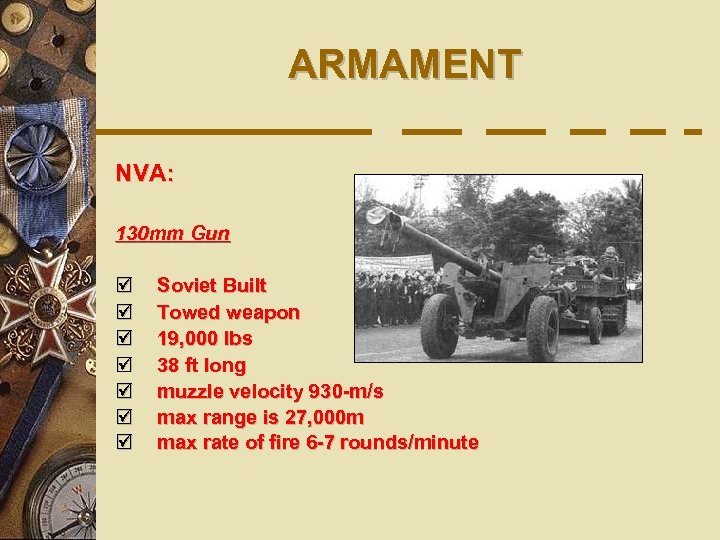 ARMAMENT NVA: 130 mm Gun þ þ þ þ Soviet Built Towed weapon 19, 000 lbs 38 ft long muzzle velocity 930 -m/s max range is 27, 000 m max rate of fire 6 -7 rounds/minute
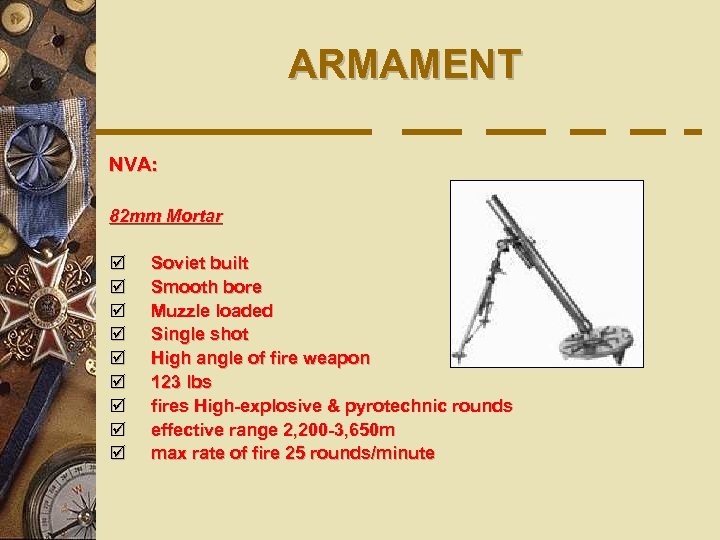 ARMAMENT NVA: 82 mm Mortar þ þ þ þ þ Soviet built Smooth bore Muzzle loaded Single shot High angle of fire weapon 123 lbs fires High-explosive & pyrotechnic rounds effective range 2, 200 -3, 650 m max rate of fire 25 rounds/minute
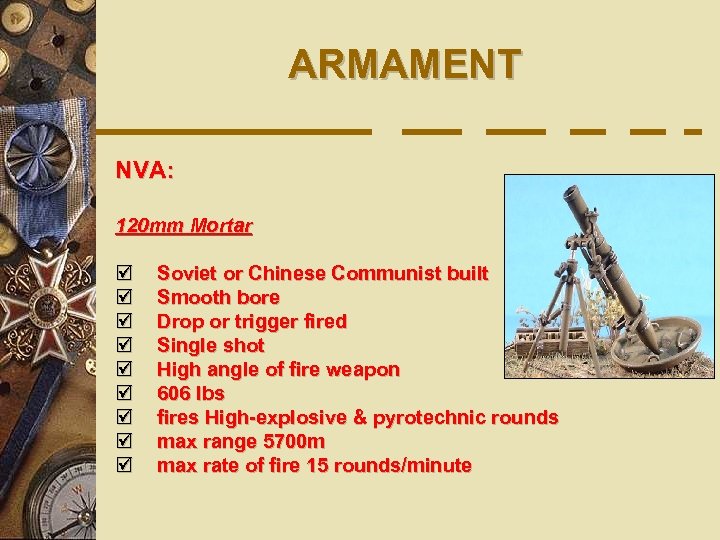 ARMAMENT NVA: 120 mm Mortar þ þ þ þ þ Soviet or Chinese Communist built Smooth bore Drop or trigger fired Single shot High angle of fire weapon 606 lbs fires High-explosive & pyrotechnic rounds max range 5700 m max rate of fire 15 rounds/minute
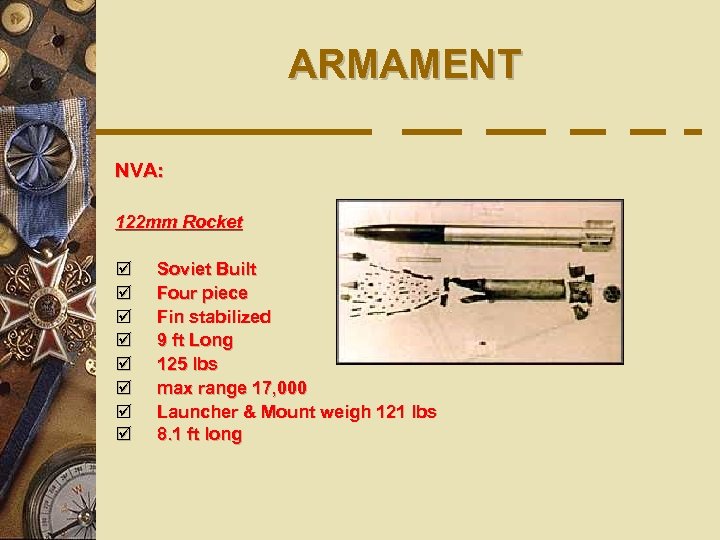 ARMAMENT NVA: 122 mm Rocket þ þ þ þ Soviet Built Four piece Fin stabilized 9 ft Long 125 lbs max range 17, 000 Launcher & Mount weigh 121 lbs 8. 1 ft long
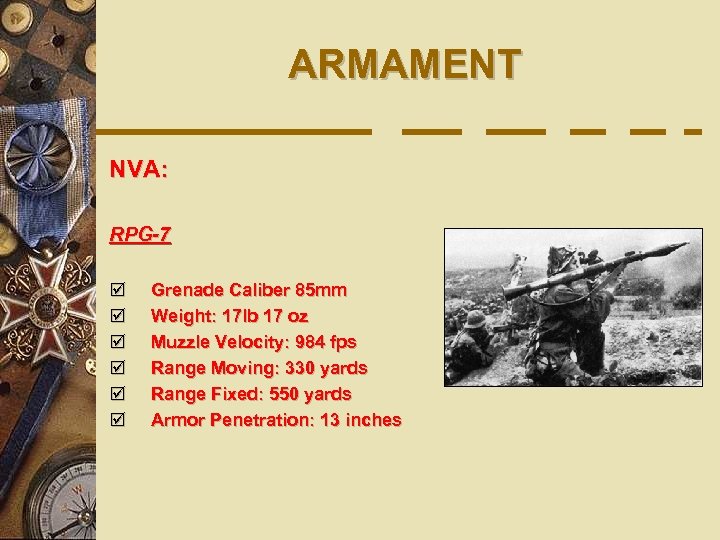 ARMAMENT NVA: RPG-7 þ þ þ Grenade Caliber 85 mm Weight: 17 lb 17 oz Muzzle Velocity: 984 fps Range Moving: 330 yards Range Fixed: 550 yards Armor Penetration: 13 inches
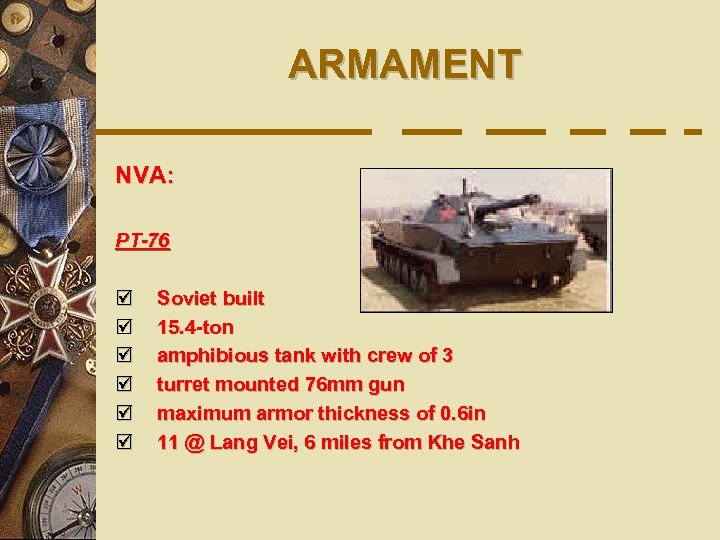 ARMAMENT NVA: PT-76 þ þ þ Soviet built 15. 4 -ton amphibious tank with crew of 3 turret mounted 76 mm gun maximum armor thickness of 0. 6 in 11 @ Lang Vei, 6 miles from Khe Sanh
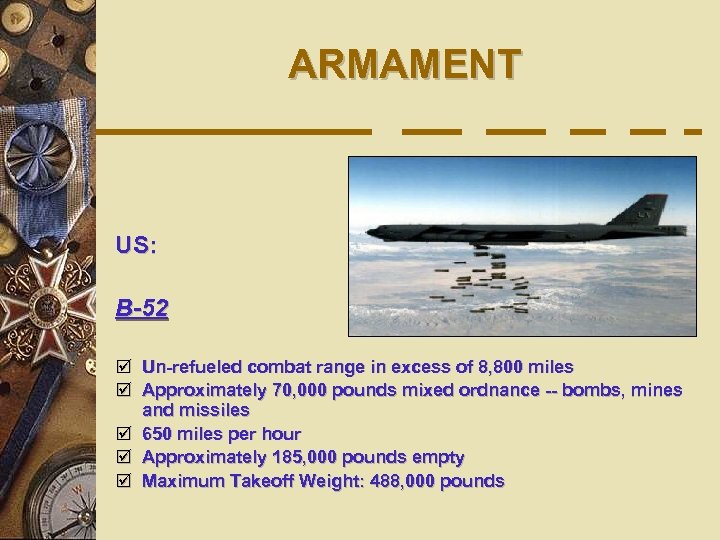 ARMAMENT US: B-52 þ Un-refueled combat range in excess of 8, 800 miles þ Approximately 70, 000 pounds mixed ordnance -- bombs, mines and missiles þ 650 miles per hour þ Approximately 185, 000 pounds empty þ Maximum Takeoff Weight: 488, 000 pounds
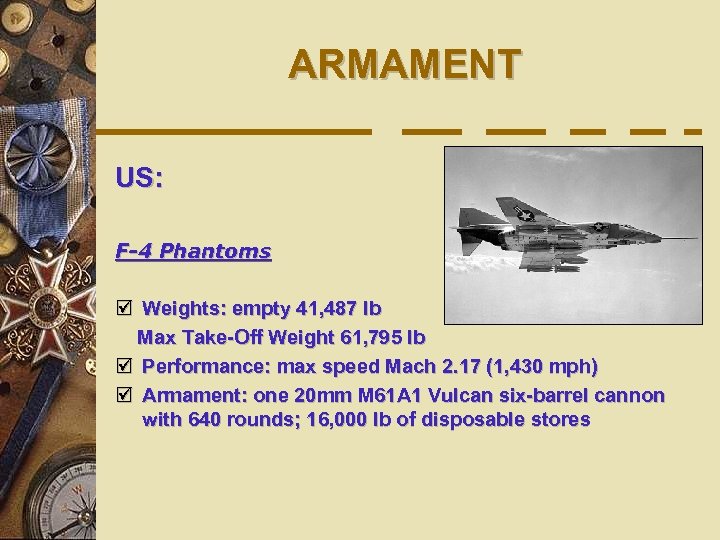 ARMAMENT US: F-4 Phantoms þ Weights: empty 41, 487 lb Max Take-Off Weight 61, 795 lb þ Performance: max speed Mach 2. 17 (1, 430 mph) þ Armament: one 20 mm M 61 A 1 Vulcan six-barrel cannon with 640 rounds; 16, 000 lb of disposable stores
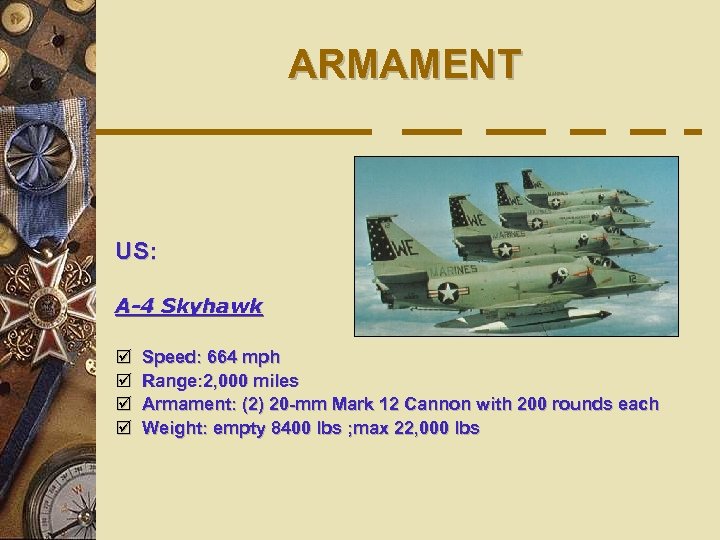 ARMAMENT US: A-4 Skyhawk þ þ Speed: 664 mph Range: 2, 000 miles Armament: (2) 20 -mm Mark 12 Cannon with 200 rounds each Weight: empty 8400 lbs ; max 22, 000 lbs
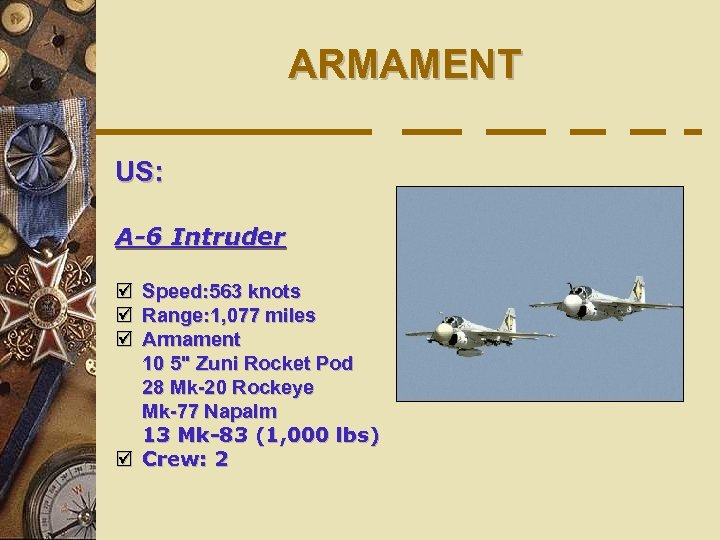 ARMAMENT US: A-6 Intruder þ Speed: 563 knots þ Range: 1, 077 miles þ Armament 10 5" Zuni Rocket Pod 28 Mk-20 Rockeye Mk-77 Napalm 13 Mk-83 (1, 000 lbs) þ Crew: 2
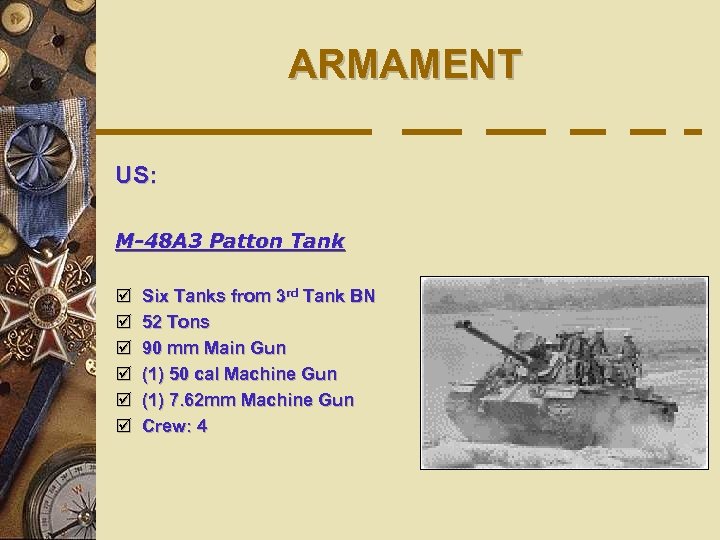 ARMAMENT US: M-48 A 3 Patton Tank þ þ þ Six Tanks from 3 rd Tank BN 52 Tons 90 mm Main Gun (1) 50 cal Machine Gun (1) 7. 62 mm Machine Gun Crew: 4
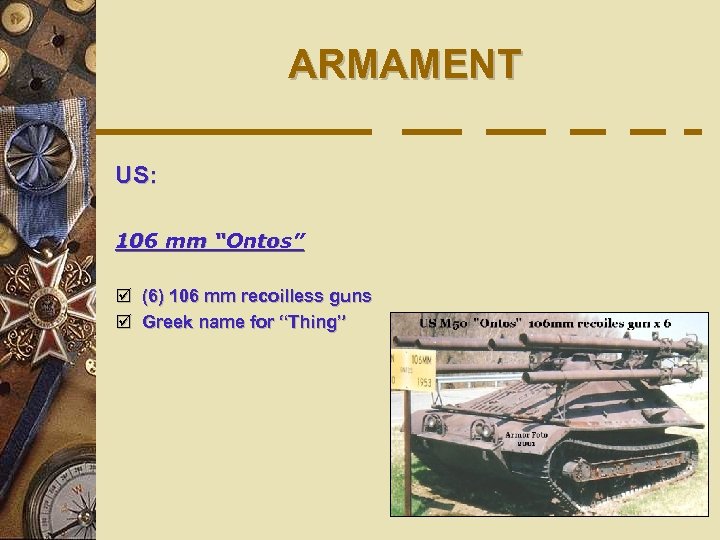 ARMAMENT US: 106 mm “Ontos” þ (6) 106 mm recoilless guns þ Greek name for “Thing”
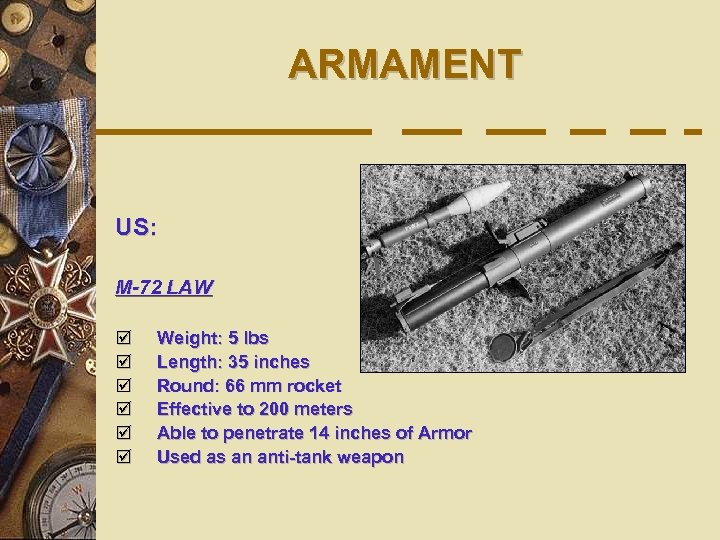 ARMAMENT US: M-72 LAW þ þ þ Weight: 5 lbs Length: 35 inches Round: 66 mm rocket Effective to 200 meters Able to penetrate 14 inches of Armor Used as an anti-tank weapon
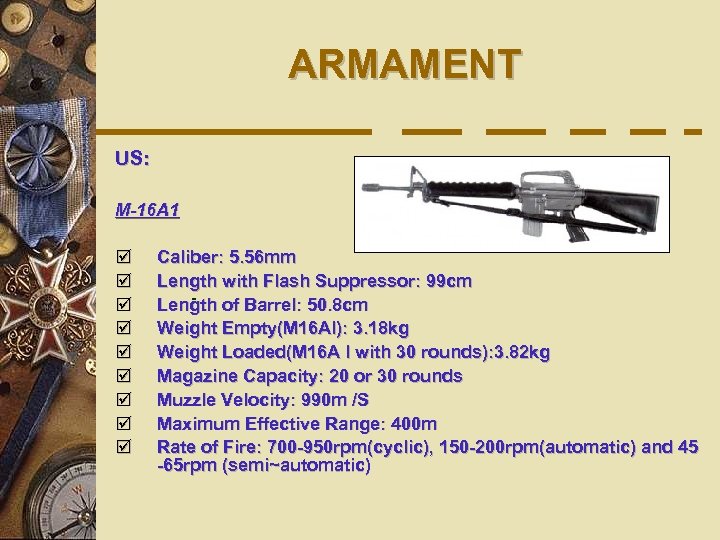 ARMAMENT US: M-16 A 1 þ þ þ þ þ Caliber: 5. 56 mm Length with Flash Suppressor: 99 cm Length of Barrel: 50. 8 cm Weight Empty(M 16 Al): 3. 18 kg Weight Loaded(M 16 A l with 30 rounds): 3. 82 kg Magazine Capacity: 20 or 30 rounds Muzzle Velocity: 990 m /S Maximum Effective Range: 400 m Rate of Fire: 700 -950 rpm(cyclic), 150 -200 rpm(automatic) and 45 -65 rpm (semi~automatic)
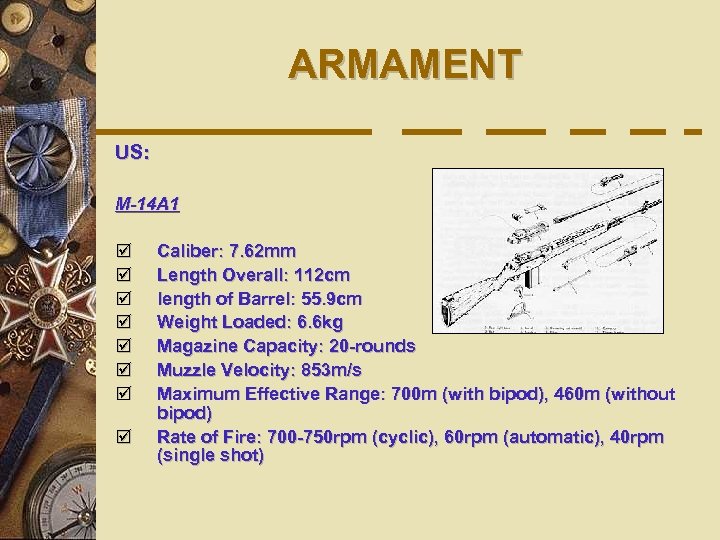 ARMAMENT US: M-14 A 1 þ þ þ þ Caliber: 7. 62 mm Length Overall: 112 cm length of Barrel: 55. 9 cm Weight Loaded: 6. 6 kg Magazine Capacity: 20 -rounds Muzzle Velocity: 853 m/s Maximum Effective Range: 700 m (with bipod), 460 m (without bipod) Rate of Fire: 700 -750 rpm (cyclic), 60 rpm (automatic), 40 rpm (single shot)
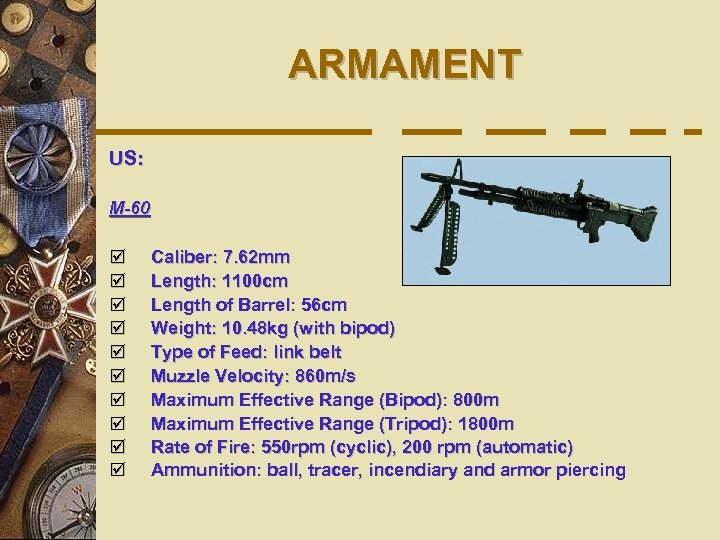 ARMAMENT US: M-60 þ þ þ þ þ Caliber: 7. 62 mm Length: 1100 cm Length of Barrel: 56 cm Weight: 10. 48 kg (with bipod) Type of Feed: link belt Muzzle Velocity: 860 m/s Maximum Effective Range (Bipod): 800 m Maximum Effective Range (Tripod): 1800 m Rate of Fire: 550 rpm (cyclic), 200 rpm (automatic) Ammunition: ball, tracer, incendiary and armor piercing
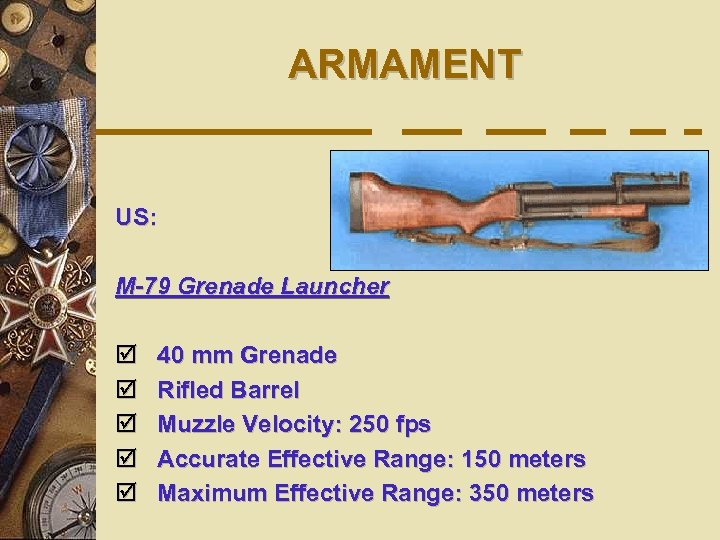 ARMAMENT US: M-79 Grenade Launcher þ þ þ 40 mm Grenade Rifled Barrel Muzzle Velocity: 250 fps Accurate Effective Range: 150 meters Maximum Effective Range: 350 meters
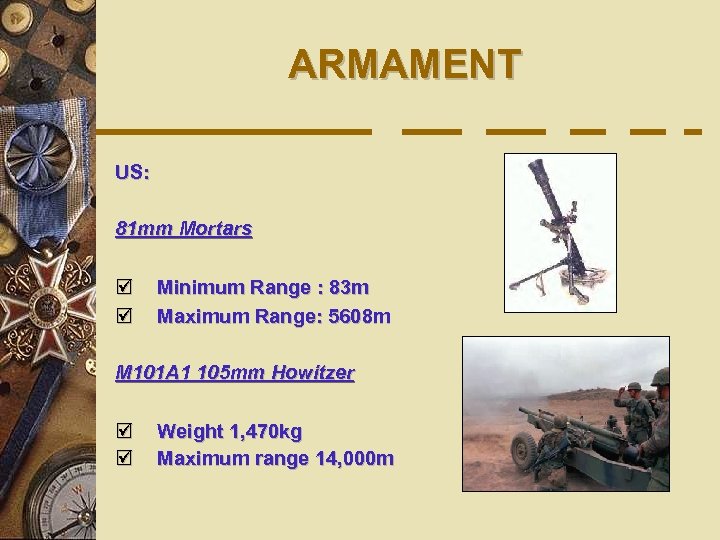 ARMAMENT US: 81 mm Mortars þ þ Minimum Range : 83 m Maximum Range: 5608 m M 101 A 1 105 mm Howitzer þ þ Weight 1, 470 kg Maximum range 14, 000 m
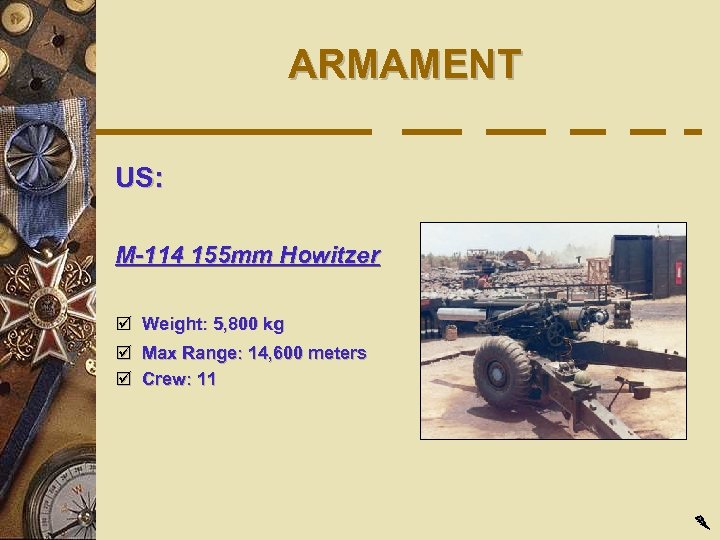 ARMAMENT US: M-114 155 mm Howitzer þ Weight: 5, 800 kg þ Max Range: 14, 600 meters þ Crew: 11
 DOCTRINE OF FORCES Gy. Sgt Kash
 MARINE CORPS DOCTRINE þ During the war the Marines had a maneuver warfare þ This was used by both the Marines and the Army þ The Marine Corps was ordered to take up a static defense and was argued by Lt. Gen Krulak because we are an offensive force
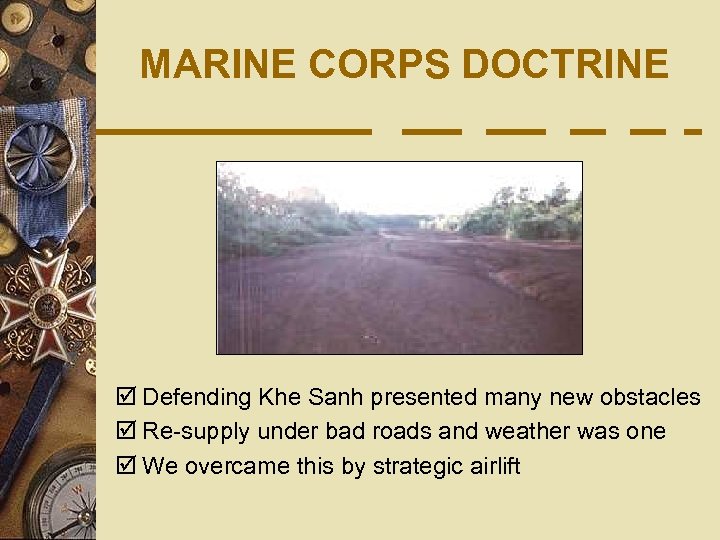 MARINE CORPS DOCTRINE þ Defending Khe Sanh presented many new obstacles þ Re-supply under bad roads and weather was one þ We overcame this by strategic airlift
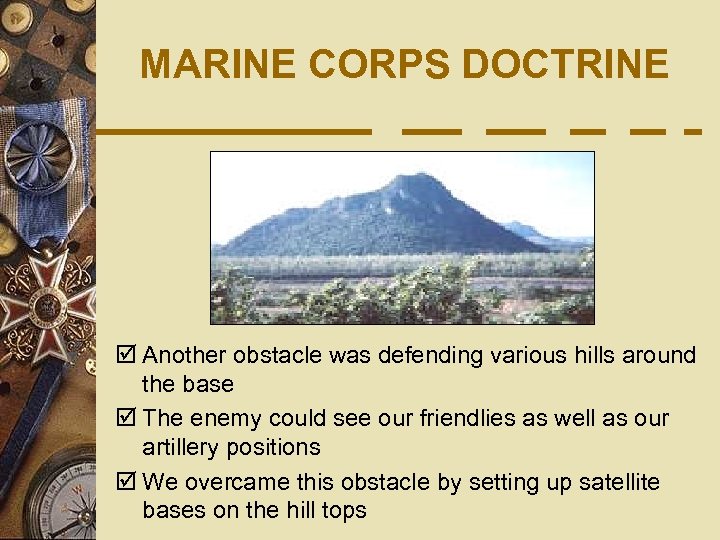 MARINE CORPS DOCTRINE þ Another obstacle was defending various hills around the base þ The enemy could see our friendlies as well as our artillery positions þ We overcame this obstacle by setting up satellite bases on the hill tops
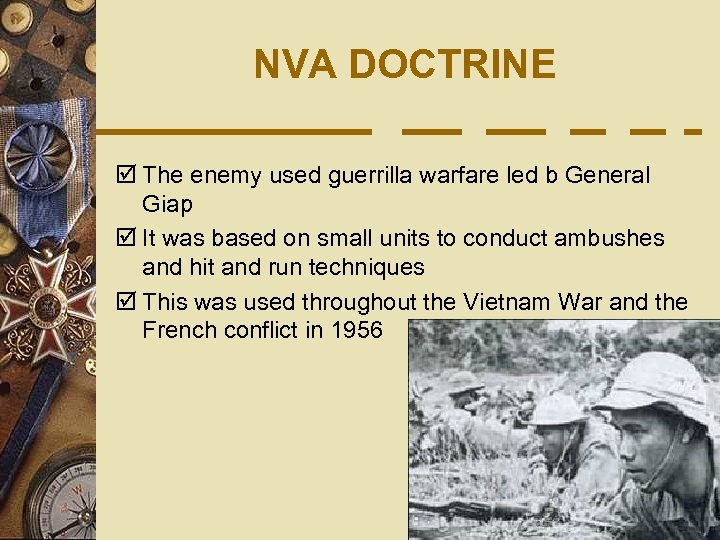 NVA DOCTRINE þ The enemy used guerrilla warfare led b General Giap þ It was based on small units to conduct ambushes and hit and run techniques þ This was used throughout the Vietnam War and the French conflict in 1956
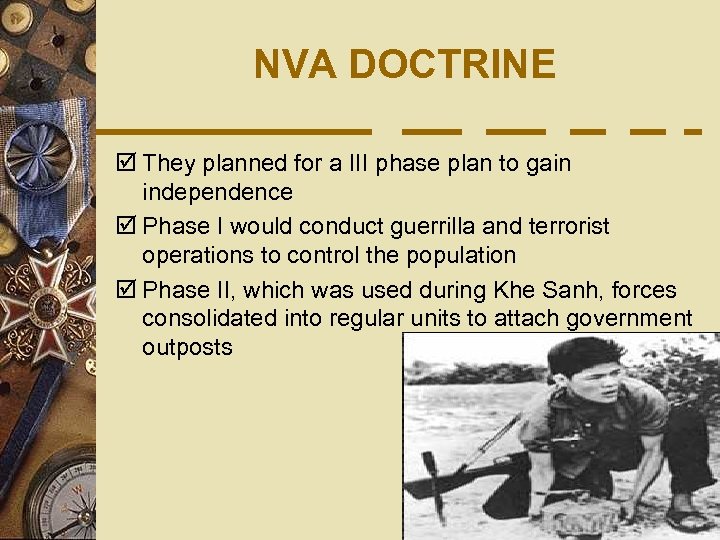 NVA DOCTRINE þ They planned for a III phase plan to gain independence þ Phase I would conduct guerrilla and terrorist operations to control the population þ Phase II, which was used during Khe Sanh, forces consolidated into regular units to attach government outposts
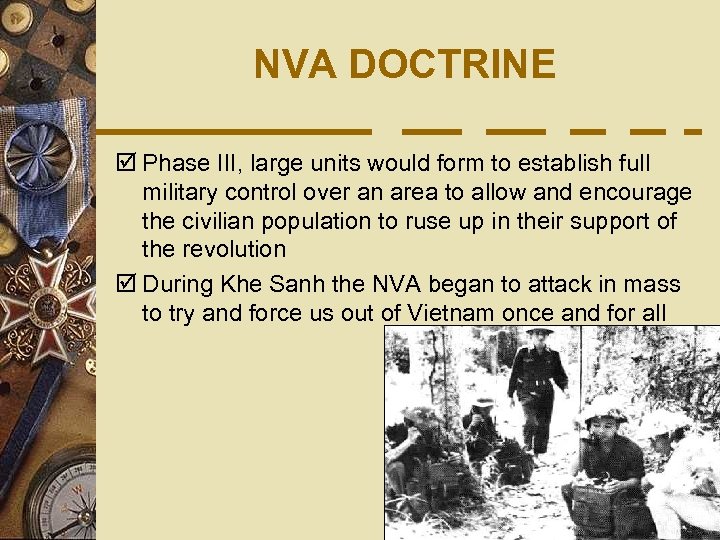 NVA DOCTRINE þ Phase III, large units would form to establish full military control over an area to allow and encourage the civilian population to ruse up in their support of the revolution þ During Khe Sanh the NVA began to attack in mass to try and force us out of Vietnam once and for all
 WEATHER AND TERRAIN Gy. Sgt Greenfield
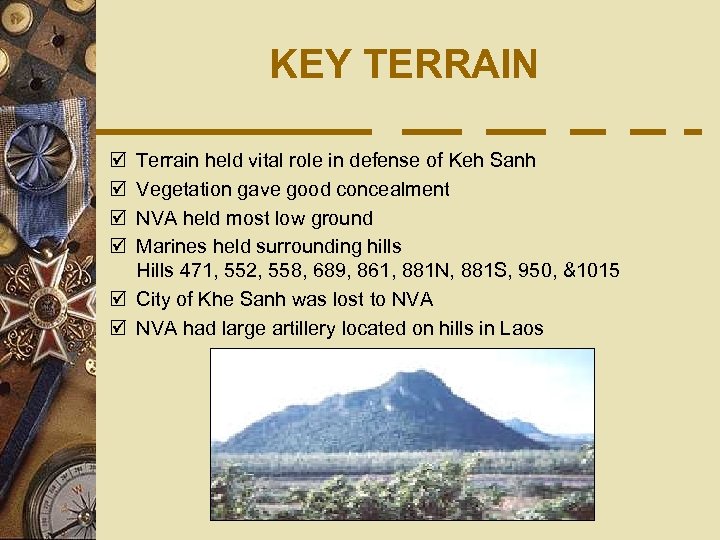 KEY TERRAIN þ þ Terrain held vital role in defense of Keh Sanh Vegetation gave good concealment NVA held most low ground Marines held surrounding hills Hills 471, 552, 558, 689, 861, 881 N, 881 S, 950, &1015 þ City of Khe Sanh was lost to NVA þ NVA had large artillery located on hills in Laos
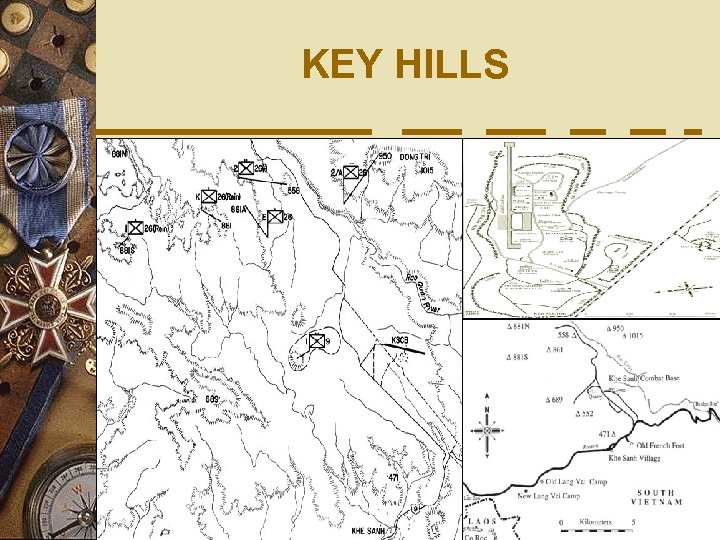 KEY HILLS
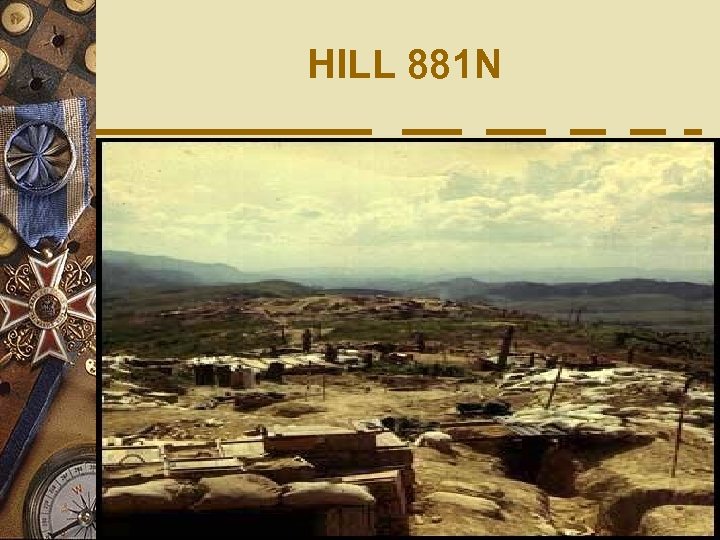 HILL 881 N
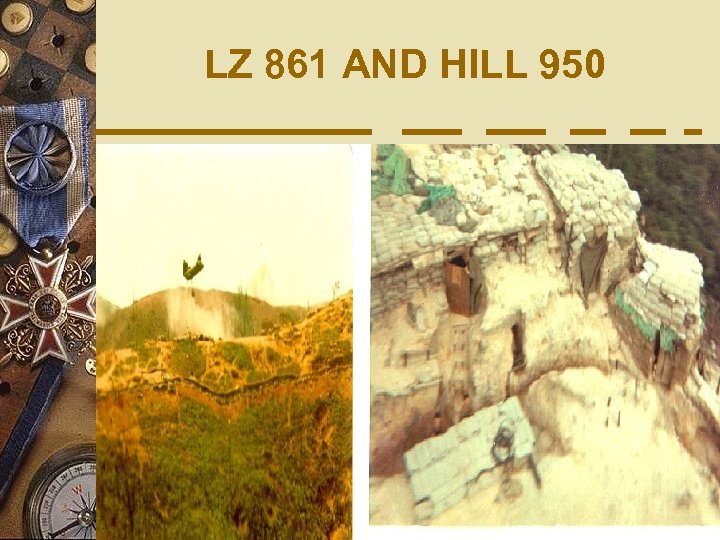 LZ 861 AND HILL 950
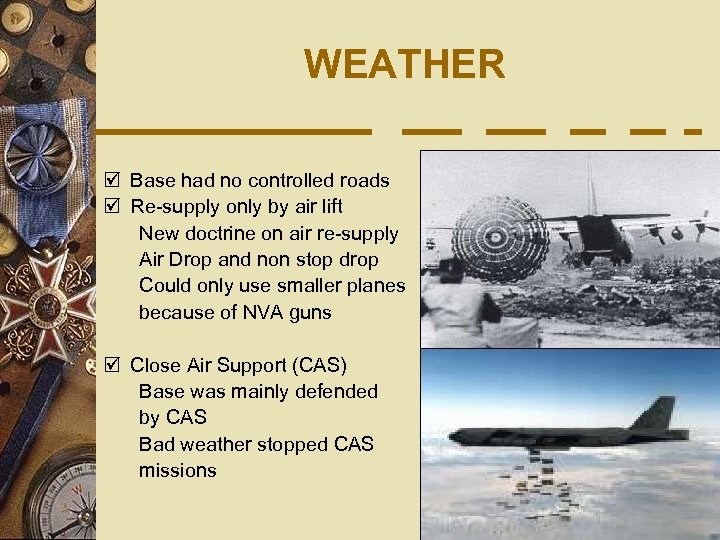 WEATHER þ Base had no controlled roads þ Re-supply only by air lift New doctrine on air re-supply Air Drop and non stop drop Could only use smaller planes because of NVA guns þ Close Air Support (CAS) Base was mainly defended by CAS Bad weather stopped CAS missions
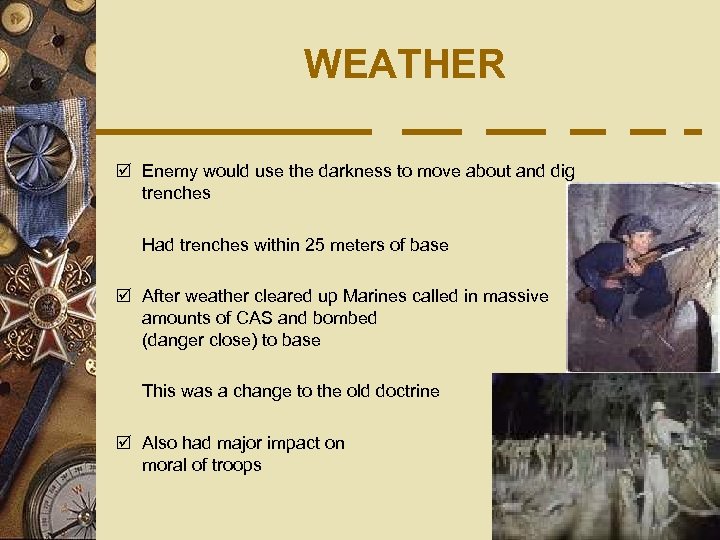 WEATHER þ Enemy would use the darkness to move about and dig trenches Had trenches within 25 meters of base þ After weather cleared up Marines called in massive amounts of CAS and bombed (danger close) to base This was a change to the old doctrine þ Also had major impact on moral of troops
 SIGNIFICANT LEADERS SSgt Claiborne
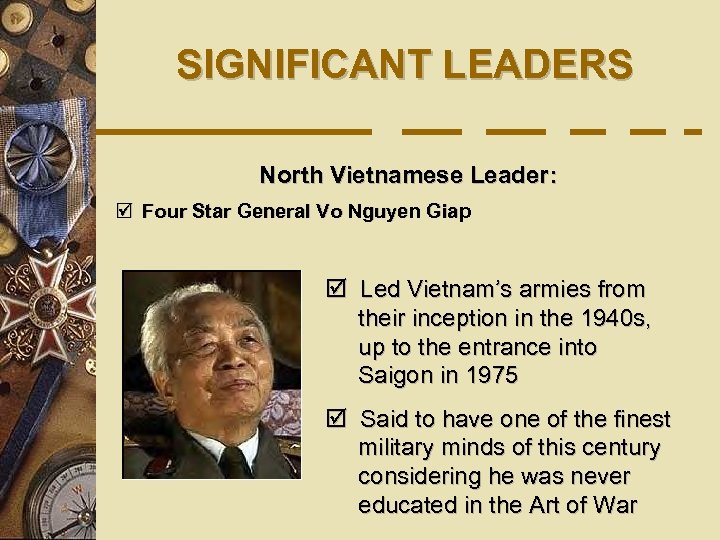 SIGNIFICANT LEADERS North Vietnamese Leader: þ Four Star General Vo Nguyen Giap þ Led Vietnam’s armies from their inception in the 1940 s, up to the entrance into Saigon in 1975 þ Said to have one of the finest military minds of this century considering he was never educated in the Art of War
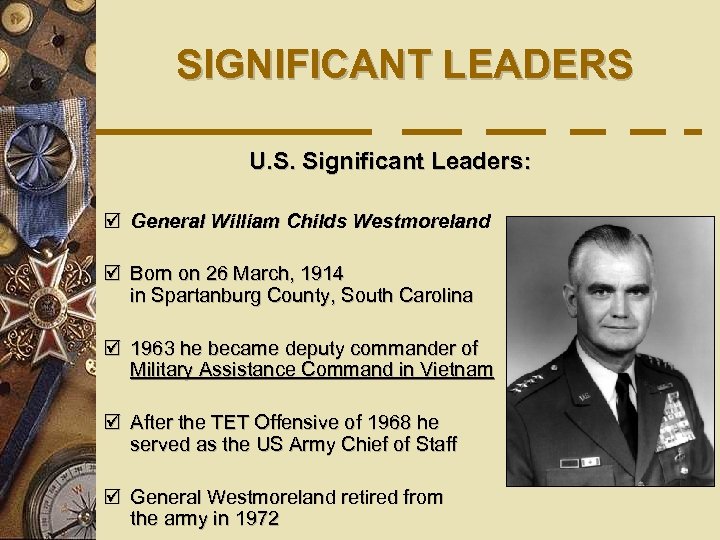 SIGNIFICANT LEADERS U. S. Significant Leaders: þ General William Childs Westmoreland þ Born on 26 March, 1914 in Spartanburg County, South Carolina þ 1963 he became deputy commander of Military Assistance Command in Vietnam þ After the TET Offensive of 1968 he served as the US Army Chief of Staff þ General Westmoreland retired from the army in 1972
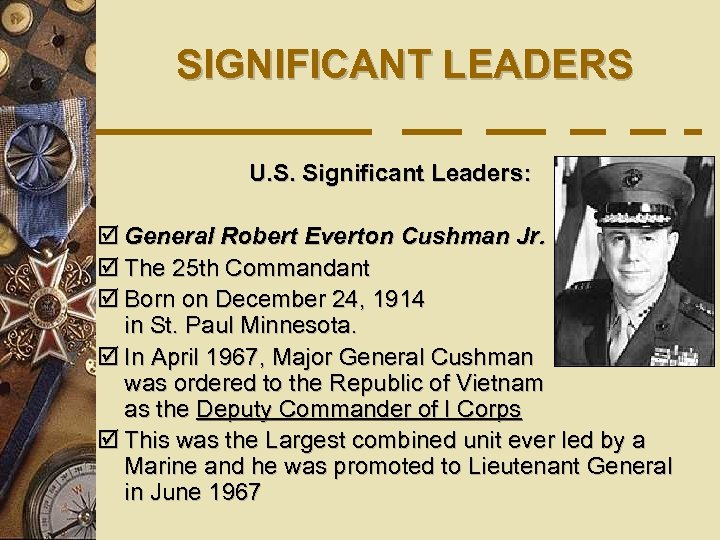 SIGNIFICANT LEADERS U. S. Significant Leaders: þ General Robert Everton Cushman Jr. þ The 25 th Commandant þ Born on December 24, 1914 in St. Paul Minnesota. þ In April 1967, Major General Cushman was ordered to the Republic of Vietnam as the Deputy Commander of I Corps þ This was the Largest combined unit ever led by a Marine and he was promoted to Lieutenant General in June 1967
 SIGNIFICANT LEADERS U. S. Significant Leaders: þ Major General Rathvon M. Tompkins þ Commanding General, 3 d Marine Division þ Received the Navy Cross at Siapan in WW II, the Silver Star at Tarawa and the Bronze Star at Guadalcanal þ Commanded the 5 th Marines of the 1 st Marine Division during the Korean War
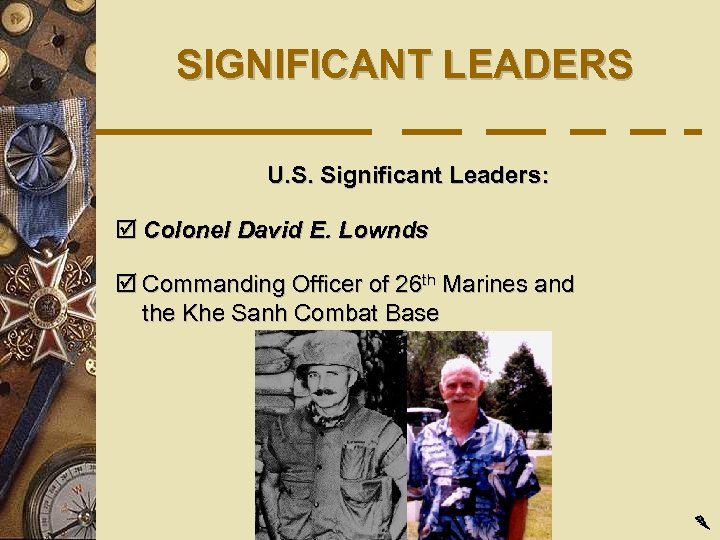 SIGNIFICANT LEADERS U. S. Significant Leaders: þ Colonel David E. Lownds þ Commanding Officer of 26 th Marines and the Khe Sanh Combat Base
 LESSONS LEARNED Immediate: þ The Marines held the firebase at Khe Sanh, but the victory was not favorable for the United States as a whole þ Tet was not a full-scale shock to the American public, but it was at the very least, an awakening þ The enemy that President Johnson and his Generals had described as disillusioned and crumbling had shown itself to be very alive and unbeaten
 LESSONS LEARNED Immediate: þ 730 Americans Killed in Action þ 2, 642 Americans Wounded in Action þ 7 Americans Missing in Action þ Un-official estimates place NVA deaths at between 10 and 15, 000, some experts feel that estimate is conservative
 LESSONS LEARNED Long Term: þ Even though the NVA decisively lost in the siege of Khe Sanh, their defeat turned into an overall victory by shattering the U. S. resolve to continue þ Expert Military Analysts say that during the Siege there was more tonnage of bombs dropped in support of Khe Sanh, then there was in all of W W II by all Allied Aircraft
 LESSONS LEARNED Deciding the outcome of the War þ The Siege of Khe Sanh combined with the entire TET Offensive destroyed the American resolve for Vietnamization þ In the wake of the serious political defeats combined with the military victories, President Johnson ultimately started the end of the U. S. involvement in Vietnam
 SUMMARY þ þ þ þ Operational Context Organization Strength Armament Doctrine of Forces Weather and Terrain Significant Leaders Lessons Learned