Скачать презентацию Kharkiv National Medical University Department of Hygiene and
c65b8ce17105bbd1572856becef628b7.ppt
- Количество слайдов: 24
 Kharkiv National Medical University Department of Hygiene and Ecology № 1 HYGIENE OF MEDICAL PREVENTIVE ESTABLISHMENTS
 Main problems of lecture 1. Tasks of hospital hygiene 2. Hygienic requirements to the hospital location 3. Functional zones at the hospital area 4. The systems of hospital planning 5. Internal design of hospital
 Main Tasks of Hospital Hygiene 1. Preference to acceleration of recovery the pa tient, medical and psychological rehabilitation. 2. Achievement for psychological and somatic comfort for the patients during stay in hospital in stitutions. 3. Prevention of nosocomial infection. 4. Maintenance of epidemic and radiologic safety. 5. Maintenance of healthy occupational environ ment for the medical personnel. 6. A regulation of use of new materials, equipment and technologies in medical institutions. 7. Formation of a healthy life style bases. 8. Minimization of harmful environmental influence on an constructing and operating of medical institutions.
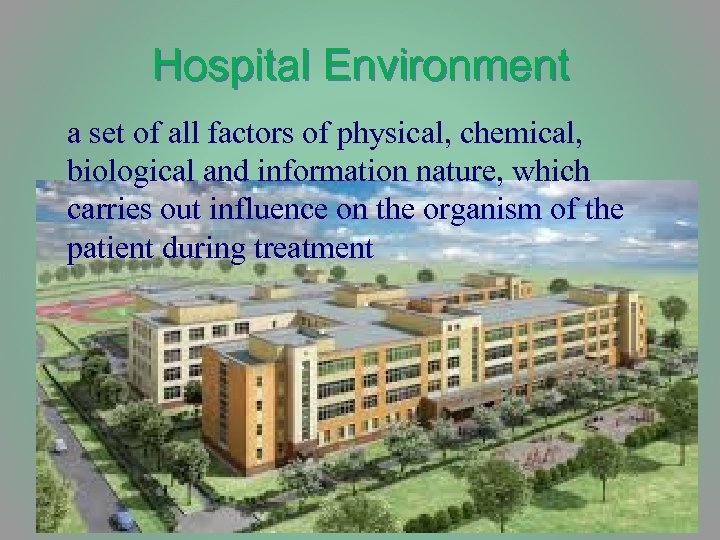 Hospital Environment a set of all factors of physical, chemical, biological and information nature, which carries out influence on the organism of the patient during treatment
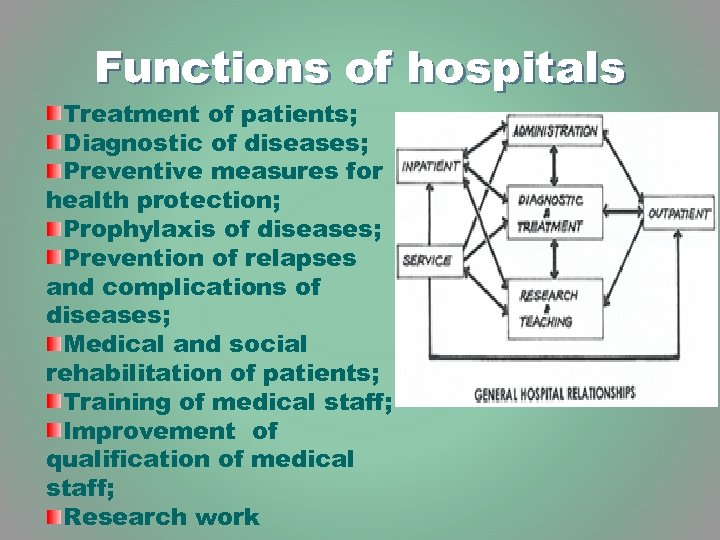 Functions of hospitals Treatment of patients; Diagnostic of diseases; Preventive measures for health protection; Prophylaxis of diseases; Prevention of relapses and complications of diseases; Medical and social rehabilitation of patients; Training of medical staff; Improvement of qualification of medical staff; Research work
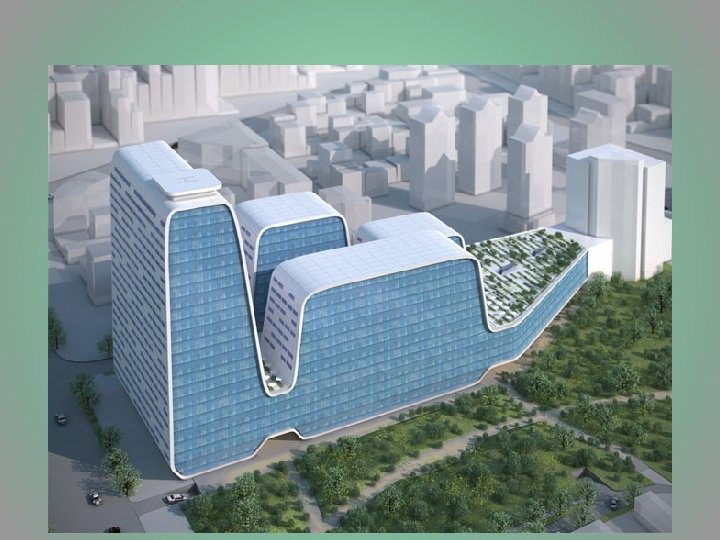
 Hygienic requirements to the hospital location Ø far from the railways, airports, high speed high ways and other powerful sources of pollution Ø ground should be clean, dry, without sharp differences of a relief, gardened and com fortable Ø should be electrify, supply with water pipes and water drain, bordered on perimeter and pro tect by a strip of green plantings Ø maximal ap proximation to groups of the population, which they are served Ø distance not less than 30 m from a red line of build ing and 30 50 m from apartment houses
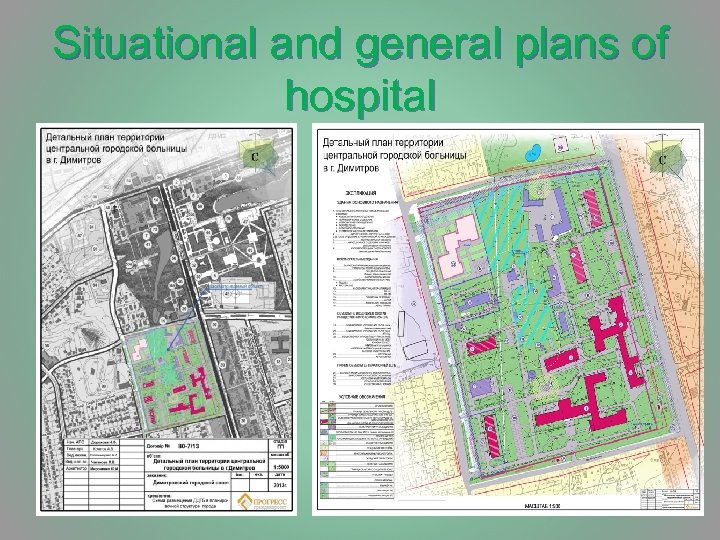 Situational and general plans of hospital
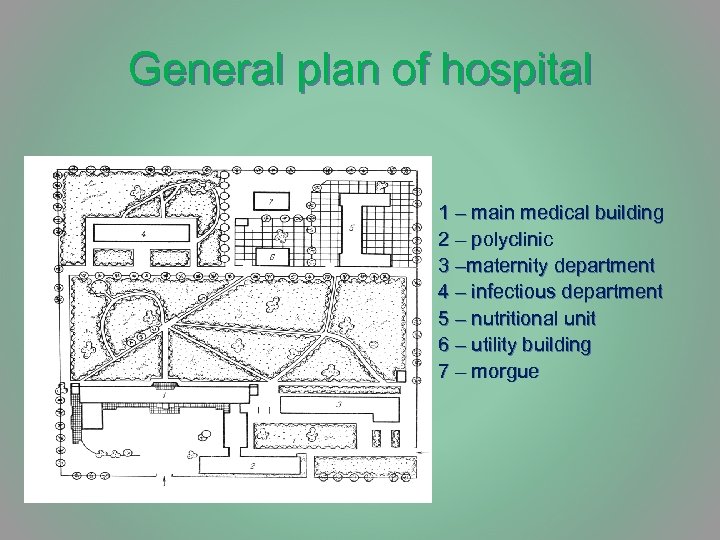 General plan of hospital 1 – main medical building 2 – polyclinic 3 –maternity department 4 – infectious department 5 – nutritional unit 6 – utility building 7 – morgue
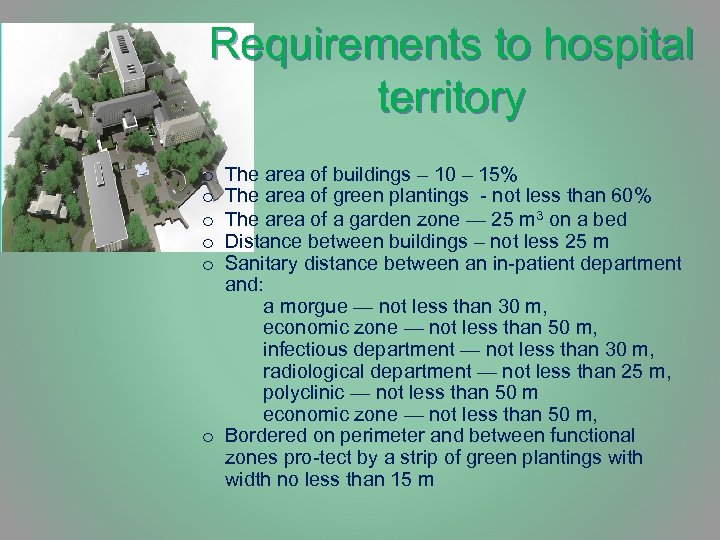 Requirements to hospital territory The area of buildings – 10 – 15% The area of green plantings not less than 60% The area of a garden zone — 25 m 3 on a bed Distance between buildings – not less 25 m Sanitary distance between an in patient department and: a morgue — not less than 30 m, economic zone — not less than 50 m, infectious department — not less than 30 m, radiological department — not less than 25 m, polyclinic — not less than 50 m economic zone — not less than 50 m, o Bordered on perimeter and between functional zones pro tect by a strip of green plantings with width no less than 15 m o o o
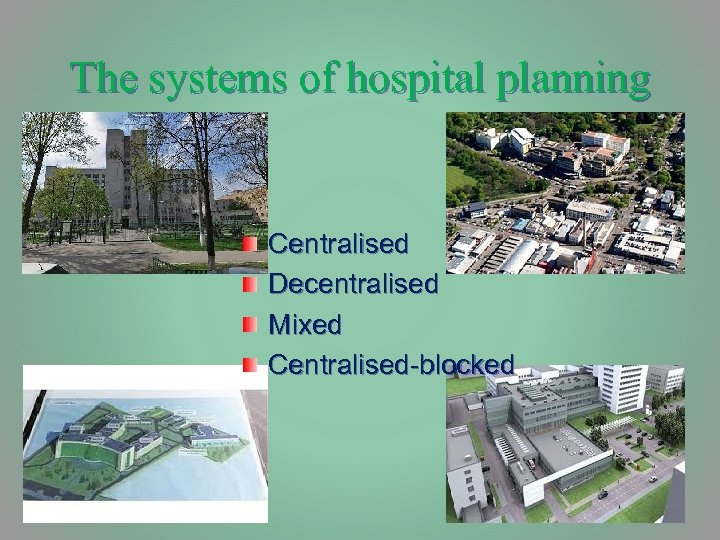 The systems of hospital planning Centralised Decentralised Mixed Centralised blocked
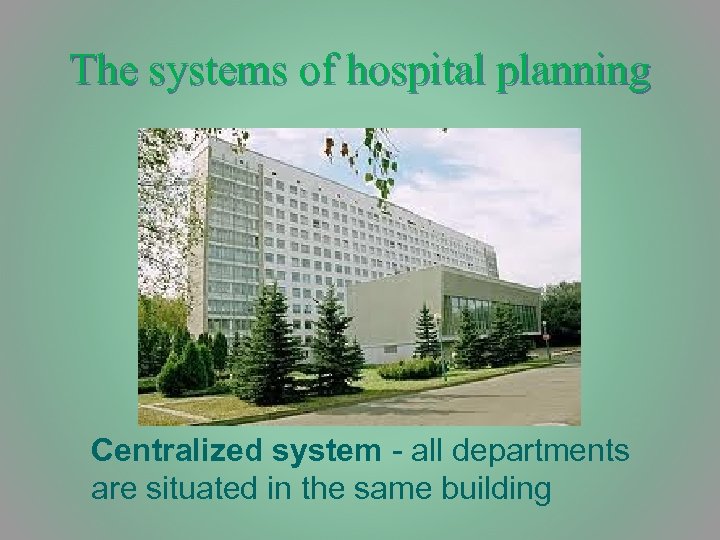 The systems of hospital planning Centralized system all departments are situated in the same building
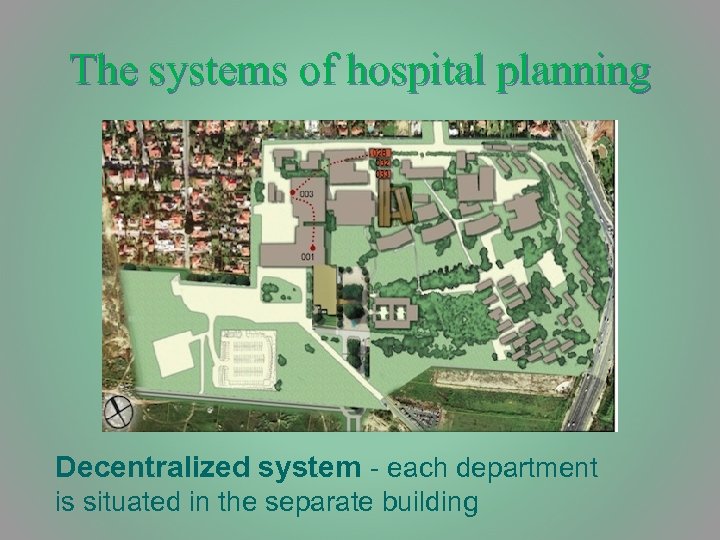 The systems of hospital planning Decentralized system each department is situated in the separate building
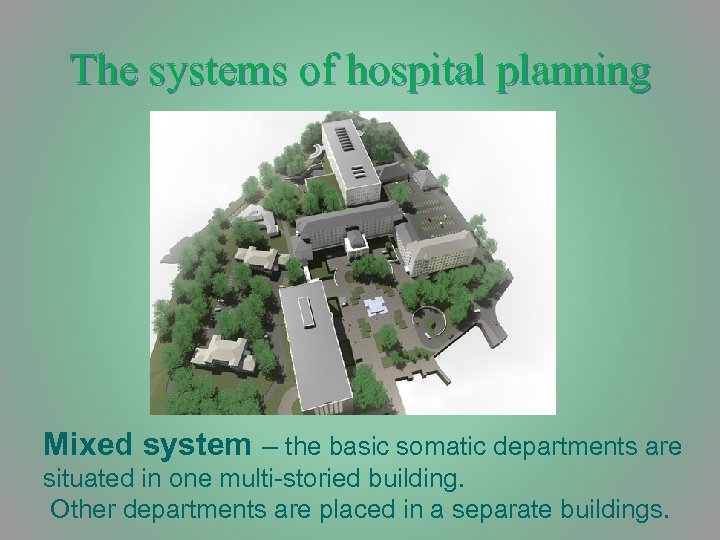 The systems of hospital planning Mixed system – the basic somatic departments are situated in one multi storied building. Other departments are placed in a separate buildings.
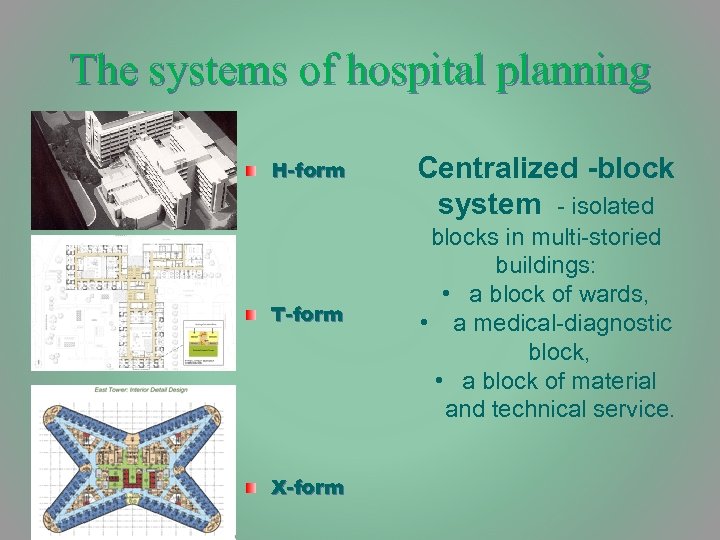 The systems of hospital planning H-f o r m T -f o r m X -f o r m Centralized -block system isolated blocks in multi storied buildings: • a block of wards, • a medical diagnostic block, • a block of material and technical service.
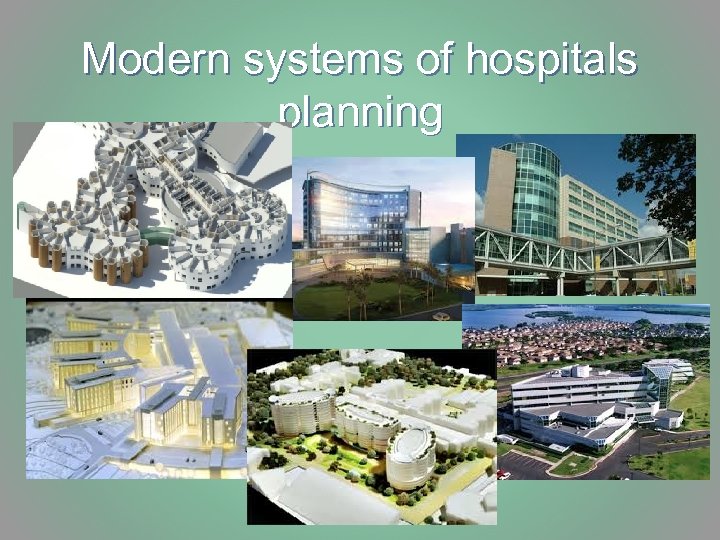 Modern systems of hospitals planning
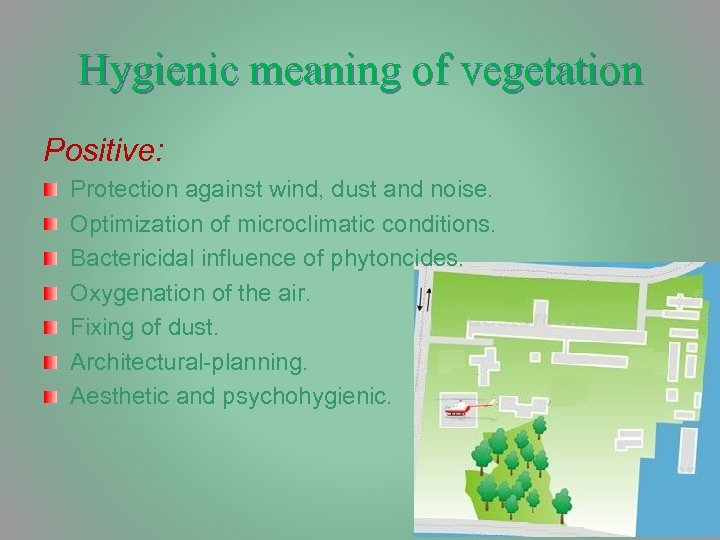 Hygienic meaning of vegetation Positive: Protection against wind, dust and noise. Optimization of microclimatic conditions. Bactericidal influence of phytoncides. Oxygenation of the air. Fixing of dust. Architectural planning. Aesthetic and psychohygienic.
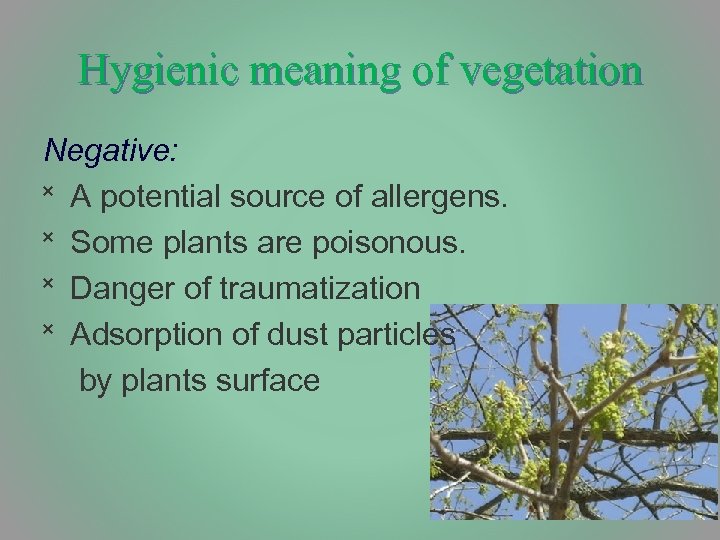 Hygienic meaning of vegetation Negative: ˟ А potential source of allergens. ˟ Some plants are poisonous. ˟ Danger of traumatization ˟ Adsorption of dust particles by plants surface
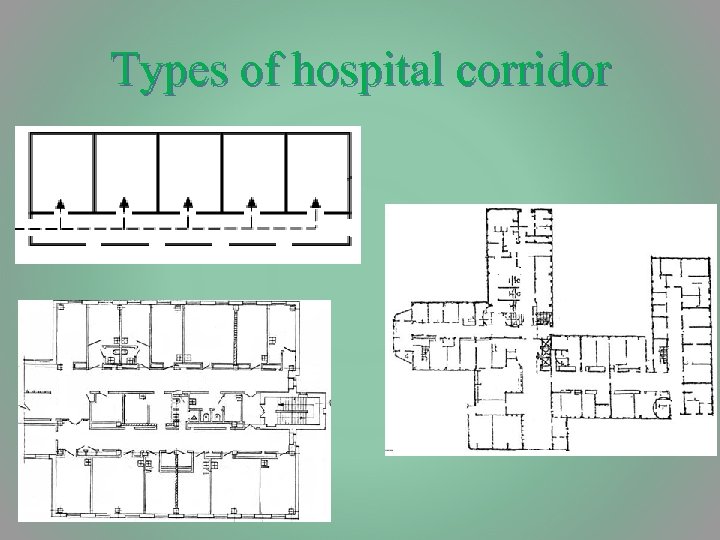 Types of hospital corridor
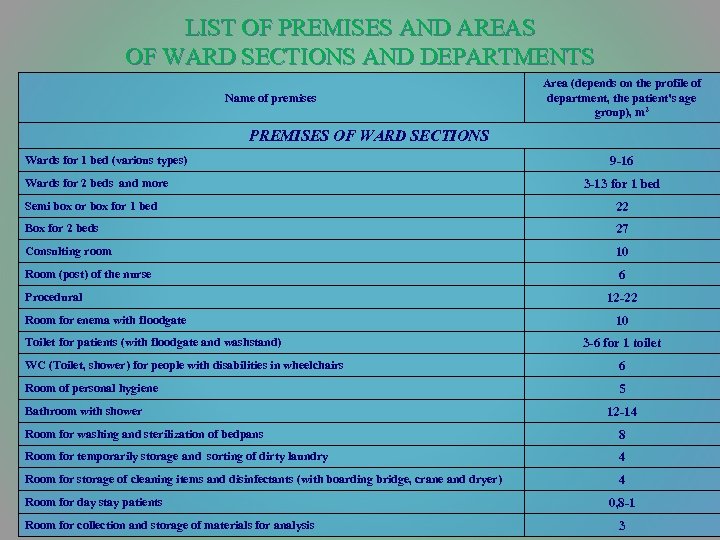 LIST OF PREMISES AND AREAS OF WARD SECTIONS AND DEPARTMENTS Name of premises Area (depends on the profile of department, the patient's age group), m 2 PREMISES OF WARD SECTIONS Wards for 1 bed (various types) Wards for 2 beds and more 9 -16 3 -13 for 1 bed Semi box or box for 1 bed 22 Box for 2 beds 27 Consulting room 10 Room (post) of the nurse 6 Procedural Room for enema with floodgate Toilet for patients (with floodgate and washstand) 12 -22 10 3 -6 for 1 toilet WC (Toilet, shower) for people with disabilities in wheelchairs 6 Room of personal hygiene 5 Bathroom with shower 12 -14 Room for washing and sterilization of bedpans 8 Room for temporarily storage and sorting of dirty laundry 4 Room for storage of cleaning items and disinfectants (with boarding bridge, crane and dryer) 4 Room for day stay patients Room for collection and storage of materials for analysis 0, 8 -1 3
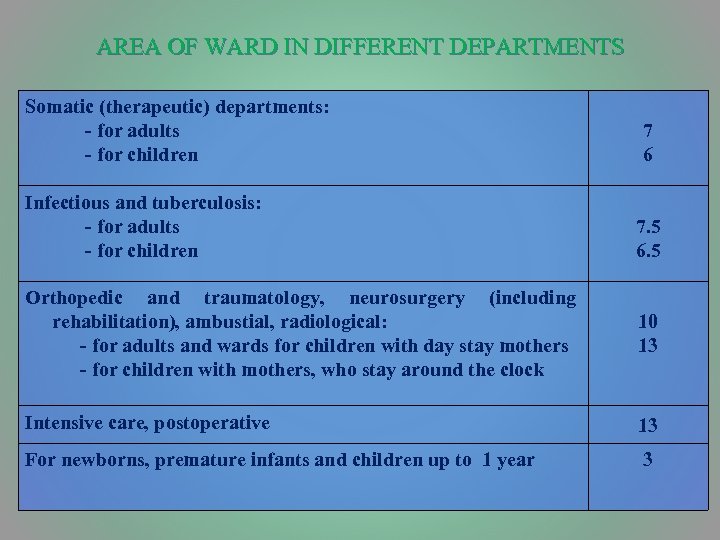 AREA OF WARD IN DIFFERENT DEPARTMENTS Somatic (therapeutic) departments: - for adults - for children Infectious and tuberculosis: - for adults - for children 7 6 7. 5 6. 5 Orthopedic and traumatology, neurosurgery (including rehabilitation), ambustial, radiological: - for adults and wards for children with day stay mothers - for children with mothers, who stay around the clock 10 13 Intensive care, postoperative 13 For newborns, premature infants and children up to 1 year 3
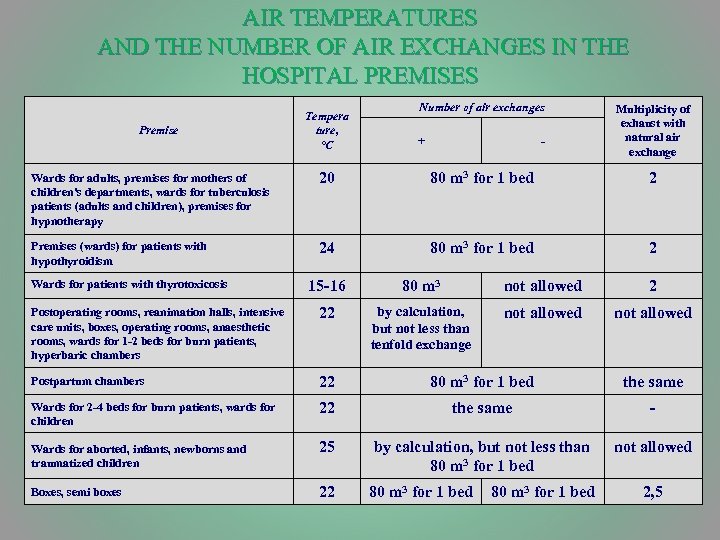 AIR TEMPERATURES AND THE NUMBER OF AIR EXCHANGES IN THE HOSPITAL PREMISES Premise Tempera ture, °С Number of air exchanges + - Multiplicity of exhaust with natural air exchange Wards for adults, premises for mothers of children's departments, wards for tuberculosis patients (adults and children), premises for hypnotherapy 20 80 m 3 for 1 bed 2 Premises (wards) for patients with hypothyroidism 24 80 m 3 for 1 bed 2 Wards for patients with thyrotoxicosis 15 -16 80 m 3 not allowed 2 Postoperating rooms, reanimation halls, intensive care units, boxes, operating rooms, anaesthetic rooms, wards for 1 -2 beds for burn patients, hyperbaric chambers 22 by calculation, but not less than tenfold exchange not allowed Postpartum chambers 22 80 m 3 for 1 bed the same Wards for 2 -4 beds for burn patients, wards for children 22 the same - Wards for aborted, infants, newborns and traumatized children 25 by calculation, but not less than 80 m 3 for 1 bed not allowed Boxes, semi boxes 22 80 m 3 for 1 bed 2, 5
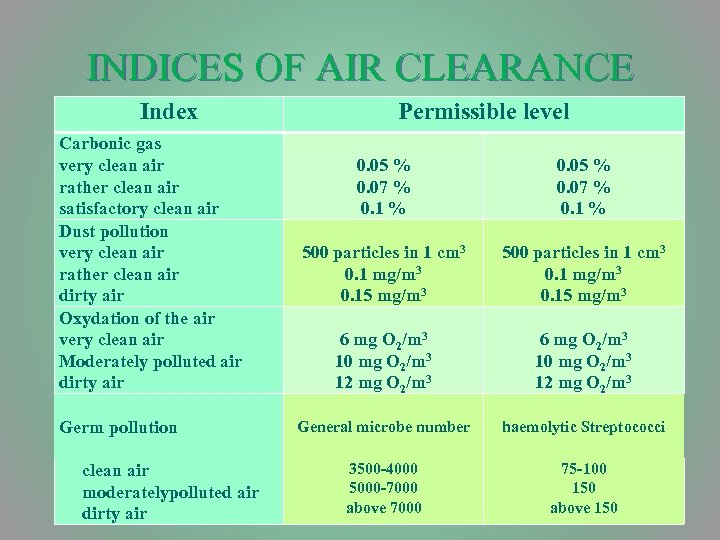 INDICES OF AIR CLEARANCE Index Permissible level Carbonic gas very clean air rather clean air satisfactory clean air Dust pollution very clean air rather clean air dirty air Oxydation of the air very clean air Moderately polluted air dirty air 0. 05 % 0. 07 % 0. 1 % 500 particles in 1 cm 3 0. 1 mg/m 3 0. 15 mg/m 3 6 mg O 2/m 3 10 mg O 2/m 3 12 mg O 2/m 3 Germ pollution General microbe number haemolytic Streptococci 3500 -4000 5000 -7000 above 7000 75 -100 150 above 150 clean air moderatelypolluted air dirty air